

Force Drawing
 |
Description
Book Introduction
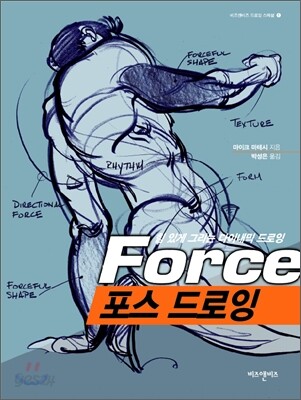
This book focuses on 'humans' rather than techniques, and helps you understand the human body and draw with your own perspective.
After understanding the force of the drawing subject, you can create drawings with lively, attractive, and dynamic poses using drawing techniques that bring out a sense of rhythm.
Additionally, you will learn how to feel the energy of objects in three-dimensional space and apply it to your drawings, and you will acquire force theory, which will be helpful for field observation and animal drawing.
It consists of a total of 6 chapters.
Chapter 1 covers how to properly observe the human body, understand its force, and analyze its characteristics and rhythm. Chapter 2 covers how to recognize form by applying perspective, structure, and spatial concepts, and how to create shapes through intuition and silhouette.
In Chapter 3, you will learn to 'trust your intuition' and to identify the key points of a forceful shape. In Chapter 4, you will express clothes through the types and functions of fabrics and the texture of lines, and recognize silhouettes by dissecting shapes.
Chapter 5 explores the art of storytelling, exploring inner thoughts, outer intuitions, and various moments and relationships. Chapter 6 explores the drawing of various animals, including simplified seals, vertebrates, and primates.
After understanding the force of the drawing subject, you can create drawings with lively, attractive, and dynamic poses using drawing techniques that bring out a sense of rhythm.
Additionally, you will learn how to feel the energy of objects in three-dimensional space and apply it to your drawings, and you will acquire force theory, which will be helpful for field observation and animal drawing.
It consists of a total of 6 chapters.
Chapter 1 covers how to properly observe the human body, understand its force, and analyze its characteristics and rhythm. Chapter 2 covers how to recognize form by applying perspective, structure, and spatial concepts, and how to create shapes through intuition and silhouette.
In Chapter 3, you will learn to 'trust your intuition' and to identify the key points of a forceful shape. In Chapter 4, you will express clothes through the types and functions of fabrics and the texture of lines, and recognize silhouettes by dissecting shapes.
Chapter 5 explores the art of storytelling, exploring inner thoughts, outer intuitions, and various moments and relationships. Chapter 6 explores the drawing of various animals, including simplified seals, vertebrates, and primates.
- You can preview some of the book's contents.
Preview
index
Chapter 1: Seeing the Human Body Properly
Understanding the Force
-Main features of the human body
- Directional Force: Beginning, Middle, and End
-Applied force
The path of rhythm
Roller Coaster of Rhythm
Key points of Force
Chapter 2: Form with Force
Perspective: The Drama of Angles
-1 point, 2 point, 3 point perspective
-4-point perspective
structure
-Surface line
- Force refinement
spatial concept
-Overlap and Tangent
-Size and shortening
Force-based form practice
Chapter 3: Shapes with Force
silhouette
A forceful appearance
-Do's and Don'ts in Force Form
Anatomy of shape
Trust your intuition
Key points of the forceful shape
Chapter 4: Expression of Clothing
The texture of the lines is revealed
Function and form of fabric
Variety of shapes
Key points of forceful texture
Chapter 5: Field Report
Vivid storytelling
-Inner thoughts, outer intuition
-Creating a situation with one person
-Many moments
-relationship
-crowd
Key points of the reportage
Chapter 6: Animal Drawings
comparative anatomy
Go to the zoo
-Simplified seal
- Vertebrates
-Liberal animals
- Hoofed animals
-Primates
-bird
Key Points in Animal Drawing
Conclusion
-Recommended books
-Terminology
Search
Understanding the Force
-Main features of the human body
- Directional Force: Beginning, Middle, and End
-Applied force
The path of rhythm
Roller Coaster of Rhythm
Key points of Force
Chapter 2: Form with Force
Perspective: The Drama of Angles
-1 point, 2 point, 3 point perspective
-4-point perspective
structure
-Surface line
- Force refinement
spatial concept
-Overlap and Tangent
-Size and shortening
Force-based form practice
Chapter 3: Shapes with Force
silhouette
A forceful appearance
-Do's and Don'ts in Force Form
Anatomy of shape
Trust your intuition
Key points of the forceful shape
Chapter 4: Expression of Clothing
The texture of the lines is revealed
Function and form of fabric
Variety of shapes
Key points of forceful texture
Chapter 5: Field Report
Vivid storytelling
-Inner thoughts, outer intuition
-Creating a situation with one person
-Many moments
-relationship
-crowd
Key points of the reportage
Chapter 6: Animal Drawings
comparative anatomy
Go to the zoo
-Simplified seal
- Vertebrates
-Liberal animals
- Hoofed animals
-Primates
-bird
Key Points in Animal Drawing
Conclusion
-Recommended books
-Terminology
Search
Publisher's Review
Dynamic Human Figure Drawing Guide
Understand the force of the drawing object!
-You can learn how to bring life to your drawings with drawing techniques that bring out a sense of rhythm.
-You can create drawings with attractive and dynamic poses.
-You can learn how to feel the energy of the drawing object in three-dimensional space.
-The asymmetry of straight lines and curves can be used to clearly show the direction of force in the human body.
You can develop basic anatomy knowledge and human body drawing skills to create animations from your drawings.
-You can learn how to apply force theory when making field observations or observing for animal drawing.
Drawing is not all about simply expressing the subject as it is, as it appears, realistically.
What is the essence of drawing? Most books that claim to teach you how to draw easily only explain drawing methods and techniques.
『Force Drawing』 presents a new perspective.
He points out that almost all art education using human models teaches only drawing techniques rather than focusing on experiencing the richness of humanity, and advises focusing on 'humanity'.
He also advises that you understand the human body and the gravity surrounding it, and draw with your own subjectivity using 'force'.
Understand the force of the drawing object!
-You can learn how to bring life to your drawings with drawing techniques that bring out a sense of rhythm.
-You can create drawings with attractive and dynamic poses.
-You can learn how to feel the energy of the drawing object in three-dimensional space.
-The asymmetry of straight lines and curves can be used to clearly show the direction of force in the human body.
You can develop basic anatomy knowledge and human body drawing skills to create animations from your drawings.
-You can learn how to apply force theory when making field observations or observing for animal drawing.
Drawing is not all about simply expressing the subject as it is, as it appears, realistically.
What is the essence of drawing? Most books that claim to teach you how to draw easily only explain drawing methods and techniques.
『Force Drawing』 presents a new perspective.
He points out that almost all art education using human models teaches only drawing techniques rather than focusing on experiencing the richness of humanity, and advises focusing on 'humanity'.
He also advises that you understand the human body and the gravity surrounding it, and draw with your own subjectivity using 'force'.
GOODS SPECIFICS
- Date of issue: December 12, 2008
- Page count, weight, size: 248 pages | 746g | 210*276*20mm
- ISBN13: 9788992607247
- ISBN10: 8992607245
You may also like
카테고리
korean


korean

![GQ KOREA Mark (Monthly): December [2025]](http://librairie.coreenne.fr/cdn/shop/files/8ef265dbbfbf186523ed75ba7319009d.jpg?v=1765340328&width=3840)


