

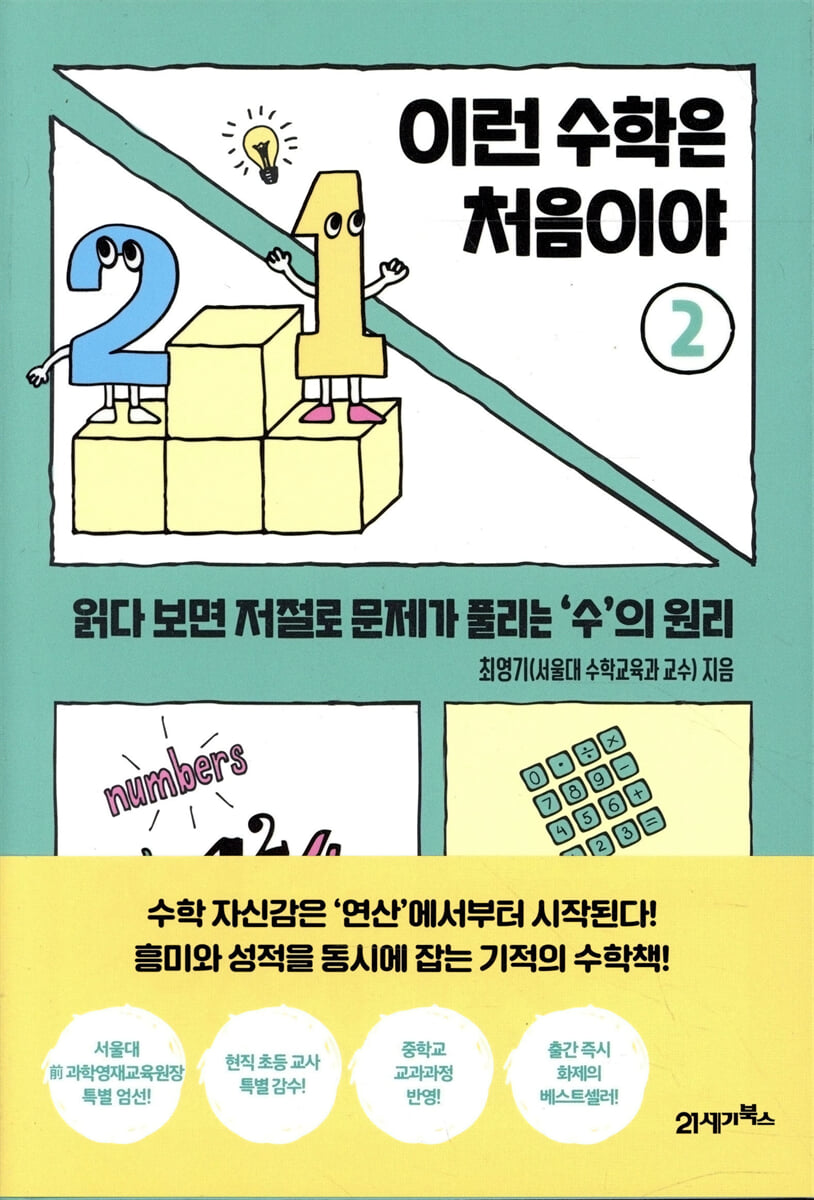
This is my first time doing math like this 2
 |
Description
Book Introduction
It's fun! It's easy! Problems are solved easily! The popular "This is my first time seeing math like this" series presented by a professor of mathematics education at Seoul National University! The sequel to the best-selling book, "This is the first time my child has read a book with such concentration!" and "I was so touched by the sincerity shown towards the children!" has been released. From exciting stories that unfold in the 'Kingdom of Natural Numbers' and the 'Land of Prime Numbers' to great mathematical discoveries, including 'Irrational Numbers and Infinity' and 'Euler's Numbers'. In this book, Professor Choi Young-gi of the Department of Mathematics Education at Seoul National University guides us into the world of numbers with a unique and original story that has never been seen before. The biggest reason children dislike math is undoubtedly "arithmetic." Professor Choi Young-ki, who has dedicated his life to researching and developing "real math education" for children, carefully selects essential math concepts to help children experience the joy of numbers and simultaneously build their confidence and interest in math. He explains the "principles of numbers" in the easiest and most engaging way possible. Through this book, which offers endless fun and excitement, you will experience an amazing transformation that will allow you to instantly understand the principles of numbers and gain boundless confidence in mathematics. |
- You can preview some of the book's contents.
Preview
index
As the book was published, “If you follow the story, the problem will be solved on its own!”
Prologue: A surprising and wonderful world of numbers created by curiosity and imagination!
Lecture 1: How did numbers come into being? - The Birth of 0 · Natural Numbers · Integers, Rational Numbers, and Irrational Numbers
How do you read 11?
Place value - the most creative discovery in human history!
The Birth of Zero - Expressing Nothingness?
The world of decimal system opens up
The place where it was placed - it's this easy to calculate!
What if we had eight fingers?
0 - I am the center and hope of numbers!
'Su' exists in all of our hearts!
How do numbers grow?
Integers - Natural numbers grow into strong numbers!
Rational numbers - arithmetic operations? I'll solve it all!
How do you express numbers less than 1?
What happens when a number and a line intersect?
Addition and subtraction move?
Irrational - How long have you been there?
The moment you open your eyes to mathematics, the mathematicians of the century who challenged irrational numbers!
■ Looking back at the story 1
Chapter 2: How did numbers become perfect? - Finite decimals, infinite decimals, recurring decimals, and real numbers
Why couldn't 1 enter a minority country?
Mistake - I'll fill in your gaps!
How many prime numbers are there?
What does it mean to be able to count?
One-on-one correspondence - Bringing order to the infinite world!
An abstraction process that leaves only purity
Minorities - Numbers, I will give you names!
Can infinite decimals be expressed as fractions?
Rational numbers and irrational numbers, do we have another name for them?
I collected positive numbers but a negative number appeared!?
The moment when you open your eyes to mathematics 2 The discovery of 'infinity', the birth of modern mathematics!
■ Looking back at the story 2
Chapter 3: Numbers Make the World Beautiful - With Gauss, Pascal, and Euler
Looking at the other side - What if you add up all the numbers from 1 to 100?
Distributive Law - If you make you and me equal, calculations become easier!
Isn't 2-2=0?
The moment when 0 becomes infinity
The Caprica Constant - The Secret of How No Matter What You Think, You Always Get 9
Pascal's Triangle - When you multiply by 11, something fun happens!
Euler Numbers - Seeing the Universe Through Numbers
The moment you open your eyes to mathematics 3 Pythagoras, numbers are the foundation of all things
■ Looking back at the story 3
Prologue: A surprising and wonderful world of numbers created by curiosity and imagination!
Lecture 1: How did numbers come into being? - The Birth of 0 · Natural Numbers · Integers, Rational Numbers, and Irrational Numbers
How do you read 11?
Place value - the most creative discovery in human history!
The Birth of Zero - Expressing Nothingness?
The world of decimal system opens up
The place where it was placed - it's this easy to calculate!
What if we had eight fingers?
0 - I am the center and hope of numbers!
'Su' exists in all of our hearts!
How do numbers grow?
Integers - Natural numbers grow into strong numbers!
Rational numbers - arithmetic operations? I'll solve it all!
How do you express numbers less than 1?
What happens when a number and a line intersect?
Addition and subtraction move?
Irrational - How long have you been there?
The moment you open your eyes to mathematics, the mathematicians of the century who challenged irrational numbers!
■ Looking back at the story 1
Chapter 2: How did numbers become perfect? - Finite decimals, infinite decimals, recurring decimals, and real numbers
Why couldn't 1 enter a minority country?
Mistake - I'll fill in your gaps!
How many prime numbers are there?
What does it mean to be able to count?
One-on-one correspondence - Bringing order to the infinite world!
An abstraction process that leaves only purity
Minorities - Numbers, I will give you names!
Can infinite decimals be expressed as fractions?
Rational numbers and irrational numbers, do we have another name for them?
I collected positive numbers but a negative number appeared!?
The moment when you open your eyes to mathematics 2 The discovery of 'infinity', the birth of modern mathematics!
■ Looking back at the story 2
Chapter 3: Numbers Make the World Beautiful - With Gauss, Pascal, and Euler
Looking at the other side - What if you add up all the numbers from 1 to 100?
Distributive Law - If you make you and me equal, calculations become easier!
Isn't 2-2=0?
The moment when 0 becomes infinity
The Caprica Constant - The Secret of How No Matter What You Think, You Always Get 9
Pascal's Triangle - When you multiply by 11, something fun happens!
Euler Numbers - Seeing the Universe Through Numbers
The moment you open your eyes to mathematics 3 Pythagoras, numbers are the foundation of all things
■ Looking back at the story 3
Detailed image

Into the book
The biggest reason children have difficulty with math when they first encounter it is calculations.
The reason why calculations are difficult is because the process of conceptualizing things that are invisible is not easy.
If, in the process of learning operations, students are taught in a way that requires them to explain the problem rather than being satisfied with solving it in their heads, they will be able to grasp the principles more clearly.
Furthermore, as students progress through the grades, it is crucial to develop an eye for more than just calculations and a curiosity about numbers.
Having an eye for numbers along with computational ability is a very important aspect of mathematics education.
--- p.6
Even now, numbers are expressed in various forms and continue to develop by harmoniously combining and merging with other fields.
Although numbers have grown in the human imagination, they mysteriously have an amazing ability to apply to the phenomena of nature and the universe.
The area that the Earth occupies in the universe is not even the size of a speck of dust that would blow away if blown, and humans are just beings standing on a small corner of that tiny Earth.
The properties of numbers developed through our imagination penetrate the essence of the universe.
Calculating numbers can be tedious and sometimes confusing due to incorrect results, but I hope you never forget that numbers are a gift given to us.
Su will definitely reward us for our efforts.
It's a truly precious gift.
--- p.12
When subtracting a smaller number from a larger number, such as '9-6', there is no problem with just 0 and natural numbers, but when subtracting a larger number from a smaller number, such as '2-5', there is a problem.
How do you subtract what is from what is not? Until the 15th century, this problem was ignored, not actively addressed.
But as the concept of numbers continued to grow, I couldn't ignore it until the end, and eventually I had to solve the problem somehow.
When you can't find the answer within your own world, expanding yourself can surprisingly easily solve the problem.
In other words, the number itself was expanded to negative numbers, and the concept was expanded accordingly.
--- p.49
How can we understand that a+b is equal to b+a for all numbers, when we haven't even handled or experienced all numbers? Perhaps we could argue that our collective minds created this universality.
There is a universal principle of numbers that we all have within us, which we can know without having to experience everything.
Although we may not have been the first to discover the beauty and universality of numbers, we are noble beings who inherently possess them and constantly pursue, enjoy, and develop them.
The reason why calculations are difficult is because the process of conceptualizing things that are invisible is not easy.
If, in the process of learning operations, students are taught in a way that requires them to explain the problem rather than being satisfied with solving it in their heads, they will be able to grasp the principles more clearly.
Furthermore, as students progress through the grades, it is crucial to develop an eye for more than just calculations and a curiosity about numbers.
Having an eye for numbers along with computational ability is a very important aspect of mathematics education.
--- p.6
Even now, numbers are expressed in various forms and continue to develop by harmoniously combining and merging with other fields.
Although numbers have grown in the human imagination, they mysteriously have an amazing ability to apply to the phenomena of nature and the universe.
The area that the Earth occupies in the universe is not even the size of a speck of dust that would blow away if blown, and humans are just beings standing on a small corner of that tiny Earth.
The properties of numbers developed through our imagination penetrate the essence of the universe.
Calculating numbers can be tedious and sometimes confusing due to incorrect results, but I hope you never forget that numbers are a gift given to us.
Su will definitely reward us for our efforts.
It's a truly precious gift.
--- p.12
When subtracting a smaller number from a larger number, such as '9-6', there is no problem with just 0 and natural numbers, but when subtracting a larger number from a smaller number, such as '2-5', there is a problem.
How do you subtract what is from what is not? Until the 15th century, this problem was ignored, not actively addressed.
But as the concept of numbers continued to grow, I couldn't ignore it until the end, and eventually I had to solve the problem somehow.
When you can't find the answer within your own world, expanding yourself can surprisingly easily solve the problem.
In other words, the number itself was expanded to negative numbers, and the concept was expanded accordingly.
--- p.49
How can we understand that a+b is equal to b+a for all numbers, when we haven't even handled or experienced all numbers? Perhaps we could argue that our collective minds created this universality.
There is a universal principle of numbers that we all have within us, which we can know without having to experience everything.
Although we may not have been the first to discover the beauty and universality of numbers, we are noble beings who inherently possess them and constantly pursue, enjoy, and develop them.
--- p.175
Publisher's Review
Math confidence starts with 'calculation'!
A miraculous math book that captures both interest and grades!
★ Specially selected by the former director of Seoul National University's Science Gifted Education Center!
★ Special review by a current elementary school teacher!
★ Reflected in middle school curriculum!
★ An instant bestseller upon publication!
“I’m starting to look forward to math class!”
A fascinating story that will help you understand the principles and build confidence in math!
If 『This Kind of Math is a First Time』 Volume 1 dealt with shapes, 『This Kind of Math is a First Time』 Volume 2, which is being published this time, deals with ‘numbers.’
While Pythagoras spoke about the importance of numbers by saying, “Numbers are the foundation of all things,” Plato spoke about the importance of geometry by saying, “Let no one who does not know geometry enter here,” so figures and numbers are the two axes that form the foundation of mathematics.
This is why the author chose ‘number’ after ‘shape’.
Unlike shapes, numbers require a process of abstraction, which is why many students find mathematics particularly difficult.
The author emphasizes that, in order to enjoy numbers, it is more important than simply solving problems to understand the principles of operations.
To achieve this, the author has carefully selected only the essential concepts from the middle school curriculum and developed an exciting story within them. In this book, the author has specially reviewed the book by an elementary school teacher to add a sense of realism and make it easier and more comfortable for students to read.
This book tells an exciting story of the world of numbers, with cute illustrations, about how numbers were born, developed, and how concepts expanded within them. It will make us interested in the principles of numbers, and through that interest, we will become curious, and through that curiosity, we will be guided to develop an eye for numbers, that is, an eye for mathematics.
“You can’t solve any problem without understanding numbers!”
From the birth of 0 to Pascal's triangle,
A miraculous math book where problems are solved on their own as you follow the story!
This book tells an interesting story of how numbers were created and developed, from the discovery of zero to Pascal's triangle, and how mathematical concepts were developed within them.
The author argues that while numbers may appear stiff and lifeless when written on paper, the concepts contained within them are not lifeless, and emphasizes that to truly meaningfully study mathematics, one must go beyond simply solving problems repeatedly using rigid formulas, and reach the joy of discovering the concepts contained within.
This book consists of three chapters.
In 'Lecture 1: How Did Numbers Come About?', we examine how mathematical concepts have developed through the creation of zero and the discovery of place value, as well as the creation and discovery of numbers, including natural numbers, integers, rational numbers, and irrational numbers.
In 'Lecture 2: How did 'Numbers' become perfect?', we cover more advanced concepts of numbers, focusing on core concepts that should be understood and passed over in middle school, such as finite decimals, infinite decimals, recurring decimals, and real numbers.
In 'Lecture 3: Numbers Make the World Beautiful', we will cover the great discoveries made in the history of mathematics by mathematicians such as Gauss, Euler, and Pascal, and their mathematical discoveries, thereby guiding us to expand not only our mathematical abilities but also our humanistic thinking through mathematics.
Additionally, the 'Moments When You Open Your Eyes to Math' section, included throughout the text, contains interesting reading material centered around stories of great mathematical discoveries.
Lastly, the 'Story Review' section at the end of each chapter extracts only the mathematical concepts from the story and organizes them with curriculum notation so that the concepts and formulas can be summarized at a glance.
After reading this book, you will have the amazing experience of naturally organizing the concepts and formulas in your head, making math classes, which used to be difficult, enjoyable, and solving math problems smoothly without any difficulties.
A miraculous math book that captures both interest and grades!
★ Specially selected by the former director of Seoul National University's Science Gifted Education Center!
★ Special review by a current elementary school teacher!
★ Reflected in middle school curriculum!
★ An instant bestseller upon publication!
“I’m starting to look forward to math class!”
A fascinating story that will help you understand the principles and build confidence in math!
If 『This Kind of Math is a First Time』 Volume 1 dealt with shapes, 『This Kind of Math is a First Time』 Volume 2, which is being published this time, deals with ‘numbers.’
While Pythagoras spoke about the importance of numbers by saying, “Numbers are the foundation of all things,” Plato spoke about the importance of geometry by saying, “Let no one who does not know geometry enter here,” so figures and numbers are the two axes that form the foundation of mathematics.
This is why the author chose ‘number’ after ‘shape’.
Unlike shapes, numbers require a process of abstraction, which is why many students find mathematics particularly difficult.
The author emphasizes that, in order to enjoy numbers, it is more important than simply solving problems to understand the principles of operations.
To achieve this, the author has carefully selected only the essential concepts from the middle school curriculum and developed an exciting story within them. In this book, the author has specially reviewed the book by an elementary school teacher to add a sense of realism and make it easier and more comfortable for students to read.
This book tells an exciting story of the world of numbers, with cute illustrations, about how numbers were born, developed, and how concepts expanded within them. It will make us interested in the principles of numbers, and through that interest, we will become curious, and through that curiosity, we will be guided to develop an eye for numbers, that is, an eye for mathematics.
“You can’t solve any problem without understanding numbers!”
From the birth of 0 to Pascal's triangle,
A miraculous math book where problems are solved on their own as you follow the story!
This book tells an interesting story of how numbers were created and developed, from the discovery of zero to Pascal's triangle, and how mathematical concepts were developed within them.
The author argues that while numbers may appear stiff and lifeless when written on paper, the concepts contained within them are not lifeless, and emphasizes that to truly meaningfully study mathematics, one must go beyond simply solving problems repeatedly using rigid formulas, and reach the joy of discovering the concepts contained within.
This book consists of three chapters.
In 'Lecture 1: How Did Numbers Come About?', we examine how mathematical concepts have developed through the creation of zero and the discovery of place value, as well as the creation and discovery of numbers, including natural numbers, integers, rational numbers, and irrational numbers.
In 'Lecture 2: How did 'Numbers' become perfect?', we cover more advanced concepts of numbers, focusing on core concepts that should be understood and passed over in middle school, such as finite decimals, infinite decimals, recurring decimals, and real numbers.
In 'Lecture 3: Numbers Make the World Beautiful', we will cover the great discoveries made in the history of mathematics by mathematicians such as Gauss, Euler, and Pascal, and their mathematical discoveries, thereby guiding us to expand not only our mathematical abilities but also our humanistic thinking through mathematics.
Additionally, the 'Moments When You Open Your Eyes to Math' section, included throughout the text, contains interesting reading material centered around stories of great mathematical discoveries.
Lastly, the 'Story Review' section at the end of each chapter extracts only the mathematical concepts from the story and organizes them with curriculum notation so that the concepts and formulas can be summarized at a glance.
After reading this book, you will have the amazing experience of naturally organizing the concepts and formulas in your head, making math classes, which used to be difficult, enjoyable, and solving math problems smoothly without any difficulties.
GOODS SPECIFICS
- Date of issue: May 20, 2021
- Page count, weight, size: 180 pages | 328g | 135*197*14mm
- ISBN13: 9788950995492
- ISBN10: 8950995492
You may also like
카테고리
korean


korean

![GQ KOREA Mark (Monthly): December [2025]](http://librairie.coreenne.fr/cdn/shop/files/8ef265dbbfbf186523ed75ba7319009d.jpg?v=1765340328&width=3840)


