

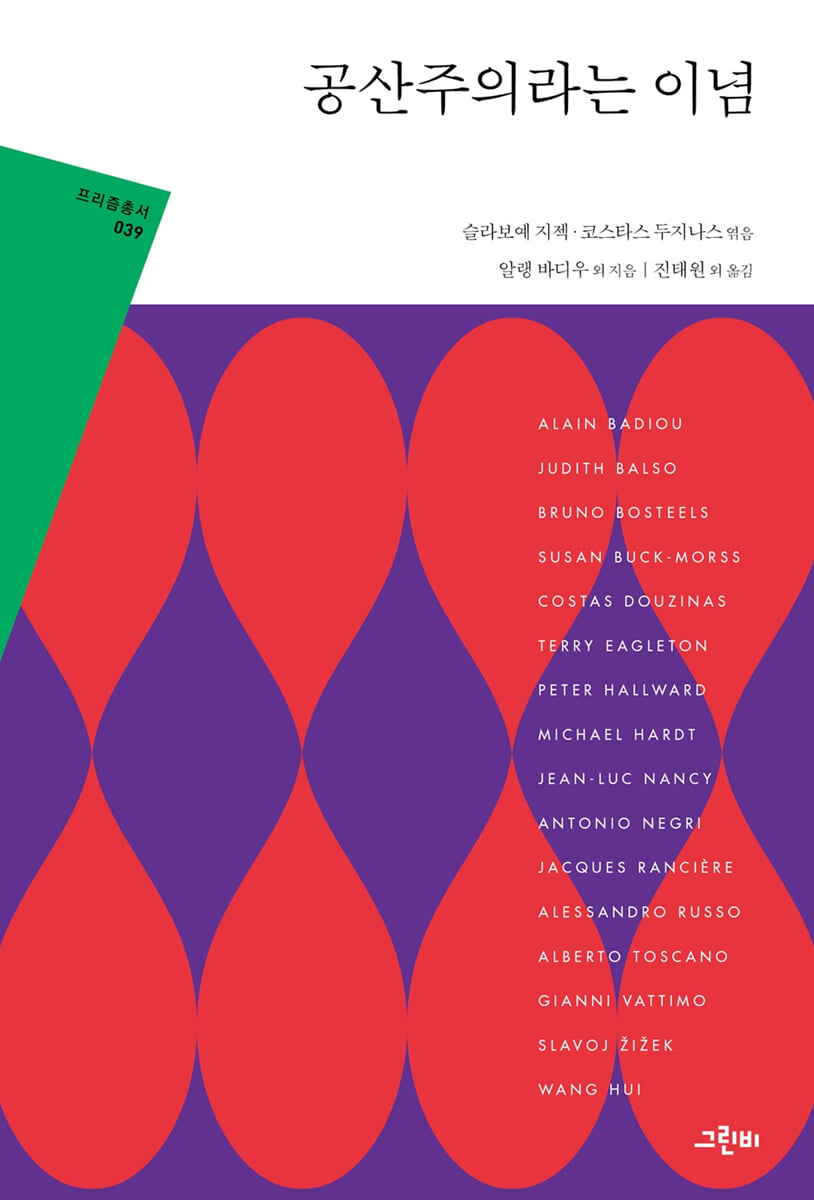
The ideology of communism
 |
Description
Book Introduction
In March 2009, giants of thought such as Slavoj Žižek, Alain Badiou, Jacques Rancière, Terry Eagleton, Jean-Luc Nancy, and Antonio Negri gathered in London.
It was to attend the conference “The Ideology of Communism” hosted by the Institute of Humanities at Birkbeck University.
The organizers had initially expected an audience of around 200, but over 1,000 people attended, proving that communism remains a hot topic in the 21st century.
Prism Series Volume 39, "The Ideology of Communism," attempts to capture the fervor of the time by minimally editing the content read by conference presenters.
The “Ideology of Communism” conference was praised for reactivating the powerful link between radical philosophy and radical politics by moving away from the demonization of the communist signifier.
In an age where socialism is given to the banks and capitalism to the poor, this book will serve as an opportunity to restore communism as a political alternative.
It was to attend the conference “The Ideology of Communism” hosted by the Institute of Humanities at Birkbeck University.
The organizers had initially expected an audience of around 200, but over 1,000 people attended, proving that communism remains a hot topic in the 21st century.
Prism Series Volume 39, "The Ideology of Communism," attempts to capture the fervor of the time by minimally editing the content read by conference presenters.
The “Ideology of Communism” conference was praised for reactivating the powerful link between radical philosophy and radical politics by moving away from the demonization of the communist signifier.
In an age where socialism is given to the banks and capitalism to the poor, this book will serve as an opportunity to restore communism as a political alternative.
- You can preview some of the book's contents.
Preview
index
Introduction: The Ideology of Communism - Slavoj Žižek, Kostas Dužinas 4
Chapter 1: The Ideology of Communism - Alain Badiou 15
Chapter 2: Being Present.
The Communist Hypothesis: A Possible Hypothesis for Philosophy, an Impossible Name for Politics? ― Judith Balsow, 39
Chapter 3: The Left Hypothesis: Communism in the Age of Terror - Bruno Bosteels 69
Chapter 4: The Second is Comedy… Historical Pragmatics and the Untimely Present ― Susan Buckmoss 125
Chapter 5: Adikia: On Communism and Rights - Costas Dužinas 149
Chapter 6: Communism: Lear or Gonzalo? — Terry Eagleton 185
Chapter 7: "Communism of the Intellect, Communism of the Will" - Peter Hallward 205
Chapter 8: What Communism Has in Common - Michael Hart 239
Chapter 9: Communism, the Word - Jean-Luc Nancy 263
Chapter 10: Communism: Some Thoughts on Concept and Practice - Antonio Negri 289
Chapter 11: Communists Without Communism? ― Jacques Rancière 307
Chapter 12: Did the Cultural Revolution End Communism? Eight Commentaries on Philosophy and Politics Today - Alessandro Russo 327
Chapter 13: The Politics of Abstraction: Communism and Philosophy - Alberto Toscano 353
Chapter 14: Weak Communism? ― Gianni Vattimo 371
Chapter 15: How to Start from Scratch - Slavoj Žižek 377
Appendix Our Future in Debate: Intellectual Politics in Contemporary China - Wang Hui 407
Search 433
About the Author 443
Translator's Note 447
Chapter 1: The Ideology of Communism - Alain Badiou 15
Chapter 2: Being Present.
The Communist Hypothesis: A Possible Hypothesis for Philosophy, an Impossible Name for Politics? ― Judith Balsow, 39
Chapter 3: The Left Hypothesis: Communism in the Age of Terror - Bruno Bosteels 69
Chapter 4: The Second is Comedy… Historical Pragmatics and the Untimely Present ― Susan Buckmoss 125
Chapter 5: Adikia: On Communism and Rights - Costas Dužinas 149
Chapter 6: Communism: Lear or Gonzalo? — Terry Eagleton 185
Chapter 7: "Communism of the Intellect, Communism of the Will" - Peter Hallward 205
Chapter 8: What Communism Has in Common - Michael Hart 239
Chapter 9: Communism, the Word - Jean-Luc Nancy 263
Chapter 10: Communism: Some Thoughts on Concept and Practice - Antonio Negri 289
Chapter 11: Communists Without Communism? ― Jacques Rancière 307
Chapter 12: Did the Cultural Revolution End Communism? Eight Commentaries on Philosophy and Politics Today - Alessandro Russo 327
Chapter 13: The Politics of Abstraction: Communism and Philosophy - Alberto Toscano 353
Chapter 14: Weak Communism? ― Gianni Vattimo 371
Chapter 15: How to Start from Scratch - Slavoj Žižek 377
Appendix Our Future in Debate: Intellectual Politics in Contemporary China - Wang Hui 407
Search 433
About the Author 443
Translator's Note 447
Into the book
The long night of the left is coming to an end.
The defeats of the 1980s and 1990s, the condemnation and despair, those who proclaimed the triumph of the "end of history," the unipolar world of American hegemony—all of this is rapidly becoming old news.
In Europe, in 2000, Jürgen Habermas and Ulrich Beck were enthusiastic about the European Union and its common currency.
Predicting that this will be a model for the future of humanity.
How different the reality is today! The European Union is no longer a model, but a dysfunctional organization composed of fanatical right-wing governments and impotent social democrats, who are pushing unprecedented austerity measures and unemployment and poverty onto working people in an attempt to return to "fiscal soundness."
--- p.4
Politics exists on its own, because it is not combined with history.
Even if it remains true that the history of mankind is the history of class struggle, politics must not be confused with class struggle, and revolution is no longer a vehicle of politics.
In my view, the idea of politics being about a better tomorrow (a not only necessary but also a beneficial idea) is now dead.
The cynical flip side of this notion today is the practice of 'democratic' apologies and regrets for past wrongdoings.
An undocumented immigrant friend from Africa once said to me:
“What we want is for people to treat us well now.
Instead of going tomorrow and apologizing for the mistakes I made before.”
--- p.56
If the communist hypothesis is not to remain a fleeting, timeless, regulative ideology like Platonic or Kantian ideals, it must also be actualized and organized as a real movement that abolishes the status quo.
In other words, communism must be re-inscribed in the concrete body, flesh, and thought of political subjectivity.
Although this act of subjectivation does not have to go through the traditional party form to be realized.
--- p.113
One reason why the old communist hypothesis is no longer valid is that the composition of capital (as well as the conditions and products of capitalist production) has changed.
Most importantly, the technical composition of labor has changed.
How do people produce, both inside and outside the workplace? (…) And what are the divisions of labor and power that separate people along lines of gender and race, and in local, regional, and global contexts? In addition to studying the current composition of labor, we must analyze the relations of ownership that labor produces under its influence.
The defeats of the 1980s and 1990s, the condemnation and despair, those who proclaimed the triumph of the "end of history," the unipolar world of American hegemony—all of this is rapidly becoming old news.
In Europe, in 2000, Jürgen Habermas and Ulrich Beck were enthusiastic about the European Union and its common currency.
Predicting that this will be a model for the future of humanity.
How different the reality is today! The European Union is no longer a model, but a dysfunctional organization composed of fanatical right-wing governments and impotent social democrats, who are pushing unprecedented austerity measures and unemployment and poverty onto working people in an attempt to return to "fiscal soundness."
--- p.4
Politics exists on its own, because it is not combined with history.
Even if it remains true that the history of mankind is the history of class struggle, politics must not be confused with class struggle, and revolution is no longer a vehicle of politics.
In my view, the idea of politics being about a better tomorrow (a not only necessary but also a beneficial idea) is now dead.
The cynical flip side of this notion today is the practice of 'democratic' apologies and regrets for past wrongdoings.
An undocumented immigrant friend from Africa once said to me:
“What we want is for people to treat us well now.
Instead of going tomorrow and apologizing for the mistakes I made before.”
--- p.56
If the communist hypothesis is not to remain a fleeting, timeless, regulative ideology like Platonic or Kantian ideals, it must also be actualized and organized as a real movement that abolishes the status quo.
In other words, communism must be re-inscribed in the concrete body, flesh, and thought of political subjectivity.
Although this act of subjectivation does not have to go through the traditional party form to be realized.
--- p.113
One reason why the old communist hypothesis is no longer valid is that the composition of capital (as well as the conditions and products of capitalist production) has changed.
Most importantly, the technical composition of labor has changed.
How do people produce, both inside and outside the workplace? (…) And what are the divisions of labor and power that separate people along lines of gender and race, and in local, regional, and global contexts? In addition to studying the current composition of labor, we must analyze the relations of ownership that labor produces under its influence.
--- p.241
Publisher's Review
Zizek, Badiou, Rancière, Nancy, Negri,
"Communism of Liberation" as proclaimed by leading thinkers of the era
In 2009, Slavoj Žižek and Kostas Dužinas of Birkbeck University's Institute of Humanities organized the conference “The Idea of Communism” to reimagine communism.
As if in agreement with the need for a political project to transcend late capitalism, giants of thought such as Alain Badiou, Jean-Luc Nancy, Antonio Negri, Jacques Rancière, and Terry Eagleton gathered at the London conference.
Organizers had initially anticipated an audience of around 200, but the auditorium, which seats 900, was ultimately full, and a room had to be reserved for a video broadcast for another 300 people.
The large turnout was just the beginning of the surprises.
Throughout the conference, participants engaged in discussions that transcended factionalism, and the era's most distinguished philosophers traversed what had once seemed disparate strands of thought.
The “Ideology of Communism” conference was more than just an interesting intellectual encounter; it became a significant political event.
The 39th volume of the Green Bee Prism series, “The Ideology of Communism,” is a minimally edited version of the conference speakers’ readings, capturing the fervor of the time.
What made this conference so successful? Slavoj Žižek and Kostas Dužinas attribute it to its departure from the demonization of communism and its reactivation of the powerful link between radical philosophy and radical politics.
As the second decade of the 21st century dawned, the dominance of capitalist ideology came to an end.
The fanatical right-wing government is passing unemployment and poverty on to the working people, and the social democratic government has become a dysfunctional organization.
In an era of late capitalism that offers socialism to the banks and capitalism to the poor, this book offers a fresh interpretation of communism and will serve as a starting point for restoring communism as a political alternative.
Failure of the country and the party,
Who is the true subject of communism?
Badiou opens the conference with a reflection on the concept of 'ideology'.
Is ideology a regulation that sets our rational goals? Or is it a program to be gradually implemented through state action? Ideology historically fixes elusive, fleeting things in the creation of truth.
This ideology supports the incorporation of individuals and allows them to transcend national constraints by becoming part of a subjectivable body.
This is why socialist countries and parties cannot provide real support for the ideology of communism.
Although the communist hypothesis is only possible when it is based on the hypothesis of liberation, Rancière points out that there is a historical tension between communism and liberation.
Liberation is possible only when the power of ‘anyone’ comes together.
But the communist movement is permeated by the opposite premise: the premise of inequality.
This is the educational-progressive hypothesis of differences among intellectuals.
This hypothesis gave rise to a conflict between communists and workers, which resulted in a double bind: the workers' experience disqualified the communists' knowledge, and the communists' knowledge disqualified the workers' experience.
Rancière argues that if communism is to become the name of a new alternative, communist ideology must break free from this double bind.
Zizek boldly argues that rather than "building on the foundations" of the revolutionary era of the 20th century, we should "go down" to the starting point and follow a different path.
According to Zizek, today's historical situation demands a more radical conception of the proletarian subject.
It is a subject in danger of losing everything, an empty Cartesian subject stripped of all substantial content, in contrast to the classical image of the proletariat who has 'nothing to lose but his chains'.
Stripped of our symbolic identity, our genetic code manipulated, and struggling in an uninhabitable natural environment, we are all potentially Homo sacer.
The new politics of liberation will no longer be the actions of specific social actors, but rather an explosive combination of diverse actors.
Communism is the only political ideology worthwhile for philosophers.
The 1990s were a time of triple failure for the left.
In advanced welfare states, social democratic politics has declined.
Socialist countries such as the Soviet Union disappeared and their economies were integrated into the global industry.
Third World liberation movements also experienced stagnation.
These events marked the end of an era that had its beginnings in the Russian Revolution of 1917, an era that could be characterized by the political organization of the party-state.
Does this mean that the time for radical liberation politics is over?
Rather, numerous signs over the past two decades indicate that we need a fresh start.
Francis Fukuyama declared the “end of history,” viewing liberal democratic capitalism as the finally realized natural social order, but this 1990s utopia met two deaths in the first decade of the 21st century.
That is, if the September 11, 2001 terrorist attacks signaled the death of this utopia in the political realm, the 2008 financial crisis symbolized its economic death.
The key within these new conditions is to fundamentally rethink the foundations of the politics of liberation while striving to develop new strategies.
The remarkable success of the "Ideology of Communism" conference, which brought together world-renowned figures representing today's Marxist thought, proves that the project of liberation is still ongoing and being renewed.
Conference participants argue that we must move beyond simply rejecting the Stalinist form of the party-state that is taken for granted today.
The so-called democratic left's simple systemic reforms, which do not seek a fundamental reform of parliamentary democracy itself, should also be rejected.
The failure of the 1990s was less about the collapse of real socialism and more about the decisive failure of the democratic left.
Therefore, participants in the “Ideology of Communism” conference raise the following question:
Is the word "communism" an appropriate term to denote the horizon of a radical liberation project? Despite the subtle differences between their respective theoretical positions, participants shared the belief that it is useful to remain faithful to the term "communism."
In short, communism can function as an ideology that guides our exploration.
It could further serve as a means of denouncing the debacles of 20th-century politics, including those perpetrated under the Left's own name.
As Alain Badiou and Slavoj Žižek said at the start of the conference, communism is the only political ideology suitable for philosophers since Plato.
"Communism of Liberation" as proclaimed by leading thinkers of the era
In 2009, Slavoj Žižek and Kostas Dužinas of Birkbeck University's Institute of Humanities organized the conference “The Idea of Communism” to reimagine communism.
As if in agreement with the need for a political project to transcend late capitalism, giants of thought such as Alain Badiou, Jean-Luc Nancy, Antonio Negri, Jacques Rancière, and Terry Eagleton gathered at the London conference.
Organizers had initially anticipated an audience of around 200, but the auditorium, which seats 900, was ultimately full, and a room had to be reserved for a video broadcast for another 300 people.
The large turnout was just the beginning of the surprises.
Throughout the conference, participants engaged in discussions that transcended factionalism, and the era's most distinguished philosophers traversed what had once seemed disparate strands of thought.
The “Ideology of Communism” conference was more than just an interesting intellectual encounter; it became a significant political event.
The 39th volume of the Green Bee Prism series, “The Ideology of Communism,” is a minimally edited version of the conference speakers’ readings, capturing the fervor of the time.
What made this conference so successful? Slavoj Žižek and Kostas Dužinas attribute it to its departure from the demonization of communism and its reactivation of the powerful link between radical philosophy and radical politics.
As the second decade of the 21st century dawned, the dominance of capitalist ideology came to an end.
The fanatical right-wing government is passing unemployment and poverty on to the working people, and the social democratic government has become a dysfunctional organization.
In an era of late capitalism that offers socialism to the banks and capitalism to the poor, this book offers a fresh interpretation of communism and will serve as a starting point for restoring communism as a political alternative.
Failure of the country and the party,
Who is the true subject of communism?
Badiou opens the conference with a reflection on the concept of 'ideology'.
Is ideology a regulation that sets our rational goals? Or is it a program to be gradually implemented through state action? Ideology historically fixes elusive, fleeting things in the creation of truth.
This ideology supports the incorporation of individuals and allows them to transcend national constraints by becoming part of a subjectivable body.
This is why socialist countries and parties cannot provide real support for the ideology of communism.
Although the communist hypothesis is only possible when it is based on the hypothesis of liberation, Rancière points out that there is a historical tension between communism and liberation.
Liberation is possible only when the power of ‘anyone’ comes together.
But the communist movement is permeated by the opposite premise: the premise of inequality.
This is the educational-progressive hypothesis of differences among intellectuals.
This hypothesis gave rise to a conflict between communists and workers, which resulted in a double bind: the workers' experience disqualified the communists' knowledge, and the communists' knowledge disqualified the workers' experience.
Rancière argues that if communism is to become the name of a new alternative, communist ideology must break free from this double bind.
Zizek boldly argues that rather than "building on the foundations" of the revolutionary era of the 20th century, we should "go down" to the starting point and follow a different path.
According to Zizek, today's historical situation demands a more radical conception of the proletarian subject.
It is a subject in danger of losing everything, an empty Cartesian subject stripped of all substantial content, in contrast to the classical image of the proletariat who has 'nothing to lose but his chains'.
Stripped of our symbolic identity, our genetic code manipulated, and struggling in an uninhabitable natural environment, we are all potentially Homo sacer.
The new politics of liberation will no longer be the actions of specific social actors, but rather an explosive combination of diverse actors.
Communism is the only political ideology worthwhile for philosophers.
The 1990s were a time of triple failure for the left.
In advanced welfare states, social democratic politics has declined.
Socialist countries such as the Soviet Union disappeared and their economies were integrated into the global industry.
Third World liberation movements also experienced stagnation.
These events marked the end of an era that had its beginnings in the Russian Revolution of 1917, an era that could be characterized by the political organization of the party-state.
Does this mean that the time for radical liberation politics is over?
Rather, numerous signs over the past two decades indicate that we need a fresh start.
Francis Fukuyama declared the “end of history,” viewing liberal democratic capitalism as the finally realized natural social order, but this 1990s utopia met two deaths in the first decade of the 21st century.
That is, if the September 11, 2001 terrorist attacks signaled the death of this utopia in the political realm, the 2008 financial crisis symbolized its economic death.
The key within these new conditions is to fundamentally rethink the foundations of the politics of liberation while striving to develop new strategies.
The remarkable success of the "Ideology of Communism" conference, which brought together world-renowned figures representing today's Marxist thought, proves that the project of liberation is still ongoing and being renewed.
Conference participants argue that we must move beyond simply rejecting the Stalinist form of the party-state that is taken for granted today.
The so-called democratic left's simple systemic reforms, which do not seek a fundamental reform of parliamentary democracy itself, should also be rejected.
The failure of the 1990s was less about the collapse of real socialism and more about the decisive failure of the democratic left.
Therefore, participants in the “Ideology of Communism” conference raise the following question:
Is the word "communism" an appropriate term to denote the horizon of a radical liberation project? Despite the subtle differences between their respective theoretical positions, participants shared the belief that it is useful to remain faithful to the term "communism."
In short, communism can function as an ideology that guides our exploration.
It could further serve as a means of denouncing the debacles of 20th-century politics, including those perpetrated under the Left's own name.
As Alain Badiou and Slavoj Žižek said at the start of the conference, communism is the only political ideology suitable for philosophers since Plato.
GOODS SPECIFICS
- Publication date: November 10, 2021
- Page count, weight, size: 448 pages | 650g | 152*224*30mm
- ISBN13: 9788976826640
- ISBN10: 8976826647
You may also like
카테고리
korean


korean

![GQ KOREA Mark (Monthly): December [2025]](http://librairie.coreenne.fr/cdn/shop/files/8ef265dbbfbf186523ed75ba7319009d.jpg?v=1765340328&width=3840)


