

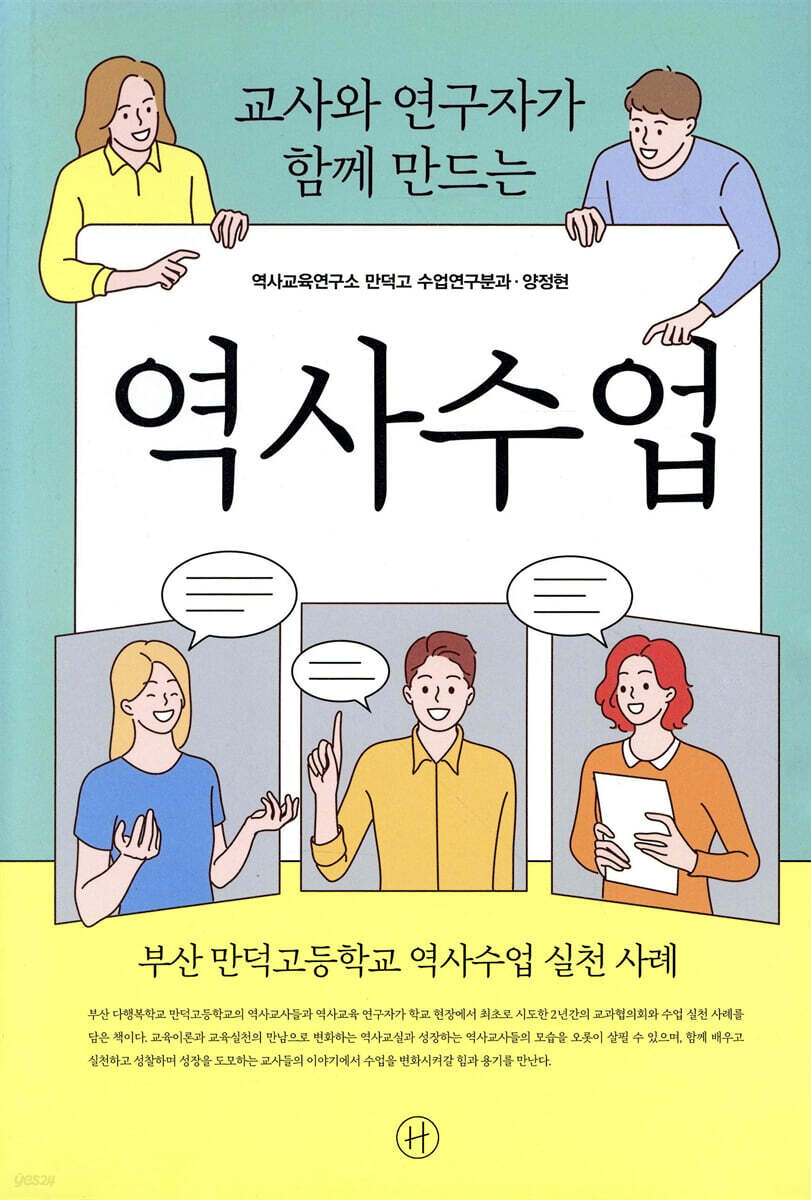
History classes created by teachers and researchers together
 |
Description
Book Introduction
History teachers and history education researchers meet in the classroom!
The first attempt to combine educational theory and educational practice
A two-year record of student-teacher-researcher collaboration
This is a record of the two-year curriculum council and class sharing between history teachers at Busan Mandeok High School and professors of history education at Pusan National University.
Unlike simple scholarship guidance or consulting, this is the first case in which a researcher went directly into the classroom where classes were held and worked closely with teachers to carefully consider and develop historical education.
This vivid record presents a design of a lesson direction suitable for history classes through observation, analysis, and consultation, focusing on class sharing and student learning, from curriculum design and worksheet production to class sharing.
Furthermore, we explore the possibilities of everyday curriculum councils and discover history classrooms where students and teachers can grow together.
The first attempt to combine educational theory and educational practice
A two-year record of student-teacher-researcher collaboration
This is a record of the two-year curriculum council and class sharing between history teachers at Busan Mandeok High School and professors of history education at Pusan National University.
Unlike simple scholarship guidance or consulting, this is the first case in which a researcher went directly into the classroom where classes were held and worked closely with teachers to carefully consider and develop historical education.
This vivid record presents a design of a lesson direction suitable for history classes through observation, analysis, and consultation, focusing on class sharing and student learning, from curriculum design and worksheet production to class sharing.
Furthermore, we explore the possibilities of everyday curriculum councils and discover history classrooms where students and teachers can grow together.
- You can preview some of the book's contents.
Preview
index
In publishing the book
Prologue: I Want to Be a Good History Teacher | Half of Teaching Is Learning
Part 1: Being Together
Chapter 1: Is this a happy school for everyone?
1. Dahaengbok School, Busan Mandeok High School | 2. Beginning Class Innovation | 3. Four History Teachers' First Meeting | 4. Each's Challenges and Growth
Chapter 2 How to structure a year's history class?
1 February Curriculum Council, the Beginning of the Year | 2 Korean History, a Required Subject for the College Scholastic Ability Test (CSAT), How Should We Teach It? | 3 Misconceptions and Understandings About the Korean History CSAT | 4 Tailoring a History Curriculum to Students | 5 Entrance Exams? Focusing on Early Admissions with the Integration of "Teachers, Professors, Pyeong-gi, and Elementary Schools"
Chapter 3: Preparing for Classes Together and Creating Worksheets
1. Lessons Using Worksheets | 2. Creating Worksheets Together | 3. Characteristics of Mandeok High School's Worksheets? Worksheets as Lesson Plans
Chapter 4: Into the Classroom: Neither Teachers nor Students Change in One or Two Attempts
1 How to Start? | 2 "Let's Take a Look First" | 3 Two Years of Class Sharing and Consultations
Part 2 Separately and Together
Chapter 5: Same workbook, different classes
1. Will classroom instruction become the same if we design lessons together? | 2. Class Characteristics 1? Narrative Structure and Group Activity Management | 3. Class Characteristics 2? Context of Explanation
Chapter 6: Cover the textbook and teach each student on the same topic.
1 3 people, 3 colors, each with their own class color | 2 The historical awareness and learning perspective that most influenced class design | 3 Real classes with a clearer individual color, finding things to learn from each other | 4 What and how can we learn from each other in class council meetings?
Chapter 7: How can teachers continuously develop themselves?
1. Teachers cannot develop through short-term and temporary events | 2. The professionalism preparation council that teachers desire | 3. From diagnosis to stabilization 1? Teacher A's ups and downs in adapting to group classes | 4. From diagnosis to stabilization 2? Teacher B's challenge to objectify his own classes | 5. From diagnosis to stabilization 3? Teacher C's dream of an enjoyable history class | 6. Experiences through the three-stage class council
3rd Division Academic Award
Chapter 8: What will students be thinking when they enter history class?
1. History class as told by students | 2. Students' affinity for history confirmed at the starting line | 3. Changes in affinity for history after one year | 4. Students' personal growth as told by students
Chapter 9: Group learning through reading, listening, and speaking
1. A classroom filled with the sounds of students | 2. Group classes where students teach and learn from each other | 3. Students learning history through group classes | 4. Students' evaluations of group classes | [Reference] Let's do group classes like this
Chapter 10: A History Writing Class: Learning Through Thinking and Writing
1. Starting with My History Writing | 2. Completing the History Writing Class: Writing a Short Essay | 3. A History Writing Class That Develops Students' Thinking
Chapter 11: History Classes that Cultivate Democratic Citizens
1. History class that teaches democracy | 2. Historical debates brought into the classroom, discussion classes | 3. Exploring history outside the classroom, project classes
Chapter 12: Learning History Beyond the Classroom and Textbooks
1 Children who joined the history club | 2 Become interested in history while playing | 3 Playing bigger and bigger | 4 Having fun with history
Epilogue: How Are History Teachers' Professionalism Cultivated? From the Perspective of a History Education Researcher
Reviews
Prologue: I Want to Be a Good History Teacher | Half of Teaching Is Learning
Part 1: Being Together
Chapter 1: Is this a happy school for everyone?
1. Dahaengbok School, Busan Mandeok High School | 2. Beginning Class Innovation | 3. Four History Teachers' First Meeting | 4. Each's Challenges and Growth
Chapter 2 How to structure a year's history class?
1 February Curriculum Council, the Beginning of the Year | 2 Korean History, a Required Subject for the College Scholastic Ability Test (CSAT), How Should We Teach It? | 3 Misconceptions and Understandings About the Korean History CSAT | 4 Tailoring a History Curriculum to Students | 5 Entrance Exams? Focusing on Early Admissions with the Integration of "Teachers, Professors, Pyeong-gi, and Elementary Schools"
Chapter 3: Preparing for Classes Together and Creating Worksheets
1. Lessons Using Worksheets | 2. Creating Worksheets Together | 3. Characteristics of Mandeok High School's Worksheets? Worksheets as Lesson Plans
Chapter 4: Into the Classroom: Neither Teachers nor Students Change in One or Two Attempts
1 How to Start? | 2 "Let's Take a Look First" | 3 Two Years of Class Sharing and Consultations
Part 2 Separately and Together
Chapter 5: Same workbook, different classes
1. Will classroom instruction become the same if we design lessons together? | 2. Class Characteristics 1? Narrative Structure and Group Activity Management | 3. Class Characteristics 2? Context of Explanation
Chapter 6: Cover the textbook and teach each student on the same topic.
1 3 people, 3 colors, each with their own class color | 2 The historical awareness and learning perspective that most influenced class design | 3 Real classes with a clearer individual color, finding things to learn from each other | 4 What and how can we learn from each other in class council meetings?
Chapter 7: How can teachers continuously develop themselves?
1. Teachers cannot develop through short-term and temporary events | 2. The professionalism preparation council that teachers desire | 3. From diagnosis to stabilization 1? Teacher A's ups and downs in adapting to group classes | 4. From diagnosis to stabilization 2? Teacher B's challenge to objectify his own classes | 5. From diagnosis to stabilization 3? Teacher C's dream of an enjoyable history class | 6. Experiences through the three-stage class council
3rd Division Academic Award
Chapter 8: What will students be thinking when they enter history class?
1. History class as told by students | 2. Students' affinity for history confirmed at the starting line | 3. Changes in affinity for history after one year | 4. Students' personal growth as told by students
Chapter 9: Group learning through reading, listening, and speaking
1. A classroom filled with the sounds of students | 2. Group classes where students teach and learn from each other | 3. Students learning history through group classes | 4. Students' evaluations of group classes | [Reference] Let's do group classes like this
Chapter 10: A History Writing Class: Learning Through Thinking and Writing
1. Starting with My History Writing | 2. Completing the History Writing Class: Writing a Short Essay | 3. A History Writing Class That Develops Students' Thinking
Chapter 11: History Classes that Cultivate Democratic Citizens
1. History class that teaches democracy | 2. Historical debates brought into the classroom, discussion classes | 3. Exploring history outside the classroom, project classes
Chapter 12: Learning History Beyond the Classroom and Textbooks
1 Children who joined the history club | 2 Become interested in history while playing | 3 Playing bigger and bigger | 4 Having fun with history
Epilogue: How Are History Teachers' Professionalism Cultivated? From the Perspective of a History Education Researcher
Reviews
Publisher's Review
1.
Teachers and researchers work together to address history classes.
―The first long-term collaboration between teachers and researchers in a school setting.
Mandeok High School, a multi-happiness school (innovative school) in Busan, has been focusing on class innovation since 2015. Since then, it has been holding open classes in which teachers of all subjects can observe, and has been regularizing open classes and council meetings to consider, practice, and reflect on the direction and process of class innovation as a general high school.
Among them, the History and Council was special.
Mandeok High School history teachers were eager for more in-depth class research and reflection to improve their professionalism as history teachers.
At that time, the Mandeok High School History Curriculum Council was created at the suggestion of Professor Yang Jeong-hyeon of the College of Education at Pusan National University, who was researching the professional development of teachers and changes in the classroom.
There are not many cases where all teachers in a subject at a school have held continuous council meetings.
What is even more special is that, unlike simple scholarship guidance or consulting, this was the first practical collaboration between educational theory and educational practice, where a history education researcher worked closely with teachers in schools to create new, dense classes suitable for history classes.
This book contains the entire record of two years of class research and practice conducted by four history teachers from Mandeok High School and a researcher.
This book emphasizes that a teacher's expertise is secured through a process of learning, reflecting, and practicing while teaching.
To improve the professionalism of teachers, provincial offices of education operated scholarship guidance and school consulting, and each school operated a professional learning community for teachers, including class sharing. However, most teachers were faced with the reality of school life and often had to shoulder their concerns about classes alone.
In this context, the collaborative process between teachers and researchers demonstrates that teachers' expertise can be cultivated only through daily, consistent practice and reflection, rather than through short-term, temporary events.
Furthermore, instead of top-down approaches like scholarships or symptomatic treatment, such as consulting systems, we propose fostering teachers' expertise through long-term collaboration between subject matter experts and field teachers.
From curriculum design and worksheet production to class observation, analysis, and consultation focused on student learning and teacher professional development, we design and implement lesson plans appropriate for history classes. Through this process, we explore the potential of daily curriculum councils and create history classrooms where students learn and teachers grow together.
It is difficult to bring about real and meaningful change in the teaching-learning process by approaching it from a consulting perspective.
Here, we would like to propose an alternative: long-term collaboration between subject matter experts and field teachers.
This is a method in which university researchers and school teachers meet together to discuss and develop curriculum management.
To explore how historical education research and practice intersect, and whether they can even do so, researchers must first enter the field and engage in a lengthy discussion with history teachers about the day-to-day aspects of their classes.
This is neither a scholarship nor a consulting approach.
―From “Prologue: Half of Teaching Is Learning” (page 19)
Of the many class sharing groups established at Mandeok High School, I dare say that the History Department Class Council was the most consistent and professional.
Although I gained fellow teachers who shared my concerns and dreams through class sharing meetings, I found it difficult to discuss the essential aspects of history classes, such as the direction of the classes, the level of texts to be read in class, and the review of teacher comments, with English or math teachers.
So, history teachers held regular class meetings in 2018 and 2019.
The history class council worked together to establish annual plans, create worksheets for use in class, open and film history classes, and evaluate classes.
It could be said to be a curriculum council of another school, but rather than a formal meeting, it was a repeated process of planning, practicing, and reflecting.
―From Chapter 1, “A School Where Everyone is Happy?” (Page 30)
For two years, researchers and teachers have been working together on research and practice, and at times, they have been hurt by sharp criticism and have been stressed by the constant deliberation to come up with new solutions.
However, the consultation process based on mutual trust was itself a process of growing into a 'good' history teacher with expertise.
Experienced teachers, full of confidence and enthusiasm, can open new paths for new teachers.
… … Opening classes and attracting attention within a school is a great opportunity for teachers, but it can also be a huge burden.
However, in the current reality of Korean education, it is a blessing to have a fellow teacher to ask questions about and refer to regarding one's own class.
―From "Epilogue: How is the Expertise of History Teachers Developed?" (pp. 295-296)
2.
How did the History Council proceed?
―Creating classes that highlight each teacher's unique characteristics with fellow teachers
How was the Mandeok High School History Department Council possible, and how did it come to fruition? Parts 1 and 2 illustrate the process through concrete examples: from the initial meeting of four history teachers and researchers with diverse backgrounds, values, and teaching styles, to the joint development of an annual lesson plan, assignments of topics, and the creation of worksheets, to the public presentation of lessons, and the repeated processes of observation, analysis, and discussion.
The start of the council was a time to lay the foundation for working together for the next two years.
So, instead of discussing time allocation, progress, and evaluation, we wrote down and shared our vision of the history classroom we dream of, and we got to know ourselves and our colleagues better and set the direction for the council.
After learning about each student's thoughts on history education, we prepared for the year's history classes through several rounds of discussions, including curriculum development, entrance exam preparation, lesson plans, and workbook production.
The open class observed and analyzed the class, focusing on students' learning.
Existing research classes were designed to evaluate teachers' classes and point out mistakes, and the observers shared what they felt and learned, building trust and cooperative relationships among teachers.
Going a step further, we held a three-stage class council (diagnosis-correction-stabilization) focused on improving teachers' professionalism throughout the semester, observing the difficulties each teacher experiences in class and discussing ways to overcome them.
This can be called a 'personalized history curriculum council' that takes into account the teaching orientation, operation method, and differences in skill level and expertise of each teacher.
Based on trust with their fellow students, the four teachers developed into 'good' history teachers by creating history classes that reflected their own unique characteristics and aspirations.
In the stories of teachers who learn, practice, reflect, and continuously grow together, we can glimpse the power to reach out to fellow teachers, transform classes, and grow ourselves.
The researcher suggested that three teachers teaching the same grade compare their classes on the same topic.
The goal was to see how three teachers were similar and different when teaching the same subject using the same worksheets, and if so, to what extent and what characteristics they exhibited.
And we decided to consider what meaning to give to the similarities and differences.
… … Teachers produce classroom historical knowledge by reconstructing textbooks or creating separate learning materials during the teaching and learning phase.
In this process, history teachers reconstruct the content according to their own historical education goals.
The classroom history that teachers construct is determined by the framework of the national curriculum or textbooks.
History teachers use the national curriculum and textbooks as guidelines, but are not entirely bound by or dependent on them.
In this context, the expertise of history teachers is realized.
―From Chapter 5, “Same Workbook, Different Classes” (pp. 100-101)
The three-person, three-color class presentation and discussion were quite interesting.
Although the class covered the same incident, the textbook's regulatory power was weak, and the subject could be interpreted differently depending on the teacher, so the differences in the classes were clearly noticeable.
Each person had different goals for what they wanted to teach, and the parts they chose as the main content of the class also differed.
How can holding class council meetings, given these differences, help teachers? While dividing classes and holding council meetings, teachers always think about their own classes.
… … While observing the class, I observed how the orientation and capabilities of my fellow teachers were displayed at each moment.
While observing the class, the observers constantly asked themselves, “What is my class like?”
… … When I try to question and reflect on my own lessons, it helps to watch other teachers’ lessons.
Because I can compare and contrast my class with other classes.
―From Chapter 6, “Putting the Textbooks Behind and Teaching the Same Topic Each Student” (page 133)
3.
A history classroom where students and teachers grow together
―Examining student learning changes through examples of student-centered classes.
Part 3, "Teaching and Learning Awards," looks into what students learn, how much they grow, and how they change in actual history classes, and contains stories of teachers and students who have grown together through teaching and learning.
Mandeok High School's history classes were mainly comprised of student-centered classes such as group classes, history writing classes, CEDA discussion classes, and project classes. According to a survey on history favorability conducted on students at the beginning and end of each year, many students found history interesting and liked history classes because of this teaching method.
Through the specific practical examples and classroom scenes of these classes, we can examine students' affinity for history, changes in their perspectives on history, and the growth process of learning.
The booklet, “Let’s do group learning like this,” outlines the group composition for group learning, things to keep in mind before starting, and how to operate the group.
In a situation where there is little reference material on the purpose and operation methods of group classes suitable for history classes, these tips, derived from the experiences of Mandeok High School history teachers, will serve as a good guide for history teachers who are taking on the challenge of group classes.
When it comes to history, students have different experiences and different tastes.
Unless teachers are following a textbook format or teaching for entrance exams, they must structure their lessons with the students in front of them in mind.
Depending on the school, each year, each class, and each student's historical knowledge and perception of history are bound to differ.
That's why we started our classes by assessing how interested students are in history and how much they know about it.
Specifically, it was necessary to find out what kind of people and events students were interested in and what level of historical knowledge they had.
We decided to create and review a questionnaire for each student to ask them what they wanted to ask.
―From Chapter 8, “What Are Students Thinking About When They Enter History Class?” (pp. 188-190)
Students said that group learning where they debated in history class was fun.
… … I enjoyed learning about various interpretations and arguments in history class, but I had a hard time with arguments that didn’t reach a conclusion.
… … Although group activities were difficult because students had different opinions, I also learned that having someone with a different opinion from me allowed me to come up with new ideas.
He also said that he checks his logic by listening to opinions that differ from his own.
In this way, students developed their thinking skills through historical debates.
… … In relation to group learning, the students hated doing everything alone, but still received the same grades, which was called ‘free riding.’
However, students also learned role distribution naturally in group learning.
I was able to recognize my friends' strengths and learn consideration.
―From “Chapter 9: Group Lessons: Reading, Listening, and Speaking” (pp. 210-213)
Teachers and researchers work together to address history classes.
―The first long-term collaboration between teachers and researchers in a school setting.
Mandeok High School, a multi-happiness school (innovative school) in Busan, has been focusing on class innovation since 2015. Since then, it has been holding open classes in which teachers of all subjects can observe, and has been regularizing open classes and council meetings to consider, practice, and reflect on the direction and process of class innovation as a general high school.
Among them, the History and Council was special.
Mandeok High School history teachers were eager for more in-depth class research and reflection to improve their professionalism as history teachers.
At that time, the Mandeok High School History Curriculum Council was created at the suggestion of Professor Yang Jeong-hyeon of the College of Education at Pusan National University, who was researching the professional development of teachers and changes in the classroom.
There are not many cases where all teachers in a subject at a school have held continuous council meetings.
What is even more special is that, unlike simple scholarship guidance or consulting, this was the first practical collaboration between educational theory and educational practice, where a history education researcher worked closely with teachers in schools to create new, dense classes suitable for history classes.
This book contains the entire record of two years of class research and practice conducted by four history teachers from Mandeok High School and a researcher.
This book emphasizes that a teacher's expertise is secured through a process of learning, reflecting, and practicing while teaching.
To improve the professionalism of teachers, provincial offices of education operated scholarship guidance and school consulting, and each school operated a professional learning community for teachers, including class sharing. However, most teachers were faced with the reality of school life and often had to shoulder their concerns about classes alone.
In this context, the collaborative process between teachers and researchers demonstrates that teachers' expertise can be cultivated only through daily, consistent practice and reflection, rather than through short-term, temporary events.
Furthermore, instead of top-down approaches like scholarships or symptomatic treatment, such as consulting systems, we propose fostering teachers' expertise through long-term collaboration between subject matter experts and field teachers.
From curriculum design and worksheet production to class observation, analysis, and consultation focused on student learning and teacher professional development, we design and implement lesson plans appropriate for history classes. Through this process, we explore the potential of daily curriculum councils and create history classrooms where students learn and teachers grow together.
It is difficult to bring about real and meaningful change in the teaching-learning process by approaching it from a consulting perspective.
Here, we would like to propose an alternative: long-term collaboration between subject matter experts and field teachers.
This is a method in which university researchers and school teachers meet together to discuss and develop curriculum management.
To explore how historical education research and practice intersect, and whether they can even do so, researchers must first enter the field and engage in a lengthy discussion with history teachers about the day-to-day aspects of their classes.
This is neither a scholarship nor a consulting approach.
―From “Prologue: Half of Teaching Is Learning” (page 19)
Of the many class sharing groups established at Mandeok High School, I dare say that the History Department Class Council was the most consistent and professional.
Although I gained fellow teachers who shared my concerns and dreams through class sharing meetings, I found it difficult to discuss the essential aspects of history classes, such as the direction of the classes, the level of texts to be read in class, and the review of teacher comments, with English or math teachers.
So, history teachers held regular class meetings in 2018 and 2019.
The history class council worked together to establish annual plans, create worksheets for use in class, open and film history classes, and evaluate classes.
It could be said to be a curriculum council of another school, but rather than a formal meeting, it was a repeated process of planning, practicing, and reflecting.
―From Chapter 1, “A School Where Everyone is Happy?” (Page 30)
For two years, researchers and teachers have been working together on research and practice, and at times, they have been hurt by sharp criticism and have been stressed by the constant deliberation to come up with new solutions.
However, the consultation process based on mutual trust was itself a process of growing into a 'good' history teacher with expertise.
Experienced teachers, full of confidence and enthusiasm, can open new paths for new teachers.
… … Opening classes and attracting attention within a school is a great opportunity for teachers, but it can also be a huge burden.
However, in the current reality of Korean education, it is a blessing to have a fellow teacher to ask questions about and refer to regarding one's own class.
―From "Epilogue: How is the Expertise of History Teachers Developed?" (pp. 295-296)
2.
How did the History Council proceed?
―Creating classes that highlight each teacher's unique characteristics with fellow teachers
How was the Mandeok High School History Department Council possible, and how did it come to fruition? Parts 1 and 2 illustrate the process through concrete examples: from the initial meeting of four history teachers and researchers with diverse backgrounds, values, and teaching styles, to the joint development of an annual lesson plan, assignments of topics, and the creation of worksheets, to the public presentation of lessons, and the repeated processes of observation, analysis, and discussion.
The start of the council was a time to lay the foundation for working together for the next two years.
So, instead of discussing time allocation, progress, and evaluation, we wrote down and shared our vision of the history classroom we dream of, and we got to know ourselves and our colleagues better and set the direction for the council.
After learning about each student's thoughts on history education, we prepared for the year's history classes through several rounds of discussions, including curriculum development, entrance exam preparation, lesson plans, and workbook production.
The open class observed and analyzed the class, focusing on students' learning.
Existing research classes were designed to evaluate teachers' classes and point out mistakes, and the observers shared what they felt and learned, building trust and cooperative relationships among teachers.
Going a step further, we held a three-stage class council (diagnosis-correction-stabilization) focused on improving teachers' professionalism throughout the semester, observing the difficulties each teacher experiences in class and discussing ways to overcome them.
This can be called a 'personalized history curriculum council' that takes into account the teaching orientation, operation method, and differences in skill level and expertise of each teacher.
Based on trust with their fellow students, the four teachers developed into 'good' history teachers by creating history classes that reflected their own unique characteristics and aspirations.
In the stories of teachers who learn, practice, reflect, and continuously grow together, we can glimpse the power to reach out to fellow teachers, transform classes, and grow ourselves.
The researcher suggested that three teachers teaching the same grade compare their classes on the same topic.
The goal was to see how three teachers were similar and different when teaching the same subject using the same worksheets, and if so, to what extent and what characteristics they exhibited.
And we decided to consider what meaning to give to the similarities and differences.
… … Teachers produce classroom historical knowledge by reconstructing textbooks or creating separate learning materials during the teaching and learning phase.
In this process, history teachers reconstruct the content according to their own historical education goals.
The classroom history that teachers construct is determined by the framework of the national curriculum or textbooks.
History teachers use the national curriculum and textbooks as guidelines, but are not entirely bound by or dependent on them.
In this context, the expertise of history teachers is realized.
―From Chapter 5, “Same Workbook, Different Classes” (pp. 100-101)
The three-person, three-color class presentation and discussion were quite interesting.
Although the class covered the same incident, the textbook's regulatory power was weak, and the subject could be interpreted differently depending on the teacher, so the differences in the classes were clearly noticeable.
Each person had different goals for what they wanted to teach, and the parts they chose as the main content of the class also differed.
How can holding class council meetings, given these differences, help teachers? While dividing classes and holding council meetings, teachers always think about their own classes.
… … While observing the class, I observed how the orientation and capabilities of my fellow teachers were displayed at each moment.
While observing the class, the observers constantly asked themselves, “What is my class like?”
… … When I try to question and reflect on my own lessons, it helps to watch other teachers’ lessons.
Because I can compare and contrast my class with other classes.
―From Chapter 6, “Putting the Textbooks Behind and Teaching the Same Topic Each Student” (page 133)
3.
A history classroom where students and teachers grow together
―Examining student learning changes through examples of student-centered classes.
Part 3, "Teaching and Learning Awards," looks into what students learn, how much they grow, and how they change in actual history classes, and contains stories of teachers and students who have grown together through teaching and learning.
Mandeok High School's history classes were mainly comprised of student-centered classes such as group classes, history writing classes, CEDA discussion classes, and project classes. According to a survey on history favorability conducted on students at the beginning and end of each year, many students found history interesting and liked history classes because of this teaching method.
Through the specific practical examples and classroom scenes of these classes, we can examine students' affinity for history, changes in their perspectives on history, and the growth process of learning.
The booklet, “Let’s do group learning like this,” outlines the group composition for group learning, things to keep in mind before starting, and how to operate the group.
In a situation where there is little reference material on the purpose and operation methods of group classes suitable for history classes, these tips, derived from the experiences of Mandeok High School history teachers, will serve as a good guide for history teachers who are taking on the challenge of group classes.
When it comes to history, students have different experiences and different tastes.
Unless teachers are following a textbook format or teaching for entrance exams, they must structure their lessons with the students in front of them in mind.
Depending on the school, each year, each class, and each student's historical knowledge and perception of history are bound to differ.
That's why we started our classes by assessing how interested students are in history and how much they know about it.
Specifically, it was necessary to find out what kind of people and events students were interested in and what level of historical knowledge they had.
We decided to create and review a questionnaire for each student to ask them what they wanted to ask.
―From Chapter 8, “What Are Students Thinking About When They Enter History Class?” (pp. 188-190)
Students said that group learning where they debated in history class was fun.
… … I enjoyed learning about various interpretations and arguments in history class, but I had a hard time with arguments that didn’t reach a conclusion.
… … Although group activities were difficult because students had different opinions, I also learned that having someone with a different opinion from me allowed me to come up with new ideas.
He also said that he checks his logic by listening to opinions that differ from his own.
In this way, students developed their thinking skills through historical debates.
… … In relation to group learning, the students hated doing everything alone, but still received the same grades, which was called ‘free riding.’
However, students also learned role distribution naturally in group learning.
I was able to recognize my friends' strengths and learn consideration.
―From “Chapter 9: Group Lessons: Reading, Listening, and Speaking” (pp. 210-213)
GOODS SPECIFICS
- Publication date: October 18, 2021
- Page count, weight, size: 304 pages | 476g | 150*220*30mm
- ISBN13: 9791160807189
- ISBN10: 1160807183
You may also like
카테고리
korean


korean

![GQ KOREA Mark (Monthly): December [2025]](http://librairie.coreenne.fr/cdn/shop/files/8ef265dbbfbf186523ed75ba7319009d.jpg?v=1765340328&width=3840)


