

Teacher's Note
 |
Description
Book Introduction
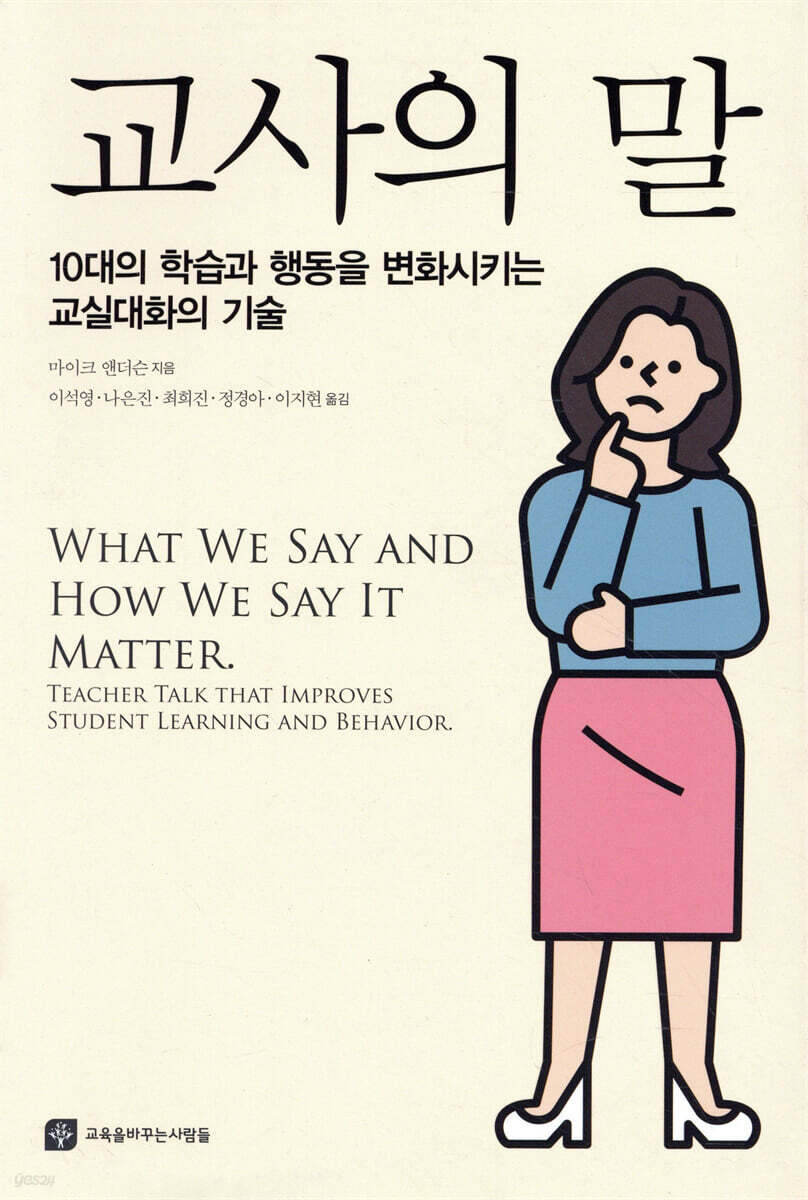
Teacher, what should I say and how should I say it?
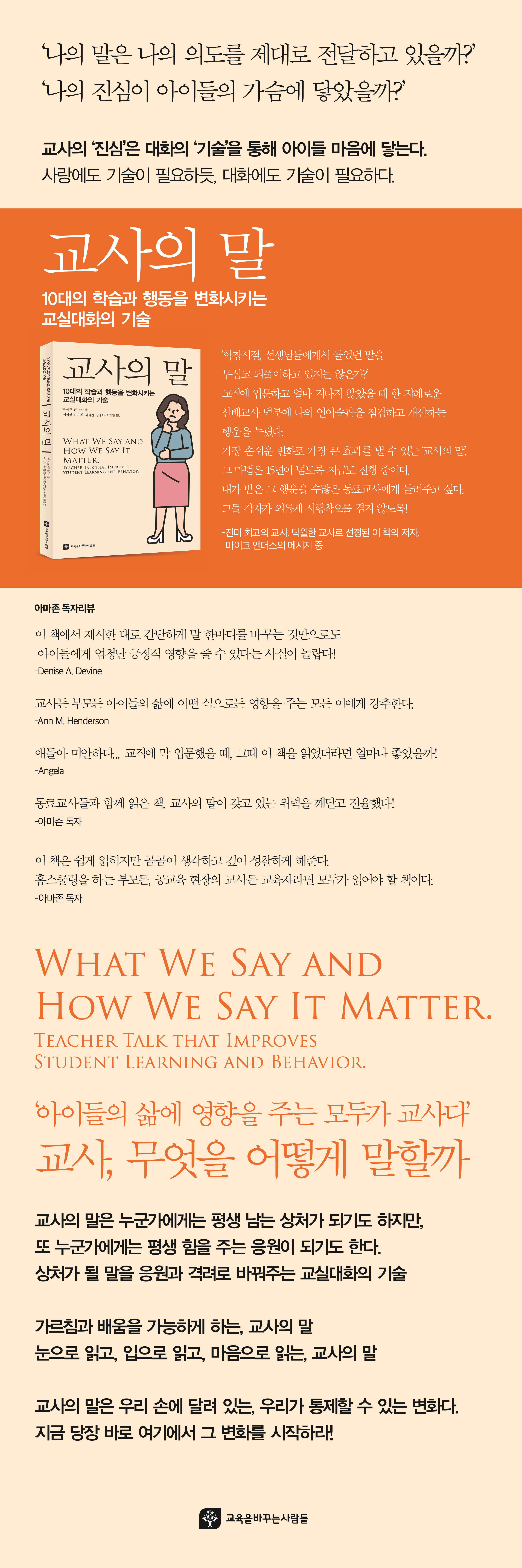
The teacher's 'sincerity' reaches the children's hearts through the 'skill' of conversation.
A teacher's words have a direct impact, for better or worse, on children's learning and behavior, and the effects last throughout their lives.
A single word from a teacher can leave a lifelong scar on some children, but for others, it can be a source of encouragement that rings in their ears for the rest of their lives.
In this way, a single word from a teacher has the power to lead a child to growth.
What truly builds between teachers and students in seemingly trivial conversations of everyday life? How can a teacher's sincerity reach children's hearts? A teacher's sincerity reaches children's hearts through the art of conversation.
Just as love requires skill, so does conversation.
This book contains conversation techniques that can reach children's hearts while faithfully conveying the teacher's original intentions when talking to them.
It also explains how familiar expressions we use without thinking can hurt children, and reveals hidden meanings that we never thought of, while suggesting effective alternative expressions that can be easily replaced.
The diverse examples and positive examples presented throughout the book will encourage teachers to reflect on their language habits and practice conversations that can improve relationships and foster growth with children.
If you read this book first with your eyes, then with your heart, and then with your mouth, you will be able to experience the amazing, magical change that the teacher's words bring.
You will also realize that the weapon that has the most decisive influence on children's growth still lies with the teacher.
The teacher's 'sincerity' reaches the children's hearts through the 'skill' of conversation.
A teacher's words have a direct impact, for better or worse, on children's learning and behavior, and the effects last throughout their lives.
A single word from a teacher can leave a lifelong scar on some children, but for others, it can be a source of encouragement that rings in their ears for the rest of their lives.
In this way, a single word from a teacher has the power to lead a child to growth.
What truly builds between teachers and students in seemingly trivial conversations of everyday life? How can a teacher's sincerity reach children's hearts? A teacher's sincerity reaches children's hearts through the art of conversation.
Just as love requires skill, so does conversation.
This book contains conversation techniques that can reach children's hearts while faithfully conveying the teacher's original intentions when talking to them.
It also explains how familiar expressions we use without thinking can hurt children, and reveals hidden meanings that we never thought of, while suggesting effective alternative expressions that can be easily replaced.
The diverse examples and positive examples presented throughout the book will encourage teachers to reflect on their language habits and practice conversations that can improve relationships and foster growth with children.
If you read this book first with your eyes, then with your heart, and then with your mouth, you will be able to experience the amazing, magical change that the teacher's words bring.
You will also realize that the weapon that has the most decisive influence on children's growth still lies with the teacher.
- You can preview some of the book's contents.
Preview
index
Recommendation ---4
Acknowledgments---6
01 Teacher, What to Say and How to Say It---10
02 “There’s no way you brought your homework.”
Sarcasm---28
03 “Anyone with a good idea, want to speak up?”
Comparative Words---44
04 “Our children, look at the blackboard.”
Words that hurt self-esteem---54
05 “It’s getting noisier!”
Unclear instructions---68
06 “How many times do I have to tell you this?”
Words used to describe a problem child---90
07 “If you don’t put it in now, I’ll confiscate it!”
Words that rely on rewards and punishments---110
08 “Once this is over, we can play!”
Words that take away the joy of learning---130
09 “Teacher, in your opinion….”
Teacher-centered speech---144
10 “Can we move on to the next one?”
Words that silence children's mouths---156
11 “If you want to get good grades, study!”
Words that Destroy Intrinsic Motivation---168
12 “You were born with a talent for writing!”
Words Emphasizing Talent---190
13 “They are beyond help!”
Teachers Talking to Each Other---212
14 Things You Can Start Doing Right Now---230
References---252
Search---255
Acknowledgments---6
01 Teacher, What to Say and How to Say It---10
02 “There’s no way you brought your homework.”
Sarcasm---28
03 “Anyone with a good idea, want to speak up?”
Comparative Words---44
04 “Our children, look at the blackboard.”
Words that hurt self-esteem---54
05 “It’s getting noisier!”
Unclear instructions---68
06 “How many times do I have to tell you this?”
Words used to describe a problem child---90
07 “If you don’t put it in now, I’ll confiscate it!”
Words that rely on rewards and punishments---110
08 “Once this is over, we can play!”
Words that take away the joy of learning---130
09 “Teacher, in your opinion….”
Teacher-centered speech---144
10 “Can we move on to the next one?”
Words that silence children's mouths---156
11 “If you want to get good grades, study!”
Words that Destroy Intrinsic Motivation---168
12 “You were born with a talent for writing!”
Words Emphasizing Talent---190
13 “They are beyond help!”
Teachers Talking to Each Other---212
14 Things You Can Start Doing Right Now---230
References---252
Search---255
Detailed image
Into the book
This book examines whether the teacher's language is being conveyed accurately as intended.
Ultimately, don't we all have positive intentions and goals for our students? Teachers want their students to learn enthusiastically throughout the day, engage in desirable interactions, and behave positively and appropriately, guided by moral judgment.
Although there are many different views and debates about teaching methods in the educational world today, most educators identify the above as common core values.
That is, all teachers want what they think is best for the children.
But we all have times when we use language patterns that don't align with our best intentions.
Sometimes, we develop language habits that are the exact opposite of what we know is best for our students.
--- p.11
Until then, whenever I wanted to give positive feedback on my children's achievements or behavior, I would say this:
“It’s great that you’re working hard on math problems!”
“It’s so nice to walk quietly in the hallway!”
“Thank you so much for working so hard on the science project!”
“Thank you so much for putting the chair away!”
This means that I have been unintentionally training my children to be teachers' pleasers.
As a result, the children constantly depended on me, their teacher, to confirm that they were valuable and that they were doing well.
As I began to become more conscious of how I was giving positive feedback, I realized that, despite my goal of creating a "student-centered classroom," the language I was using was incredibly teacher-centered.
All this time, I've been using language that doesn't match my beliefs or goals at all.
--- pp.13-14
In this book, the word 'teacher' is used in a broad and comprehensive sense.
Teachers, arts integration specialists, special education teachers, principals, superintendents, administrative staff, facility managers, teaching assistants, parents—no matter where you are, you are all teachers.
Anyone who plays any role in a child's life is a teacher.
Please remember that throughout this book the word 'teacher' is used as a broad and inclusive term.
--- p.22
If a child already has healthy social and emotional development, is kind, and follows rules well, it is easier for teachers to treat them with respect and humanity.
Unfortunately, the very students who desperately need respect, empathy, and compassion every day are often the ones who are disrespectful and violent.
So it is not easy to treat these children kindly.
We worry that showing respect to aggressive and arrogant children will reinforce their negative behavior.
Sometimes, we rationalize this by saying, “Children must respect their teachers first, and only then will teachers respect children.”
But that's like saying to someone suffering from asthma now, "You'll only be eligible for an inhaler once you can breathe properly," instead of giving them an inhaler right away.
Keep this in mind when considering using respectful language with students.
Children who have difficulty demonstrating respect need more experiences of being respected by others.
Otherwise, how will these children learn to respect others?
--- pp.42-43
Even words that encourage comparison and competition are likely to come from good intentions.
The reason teachers encourage competition is to inspire and motivate students to participate, work hard, and do well on assignments.
It may be to stimulate students who are too shy to participate actively or who lack motivation and effort.
However, words that encourage comparison and competition can discourage children's motivation, despite the teacher's intention.
These remarks do little harm to students who are highly engaged and successful in class.
Rather, it may further strengthen the children's sense of accomplishment and superiority.
But students who desperately need a safe space where they won't be judged for failing are further discouraged by teachers who encourage comparison and competition.
You may be reluctant to invest energy and emotion into something that is sure to fail.
--- p.53
You want your students to feel confident trying new things, proactively seek help when they need it, and have a positive sense of self overall.
One of the simplest ways to make this possible is by how we address our students' names.
--- p.55
It is also important to remember that how a teacher treats a child will impact their entire learning experience.
--- p.63
When teachers express irritation, frustration, anger, sarcasm, disgust, or disappointment when children make a behavioral mistake or commit a wrongdoing, what message do they receive from their teachers? When teachers express such emotions, children experience feelings like shame, embarrassment, fear, hostility, and anger.
If we want our children to learn and grow, we cannot allow them to feel this way.
This type of emotional response has a very negative impact on learning.
Eric Jensen, a renowned educator and brain expert, says, “Threats trigger defense mechanisms that lead us to behave appropriately for survival, but they are the worst for learning.
“This fact cannot be overemphasized,” he said.
--- p.102
Teachers must be skilled observers, observing their students' learning processes and intentionally identifying specific elements that can be helpful.
Teachers should talk less about their thoughts and feelings and more about what they observe as teachers.
This means that you should act as a coach rather than judge and jury.
--- p.198
Unfortunately, the children who receive the most unmanageable negative feedback after completing a task are also the ones who most desperately need positive, empowering feedback—the ones with the lowest levels of patience and self-esteem.
Remember that constructive feedback must be provided throughout the course of the assignment.
Once a task is completed, focus on encouraging the child's strengths so that he or she can build enthusiasm and positive energy to tackle the next task.
Ultimately, don't we all have positive intentions and goals for our students? Teachers want their students to learn enthusiastically throughout the day, engage in desirable interactions, and behave positively and appropriately, guided by moral judgment.
Although there are many different views and debates about teaching methods in the educational world today, most educators identify the above as common core values.
That is, all teachers want what they think is best for the children.
But we all have times when we use language patterns that don't align with our best intentions.
Sometimes, we develop language habits that are the exact opposite of what we know is best for our students.
--- p.11
Until then, whenever I wanted to give positive feedback on my children's achievements or behavior, I would say this:
“It’s great that you’re working hard on math problems!”
“It’s so nice to walk quietly in the hallway!”
“Thank you so much for working so hard on the science project!”
“Thank you so much for putting the chair away!”
This means that I have been unintentionally training my children to be teachers' pleasers.
As a result, the children constantly depended on me, their teacher, to confirm that they were valuable and that they were doing well.
As I began to become more conscious of how I was giving positive feedback, I realized that, despite my goal of creating a "student-centered classroom," the language I was using was incredibly teacher-centered.
All this time, I've been using language that doesn't match my beliefs or goals at all.
--- pp.13-14
In this book, the word 'teacher' is used in a broad and comprehensive sense.
Teachers, arts integration specialists, special education teachers, principals, superintendents, administrative staff, facility managers, teaching assistants, parents—no matter where you are, you are all teachers.
Anyone who plays any role in a child's life is a teacher.
Please remember that throughout this book the word 'teacher' is used as a broad and inclusive term.
--- p.22
If a child already has healthy social and emotional development, is kind, and follows rules well, it is easier for teachers to treat them with respect and humanity.
Unfortunately, the very students who desperately need respect, empathy, and compassion every day are often the ones who are disrespectful and violent.
So it is not easy to treat these children kindly.
We worry that showing respect to aggressive and arrogant children will reinforce their negative behavior.
Sometimes, we rationalize this by saying, “Children must respect their teachers first, and only then will teachers respect children.”
But that's like saying to someone suffering from asthma now, "You'll only be eligible for an inhaler once you can breathe properly," instead of giving them an inhaler right away.
Keep this in mind when considering using respectful language with students.
Children who have difficulty demonstrating respect need more experiences of being respected by others.
Otherwise, how will these children learn to respect others?
--- pp.42-43
Even words that encourage comparison and competition are likely to come from good intentions.
The reason teachers encourage competition is to inspire and motivate students to participate, work hard, and do well on assignments.
It may be to stimulate students who are too shy to participate actively or who lack motivation and effort.
However, words that encourage comparison and competition can discourage children's motivation, despite the teacher's intention.
These remarks do little harm to students who are highly engaged and successful in class.
Rather, it may further strengthen the children's sense of accomplishment and superiority.
But students who desperately need a safe space where they won't be judged for failing are further discouraged by teachers who encourage comparison and competition.
You may be reluctant to invest energy and emotion into something that is sure to fail.
--- p.53
You want your students to feel confident trying new things, proactively seek help when they need it, and have a positive sense of self overall.
One of the simplest ways to make this possible is by how we address our students' names.
--- p.55
It is also important to remember that how a teacher treats a child will impact their entire learning experience.
--- p.63
When teachers express irritation, frustration, anger, sarcasm, disgust, or disappointment when children make a behavioral mistake or commit a wrongdoing, what message do they receive from their teachers? When teachers express such emotions, children experience feelings like shame, embarrassment, fear, hostility, and anger.
If we want our children to learn and grow, we cannot allow them to feel this way.
This type of emotional response has a very negative impact on learning.
Eric Jensen, a renowned educator and brain expert, says, “Threats trigger defense mechanisms that lead us to behave appropriately for survival, but they are the worst for learning.
“This fact cannot be overemphasized,” he said.
--- p.102
Teachers must be skilled observers, observing their students' learning processes and intentionally identifying specific elements that can be helpful.
Teachers should talk less about their thoughts and feelings and more about what they observe as teachers.
This means that you should act as a coach rather than judge and jury.
--- p.198
Unfortunately, the children who receive the most unmanageable negative feedback after completing a task are also the ones who most desperately need positive, empowering feedback—the ones with the lowest levels of patience and self-esteem.
Remember that constructive feedback must be provided throughout the course of the assignment.
Once a task is completed, focus on encouraging the child's strengths so that he or she can build enthusiasm and positive energy to tackle the next task.
--- p.208
Publisher's Review
Teachers need shooters too.
So that each of us does not have to go through lonely and difficult trial and error
"Are you unconsciously repeating things you heard from your teachers during your school days?" "Are you perhaps using the same things your parents often told you as children?" We may be consciously or unconsciously repeating things we heard from our teachers and parents in the past.
Because everyone was once a child and a student.
The author of this book considers it a great stroke of luck that, shortly after entering the teaching profession, he met a wise senior teacher who gave him the opportunity to examine and improve his language habits.
Experience the impact that small changes in language habits can have on children, and realize that the teacher's words are at the center of the greatest influence on children's learning and behavior.
Since then, he has developed the habit of always reflecting on his words, and he confesses that in the process of constantly checking and paying attention to whether 'my words are properly conveying my intentions' and 'whether my sincerity is fully reaching the children's hearts', not only has his relationship with the children improved, but he has also grown significantly as a teacher.
This book is written by an author who experienced a magical transformation in which a teacher's words changed their relationship with their children, and when that relationship with their children changed, their daily lives changed. The author presents the secrets with concrete expressions.
The author hopes to share with numerous fellow teachers and prospective teachers the good fortune he enjoyed by meeting senior teachers early in his teaching career, and to become a mentor who can help alleviate the lonely trials and errors each teacher experiences as they become veteran teachers.
The factor that has the greatest influence on children's learning and behavior,
At the center of it all are the teacher's words.
All factors that directly affect children's learning and behavior, such as the relationship between teachers and students, the classroom atmosphere, and the teacher's feedback, are deeply related to 'the teacher's words.'
Depending on the teacher's reaction and a single word, children may become motivated to learn or give up on learning.
Sometimes they obey the teacher, and sometimes they rebel.
A teacher's words can have a positive or negative impact on children's learning and behavior, which can make a teacher's teaching either successful or ineffective.
A teacher's words can leave a lifelong scar on some children, but for others, they can be a source of encouragement that gives them strength for life.
But where do teachers learn such crucial "teacher's language"? Does becoming a teacher automatically enable them to speak like a teacher? How can they expect to become effective as a teacher immediately after joining the profession if they've never formally learned how to speak effectively in college or at a teacher training program? They must learn every single word of the teacher's language.
We must learn how to express the teacher's good intentions in the right language and how to make the intentions and language match.
Just as love requires skill, so does expression.
A teacher's sincerity reaches children's hearts through conversation skills.
This book is about classroom conversation techniques that can change children's learning and behavior, and can last a lifetime.
It contains classroom conversation techniques that can turn words that would otherwise leave a scar into support and encouragement that last a lifetime.
The most effective, yet easiest change, a teacher's words
Read with your eyes, read with your heart, read with your mouth, and deal with the child in front of you now.
The book consists of 14 chapters, each aimed at using language that best reflects the teacher's good intentions for the students.
We analyze various expressions used in classroom situations to see what meaning teachers can convey to children through words they use without thinking, and suggest effective alternative expressions that can be easily replaced.
'I didn't know that my words were meant to be conveyed in that way...' Just realizing that your words were being taken in a completely unexpected way, different from your original intention, is already a huge accomplishment for a teacher.
From now on, you will reflect on your language habits, check each expression, pay attention, and think about effective conversation techniques.
The author, who has worked as a field teacher and teacher training specialist for a long time, shares classroom conversation techniques that are all the more vivid and persuasive because they are gleaned from his extensive field experience.
Above all, the author argues that the teacher's words are the change that I can control and implement at my own will without the approval of the school management committee, and that they are not grand changes, but rather the most effective changes that can be easily implemented. So, he persuasively but warmly suggests that I start making that change right now with the children in front of me.
So that each of us does not have to go through lonely and difficult trial and error
"Are you unconsciously repeating things you heard from your teachers during your school days?" "Are you perhaps using the same things your parents often told you as children?" We may be consciously or unconsciously repeating things we heard from our teachers and parents in the past.
Because everyone was once a child and a student.
The author of this book considers it a great stroke of luck that, shortly after entering the teaching profession, he met a wise senior teacher who gave him the opportunity to examine and improve his language habits.
Experience the impact that small changes in language habits can have on children, and realize that the teacher's words are at the center of the greatest influence on children's learning and behavior.
Since then, he has developed the habit of always reflecting on his words, and he confesses that in the process of constantly checking and paying attention to whether 'my words are properly conveying my intentions' and 'whether my sincerity is fully reaching the children's hearts', not only has his relationship with the children improved, but he has also grown significantly as a teacher.
This book is written by an author who experienced a magical transformation in which a teacher's words changed their relationship with their children, and when that relationship with their children changed, their daily lives changed. The author presents the secrets with concrete expressions.
The author hopes to share with numerous fellow teachers and prospective teachers the good fortune he enjoyed by meeting senior teachers early in his teaching career, and to become a mentor who can help alleviate the lonely trials and errors each teacher experiences as they become veteran teachers.
The factor that has the greatest influence on children's learning and behavior,
At the center of it all are the teacher's words.
All factors that directly affect children's learning and behavior, such as the relationship between teachers and students, the classroom atmosphere, and the teacher's feedback, are deeply related to 'the teacher's words.'
Depending on the teacher's reaction and a single word, children may become motivated to learn or give up on learning.
Sometimes they obey the teacher, and sometimes they rebel.
A teacher's words can have a positive or negative impact on children's learning and behavior, which can make a teacher's teaching either successful or ineffective.
A teacher's words can leave a lifelong scar on some children, but for others, they can be a source of encouragement that gives them strength for life.
But where do teachers learn such crucial "teacher's language"? Does becoming a teacher automatically enable them to speak like a teacher? How can they expect to become effective as a teacher immediately after joining the profession if they've never formally learned how to speak effectively in college or at a teacher training program? They must learn every single word of the teacher's language.
We must learn how to express the teacher's good intentions in the right language and how to make the intentions and language match.
Just as love requires skill, so does expression.
A teacher's sincerity reaches children's hearts through conversation skills.
This book is about classroom conversation techniques that can change children's learning and behavior, and can last a lifetime.
It contains classroom conversation techniques that can turn words that would otherwise leave a scar into support and encouragement that last a lifetime.
The most effective, yet easiest change, a teacher's words
Read with your eyes, read with your heart, read with your mouth, and deal with the child in front of you now.
The book consists of 14 chapters, each aimed at using language that best reflects the teacher's good intentions for the students.
We analyze various expressions used in classroom situations to see what meaning teachers can convey to children through words they use without thinking, and suggest effective alternative expressions that can be easily replaced.
'I didn't know that my words were meant to be conveyed in that way...' Just realizing that your words were being taken in a completely unexpected way, different from your original intention, is already a huge accomplishment for a teacher.
From now on, you will reflect on your language habits, check each expression, pay attention, and think about effective conversation techniques.
The author, who has worked as a field teacher and teacher training specialist for a long time, shares classroom conversation techniques that are all the more vivid and persuasive because they are gleaned from his extensive field experience.
Above all, the author argues that the teacher's words are the change that I can control and implement at my own will without the approval of the school management committee, and that they are not grand changes, but rather the most effective changes that can be easily implemented. So, he persuasively but warmly suggests that I start making that change right now with the children in front of me.
GOODS SPECIFICS
- Publication date: September 23, 2021
- Page count, weight, size: 256 pages | 460g | 152*225*20mm
- ISBN13: 9788997724123
- ISBN10: 8997724126
You may also like
카테고리
korean


korean

![GQ KOREA Mark (Monthly): December [2025]](http://librairie.coreenne.fr/cdn/shop/files/8ef265dbbfbf186523ed75ba7319009d.jpg?v=1765340328&width=3840)


