

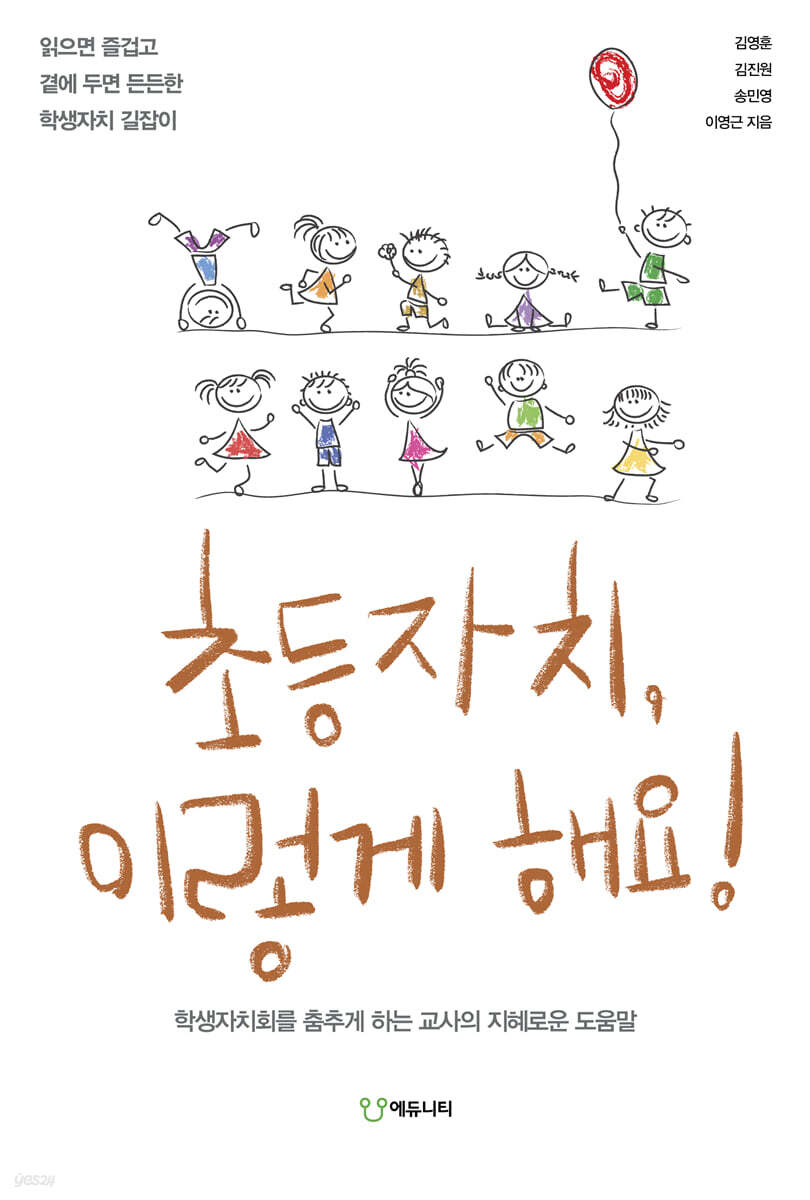
Elementary school self-government, this is how it is done!
 |
Description
Book Introduction
Everyday democracy starting from elementary school
Self-government work, along with school violence-related work, is work that teachers try to avoid unless absolutely necessary.
However, teachers in the elementary school student self-government group 'Elementary Self-government' unanimously say that once they have taken on the task, they want to do it properly, and once they have experienced it, they cannot stop.
Teachers who had been growing the joy of student self-government work by sharing each other's failures and successes took advantage of the temporary lull in student self-government work due to the pandemic to quickly organize the experiences they had accumulated in the elementary school self-government band.
The phenomenon of autonomous activities being carried out through a blend of online and offline channels in line with environmental changes was also detailed.
Just imagining how our society would change if our children began to experience changing reality through their own thoughts, starting in elementary school, makes teachers' hearts race.
That's exactly what elementary school self-government is all about.
It is structured so that teachers can concretely envision the autonomous life of the elementary school where they work by starting with the legal basis for why this work must be done and what and how teachers can do it, and covering various cases from large and small schools.
We provide realistic and specific guidelines so that teachers in charge of student self-government work can work with the students in the student council without being intimidated, easily tired, and with a happy heart.
Self-government work, along with school violence-related work, is work that teachers try to avoid unless absolutely necessary.
However, teachers in the elementary school student self-government group 'Elementary Self-government' unanimously say that once they have taken on the task, they want to do it properly, and once they have experienced it, they cannot stop.
Teachers who had been growing the joy of student self-government work by sharing each other's failures and successes took advantage of the temporary lull in student self-government work due to the pandemic to quickly organize the experiences they had accumulated in the elementary school self-government band.
The phenomenon of autonomous activities being carried out through a blend of online and offline channels in line with environmental changes was also detailed.
Just imagining how our society would change if our children began to experience changing reality through their own thoughts, starting in elementary school, makes teachers' hearts race.
That's exactly what elementary school self-government is all about.
It is structured so that teachers can concretely envision the autonomous life of the elementary school where they work by starting with the legal basis for why this work must be done and what and how teachers can do it, and covering various cases from large and small schools.
We provide realistic and specific guidelines so that teachers in charge of student self-government work can work with the students in the student council without being intimidated, easily tired, and with a happy heart.
- You can preview some of the book's contents.
Preview
index
Prologue - Let's Join Hands for Elementary Autonomy
Chapter 1: Student Autonomy Right Next to You, Who Are You?
Student autonomy, this is why we do it!
When organizing student council activities, this is a must!
Teacher and school attitude
Chapter 2: Decorating the Student Self-Government Office: Empathizing with Space
Why do we need a student council?
How do you organize the student council?
What should be in the student council room
Chapter 3: Taking Steps Together: Establishing and Running a Student Council
What exactly is the Student Council?
Student Council: Let's take a closer look.
Student Council Formation
Leadership Camp: How to Run It?
Chapter 4: How to Run Student Council Meetings That Match Differences
What do they talk about at student council meetings?
Student Council Meeting Methods
Community play that opens meetings
Decision-making methods
We're holding a student debate.
Chapter 5: How to Run a Local Council Event: Beyond the Event
Do I really have to hold an event?
Event, from start to finish
Various events
Chapter 6: Understanding the Different Types of Autonomy: There Are No Right Answers, But There Are Answers
Cases of large school autonomy
Case of small school autonomy
Chapter 7: Expanding the Spatiality of Student Autonomy
Things that have changed due to COVID-19
Non-face-to-face student council operation
Class-school student self-government together
School (linked to parent association).
Expansion into the village (region)
Chapter 8: Ah? Ah! Frequently Asked Questions and Answers
Epilogue - I want to keep seeing you
Chapter 1: Student Autonomy Right Next to You, Who Are You?
Student autonomy, this is why we do it!
When organizing student council activities, this is a must!
Teacher and school attitude
Chapter 2: Decorating the Student Self-Government Office: Empathizing with Space
Why do we need a student council?
How do you organize the student council?
What should be in the student council room
Chapter 3: Taking Steps Together: Establishing and Running a Student Council
What exactly is the Student Council?
Student Council: Let's take a closer look.
Student Council Formation
Leadership Camp: How to Run It?
Chapter 4: How to Run Student Council Meetings That Match Differences
What do they talk about at student council meetings?
Student Council Meeting Methods
Community play that opens meetings
Decision-making methods
We're holding a student debate.
Chapter 5: How to Run a Local Council Event: Beyond the Event
Do I really have to hold an event?
Event, from start to finish
Various events
Chapter 6: Understanding the Different Types of Autonomy: There Are No Right Answers, But There Are Answers
Cases of large school autonomy
Case of small school autonomy
Chapter 7: Expanding the Spatiality of Student Autonomy
Things that have changed due to COVID-19
Non-face-to-face student council operation
Class-school student self-government together
School (linked to parent association).
Expansion into the village (region)
Chapter 8: Ah? Ah! Frequently Asked Questions and Answers
Epilogue - I want to keep seeing you
Detailed image
Into the book
The word 'autonomy' literally means 'the experience of governing oneself'.
It's about exploring problems and solutions on your own, gradually changing reality and designing a better future.
‘Student autonomy’ means that the subjects of ‘autonomy’ are students.
In other words, it can be said that it is an activity in which students take the initiative in designing many aspects of school life, expressing opinions through democratic procedures, and putting them into practice.
Student autonomy holds great significance in that it allows our students, who will live in the future, to cultivate qualities as democratic citizens and take charge of their own living spaces.
--- p.13
I recommend that you create a student self-government activity plan together with the student council members.
The basic direction is to discuss the goals and policies at the school level, and once the student council is formed, a plan is created based on that discussion.
The autonomous teacher can write it based on what was discussed at the student council meeting, or the method of operation can be flexible, such as requesting that it be written according to a framework.
Be sure to set aside time to write your self-government activity plan with your students, as it will be more meaningful and prevent you from doing the same thing twice.
Teachers can ask questions and receive various opinions from students, and write them down.
Alternatively, you could plan out the year by defining student council values, envisioning how you will achieve them, and prioritizing them.
--- pp.43~44
Teachers who are new to student government often say, "It's frustrating to see how clumsy the students are and how many mistakes they make. I want to step up and help."
But the important thing is to wait.
Students find their own solutions using various methods.
You have to let them know that it's okay to make mistakes.
Because mistakes help us grow.
If you don't wait and intervene, your students won't learn to do things on their own.
The foundation of autonomous activities lies in believing in, waiting for, and supporting students' autonomous capabilities.
--- p.50
Why create a student self-government office when we're already so busy? While the answer to this question could be posed through various official documents and drafts, I'd like to address it from a student self-government perspective.
What do we want to give students through student autonomy? If we continue to answer this question, it ultimately boils down to "giving them the experience of doing things on their own."
To do this, students need to have something 'to do' on their own.
The student council room is a space where such ‘streets’ are gathered.
--- p.53
The student council cannot be run by the students alone.
Of course, this doesn't just apply to the student council.
It is not an exaggeration to say that student autonomy depends entirely on how open the teachers are in the school and classroom.
The more we open up, the more students imagine, plan, and act.
Therefore, in order to become a student council, it is necessary to first gather the will of the teachers of each grade to try it.
If this is not possible, forcing the student council to do so could easily end up only burdening the students.
In times like these, I think it would be better to give up on the grade-level student council and save the class-level student council.
I think student autonomy is about giving students as much space as possible.
--- pp.80~81
There is no set content for what students talk about at student council meetings.
Because each student's school life and life experiences are different.
However, since the content is mainly related to students' school life, it can be categorized into 'event-centered content' such as social activities and anniversaries, 'consultation-centered content' such as promises and rules, and 'suggestion-centered content'.
The process of the student council meeting is to listen to, understand, and accommodate each other's different thoughts, different situations, and different demands.
--- p.101
A look at the meeting rules clearly reveals, "Yes! We decided to value these things in our meetings!"
Self-created meeting rules give students a sense of psychological stability.
It also helps prevent conflicts in advance.
When a student interrupts another student in the middle of a conversation, instead of saying, “You shouldn’t do that,” say, “Our meeting rule is to listen to the other student until the end and then talk.”
This gives you the basis to say, “Why don’t we listen to other students’ stories first and then talk?”
Through the rules of the meeting, our student council can create another meaning by pursuing the promised meeting.
--- p.112
When we think of elementary school students' autonomous activities, we often think of 'events'.
These days, many administrators are demanding that students take ownership of their own events, planning and implementing them.
I guess it's because, like the meaning of 'self-governance', 'event' contains the process of planning, preparing, executing, and reflecting on one's own.
Events aren't everything in self-governance, but they do have their advantages.
The more events you hold, the more your self-confidence grows.
Although there are many positive aspects to events, we must always consider the purpose of the event.
--- p.131
Meanwhile, if you look at the individual schedules of students, you can see that they are very busy.
Sometimes, there are friends who feel burdened by participating in meetings or activities.
However, through non-face-to-face meetings, students have the advantage of being able to participate in meetings from anywhere.
This provided an opportunity to explore various forms of student government activities suited to the new educational environment.
Therefore, rather than taking something away from students, our role should be to think about how students can connect with their environment.
Through student council activities that combine online and offline activities, we can foster democratic citizens with self-determination and a sense of responsibility.
To foster a student-led culture of self-governance based on autonomy, publicness, and solidarity, I hope we don't focus solely on the changes brought about by COVID-19.
Rather, if we consider and move forward with what remains constant in student self-government activities even as our environment changes, we can guarantee the autonomy of student self-government activities in an online environment and achieve new ways to activate student self-government.
--- pp.192~193
Even something as trivial as this requires students to experience some sort of process for solving problems in their lives, whether they solve them themselves or wait for someone else to do it for them.
And the process that leads to class autonomy is absolutely necessary.
In elementary school, class self-government, which is a real-life unit, is important.
This is because most of the classes and daily life take place in the classroom with the homeroom teacher and students, and within that space, certain rules are created and applied.
However, it should not remain as just a class self-government.
This is because, for autonomy in life to be fully realized, it must extend beyond solving problems within the classroom and connect to problem-solving and culture-building activities for the entire grade or school.
--- pp.202~203
It is often said that when a student council is formed, one more class is created.
So at first, I struggled a lot.
Because I have to take care of my class and the student council as well.
But strangely enough, the more you do this, the more relaxed you become.
Even though the students change every year, the number of teachers helping with the event decreases.
It's partly because there are materials left behind by students in the student council room, but it's also because all students learn by participating in the event.
Because a culture of autonomy is established in schools.
So, like anything else, the first year of student council is the most difficult.
The first event is the hardest, and the first leadership camp is the hardest.
Once you get past that first step, it definitely gets better.
Not only will you get better, you will find joy.
I think the student council is a wonderful thing to think about together with the students about what to do.
But it takes time for that to happen.
So don't be too impatient and take it one step at a time.
If we continue like this, I believe that one day, a student council unique to your school will blossom.
It's about exploring problems and solutions on your own, gradually changing reality and designing a better future.
‘Student autonomy’ means that the subjects of ‘autonomy’ are students.
In other words, it can be said that it is an activity in which students take the initiative in designing many aspects of school life, expressing opinions through democratic procedures, and putting them into practice.
Student autonomy holds great significance in that it allows our students, who will live in the future, to cultivate qualities as democratic citizens and take charge of their own living spaces.
--- p.13
I recommend that you create a student self-government activity plan together with the student council members.
The basic direction is to discuss the goals and policies at the school level, and once the student council is formed, a plan is created based on that discussion.
The autonomous teacher can write it based on what was discussed at the student council meeting, or the method of operation can be flexible, such as requesting that it be written according to a framework.
Be sure to set aside time to write your self-government activity plan with your students, as it will be more meaningful and prevent you from doing the same thing twice.
Teachers can ask questions and receive various opinions from students, and write them down.
Alternatively, you could plan out the year by defining student council values, envisioning how you will achieve them, and prioritizing them.
--- pp.43~44
Teachers who are new to student government often say, "It's frustrating to see how clumsy the students are and how many mistakes they make. I want to step up and help."
But the important thing is to wait.
Students find their own solutions using various methods.
You have to let them know that it's okay to make mistakes.
Because mistakes help us grow.
If you don't wait and intervene, your students won't learn to do things on their own.
The foundation of autonomous activities lies in believing in, waiting for, and supporting students' autonomous capabilities.
--- p.50
Why create a student self-government office when we're already so busy? While the answer to this question could be posed through various official documents and drafts, I'd like to address it from a student self-government perspective.
What do we want to give students through student autonomy? If we continue to answer this question, it ultimately boils down to "giving them the experience of doing things on their own."
To do this, students need to have something 'to do' on their own.
The student council room is a space where such ‘streets’ are gathered.
--- p.53
The student council cannot be run by the students alone.
Of course, this doesn't just apply to the student council.
It is not an exaggeration to say that student autonomy depends entirely on how open the teachers are in the school and classroom.
The more we open up, the more students imagine, plan, and act.
Therefore, in order to become a student council, it is necessary to first gather the will of the teachers of each grade to try it.
If this is not possible, forcing the student council to do so could easily end up only burdening the students.
In times like these, I think it would be better to give up on the grade-level student council and save the class-level student council.
I think student autonomy is about giving students as much space as possible.
--- pp.80~81
There is no set content for what students talk about at student council meetings.
Because each student's school life and life experiences are different.
However, since the content is mainly related to students' school life, it can be categorized into 'event-centered content' such as social activities and anniversaries, 'consultation-centered content' such as promises and rules, and 'suggestion-centered content'.
The process of the student council meeting is to listen to, understand, and accommodate each other's different thoughts, different situations, and different demands.
--- p.101
A look at the meeting rules clearly reveals, "Yes! We decided to value these things in our meetings!"
Self-created meeting rules give students a sense of psychological stability.
It also helps prevent conflicts in advance.
When a student interrupts another student in the middle of a conversation, instead of saying, “You shouldn’t do that,” say, “Our meeting rule is to listen to the other student until the end and then talk.”
This gives you the basis to say, “Why don’t we listen to other students’ stories first and then talk?”
Through the rules of the meeting, our student council can create another meaning by pursuing the promised meeting.
--- p.112
When we think of elementary school students' autonomous activities, we often think of 'events'.
These days, many administrators are demanding that students take ownership of their own events, planning and implementing them.
I guess it's because, like the meaning of 'self-governance', 'event' contains the process of planning, preparing, executing, and reflecting on one's own.
Events aren't everything in self-governance, but they do have their advantages.
The more events you hold, the more your self-confidence grows.
Although there are many positive aspects to events, we must always consider the purpose of the event.
--- p.131
Meanwhile, if you look at the individual schedules of students, you can see that they are very busy.
Sometimes, there are friends who feel burdened by participating in meetings or activities.
However, through non-face-to-face meetings, students have the advantage of being able to participate in meetings from anywhere.
This provided an opportunity to explore various forms of student government activities suited to the new educational environment.
Therefore, rather than taking something away from students, our role should be to think about how students can connect with their environment.
Through student council activities that combine online and offline activities, we can foster democratic citizens with self-determination and a sense of responsibility.
To foster a student-led culture of self-governance based on autonomy, publicness, and solidarity, I hope we don't focus solely on the changes brought about by COVID-19.
Rather, if we consider and move forward with what remains constant in student self-government activities even as our environment changes, we can guarantee the autonomy of student self-government activities in an online environment and achieve new ways to activate student self-government.
--- pp.192~193
Even something as trivial as this requires students to experience some sort of process for solving problems in their lives, whether they solve them themselves or wait for someone else to do it for them.
And the process that leads to class autonomy is absolutely necessary.
In elementary school, class self-government, which is a real-life unit, is important.
This is because most of the classes and daily life take place in the classroom with the homeroom teacher and students, and within that space, certain rules are created and applied.
However, it should not remain as just a class self-government.
This is because, for autonomy in life to be fully realized, it must extend beyond solving problems within the classroom and connect to problem-solving and culture-building activities for the entire grade or school.
--- pp.202~203
It is often said that when a student council is formed, one more class is created.
So at first, I struggled a lot.
Because I have to take care of my class and the student council as well.
But strangely enough, the more you do this, the more relaxed you become.
Even though the students change every year, the number of teachers helping with the event decreases.
It's partly because there are materials left behind by students in the student council room, but it's also because all students learn by participating in the event.
Because a culture of autonomy is established in schools.
So, like anything else, the first year of student council is the most difficult.
The first event is the hardest, and the first leadership camp is the hardest.
Once you get past that first step, it definitely gets better.
Not only will you get better, you will find joy.
I think the student council is a wonderful thing to think about together with the students about what to do.
But it takes time for that to happen.
So don't be too impatient and take it one step at a time.
If we continue like this, I believe that one day, a student council unique to your school will blossom.
--- pp.231~232
GOODS SPECIFICS
- Publication date: September 20, 2021
- Page count, weight, size: 240 pages | 464g | 152*225*20mm
- ISBN13: 9791164250943
- ISBN10: 1164250949
You may also like
카테고리
korean


korean

![GQ KOREA Mark (Monthly): December [2025]](http://librairie.coreenne.fr/cdn/shop/files/8ef265dbbfbf186523ed75ba7319009d.jpg?v=1765340328&width=3840)


