

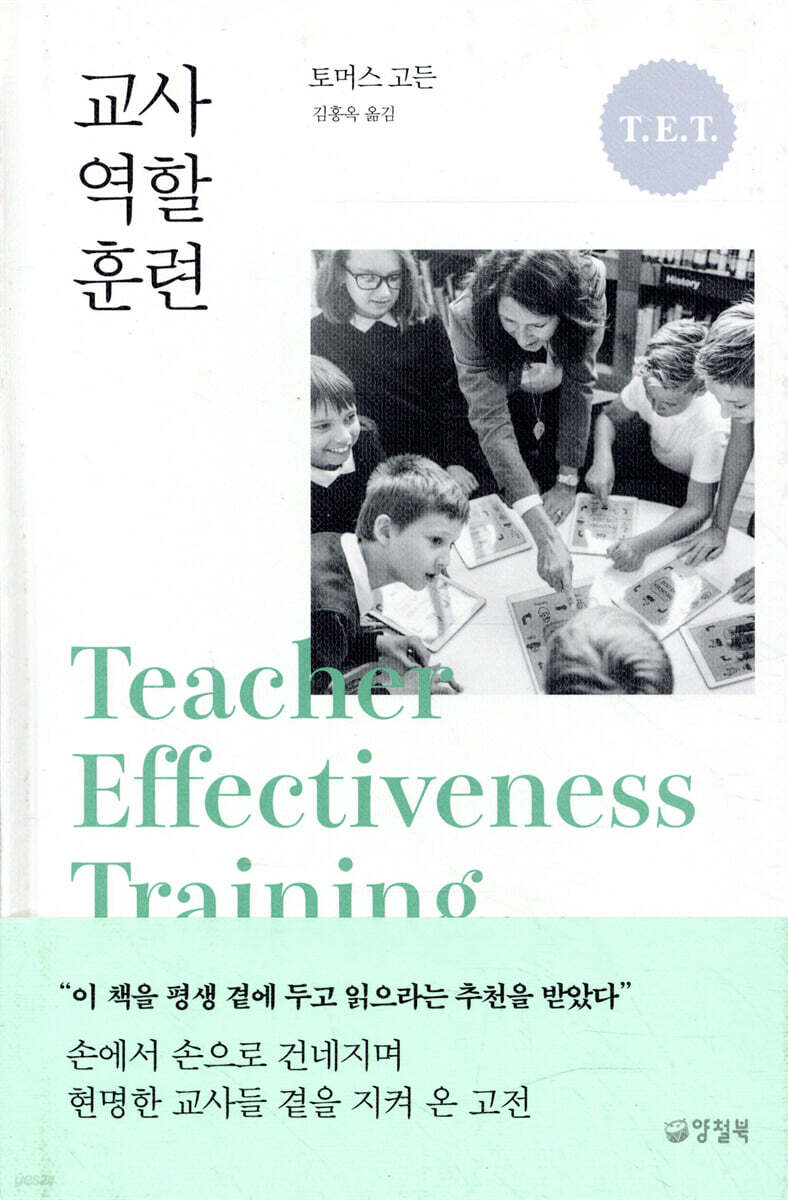
Teacher Role Training
 |
Description
Book Introduction
Rebuilding relationships allows you to focus on teaching and learning.
- A classic that has been with hundreds of thousands of teachers around the world
'Teacher Effectiveness Training' is a program that is being trained and applied in the classroom by current teachers in public and private schools in every state in the United States.
This program is being used as a communication method to build close relationships between teachers and students.
Launched in 1966, TET has spread to hundreds of thousands of teachers around the world.
This program, which has stood the test of time for over half a century, is now accepted as a universal principle.
This book, which summarizes the core concepts of TET and real-life examples of teachers, will help teachers develop a new model for teaching.
You can maintain order in the classroom peacefully without being overbearing or powerless and blindly following students' every word.
Teachers can learn how to make students feel comfortable talking to and listening to their teachers, how to help them take responsibility for their own problems and solve them, and how to develop communication and conflict resolution skills necessary to build positive relationships with students.
In this way, it will be possible to implement the ideal educational philosophy in the classroom.
- A classic that has been with hundreds of thousands of teachers around the world
'Teacher Effectiveness Training' is a program that is being trained and applied in the classroom by current teachers in public and private schools in every state in the United States.
This program is being used as a communication method to build close relationships between teachers and students.
Launched in 1966, TET has spread to hundreds of thousands of teachers around the world.
This program, which has stood the test of time for over half a century, is now accepted as a universal principle.
This book, which summarizes the core concepts of TET and real-life examples of teachers, will help teachers develop a new model for teaching.
You can maintain order in the classroom peacefully without being overbearing or powerless and blindly following students' every word.
Teachers can learn how to make students feel comfortable talking to and listening to their teachers, how to help them take responsibility for their own problems and solve them, and how to develop communication and conflict resolution skills necessary to build positive relationships with students.
In this way, it will be possible to implement the ideal educational philosophy in the classroom.
- You can preview some of the book's contents.
Preview
index
To Korean readers
How Teachers Can Get the Most Out of This Book
How Parents Can Get the Most Out of This Book
Until I wrote this book
1.
What is TET
More important than teaching is the relationship between teacher and student.
TET is a proven program
TET is about helping students solve problems on their own.
What are the limitations of reward-based education?
TET for students of any age
The program is useful
TET is an alternative to traditional education that relies on power and authority.
TET is a new educational paradigm
2 Teachers are also people with emotions.
Common stereotypes about teachers
Desirable relationship between teacher and student
How to view the teacher-student relationship
The difference between receptive and non-receptive teachers
A teacher's acceptance line changes with time and emotion
The problem with false acceptance, which is only superficial acceptance of behavior
Is it the teacher's problem or the student's problem?
Why It Matters Whose Problem It Is
Why the 'No Problem Zone' is Important
3 How to Respond When a Student Feels Problematic
Why Teachers Are Helpless Against the "Student Ownership Problem"
Twelve Conversational Strategies That Block Communication
How is the language of acceptance effective?
A simple way to get students talking
The reality and structure of communication
Why Teachers Should Learn Active Listening
How to Make Active Listening Work
Examples and Effects of Active Listening
The Dangers of Twelve Conversational Barriers
4 Different Ways to Use Active Listening
Encourage various discussions
Able to deal with student opposition or resistance
Can help dependent students
Effective for student-centered discussions
It is useful for interviews between parents and teachers.
Parent-Teacher-Student Three-Way Interview
5 How to Respond When a Teacher Feels a Problem
What Teachers Should Do When They Feel a Problem
Ineffective messages when confronting students
Why Messages Offering Solutions Fail
Why Blaming Messages Fail
Why Roundabout Messages Fail
You-message and I-message
Why You-Messages Aren't Effective
Why I-Messages Are Effective
Components of a Na-Message
Switch to active listening after sending a message
How to manage anger
Are there risks to me-messages?
The Effect of I-Message
6. Create a learning atmosphere in the classroom by changing the environment.
Creative thinking to change the classroom environment
Eight Ways to Transform Your Classroom Environment
How to improve the quality of time spent in the classroom
Potential of the problem-free zone
7 Conflicts that are bound to arise in the classroom
What is conflict anyway?
What causes conflict
How do teachers typically resolve conflicts?
A power struggle between teachers and students - who will win and who will lose?
Is authority necessary in the classroom?
The serious limitations of teachers' power
Students' response mechanisms against teachers' power
Why You Shouldn't Use Method 2 as an Alternative to Method 1
What comes back to the teacher who becomes a winner through power and authority?
The basis for the argument that power and authority are necessary
8 Why the Unbeaten Method Works in the Classroom
What is the undefeated method?
How Method 3 Works in the Classroom
Prerequisites for using Method 3 effectively
Six Steps to Solving the Problem with Method 3
Applying Method 3 in the Classroom
Why Method 3 Works
9 How to Practice the 'Invincible Method'
Resolving Conflicts Arising in the Teaching-Learning Area Using Method 3
Method 3: Resolving Student-Student Conflicts
How to Use Method 3 to Set Rules in the Classroom
How to Conduct a Class Meeting to Establish Rules
Problems you may encounter when using Method 3
When you must use method 1
10 How to Deal with Conflicting Values
What is a conflict of values?
A clash of values that renders even the I-Message powerless
Conflict of values that is difficult even with method 3
Why Method 1 Doesn't Work When Values Conflict
Why Method 2 Doesn't Work When Values Conflict
How to Deal with Conflicting Values
11 The Role of Teachers in Transforming Schools
How to effectively promote the teacher role
How to Deal with Conflicts with Your Organization's Leader
How to Use Group Meetings Effectively
The teacher's role as a competent counselor
The teacher's role as a student advocate
supplement
Parents are their children's first teachers, and their role is crucial.
The subject of learning is neither parents nor teachers.
We must create a home environment conducive to learning.
You should not try to teach your children until they want to.
If you try to teach your children by force or authority, you will fail.
To pass on the values of parents, one must first be a role model.
When your child has problems at school, it's the child who is responsible for the problem.
How Should Parents Address Homework Issues?
Obsessing over your child's grades and report cards is detrimental to both parties.
Parents can change teachers simply by actively listening.
A special team consisting of parents, teachers, and the school principal will be formed.
Take an active interest in the school your child attends.
For a better relationship
How Teachers Can Get the Most Out of This Book
How Parents Can Get the Most Out of This Book
Until I wrote this book
1.
What is TET
More important than teaching is the relationship between teacher and student.
TET is a proven program
TET is about helping students solve problems on their own.
What are the limitations of reward-based education?
TET for students of any age
The program is useful
TET is an alternative to traditional education that relies on power and authority.
TET is a new educational paradigm
2 Teachers are also people with emotions.
Common stereotypes about teachers
Desirable relationship between teacher and student
How to view the teacher-student relationship
The difference between receptive and non-receptive teachers
A teacher's acceptance line changes with time and emotion
The problem with false acceptance, which is only superficial acceptance of behavior
Is it the teacher's problem or the student's problem?
Why It Matters Whose Problem It Is
Why the 'No Problem Zone' is Important
3 How to Respond When a Student Feels Problematic
Why Teachers Are Helpless Against the "Student Ownership Problem"
Twelve Conversational Strategies That Block Communication
How is the language of acceptance effective?
A simple way to get students talking
The reality and structure of communication
Why Teachers Should Learn Active Listening
How to Make Active Listening Work
Examples and Effects of Active Listening
The Dangers of Twelve Conversational Barriers
4 Different Ways to Use Active Listening
Encourage various discussions
Able to deal with student opposition or resistance
Can help dependent students
Effective for student-centered discussions
It is useful for interviews between parents and teachers.
Parent-Teacher-Student Three-Way Interview
5 How to Respond When a Teacher Feels a Problem
What Teachers Should Do When They Feel a Problem
Ineffective messages when confronting students
Why Messages Offering Solutions Fail
Why Blaming Messages Fail
Why Roundabout Messages Fail
You-message and I-message
Why You-Messages Aren't Effective
Why I-Messages Are Effective
Components of a Na-Message
Switch to active listening after sending a message
How to manage anger
Are there risks to me-messages?
The Effect of I-Message
6. Create a learning atmosphere in the classroom by changing the environment.
Creative thinking to change the classroom environment
Eight Ways to Transform Your Classroom Environment
How to improve the quality of time spent in the classroom
Potential of the problem-free zone
7 Conflicts that are bound to arise in the classroom
What is conflict anyway?
What causes conflict
How do teachers typically resolve conflicts?
A power struggle between teachers and students - who will win and who will lose?
Is authority necessary in the classroom?
The serious limitations of teachers' power
Students' response mechanisms against teachers' power
Why You Shouldn't Use Method 2 as an Alternative to Method 1
What comes back to the teacher who becomes a winner through power and authority?
The basis for the argument that power and authority are necessary
8 Why the Unbeaten Method Works in the Classroom
What is the undefeated method?
How Method 3 Works in the Classroom
Prerequisites for using Method 3 effectively
Six Steps to Solving the Problem with Method 3
Applying Method 3 in the Classroom
Why Method 3 Works
9 How to Practice the 'Invincible Method'
Resolving Conflicts Arising in the Teaching-Learning Area Using Method 3
Method 3: Resolving Student-Student Conflicts
How to Use Method 3 to Set Rules in the Classroom
How to Conduct a Class Meeting to Establish Rules
Problems you may encounter when using Method 3
When you must use method 1
10 How to Deal with Conflicting Values
What is a conflict of values?
A clash of values that renders even the I-Message powerless
Conflict of values that is difficult even with method 3
Why Method 1 Doesn't Work When Values Conflict
Why Method 2 Doesn't Work When Values Conflict
How to Deal with Conflicting Values
11 The Role of Teachers in Transforming Schools
How to effectively promote the teacher role
How to Deal with Conflicts with Your Organization's Leader
How to Use Group Meetings Effectively
The teacher's role as a competent counselor
The teacher's role as a student advocate
supplement
Parents are their children's first teachers, and their role is crucial.
The subject of learning is neither parents nor teachers.
We must create a home environment conducive to learning.
You should not try to teach your children until they want to.
If you try to teach your children by force or authority, you will fail.
To pass on the values of parents, one must first be a role model.
When your child has problems at school, it's the child who is responsible for the problem.
How Should Parents Address Homework Issues?
Obsessing over your child's grades and report cards is detrimental to both parties.
Parents can change teachers simply by actively listening.
A special team consisting of parents, teachers, and the school principal will be formed.
Take an active interest in the school your child attends.
For a better relationship
Into the book
It is important to note that teaching and learning are distinct and completely different processes.
Among the many differences, it is important to note that while the teacher conveys something outwardly, the learning process takes place in someone else's mind.
It may seem obvious, but it is still something we need to think about.
This is also why, for the teaching and learning process to be effective, there must be a special relationship, a kind of bond, a link, a bridge, between the two people.
So, a significant portion of this book is devoted to effective communication skills that build rapport and connections.
(……) The techniques I’m going to explain here are mainly related to conversations that anyone can easily do.
Conversation can either strengthen or destroy relationships, bringing teachers and students closer together or driving them apart.
This is also an obvious point, but it needs to be seriously considered.
The success or failure of a conversation depends on the teacher's ability to judge which conversation method and content are most appropriate for various situations.
--- p.21-22
Most books on education argue that different techniques, strategies, and methods should be used depending on the age of the child.
As if different age groups require different educational philosophies.
Teaching kindergarten is completely different from teaching high school students or sixth graders.
Of course, it's natural to consider a child's developmental stage when deciding on teaching materials or teaching methods, but the basic human relationship between teacher and student remains the same regardless of the child's age.
This book and TET
The techniques and methods introduced in the course can be usefully applied to students of any age, even college students.
No matter how old they are, all students are human, and how teachers treat their students can make or break their relationships.
We believe that students are beings who form relationships with their teachers.
--- p.32-33
School administrators and teachers agree that the most important purpose of schools is to help students grow into responsible, mature adults.
This is a basic quality required in civil society.
For decades, educators have identified "educating responsible citizens" as a crucial (if not the most important) function of schools.
However, understanding this ideal in your head does not automatically lead to its realization.
Students will never become responsible or mature unless schools stop relying excessively on adult power and authority.
When we dominate and control children by exercising power—by punishing or threatening to punish, by rewarding or taking away rewards—we deny them the opportunity to develop a sense of responsibility.
Children are trapped in a trap of permanent dependence and immaturity.
--- p.363-364
When adults try to hide their true feelings, students perceive it as an attempt to deceive them.
This is why teachers should send messages that clearly express their feelings, even if they cannot change students' behavior.
Honesty is not always the best, but students still prefer honest teachers.
Rather than forcing a smile and pretending nothing happened when a student uses offensive language in front of you, it's much better to try to send an I-message that reveals yourself, like this:
“When you say things like that, it really grates on my ears and makes me angry.
Even if you don't try to do it, it happens on its own.
“I just can’t let that go.” Even if the teacher isn’t seriously harmed, the student at least knows that he or she has offended the teacher.
Knowing this fact forces students to consider whether or not they should continue their behavior.
If the teacher conveys the message by smiling or awkwardly feigning acceptance, the student will never have to worry about his or her behavior.
Among the many differences, it is important to note that while the teacher conveys something outwardly, the learning process takes place in someone else's mind.
It may seem obvious, but it is still something we need to think about.
This is also why, for the teaching and learning process to be effective, there must be a special relationship, a kind of bond, a link, a bridge, between the two people.
So, a significant portion of this book is devoted to effective communication skills that build rapport and connections.
(……) The techniques I’m going to explain here are mainly related to conversations that anyone can easily do.
Conversation can either strengthen or destroy relationships, bringing teachers and students closer together or driving them apart.
This is also an obvious point, but it needs to be seriously considered.
The success or failure of a conversation depends on the teacher's ability to judge which conversation method and content are most appropriate for various situations.
--- p.21-22
Most books on education argue that different techniques, strategies, and methods should be used depending on the age of the child.
As if different age groups require different educational philosophies.
Teaching kindergarten is completely different from teaching high school students or sixth graders.
Of course, it's natural to consider a child's developmental stage when deciding on teaching materials or teaching methods, but the basic human relationship between teacher and student remains the same regardless of the child's age.
This book and TET
The techniques and methods introduced in the course can be usefully applied to students of any age, even college students.
No matter how old they are, all students are human, and how teachers treat their students can make or break their relationships.
We believe that students are beings who form relationships with their teachers.
--- p.32-33
School administrators and teachers agree that the most important purpose of schools is to help students grow into responsible, mature adults.
This is a basic quality required in civil society.
For decades, educators have identified "educating responsible citizens" as a crucial (if not the most important) function of schools.
However, understanding this ideal in your head does not automatically lead to its realization.
Students will never become responsible or mature unless schools stop relying excessively on adult power and authority.
When we dominate and control children by exercising power—by punishing or threatening to punish, by rewarding or taking away rewards—we deny them the opportunity to develop a sense of responsibility.
Children are trapped in a trap of permanent dependence and immaturity.
--- p.363-364
When adults try to hide their true feelings, students perceive it as an attempt to deceive them.
This is why teachers should send messages that clearly express their feelings, even if they cannot change students' behavior.
Honesty is not always the best, but students still prefer honest teachers.
Rather than forcing a smile and pretending nothing happened when a student uses offensive language in front of you, it's much better to try to send an I-message that reveals yourself, like this:
“When you say things like that, it really grates on my ears and makes me angry.
Even if you don't try to do it, it happens on its own.
“I just can’t let that go.” Even if the teacher isn’t seriously harmed, the student at least knows that he or she has offended the teacher.
Knowing this fact forces students to consider whether or not they should continue their behavior.
If the teacher conveys the message by smiling or awkwardly feigning acceptance, the student will never have to worry about his or her behavior.
--- p.428
Publisher's Review
School violence, bullying, game addiction, sexual problems…
Due to conflicts that occur inside and outside the classroom
Effective Coping Strategies for Teachers Who Have Trouble Concentrating on Teaching
Thomas Gordon's Teacher Effectiveness Training (TET) evolved from Parent Effectiveness Training (PET), which has been completed by millions of parents in 43 countries around the world.
This is a special program for teachers that was created at the request of parents who wanted to share the communication and conflict resolution skills they learned at PET with teachers and apply them in schools.
Since its inception in 1966, TET has been introduced across the United States and has expanded globally through Gordon Training Institute International (GTI).
《Teacher Role Training》 is TET
This book contains principles and cases developed and refined through training teachers through programs and applying them in actual fields.
Many of the examples in this book were obtained directly from current teachers.
What is the difference between effective and ineffective education? This book focuses on the single factor that most significantly influences that difference.
It is the special relationship that a teacher has with a student.
If the relationship between teacher and student is good, any difficult knowledge can be learned with enjoyment.
The relationship between teacher and student is more important than what or how is taught.
This book deals with how teachers and students can build good relationships.
TET assumes that teachers are also human beings with feelings and needs, and deserve to be respected.
Students' feelings and needs must also be respected.
How can we find common ground and resolve problems in a classroom where conflicts arise due to the conflicting emotions and desires of many people? How can we effectively help children with their problems? How can we transform classroom meetings, which often end in idle chatter, into spontaneous and effective ones? TET offers practical and specific methods for teachers to effectively support students' growth, communicate their opinions to students without ignoring or dismissing their own needs and feelings, encourage students to actively participate in classroom management, build smooth relationships with parents, and make schools better workplaces.
How to resolve conflicts that arise in the classroom
- Problem-solving methods that foster responsibility in students
School is a space where numerous desires collide, such as the 'student problems' that teachers cannot properly solve, the 'teacher problems' that arise from rebellious students, and the conflict between teachers and the school principal.
The important question is how to resolve this conflict of desires.
Because conflict can become a motive for new wisdom and development, or it can deepen and nurture the seeds of discord.
However, many teachers are not properly educated or trained on how to approach students, resolve conflicts, and develop genuine relationships.
Although we have been educated and studied about abstract concepts and teaching methods, we have not learned specific methods on how to solve the various problems that arise in the classroom.
This book covers the entire spectrum of how teachers resolve conflict through dialogue, from defining who owns the problem to how to resolve it.
The foundation of this book can be summarized as the Gordon Model: 'active listening', 'I-message delivery', and 'the invincible method'.
Passionate teachers try to help students with problems in any way possible.
Advise, counsel and suggest solutions.
However, since it is difficult to know a student's problem better than the student himself, the advice a teacher gives is usually of little help to the student.
It only indirectly conveys the message that 'you are not capable of solving that problem'.
This book says that it is much more effective to have students define their own problems and find solutions through the 'active listening' method.
This listening method allows students to easily share their deepest concerns with the teacher without taking the initiative in problem-solving from them.
If a teacher feels troubled by a student's unacceptable behavior, such as interrupting another student who is presenting or talking loudly during a test, it is a good idea to utilize the "I-message" method.
When you define student behavior without judging or blaming it, communicate how the behavior makes you feel, and explain the real, concrete impact it has, students come to understand your feelings and needs.
Also, in cases where there are problems for both students and teachers, I suggest using the "no-lose method," which is a way to resolve the problem without anyone feeling ignored or offended, i.e., without anyone losing.
It covers a variety of examples, including how to lead a meeting at the beginning of the semester to establish rules that everyone must follow, how to involve students in parent-teacher conferences, and how to lead discussions.
Using the methods suggested by TET, students will develop self-direction, develop responsibility, self-reliance, and self-control, and acquire skills and methods for self-reflection.
Such qualities do not arise spontaneously.
Teachers should take care and encourage students to develop such abilities.
TET brings ideal educational ideals to life in the classroom.
“These are all good stories.
“But how can I possibly listen to the stories and opinions of 35 students in my class?” Many teachers who take TET ask this question.
However, if the teacher creates an environment where children can speak up, participate in meetings, and express their opinions voluntarily.
Since he participated directly, he moved voluntarily.
Teachers don't have to waste time trying to convince students.
The method proposed by TET is the fastest and most effective way to democratize the classroom, respect the needs of both students and teachers, and ultimately help students grow and develop.
Teachers must continue to practice these skills until they become second nature, and the numerous examples in this book will help.
We've also detailed how to respond to various situations that may arise when using this method.
This is possible because we have collected stories from teachers who have experienced various variables before.
How to Make School a Better Workplace
Teachers have the right to work happily in a workplace with better working conditions.
The methods proposed by TET can be applied to all human relationships and can be used by everyone involved in school.
It presents communication strategies that teachers can use to deal with problematic situations, including the principal, vice principal, board of education, parent-teacher association, administrative staff, and even security guards.
It covers a variety of communication techniques that schools can use, including how to hold a meeting where all students participate to establish classroom rules, how to interview parents, how to involve students in parent-teacher conferences, how to get your point across to the principal, and how to resolve issues with school staff.
A timeless classic passed from hand to hand
Despite the passage of time, TET is still valid.
This is because the essence of human relationships, such as the relationship between teachers and students, has not changed.
That is why readers have been praising this book, which was first published in Korea in 2003.
“This book changed my perspective on teaching.
Rather than worrying about how to redesign the curriculum and teach in a new way, I came to believe that it was more important to show the lives of teachers and help students understand the human nature of teachers.
A class with a good relationship between students and teachers has an enjoyable year.
“That is the premise of this book” “It is not a book to be read once and put aside, but a book to be kept by your side and practiced over and over again” “It is a book that provides practical, theoretical, and specific information to teachers who need constant training” “It helped me understand the meaning of the phrase ‘respect children,’ which I had heard over and over again throughout my school years, but had forgotten after becoming a teacher” “This book gave me an opportunity to seriously think about what the countless actions and words I have done so far have meant to children.
It has been praised as “a valuable book that teaches us how to resolve conflicts with children and how to create an efficient and effective learning environment.”
TET has been recognized as a universal principle for over half a century, transcending time and borders and still being valid today.
-When I taught physics and mathematics in high school, I thought my greatest accomplishment as a teacher was having students graduate knowing things like Newton's laws and quadratic equations.
But looking back, if I had to choose just one piece of knowledge or skill that students should learn in school, it would be communication skills.
It helps develop self-control, a skill that is most useful both in school and in society.
Unless something better comes along, I will always choose Gordon's communication model._Robert T.
Tober, in Classroom Management
-TET applies to all relationships in school beyond the classroom.
"It's the most valuable program I've had in 22 years." —Kenneth Fields, Principal, Trinity Elementary School, Los Angeles, California
"TET is the best! I'm very satisfied with the course results." -Ronald Simcox, Superintendent of Chicago Hinsdale School District
-TET will produce great results for you, just as it did for me. - Charles Bruning, Professor of Education, University of Minnesota
-The theory is simple, but it is an important book that will change the paradigm of educators. _Amazon Reader Spliceosome
-It's a classic.
It will remain the best book on teaching communication for many years to come. _Amazon Reader Miller
Due to conflicts that occur inside and outside the classroom
Effective Coping Strategies for Teachers Who Have Trouble Concentrating on Teaching
Thomas Gordon's Teacher Effectiveness Training (TET) evolved from Parent Effectiveness Training (PET), which has been completed by millions of parents in 43 countries around the world.
This is a special program for teachers that was created at the request of parents who wanted to share the communication and conflict resolution skills they learned at PET with teachers and apply them in schools.
Since its inception in 1966, TET has been introduced across the United States and has expanded globally through Gordon Training Institute International (GTI).
《Teacher Role Training》 is TET
This book contains principles and cases developed and refined through training teachers through programs and applying them in actual fields.
Many of the examples in this book were obtained directly from current teachers.
What is the difference between effective and ineffective education? This book focuses on the single factor that most significantly influences that difference.
It is the special relationship that a teacher has with a student.
If the relationship between teacher and student is good, any difficult knowledge can be learned with enjoyment.
The relationship between teacher and student is more important than what or how is taught.
This book deals with how teachers and students can build good relationships.
TET assumes that teachers are also human beings with feelings and needs, and deserve to be respected.
Students' feelings and needs must also be respected.
How can we find common ground and resolve problems in a classroom where conflicts arise due to the conflicting emotions and desires of many people? How can we effectively help children with their problems? How can we transform classroom meetings, which often end in idle chatter, into spontaneous and effective ones? TET offers practical and specific methods for teachers to effectively support students' growth, communicate their opinions to students without ignoring or dismissing their own needs and feelings, encourage students to actively participate in classroom management, build smooth relationships with parents, and make schools better workplaces.
How to resolve conflicts that arise in the classroom
- Problem-solving methods that foster responsibility in students
School is a space where numerous desires collide, such as the 'student problems' that teachers cannot properly solve, the 'teacher problems' that arise from rebellious students, and the conflict between teachers and the school principal.
The important question is how to resolve this conflict of desires.
Because conflict can become a motive for new wisdom and development, or it can deepen and nurture the seeds of discord.
However, many teachers are not properly educated or trained on how to approach students, resolve conflicts, and develop genuine relationships.
Although we have been educated and studied about abstract concepts and teaching methods, we have not learned specific methods on how to solve the various problems that arise in the classroom.
This book covers the entire spectrum of how teachers resolve conflict through dialogue, from defining who owns the problem to how to resolve it.
The foundation of this book can be summarized as the Gordon Model: 'active listening', 'I-message delivery', and 'the invincible method'.
Passionate teachers try to help students with problems in any way possible.
Advise, counsel and suggest solutions.
However, since it is difficult to know a student's problem better than the student himself, the advice a teacher gives is usually of little help to the student.
It only indirectly conveys the message that 'you are not capable of solving that problem'.
This book says that it is much more effective to have students define their own problems and find solutions through the 'active listening' method.
This listening method allows students to easily share their deepest concerns with the teacher without taking the initiative in problem-solving from them.
If a teacher feels troubled by a student's unacceptable behavior, such as interrupting another student who is presenting or talking loudly during a test, it is a good idea to utilize the "I-message" method.
When you define student behavior without judging or blaming it, communicate how the behavior makes you feel, and explain the real, concrete impact it has, students come to understand your feelings and needs.
Also, in cases where there are problems for both students and teachers, I suggest using the "no-lose method," which is a way to resolve the problem without anyone feeling ignored or offended, i.e., without anyone losing.
It covers a variety of examples, including how to lead a meeting at the beginning of the semester to establish rules that everyone must follow, how to involve students in parent-teacher conferences, and how to lead discussions.
Using the methods suggested by TET, students will develop self-direction, develop responsibility, self-reliance, and self-control, and acquire skills and methods for self-reflection.
Such qualities do not arise spontaneously.
Teachers should take care and encourage students to develop such abilities.
TET brings ideal educational ideals to life in the classroom.
“These are all good stories.
“But how can I possibly listen to the stories and opinions of 35 students in my class?” Many teachers who take TET ask this question.
However, if the teacher creates an environment where children can speak up, participate in meetings, and express their opinions voluntarily.
Since he participated directly, he moved voluntarily.
Teachers don't have to waste time trying to convince students.
The method proposed by TET is the fastest and most effective way to democratize the classroom, respect the needs of both students and teachers, and ultimately help students grow and develop.
Teachers must continue to practice these skills until they become second nature, and the numerous examples in this book will help.
We've also detailed how to respond to various situations that may arise when using this method.
This is possible because we have collected stories from teachers who have experienced various variables before.
How to Make School a Better Workplace
Teachers have the right to work happily in a workplace with better working conditions.
The methods proposed by TET can be applied to all human relationships and can be used by everyone involved in school.
It presents communication strategies that teachers can use to deal with problematic situations, including the principal, vice principal, board of education, parent-teacher association, administrative staff, and even security guards.
It covers a variety of communication techniques that schools can use, including how to hold a meeting where all students participate to establish classroom rules, how to interview parents, how to involve students in parent-teacher conferences, how to get your point across to the principal, and how to resolve issues with school staff.
A timeless classic passed from hand to hand
Despite the passage of time, TET is still valid.
This is because the essence of human relationships, such as the relationship between teachers and students, has not changed.
That is why readers have been praising this book, which was first published in Korea in 2003.
“This book changed my perspective on teaching.
Rather than worrying about how to redesign the curriculum and teach in a new way, I came to believe that it was more important to show the lives of teachers and help students understand the human nature of teachers.
A class with a good relationship between students and teachers has an enjoyable year.
“That is the premise of this book” “It is not a book to be read once and put aside, but a book to be kept by your side and practiced over and over again” “It is a book that provides practical, theoretical, and specific information to teachers who need constant training” “It helped me understand the meaning of the phrase ‘respect children,’ which I had heard over and over again throughout my school years, but had forgotten after becoming a teacher” “This book gave me an opportunity to seriously think about what the countless actions and words I have done so far have meant to children.
It has been praised as “a valuable book that teaches us how to resolve conflicts with children and how to create an efficient and effective learning environment.”
TET has been recognized as a universal principle for over half a century, transcending time and borders and still being valid today.
-When I taught physics and mathematics in high school, I thought my greatest accomplishment as a teacher was having students graduate knowing things like Newton's laws and quadratic equations.
But looking back, if I had to choose just one piece of knowledge or skill that students should learn in school, it would be communication skills.
It helps develop self-control, a skill that is most useful both in school and in society.
Unless something better comes along, I will always choose Gordon's communication model._Robert T.
Tober, in Classroom Management
-TET applies to all relationships in school beyond the classroom.
"It's the most valuable program I've had in 22 years." —Kenneth Fields, Principal, Trinity Elementary School, Los Angeles, California
"TET is the best! I'm very satisfied with the course results." -Ronald Simcox, Superintendent of Chicago Hinsdale School District
-TET will produce great results for you, just as it did for me. - Charles Bruning, Professor of Education, University of Minnesota
-The theory is simple, but it is an important book that will change the paradigm of educators. _Amazon Reader Spliceosome
-It's a classic.
It will remain the best book on teaching communication for many years to come. _Amazon Reader Miller
GOODS SPECIFICS
- Publication date: August 30, 2021
- Format: Hardcover book binding method guide
- Page count, weight, size: 520 pages | 718g | 146*215*35mm
- ISBN13: 9788963723747
- ISBN10: 8963723747
You may also like
카테고리
korean


korean

![GQ KOREA Mark (Monthly): December [2025]](http://librairie.coreenne.fr/cdn/shop/files/8ef265dbbfbf186523ed75ba7319009d.jpg?v=1765340328&width=3840)


