

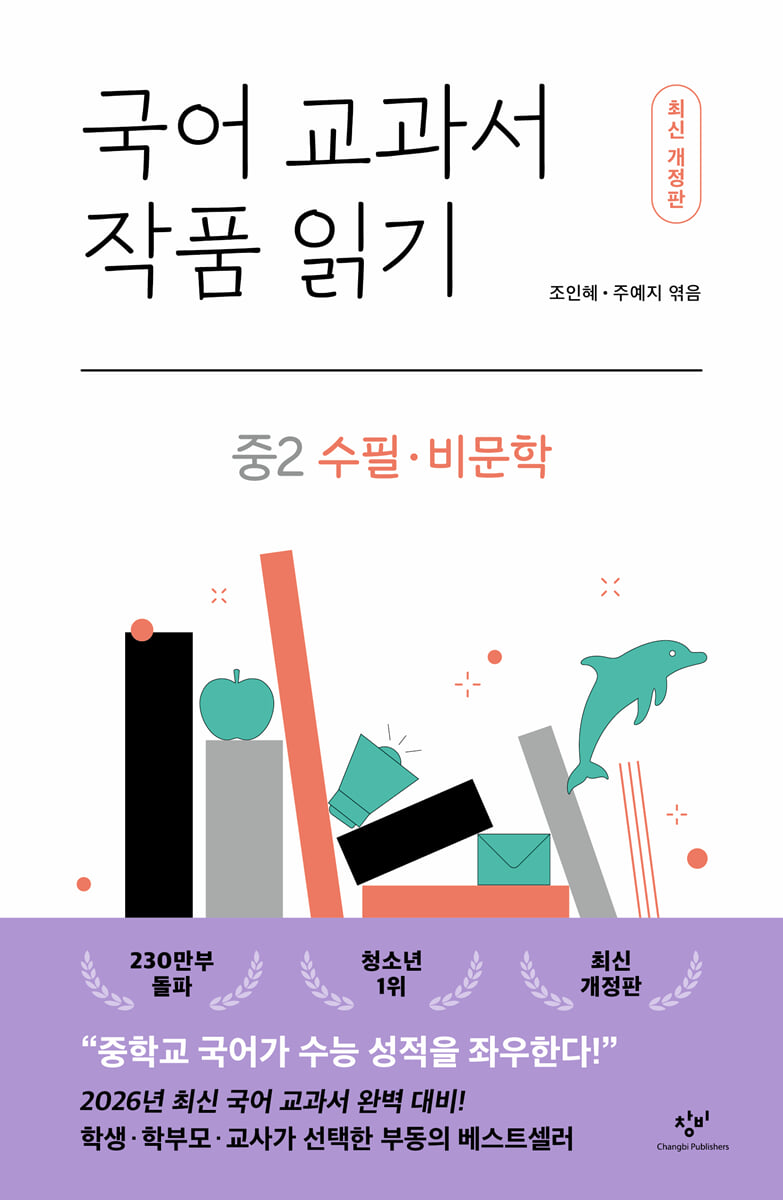
Reading Korean language textbook works for second-year middle school students: essays and non-fiction
 |
Description
Book Introduction
“Middle school Korean language skills determine college entrance exam scores!”
Perfect preparation for the latest Korean language textbooks in 2026
A bestseller chosen by students, parents, and teachers
The series 'Reading Korean Language Textbooks', which was first introduced in 2010 and has been chosen by 2.3 million readers, has been republished in its latest revised edition.
Changbi's 'Reading Korean Textbooks' has been published in revised editions in accordance with the new curriculum since its first edition, and with the implementation of the '2022 Revised Curriculum', it is publishing the latest revised edition to prepare for the new Korean textbooks that second-year middle school students will be learning in 2026.
This curriculum emphasizes the ability to respond to future changes and adds a 'media' area.
The ability to critically understand media materials and creatively express one's thoughts has become more important than simply accepting the information given at face value.
Recently, as students' literacy skills have been declining due to not knowing the meaning of words and having difficulty understanding texts or understanding the context of texts they read, this has become a hot topic in schools.
Current Korean language teachers agree that starting with reading the original text of a Korean language textbook and building reading skills helps improve literacy.
Korean is the foundation for learning all subjects, and by establishing a solid foundation in Korean, critical and creative thinking skills can also be strengthened.
The latest revised edition of Changbi's 'Reading Korean Textbooks' has been strengthened with a customized structure that helps build a foundation for literacy and improve Korean language skills.
The latest revised edition of Changbi's 'Reading Korean Language Textbook Works' is organized by genre: poetry, novels, essays, and non-fiction, with the works included in the 10 newly revised Korean language textbooks for second-year middle school students.
In keeping with the changes in textbooks that have strengthened the inclusion of new contemporary works, as well as essential works that are repeatedly included in various textbooks, we have carefully selected and compiled works that are being included in textbooks for the first time.
Additionally, we have prepared activities to help strengthen literacy skills by including helpful articles tailored to the level of second-year middle school students.
Through various activities, students can read independently to determine whether they know the exact meaning of words, whether they have properly grasped the main idea, and whether they have grasped the meaning of the work based on the context.
Many schools implement a free semester system and do not administer written exams during the first year of middle school, so the second year of middle school is the time when students really begin to feel the weight of studying and exams.
The second part of 'Reading Korean Language Textbooks' contains expected written exam questions prepared by current teachers.
We have prepared for your first written exam by solving a variety of multiple-choice and essay-type questions, checking the grading criteria and sample answers, and thoroughly preparing for your life's first written exam.
With 15 years of accumulated expertise and the trust of countless readers, "Reading Korean Textbooks" is not only the perfect preparation for the changing textbooks, but also serves as a stepping stone for building a solid foundation in the Korean language.
Perfect preparation for the latest Korean language textbooks in 2026
A bestseller chosen by students, parents, and teachers
The series 'Reading Korean Language Textbooks', which was first introduced in 2010 and has been chosen by 2.3 million readers, has been republished in its latest revised edition.
Changbi's 'Reading Korean Textbooks' has been published in revised editions in accordance with the new curriculum since its first edition, and with the implementation of the '2022 Revised Curriculum', it is publishing the latest revised edition to prepare for the new Korean textbooks that second-year middle school students will be learning in 2026.
This curriculum emphasizes the ability to respond to future changes and adds a 'media' area.
The ability to critically understand media materials and creatively express one's thoughts has become more important than simply accepting the information given at face value.
Recently, as students' literacy skills have been declining due to not knowing the meaning of words and having difficulty understanding texts or understanding the context of texts they read, this has become a hot topic in schools.
Current Korean language teachers agree that starting with reading the original text of a Korean language textbook and building reading skills helps improve literacy.
Korean is the foundation for learning all subjects, and by establishing a solid foundation in Korean, critical and creative thinking skills can also be strengthened.
The latest revised edition of Changbi's 'Reading Korean Textbooks' has been strengthened with a customized structure that helps build a foundation for literacy and improve Korean language skills.
The latest revised edition of Changbi's 'Reading Korean Language Textbook Works' is organized by genre: poetry, novels, essays, and non-fiction, with the works included in the 10 newly revised Korean language textbooks for second-year middle school students.
In keeping with the changes in textbooks that have strengthened the inclusion of new contemporary works, as well as essential works that are repeatedly included in various textbooks, we have carefully selected and compiled works that are being included in textbooks for the first time.
Additionally, we have prepared activities to help strengthen literacy skills by including helpful articles tailored to the level of second-year middle school students.
Through various activities, students can read independently to determine whether they know the exact meaning of words, whether they have properly grasped the main idea, and whether they have grasped the meaning of the work based on the context.
Many schools implement a free semester system and do not administer written exams during the first year of middle school, so the second year of middle school is the time when students really begin to feel the weight of studying and exams.
The second part of 'Reading Korean Language Textbooks' contains expected written exam questions prepared by current teachers.
We have prepared for your first written exam by solving a variety of multiple-choice and essay-type questions, checking the grading criteria and sample answers, and thoroughly preparing for your life's first written exam.
With 15 years of accumulated expertise and the trust of countless readers, "Reading Korean Textbooks" is not only the perfect preparation for the changing textbooks, but also serves as a stepping stone for building a solid foundation in the Korean language.
- You can preview some of the book's contents.
Preview
index
Publishing the latest revised edition of 'Reading Korean Language Textbook Works'
Part 1: Time to Meet Me
Opening remarks
Jeong Yak-yong / Letter from Father
Yoo Byeong-rok / The Well of the Heart
Park Jin-young and Ahn Yoon-ji / No One Is Special
Lee Cheong-jun / Beautiful Scars
Jang Young-hee / I'm sorry
Hwang Hyo-jin / About Talent
activity
Part 2: We Grow Through Communication
Opening remarks
Lee Geum-hee / Let's talk comfortably
Kim Yun-na / For those who need listening skills
Lee Man-su / Jeong Yak-yong's cursive writing style
Kim Sang-woo / Resignation is essential
Lee Geon-ho / What descriptive words do reporters choose?
Kim Bong-seop / News and Fake News
Kim Ji-yeon / How Media Materials Show Reality
Kim Soo-ah / No longer a virtual space
activity
Part 3: A Movement That Changes the World
Opening remarks
National Moral Teachers' Association / Consumption that Changes the World
An Chi-yong et al. / This is Better for the World: The Rebellion of Ugly Produce
Oh Yohan / Universal Design for Pedestrians
Kim Kyung-hoon / Photos that changed the world
Mo Sang-hyun / How to Deal with the Bystander Effect
Jeong Jae-min / Septed: Preventing Crime Through Architectural Design
Kim Go-yeon / How different are men and women?
activity
Part 4: Curious! The World We Live In
Opening remarks
Son Young-un / Why do baseball players wear black tape under their eyes?
Choi Won-seok / I'm curious about UV rays
Yoon Deok-no / Why Noodles Became a Banquet Food
Jo Young-eun / Why studying in the library helps you concentrate
Tae Ji-won / Why do we like first love stories?
Kim Young-sook / Abstraction is not graffiti
Song Hyun-soo / How Dogs and Cats Drink Water
Noh Yu-jeong / Are apples disappearing from South Korea?
activity
Expected written exam questions
Answer and Explanation
Source of the work
View included textbooks
Part 1: Time to Meet Me
Opening remarks
Jeong Yak-yong / Letter from Father
Yoo Byeong-rok / The Well of the Heart
Park Jin-young and Ahn Yoon-ji / No One Is Special
Lee Cheong-jun / Beautiful Scars
Jang Young-hee / I'm sorry
Hwang Hyo-jin / About Talent
activity
Part 2: We Grow Through Communication
Opening remarks
Lee Geum-hee / Let's talk comfortably
Kim Yun-na / For those who need listening skills
Lee Man-su / Jeong Yak-yong's cursive writing style
Kim Sang-woo / Resignation is essential
Lee Geon-ho / What descriptive words do reporters choose?
Kim Bong-seop / News and Fake News
Kim Ji-yeon / How Media Materials Show Reality
Kim Soo-ah / No longer a virtual space
activity
Part 3: A Movement That Changes the World
Opening remarks
National Moral Teachers' Association / Consumption that Changes the World
An Chi-yong et al. / This is Better for the World: The Rebellion of Ugly Produce
Oh Yohan / Universal Design for Pedestrians
Kim Kyung-hoon / Photos that changed the world
Mo Sang-hyun / How to Deal with the Bystander Effect
Jeong Jae-min / Septed: Preventing Crime Through Architectural Design
Kim Go-yeon / How different are men and women?
activity
Part 4: Curious! The World We Live In
Opening remarks
Son Young-un / Why do baseball players wear black tape under their eyes?
Choi Won-seok / I'm curious about UV rays
Yoon Deok-no / Why Noodles Became a Banquet Food
Jo Young-eun / Why studying in the library helps you concentrate
Tae Ji-won / Why do we like first love stories?
Kim Young-sook / Abstraction is not graffiti
Song Hyun-soo / How Dogs and Cats Drink Water
Noh Yu-jeong / Are apples disappearing from South Korea?
activity
Expected written exam questions
Answer and Explanation
Source of the work
View included textbooks
Detailed image
Publisher's Review
Features of "Reading Korean Language Textbook Works: Essays and Non-Fiction for Middle School Students" (Revised Edition)
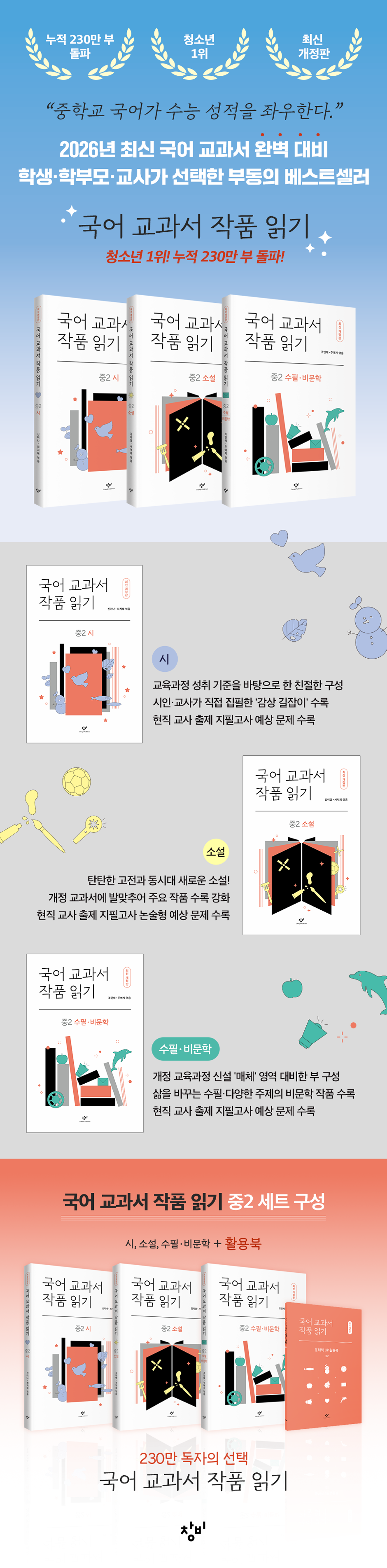
* Based on 10 revised middle school textbooks, carefully selected by current Korean language teachers
According to the revised 2022 curriculum, second-year middle school students in 2026 will study with new textbooks.
All essays and non-fiction prose included in the 10 new textbooks were carefully read and analyzed by current Korean language teachers.
Considering the objectives of the curriculum, 25 essays and non-fiction works were carefully selected, and four works carefully selected from outside the textbook were also included to promote a broader understanding.
* Strengthening the inclusion of non-literary prose, including media areas added in the revised curriculum.
The 2022 revised curriculum added a "media" section to foster digital and media capabilities.
In line with this, we have organized non-fiction prose related to media into a single section to help readers critically understand media materials, and we provide helpful explanations of complex forms of writing that combine various symbols, such as photographs, advertisements, news, and graphs, and how to critically read them.
* Strengthening of post-reading activities and supportive writing to encourage self-directed appreciation
We added helpful notes tailored to the curriculum at the beginning of each section to enhance understanding of the work and encourage self-directed appreciation.
Additionally, each work includes a definition of the word to help readers learn unfamiliar vocabulary and improve literacy skills.
At the end of each section, there are activity questions that allow readers to think about and write about the main content of the work in relation to their real lives. As an appendix, there are sample written exam questions and answers created by current teachers.
* Based on 10 revised middle school textbooks, carefully selected by current Korean language teachers
According to the revised 2022 curriculum, second-year middle school students in 2026 will study with new textbooks.
All essays and non-fiction prose included in the 10 new textbooks were carefully read and analyzed by current Korean language teachers.
Considering the objectives of the curriculum, 25 essays and non-fiction works were carefully selected, and four works carefully selected from outside the textbook were also included to promote a broader understanding.
* Strengthening the inclusion of non-literary prose, including media areas added in the revised curriculum.
The 2022 revised curriculum added a "media" section to foster digital and media capabilities.
In line with this, we have organized non-fiction prose related to media into a single section to help readers critically understand media materials, and we provide helpful explanations of complex forms of writing that combine various symbols, such as photographs, advertisements, news, and graphs, and how to critically read them.
* Strengthening of post-reading activities and supportive writing to encourage self-directed appreciation
We added helpful notes tailored to the curriculum at the beginning of each section to enhance understanding of the work and encourage self-directed appreciation.
Additionally, each work includes a definition of the word to help readers learn unfamiliar vocabulary and improve literacy skills.
At the end of each section, there are activity questions that allow readers to think about and write about the main content of the work in relation to their real lives. As an appendix, there are sample written exam questions and answers created by current teachers.
GOODS SPECIFICS
- Date of issue: November 7, 2025
- Page count, weight, size: 188 pages | 309g | 149*226*11mm
- ISBN13: 9788936431648
- ISBN10: 8936431641
You may also like
카테고리
korean


korean

![GQ KOREA Mark (Monthly): December [2025]](http://librairie.coreenne.fr/cdn/shop/files/8ef265dbbfbf186523ed75ba7319009d.jpg?v=1765340328&width=3840)


