

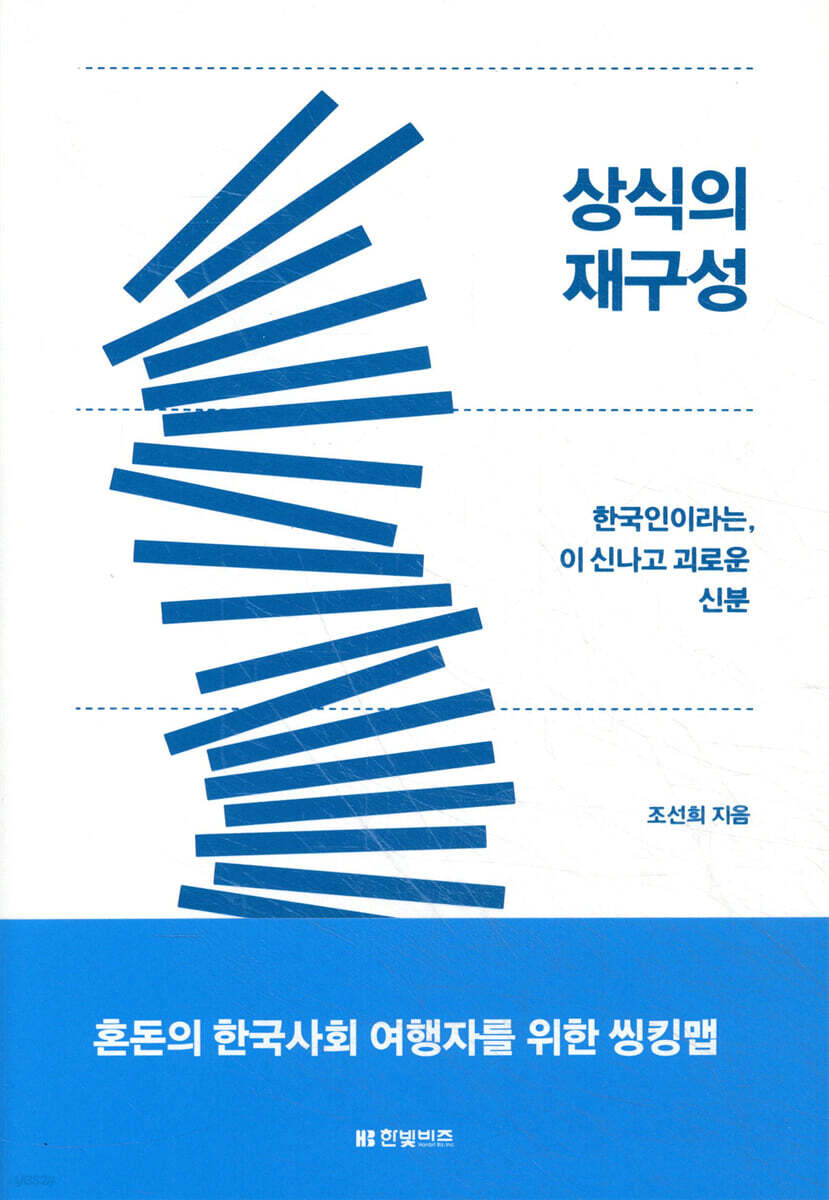
Reconstruction of common sense
 |
Description
Book Introduction
Incorrect information, misconceptions, and broken flow...
Putting together a messy mosaic
Korean society is suffering from social conflict.
Even political and social issues that should be understood objectively are being emotionally distorted and polarized into anger.
Disconnected and out-of-context information pouring out from various media and social media is causing confusion and misunderstanding among the public.
This also means that Korean democracy is not that mature.
This book focuses on the conflicts in our society.
In a democratic society with many issues and conflicts, we check the facts and provide background information from a journalist's perspective so that citizens can live as healthy citizens, allowing them to look at issues from a broader perspective and make independent judgments.
Putting together a messy mosaic
Korean society is suffering from social conflict.
Even political and social issues that should be understood objectively are being emotionally distorted and polarized into anger.
Disconnected and out-of-context information pouring out from various media and social media is causing confusion and misunderstanding among the public.
This also means that Korean democracy is not that mature.
This book focuses on the conflicts in our society.
In a democratic society with many issues and conflicts, we check the facts and provide background information from a journalist's perspective so that citizens can live as healthy citizens, allowing them to look at issues from a broader perspective and make independent judgments.
- You can preview some of the book's contents.
Preview
index
A reading guide for readers of this book
Prologue: 2020 Global COVID-19 Test
Chapter 1: Inequality Puzzle
Chapter 2: Media Utopia and Dystopia
Chapter 3: Democracy's Sickness
Chapter 4: The Case of Germany
Chapter 5: Ideological Trauma
Chapter 6: The Japanese Dilemma
Chapter 7: Who are Koreans?
In closing the book
Prologue: 2020 Global COVID-19 Test
Chapter 1: Inequality Puzzle
Chapter 2: Media Utopia and Dystopia
Chapter 3: Democracy's Sickness
Chapter 4: The Case of Germany
Chapter 5: Ideological Trauma
Chapter 6: The Japanese Dilemma
Chapter 7: Who are Koreans?
In closing the book
Detailed image

Into the book
In the early stages of the coronavirus outbreak, when Korea became the second most infected country after China, Korean society became hysterical.
As the adrenaline of those stressed by the surprise attack of the virus was seeking an outlet, the media rushed to headlines filled with hatred and disgust, targeting China, the government, and Shincheonji.
(…)
The media became hysterical again as vaccinations were delayed compared to the US and Europe.
(…)
When a highly contagious virus entered Korean society, the psychological density of media saturation became a bigger problem than the physical density of the population.
Moreover, our own identity, which swings between pride and inferiority complex, has been as changeable as the pace of social development over the past 100 years, and has been as sensitive to the evaluation of others as our history, which has been swayed by external forces.
Korean identity is like a fragile item that can easily be cracked by even a small shock.
(…) What’s next for politics and media?
When another national crisis strikes, which path will lead to a happier future? Politics and media that play a more responsible role, rather than one that exacerbates public anxiety and confusion.
--- pp.16-19
We need to rethink the 'manners' of sending off the past.
Evaluations of Park Chung-hee are also polarized between worship and curses, which is not helpful at all for the future of Korean society.
Instead of learning from history, history remains a source of conflict.
After the early Mao Zedong era of communist China came to an end, Deng Xiaoping, who overturned Maoism and declared a pragmatic modernization policy, had his own history of being persecuted and purged, but he summarized his evaluation of Mao with the phrase "7 merits and 3 faults" (功七過三, 7 merits and 3 faults).
It was a way to clearly draw a line with the Mao Zedong era while preventing the chaos that a movement to degrade Mao Zedong would cause.
If any president, whether progressive or conservative, among Park Chung-hee's successors can say, "70% of the credit is his, 30% his fault," it will be proof that we are finally graduating from an era of controversy.
--- p.196
In an era when the military is neutralized, prosecutors sometimes step into politics, which is something that happens in 'developing democracies' that have not yet established checks and balances on the prosecution.
In this transitional period, a time of prosecutorial hegemony, the head of the prosecution sometimes receives more attention than a politician, but the fact that an "issue man" who has emerged from political strife is emerging as a presidential candidate is a strange sight brought about by political polarization, something that would only happen in a politically underdeveloped country.
This is a sign of a crisis in democracy.
--- p.180
Democracy prohibits violence while allowing freedom of expression.
In this way, we have become a society that is strict about physical violence and lenient about verbal violence.
We have moved from a ‘polite violent society’ to a ‘rude non-violent society.’
The individual's potential aggression was transferred from the muscles to the mouth.
Political commentary has become a national pastime.
--- p.153
The era of the fighter is over.
The days of forming a scrum and charging towards a single enemy in unison are over.
In the past, dialogue and compromise were considered cowardly and mean, but now they are virtues and skills.
Dialogue and compromise require training.
That is the key to whether Korean society moves on to the next stage of democratization and evolves into a society with the ability to resolve conflicts.
--- p.218
The only norm in a democratic society is that there is no norm.
There is no single, immutable norm that applies to any group or individual, and that is the same as it was five or ten years ago.
The middle ground of common sense arises from the idea that I could be wrong and you could be right.
The middle ground is like the ballast of a large ship, keeping society from shaking and sinking.
--- p.217
The fact is that state-run/public broadcasters must break free from the vicious cycle of being bombed by changes in government and news reports and programs swinging from one extreme to the other in political bias.
This kind of ping-pong is what makes me dizzy.
If public broadcasting is the spoils of the presidential election, then society is bound to become a media dead end.
(…)
Having lived through a century of colonialism, war, and military dictatorship, a history of individuals being abused due to the absence, mismanagement, and abuse of political leadership, our people now need a politics of healing.
The most common definition of politics is 'the distribution of values'.
What is needed for healing is not a war of distribution, but an art of distribution.
--- p.220
When they got older, everything was confusing.
For those who are 'task-oriented', 'tasks' are no longer given, and only death awaits them in the future, and the place where the target was has become an empty lot.
If you work hard all your life and only find poverty, if you work for your children and they are no longer around, you will want to end the rest of your life quickly.
Some people, unable to manage the mental panic that comes with stepping down from the competitive track of a lifetime at their local senior center, take to the streets waving the Taegeukgi flag in search of work and companions.
--- pp.483-484
Arresting a professor in front of his students during a lecture was a vulgar 'punishment protest' and a 'show of force' by public authority.
The reason literary publishers protested the arrest of Ma Kwang-su and the publisher's representative was not because they all thought "Happy Sara" was a great work.
--- p.539
So, it was free competition, not protectionist policies, that fostered Korean cinema.
When the protective shield was blown away and the battlefield became a battlefield, Korean filmmakers relied on their own strength with amazing fighting spirit.
It's about turning a crisis into an opportunity, but that's not something anyone can do.
In most countries, the film industry was washed away by the tsunami of openness.
Among the three East Asian countries, Korea, China, and Japan, Korea's market share of 50% is special.
--- p.517
Feeling frustrated with the society you belong to is a characteristic and privilege of youth.
In Europe, as the economies of Greece, Italy, and Spain are in recession, young people are leaving for France or Germany, while German youth are leaving for Switzerland or the United States, believing there is no hope in Germany.
Young Germans compare themselves to Scandinavia, where working hours are shorter and welfare is better.
'They work and live like that, but what about us?'
--- p.499
Mr. A confirmed that the 'slave overseer' living inside him did not exist in his daughter.
Most of Generation A live with what Professor Kim Nu-ri called a "slave supervisor" and a "superego" that encourages their own productivity, but their children's generation is not like that.
(…)
As long as you're clear about what you're doing and don't let things get tangled up, there doesn't seem to be much room for you to annoy each other.
But it would be difficult to call someone late at night because you are having a hard time personally.
That is the cost of individualism.
If you want to protect your personal space and freedom, you can't expect any personal comfort or consideration.
Their generation's dilemma is that they don't want their workplace to be too dull, but they also don't want to be too conformed to it.
--- pp.504-505
If global business was like 'swimming with your feet on the ground' for them, it was like 'heading into bare ground' for Korean companies.
Without the support of a national brand, we had to fight against language and racial barriers on our own.
It started out as a minority in the global market and became a major player.
For example, Samsung won the economic war of the post-colonial era over the past 50 years, soothing the pride of Koreans wounded by colonialism and division.
However, Samsung's unlawful and extralegal attitudes put us in a dilemma.
Our athlete won an Olympic gold medal, but was caught in a doping test. Should we applaud or not?
--- pp.
523-524
The word "Korean" no longer evokes war or Confucianism, but rather a sophisticated, vibrant, and creative allure. Images from BTS's new song and Bong Joon-ho's film further solidify the "well-made" seal of approval for Korean cellphones, TVs, and automobiles.
--- p.517
The world's acclaim for the Korean film "Parasite," yet the fact that it illuminates the deep, dark rifts of class conflict in Korean society—this exhilarating yet daunting feeling is an irony that comes from the exciting yet painful status of being Korean.
--- p.82
If the European baby boomers were born after 1945, we are born after 1953, so we have followed a similar path with a 10-year gap.
In Korea, when baby boomers became college students, student movements and feminism emerged, and when they became parents, alternative schools and co-parenting boomed.
As they grow older and enter an aging society, national pension balances become an issue and elderly suicides increase.
Older baby boomers have created a trend of 'twilight divorce.'
--- p.481
Whether they are stay-at-home moms who seek self-fulfillment through their children or working moms who have to juggle childcare, housework, and work without any help from their husbands, once they reach their 50s or 60s and feel they have fulfilled their family responsibilities, they become exhausted or angry and suggest a "twilight divorce" to their husbands.
It is a natural consequence of the transitional period of life, starting from collectivism and arriving at individualism.
--- p.482
A common misconception about suicide rates is that Korea's high suicide rate is a phenomenon of the era of prosperity since the 1990s.
It is true that the suicide rate increased from less than 10 per 100,000 people in the 1980s to become the highest in the OECD in 2003, but this is because the suicide rate was first made public in 1983 when Statistics Korea was established.
According to previous police statistics, suicides began to increase in the mid-1950s after the war, and the suicide rate during the development period of the 1960s and 1970s was already at a similar level to that of the 2000s.
When Hungary, the famous 'suicide kingdom', recorded the world's highest rate of 24.9 in 1961, Korea was almost at Hungary's level with 24.4.
Therefore, the current suicide syndrome in Korea should not be understood as a "developed country disease" suffered by wealthy countries, but as the stress experienced by individuals amid Korea's particularly tough modernization process, economic growth driven by competition and overwork, and rapid urbanization.
The so-called 'suicide republic' began with the takeoff of the Korean economy.
It's like airsickness, which occurs when the engines are running at full blast and the aircraft shakes as it rapidly rises from the ground.
In other words, the suicide syndrome is a collective 'modernization sickness'.
--- p.474
Helsinki, the capital of Finland, which was once a colony rather than an empire, does not have the magnificent royal palace that all European capitals boast, nor does it have a museum housing Egyptian mummies.
What catches the eye of foreigners in Helsinki is not the Royal Palace, but the library 'Odi'.
Due to its small population, the film industry is sluggish, with no notable directors other than Aki Kaurismäki, and the limited domestic film menu may seem a bit boring, but the peaceful Finnish society is worthy of our benchmarking.
Above all, 'Odi', a paradise in the city, is a space you want to steal.
As the adrenaline of those stressed by the surprise attack of the virus was seeking an outlet, the media rushed to headlines filled with hatred and disgust, targeting China, the government, and Shincheonji.
(…)
The media became hysterical again as vaccinations were delayed compared to the US and Europe.
(…)
When a highly contagious virus entered Korean society, the psychological density of media saturation became a bigger problem than the physical density of the population.
Moreover, our own identity, which swings between pride and inferiority complex, has been as changeable as the pace of social development over the past 100 years, and has been as sensitive to the evaluation of others as our history, which has been swayed by external forces.
Korean identity is like a fragile item that can easily be cracked by even a small shock.
(…) What’s next for politics and media?
When another national crisis strikes, which path will lead to a happier future? Politics and media that play a more responsible role, rather than one that exacerbates public anxiety and confusion.
--- pp.16-19
We need to rethink the 'manners' of sending off the past.
Evaluations of Park Chung-hee are also polarized between worship and curses, which is not helpful at all for the future of Korean society.
Instead of learning from history, history remains a source of conflict.
After the early Mao Zedong era of communist China came to an end, Deng Xiaoping, who overturned Maoism and declared a pragmatic modernization policy, had his own history of being persecuted and purged, but he summarized his evaluation of Mao with the phrase "7 merits and 3 faults" (功七過三, 7 merits and 3 faults).
It was a way to clearly draw a line with the Mao Zedong era while preventing the chaos that a movement to degrade Mao Zedong would cause.
If any president, whether progressive or conservative, among Park Chung-hee's successors can say, "70% of the credit is his, 30% his fault," it will be proof that we are finally graduating from an era of controversy.
--- p.196
In an era when the military is neutralized, prosecutors sometimes step into politics, which is something that happens in 'developing democracies' that have not yet established checks and balances on the prosecution.
In this transitional period, a time of prosecutorial hegemony, the head of the prosecution sometimes receives more attention than a politician, but the fact that an "issue man" who has emerged from political strife is emerging as a presidential candidate is a strange sight brought about by political polarization, something that would only happen in a politically underdeveloped country.
This is a sign of a crisis in democracy.
--- p.180
Democracy prohibits violence while allowing freedom of expression.
In this way, we have become a society that is strict about physical violence and lenient about verbal violence.
We have moved from a ‘polite violent society’ to a ‘rude non-violent society.’
The individual's potential aggression was transferred from the muscles to the mouth.
Political commentary has become a national pastime.
--- p.153
The era of the fighter is over.
The days of forming a scrum and charging towards a single enemy in unison are over.
In the past, dialogue and compromise were considered cowardly and mean, but now they are virtues and skills.
Dialogue and compromise require training.
That is the key to whether Korean society moves on to the next stage of democratization and evolves into a society with the ability to resolve conflicts.
--- p.218
The only norm in a democratic society is that there is no norm.
There is no single, immutable norm that applies to any group or individual, and that is the same as it was five or ten years ago.
The middle ground of common sense arises from the idea that I could be wrong and you could be right.
The middle ground is like the ballast of a large ship, keeping society from shaking and sinking.
--- p.217
The fact is that state-run/public broadcasters must break free from the vicious cycle of being bombed by changes in government and news reports and programs swinging from one extreme to the other in political bias.
This kind of ping-pong is what makes me dizzy.
If public broadcasting is the spoils of the presidential election, then society is bound to become a media dead end.
(…)
Having lived through a century of colonialism, war, and military dictatorship, a history of individuals being abused due to the absence, mismanagement, and abuse of political leadership, our people now need a politics of healing.
The most common definition of politics is 'the distribution of values'.
What is needed for healing is not a war of distribution, but an art of distribution.
--- p.220
When they got older, everything was confusing.
For those who are 'task-oriented', 'tasks' are no longer given, and only death awaits them in the future, and the place where the target was has become an empty lot.
If you work hard all your life and only find poverty, if you work for your children and they are no longer around, you will want to end the rest of your life quickly.
Some people, unable to manage the mental panic that comes with stepping down from the competitive track of a lifetime at their local senior center, take to the streets waving the Taegeukgi flag in search of work and companions.
--- pp.483-484
Arresting a professor in front of his students during a lecture was a vulgar 'punishment protest' and a 'show of force' by public authority.
The reason literary publishers protested the arrest of Ma Kwang-su and the publisher's representative was not because they all thought "Happy Sara" was a great work.
--- p.539
So, it was free competition, not protectionist policies, that fostered Korean cinema.
When the protective shield was blown away and the battlefield became a battlefield, Korean filmmakers relied on their own strength with amazing fighting spirit.
It's about turning a crisis into an opportunity, but that's not something anyone can do.
In most countries, the film industry was washed away by the tsunami of openness.
Among the three East Asian countries, Korea, China, and Japan, Korea's market share of 50% is special.
--- p.517
Feeling frustrated with the society you belong to is a characteristic and privilege of youth.
In Europe, as the economies of Greece, Italy, and Spain are in recession, young people are leaving for France or Germany, while German youth are leaving for Switzerland or the United States, believing there is no hope in Germany.
Young Germans compare themselves to Scandinavia, where working hours are shorter and welfare is better.
'They work and live like that, but what about us?'
--- p.499
Mr. A confirmed that the 'slave overseer' living inside him did not exist in his daughter.
Most of Generation A live with what Professor Kim Nu-ri called a "slave supervisor" and a "superego" that encourages their own productivity, but their children's generation is not like that.
(…)
As long as you're clear about what you're doing and don't let things get tangled up, there doesn't seem to be much room for you to annoy each other.
But it would be difficult to call someone late at night because you are having a hard time personally.
That is the cost of individualism.
If you want to protect your personal space and freedom, you can't expect any personal comfort or consideration.
Their generation's dilemma is that they don't want their workplace to be too dull, but they also don't want to be too conformed to it.
--- pp.504-505
If global business was like 'swimming with your feet on the ground' for them, it was like 'heading into bare ground' for Korean companies.
Without the support of a national brand, we had to fight against language and racial barriers on our own.
It started out as a minority in the global market and became a major player.
For example, Samsung won the economic war of the post-colonial era over the past 50 years, soothing the pride of Koreans wounded by colonialism and division.
However, Samsung's unlawful and extralegal attitudes put us in a dilemma.
Our athlete won an Olympic gold medal, but was caught in a doping test. Should we applaud or not?
--- pp.
523-524
The word "Korean" no longer evokes war or Confucianism, but rather a sophisticated, vibrant, and creative allure. Images from BTS's new song and Bong Joon-ho's film further solidify the "well-made" seal of approval for Korean cellphones, TVs, and automobiles.
--- p.517
The world's acclaim for the Korean film "Parasite," yet the fact that it illuminates the deep, dark rifts of class conflict in Korean society—this exhilarating yet daunting feeling is an irony that comes from the exciting yet painful status of being Korean.
--- p.82
If the European baby boomers were born after 1945, we are born after 1953, so we have followed a similar path with a 10-year gap.
In Korea, when baby boomers became college students, student movements and feminism emerged, and when they became parents, alternative schools and co-parenting boomed.
As they grow older and enter an aging society, national pension balances become an issue and elderly suicides increase.
Older baby boomers have created a trend of 'twilight divorce.'
--- p.481
Whether they are stay-at-home moms who seek self-fulfillment through their children or working moms who have to juggle childcare, housework, and work without any help from their husbands, once they reach their 50s or 60s and feel they have fulfilled their family responsibilities, they become exhausted or angry and suggest a "twilight divorce" to their husbands.
It is a natural consequence of the transitional period of life, starting from collectivism and arriving at individualism.
--- p.482
A common misconception about suicide rates is that Korea's high suicide rate is a phenomenon of the era of prosperity since the 1990s.
It is true that the suicide rate increased from less than 10 per 100,000 people in the 1980s to become the highest in the OECD in 2003, but this is because the suicide rate was first made public in 1983 when Statistics Korea was established.
According to previous police statistics, suicides began to increase in the mid-1950s after the war, and the suicide rate during the development period of the 1960s and 1970s was already at a similar level to that of the 2000s.
When Hungary, the famous 'suicide kingdom', recorded the world's highest rate of 24.9 in 1961, Korea was almost at Hungary's level with 24.4.
Therefore, the current suicide syndrome in Korea should not be understood as a "developed country disease" suffered by wealthy countries, but as the stress experienced by individuals amid Korea's particularly tough modernization process, economic growth driven by competition and overwork, and rapid urbanization.
The so-called 'suicide republic' began with the takeoff of the Korean economy.
It's like airsickness, which occurs when the engines are running at full blast and the aircraft shakes as it rapidly rises from the ground.
In other words, the suicide syndrome is a collective 'modernization sickness'.
--- p.474
Helsinki, the capital of Finland, which was once a colony rather than an empire, does not have the magnificent royal palace that all European capitals boast, nor does it have a museum housing Egyptian mummies.
What catches the eye of foreigners in Helsinki is not the Royal Palace, but the library 'Odi'.
Due to its small population, the film industry is sluggish, with no notable directors other than Aki Kaurismäki, and the limited domestic film menu may seem a bit boring, but the peaceful Finnish society is worthy of our benchmarking.
Above all, 'Odi', a paradise in the city, is a space you want to steal.
--- p.
553
553
Publisher's Review
If you know the facts and historical context accurately,
Common sense is established in society
Many people are emotionally conflicted, swayed by the flood of information without understanding the historical context.
This book contains modern and contemporary history of Korea.
Because common sense begins with knowing the facts accurately.
The middle ground of common sense is created by knowing broadly, deeply, and accurately.
As the middle ground of common sense expands, the skill to resolve conflict also increases.
Although this book deals with social conflict, it may seem to be a step removed from current issues.
This is to allow readers to use their thinking power to make their own judgments.
It provides the knowledge that Korean society needs to know, but it is structured so that readers can make their own judgments and choose their own knowledge.
The ability to read society,
Develop media literacy
The public is getting a tremendous amount of information from the news and social media.
But in most cases, we do not have a comprehensive and accurate information in our heads.
Because of this, we react emotionally to unfiltered information.
This book develops the ability to think about social issues and helps us see the structure of how the media operates.
You don't have to read this book in order.
Reading them in order has the advantage of being logically connected, and starting with topics that interest you will help you understand the biggest causes of confusion and conflict.
Readers can enjoy the fun of mosaicking information and knowledge by organizing 'facts' on each topic.
Common sense is established in society
Many people are emotionally conflicted, swayed by the flood of information without understanding the historical context.
This book contains modern and contemporary history of Korea.
Because common sense begins with knowing the facts accurately.
The middle ground of common sense is created by knowing broadly, deeply, and accurately.
As the middle ground of common sense expands, the skill to resolve conflict also increases.
Although this book deals with social conflict, it may seem to be a step removed from current issues.
This is to allow readers to use their thinking power to make their own judgments.
It provides the knowledge that Korean society needs to know, but it is structured so that readers can make their own judgments and choose their own knowledge.
The ability to read society,
Develop media literacy
The public is getting a tremendous amount of information from the news and social media.
But in most cases, we do not have a comprehensive and accurate information in our heads.
Because of this, we react emotionally to unfiltered information.
This book develops the ability to think about social issues and helps us see the structure of how the media operates.
You don't have to read this book in order.
Reading them in order has the advantage of being logically connected, and starting with topics that interest you will help you understand the biggest causes of confusion and conflict.
Readers can enjoy the fun of mosaicking information and knowledge by organizing 'facts' on each topic.
GOODS SPECIFICS
- Date of issue: July 1, 2021
- Page count, weight, size: 560 pages | 746g | 145*210*35mm
- ISBN13: 9791157845187
- ISBN10: 1157845185
You may also like
카테고리
korean


korean

![GQ KOREA Mark (Monthly): December [2025]](http://librairie.coreenne.fr/cdn/shop/files/8ef265dbbfbf186523ed75ba7319009d.jpg?v=1765340328&width=3840)


