

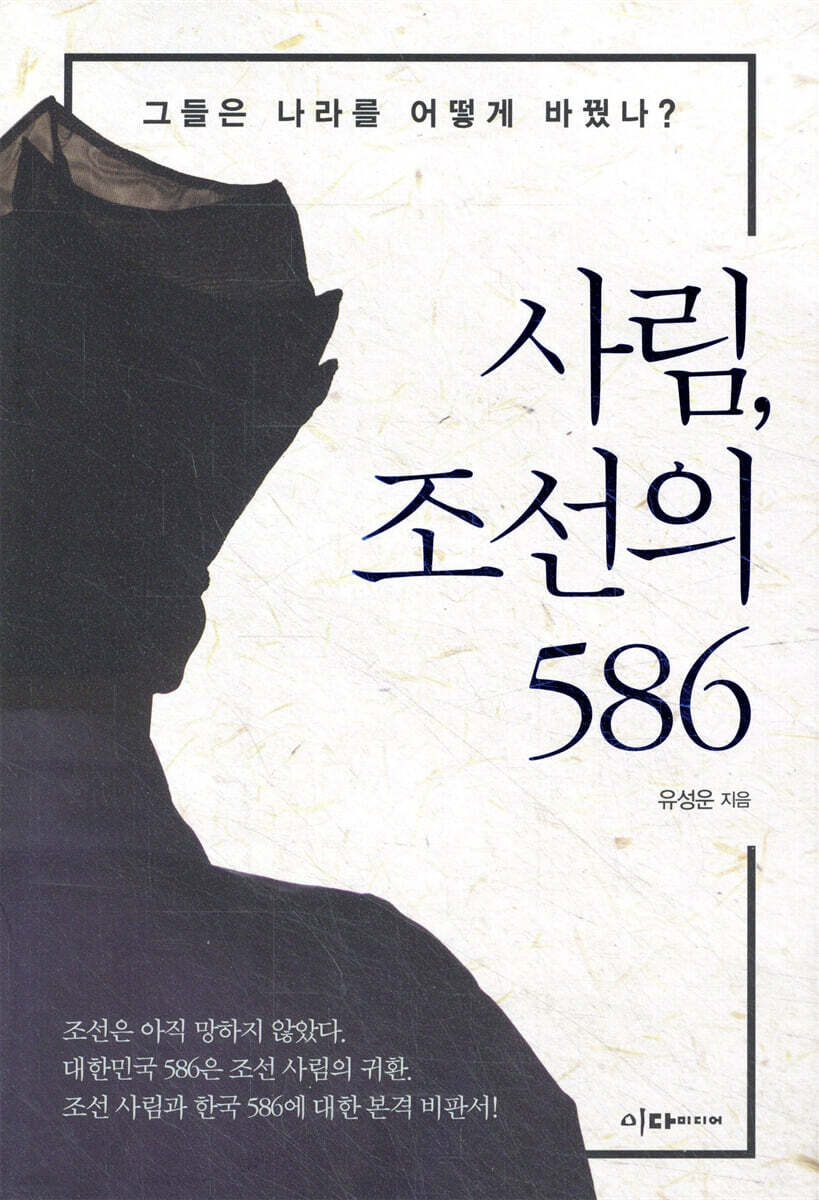
Sarim, Joseon Dynasty 586
 |
Description
Book Introduction
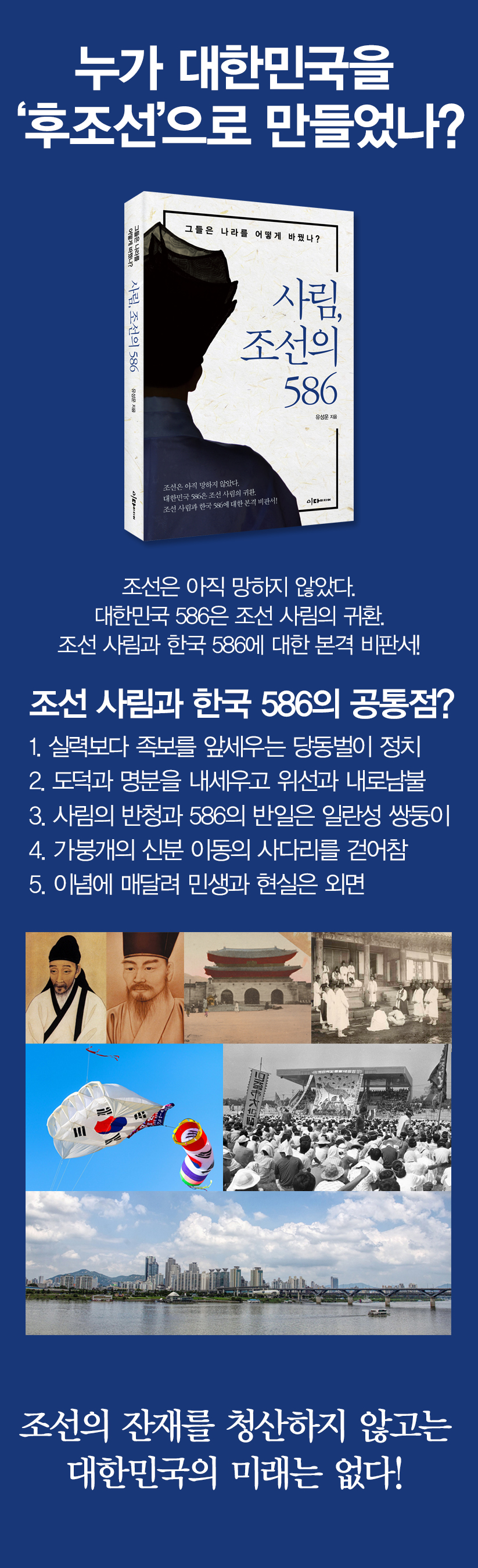
Who turned South Korea into 'Post-Joseon'?
Since some time ago, voices of resignation have been growing louder, saying that we are living in a 'post-Joseon'.
The ladder of social mobility is disappearing, and wealth, education, and class are being passed down through generations.
But this is not a complaint against the capitalist system.
It is a warning and anger toward the current ruling class who came to power by prioritizing legitimacy and morality, but then turned a blind eye to reality and failed to take care of the practical matters.
Looking at them, who are so confident in front of Japan but cower in front of China, who tie us up with all kinds of regulations and cause housing prices to skyrocket, who are content to live in a humble household while busy building up fancy qualifications for their children, I am reminded of the incompetent ruling class of Joseon.
The Joseon literati differentiated themselves by criticizing the corruption of the Goryeo aristocracy, but after transforming Joseon into a world of Neo-Confucianism, they became obsessed with securing their own privileges and interests.
Immersed in Sinocentrism, they closed their eyes and ears to how the world was going, demonized commerce and impoverished the entire country, looked down on the military and weakened the national defense, kicked away the ladder of social mobility and increased the number of slaves, and were obsessed with creating a "sacred" genealogy that would guarantee their privileges for generations.
But Joseon was not like this from the beginning.
The early Joseon Dynasty was a dynamic era with a loose caste system, women's remarriage was permitted, and national defense was highly valued.
It was the Sarim who changed Joseon.
The Sarim faction, a fundamentalist group that sought to spread the teachings of the Elementary Learning throughout society, changed the course of history by making Jeong Mong-ju, who opposed the founding of Joseon, the leader of Neo-Confucianism.
Afterwards, the Sarim, who took control of the political world, set loyalty as the standard rather than ability, and branded those who did not agree with them as “petty people” or “non-believers.”
He also set the preservation of 'China' as the most important goal and ideologized and dogmatized the entire country by saying that revenge for the fallen Ming Dynasty must be taken.
Since some time ago, voices of resignation have been growing louder, saying that we are living in a 'post-Joseon'.
The ladder of social mobility is disappearing, and wealth, education, and class are being passed down through generations.
But this is not a complaint against the capitalist system.
It is a warning and anger toward the current ruling class who came to power by prioritizing legitimacy and morality, but then turned a blind eye to reality and failed to take care of the practical matters.
Looking at them, who are so confident in front of Japan but cower in front of China, who tie us up with all kinds of regulations and cause housing prices to skyrocket, who are content to live in a humble household while busy building up fancy qualifications for their children, I am reminded of the incompetent ruling class of Joseon.
The Joseon literati differentiated themselves by criticizing the corruption of the Goryeo aristocracy, but after transforming Joseon into a world of Neo-Confucianism, they became obsessed with securing their own privileges and interests.
Immersed in Sinocentrism, they closed their eyes and ears to how the world was going, demonized commerce and impoverished the entire country, looked down on the military and weakened the national defense, kicked away the ladder of social mobility and increased the number of slaves, and were obsessed with creating a "sacred" genealogy that would guarantee their privileges for generations.
But Joseon was not like this from the beginning.
The early Joseon Dynasty was a dynamic era with a loose caste system, women's remarriage was permitted, and national defense was highly valued.
It was the Sarim who changed Joseon.
The Sarim faction, a fundamentalist group that sought to spread the teachings of the Elementary Learning throughout society, changed the course of history by making Jeong Mong-ju, who opposed the founding of Joseon, the leader of Neo-Confucianism.
Afterwards, the Sarim, who took control of the political world, set loyalty as the standard rather than ability, and branded those who did not agree with them as “petty people” or “non-believers.”
He also set the preservation of 'China' as the most important goal and ideologized and dogmatized the entire country by saying that revenge for the fallen Ming Dynasty must be taken.
- You can preview some of the book's contents.
Preview
index
Recommended Article: Korea's 586: The Return of Joseon's Sarim
Prologue: Who turned South Korea into a 'post-Joseon'?
Chapter 1: The Birth of Neo-Confucianism and the Sarim
The night of November 1519, the prelude to the Gimyo Incident ┃ Make Jo Gwang-jo the leader ┃ Joseon, a country created by the Sarim ┃ There is no difference in the background of the Hungu and Sarim ┃ 《Sohak》 and 《Haejeonsa》, creating a warrior of ideology ┃ Sarim who dreamed of an ideal state of Neo-Confucianism ┃ The Neo-Confucian order completed during the reigns of Seongjong and Jungjong ┃ The Gyeyujeongnan was a great shock to the literati ┃ Sarim entered politics during the reign of Seongjong ┃ Sarim was restored to power during the reign of Jungjong ┃ The emergence of Jo Gwang-jo, the favorite of Sarim ┃ Gimyo Sarim was the 0.1% privileged class of Joseon ┃ Jo Gwang-jo's purpose in establishing the 'Hyeonryanggwa' ┃ The conflict between the Hungu and Sarim surrounding the 'Hyeonryanggwa' ┃ Those with similar opinions are recommended, those with different opinions are rejected
Chapter 2: Genealogy of the Moralist Sarim
Genealogy is more important than ability! ┃ 'Jeong Mong-ju - Gil Jae - Kim Sook-ja - Kim Jong-jik - Kim Hong-pil - Jo Gwang-jo' ┃ Ju Hee, who compiled the genealogy of Neo-Confucianism ┃ Kwon Geun, the first person mentioned in Joseon's Dotong ┃ Kwon Geun, who laid the foundation for Joseon's Neo-Confucianism ┃ Taejong decides to reinstate Jeong Mong-ju ┃ Kwon Geun's defeat, Jeong Mong-ju's victory ┃ The founding forces of the Republic of Korea who became the losers of history ┃ Inchon Kim Seong-su, who fell to being a pro-Japanese collaborator ┃ The 586 faction's making of Kim Won-bong a hero ┃ Jeong Mong-ju, who prevented the founding of Joseon, is the legitimate successor ┃ Summer of the 12th year of King Jungjong's reign ① - The emergence of Kim Hong-pil ┃ Summer of the 12th year of King Jungjong's reign ② - The victory of the Sarim ┃ The dispute between King Seonjo and Sarim over the enshrinement of the Confucian shrine ┃ The enshrinement of the five sages at the Confucian shrine confirmed during the reign of King Gwanghaegun
Chapter 3: The Hypocrisy of the Sarim, the Naeronambul of 586
The life of Yu Hee-chun, who was exiled for 20 years, turns around ┃ The cartel of wealth accumulation shown by the Sarim ┃ The rewards for the democratization movement received by the 586 generation ┃ The number of slaves increased while talking about human duty ┃ Jeong Yak-yong also criticized the liberation of public slaves ┃ Joseon Sarim, who set out to 'create chaste women' ┃ Yangban, who were obsessed with 'biographies of chaste women' after the Imjin War ┃ What is the difference between Ahn Hee-jung and Park Won-soon? ┃ Turning a politician's dishonorable death into a sacred place ┃ The forces that authorized the deaths of Minerva and Kim Ji-ha ┃ Seizing local power through Seowon and Hyangyak ┃ Sarim, who took care of Yuhyangso instead of Gwajeonbeop ┃ Controlling the Hyangri group through Yuhyangso ┃ The reason for promoting a modern-day Yuhyangso ┃ Who is the force that is siphoning off taxpayers' money? ┃ Controlling central politics through Seowon
Chapter 4: The Gentleman and the Small Man, the Sarim's Partisanship
The politics of the Sarim of 'Dangdongbeol-i' ┃ He is the 'Gentleman Party', the opposition is the 'Petty Party' ┃ The revival of the Sarim is the 'legacy' of Yeonsangun ┃ 'Park Geun-hye's impeachment' and the rise of the 586 faction ┃ "It is difficult for a gentleman and a petty person to live together" ┃ The negative impact of the debate between the gentleman and the petty person ┃ When others do it, it is 'corruption', when you do it, it is 'legal' ┃ The internal strife policy of the new airport in Gadeokdo ┃ When a gentleman does politics, everything gets better?
Chapter 5: The Royal Road of the Idealist Jo Gwang-jo
The transition from the Yuan to the Ming Dynasty and the chaos of the late Goryeo Dynasty ┃ Neo-Confucianism introduced from the Yuan Dynasty ┃ The balance of civil and military power in the ruling class in the early Joseon Dynasty ┃ Internal conflict over the deception of the Jurchen people ┃ King Yeonsangun orders silver production with the 'Silver and Silver Separation Act' ┃ Silver production blocked by the Jungjong Restoration ┃ Japan's silver production becomes the world's second largest ┃ Overseas resource development also labeled as an evil practice ┃ The aftereffects of the nuclear phase-out policy driven by justification
Chapter 6: The Fall of Joseon, the Undead Kingdom
The hypocrisy of the Yangban who sang of contentment with poverty ┃ The literati controlled morality, power, and even wealth ┃ Why were they poor when they lived as the country commanded? ┃ “If the people engage in commerce and industry, they become treacherous.” ┃ The Sarim who ignored commerce and focused only on agriculture ┃ Private trade prohibited by national law ┃ The envoy’s carts were filled with goods to be sold to China ┃ The ruling class of Joseon obsessed with the Saraneungdan ┃ The reason Joseon did not fall and lasted 500 years ┃ Resignation and helplessness brought about by absolute poverty ┃ Both the sale and lease of houses within the capital city were banned ┃ The price of houses in Hanyang soared even though sales were prohibited ┃ Jeong Yak-yong who emphasized the importance of ‘Seoul’ ┃ The population of Hanyang in the 18th century was around 200,000
Chapter 7: The Anti-Qing Movement of the Sarim and the Anti-Japanese Movement of 586
The 17th century, which experienced two Manchu invasions and a great famine ┃ The dilemma of Mao Wenlong, a 'hot potato' in the Ming Dynasty ┃ "I have sinned against China and incurred the resentment of the people" ┃ King Gwanghaegun, who predicted the defeat of the Ming Dynasty ┃ Consistently ignored and optimistic about the Later Jin ┃ The Ming Dynasty and Joseon, which became a 'father-son relationship' ┃ The eve of the Byeongja Horan ① - King Injo's anger ┃ The eve of the Byeongja Horan ② - Hong Taiji's fury ┃ Hong Taiji appears leading 100,000 troops ┃ The conflict between Choi Myeong-gil of the pro-peace faction and Kim Sang-heon of the anti-peace faction ┃ Choi Myeong-gil of the 'treacherous' faction and Kim Sang-heon of the 'loyal' faction ┃ The preservation of 'China', which was more important than the fall of 'Joseon' ┃ Song Si-yeol's Northern Expedition and the anti-Japanese movement of 586 ┃ Exploitation of international relations for domestic politics
Epilogue: The scholars who preached morality enjoyed privileges!
References
Prologue: Who turned South Korea into a 'post-Joseon'?
Chapter 1: The Birth of Neo-Confucianism and the Sarim
The night of November 1519, the prelude to the Gimyo Incident ┃ Make Jo Gwang-jo the leader ┃ Joseon, a country created by the Sarim ┃ There is no difference in the background of the Hungu and Sarim ┃ 《Sohak》 and 《Haejeonsa》, creating a warrior of ideology ┃ Sarim who dreamed of an ideal state of Neo-Confucianism ┃ The Neo-Confucian order completed during the reigns of Seongjong and Jungjong ┃ The Gyeyujeongnan was a great shock to the literati ┃ Sarim entered politics during the reign of Seongjong ┃ Sarim was restored to power during the reign of Jungjong ┃ The emergence of Jo Gwang-jo, the favorite of Sarim ┃ Gimyo Sarim was the 0.1% privileged class of Joseon ┃ Jo Gwang-jo's purpose in establishing the 'Hyeonryanggwa' ┃ The conflict between the Hungu and Sarim surrounding the 'Hyeonryanggwa' ┃ Those with similar opinions are recommended, those with different opinions are rejected
Chapter 2: Genealogy of the Moralist Sarim
Genealogy is more important than ability! ┃ 'Jeong Mong-ju - Gil Jae - Kim Sook-ja - Kim Jong-jik - Kim Hong-pil - Jo Gwang-jo' ┃ Ju Hee, who compiled the genealogy of Neo-Confucianism ┃ Kwon Geun, the first person mentioned in Joseon's Dotong ┃ Kwon Geun, who laid the foundation for Joseon's Neo-Confucianism ┃ Taejong decides to reinstate Jeong Mong-ju ┃ Kwon Geun's defeat, Jeong Mong-ju's victory ┃ The founding forces of the Republic of Korea who became the losers of history ┃ Inchon Kim Seong-su, who fell to being a pro-Japanese collaborator ┃ The 586 faction's making of Kim Won-bong a hero ┃ Jeong Mong-ju, who prevented the founding of Joseon, is the legitimate successor ┃ Summer of the 12th year of King Jungjong's reign ① - The emergence of Kim Hong-pil ┃ Summer of the 12th year of King Jungjong's reign ② - The victory of the Sarim ┃ The dispute between King Seonjo and Sarim over the enshrinement of the Confucian shrine ┃ The enshrinement of the five sages at the Confucian shrine confirmed during the reign of King Gwanghaegun
Chapter 3: The Hypocrisy of the Sarim, the Naeronambul of 586
The life of Yu Hee-chun, who was exiled for 20 years, turns around ┃ The cartel of wealth accumulation shown by the Sarim ┃ The rewards for the democratization movement received by the 586 generation ┃ The number of slaves increased while talking about human duty ┃ Jeong Yak-yong also criticized the liberation of public slaves ┃ Joseon Sarim, who set out to 'create chaste women' ┃ Yangban, who were obsessed with 'biographies of chaste women' after the Imjin War ┃ What is the difference between Ahn Hee-jung and Park Won-soon? ┃ Turning a politician's dishonorable death into a sacred place ┃ The forces that authorized the deaths of Minerva and Kim Ji-ha ┃ Seizing local power through Seowon and Hyangyak ┃ Sarim, who took care of Yuhyangso instead of Gwajeonbeop ┃ Controlling the Hyangri group through Yuhyangso ┃ The reason for promoting a modern-day Yuhyangso ┃ Who is the force that is siphoning off taxpayers' money? ┃ Controlling central politics through Seowon
Chapter 4: The Gentleman and the Small Man, the Sarim's Partisanship
The politics of the Sarim of 'Dangdongbeol-i' ┃ He is the 'Gentleman Party', the opposition is the 'Petty Party' ┃ The revival of the Sarim is the 'legacy' of Yeonsangun ┃ 'Park Geun-hye's impeachment' and the rise of the 586 faction ┃ "It is difficult for a gentleman and a petty person to live together" ┃ The negative impact of the debate between the gentleman and the petty person ┃ When others do it, it is 'corruption', when you do it, it is 'legal' ┃ The internal strife policy of the new airport in Gadeokdo ┃ When a gentleman does politics, everything gets better?
Chapter 5: The Royal Road of the Idealist Jo Gwang-jo
The transition from the Yuan to the Ming Dynasty and the chaos of the late Goryeo Dynasty ┃ Neo-Confucianism introduced from the Yuan Dynasty ┃ The balance of civil and military power in the ruling class in the early Joseon Dynasty ┃ Internal conflict over the deception of the Jurchen people ┃ King Yeonsangun orders silver production with the 'Silver and Silver Separation Act' ┃ Silver production blocked by the Jungjong Restoration ┃ Japan's silver production becomes the world's second largest ┃ Overseas resource development also labeled as an evil practice ┃ The aftereffects of the nuclear phase-out policy driven by justification
Chapter 6: The Fall of Joseon, the Undead Kingdom
The hypocrisy of the Yangban who sang of contentment with poverty ┃ The literati controlled morality, power, and even wealth ┃ Why were they poor when they lived as the country commanded? ┃ “If the people engage in commerce and industry, they become treacherous.” ┃ The Sarim who ignored commerce and focused only on agriculture ┃ Private trade prohibited by national law ┃ The envoy’s carts were filled with goods to be sold to China ┃ The ruling class of Joseon obsessed with the Saraneungdan ┃ The reason Joseon did not fall and lasted 500 years ┃ Resignation and helplessness brought about by absolute poverty ┃ Both the sale and lease of houses within the capital city were banned ┃ The price of houses in Hanyang soared even though sales were prohibited ┃ Jeong Yak-yong who emphasized the importance of ‘Seoul’ ┃ The population of Hanyang in the 18th century was around 200,000
Chapter 7: The Anti-Qing Movement of the Sarim and the Anti-Japanese Movement of 586
The 17th century, which experienced two Manchu invasions and a great famine ┃ The dilemma of Mao Wenlong, a 'hot potato' in the Ming Dynasty ┃ "I have sinned against China and incurred the resentment of the people" ┃ King Gwanghaegun, who predicted the defeat of the Ming Dynasty ┃ Consistently ignored and optimistic about the Later Jin ┃ The Ming Dynasty and Joseon, which became a 'father-son relationship' ┃ The eve of the Byeongja Horan ① - King Injo's anger ┃ The eve of the Byeongja Horan ② - Hong Taiji's fury ┃ Hong Taiji appears leading 100,000 troops ┃ The conflict between Choi Myeong-gil of the pro-peace faction and Kim Sang-heon of the anti-peace faction ┃ Choi Myeong-gil of the 'treacherous' faction and Kim Sang-heon of the 'loyal' faction ┃ The preservation of 'China', which was more important than the fall of 'Joseon' ┃ Song Si-yeol's Northern Expedition and the anti-Japanese movement of 586 ┃ Exploitation of international relations for domestic politics
Epilogue: The scholars who preached morality enjoyed privileges!
References
Detailed image
Publisher's Review
The hypocrisy of Joseon scholars and the hypocrisy of the 586 generation in the Republic of Korea
Just as the Joseon Dynasty's Sarim were enraged by the Gyeyujeongnan, a coup by Prince Suyang, and gained moral justification through the suppression known as the Gimyo Purge, and grew into a political force, the 586 generation in South Korea were enraged by the coups of Park Chung-hee and Chun Doo-hwan, and gained justification through the May 18 and 1987 democratization movements, and succeeded in becoming a political force.
The Sarim, who fought to restore the rights of dissidents like Jeong Mong-ju, who opposed the founding of Joseon, and to gain national recognition, after taking power, declared themselves to be the "righteous force" and downgraded the forces that participated in the founding of the Joseon Dynasty as the "unjust force."
586 evaluates those who opposed the founding of the Republic of Korea as “anti-Japanese nationalists,” and denounces those who participated in the founding of the country as “pro-Japanese, pro-American, anti-national forces.”
The Sarim, who had condemned the corruption and greed of the early Joseon Dynasty officials, enjoyed privileges no less than those of the officials after taking power, and when criticized for their injustice and advancement, they made excuses by saying, “It was the same in the past.”
The Moon Jae-in administration, which criticized the Lee Myung-bak and Park Geun-hye administrations for their lack of communication, pushed through the largest number of appointments in history without hearing reports and passed the budget for the Gadeokdo New Airport, which is larger than the budget for the Four Major Rivers Project, through the National Assembly without a preliminary feasibility study.
The Moon Jae-in administration and the Democratic Party of Korea, which had been boastful of monopolizing justice and morality since taking office, have now become symbols of "self-righteousness."
This book shows the process by which the Sarim emerged as a political force and how they changed Joseon after taking power, and examines the current situation of the Republic of Korea, which has become the nation of 586.
As we observe similar trends, as if we are putting together a mirror that was split in two, we will be alarmed to see whether we are now witnessing the unfolding of a 'post-Joseon' before us.
It is time to liquidate the remnants of Joseon that prioritize lineage over ability, criticize those in power for not being properly respectful, swear "succession" by visiting the graves of the dead rather than the living, and struggle with Sinocentrism.
There is no future for the Republic of Korea as a democratic republic without holding a funeral for Joseon.
Just as the Joseon Dynasty's Sarim were enraged by the Gyeyujeongnan, a coup by Prince Suyang, and gained moral justification through the suppression known as the Gimyo Purge, and grew into a political force, the 586 generation in South Korea were enraged by the coups of Park Chung-hee and Chun Doo-hwan, and gained justification through the May 18 and 1987 democratization movements, and succeeded in becoming a political force.
The Sarim, who fought to restore the rights of dissidents like Jeong Mong-ju, who opposed the founding of Joseon, and to gain national recognition, after taking power, declared themselves to be the "righteous force" and downgraded the forces that participated in the founding of the Joseon Dynasty as the "unjust force."
586 evaluates those who opposed the founding of the Republic of Korea as “anti-Japanese nationalists,” and denounces those who participated in the founding of the country as “pro-Japanese, pro-American, anti-national forces.”
The Sarim, who had condemned the corruption and greed of the early Joseon Dynasty officials, enjoyed privileges no less than those of the officials after taking power, and when criticized for their injustice and advancement, they made excuses by saying, “It was the same in the past.”
The Moon Jae-in administration, which criticized the Lee Myung-bak and Park Geun-hye administrations for their lack of communication, pushed through the largest number of appointments in history without hearing reports and passed the budget for the Gadeokdo New Airport, which is larger than the budget for the Four Major Rivers Project, through the National Assembly without a preliminary feasibility study.
The Moon Jae-in administration and the Democratic Party of Korea, which had been boastful of monopolizing justice and morality since taking office, have now become symbols of "self-righteousness."
This book shows the process by which the Sarim emerged as a political force and how they changed Joseon after taking power, and examines the current situation of the Republic of Korea, which has become the nation of 586.
As we observe similar trends, as if we are putting together a mirror that was split in two, we will be alarmed to see whether we are now witnessing the unfolding of a 'post-Joseon' before us.
It is time to liquidate the remnants of Joseon that prioritize lineage over ability, criticize those in power for not being properly respectful, swear "succession" by visiting the graves of the dead rather than the living, and struggle with Sinocentrism.
There is no future for the Republic of Korea as a democratic republic without holding a funeral for Joseon.
GOODS SPECIFICS
- Publication date: June 28, 2021
- Page count, weight, size: 268 pages | 372g | 153*224*20mm
- ISBN13: 9791163940487
- ISBN10: 1163940488
You may also like
카테고리
korean


korean

![GQ KOREA Mark (Monthly): December [2025]](http://librairie.coreenne.fr/cdn/shop/files/8ef265dbbfbf186523ed75ba7319009d.jpg?v=1765340328&width=3840)


