

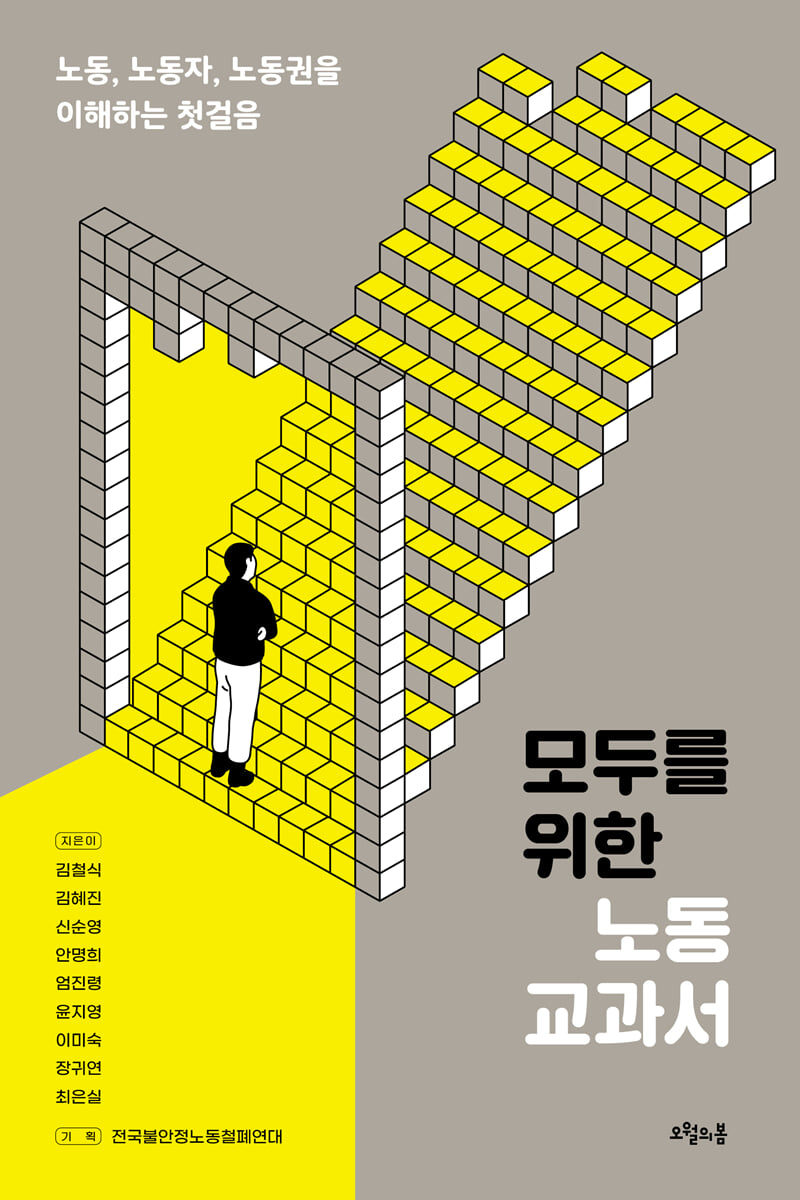
Labor Textbook for Everyone
 |
Description
Book Introduction
Change your distorted perspective,
The Labor Textbook You Need to Know to Find Your and My Rights Now
We call people who make a living by working with their own labor a worker.
There is no society that can function without the labor of workers, and most members of society are workers or their families.
Therefore, there have been voices for some time that education on labor, labor rights, and labor human rights should be implemented starting from schools, or that this should be established as part of civic education.
The Constitution, the primary law that defines the framework of our society, also stipulates the three labor rights (the right to organize, the right to collective bargaining and agreement, and the right to collective action).
However, the national education curriculum still does not pay attention to labor rights education, and it is difficult to find systematic and easily understandable stories about labor, workers, and labor rights, whether inside or outside the system.
Without explaining what labor is, who a worker is, or what workers' rights are, all the fights workers make to regain their dignity and live are often viewed negatively.
“Everyone can become a worker, but the reality that they cannot learn about labor rights in school is the background that causes most young people to internalize and perpetuate existing prejudices about labor.” (p. 247)
This is clearly evident from the perspective of looking at the workers' struggle.
When workers go on strike to reform society, they are labeled as “illegal.” When regular unions go on strike or fight for working conditions, the unions are labeled as selfish organizations that only look out for their own interests. Non-regular workers’ demands for conversion to regular workers are criticized as “free riding.”
The reason why such anti-labor perceptions can be expressed without filtering is because the status of labor rights in our society is still low.
“Political democratization, which progressed as rapidly as industrialization, became separated from the economic democratization that should have been its foundation, and within this, citizens and workers were once again separated.
“The past of workers’ struggles is commemorated by citizens and governments, but the present of workers’ struggles is subject to criticism and distortion.” (p. 244)
The Labor Textbook You Need to Know to Find Your and My Rights Now
We call people who make a living by working with their own labor a worker.
There is no society that can function without the labor of workers, and most members of society are workers or their families.
Therefore, there have been voices for some time that education on labor, labor rights, and labor human rights should be implemented starting from schools, or that this should be established as part of civic education.
The Constitution, the primary law that defines the framework of our society, also stipulates the three labor rights (the right to organize, the right to collective bargaining and agreement, and the right to collective action).
However, the national education curriculum still does not pay attention to labor rights education, and it is difficult to find systematic and easily understandable stories about labor, workers, and labor rights, whether inside or outside the system.
Without explaining what labor is, who a worker is, or what workers' rights are, all the fights workers make to regain their dignity and live are often viewed negatively.
“Everyone can become a worker, but the reality that they cannot learn about labor rights in school is the background that causes most young people to internalize and perpetuate existing prejudices about labor.” (p. 247)
This is clearly evident from the perspective of looking at the workers' struggle.
When workers go on strike to reform society, they are labeled as “illegal.” When regular unions go on strike or fight for working conditions, the unions are labeled as selfish organizations that only look out for their own interests. Non-regular workers’ demands for conversion to regular workers are criticized as “free riding.”
The reason why such anti-labor perceptions can be expressed without filtering is because the status of labor rights in our society is still low.
“Political democratization, which progressed as rapidly as industrialization, became separated from the economic democratization that should have been its foundation, and within this, citizens and workers were once again separated.
“The past of workers’ struggles is commemorated by citizens and governments, but the present of workers’ struggles is subject to criticism and distortion.” (p. 244)
- You can preview some of the book's contents.
Preview
index
Introduction
Part 1
1.
Labor: The Meaning of Labor in Modern Capitalist Society (Kim Cheol-sik)
2.
Neoliberalism: Whose Freedom? (Jang Gwi-yeon)
3.
Irregular Workers: Workers Deprived of Hope and Rights (Jang Gwi-yeon)
4.
Labor Control: How Companies Tame Workers (Kim Hye-jin)
5.
Workplace Democracy: Building Relationships with Dignity (Eom Jin-ryeong)
6.
Social Struggle: Why Labor Issues Are Social Issues (Kim Hye-jin)
Part 2
7.
Wages: Wages are a right (Um Jin-ryeong)
8.
Working Hours: Workers Have the Right to Work Hours (Ahn Myung-hee)
9.
Occupational Safety: For the Right to Work Healthy (Lee Mi-sook)
10.
Labor Unions: Workers Have the Right to Organize (Lee Mi-sook)
11.
Strikes: The Key to Securing Labor Rights (Shin Sun-young)
Part 3
12.
Constitution: Workers' Rights Are Above the Constitution (Yoon Ji-young)
13.
Labor Standards Act: Labor Standards Act for All Workers! (Ahn Myung-hee)
14.
Labor Union Law: A User's Guide to the Three Labor Rights (Choi Eun-sil)
15.
The Non-Regular Workers Act: Protecting Non-Regular Workers? Mass-Producing Them! (Choi Eun-sil)
16.
Social Security: A State Obligation and a Member's Right (Shin Sun-young)
Part 1
1.
Labor: The Meaning of Labor in Modern Capitalist Society (Kim Cheol-sik)
2.
Neoliberalism: Whose Freedom? (Jang Gwi-yeon)
3.
Irregular Workers: Workers Deprived of Hope and Rights (Jang Gwi-yeon)
4.
Labor Control: How Companies Tame Workers (Kim Hye-jin)
5.
Workplace Democracy: Building Relationships with Dignity (Eom Jin-ryeong)
6.
Social Struggle: Why Labor Issues Are Social Issues (Kim Hye-jin)
Part 2
7.
Wages: Wages are a right (Um Jin-ryeong)
8.
Working Hours: Workers Have the Right to Work Hours (Ahn Myung-hee)
9.
Occupational Safety: For the Right to Work Healthy (Lee Mi-sook)
10.
Labor Unions: Workers Have the Right to Organize (Lee Mi-sook)
11.
Strikes: The Key to Securing Labor Rights (Shin Sun-young)
Part 3
12.
Constitution: Workers' Rights Are Above the Constitution (Yoon Ji-young)
13.
Labor Standards Act: Labor Standards Act for All Workers! (Ahn Myung-hee)
14.
Labor Union Law: A User's Guide to the Three Labor Rights (Choi Eun-sil)
15.
The Non-Regular Workers Act: Protecting Non-Regular Workers? Mass-Producing Them! (Choi Eun-sil)
16.
Social Security: A State Obligation and a Member's Right (Shin Sun-young)
Detailed image
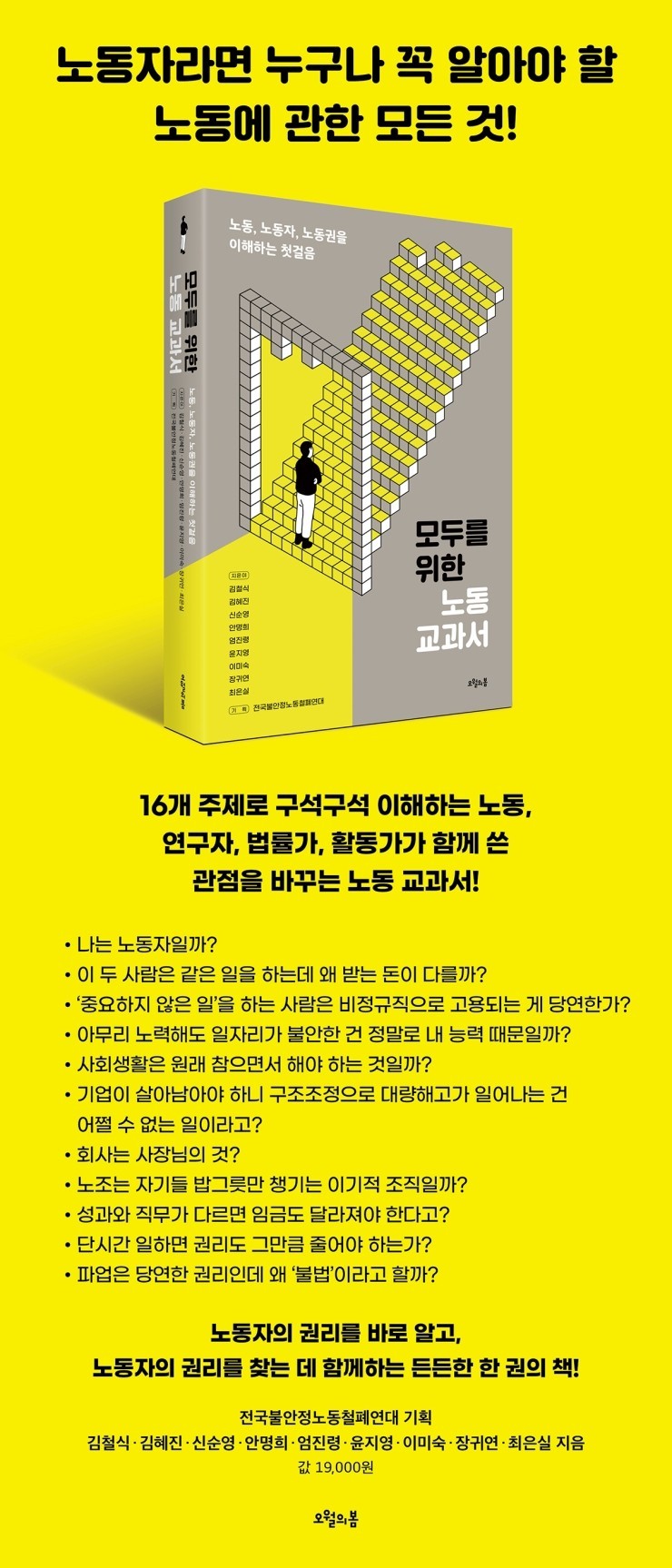
Into the book
“As the framework of employment and the form of wage labor become more ambiguous, the social framework that grants social rights based on employment and wage labor is being shaken.
In a wage-based society, if the form of wage labor becomes ambiguous, many workers may face serious problems, such as being excluded from the social safety net associated with wage labor and being pushed to the brink of survival.
Therefore, we need to fundamentally rethink the framework of our current wage-centered society, the framework in which we must live absolutely dependent on wage labor.”
---p.33
“Ultimately, the freedom of neoliberalism is the freedom of business.
Companies want to be free to fire workers.
According to the Labor Standards Act, workers cannot be fired arbitrarily unless they have committed a special offense.
At first glance, it seems unfair that there are no restrictions on workers quitting their jobs, but companies are regulated from firing employees.
However, this is to ensure fairness, as the two parties to the employment contract, the company and the worker, do not have equal power.”
---p.49
“Labor rights are a system established historically through the persistent struggles of workers and social consensus.
… … But now companies have figured out how to legally evade labor rights and escape their responsibilities as employers by using non-regular workers.”
---p.78
“There is a need to broaden the concept of worker.
Specially employed workers, freelancers, and platform call workers who are not formally employed by a company but are self-employed should also be granted the same labor rights as wage workers.
These people also do not have assets, but rather work to make a living.”
---p.81
“Those who pass the exam and become regular employees believe that their high wages and good working conditions are due to their abilities.
So they ignore or discriminate against workers who do not take the test and justify their low wages.
Even though everyone is connected and doing one job, some workers are full-time, some are contract workers, some are temporary workers, and some are dispatched workers. They also discriminate against workers by dividing their jobs into important and unimportant, core and unessential.
“If this happens, workers will lose the power to unite.”
---p.93
“Because the current labor control system is a method of individualizing workers and forcing them to compete, if workers refuse to compete and declare that they will ‘live together,’ labor control will not be easily implemented.
“The public sector workers’ rejection of the performance-based pay system attempted by the Park Geun-hye administration was a resistance to the structure that discriminated against and made workers compete.”
---p.100
Let's also question the familiar capitalist notions that businesses are run according to the will of their owners, that even government power should not interfere with the operations of private businesses, or that private businesses are private property, and therefore, are owned by individuals and can be manipulated as they please.
---p.108
“It is common to perceive that the moment we are granted the status of worker, we are bound by an employment relationship, but we live ‘as humans’ even in the workplace.
… … the fact that you are employed does not mean that you are paying the employer for your personality itself.”
---p.122
“Talking about democracy in the workplace doesn’t just mean listening to the opinions of employees or modifying operating methods to accommodate the majority’s views.
Because as long as workers are viewed as mere objects of management, the kind actions of businessmen are only temporary.
“The beginning of workplace democracy is not to view as abnormal the large and small conflicts that naturally arise amid the constant tension between labor and capital.”
---p.123
“If we narrow down labor unions to organizations that merely represent the interests and demands of their members and block their efforts to fulfill their social responsibilities, they become ‘selfish organizations.’
… … The lives of workers are not separate from society, and changes in society affect the lives of workers, so they must fight not only for immediate gains but also for the interests and rights of society as a whole.
“That’s what a real labor union is.”
---pp.138,139
“Social solidarity must be a persistent effort to connect a single issue to the advancement of the rights of all workers.”
---p.141
“Wages are not given by the business owner, but are the worker’s right because they are the worker’s share of the results produced by the business and the worker together.
If so, it would be reasonable for companies and workers to jointly decide on the level of wages, but that is not the reality.
“Wages are the main means of livelihood for workers, but the easiest way for employers to increase profits is to reduce workers’ wages.”
---p.150
“Ultimately, the total amount of wages is not fixed, nor is the value of labor determined from the beginning.
Wages depend on how much strength workers' struggles gain within the dynamics of labor and capital, labor and government.”
---p.162
“Discipline through laws and institutions is necessary and must be supplemented, but it is not sufficient.
Because the reasons for discrimination are constantly being invented and developed.
“What fills that gap is the active work of labor unions that can address discrimination in the gaps in the legal system.”
---p.165
“We often see media incitement like, ‘Workers with annual salaries in the tens of millions of won are going on strike,’ or ‘Workers with annual salaries in the hundreds of millions are demanding rights.’
However, wages are not a substitute for other rights.
“Nor can any other rights held by workers be diminished simply by receiving higher wages.”
---p.166
“The conflict between workers and capitalists over working hours is very sharp.
Because the health of workers and the profits of capital depend on working hours.
Ultimately, working hours are a question of who will have more power.”
---p.173
“In addition to reducing the length of working hours, we must also make the arrangement of working hours based on the workers’ bodies and lives.”
---p.184
“Workplace hazards attack workers in various ways beyond manufacturing-focused accidents, but employers’ responsibility is increasingly diminished.
“Sometimes, the responsibility is placed on the workers themselves, such as through special employment or platform work, or it is transferred to an external party through an outsourcing system.”
---pp.201,202
“The right to work healthily has expanded along with workers’ struggles.
From the struggles of Moon Song-myeon and Wonjin Rayon to the struggles of Banollim and Kim Yong-gyun, these were struggles that continued without stopping throughout history.
“Workers themselves have protected and made known to the world the right to health that no one else could have guaranteed.”
---p.207
“It is nearly impossible for individual workers to resolve issues such as working conditions against their employers.
Therefore, Article 33 of the Constitution guarantees the right to organize, the right to collective bargaining, and the right to collective action, thereby enabling workers to make their voices heard through unity.
“The way to achieve that unity is through labor unions.”
---p.209
“The conflict of interest between businesses, labor unions, and the government is a structural conflict inherent in the capitalist economic system, and inevitably gives rise to labor union struggles.
“The criticism that ‘labor unions that only prioritize struggle are ruining the economy’ without acknowledging this stems from the intention to shift the cause of the conflict onto labor unions.”
---p.223
“We need to remember that the right to strike guaranteed by the Constitution is a collective action by workers to collectively sacrifice their labor to achieve their demands, thereby inflicting damage on employers,” and that the original purpose of a strike is to collectively protect workers’ rights by inflicting damage and harm on employers.
---p.249
“If labor rights are to be properly guaranteed, we must take into account especially the more vulnerable workers.
“Because labor rights emerged to address problems stemming from the unfair relationship between employers and workers, elevating the status of more vulnerable workers is the way to truly uphold the meaning of labor rights.”
---p.262
“Unlike labor rights or the three labor rights, the right to management rights cannot be found in the Constitution.
It's not in the law either.
Management rights are not explicitly stated anywhere.
However, the court created the right to management by drawing on fundamental constitutional rights such as property rights and freedom of occupational choice.”
---pp.277,278
“The point is that the working conditions under the Labor Standards Act are at a limit that cannot be lowered any further.
Since it sets the lower limit for working conditions, working conditions worse than those stipulated in the Labor Standards Act are not tolerated.
“Also, working conditions must not be lowered for the reason of standards under the Labor Standards Act.”
---p.285
“It is easy to assume that anyone who works will be protected by the Labor Standards Act, regardless of their status.
But the Labor Standards Act betrays our common sense.
This is because in order to be subject to the Labor Standards Act, one must first be ‘recognized’ as a ‘worker.’
In other words, only workers who are recognized as workers under the Labor Standards Act can receive the protection of the Labor Standards Act.”
---p.287
“Electronic devices are essential for work, but they are passed on to workers to purchase them, and the way work instructions are ingeniously altered to create the appearance that workers can choose or select their work. By doing so, they cleverly circumvent existing standards that recognize workers as workers, turning them into self-employed individuals.”
---p.305
When workers strike for wages or working conditions, they are criticized as union egoism, and when they strike for social issues, they are criticized as illegal strikes.
Since labor unions formed by workers are also social organizations, the right to express political views should be guaranteed as a constitutional right. It should also be widely recognized that most political issues are related to labor relations and working conditions, as they directly impact workers' working conditions.
---pp.315,316
“When there are two or three users involved, rather than just one, it becomes difficult to know who to ask for permission or consent to resolve a problem.
In reality, business owners pass the buck to one another.
“In the end, it is only the workers who end up stamping their feet.”
---p.341
“The dispatch law was a signal.
"Now, you can use indirect employment without directly hiring workers." "You can use workers without fulfilling your responsibilities as an employer." Regardless of the restrictions on the types of work permitted under the Dispatch Workers Act, employers have expanded indirect employment relationships indefinitely as needed."
---p.343
“Someone is poor because they have no job, or are unable to work, or their income is either too low or too low to get out of poverty.
The reason for the lack of jobs and income is the unstable labor market and the weakness of the social security system that supports individuals' social risks such as disability, illness, old age, and disasters.”
In a wage-based society, if the form of wage labor becomes ambiguous, many workers may face serious problems, such as being excluded from the social safety net associated with wage labor and being pushed to the brink of survival.
Therefore, we need to fundamentally rethink the framework of our current wage-centered society, the framework in which we must live absolutely dependent on wage labor.”
---p.33
“Ultimately, the freedom of neoliberalism is the freedom of business.
Companies want to be free to fire workers.
According to the Labor Standards Act, workers cannot be fired arbitrarily unless they have committed a special offense.
At first glance, it seems unfair that there are no restrictions on workers quitting their jobs, but companies are regulated from firing employees.
However, this is to ensure fairness, as the two parties to the employment contract, the company and the worker, do not have equal power.”
---p.49
“Labor rights are a system established historically through the persistent struggles of workers and social consensus.
… … But now companies have figured out how to legally evade labor rights and escape their responsibilities as employers by using non-regular workers.”
---p.78
“There is a need to broaden the concept of worker.
Specially employed workers, freelancers, and platform call workers who are not formally employed by a company but are self-employed should also be granted the same labor rights as wage workers.
These people also do not have assets, but rather work to make a living.”
---p.81
“Those who pass the exam and become regular employees believe that their high wages and good working conditions are due to their abilities.
So they ignore or discriminate against workers who do not take the test and justify their low wages.
Even though everyone is connected and doing one job, some workers are full-time, some are contract workers, some are temporary workers, and some are dispatched workers. They also discriminate against workers by dividing their jobs into important and unimportant, core and unessential.
“If this happens, workers will lose the power to unite.”
---p.93
“Because the current labor control system is a method of individualizing workers and forcing them to compete, if workers refuse to compete and declare that they will ‘live together,’ labor control will not be easily implemented.
“The public sector workers’ rejection of the performance-based pay system attempted by the Park Geun-hye administration was a resistance to the structure that discriminated against and made workers compete.”
---p.100
Let's also question the familiar capitalist notions that businesses are run according to the will of their owners, that even government power should not interfere with the operations of private businesses, or that private businesses are private property, and therefore, are owned by individuals and can be manipulated as they please.
---p.108
“It is common to perceive that the moment we are granted the status of worker, we are bound by an employment relationship, but we live ‘as humans’ even in the workplace.
… … the fact that you are employed does not mean that you are paying the employer for your personality itself.”
---p.122
“Talking about democracy in the workplace doesn’t just mean listening to the opinions of employees or modifying operating methods to accommodate the majority’s views.
Because as long as workers are viewed as mere objects of management, the kind actions of businessmen are only temporary.
“The beginning of workplace democracy is not to view as abnormal the large and small conflicts that naturally arise amid the constant tension between labor and capital.”
---p.123
“If we narrow down labor unions to organizations that merely represent the interests and demands of their members and block their efforts to fulfill their social responsibilities, they become ‘selfish organizations.’
… … The lives of workers are not separate from society, and changes in society affect the lives of workers, so they must fight not only for immediate gains but also for the interests and rights of society as a whole.
“That’s what a real labor union is.”
---pp.138,139
“Social solidarity must be a persistent effort to connect a single issue to the advancement of the rights of all workers.”
---p.141
“Wages are not given by the business owner, but are the worker’s right because they are the worker’s share of the results produced by the business and the worker together.
If so, it would be reasonable for companies and workers to jointly decide on the level of wages, but that is not the reality.
“Wages are the main means of livelihood for workers, but the easiest way for employers to increase profits is to reduce workers’ wages.”
---p.150
“Ultimately, the total amount of wages is not fixed, nor is the value of labor determined from the beginning.
Wages depend on how much strength workers' struggles gain within the dynamics of labor and capital, labor and government.”
---p.162
“Discipline through laws and institutions is necessary and must be supplemented, but it is not sufficient.
Because the reasons for discrimination are constantly being invented and developed.
“What fills that gap is the active work of labor unions that can address discrimination in the gaps in the legal system.”
---p.165
“We often see media incitement like, ‘Workers with annual salaries in the tens of millions of won are going on strike,’ or ‘Workers with annual salaries in the hundreds of millions are demanding rights.’
However, wages are not a substitute for other rights.
“Nor can any other rights held by workers be diminished simply by receiving higher wages.”
---p.166
“The conflict between workers and capitalists over working hours is very sharp.
Because the health of workers and the profits of capital depend on working hours.
Ultimately, working hours are a question of who will have more power.”
---p.173
“In addition to reducing the length of working hours, we must also make the arrangement of working hours based on the workers’ bodies and lives.”
---p.184
“Workplace hazards attack workers in various ways beyond manufacturing-focused accidents, but employers’ responsibility is increasingly diminished.
“Sometimes, the responsibility is placed on the workers themselves, such as through special employment or platform work, or it is transferred to an external party through an outsourcing system.”
---pp.201,202
“The right to work healthily has expanded along with workers’ struggles.
From the struggles of Moon Song-myeon and Wonjin Rayon to the struggles of Banollim and Kim Yong-gyun, these were struggles that continued without stopping throughout history.
“Workers themselves have protected and made known to the world the right to health that no one else could have guaranteed.”
---p.207
“It is nearly impossible for individual workers to resolve issues such as working conditions against their employers.
Therefore, Article 33 of the Constitution guarantees the right to organize, the right to collective bargaining, and the right to collective action, thereby enabling workers to make their voices heard through unity.
“The way to achieve that unity is through labor unions.”
---p.209
“The conflict of interest between businesses, labor unions, and the government is a structural conflict inherent in the capitalist economic system, and inevitably gives rise to labor union struggles.
“The criticism that ‘labor unions that only prioritize struggle are ruining the economy’ without acknowledging this stems from the intention to shift the cause of the conflict onto labor unions.”
---p.223
“We need to remember that the right to strike guaranteed by the Constitution is a collective action by workers to collectively sacrifice their labor to achieve their demands, thereby inflicting damage on employers,” and that the original purpose of a strike is to collectively protect workers’ rights by inflicting damage and harm on employers.
---p.249
“If labor rights are to be properly guaranteed, we must take into account especially the more vulnerable workers.
“Because labor rights emerged to address problems stemming from the unfair relationship between employers and workers, elevating the status of more vulnerable workers is the way to truly uphold the meaning of labor rights.”
---p.262
“Unlike labor rights or the three labor rights, the right to management rights cannot be found in the Constitution.
It's not in the law either.
Management rights are not explicitly stated anywhere.
However, the court created the right to management by drawing on fundamental constitutional rights such as property rights and freedom of occupational choice.”
---pp.277,278
“The point is that the working conditions under the Labor Standards Act are at a limit that cannot be lowered any further.
Since it sets the lower limit for working conditions, working conditions worse than those stipulated in the Labor Standards Act are not tolerated.
“Also, working conditions must not be lowered for the reason of standards under the Labor Standards Act.”
---p.285
“It is easy to assume that anyone who works will be protected by the Labor Standards Act, regardless of their status.
But the Labor Standards Act betrays our common sense.
This is because in order to be subject to the Labor Standards Act, one must first be ‘recognized’ as a ‘worker.’
In other words, only workers who are recognized as workers under the Labor Standards Act can receive the protection of the Labor Standards Act.”
---p.287
“Electronic devices are essential for work, but they are passed on to workers to purchase them, and the way work instructions are ingeniously altered to create the appearance that workers can choose or select their work. By doing so, they cleverly circumvent existing standards that recognize workers as workers, turning them into self-employed individuals.”
---p.305
When workers strike for wages or working conditions, they are criticized as union egoism, and when they strike for social issues, they are criticized as illegal strikes.
Since labor unions formed by workers are also social organizations, the right to express political views should be guaranteed as a constitutional right. It should also be widely recognized that most political issues are related to labor relations and working conditions, as they directly impact workers' working conditions.
---pp.315,316
“When there are two or three users involved, rather than just one, it becomes difficult to know who to ask for permission or consent to resolve a problem.
In reality, business owners pass the buck to one another.
“In the end, it is only the workers who end up stamping their feet.”
---p.341
“The dispatch law was a signal.
"Now, you can use indirect employment without directly hiring workers." "You can use workers without fulfilling your responsibilities as an employer." Regardless of the restrictions on the types of work permitted under the Dispatch Workers Act, employers have expanded indirect employment relationships indefinitely as needed."
---p.343
“Someone is poor because they have no job, or are unable to work, or their income is either too low or too low to get out of poverty.
The reason for the lack of jobs and income is the unstable labor market and the weakness of the social security system that supports individuals' social risks such as disability, illness, old age, and disasters.”
---p.371
Publisher's Review
Labor, workers, and labor rights: A look at the spread of precarious work
In this situation where the status of labor rights remains low, anti-labor perceptions are widespread, and there is a lack of labor education and labor rights education, researchers, activists, and lawyers have put their heads together to create a "labor textbook" that will help change the distorted perspectives surrounding labor and understand labor.
Because you have to know to change, and you have to know to get it back.
And because workers' rights, and the laws, systems, and culture surrounding them, move and change on the battlefield.
In particular, the book was written with a focus on the current reality in which the simple requirements of the past as a worker's status have become like a high mountain and a wall, and the resulting deepening instability in labor.
It has been 50 years since Jeon Tae-il set himself on fire and shouted, “We are not machines” and “Follow the Labor Standards Act.”
Half a century has passed since he left.
Meanwhile, there was the Great Labor Struggle of 1987, democratic unions became the 'mainstream', and the voices of workers seemed to be permeating laws and systems. However, with the onset of the neoliberal system and the rapid changes in the labor environment, workers who were not called workers and unstable labor spread.
Now is the time to move beyond simply shouting, “Follow the Labor Standards Act,” and to say, “Apply the Labor Standards Act to all workers.”
In the past 20 years, even among non-regular workers, there has been a proliferation of indirect employment (in-house subcontracting, contract work, dispatch work) where the place of work and salary are different from the place of work, and there has also been an increase in cases of 'special employment' where workers providing labor are treated like self-employed individuals (golf course caddies, freight transport truck owners, private tutoring teachers, etc.).
Among the new forms of employment that have emerged due to technological change, there are many cases where the form of employment and wage labor are omitted, such as platform work.
“As the framework of employment and the form of wage labor become ambiguous, the social framework that granted social rights based on employment and wage labor is being shaken” (p. 33).
The problem is that workers' social safety net has been tied to wage labor.
In other words, as the number of workers who are not called workers increases despite being workers, the number of people who fall into the blind spot of the social safety net is also increasing, and it is time to rethink the framework of a wage-centered society.
Non-regular employment, which was 'exceptional' 20 years ago, has now become a 'common' form of employment.
Even if you work as a regular employee, you may not be properly paid overtime pay or have to work overtime as if it were nothing.
It's not like you only get half the meal because you work short hours, but the meal allowance is paid in proportion to the hours worked and the workload is not light.
Working on a temporary basis, you have to work with anxiety, not knowing when your contract will end.
The boss at the place I go to work and the 'real boss' who deposits my salary into my account are different.
I've never met a boss who paid my salary.
There are too many workers who are not called workers even though they work under subordination, and the common sense that anyone who works is a worker has become absurd.
Even though they are in an employment relationship, their worker status is denied, and it is difficult to even be recognized as a worker with the minimum protection of laws and systems.
Many workers outside the labor law, such as delivery workers, film staff, and broadcast writers, had to first determine whether they were workers or not.
Just being recognized as a 'worker' is like trying to reach for a star in the sky.
Laws that claim to "protect" irregular workers (such as the Act on the "Protection" of Temporary and Part-Time Workers, the Act on the "Protection" of Dispatched Workers, etc.) end up producing workers with unstable working conditions (Chapter 15). Although a legal system has been created to prohibit discrimination against irregular workers, it is difficult to actually recognize discrimination or apply the system in reality.
The elderly irregular workers who were the first to request discrimination correction based on the discrimination correction system had the discrimination recognized by the local labor commission, but eventually gave up on the discrimination correction application when the company threatened to outsource the work.
Since individual workers have no power and must unite to deal with management, the three labor rights are guaranteed in the Constitution. However, the Labor Union Act, a lower-level law of the Constitution, sometimes infringes on the three labor rights (Chapter 14).
A book that will serve as a strong support in the fight for everyone's labor.
The authors, who have been working with the National Coalition for the Abolition of Precarious Work, have been fighting against the spread of precarious work in our society and working to find the rights of workers who have been left in the blind spot of labor rights. They have selected 16 essential topics that vividly reveal the current labor reality, help us understand the concept of labor and the position of workers, and understand at a glance what workers' rights are and which path we should take.
Part 1 of this book covers topics such as 'labor', 'neoliberalism', and 'non-regular workers' to help readers understand the overall concepts surrounding labor, including the concept of labor that workers should know and changes in the labor environment. It then delves into the specific realities of labor, focusing on 'labor control' and 'workplace democracy' in the workplace, and the topic of 'social struggle' to define the role and direction of labor unions, pointing out that labor issues are social issues and that social issues are labor issues.
As you read Part 1, you will learn about the meaning of labor and the status of workers, and it will help you break down the distorted framework regarding labor that has been deeply ingrained in our society.
Part 2 covers labor rights, which are rights that all workers have, but are not considered rights or are not fully possessed.
These are wages, working hours, occupational safety, labor unions, and strikes.
In particular, in the context of the proliferation of new forms of employment and the resulting expansion of unstable work, the reality of workers who have been in the blind spot of labor rights was given significant attention.
In Part 3, labor-related laws and systems are explained in a way that closely connects them to specific realities.
We examined the Constitution, Labor Standards Act, Trade Union Act, Non-Regular Workers Act, and even the social security system.
Labor-related laws and systems have a specific impact on the lives of individual workers, but it is difficult to know the specific details and to see at a glance what problems and limitations they pose.
We examined how labor-related laws and systems have changed and what impact they have on the lives of our workers, and we also attempted to include the limitations, problems, and alternatives of these laws and systems.
In this journey of examining every nook and cranny of labor, we are reminded of the historical fact that no one can claim our rights for us, even if they seem very small.
We are also reminded that the problem of labor is a problem of society, and that the problem of society is a problem of labor.
Workers' rights have been acquired through the unity and struggle of workers, and the conditions and environment surrounding labor and workers have progressed or regressed accordingly.
I hope this book will be a source of inspiration for countless workers who are trying to understand, change, and survive here and now, and a link to the fight for everyone's labor.
In this situation where the status of labor rights remains low, anti-labor perceptions are widespread, and there is a lack of labor education and labor rights education, researchers, activists, and lawyers have put their heads together to create a "labor textbook" that will help change the distorted perspectives surrounding labor and understand labor.
Because you have to know to change, and you have to know to get it back.
And because workers' rights, and the laws, systems, and culture surrounding them, move and change on the battlefield.
In particular, the book was written with a focus on the current reality in which the simple requirements of the past as a worker's status have become like a high mountain and a wall, and the resulting deepening instability in labor.
It has been 50 years since Jeon Tae-il set himself on fire and shouted, “We are not machines” and “Follow the Labor Standards Act.”
Half a century has passed since he left.
Meanwhile, there was the Great Labor Struggle of 1987, democratic unions became the 'mainstream', and the voices of workers seemed to be permeating laws and systems. However, with the onset of the neoliberal system and the rapid changes in the labor environment, workers who were not called workers and unstable labor spread.
Now is the time to move beyond simply shouting, “Follow the Labor Standards Act,” and to say, “Apply the Labor Standards Act to all workers.”
In the past 20 years, even among non-regular workers, there has been a proliferation of indirect employment (in-house subcontracting, contract work, dispatch work) where the place of work and salary are different from the place of work, and there has also been an increase in cases of 'special employment' where workers providing labor are treated like self-employed individuals (golf course caddies, freight transport truck owners, private tutoring teachers, etc.).
Among the new forms of employment that have emerged due to technological change, there are many cases where the form of employment and wage labor are omitted, such as platform work.
“As the framework of employment and the form of wage labor become ambiguous, the social framework that granted social rights based on employment and wage labor is being shaken” (p. 33).
The problem is that workers' social safety net has been tied to wage labor.
In other words, as the number of workers who are not called workers increases despite being workers, the number of people who fall into the blind spot of the social safety net is also increasing, and it is time to rethink the framework of a wage-centered society.
Non-regular employment, which was 'exceptional' 20 years ago, has now become a 'common' form of employment.
Even if you work as a regular employee, you may not be properly paid overtime pay or have to work overtime as if it were nothing.
It's not like you only get half the meal because you work short hours, but the meal allowance is paid in proportion to the hours worked and the workload is not light.
Working on a temporary basis, you have to work with anxiety, not knowing when your contract will end.
The boss at the place I go to work and the 'real boss' who deposits my salary into my account are different.
I've never met a boss who paid my salary.
There are too many workers who are not called workers even though they work under subordination, and the common sense that anyone who works is a worker has become absurd.
Even though they are in an employment relationship, their worker status is denied, and it is difficult to even be recognized as a worker with the minimum protection of laws and systems.
Many workers outside the labor law, such as delivery workers, film staff, and broadcast writers, had to first determine whether they were workers or not.
Just being recognized as a 'worker' is like trying to reach for a star in the sky.
Laws that claim to "protect" irregular workers (such as the Act on the "Protection" of Temporary and Part-Time Workers, the Act on the "Protection" of Dispatched Workers, etc.) end up producing workers with unstable working conditions (Chapter 15). Although a legal system has been created to prohibit discrimination against irregular workers, it is difficult to actually recognize discrimination or apply the system in reality.
The elderly irregular workers who were the first to request discrimination correction based on the discrimination correction system had the discrimination recognized by the local labor commission, but eventually gave up on the discrimination correction application when the company threatened to outsource the work.
Since individual workers have no power and must unite to deal with management, the three labor rights are guaranteed in the Constitution. However, the Labor Union Act, a lower-level law of the Constitution, sometimes infringes on the three labor rights (Chapter 14).
A book that will serve as a strong support in the fight for everyone's labor.
The authors, who have been working with the National Coalition for the Abolition of Precarious Work, have been fighting against the spread of precarious work in our society and working to find the rights of workers who have been left in the blind spot of labor rights. They have selected 16 essential topics that vividly reveal the current labor reality, help us understand the concept of labor and the position of workers, and understand at a glance what workers' rights are and which path we should take.
Part 1 of this book covers topics such as 'labor', 'neoliberalism', and 'non-regular workers' to help readers understand the overall concepts surrounding labor, including the concept of labor that workers should know and changes in the labor environment. It then delves into the specific realities of labor, focusing on 'labor control' and 'workplace democracy' in the workplace, and the topic of 'social struggle' to define the role and direction of labor unions, pointing out that labor issues are social issues and that social issues are labor issues.
As you read Part 1, you will learn about the meaning of labor and the status of workers, and it will help you break down the distorted framework regarding labor that has been deeply ingrained in our society.
Part 2 covers labor rights, which are rights that all workers have, but are not considered rights or are not fully possessed.
These are wages, working hours, occupational safety, labor unions, and strikes.
In particular, in the context of the proliferation of new forms of employment and the resulting expansion of unstable work, the reality of workers who have been in the blind spot of labor rights was given significant attention.
In Part 3, labor-related laws and systems are explained in a way that closely connects them to specific realities.
We examined the Constitution, Labor Standards Act, Trade Union Act, Non-Regular Workers Act, and even the social security system.
Labor-related laws and systems have a specific impact on the lives of individual workers, but it is difficult to know the specific details and to see at a glance what problems and limitations they pose.
We examined how labor-related laws and systems have changed and what impact they have on the lives of our workers, and we also attempted to include the limitations, problems, and alternatives of these laws and systems.
In this journey of examining every nook and cranny of labor, we are reminded of the historical fact that no one can claim our rights for us, even if they seem very small.
We are also reminded that the problem of labor is a problem of society, and that the problem of society is a problem of labor.
Workers' rights have been acquired through the unity and struggle of workers, and the conditions and environment surrounding labor and workers have progressed or regressed accordingly.
I hope this book will be a source of inspiration for countless workers who are trying to understand, change, and survive here and now, and a link to the fight for everyone's labor.
GOODS SPECIFICS
- Publication date: April 30, 2021
- Page count, weight, size: 380 pages | 480g | 140*210*30mm
- ISBN13: 9791190422680
- ISBN10: 1190422689
You may also like
카테고리
korean


korean

![GQ KOREA Mark (Monthly): December [2025]](http://librairie.coreenne.fr/cdn/shop/files/8ef265dbbfbf186523ed75ba7319009d.jpg?v=1765340328&width=3840)


