

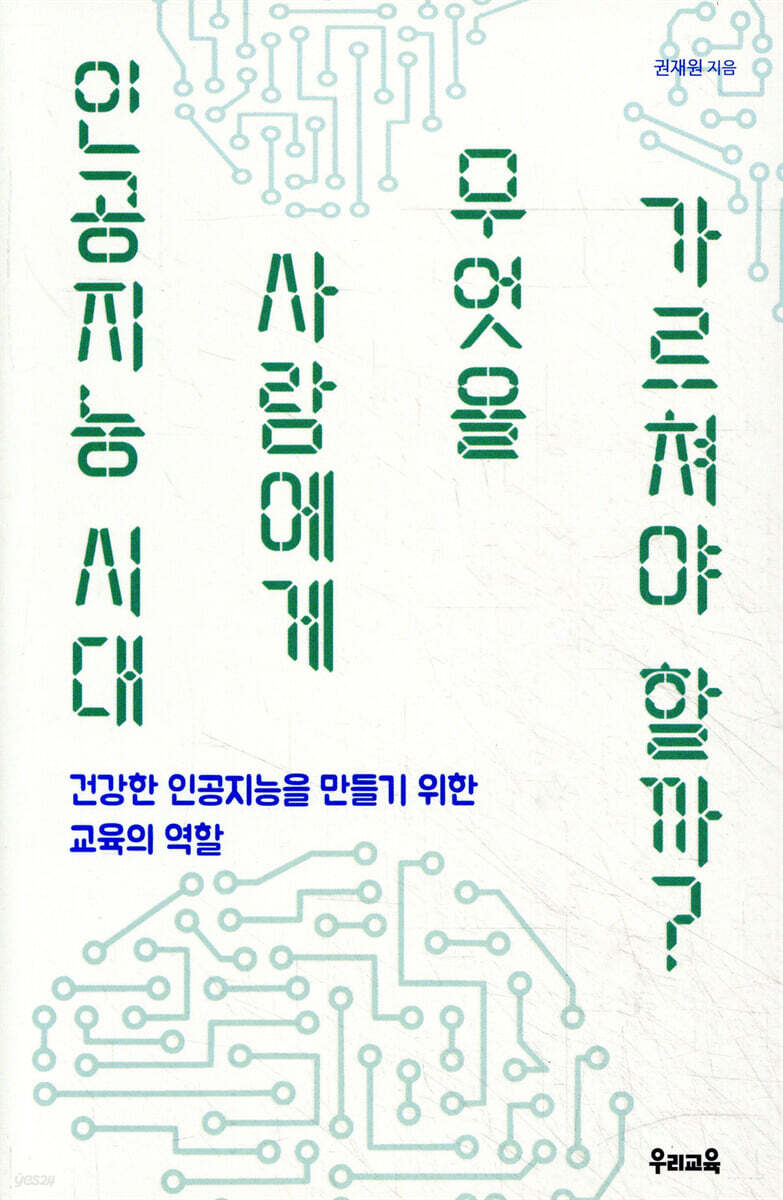
What should we teach people in the age of artificial intelligence?
 |
Description
Book Introduction
“Will artificial intelligence really take away people’s jobs?
So what jobs are worth surviving in?
“What do I need to prepare to get that job?”
If you think like this, you are wrong.
The fact that the capabilities needed in an industrial society and the capabilities needed in the age of artificial intelligence are completely different.
So what should we prepare and how?
The answer lies in education.
Educating people to be more humane than before
This book was planned in an atmosphere of threat that almost all jobs we thought of would disappear in the future due to the Fourth Industrial Revolution represented by artificial intelligence. It is an edited version of the manuscript that was serialized in eight installments in the quarterly education magazine [Our Education] from the summer of 2018 to the spring of 2020 and published as a single volume.
Lecturers on the "future" that emerged with the advent of the Fourth Industrial Revolution are urging us to prepare in advance if we want to survive, as countless jobs will disappear in the future.
From a young age, they are taught that they must be good at coding, have creative and convergent thinking skills, and that if they don't get ahead of others, they will be left behind.
All of these claims are making teachers and parents nervous.
A vague anxiety that education needs to change drastically, but also a double anxiety that we shouldn't stop doing what we've been doing.
In this situation, the burden on students doubles or triples.
Students have to shoulder the burden of their current academic burden as well as the burden of preparing for the future.
The bigger problem is that no one is sure whether this is really preparing for the future.
Amidst the flood of words like “future education” and “future teachers,” hope and faith in the future are very poor.
If you are an ordinary person who is easily deaf to those who talk about a bleak future without any alternatives and whose hearts are swayed by their words, I recommend that you first open this book, which calls itself a "Guide to the Fourth Industrial Revolution."
This book is a reflection by a teacher who is tired of running around vaguely saying, “It’s the future!”
First, these are pieces of research that take a cool-headed look at the changes currently underway, take a step back and think about what kind of education is needed within that change, how current education needs to change for that change, and what preparations are needed.
Rather than competing with AI, let's explore what kind of people we should be as users and educators of AI, and what role education should play within it.
So what jobs are worth surviving in?
“What do I need to prepare to get that job?”
If you think like this, you are wrong.
The fact that the capabilities needed in an industrial society and the capabilities needed in the age of artificial intelligence are completely different.
So what should we prepare and how?
The answer lies in education.
Educating people to be more humane than before
This book was planned in an atmosphere of threat that almost all jobs we thought of would disappear in the future due to the Fourth Industrial Revolution represented by artificial intelligence. It is an edited version of the manuscript that was serialized in eight installments in the quarterly education magazine [Our Education] from the summer of 2018 to the spring of 2020 and published as a single volume.
Lecturers on the "future" that emerged with the advent of the Fourth Industrial Revolution are urging us to prepare in advance if we want to survive, as countless jobs will disappear in the future.
From a young age, they are taught that they must be good at coding, have creative and convergent thinking skills, and that if they don't get ahead of others, they will be left behind.
All of these claims are making teachers and parents nervous.
A vague anxiety that education needs to change drastically, but also a double anxiety that we shouldn't stop doing what we've been doing.
In this situation, the burden on students doubles or triples.
Students have to shoulder the burden of their current academic burden as well as the burden of preparing for the future.
The bigger problem is that no one is sure whether this is really preparing for the future.
Amidst the flood of words like “future education” and “future teachers,” hope and faith in the future are very poor.
If you are an ordinary person who is easily deaf to those who talk about a bleak future without any alternatives and whose hearts are swayed by their words, I recommend that you first open this book, which calls itself a "Guide to the Fourth Industrial Revolution."
This book is a reflection by a teacher who is tired of running around vaguely saying, “It’s the future!”
First, these are pieces of research that take a cool-headed look at the changes currently underway, take a step back and think about what kind of education is needed within that change, how current education needs to change for that change, and what preparations are needed.
Rather than competing with AI, let's explore what kind of people we should be as users and educators of AI, and what role education should play within it.
- You can preview some of the book's contents.
Preview
index
Preface_ What will change in the age of artificial intelligence?
1.
What exactly is the Fourth Industrial Revolution?
The Specter of the Fourth Industrial Revolution
Key words for understanding the Fourth Industrial Revolution
Labor issues brought about by the Fourth Industrial Revolution
Strategies for Individuals to Cope with the Fourth Industrial Revolution
2.
What is intelligence, and what is the level of human intelligence?
What are 'artificial' and 'intelligence'?
Elements of Intelligence and Characteristics of Human Intelligence
The complexity of human intelligence that artificial intelligence cannot possibly replicate.
The Complexity of Human Intelligence and the Economics of Artificial Intelligence
3.
Artificial intelligence, thinking or acting like a human
How artificial intelligence works
Path to becoming a rational actor
Artificial Intelligence Approaches People
4.
So what should we teach?
Will we secure jobs that will survive through education?
What is so-called competence?
5.
Democratic citizenship missing from educational discourse in the age of artificial intelligence
The purpose of public education is to educate democratic citizens.
How will artificial intelligence transform democratic citizenship?
6.
So what is a human being?
Do democratic citizens include other intelligent beings than humans?
The rules of human beings have become complex and difficult
What is the justification for humans being the only subjects of rights?
The Privilege of the Fallen: What is the Status of Man?
Nevertheless, finding the ontological basis of human beings
Utilitarian Approach: The Gradient of Suffering According to the Gradient of Suffering
questioner
7.
Working with artificial intelligence
AI replaces some labor, not people.
Artificial intelligence has no motivation or meaning.
What is humane labor?
Creating new value through humane labor
The problem is politics
8.
Educational Goals in the Age of Artificial Intelligence
Creating people who set goals
Creating people who set values and direction
Creating people as comprehensive beings
Humans as Users of Artificial Intelligence: The Problem of New Subjectivity
A person who teaches artificial intelligence
9.
Artificial Intelligence Meets Blockchain Technology
Centralized and Distributed Ledger Technology
Centralized costs
Blockchain Revolution
10.
The Limits of Artificial Intelligence and the Future of Education
The limitations of artificial intelligence
Education for the AI Era
Conclusion: Beware the Trap Called "Future"
References
1.
What exactly is the Fourth Industrial Revolution?
The Specter of the Fourth Industrial Revolution
Key words for understanding the Fourth Industrial Revolution
Labor issues brought about by the Fourth Industrial Revolution
Strategies for Individuals to Cope with the Fourth Industrial Revolution
2.
What is intelligence, and what is the level of human intelligence?
What are 'artificial' and 'intelligence'?
Elements of Intelligence and Characteristics of Human Intelligence
The complexity of human intelligence that artificial intelligence cannot possibly replicate.
The Complexity of Human Intelligence and the Economics of Artificial Intelligence
3.
Artificial intelligence, thinking or acting like a human
How artificial intelligence works
Path to becoming a rational actor
Artificial Intelligence Approaches People
4.
So what should we teach?
Will we secure jobs that will survive through education?
What is so-called competence?
5.
Democratic citizenship missing from educational discourse in the age of artificial intelligence
The purpose of public education is to educate democratic citizens.
How will artificial intelligence transform democratic citizenship?
6.
So what is a human being?
Do democratic citizens include other intelligent beings than humans?
The rules of human beings have become complex and difficult
What is the justification for humans being the only subjects of rights?
The Privilege of the Fallen: What is the Status of Man?
Nevertheless, finding the ontological basis of human beings
Utilitarian Approach: The Gradient of Suffering According to the Gradient of Suffering
questioner
7.
Working with artificial intelligence
AI replaces some labor, not people.
Artificial intelligence has no motivation or meaning.
What is humane labor?
Creating new value through humane labor
The problem is politics
8.
Educational Goals in the Age of Artificial Intelligence
Creating people who set goals
Creating people who set values and direction
Creating people as comprehensive beings
Humans as Users of Artificial Intelligence: The Problem of New Subjectivity
A person who teaches artificial intelligence
9.
Artificial Intelligence Meets Blockchain Technology
Centralized and Distributed Ledger Technology
Centralized costs
Blockchain Revolution
10.
The Limits of Artificial Intelligence and the Future of Education
The limitations of artificial intelligence
Education for the AI Era
Conclusion: Beware the Trap Called "Future"
References
GOODS SPECIFICS
- Publication date: March 12, 2021
- Page count, weight, size: 316 pages | 412g | 138*210*30mm
- ISBN13: 9788980409815
- ISBN10: 8980409818
You may also like
카테고리
korean


korean

![GQ KOREA Mark (Monthly): December [2025]](http://librairie.coreenne.fr/cdn/shop/files/8ef265dbbfbf186523ed75ba7319009d.jpg?v=1765340328&width=3840)


