

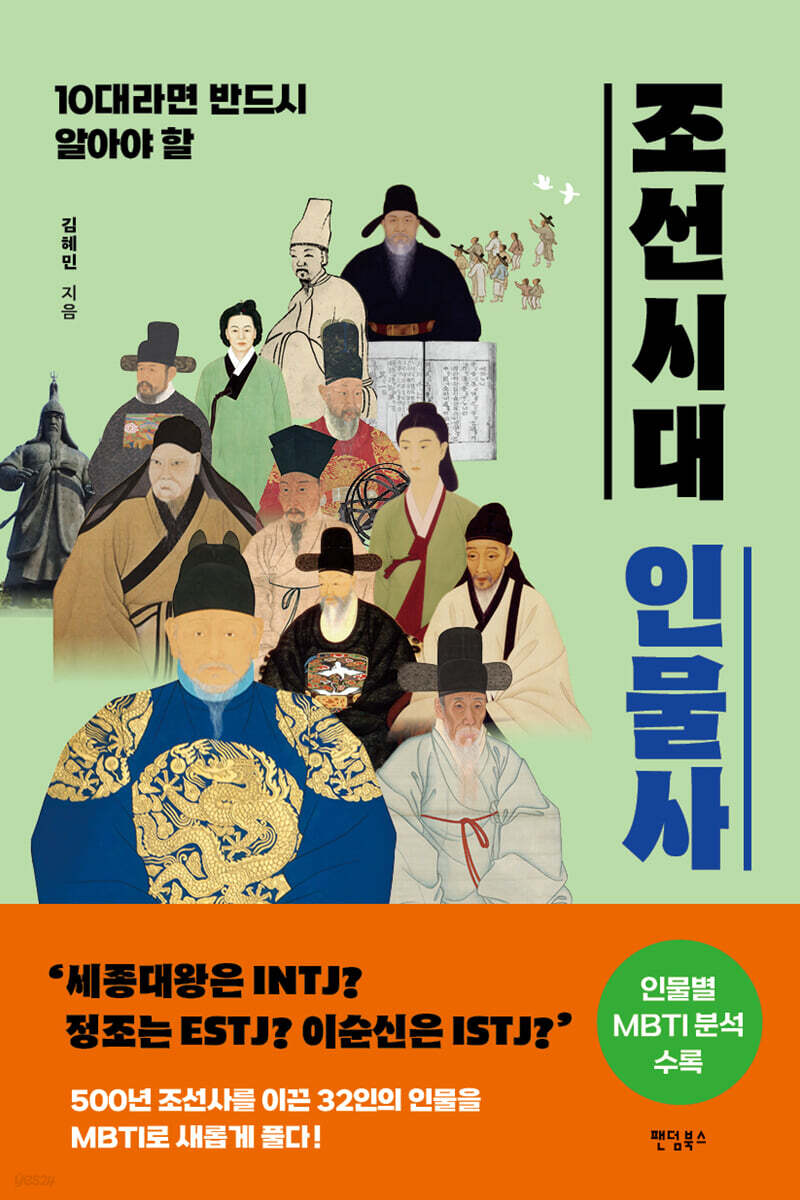
Joseon Dynasty figures that every teenager must know
 |
Description
Book Introduction
Great figures who influenced 500 years of Joseon history
Hear the turbulent story!
MBTI psychological analysis of Joseon Dynasty figures
Take a peek into their personality!
Due to the nature of the current Korean history curriculum, which focuses on the events of the Joseon Dynasty, a period spanning 500 years, students have difficulty studying history because many of the figures appearing in the history sound unfamiliar.
In that sense, this book is a history textbook that allows readers to easily understand the personalities of great figures, which are difficult to approach while studying Korean history, especially Joseon history, as a subject in middle and high school, through meticulous research and interesting MBTI psychological analysis.
Hear the turbulent story!
MBTI psychological analysis of Joseon Dynasty figures
Take a peek into their personality!
Due to the nature of the current Korean history curriculum, which focuses on the events of the Joseon Dynasty, a period spanning 500 years, students have difficulty studying history because many of the figures appearing in the history sound unfamiliar.
In that sense, this book is a history textbook that allows readers to easily understand the personalities of great figures, which are difficult to approach while studying Korean history, especially Joseon history, as a subject in middle and high school, through meticulous research and interesting MBTI psychological analysis.
- You can preview some of the book's contents.
Preview
index
prolog
A Private Look at the Footsteps of Joseon Figures
Chapter 1: The Kings Who Moved Joseon
Chapter 2: Scholars Who Tried to Change the World with Their Thoughts
Chapter 3: Generals who defended their country with swords and spears
Chapter 4: Outsiders Against the World
Chapter 5: Artists Who Captured Joseon in Their Brushes
Chapter 6: Women Who Stubbornly Found Their Own Paths
Appendix, Glossary of Terms
A Private Look at the Footsteps of Joseon Figures
Chapter 1: The Kings Who Moved Joseon
Chapter 2: Scholars Who Tried to Change the World with Their Thoughts
Chapter 3: Generals who defended their country with swords and spears
Chapter 4: Outsiders Against the World
Chapter 5: Artists Who Captured Joseon in Their Brushes
Chapter 6: Women Who Stubbornly Found Their Own Paths
Appendix, Glossary of Terms
Detailed image
.jpg)
Publisher's Review
Enough with history textbooks that only teach us about the Joseon Dynasty through events!
The Joseon Dynasty, which has existed in Korean history for 500 years since King Taejo Yi Seong-gye overthrew the Goryeo Dynasty and founded the Joseon Dynasty in 1392, has had a great influence on our lives and consciousness even today. It is an important period in our country's history, and it is an era that middle and high school students who study Korean history as part of their curriculum must study. It is also the most familiar and interesting period in our history for the general public.
However, various historical broadcasts, including Korean history textbooks, always present Joseon's history in a chronological order, focusing on events, which makes it impossible to shake off the feeling that interesting historical studies are reduced to mere memorization.
Especially when studying Joseon history, you will encounter great figures with diverse personalities, from kings, ministers, scholars, and generals to artists and women. You will wonder what kind of influence they had on Joseon history and why they are so important.
For those who feel such curiosity, this book selects 32 historical figures who cannot be left out of Joseon history and briefly examines their lives, transforming the study of history, which could have been boring, into a genuine and human experience.
This book contains the essential reason why King Sejong the Great, the sage king of Joseon, was able to ascend to the throne by pushing aside his older brother, Prince Yangnyeong; the inside story of Crown Prince Sohyeon, who was taken to the Qing Dynasty but had no choice but to face the cold reception of his father, King Injo, upon returning to Joseon; and the story of Im Yunjidang, a female Neo-Confucian scholar who deeply studied academics that were once considered the exclusive domain of men. Even studying Joseon, the inside stories and anecdotes about the figures of the time that were too unknown are all included.
In that sense, this book approaches Joseon history from a character-centered perspective, making it more accessible than history textbooks.
Yeonsangun, who could not overcome his low self-esteem,
Cold-looking kingmaker Han Myeong-hoe,
Jeong Yeo-rip, the Voldemort of Joseon
Hwang Jin-i, who loved her own fate… .
What exactly are their MBTIs?
What makes this book different from other history books about the Joseon Dynasty is that it attempts to apply the MBTI psychological analysis, which everyone in South Korea enjoys today, to the great figures of the Joseon Dynasty and try to guess their MBTI.
Just as we see people who have never met before getting to know each other and becoming close through the MBTI, readers of this book will also experience learning about their personalities through MBTI psychological analysis across 500 years, and will feel a sense of kinship that the great figures of the Joseon Dynasty were people with the same emotions as us today.
At the same time, we expect that through MBTI psychological analysis, we will be able to understand the heavy subjects of history and personal history more easily and enjoyably than with general historical studies, such as why those people made certain choices and displayed certain behaviors.
History is often said to be the study of understanding.
The great figures of the Joseon Dynasty, who left their mark throughout history, are now breathing again and revealing their charms to us through MBTI.
Therefore, I hope that readers of this book will also find it a valuable opportunity to uncover the historical truth of the Joseon Dynasty and the true face of human history by making an effort to easily understand the personalities of figures who were once thought to be simply trapped in history.
The structure of this book is as follows: Chapter 1 deals with the stories of the kings and crown princes who wielded the greatest power at the peak of the Joseon Dynasty.
Unlike the late Goryeo Dynasty, when the power of the powerful families grew so strong after the death of King Gongmin that the king's authority was relatively limited, Joseon was able to establish a system in which the king could wield strong royal authority and influence state affairs through the efforts of King Taejong.
For this reason, the king's role in Joseon history was significant, and his successor, the crown prince, was also bound to emerge as an important figure.
The story of the kings and princes who decorated the political history of Joseon unfolds, from Sejong, who created Hangeul and left an indelible mark on our national culture; Sejo, who usurped the throne from his nephew but lived an unhappy later life; Sukjong, who strengthened the royal authority of the late Joseon Dynasty through two revolts; Jeongjo, who tried to revive Joseon with his outstanding abilities; to Crown Prince Sohyeon, who was unfortunately sacrificed when caught up in the international situation of the Ming-Qing transition; and Crown Prince Sado, who met a tragic death after failing to resolve the conflict with his father, Yeongjo.
Chapter 2 deals with the story of the scholars who sought to make Joseon a country of the literati and implement politics that prioritized the people.
In Joseon, which was founded on the foundation of Neo-Confucianism, all of the political elites were scholars who had studied Confucianism.
They each tried to achieve the ultimate goal of Neo-Confucianism, a politics based on the people, in their own way, and in the process, they created various twists and turns, which are still vividly engraved in our eyes when we look at Joseon.
You can encounter the biographies of scholars who dominated each period of Joseon, from Jeong Do-jeon, who joined hands with King Taejo Yi Seong-gye to plan the Joseon Dynasty, to Han Myeong-hoe, the founder of the Hungu faction who wielded absolute power by making Sejo the king, to Jo Gwang-jo, a scholar who sought to stop the tyranny of the Hungu faction and restore true Neo-Confucian politics, to Jeong Yak-yong and Park Ji-won, the Silhak scholars representing the era of King Jeongjo.
Chapter 3 tells the story of the warriors who protected Joseon against the Imjin War, a great war that occurred 200 years after the founding of Joseon.
Through the exploits of the well-known hero Yi Sun-sin and Gwak Jae-u, who was the first leader of a volunteer army and whose achievements were comparable to those of the government forces, readers will be able to learn how Joseon overcame national crises and feel the heartbreaking efforts of the warriors who stood at the forefront.
Chapter 4 deals with the stories of outsiders who broke away from the Joseon Dynasty's institutional system and wrote their own stories.
The story unfolds about Im Kkeok-jeong and Hong Gil-dong, who became famous as bandits during the chaotic times of King Yeonsangun and King Myeongjong's reign, and Jeong Yeo-rip, who was ostracized and unjustly killed because of his advanced ideas that were unacceptable in Joseon at the time.
Through their stories, readers will be able to experience the true face of Joseon, which was weakened by the tyranny of King Yeonsangun, the aggression of the royal relatives, and the intensification of factional strife during the early and mid-Joseon period, and will be able to honestly feel what the people who lived at the time wanted to say to society by borrowing their names.
Chapter 5 explores the stories and works of three representative Joseon artists: Jeong Seon, Kim Hong-do, and Kim Jeong-hui, revealing how outstanding and brilliant Joseon's cultural level was. It also provides an opportunity to learn about interesting stories about Joseon Dynasty artists that are not well known to us today.
Jeong Seon's landscape paintings, Kim Hong-do's genre paintings, and Kim Jeong-hui's Chusa calligraphy are all cultural heritages that we must preserve for a long time.
By learning about the background of this literary renaissance, which was concentrated in the late Joseon Dynasty when these three people lived, you will be able to indirectly experience the passion they poured into art.
Chapter 6 deals with the story of women of the Joseon Dynasty, who are not well known to us but whom we should not forget today.
We often have the prejudice that the Joseon Dynasty was simply a male-centered patriarchal society, but this is quite far from the historical truth.
Until the early and mid-Joseon period, women in Joseon were also able to inherit property and had free opportunities to study, and even in the late Joseon period, it was common for women to serve as heads of households.
This chapter directly addresses the history of women in Joseon.
From the well-known female poet Heo Nanseolheon to the female philosopher Im Yunjidang, who was groundbreaking both for her time and from our perspective today, we shed new light on the lives of women in Joseon society that we have forgotten.
The Joseon Dynasty, which has existed in Korean history for 500 years since King Taejo Yi Seong-gye overthrew the Goryeo Dynasty and founded the Joseon Dynasty in 1392, has had a great influence on our lives and consciousness even today. It is an important period in our country's history, and it is an era that middle and high school students who study Korean history as part of their curriculum must study. It is also the most familiar and interesting period in our history for the general public.
However, various historical broadcasts, including Korean history textbooks, always present Joseon's history in a chronological order, focusing on events, which makes it impossible to shake off the feeling that interesting historical studies are reduced to mere memorization.
Especially when studying Joseon history, you will encounter great figures with diverse personalities, from kings, ministers, scholars, and generals to artists and women. You will wonder what kind of influence they had on Joseon history and why they are so important.
For those who feel such curiosity, this book selects 32 historical figures who cannot be left out of Joseon history and briefly examines their lives, transforming the study of history, which could have been boring, into a genuine and human experience.
This book contains the essential reason why King Sejong the Great, the sage king of Joseon, was able to ascend to the throne by pushing aside his older brother, Prince Yangnyeong; the inside story of Crown Prince Sohyeon, who was taken to the Qing Dynasty but had no choice but to face the cold reception of his father, King Injo, upon returning to Joseon; and the story of Im Yunjidang, a female Neo-Confucian scholar who deeply studied academics that were once considered the exclusive domain of men. Even studying Joseon, the inside stories and anecdotes about the figures of the time that were too unknown are all included.
In that sense, this book approaches Joseon history from a character-centered perspective, making it more accessible than history textbooks.
Yeonsangun, who could not overcome his low self-esteem,
Cold-looking kingmaker Han Myeong-hoe,
Jeong Yeo-rip, the Voldemort of Joseon
Hwang Jin-i, who loved her own fate… .
What exactly are their MBTIs?
What makes this book different from other history books about the Joseon Dynasty is that it attempts to apply the MBTI psychological analysis, which everyone in South Korea enjoys today, to the great figures of the Joseon Dynasty and try to guess their MBTI.
Just as we see people who have never met before getting to know each other and becoming close through the MBTI, readers of this book will also experience learning about their personalities through MBTI psychological analysis across 500 years, and will feel a sense of kinship that the great figures of the Joseon Dynasty were people with the same emotions as us today.
At the same time, we expect that through MBTI psychological analysis, we will be able to understand the heavy subjects of history and personal history more easily and enjoyably than with general historical studies, such as why those people made certain choices and displayed certain behaviors.
History is often said to be the study of understanding.
The great figures of the Joseon Dynasty, who left their mark throughout history, are now breathing again and revealing their charms to us through MBTI.
Therefore, I hope that readers of this book will also find it a valuable opportunity to uncover the historical truth of the Joseon Dynasty and the true face of human history by making an effort to easily understand the personalities of figures who were once thought to be simply trapped in history.
The structure of this book is as follows: Chapter 1 deals with the stories of the kings and crown princes who wielded the greatest power at the peak of the Joseon Dynasty.
Unlike the late Goryeo Dynasty, when the power of the powerful families grew so strong after the death of King Gongmin that the king's authority was relatively limited, Joseon was able to establish a system in which the king could wield strong royal authority and influence state affairs through the efforts of King Taejong.
For this reason, the king's role in Joseon history was significant, and his successor, the crown prince, was also bound to emerge as an important figure.
The story of the kings and princes who decorated the political history of Joseon unfolds, from Sejong, who created Hangeul and left an indelible mark on our national culture; Sejo, who usurped the throne from his nephew but lived an unhappy later life; Sukjong, who strengthened the royal authority of the late Joseon Dynasty through two revolts; Jeongjo, who tried to revive Joseon with his outstanding abilities; to Crown Prince Sohyeon, who was unfortunately sacrificed when caught up in the international situation of the Ming-Qing transition; and Crown Prince Sado, who met a tragic death after failing to resolve the conflict with his father, Yeongjo.
Chapter 2 deals with the story of the scholars who sought to make Joseon a country of the literati and implement politics that prioritized the people.
In Joseon, which was founded on the foundation of Neo-Confucianism, all of the political elites were scholars who had studied Confucianism.
They each tried to achieve the ultimate goal of Neo-Confucianism, a politics based on the people, in their own way, and in the process, they created various twists and turns, which are still vividly engraved in our eyes when we look at Joseon.
You can encounter the biographies of scholars who dominated each period of Joseon, from Jeong Do-jeon, who joined hands with King Taejo Yi Seong-gye to plan the Joseon Dynasty, to Han Myeong-hoe, the founder of the Hungu faction who wielded absolute power by making Sejo the king, to Jo Gwang-jo, a scholar who sought to stop the tyranny of the Hungu faction and restore true Neo-Confucian politics, to Jeong Yak-yong and Park Ji-won, the Silhak scholars representing the era of King Jeongjo.
Chapter 3 tells the story of the warriors who protected Joseon against the Imjin War, a great war that occurred 200 years after the founding of Joseon.
Through the exploits of the well-known hero Yi Sun-sin and Gwak Jae-u, who was the first leader of a volunteer army and whose achievements were comparable to those of the government forces, readers will be able to learn how Joseon overcame national crises and feel the heartbreaking efforts of the warriors who stood at the forefront.
Chapter 4 deals with the stories of outsiders who broke away from the Joseon Dynasty's institutional system and wrote their own stories.
The story unfolds about Im Kkeok-jeong and Hong Gil-dong, who became famous as bandits during the chaotic times of King Yeonsangun and King Myeongjong's reign, and Jeong Yeo-rip, who was ostracized and unjustly killed because of his advanced ideas that were unacceptable in Joseon at the time.
Through their stories, readers will be able to experience the true face of Joseon, which was weakened by the tyranny of King Yeonsangun, the aggression of the royal relatives, and the intensification of factional strife during the early and mid-Joseon period, and will be able to honestly feel what the people who lived at the time wanted to say to society by borrowing their names.
Chapter 5 explores the stories and works of three representative Joseon artists: Jeong Seon, Kim Hong-do, and Kim Jeong-hui, revealing how outstanding and brilliant Joseon's cultural level was. It also provides an opportunity to learn about interesting stories about Joseon Dynasty artists that are not well known to us today.
Jeong Seon's landscape paintings, Kim Hong-do's genre paintings, and Kim Jeong-hui's Chusa calligraphy are all cultural heritages that we must preserve for a long time.
By learning about the background of this literary renaissance, which was concentrated in the late Joseon Dynasty when these three people lived, you will be able to indirectly experience the passion they poured into art.
Chapter 6 deals with the story of women of the Joseon Dynasty, who are not well known to us but whom we should not forget today.
We often have the prejudice that the Joseon Dynasty was simply a male-centered patriarchal society, but this is quite far from the historical truth.
Until the early and mid-Joseon period, women in Joseon were also able to inherit property and had free opportunities to study, and even in the late Joseon period, it was common for women to serve as heads of households.
This chapter directly addresses the history of women in Joseon.
From the well-known female poet Heo Nanseolheon to the female philosopher Im Yunjidang, who was groundbreaking both for her time and from our perspective today, we shed new light on the lives of women in Joseon society that we have forgotten.
GOODS SPECIFICS
- Date of issue: August 30, 2025
- Page count, weight, size: 284 pages | 620g | 140*210*24mm
- ISBN13: 9791161693576
- ISBN10: 1161693572
You may also like
카테고리
korean


korean

![GQ KOREA Mark (Monthly): December [2025]](http://librairie.coreenne.fr/cdn/shop/files/8ef265dbbfbf186523ed75ba7319009d.jpg?v=1765340328&width=3840)


