

Joaquin Sorolla Landscapes and Gardens
 |
Description
Book Introduction
Sea, Life, and Garden
Joaquin Sorolla (1863-1923), praised by Monet, known as the painter of light, as the “master of light.”
During his 40 years as a painter, Sorolla worked tirelessly, creating 4,000 works. Unfortunately, he collapsed while painting, and his last work was left unfinished.
And for a hundred years it seemed to have fallen into a deep sleep, almost forgotten by the world outside Spain.
The Joaquin Sorolla retrospective held at the Prado Museum in Spain in 2009 was the most visited exhibition at the world-renowned Prado museum in the 21st century.
The National Gallery in London, which held Sorolla's retrospective 'Master of Light' in 2019 for the first time in 100 years, paid particular attention to his 'light'.
“Between Goya and Picasso, Sorolla was the most famous painter in Spain.
He became known for his paintings depicting the harsh realities of society, but he also gained fame for his paintings of sunny beaches and splendid gardens.
“The Mediterranean sunlight depicted by Joaquin Sorolla is timeless and unique.”
As the National Gallery notes, gardens, along with seascapes, are a deeply personal yet popular theme in Joaquín Sorolla's work.
The places where he set up his easel were either the seaside, a lush forest, or a garden.
Sorolla was fascinated by the landscapes and gardens of his hometown of Valencia and all over Spain, first drawing them with his eyes and then picking up a brush to paint them again.
When his eldest daughter Maria suffered from tuberculosis, Sorolla moved to the mountains to live with her in search of fresh air, and for the sake of his family's happiness, he began to wish for a house with a garden.
And in 1911, he finally moved to a house with a garden, Casa Sorolla, on the outskirts of Madrid.
His last works were paintings depicting various scenes from his home garden.
The artist did not even sign these paintings, which he created for pure joy.
The house and garden, which he designed and painstakingly built himself, are considered Sorolla's works in themselves.
Sorolla's garden paintings are, as he put it, "memories or impressions made to contemplate what pleases us."
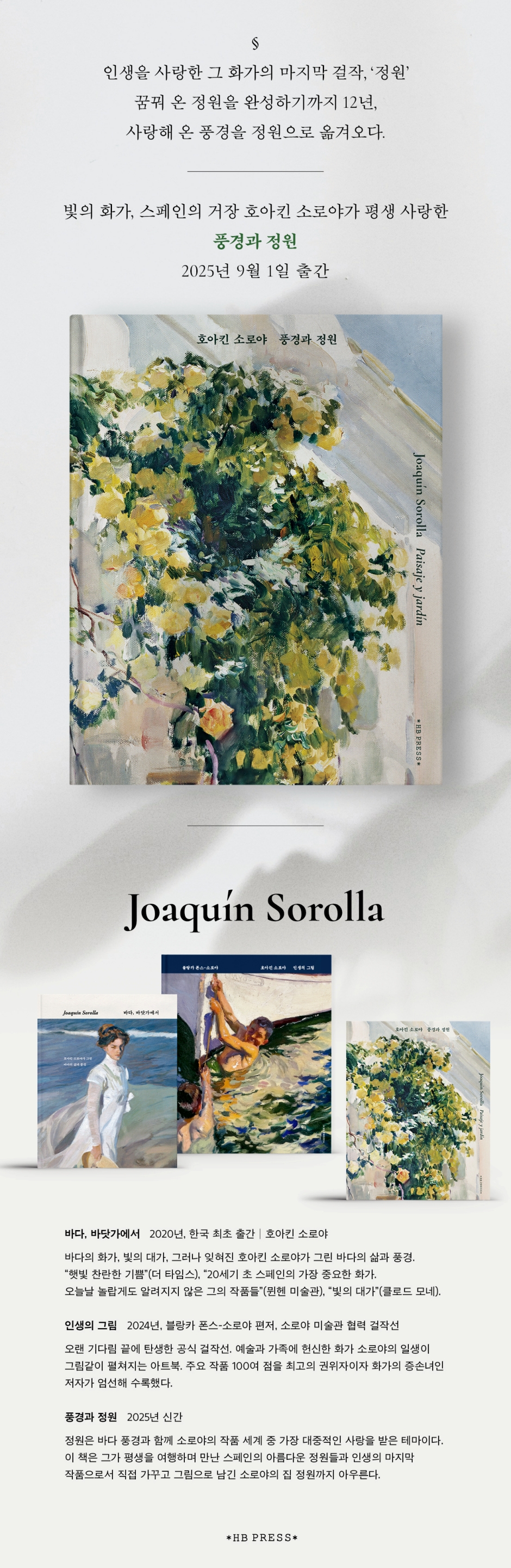
This book, "Joaquin Sorolla: Landscapes and Gardens," covers everything from the beautiful gardens of Spain that he loved (the Alcazar in Seville, the Alhambra and Generalife in Granada) to the garden of Sorolla's home, which he personally cultivated and painted as his last work.
As you turn each page of the book and reach the end, you will understand that the expressions of the landscapes the artist loved are bearing fruit and leading to his final masterpiece.
“Sorolla, who loved color, treasured the splendor and joy of Andalusia and the Mediterranean in the garden of his Madrid home.” Florencio de Santa Ana, former director of the Sorolla Museum
“Just knowing that in that faraway place, there is a small garden of a painter who sought to see and express the profound power of life, gives the traveler of long ago strength.” Kim Ha-na, author of “The Sound of the Golden Bell”
Joaquin Sorolla (1863-1923), praised by Monet, known as the painter of light, as the “master of light.”
During his 40 years as a painter, Sorolla worked tirelessly, creating 4,000 works. Unfortunately, he collapsed while painting, and his last work was left unfinished.
And for a hundred years it seemed to have fallen into a deep sleep, almost forgotten by the world outside Spain.
The Joaquin Sorolla retrospective held at the Prado Museum in Spain in 2009 was the most visited exhibition at the world-renowned Prado museum in the 21st century.
The National Gallery in London, which held Sorolla's retrospective 'Master of Light' in 2019 for the first time in 100 years, paid particular attention to his 'light'.
“Between Goya and Picasso, Sorolla was the most famous painter in Spain.
He became known for his paintings depicting the harsh realities of society, but he also gained fame for his paintings of sunny beaches and splendid gardens.
“The Mediterranean sunlight depicted by Joaquin Sorolla is timeless and unique.”
As the National Gallery notes, gardens, along with seascapes, are a deeply personal yet popular theme in Joaquín Sorolla's work.
The places where he set up his easel were either the seaside, a lush forest, or a garden.
Sorolla was fascinated by the landscapes and gardens of his hometown of Valencia and all over Spain, first drawing them with his eyes and then picking up a brush to paint them again.
When his eldest daughter Maria suffered from tuberculosis, Sorolla moved to the mountains to live with her in search of fresh air, and for the sake of his family's happiness, he began to wish for a house with a garden.
And in 1911, he finally moved to a house with a garden, Casa Sorolla, on the outskirts of Madrid.
His last works were paintings depicting various scenes from his home garden.
The artist did not even sign these paintings, which he created for pure joy.
The house and garden, which he designed and painstakingly built himself, are considered Sorolla's works in themselves.
Sorolla's garden paintings are, as he put it, "memories or impressions made to contemplate what pleases us."
This book, "Joaquin Sorolla: Landscapes and Gardens," covers everything from the beautiful gardens of Spain that he loved (the Alcazar in Seville, the Alhambra and Generalife in Granada) to the garden of Sorolla's home, which he personally cultivated and painted as his last work.
As you turn each page of the book and reach the end, you will understand that the expressions of the landscapes the artist loved are bearing fruit and leading to his final masterpiece.
“Sorolla, who loved color, treasured the splendor and joy of Andalusia and the Mediterranean in the garden of his Madrid home.” Florencio de Santa Ana, former director of the Sorolla Museum
“Just knowing that in that faraway place, there is a small garden of a painter who sought to see and express the profound power of life, gives the traveler of long ago strength.” Kim Ha-na, author of “The Sound of the Golden Bell”
- You can preview some of the book's contents.
Preview
index
Gardens of Life (Preface)
Landscapes and Gardens (Art Gallery)
The Expression of the Garden (Essay by Kim Hana)
Landscapes and Gardens (Art Gallery)
The Expression of the Garden (Essay by Kim Hana)
Detailed image
Into the book
“When the sun shines, sadness is less.” Sorolla to Pedro Gil Moreno, Javea to Paris, 1905
--- p.1
Sorolla's garden was a peaceful sanctuary, enveloping the entire house with the fragrance of flowers and the sound of flowing water.
He wanted to transfer the Spanish landscapes and gardens that inspired and impressed him as an artist into his three gardens.
The first garden in front of the house is clearly influenced by the Alcazar Palace of Seville.
In the center of the garden is a marble fountain surrounded by four flower beds, reminiscent of the fountain in the Troy Gardens painted by Sorolla at the Alcazar.
Sorolla left behind several works depicting the decoration of the building's entrance and the landscape with the fountain and the semicircular arch, as well as the landscape of the Alcazar Palace and the garden of his home.
This garden is a place of hospitality where anyone who visits Sorolla's house is warmly welcomed.
--- p.7
The garden of Sorolla's home is adorned with beautiful, colorful ceramic tiles, the floor of which was probably intended for his wife, Clotilde. In 1908, while visiting the Alcázar Palace in Seville to paint the queen's portrait, Sorolla wrote to his wife:
“This is a place you might like.
Because in this garden you will never set foot on dirt.
The floor is all paved and decorated with tiles.
“The tile fountain surrounded by gilt leaves creates a very poetic atmosphere.”
--- p.9
Sorolla painted more than 60 landscapes of the garden of his Madrid home.
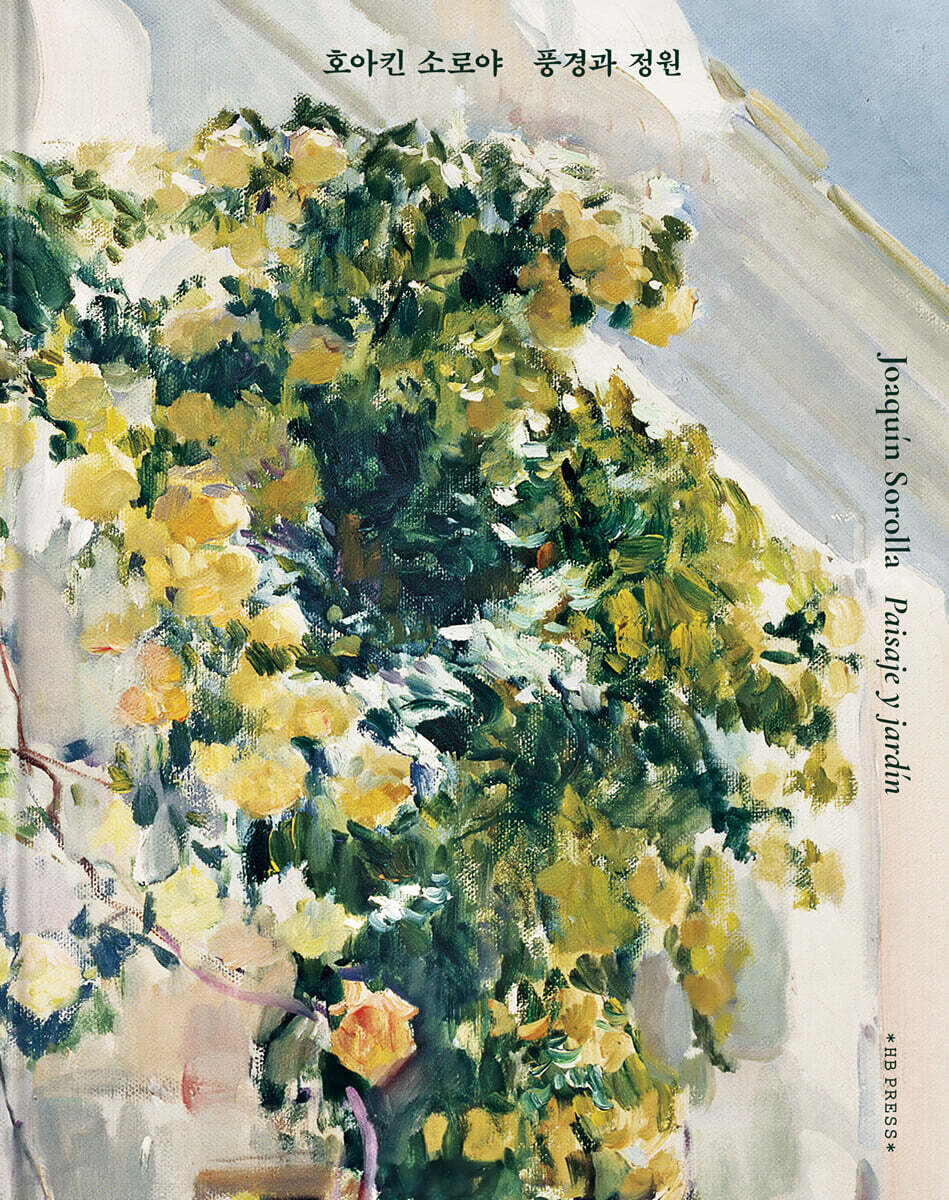
The rose bush that he planted next to the front door of his house and which bloomed brilliantly was also vividly recorded as “The Yellow Rose Bush at Sorolla’s House.”
However, it is said that after Soroya's death, the yellow rose bush became sick and withered.
“Do you remember this house ten years ago? There was a beautiful rosebush full of yellow roses by the front door.
When my father passed away, the rose bush also became sick.
It had lost its former vitality and no longer stretched its branches near the high windows to bloom.
We tried everything, but it was no use.
Six years later, when my mother also passed away, the rosebush visibly withered.
I called in a professional gardener and he took better care of it than before.
We tried to save the rose bush somehow, but it was in vain.
“The rose bush eventually died.”
--- p.10
The background of the painting is Sorolla's home and studio, located at 9 Calle Miguel Ángel, Madrid.
After twelve months of his most creative work in 1904, completing 250 paintings, Sorolla rented this house and moved in that December.
He hoped that his beloved wife Clotilde could soothe her longing for her hometown of Valencia in the garden, and he thought that his often-ill eldest daughter Maria desperately needed sunshine and fresh air.
Although he did not leave behind many paintings from this house, his family portraits, such as “Elena in the Rose Garden” (1907) and “Wife and Daughters in the Garden” (1910), are beloved masterpieces.
--- p.42
“When you see the abundant water overflowing and gushing along the small waterway, you can call it a water festival.
It's harmonious music.
As you know, those buildings are also music.
So it was a good time and I thought of you a lot.” Joaquin Sorolla, letter to Clotilde from Granada, 1917
--- p.100
Just like the beach, the painter found true joy in translating the garden onto canvas with various perspectives and nuances.
The doctor advised Sorolla, who was exhausted from working on the series "Spanish Scenes," to rest, but he did not follow it.
The gardens of Sorolla's home evoke the beauty and character of the Spanish gardens that so greatly influenced him.
The garden is also decorated with tiles he purchased during his travels, such as Clotilde in the Garden (1919) and a fountain (Fountain and Roses at Sorolla's House, 1918-1919).
One of Sorolla's last completed works, "The Garden at Sorolla's House," is also subtitled "Empty Chair."
In this scene, which lyrically expresses the happiness of enjoying sunlight and nature, the artist seems to have substituted his signature with the empty wicker chair he often sat on.
--- p.1
Sorolla's garden was a peaceful sanctuary, enveloping the entire house with the fragrance of flowers and the sound of flowing water.
He wanted to transfer the Spanish landscapes and gardens that inspired and impressed him as an artist into his three gardens.
The first garden in front of the house is clearly influenced by the Alcazar Palace of Seville.
In the center of the garden is a marble fountain surrounded by four flower beds, reminiscent of the fountain in the Troy Gardens painted by Sorolla at the Alcazar.
Sorolla left behind several works depicting the decoration of the building's entrance and the landscape with the fountain and the semicircular arch, as well as the landscape of the Alcazar Palace and the garden of his home.
This garden is a place of hospitality where anyone who visits Sorolla's house is warmly welcomed.
--- p.7
The garden of Sorolla's home is adorned with beautiful, colorful ceramic tiles, the floor of which was probably intended for his wife, Clotilde. In 1908, while visiting the Alcázar Palace in Seville to paint the queen's portrait, Sorolla wrote to his wife:
“This is a place you might like.
Because in this garden you will never set foot on dirt.
The floor is all paved and decorated with tiles.
“The tile fountain surrounded by gilt leaves creates a very poetic atmosphere.”
--- p.9
Sorolla painted more than 60 landscapes of the garden of his Madrid home.
The rose bush that he planted next to the front door of his house and which bloomed brilliantly was also vividly recorded as “The Yellow Rose Bush at Sorolla’s House.”
However, it is said that after Soroya's death, the yellow rose bush became sick and withered.
“Do you remember this house ten years ago? There was a beautiful rosebush full of yellow roses by the front door.
When my father passed away, the rose bush also became sick.
It had lost its former vitality and no longer stretched its branches near the high windows to bloom.
We tried everything, but it was no use.
Six years later, when my mother also passed away, the rosebush visibly withered.
I called in a professional gardener and he took better care of it than before.
We tried to save the rose bush somehow, but it was in vain.
“The rose bush eventually died.”
--- p.10
The background of the painting is Sorolla's home and studio, located at 9 Calle Miguel Ángel, Madrid.
After twelve months of his most creative work in 1904, completing 250 paintings, Sorolla rented this house and moved in that December.
He hoped that his beloved wife Clotilde could soothe her longing for her hometown of Valencia in the garden, and he thought that his often-ill eldest daughter Maria desperately needed sunshine and fresh air.
Although he did not leave behind many paintings from this house, his family portraits, such as “Elena in the Rose Garden” (1907) and “Wife and Daughters in the Garden” (1910), are beloved masterpieces.
--- p.42
“When you see the abundant water overflowing and gushing along the small waterway, you can call it a water festival.
It's harmonious music.
As you know, those buildings are also music.
So it was a good time and I thought of you a lot.” Joaquin Sorolla, letter to Clotilde from Granada, 1917
--- p.100
Just like the beach, the painter found true joy in translating the garden onto canvas with various perspectives and nuances.
The doctor advised Sorolla, who was exhausted from working on the series "Spanish Scenes," to rest, but he did not follow it.
The gardens of Sorolla's home evoke the beauty and character of the Spanish gardens that so greatly influenced him.
The garden is also decorated with tiles he purchased during his travels, such as Clotilde in the Garden (1919) and a fountain (Fountain and Roses at Sorolla's House, 1918-1919).
One of Sorolla's last completed works, "The Garden at Sorolla's House," is also subtitled "Empty Chair."
In this scene, which lyrically expresses the happiness of enjoying sunlight and nature, the artist seems to have substituted his signature with the empty wicker chair he often sat on.
--- p.116
Publisher's Review
Three Precious Things the Artist Loved: Family, Painting, and a Home and Garden Embracing Nature
Sorolla began to realize his dream of building a home for his family in Madrid.
He planned to incorporate the three things he had cherished throughout his life into his home and garden: family, work (painting), and nature.
Sorolla's garden was a peaceful sanctuary, enveloping the entire house with the fragrance of flowers and the sound of flowing water.
He wanted to transfer the Spanish landscapes and gardens that inspired and impressed him as an artist into his three gardens.
The first garden in front of the house is clearly influenced by the Alcazar Palace of Seville.
This garden is a place of hospitality where anyone who visits Sorolla's house is warmly welcomed.
The second garden, adjacent to the first garden, was completed most recently.
Sorolla put his heart and soul into the design, changing it several times.
The low fountains along the water channels that run through this garden create a tunnel of water in the Granadan style.
Sorolla visited Grenada in 1909 and painted the Alhambra, cityscapes, and the Sierra Nevada for the first time.
He arrived in late autumn and, despite the cloudy weather and cold temperatures (and the absence of his beloved wife? “If only you were here with me!”), completed fourteen works in eight days.
The baptismal font and washbasin purchased in Granada were placed in the second garden.
This garden also reflects Sorolla's special efforts in studying the gardens of Rome and Florence.
The third garden is the innermost one, adjacent to the studio.
Above all, this place is connected to Valencia, the painter's hometown.
In front of the fountain, a pergola, a common installation in Valencia, was built to block the hot sunlight, and the entrance steps were decorated with Valencian tiles.
“Because in this garden you will never set foot on dirt.”
A love scene for his wife Clotilde
The garden of Sorolla's home is adorned with beautiful, colorful ceramic tiles, the floor of which was probably intended for his wife, Clotilde. In 1908, while visiting the Alcázar Palace in Seville to paint the queen's portrait, Sorolla wrote to his wife:
“This is a place you might like.
Because in this garden you will never set foot on dirt.
The floor is all paved and decorated with tiles.
“The tile fountain surrounded by gilt leaves creates a very poetic atmosphere.”
While he was away from home, Sorolla would send flowers from there to his wife.
In March 1918, while staying in Seville to work on “Spanish Scenes,” he expressed his regret in a letter to his wife, saying that the flowers had not yet bloomed.
“The most beautiful month in Seville is April.
“If it weren’t for the portrait of the Empress, I would stay here and paint flowers.” Roses are known to have been the flower to which Sorolla gave the greatest attention, and they remain beautifully in his garden and in his works.
The rose bush that he planted next to the front door of his house and which bloomed brilliantly was also vividly recorded as “The Yellow Rose Bush at Sorolla’s House.”
An empty chair left behind instead of a signature on the final masterpiece
Like the beaches of his native Valencia, the gardens of his home were a source of refuge and joy for Sorolla, a subject of his paintings.
This garden could be said to have been first drawn by the artist with his eyes in order to paint, and then actually painted.
Just like the beach, the painter found true joy in translating the garden onto canvas with various perspectives and nuances.
The doctor advised Sorolla, who was exhausted from working on the Spanish Scenes series for eight years, to rest, but he did not follow it.
The gardens of Sorolla's home evoke the beauty and character of the Spanish gardens that so greatly influenced him.
The garden is also decorated with tiles he purchased during his travels, such as Clotilde in the Garden (1919) and a fountain (Fountain and Roses at Sorolla's House, 1918-1919).
One of Sorolla's last completed works, "The Garden at Sorolla's House," is also subtitled "Empty Chair."
In this scene, which lyrically expresses the happiness of enjoying sunlight and nature, the artist seems to have substituted his signature with the empty wicker chair he often sat on.
Includes author Kim Ha-na's essay "The Expression of the Garden"
“…the garden was a space where he brought to life the expressions he had kept throughout his life.
Perhaps the only things we can truly cherish in life are the memories of looking at something with love for a long time.
The power of love is always deep and strong, and even when it seems to disappear, it comes back to life and revives again.
In that small garden, where his eyes and heart were everywhere, the landscapes and memories he had carefully observed throughout his life are alive and transfer to the visitor in the form of a quiet satisfaction.
“Just knowing that in that distant place, there is a small garden of a painter who sought to see and express the deep power of life, still gives strength to the traveler of long ago.”
Joaquin Sorolla, 1863-1923
Born in Valencia, Spain.
When he was two years old, he lost both his parents to the cholera that swept through Spain and was adopted by his aunt and uncle, where he spent his childhood.
His adoptive parents supported their young nephew, who showed a talent for drawing, to attend the Valencia School of Fine Arts.
He won a regional competition at the age of twenty, and the following year he received acclaim for placing second at a national exhibition.
“If you want to get noticed and win medals here, you have to be dead.”
Sorolla, who received a scholarship to study in Rome and cultivated his inspiration in Paris, soon became a world-renowned painter with his own style, moving from naturalism to realism.
He focused on capturing the effects of light.
Claude Monet praised him as the 'master of light'.
He preferred to work outdoors, and often depicted people enjoying leisure or working on the beach, which perfectly matched the artist's intention to capture the fleeting beauty of time in his paintings.
On June 20, 1920, he collapsed in the garden of his home while painting a portrait of the wife of the writer Ramón Pérez de Ayala.
He got up with help and tried four strokes of the brush, but it was not the same as before, and the portrait was left unfinished.
He believed that “people can be truly happy when they draw,” and he left behind 4,000 works of art, 8,000 drawings, and 988 letters to his wife and children.
In 1932, his house and gardens in Madrid were opened as the National Museum of Sorolla.
Sorolla began to realize his dream of building a home for his family in Madrid.
He planned to incorporate the three things he had cherished throughout his life into his home and garden: family, work (painting), and nature.
Sorolla's garden was a peaceful sanctuary, enveloping the entire house with the fragrance of flowers and the sound of flowing water.
He wanted to transfer the Spanish landscapes and gardens that inspired and impressed him as an artist into his three gardens.
The first garden in front of the house is clearly influenced by the Alcazar Palace of Seville.
This garden is a place of hospitality where anyone who visits Sorolla's house is warmly welcomed.
The second garden, adjacent to the first garden, was completed most recently.
Sorolla put his heart and soul into the design, changing it several times.
The low fountains along the water channels that run through this garden create a tunnel of water in the Granadan style.
Sorolla visited Grenada in 1909 and painted the Alhambra, cityscapes, and the Sierra Nevada for the first time.
He arrived in late autumn and, despite the cloudy weather and cold temperatures (and the absence of his beloved wife? “If only you were here with me!”), completed fourteen works in eight days.
The baptismal font and washbasin purchased in Granada were placed in the second garden.
This garden also reflects Sorolla's special efforts in studying the gardens of Rome and Florence.
The third garden is the innermost one, adjacent to the studio.
Above all, this place is connected to Valencia, the painter's hometown.
In front of the fountain, a pergola, a common installation in Valencia, was built to block the hot sunlight, and the entrance steps were decorated with Valencian tiles.
“Because in this garden you will never set foot on dirt.”
A love scene for his wife Clotilde
The garden of Sorolla's home is adorned with beautiful, colorful ceramic tiles, the floor of which was probably intended for his wife, Clotilde. In 1908, while visiting the Alcázar Palace in Seville to paint the queen's portrait, Sorolla wrote to his wife:
“This is a place you might like.
Because in this garden you will never set foot on dirt.
The floor is all paved and decorated with tiles.
“The tile fountain surrounded by gilt leaves creates a very poetic atmosphere.”
While he was away from home, Sorolla would send flowers from there to his wife.
In March 1918, while staying in Seville to work on “Spanish Scenes,” he expressed his regret in a letter to his wife, saying that the flowers had not yet bloomed.
“The most beautiful month in Seville is April.
“If it weren’t for the portrait of the Empress, I would stay here and paint flowers.” Roses are known to have been the flower to which Sorolla gave the greatest attention, and they remain beautifully in his garden and in his works.
The rose bush that he planted next to the front door of his house and which bloomed brilliantly was also vividly recorded as “The Yellow Rose Bush at Sorolla’s House.”
An empty chair left behind instead of a signature on the final masterpiece
Like the beaches of his native Valencia, the gardens of his home were a source of refuge and joy for Sorolla, a subject of his paintings.
This garden could be said to have been first drawn by the artist with his eyes in order to paint, and then actually painted.
Just like the beach, the painter found true joy in translating the garden onto canvas with various perspectives and nuances.
The doctor advised Sorolla, who was exhausted from working on the Spanish Scenes series for eight years, to rest, but he did not follow it.
The gardens of Sorolla's home evoke the beauty and character of the Spanish gardens that so greatly influenced him.
The garden is also decorated with tiles he purchased during his travels, such as Clotilde in the Garden (1919) and a fountain (Fountain and Roses at Sorolla's House, 1918-1919).
One of Sorolla's last completed works, "The Garden at Sorolla's House," is also subtitled "Empty Chair."
In this scene, which lyrically expresses the happiness of enjoying sunlight and nature, the artist seems to have substituted his signature with the empty wicker chair he often sat on.
Includes author Kim Ha-na's essay "The Expression of the Garden"
“…the garden was a space where he brought to life the expressions he had kept throughout his life.
Perhaps the only things we can truly cherish in life are the memories of looking at something with love for a long time.
The power of love is always deep and strong, and even when it seems to disappear, it comes back to life and revives again.
In that small garden, where his eyes and heart were everywhere, the landscapes and memories he had carefully observed throughout his life are alive and transfer to the visitor in the form of a quiet satisfaction.
“Just knowing that in that distant place, there is a small garden of a painter who sought to see and express the deep power of life, still gives strength to the traveler of long ago.”
Joaquin Sorolla, 1863-1923
Born in Valencia, Spain.
When he was two years old, he lost both his parents to the cholera that swept through Spain and was adopted by his aunt and uncle, where he spent his childhood.
His adoptive parents supported their young nephew, who showed a talent for drawing, to attend the Valencia School of Fine Arts.
He won a regional competition at the age of twenty, and the following year he received acclaim for placing second at a national exhibition.
“If you want to get noticed and win medals here, you have to be dead.”
Sorolla, who received a scholarship to study in Rome and cultivated his inspiration in Paris, soon became a world-renowned painter with his own style, moving from naturalism to realism.
He focused on capturing the effects of light.
Claude Monet praised him as the 'master of light'.
He preferred to work outdoors, and often depicted people enjoying leisure or working on the beach, which perfectly matched the artist's intention to capture the fleeting beauty of time in his paintings.
On June 20, 1920, he collapsed in the garden of his home while painting a portrait of the wife of the writer Ramón Pérez de Ayala.
He got up with help and tried four strokes of the brush, but it was not the same as before, and the portrait was left unfinished.
He believed that “people can be truly happy when they draw,” and he left behind 4,000 works of art, 8,000 drawings, and 988 letters to his wife and children.
In 1932, his house and gardens in Madrid were opened as the National Museum of Sorolla.
GOODS SPECIFICS
- Date of issue: September 1, 2025
- Page count, weight, size: 136 pages | 694g | 197*248*19mm
- ISBN13: 9791190314459
- ISBN10: 1190314452
You may also like
카테고리
korean


korean

![GQ KOREA Mark (Monthly): December [2025]](http://librairie.coreenne.fr/cdn/shop/files/8ef265dbbfbf186523ed75ba7319009d.jpg?v=1765340328&width=3840)


