

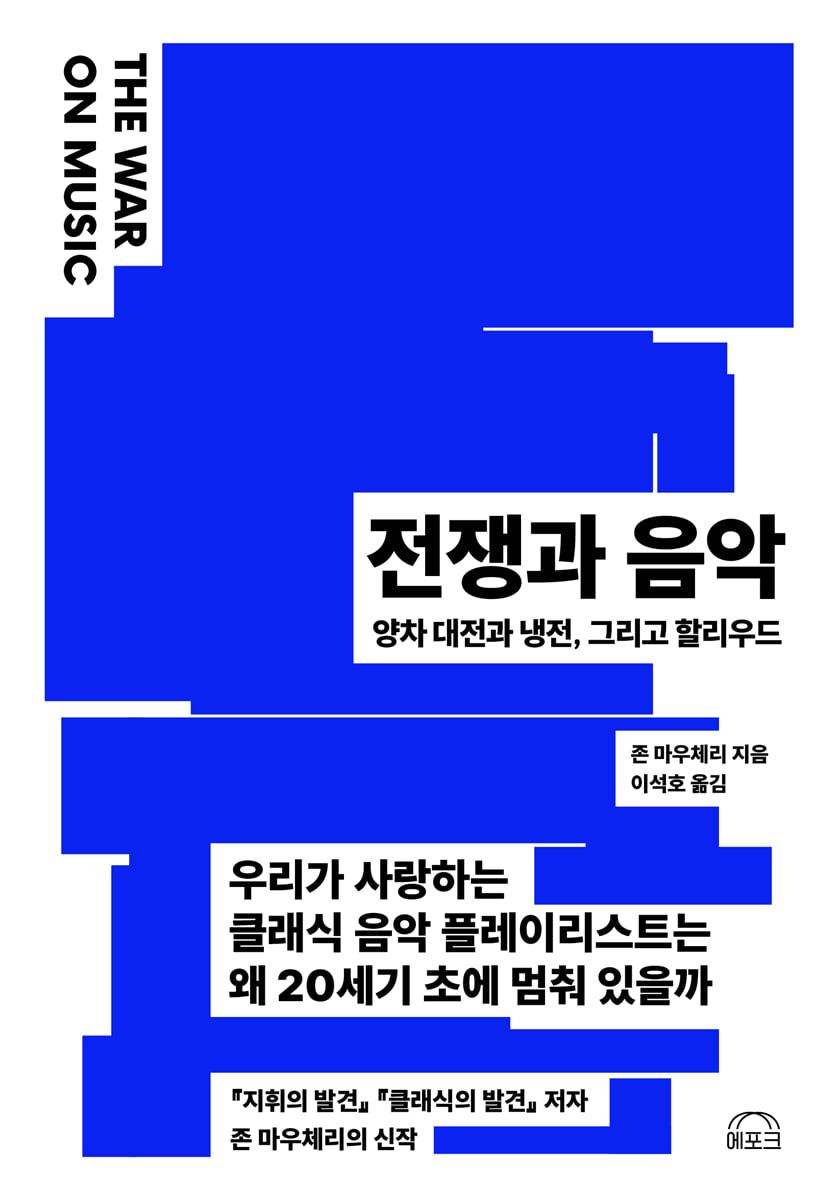
The War on Music
 |
Description
Book Introduction
Our favorite classical music playlist is
Why did it stop at the beginning of the 20th century?
A new book by John Maucheri, author of "The Discovery of Conducting" and "The Discovery of Classics."
We can break free from the dichotomous "yes" and "no" thinking that permeates the classical music world, stop the prejudice that sees popular music and serious music as competing interests, and reject the situation that treats film music like a second-class citizen.
(…) It will ultimately benefit us to confidently and guilt-freely embrace the music we already love and the unknown music that our natural curiosity leads us to.
_ From the text
Why did it stop at the beginning of the 20th century?
A new book by John Maucheri, author of "The Discovery of Conducting" and "The Discovery of Classics."
We can break free from the dichotomous "yes" and "no" thinking that permeates the classical music world, stop the prejudice that sees popular music and serious music as competing interests, and reject the situation that treats film music like a second-class citizen.
(…) It will ultimately benefit us to confidently and guilt-freely embrace the music we already love and the unknown music that our natural curiosity leads us to.
_ From the text
- You can preview some of the book's contents.
Preview
index
Introduction: Music banned in the 20th century
1. Two Parallel Universes of Classical Music
A world that has lost its emotions
2 Brahms and Wagner
What is 'new music'?
3 Stravinsky and Schoenberg
Playing Orchestral Violence | 1913, "Play" vs.
The Rite of Spring | The Sensation Created by Pierrot Lunaire | The Big Bang of Western Music
4 The Birth of 12-tone Music
Three dictators take the stage
5 Hitler and the poison that came from within
The 'decadent' music of German Jewish composers
6 Stalin and Mussolini Make Music
Official Music of the Soviet Union: Prokofiev and Shostakovich | Italian Opera Becomes a Collateral Victim
7 Film Music: A New Exit for 20th-Century Classical Music
Wagner's Theory Wins | Hollywood Composers | Music for the Eyes, Music for the Eyes
8 New Wars, Old Avant-Garde
A solution emerges: the return of the avant-garde.
9 The Cold War Defines Modern Music
America Enters the New Music Wars | Musical Aesthetics for a Free West | Timeless Art
10 Creating History, Erasing History
Common Misconceptions About Hollywood Film Scores | Oh, He Was a Film Scoring Conductor | Beware of Boulez's Reviews | Why Schoenberg Recording Commentaries Were So Critical | The Bad Reviews Continue
11 On Culture Wars and Loss
Apology for Strauss, Stravinsky, and Sibelius
12 For the unknown music that will return to us
Children of Peace | Game Music, a Truly New World
Appendix: Personal Diary
Acknowledgements
main
Search
1. Two Parallel Universes of Classical Music
A world that has lost its emotions
2 Brahms and Wagner
What is 'new music'?
3 Stravinsky and Schoenberg
Playing Orchestral Violence | 1913, "Play" vs.
The Rite of Spring | The Sensation Created by Pierrot Lunaire | The Big Bang of Western Music
4 The Birth of 12-tone Music
Three dictators take the stage
5 Hitler and the poison that came from within
The 'decadent' music of German Jewish composers
6 Stalin and Mussolini Make Music
Official Music of the Soviet Union: Prokofiev and Shostakovich | Italian Opera Becomes a Collateral Victim
7 Film Music: A New Exit for 20th-Century Classical Music
Wagner's Theory Wins | Hollywood Composers | Music for the Eyes, Music for the Eyes
8 New Wars, Old Avant-Garde
A solution emerges: the return of the avant-garde.
9 The Cold War Defines Modern Music
America Enters the New Music Wars | Musical Aesthetics for a Free West | Timeless Art
10 Creating History, Erasing History
Common Misconceptions About Hollywood Film Scores | Oh, He Was a Film Scoring Conductor | Beware of Boulez's Reviews | Why Schoenberg Recording Commentaries Were So Critical | The Bad Reviews Continue
11 On Culture Wars and Loss
Apology for Strauss, Stravinsky, and Sibelius
12 For the unknown music that will return to us
Children of Peace | Game Music, a Truly New World
Appendix: Personal Diary
Acknowledgements
main
Search
Detailed image

Into the book
New music that is labeled as new is almost always extremely complex and lacking in tonality, to the point where most people cannot understand it.
New music is sought after only by a very small minority of music lovers, and, I should add, is often written with that intention from the beginning.
How many people have approached me and confessed their dislike of "modern" music, and how many have asked me to explain this aversion to modern music? They often blame themselves for their lack of understanding of it.
(…) This phenomenon has been repeating itself for over a century.
--- p.43
Could it be that the 75-year-long gap in the classical canon has left us without a connection to engage with contemporary audiences? I was born in the era of Richard Strauss, Rachmaninoff, Stravinsky, Kurt Weill, Sibelius, Shostakovich, Prokofiev, Hindemith, Korngold, Bartók, Schoenberg, and Britten.
But who will the baby born today be able to name as a contemporary composer when he grows up?
--- p.52
All three of these dictators controlled music.
Hitler and Mussolini admired many aspects of America, and all three loved Hollywood movies, often watching them at home.
If I were to picture Stalin returning from a state banquet to watch Tarzan, or Hitler gazing intently at Snow White and the Seven Dwarfs, I would be forced to ponder the psychology of dictators who needed objects of fantasy and their reverence for the often-ridiculed American entertainment industry.
Meanwhile, Mussolini built the film village 'Cinecitta' in Rome, bringing Italy into the ranks of film-producing countries.
--- p.136
Stravinsky had the 'freedom' to write whatever music he wanted, but he suffered from the world's expectation that he should never stop being modern.
He was the eternal 'enfant terrible', who maintained his reputation and tried to "surpass it" in 1913.
Although Shostakovich was routinely cited as a leading figure in Soviet music, he was often publicly humiliated for not adhering to socialist realism.
In short, I was forced to live a life like a roller coaster with big drops.
Stravinsky's life was also like a roller coaster.
However, in Stravinsky's case, it was a roller coaster of his own choosing.
This is because he was able to catch the attention of the media by making sharp and humorous comments with a keen understanding of the times (e.g., “The only way to escape Hollywood is to live in Hollywood”).
--- p.162
What kind of new classical music should the West officially support? Whose voices should fill the concert halls and opera houses of the United States and the United Kingdom? What kind of music should audiences in Western Europe, where funding from the US government and private foundations supported new art and music, experience? (…) In any case, most of the money for Europe's reconstruction came from American pockets.
Looking back, there is an ironic aspect to it.
The idea that all new music should speak a universally accepted common language is not only totalitarian, but especially so when you consider that those who promote and facilitate it are those who fought against totalitarianism.
--- p.226
The overwhelming amount of music coming out of Tin Pan Alley, Broadway, Hollywood, and the world's great cities is because, despite all the wars, political turmoil, and philosophical debates, there is music out there that millions of people want to hear.
Even if experimental works don't last, the music people love is still with us.
(…) “Great art is neither modern nor old-fashioned, but only timeless.
…the reason why contemporary music is not welcome is not because we do not respect it, but because we do not love it.”
--- p.259
Germany has no way of honoring Kurt Weill as a living tradition.
Because Byle, his wife, and those who followed him all settled in New York.
Weill's lineage of dramatic music can be heard in the musicals of John Kander and Fred Ebb, and in the film scores of Nino Rota and Danny Elfman, who studied composition at the Curtis Institute of Music in Philadelphia, but never in Germany.
Vienna, too, failed to continue the tradition of Mahler and Strauss.
The lineage of Mahler and Strauss continued in the American symphonic tradition.
--- p.324~325
If we talk about classical music specifically, the 20th century was largely a century of loss.
The loss is painful.
One thing is clear.
We have excluded several composers whose music was once frequently performed and enjoyed.
Some might say this was normal procedure.
In any case, countless symphonies, chamber music, and operas written in the 19th century have been relegated to the side streets of history, and we accept that as a natural process of separating the wheat from the chaff.
But one difference is that the threshing operation of the mid-20th century sifted out the works and composers that had achieved sustained success, leaving them as the chaff.
Now that 75 years have passed since the end of World War II, it is time to re-establish ourselves.
The claim that you want to play but don't have a repertoire to play is just an unfounded lie.
New music is sought after only by a very small minority of music lovers, and, I should add, is often written with that intention from the beginning.
How many people have approached me and confessed their dislike of "modern" music, and how many have asked me to explain this aversion to modern music? They often blame themselves for their lack of understanding of it.
(…) This phenomenon has been repeating itself for over a century.
--- p.43
Could it be that the 75-year-long gap in the classical canon has left us without a connection to engage with contemporary audiences? I was born in the era of Richard Strauss, Rachmaninoff, Stravinsky, Kurt Weill, Sibelius, Shostakovich, Prokofiev, Hindemith, Korngold, Bartók, Schoenberg, and Britten.
But who will the baby born today be able to name as a contemporary composer when he grows up?
--- p.52
All three of these dictators controlled music.
Hitler and Mussolini admired many aspects of America, and all three loved Hollywood movies, often watching them at home.
If I were to picture Stalin returning from a state banquet to watch Tarzan, or Hitler gazing intently at Snow White and the Seven Dwarfs, I would be forced to ponder the psychology of dictators who needed objects of fantasy and their reverence for the often-ridiculed American entertainment industry.
Meanwhile, Mussolini built the film village 'Cinecitta' in Rome, bringing Italy into the ranks of film-producing countries.
--- p.136
Stravinsky had the 'freedom' to write whatever music he wanted, but he suffered from the world's expectation that he should never stop being modern.
He was the eternal 'enfant terrible', who maintained his reputation and tried to "surpass it" in 1913.
Although Shostakovich was routinely cited as a leading figure in Soviet music, he was often publicly humiliated for not adhering to socialist realism.
In short, I was forced to live a life like a roller coaster with big drops.
Stravinsky's life was also like a roller coaster.
However, in Stravinsky's case, it was a roller coaster of his own choosing.
This is because he was able to catch the attention of the media by making sharp and humorous comments with a keen understanding of the times (e.g., “The only way to escape Hollywood is to live in Hollywood”).
--- p.162
What kind of new classical music should the West officially support? Whose voices should fill the concert halls and opera houses of the United States and the United Kingdom? What kind of music should audiences in Western Europe, where funding from the US government and private foundations supported new art and music, experience? (…) In any case, most of the money for Europe's reconstruction came from American pockets.
Looking back, there is an ironic aspect to it.
The idea that all new music should speak a universally accepted common language is not only totalitarian, but especially so when you consider that those who promote and facilitate it are those who fought against totalitarianism.
--- p.226
The overwhelming amount of music coming out of Tin Pan Alley, Broadway, Hollywood, and the world's great cities is because, despite all the wars, political turmoil, and philosophical debates, there is music out there that millions of people want to hear.
Even if experimental works don't last, the music people love is still with us.
(…) “Great art is neither modern nor old-fashioned, but only timeless.
…the reason why contemporary music is not welcome is not because we do not respect it, but because we do not love it.”
--- p.259
Germany has no way of honoring Kurt Weill as a living tradition.
Because Byle, his wife, and those who followed him all settled in New York.
Weill's lineage of dramatic music can be heard in the musicals of John Kander and Fred Ebb, and in the film scores of Nino Rota and Danny Elfman, who studied composition at the Curtis Institute of Music in Philadelphia, but never in Germany.
Vienna, too, failed to continue the tradition of Mahler and Strauss.
The lineage of Mahler and Strauss continued in the American symphonic tradition.
--- p.324~325
If we talk about classical music specifically, the 20th century was largely a century of loss.
The loss is painful.
One thing is clear.
We have excluded several composers whose music was once frequently performed and enjoyed.
Some might say this was normal procedure.
In any case, countless symphonies, chamber music, and operas written in the 19th century have been relegated to the side streets of history, and we accept that as a natural process of separating the wheat from the chaff.
But one difference is that the threshing operation of the mid-20th century sifted out the works and composers that had achieved sustained success, leaving them as the chaff.
Now that 75 years have passed since the end of World War II, it is time to re-establish ourselves.
The claim that you want to play but don't have a repertoire to play is just an unfounded lie.
--- p.341
Publisher's Review
Even now, half a century later
Why we don't play the music Hitler banned
I search for performances to attend a classical music concert.
We are presented with numerous performances, including regular concerts by various orchestras as well as invited collaborations with world-renowned conductors and performers.
What kind of music will they play for us? We see works by Mozart, Beethoven, and Brahms, familiar to classical music lovers.
There are also Debussy, Ravel, Rachmaninoff, Sibelius, and Verdi.
If you like Stravinsky, Shostakovich, Prokofiev, and Mahler, who have only recently come into the spotlight, you're in luck.
The music that can generally be called the 'standard repertoire' of classical music is always waiting for us.
The same goes for the playlists of classical music radio stations.
Perhaps we have never once questioned this familiar classical repertoire.
You may already think that there is enough to enjoy, as great performers and conductors each interpret and present the excellent music that proves why classical music is classical in their own way.
But if you think about it, isn't it strange?
While other art forms, such as popular music, Broadway, literature, painting, architecture, theater, and film, have produced countless masterpieces that remain beloved worldwide even in recent times, classical music has had relatively few immortal works since the 1950s.
What is the reason?
Conductor John Maucheri, who has broadened the horizons of classical music appreciation for Korean readers with 『Discovery of Conducting』, which vividly shows the conductor's life and artistic world, and 『Discovery of Classics』, which explains in detail the joy of listening to music and the standard repertoire of classical music, uncovers the secrets of 20th century classical music that have disappeared from the history of classical music through his new work 『War and Music』.
One day in 1990, the author was asked, “Why, after half a century, do we still not play the music that Hitler banned?”
For over 30 years since then, as a conductor and music educator, he has been explaining this situation and raising issues through various activities such as albums, concerts, articles, speeches, media appearances, and lectures.
“I didn’t start writing this book with the intention of proving my point,” says Maucheri.
“It was after many years of living, listening, thinking, and acting that my argument took on the form of a logic,” he says.
Unraveling the tangled web of history and music was no easy task.
Two World Wars and Dictators: Hitler, Stalin, and Mussolini Decide What Music to Listen to
The 20th century was truly a century of war, with two world wars and the equally profound Cold War.
It may come as a surprise to many that music, a singularly invisible art form, and classical music in particular, was used as a strategic element in the great wars of the last century, thus extinguishing the classical canon.
How did classical music become a national symbol and weapon?
How did music end up becoming a victim of the whirlwind of history?
The early 20th century, with the looming threat of World War I, was a time of near-madness in the vitality and diversity of the art world.
The depiction of violence in music, which began in Wagner's operas, became more prominent with Puccini and Richard Strauss, and the violence and sensationalism of the Ballets Russes led by Sergei Diaghilev captivated people.
Numerous 'schools' and 'isms' swept through Europe, including Futurism, Cubism, Expressionism, and Surrealism.
Music also responded to this trend.
The music was born, disorienting the listener with its unpredictable rhythms and abandoning the tonality that had developed over centuries.
It was music represented by Stravinsky's "The Rite of Spring" and Schoenberg's "Pierrot Lunaire."
Countries that have endured brutal wars need policies to foster national pride and identity.
Thus, after World War I, music took on the role of a spokesman for political philosophy.
The dictators who emerged in the century of war—Hitler, Stalin, and Mussolini—felt the need to control music to control people's behavior, and they demanded a specific musical style that would give their regimes an official sound.
Hitler banned the performance of numerous works under the vague label of "degenerate music," and persecuted Jewish composers.
Stalin limited the scope of creation to 'socialist realism'.
Mussolini put a muzzle on 'experimental' music.
As a result, many composers who had created sensations in their respective countries had to make difficult choices that would put their own fate and that of their families at stake.
The author highlights four representative German composers: Arnold Schoenberg, Erich Wolfgang Korngold, Paul Hindemith, and Kurt Weill, and sheds new light on their musical lives and underappreciated works.
The Cold War and the Culture Wars: The Avant-Garde and Contemporary Music
Meanwhile, after two wars that had resulted in enormous sacrifices, the international order was rapidly reorganized as the world laid down its arms.
The Soviet Union, which had been an ally of the United States during World War II, now emerged as a far greater threat to the United States than the Nazis and fascists.
Nations that had only recently been enemies joined forces to fight another war against Soviet communism.
We have entered the so-called Cold War era.
The United States, which raised the banner of freedom, joined hands with Europe under the pretext of helping the defeated countries rebuild, and music once again took the lead on the battlefield.
The Western world, led by the United States, began the process of 'denazifying' the music industry.
It also presented the 'avant-garde' as a representative of the Western world against Soviet socialist realism.
The avant-garde, which championed innovation and freedom of expression, fought in the cultural battlefield with the secret support of the state.
The avant-garde, completely absorbed into the establishment, became 20th century modern music itself.
In the process, the works written in the United States by exiled composers who distanced themselves from the avant-garde line were devalued for various reasons and were reluctant to be performed, and at some point they disappeared from concert halls.
Contemporary music has been blessed with the approval of donors, critics, and institutions, but this trinity has been missing the 'audience'.
The distance between contemporary music and its listeners has grown increasingly distant.
What fills the void between music discarded and music ignored by audiences? The author addresses this matter-of-factly.
There was no music to replace that spot, and the void remained a void.
As a result, concert halls ended up presenting only the "standard repertoire" of works written between 1710 and 1930, and we ended up living in an era where we could not easily recall the contemporary classical music we loved or the names of the great classical composers who are still alive today.
Film scores, an important puzzle piece of 20th-century classical music
The author questions the boundaries of what we commonly define as 'classical' music, and argues that film scores are an essential piece in the puzzle of 20th-century classical music.
The art of film, invented in the late 19th century and undergoing revolutionary development in the early 20th century, provided another escape route for classical composers who were at a dead end in life.
The author defines Wagner as the direct ancestor of film music.
Just as Wagner composed the motif for Siegfried in Der Ring des Nibelungen, composer Max Steiner composed the 'Theme for Tara' in Gone with the Wind.
Steiner said, “The idea of film music came from Wagner.
“If Wagner had been born in the 20th century, he would have undoubtedly become the greatest film composer,” he said.
Jewish composers who experienced firsthand the effectiveness of Wagner's way of synchronizing music and movement and who knew Wagner's grammar, such as the leitmotif technique, became successors to classical music through another path: film music.
The first generation of composers who wrote music for Hollywood sound films were also "degenerate musicians" whom Hitler had put on his list of dangerous producers of illegal music.
American-born film composers who learned from the first generation of composers wrote some of the most beautiful and wonderful symphonies, but music critics and academic experts only dealt with music within the establishment, belittling and ignoring their music with the term "movie music."
Many prejudices against Hollywood music ('they use Mickey Mouse music', 'they use material stolen from past classical masters', 'film composers compete on quantity over quality', 'film music is not for appreciation', etc.) have become engraved in our perception.
It's time to reclaim the 20th-century music we've lost.
Now, a quarter of a century into the 21st century, things may have improved a little compared to before.
Now, our concert halls resonate with the soundtracks of John Williams' films, Studio Ghibli's film scores, and we often host game music concerts as well.
But this is just the beginning, the author says.
We have countless forgotten composers and works that don't belong in either the established classical music or popular film music.
It is the job of musicians to discover and perform such music, but this requires the support of the public who wants to listen to music.
The so-called "Monuments Men," responsible for finding art looted and stolen by the Nazis, were unfortunately unable to recover the lost music.
How can we recover music, the invisible art?
The author emphasizes that the only way to unravel this vast and complex story is to “play music.”
He says that we should open our hearts to music that has been lost to time and encourage living composers to sing with their own unique voices.
Such efforts will bring back to us the music that has been taken away from us.
Of course, it's okay to just stick to the music I like.
But the world of music is endless and the list of music that can make us happy is also long.
Isn't it a bit of a waste to leave it as it is now?
For those who call themselves classical music lovers but find themselves stuck in works from before the 20th century, or for those who find contemporary music too difficult, this book will spark their curiosity about unfamiliar music and provide clear answers to their questions.
Why we don't play the music Hitler banned
I search for performances to attend a classical music concert.
We are presented with numerous performances, including regular concerts by various orchestras as well as invited collaborations with world-renowned conductors and performers.
What kind of music will they play for us? We see works by Mozart, Beethoven, and Brahms, familiar to classical music lovers.
There are also Debussy, Ravel, Rachmaninoff, Sibelius, and Verdi.
If you like Stravinsky, Shostakovich, Prokofiev, and Mahler, who have only recently come into the spotlight, you're in luck.
The music that can generally be called the 'standard repertoire' of classical music is always waiting for us.
The same goes for the playlists of classical music radio stations.
Perhaps we have never once questioned this familiar classical repertoire.
You may already think that there is enough to enjoy, as great performers and conductors each interpret and present the excellent music that proves why classical music is classical in their own way.
But if you think about it, isn't it strange?
While other art forms, such as popular music, Broadway, literature, painting, architecture, theater, and film, have produced countless masterpieces that remain beloved worldwide even in recent times, classical music has had relatively few immortal works since the 1950s.
What is the reason?
Conductor John Maucheri, who has broadened the horizons of classical music appreciation for Korean readers with 『Discovery of Conducting』, which vividly shows the conductor's life and artistic world, and 『Discovery of Classics』, which explains in detail the joy of listening to music and the standard repertoire of classical music, uncovers the secrets of 20th century classical music that have disappeared from the history of classical music through his new work 『War and Music』.
One day in 1990, the author was asked, “Why, after half a century, do we still not play the music that Hitler banned?”
For over 30 years since then, as a conductor and music educator, he has been explaining this situation and raising issues through various activities such as albums, concerts, articles, speeches, media appearances, and lectures.
“I didn’t start writing this book with the intention of proving my point,” says Maucheri.
“It was after many years of living, listening, thinking, and acting that my argument took on the form of a logic,” he says.
Unraveling the tangled web of history and music was no easy task.
Two World Wars and Dictators: Hitler, Stalin, and Mussolini Decide What Music to Listen to
The 20th century was truly a century of war, with two world wars and the equally profound Cold War.
It may come as a surprise to many that music, a singularly invisible art form, and classical music in particular, was used as a strategic element in the great wars of the last century, thus extinguishing the classical canon.
How did classical music become a national symbol and weapon?
How did music end up becoming a victim of the whirlwind of history?
The early 20th century, with the looming threat of World War I, was a time of near-madness in the vitality and diversity of the art world.
The depiction of violence in music, which began in Wagner's operas, became more prominent with Puccini and Richard Strauss, and the violence and sensationalism of the Ballets Russes led by Sergei Diaghilev captivated people.
Numerous 'schools' and 'isms' swept through Europe, including Futurism, Cubism, Expressionism, and Surrealism.
Music also responded to this trend.
The music was born, disorienting the listener with its unpredictable rhythms and abandoning the tonality that had developed over centuries.
It was music represented by Stravinsky's "The Rite of Spring" and Schoenberg's "Pierrot Lunaire."
Countries that have endured brutal wars need policies to foster national pride and identity.
Thus, after World War I, music took on the role of a spokesman for political philosophy.
The dictators who emerged in the century of war—Hitler, Stalin, and Mussolini—felt the need to control music to control people's behavior, and they demanded a specific musical style that would give their regimes an official sound.
Hitler banned the performance of numerous works under the vague label of "degenerate music," and persecuted Jewish composers.
Stalin limited the scope of creation to 'socialist realism'.
Mussolini put a muzzle on 'experimental' music.
As a result, many composers who had created sensations in their respective countries had to make difficult choices that would put their own fate and that of their families at stake.
The author highlights four representative German composers: Arnold Schoenberg, Erich Wolfgang Korngold, Paul Hindemith, and Kurt Weill, and sheds new light on their musical lives and underappreciated works.
The Cold War and the Culture Wars: The Avant-Garde and Contemporary Music
Meanwhile, after two wars that had resulted in enormous sacrifices, the international order was rapidly reorganized as the world laid down its arms.
The Soviet Union, which had been an ally of the United States during World War II, now emerged as a far greater threat to the United States than the Nazis and fascists.
Nations that had only recently been enemies joined forces to fight another war against Soviet communism.
We have entered the so-called Cold War era.
The United States, which raised the banner of freedom, joined hands with Europe under the pretext of helping the defeated countries rebuild, and music once again took the lead on the battlefield.
The Western world, led by the United States, began the process of 'denazifying' the music industry.
It also presented the 'avant-garde' as a representative of the Western world against Soviet socialist realism.
The avant-garde, which championed innovation and freedom of expression, fought in the cultural battlefield with the secret support of the state.
The avant-garde, completely absorbed into the establishment, became 20th century modern music itself.
In the process, the works written in the United States by exiled composers who distanced themselves from the avant-garde line were devalued for various reasons and were reluctant to be performed, and at some point they disappeared from concert halls.
Contemporary music has been blessed with the approval of donors, critics, and institutions, but this trinity has been missing the 'audience'.
The distance between contemporary music and its listeners has grown increasingly distant.
What fills the void between music discarded and music ignored by audiences? The author addresses this matter-of-factly.
There was no music to replace that spot, and the void remained a void.
As a result, concert halls ended up presenting only the "standard repertoire" of works written between 1710 and 1930, and we ended up living in an era where we could not easily recall the contemporary classical music we loved or the names of the great classical composers who are still alive today.
Film scores, an important puzzle piece of 20th-century classical music
The author questions the boundaries of what we commonly define as 'classical' music, and argues that film scores are an essential piece in the puzzle of 20th-century classical music.
The art of film, invented in the late 19th century and undergoing revolutionary development in the early 20th century, provided another escape route for classical composers who were at a dead end in life.
The author defines Wagner as the direct ancestor of film music.
Just as Wagner composed the motif for Siegfried in Der Ring des Nibelungen, composer Max Steiner composed the 'Theme for Tara' in Gone with the Wind.
Steiner said, “The idea of film music came from Wagner.
“If Wagner had been born in the 20th century, he would have undoubtedly become the greatest film composer,” he said.
Jewish composers who experienced firsthand the effectiveness of Wagner's way of synchronizing music and movement and who knew Wagner's grammar, such as the leitmotif technique, became successors to classical music through another path: film music.
The first generation of composers who wrote music for Hollywood sound films were also "degenerate musicians" whom Hitler had put on his list of dangerous producers of illegal music.
American-born film composers who learned from the first generation of composers wrote some of the most beautiful and wonderful symphonies, but music critics and academic experts only dealt with music within the establishment, belittling and ignoring their music with the term "movie music."
Many prejudices against Hollywood music ('they use Mickey Mouse music', 'they use material stolen from past classical masters', 'film composers compete on quantity over quality', 'film music is not for appreciation', etc.) have become engraved in our perception.
It's time to reclaim the 20th-century music we've lost.
Now, a quarter of a century into the 21st century, things may have improved a little compared to before.
Now, our concert halls resonate with the soundtracks of John Williams' films, Studio Ghibli's film scores, and we often host game music concerts as well.
But this is just the beginning, the author says.
We have countless forgotten composers and works that don't belong in either the established classical music or popular film music.
It is the job of musicians to discover and perform such music, but this requires the support of the public who wants to listen to music.
The so-called "Monuments Men," responsible for finding art looted and stolen by the Nazis, were unfortunately unable to recover the lost music.
How can we recover music, the invisible art?
The author emphasizes that the only way to unravel this vast and complex story is to “play music.”
He says that we should open our hearts to music that has been lost to time and encourage living composers to sing with their own unique voices.
Such efforts will bring back to us the music that has been taken away from us.
Of course, it's okay to just stick to the music I like.
But the world of music is endless and the list of music that can make us happy is also long.
Isn't it a bit of a waste to leave it as it is now?
For those who call themselves classical music lovers but find themselves stuck in works from before the 20th century, or for those who find contemporary music too difficult, this book will spark their curiosity about unfamiliar music and provide clear answers to their questions.
GOODS SPECIFICS
- Date of issue: July 14, 2025
- Page count, weight, size: 420 pages | 526g | 141*200*27mm
- ISBN13: 9791199126626
- ISBN10: 1199126624
You may also like
카테고리
korean


korean

![GQ KOREA Mark (Monthly): December [2025]](http://librairie.coreenne.fr/cdn/shop/files/8ef265dbbfbf186523ed75ba7319009d.jpg?v=1765340328&width=3840)


