

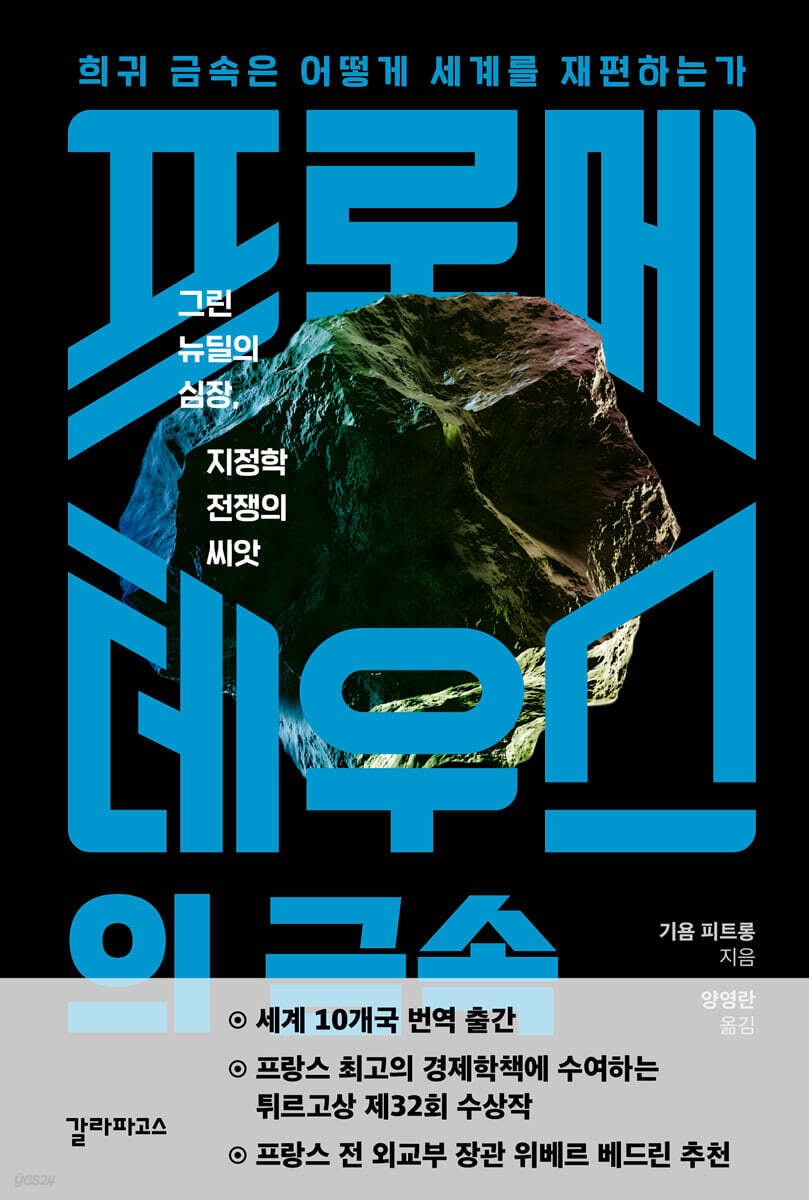
Prometheus's metal
 |
Description
Book Introduction
The history of humanity is the history of energy transition.
Coal in the 19th century, oil in the 20th century, and rare metals in the 21st century
Rare metals, often called the "next-generation oil," are at the heart of the eco-friendly capitalism that the world is pursuing.
Because it is an energy source that can replace oil and coal to achieve carbon neutrality, and is an essential strategic resource for high-tech industries and military weapons.
In the age of carbon neutrality, what resources does the world depend on now?
How is a Green New Deal possible?
What is the reality of the global trade war and territorial disputes?
The energy transition is now a global task, and China monopolizes the production of most of the rare earth metals that are key to its success.
What does this mean and what changes will it bring?
What are the environmental, economic, and geopolitical costs of our dependence on rare metals?
To answer these questions, the author and his research team spent six years reporting directly from the field in 12 countries.
From China's rare earth Silicon Valley to America's largest mining region and the Bafokeng Kingdom deep in the forests of West Africa, I have been in the heart of the rare metals war, and this book documents the process of my fierce field investigation.
Coal in the 19th century, oil in the 20th century, and rare metals in the 21st century
Rare metals, often called the "next-generation oil," are at the heart of the eco-friendly capitalism that the world is pursuing.
Because it is an energy source that can replace oil and coal to achieve carbon neutrality, and is an essential strategic resource for high-tech industries and military weapons.
In the age of carbon neutrality, what resources does the world depend on now?
How is a Green New Deal possible?
What is the reality of the global trade war and territorial disputes?
The energy transition is now a global task, and China monopolizes the production of most of the rare earth metals that are key to its success.
What does this mean and what changes will it bring?
What are the environmental, economic, and geopolitical costs of our dependence on rare metals?
To answer these questions, the author and his research team spent six years reporting directly from the field in 12 countries.
From China's rare earth Silicon Valley to America's largest mining region and the Bafokeng Kingdom deep in the forests of West Africa, I have been in the heart of the rare metals war, and this book documents the process of my fierce field investigation.
- You can preview some of the book's contents.
Preview
index
In the revised edition
Introduction
Chapter 1: The Curse of the Rare Metal
- What are rare metals?
A Brief History of the Energy Transition and Technological Revolution
- Runaway consumption of rare metals
The Reality of the Jiangxi Province Rare Earth Black Market
- Bread = Rock, Salt = Rare Metal
- Baotou Cancer Patient Village
- Economic dumping and environmental dumping
- Does sustainable mining exist?
Chapter 2: A Green World Reliant on Dirty Metals
Green technology is not green.
- The materiality of invisible things
- The future of an eco-friendly circular economy
- Return waste
- The illusion of a new era of abundance
Chapter 3: The Imperfectly Unethical Economic Logic
- When the United States dominated the rare earth market
Why France Abandoned Mining
- Impeccable economic logic
- Betrayal of an optimistic outlook
- The Cargo Cult of the 21st Century
Chapter 4: The World Trade War
- Beijing, the new owner of rare metals
- The first ban that hindered the energy transition
- The long-standing conflict surrounding the Senkaku Islands
- In search of the Platinum Queen of the Bafokeng Kingdom
- Resource nationalism is on the rise
- Secret rare metals market
Chapter 5: The High-Tech War
- Battle over a super-strong magnet
The West's Deindustrialization Odyssey
- In search of the Silicon Valley of rare earth elements
- Mining Vision for Indonesia and Africa
Chapter 6: Everything You Need to Know About Chinese Capitalism, Which Overtook the West
- Chinese high-tech Colbertism
- Remarkable technological advancements
- The great transfer of wealth
- The smile of authoritarian capitalism
Chapter 7: Geopolitics and Military Warfare
- Dog shampoo and ultra-precision missiles
- Deng Xiaoping's double agent
- Chinagate and Johnny with the money bag
- Disputes surrounding the strategically important South China Sea
- The Pentagon swaying to China's magnet
Chapter 8: The Future of Energy Transition
- Will we enter an era of metal deficiency?
- Energy transition and digital transformation at risk
- Mining fronts are growing like mushrooms
Chapter 9: The Final Frontier
- Should mining resume?
Countries that are conquering the blue economy
- Humanity's last new continent, space
Going out words
Acknowledgements
Recommendation
supplement
main
References
Introduction
Chapter 1: The Curse of the Rare Metal
- What are rare metals?
A Brief History of the Energy Transition and Technological Revolution
- Runaway consumption of rare metals
The Reality of the Jiangxi Province Rare Earth Black Market
- Bread = Rock, Salt = Rare Metal
- Baotou Cancer Patient Village
- Economic dumping and environmental dumping
- Does sustainable mining exist?
Chapter 2: A Green World Reliant on Dirty Metals
Green technology is not green.
- The materiality of invisible things
- The future of an eco-friendly circular economy
- Return waste
- The illusion of a new era of abundance
Chapter 3: The Imperfectly Unethical Economic Logic
- When the United States dominated the rare earth market
Why France Abandoned Mining
- Impeccable economic logic
- Betrayal of an optimistic outlook
- The Cargo Cult of the 21st Century
Chapter 4: The World Trade War
- Beijing, the new owner of rare metals
- The first ban that hindered the energy transition
- The long-standing conflict surrounding the Senkaku Islands
- In search of the Platinum Queen of the Bafokeng Kingdom
- Resource nationalism is on the rise
- Secret rare metals market
Chapter 5: The High-Tech War
- Battle over a super-strong magnet
The West's Deindustrialization Odyssey
- In search of the Silicon Valley of rare earth elements
- Mining Vision for Indonesia and Africa
Chapter 6: Everything You Need to Know About Chinese Capitalism, Which Overtook the West
- Chinese high-tech Colbertism
- Remarkable technological advancements
- The great transfer of wealth
- The smile of authoritarian capitalism
Chapter 7: Geopolitics and Military Warfare
- Dog shampoo and ultra-precision missiles
- Deng Xiaoping's double agent
- Chinagate and Johnny with the money bag
- Disputes surrounding the strategically important South China Sea
- The Pentagon swaying to China's magnet
Chapter 8: The Future of Energy Transition
- Will we enter an era of metal deficiency?
- Energy transition and digital transformation at risk
- Mining fronts are growing like mushrooms
Chapter 9: The Final Frontier
- Should mining resume?
Countries that are conquering the blue economy
- Humanity's last new continent, space
Going out words
Acknowledgements
Recommendation
supplement
main
References
Into the book
The United States has been addressing the rare metals issue from a national security perspective for the past two years.
Every time China made a threat, the American military had no choice but to shrink.
Because manufacturing smart missiles, Abrams tanks, and F-35 stealth fighters uses huge amounts of rare metals.
Therefore, the trade war with China was soon a matter directly related to America's national security.
--- p.10, from “Presenting the Revised Edition”
Energy transition and digital transformation require launching numerous satellites high into the sky.
This requires a launch vehicle to launch the satellite into space, as well as a massive number of computers to determine the proper orbit, transmit the appropriate waves, and encrypt the communications of digital devices.
Of course, a supercomputer division capable of analyzing the exploding data must also be mobilized.
To transmit information in real time, we need a global network of submarine cables, a densely connected terrestrial and underground power grid, millions of information processing terminals, countless data storage centers, billions of tablet PCs, smartphones, and all kinds of IoT devices, batteries, and chargers.
To achieve dematerialization, one must endure such a huge physical impact.
So the so-called happy advance into the era of dematerialization is nothing but a deception.
To create this massive beast called the digital Leviathan, we need, paradoxically, power plants burning coal, oil, and natural gas, nuclear power plants, wind power plants, and solar power plants, as well as intelligent networks.
And to build all this infrastructure, we need rare metals.
--- p.69, from “The Materiality of Invisible Things”
But while China, Congo, and Kazakhstan were devastated by irresponsible mining, what were Western countries like the United States and Europe doing? Is it truly the fault of China, Congo, and Kazakhstan alone that things have come to this point? No, we must ask again.
Are the United States and Europe truly qualified to criticize China, the Congo, or Kazakhstan? Who entrusted these countries with mining metals in harsh environments, knowing full well they would destroy the environment?
--- p.84, from “The Illusion of a New Age of Abundance”
The Chinese government launched a massive trade scheme to shift the center of its mining production from the West to the East, a strategy it continues to employ today.
China's strategy can be summarized in one word: 'dumping.'
It is economic dumping because the cost of production has been drastically reduced, and it is environmental dumping because the cost of pollution prevention has not been covered.
In 2002, the average price of one kilogram of rare earth elements produced in China was $2.80, which was twice as low as in the United States.
While the West stood by, China swept the rare metals market.
“Europe and the United States were well aware of the high cost of obtaining rare earths without polluting the environment,” asserts a French expert.
“And we also knew that China was mining rare earths while destroying their environment.
But I chose to pretend not to know.”
--- p.90~91, from “When the United States Dominated the Rare Earth Market”
Manufacturers facing rare earth supply problems have been forced to choose between two undesirable paths.
The options were to either maintain the factory in place, enduring unstable raw material supplies and slow operating speeds, or move the factory to China in exchange for unlimited raw material supplies.
Japan did not struggle long with this dilemma.
“Japan, starved for raw materials, quickly left for China, taking their valuable technology with them,” said one British analyst.
(…) Until the late 1990s, Japan, the United States, and Europe controlled 90 percent of the magnet market, but now China accounts for three-quarters of global magnet production.
In short, China, which had a monopoly on mineral production, secured a monopoly on mineral processing technology by threatening to “give up the technology if you want the resources.”
--- p.140, from “The West’s Deindustrialization Odyssey”
“The authoritarian capitalism that China has achieved will be a very encouraging phenomenon for other dictatorships,” analyzed an Indian university professor.
Because it has proven that it can guarantee both robust economic growth and political stability.
Therefore, in the future, emerging countries may seek to model themselves after the 'Beijing Consensus', or China's economic development model.
The Beijing consensus directly contradicts the Washington consensus, which asserts that economic development and democratic progress are inextricably linked.
Therefore, the argument that the rare metals war and the green industry jobs war are ideological conflicts between China and the West is indeed valid.
--- p.169, from “The Smile of Authoritarian Capitalism”
Our research team gave Jean-Yves Dumusot a small camera and asked him to take videos of the inside of the factory.
(…) “China now makes electric cars, luminescent materials, and even wind turbines.
“We have to assume that they have taken control of the entire value chain,” our insider continued.
“Furthermore, according to the enthusiastic promotion by Seon Yong-geo, Baotou produces 10,000 tons of abrasive materials, 1,000 tons of catalyst minerals, and 300 tons of luminescent materials.” Baotou is no longer introduced as a dirty mining area.
China prefers the term "rare earth Silicon Valley."
--- p.143, from “In Search of the Silicon Valley of Rare Earth Elements”
Indonesia, which accounts for 34 percent of global tin production, is the world's leading exporter of this "high-tech mineral." Since 2014, Indonesia has prohibited the export of any minerals mined from its soil (whether sand, nickel, or diamonds) in their original state.
The Indonesian government explained the reason as, 'Because we will refine the minerals and sell them as finished products.'
As the Chinese case has shown, these policies have proven to be a brilliant strategy for generating enormous wealth.
Calculations show that if value added were preserved in this way, Indonesia's profits could increase fourfold for iron, sevenfold for tin and copper, even eighteenfold for bauxite, and twentyfold for nickel.
--- p.149, from “Mining Visions for Indonesia and Africa”
In 2017, US-based MP Materials acquired Mountain Pass after China's Chinalco Group expressed interest in acquiring the mine in California.
However, part of MP Materials' shares were held by Shenghe Resources Holdings, a Chinese mining company.43 China is also a prominent investor in other competing companies.
Shenghe Resources Holdings is the majority shareholder of Greenland's Kvanefield mine, which is rich in uranium and rare earth minerals.
Wouldn't this be a brilliant strategy and a brilliant way to prevent the emergence of a deadly competitor?
--- p.209, from “Mining Fronts Growing Like Bamboo Shoots After a Rain”
The world is waking up to the fact that the oceans, which cover 71 percent of the Earth's surface, are not just liquid deserts teeming with fish.
We are discovering that there is immense potential in the so-called 'blue economy', or ocean-based economic activities.
The battle over rare earths (and the energy transition and digital transformation) is now fought not only on land but also at sea.
A new mining boom will hit.
Canadian company Nautilus is gearing up for mineral exploration in the waters off Papua New Guinea and has secured about 20 submarine sites for future operations.
Unable to stand idly by while other countries are busy, China has designed a submersible capable of exploring the ocean floor at record depths.
Every time China made a threat, the American military had no choice but to shrink.
Because manufacturing smart missiles, Abrams tanks, and F-35 stealth fighters uses huge amounts of rare metals.
Therefore, the trade war with China was soon a matter directly related to America's national security.
--- p.10, from “Presenting the Revised Edition”
Energy transition and digital transformation require launching numerous satellites high into the sky.
This requires a launch vehicle to launch the satellite into space, as well as a massive number of computers to determine the proper orbit, transmit the appropriate waves, and encrypt the communications of digital devices.
Of course, a supercomputer division capable of analyzing the exploding data must also be mobilized.
To transmit information in real time, we need a global network of submarine cables, a densely connected terrestrial and underground power grid, millions of information processing terminals, countless data storage centers, billions of tablet PCs, smartphones, and all kinds of IoT devices, batteries, and chargers.
To achieve dematerialization, one must endure such a huge physical impact.
So the so-called happy advance into the era of dematerialization is nothing but a deception.
To create this massive beast called the digital Leviathan, we need, paradoxically, power plants burning coal, oil, and natural gas, nuclear power plants, wind power plants, and solar power plants, as well as intelligent networks.
And to build all this infrastructure, we need rare metals.
--- p.69, from “The Materiality of Invisible Things”
But while China, Congo, and Kazakhstan were devastated by irresponsible mining, what were Western countries like the United States and Europe doing? Is it truly the fault of China, Congo, and Kazakhstan alone that things have come to this point? No, we must ask again.
Are the United States and Europe truly qualified to criticize China, the Congo, or Kazakhstan? Who entrusted these countries with mining metals in harsh environments, knowing full well they would destroy the environment?
--- p.84, from “The Illusion of a New Age of Abundance”
The Chinese government launched a massive trade scheme to shift the center of its mining production from the West to the East, a strategy it continues to employ today.
China's strategy can be summarized in one word: 'dumping.'
It is economic dumping because the cost of production has been drastically reduced, and it is environmental dumping because the cost of pollution prevention has not been covered.
In 2002, the average price of one kilogram of rare earth elements produced in China was $2.80, which was twice as low as in the United States.
While the West stood by, China swept the rare metals market.
“Europe and the United States were well aware of the high cost of obtaining rare earths without polluting the environment,” asserts a French expert.
“And we also knew that China was mining rare earths while destroying their environment.
But I chose to pretend not to know.”
--- p.90~91, from “When the United States Dominated the Rare Earth Market”
Manufacturers facing rare earth supply problems have been forced to choose between two undesirable paths.
The options were to either maintain the factory in place, enduring unstable raw material supplies and slow operating speeds, or move the factory to China in exchange for unlimited raw material supplies.
Japan did not struggle long with this dilemma.
“Japan, starved for raw materials, quickly left for China, taking their valuable technology with them,” said one British analyst.
(…) Until the late 1990s, Japan, the United States, and Europe controlled 90 percent of the magnet market, but now China accounts for three-quarters of global magnet production.
In short, China, which had a monopoly on mineral production, secured a monopoly on mineral processing technology by threatening to “give up the technology if you want the resources.”
--- p.140, from “The West’s Deindustrialization Odyssey”
“The authoritarian capitalism that China has achieved will be a very encouraging phenomenon for other dictatorships,” analyzed an Indian university professor.
Because it has proven that it can guarantee both robust economic growth and political stability.
Therefore, in the future, emerging countries may seek to model themselves after the 'Beijing Consensus', or China's economic development model.
The Beijing consensus directly contradicts the Washington consensus, which asserts that economic development and democratic progress are inextricably linked.
Therefore, the argument that the rare metals war and the green industry jobs war are ideological conflicts between China and the West is indeed valid.
--- p.169, from “The Smile of Authoritarian Capitalism”
Our research team gave Jean-Yves Dumusot a small camera and asked him to take videos of the inside of the factory.
(…) “China now makes electric cars, luminescent materials, and even wind turbines.
“We have to assume that they have taken control of the entire value chain,” our insider continued.
“Furthermore, according to the enthusiastic promotion by Seon Yong-geo, Baotou produces 10,000 tons of abrasive materials, 1,000 tons of catalyst minerals, and 300 tons of luminescent materials.” Baotou is no longer introduced as a dirty mining area.
China prefers the term "rare earth Silicon Valley."
--- p.143, from “In Search of the Silicon Valley of Rare Earth Elements”
Indonesia, which accounts for 34 percent of global tin production, is the world's leading exporter of this "high-tech mineral." Since 2014, Indonesia has prohibited the export of any minerals mined from its soil (whether sand, nickel, or diamonds) in their original state.
The Indonesian government explained the reason as, 'Because we will refine the minerals and sell them as finished products.'
As the Chinese case has shown, these policies have proven to be a brilliant strategy for generating enormous wealth.
Calculations show that if value added were preserved in this way, Indonesia's profits could increase fourfold for iron, sevenfold for tin and copper, even eighteenfold for bauxite, and twentyfold for nickel.
--- p.149, from “Mining Visions for Indonesia and Africa”
In 2017, US-based MP Materials acquired Mountain Pass after China's Chinalco Group expressed interest in acquiring the mine in California.
However, part of MP Materials' shares were held by Shenghe Resources Holdings, a Chinese mining company.43 China is also a prominent investor in other competing companies.
Shenghe Resources Holdings is the majority shareholder of Greenland's Kvanefield mine, which is rich in uranium and rare earth minerals.
Wouldn't this be a brilliant strategy and a brilliant way to prevent the emergence of a deadly competitor?
--- p.209, from “Mining Fronts Growing Like Bamboo Shoots After a Rain”
The world is waking up to the fact that the oceans, which cover 71 percent of the Earth's surface, are not just liquid deserts teeming with fish.
We are discovering that there is immense potential in the so-called 'blue economy', or ocean-based economic activities.
The battle over rare earths (and the energy transition and digital transformation) is now fought not only on land but also at sea.
A new mining boom will hit.
Canadian company Nautilus is gearing up for mineral exploration in the waters off Papua New Guinea and has secured about 20 submarine sites for future operations.
Unable to stand idly by while other countries are busy, China has designed a submersible capable of exploring the ocean floor at record depths.
--- p.221, from “Countries Embarking on the Conquest of the Blue Economy”
Publisher's Review
★ Published in 10 countries worldwide
★ Winner of the 32nd Turgot Prize, awarded to the best economics book in France
★ Best Economics Award presented by global news channel BFM TV
★ Recommended by Hubert Védrine, former French Foreign Minister
The history of humanity is the history of energy transition.
Coal in the 19th century, oil in the 20th century, and rare metals in the 21st century
The end of the oil age is imminent.
The International Energy Agency (IEA) recently predicted in a report that wind and solar power generation capacity will surpass coal-fired power generation by 2024.
Major American automakers, including Ford and GM, have announced that they will stop producing internal combustion engine vehicles and produce only electric vehicles starting in 2035.
Witnessing the world moving towards carbon neutrality, the author asks a question.
"What resources are needed to develop cutting-edge green technologies like electric and hybrid vehicles, or renewable energy sources like wind and solar power?" Electric vehicles typically carry heavy lithium-ion batteries, which account for 25% of the vehicle's weight, and the primary raw material for these batteries is rare metals.
Huge quantities of rare metals are also used to make wind turbines and the massive panels of solar power plants.
The author points out that there is something we overlook when we advocate for carbon neutrality.
The technologies we use may change, but the one thing that remains constant is the need for energy resources to use the technologies.
Rare metals are widely used in many of the most important industries of the future economy, including artificial intelligence, biomedical technology, and robotics, as well as being essential for the development of advanced green technologies and renewable energy.
Military weapons, such as smart missiles and the F-35 stealth fighter, also use huge amounts of rare metals.
We have not been liberated from resource dependence and scarcity, but have moved from an era of dependence on oil to an era of dependence on rare metals.
“The country that controls metals will gain economic and military superiority.”
A completely new rare metals economy and the rise of resource wars.
The Chinese government sees the economic conflict as an opportunity to strengthen its dominance in mineral production.
China restricts the export of mineral resources and develops its own technologies using these resources domestically.
(Page 10)
Many hoped that the energy transition would put an end to geopolitical wars and quell global divisions and conflicts.
However, the new transition has rather brought about a war over rare metals and further intensified competition between countries.
The author explains that “many countries around the world have placed the fate of their high-tech industries and national security in the hands of rare metals producers, particularly China.”
China is virtually the sole supplier of several rare metals, including the most valuable of these, rare earth elements.
Moreover, they are not only producing minerals, but are also creating a rare earth Silicon Valley, aiming to dominate almost the entire metals industry value chain.
In Chapter 3, the author analyzes how China overtook the United States as the world's largest mining nation to become the new owner of rare earths, and how countries around the world are currently working to secure mineral sovereignty.
Chapters 4 and 5 explore the global trade conflict and technology war centered on strategic resources, drawing on a wealth of field research and interviews.
Chapter 6 explores the history and future strategies of China's economic development model, which achieved tremendous technological superiority and hegemony through authoritarian capitalist strategies.
“We live in an eco-friendly world that relies on dirty, rare metals.”
How is a Green New Deal and zero carbon possible?
The very first step in the energy transition and digital transformation begins with extracting underground resources from the ground.
What we call 'green technology' may not be as environmentally friendly as we expect.
(Page 70)
Global demand for rare metals is exploding.
The problem is that mining it, developing the surface, and refining it using harsh chemicals causes serious pollution.
The author highlights the environmental blind spots of the digital and energy transitions, which are largely unknown to us, and exposes the dilemmas of the eco-friendly era with inconvenient truths.
For example, the information and communications technology (ICT) sector consumes 10 percent of global electricity production and emits more greenhouse gases than the aviation industry.
Additionally, the manufacturing process of electric vehicles generates a huge amount of carbon.
A study comparing the product life cycle from manufacturing to disposal found that electric vehicles have a carbon footprint no less than that of internal combustion engine vehicles.
And above all, rare metals are needed to build the infrastructure to utilize all these green technologies.
So how can we overcome this dilemma? The author argues that countries around the world must resume responsible metal production.
With importing countries currently at the mercy of China's monopoly on rare earth production, opening eco-friendly mines within their borders is the only strategy for each country to secure its mineral sovereignty, an economic plan that can create thousands of jobs and increase tax revenues, and, above all, the most ethical decision to avoid exporting pollution.
As readers read the book, they will realize that in the current eco-friendly era, the most effective discussion is not about what to pursue, but rather about how.
Only then can we envision a tangible Green New Deal and a future energy transition.
Vivid records of field investigations and a solid appendix
Guillaume Pitron, author, has consistently covered global political, economic, and environmental issues related to raw materials, producing over 100 articles and documentaries in over 40 countries.
To write this book, he and his research team traveled to 12 countries over six years, collecting data and interviewing numerous individuals, completing the most practical record of rare metals.
The book's final section is enriched with appendices and visual aids that provide a quick overview of how much of each rare metal is used in iPhones and electric vehicles, as well as the major industrial applications of rare earth elements.
"No other book has analyzed the contradictions of the eco-friendly era, the global economy and power structures reorganized around strategic resources, from such a multifaceted perspective."
- [Publisher's Weekly]
★ Winner of the 32nd Turgot Prize, awarded to the best economics book in France
★ Best Economics Award presented by global news channel BFM TV
★ Recommended by Hubert Védrine, former French Foreign Minister
The history of humanity is the history of energy transition.
Coal in the 19th century, oil in the 20th century, and rare metals in the 21st century
The end of the oil age is imminent.
The International Energy Agency (IEA) recently predicted in a report that wind and solar power generation capacity will surpass coal-fired power generation by 2024.
Major American automakers, including Ford and GM, have announced that they will stop producing internal combustion engine vehicles and produce only electric vehicles starting in 2035.
Witnessing the world moving towards carbon neutrality, the author asks a question.
"What resources are needed to develop cutting-edge green technologies like electric and hybrid vehicles, or renewable energy sources like wind and solar power?" Electric vehicles typically carry heavy lithium-ion batteries, which account for 25% of the vehicle's weight, and the primary raw material for these batteries is rare metals.
Huge quantities of rare metals are also used to make wind turbines and the massive panels of solar power plants.
The author points out that there is something we overlook when we advocate for carbon neutrality.
The technologies we use may change, but the one thing that remains constant is the need for energy resources to use the technologies.
Rare metals are widely used in many of the most important industries of the future economy, including artificial intelligence, biomedical technology, and robotics, as well as being essential for the development of advanced green technologies and renewable energy.
Military weapons, such as smart missiles and the F-35 stealth fighter, also use huge amounts of rare metals.
We have not been liberated from resource dependence and scarcity, but have moved from an era of dependence on oil to an era of dependence on rare metals.
“The country that controls metals will gain economic and military superiority.”
A completely new rare metals economy and the rise of resource wars.
The Chinese government sees the economic conflict as an opportunity to strengthen its dominance in mineral production.
China restricts the export of mineral resources and develops its own technologies using these resources domestically.
(Page 10)
Many hoped that the energy transition would put an end to geopolitical wars and quell global divisions and conflicts.
However, the new transition has rather brought about a war over rare metals and further intensified competition between countries.
The author explains that “many countries around the world have placed the fate of their high-tech industries and national security in the hands of rare metals producers, particularly China.”
China is virtually the sole supplier of several rare metals, including the most valuable of these, rare earth elements.
Moreover, they are not only producing minerals, but are also creating a rare earth Silicon Valley, aiming to dominate almost the entire metals industry value chain.
In Chapter 3, the author analyzes how China overtook the United States as the world's largest mining nation to become the new owner of rare earths, and how countries around the world are currently working to secure mineral sovereignty.
Chapters 4 and 5 explore the global trade conflict and technology war centered on strategic resources, drawing on a wealth of field research and interviews.
Chapter 6 explores the history and future strategies of China's economic development model, which achieved tremendous technological superiority and hegemony through authoritarian capitalist strategies.
“We live in an eco-friendly world that relies on dirty, rare metals.”
How is a Green New Deal and zero carbon possible?
The very first step in the energy transition and digital transformation begins with extracting underground resources from the ground.
What we call 'green technology' may not be as environmentally friendly as we expect.
(Page 70)
Global demand for rare metals is exploding.
The problem is that mining it, developing the surface, and refining it using harsh chemicals causes serious pollution.
The author highlights the environmental blind spots of the digital and energy transitions, which are largely unknown to us, and exposes the dilemmas of the eco-friendly era with inconvenient truths.
For example, the information and communications technology (ICT) sector consumes 10 percent of global electricity production and emits more greenhouse gases than the aviation industry.
Additionally, the manufacturing process of electric vehicles generates a huge amount of carbon.
A study comparing the product life cycle from manufacturing to disposal found that electric vehicles have a carbon footprint no less than that of internal combustion engine vehicles.
And above all, rare metals are needed to build the infrastructure to utilize all these green technologies.
So how can we overcome this dilemma? The author argues that countries around the world must resume responsible metal production.
With importing countries currently at the mercy of China's monopoly on rare earth production, opening eco-friendly mines within their borders is the only strategy for each country to secure its mineral sovereignty, an economic plan that can create thousands of jobs and increase tax revenues, and, above all, the most ethical decision to avoid exporting pollution.
As readers read the book, they will realize that in the current eco-friendly era, the most effective discussion is not about what to pursue, but rather about how.
Only then can we envision a tangible Green New Deal and a future energy transition.
Vivid records of field investigations and a solid appendix
Guillaume Pitron, author, has consistently covered global political, economic, and environmental issues related to raw materials, producing over 100 articles and documentaries in over 40 countries.
To write this book, he and his research team traveled to 12 countries over six years, collecting data and interviewing numerous individuals, completing the most practical record of rare metals.
The book's final section is enriched with appendices and visual aids that provide a quick overview of how much of each rare metal is used in iPhones and electric vehicles, as well as the major industrial applications of rare earth elements.
"No other book has analyzed the contradictions of the eco-friendly era, the global economy and power structures reorganized around strategic resources, from such a multifaceted perspective."
- [Publisher's Weekly]
GOODS SPECIFICS
- Publication date: February 26, 2021
- Page count, weight, size: 304 pages | 430g | 145*215*17mm
- ISBN13: 9791187038672
- ISBN10: 1187038679
You may also like
카테고리
korean


korean

![GQ KOREA Mark (Monthly): December [2025]](http://librairie.coreenne.fr/cdn/shop/files/8ef265dbbfbf186523ed75ba7319009d.jpg?v=1765340328&width=3840)


