

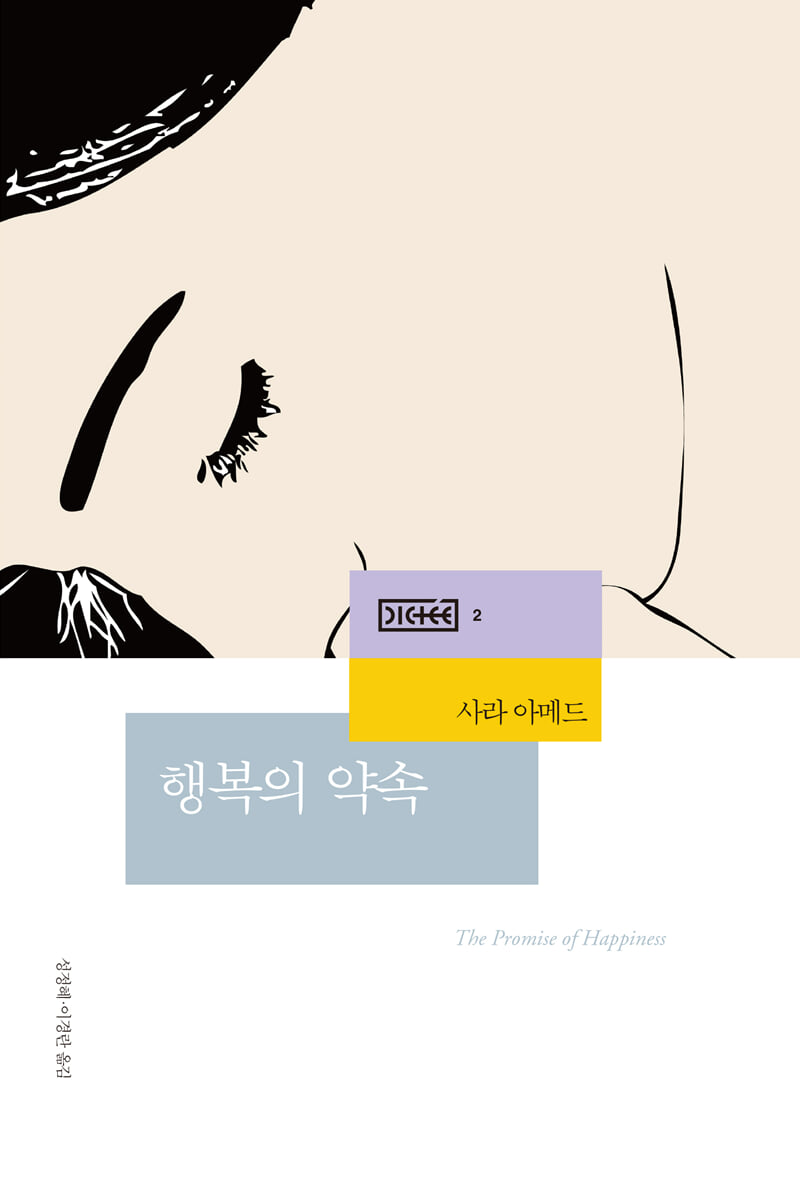
Promise of Happiness
 |
Description
Book Introduction
According to research on happiness in the field of positive psychology, which began to emerge in the 1990s and has enjoyed steady popularity to this day, positive psychology emerged as a “correction” of the existing tendency in psychology to focus only on negative feelings, and has also become very popular among the general public.
People like Mihaly Csikszentmihalyi are representative examples.
Happy people have several characteristics.
According to the research results derived by happiness researchers who claim to have discovered the 'secret' of happiness by using various surveys, interviews, and statistical techniques, "the higher the income level," the happier "married people are happier than single people," the "more positive" the person, and the "stronger the family," the higher the happiness level.
What do these things really tell us? Or do they tell us anything at all?
Queer feminist philosopher Sarah Ahmed asks what the answers to the question “what is happiness?” are actually “doing,” and dissects the notion of “happiness” that dominates our lives from the perspective of “affect theory.”
According to this, the concept of happiness usually takes the form of a 'promise' that guarantees the future, and usually serves to produce good subjects who pursue it by reaffirming what is already socially considered good.
This mechanism gains strength by positioning those who deviate from the path to happiness, those who do not follow the happiness script, those who are different, at the opposite pole, and representing them as the causes of unhappiness.
This book conceptualizes unfortunate subjects such as feminists, immigrants, and queers as "emotional strangers" alienated from "emotional communities" such as "happy families" and "happy nations," endowing their unhappiness and depression with political power, while also showing what the dominant notion of happiness forces "other" subjects to give up, thereby discussing the operation of power through emotions.
People like Mihaly Csikszentmihalyi are representative examples.
Happy people have several characteristics.
According to the research results derived by happiness researchers who claim to have discovered the 'secret' of happiness by using various surveys, interviews, and statistical techniques, "the higher the income level," the happier "married people are happier than single people," the "more positive" the person, and the "stronger the family," the higher the happiness level.
What do these things really tell us? Or do they tell us anything at all?
Queer feminist philosopher Sarah Ahmed asks what the answers to the question “what is happiness?” are actually “doing,” and dissects the notion of “happiness” that dominates our lives from the perspective of “affect theory.”
According to this, the concept of happiness usually takes the form of a 'promise' that guarantees the future, and usually serves to produce good subjects who pursue it by reaffirming what is already socially considered good.
This mechanism gains strength by positioning those who deviate from the path to happiness, those who do not follow the happiness script, those who are different, at the opposite pole, and representing them as the causes of unhappiness.
This book conceptualizes unfortunate subjects such as feminists, immigrants, and queers as "emotional strangers" alienated from "emotional communities" such as "happy families" and "happy nations," endowing their unhappiness and depression with political power, while also showing what the dominant notion of happiness forces "other" subjects to give up, thereby discussing the operation of power through emotions.
- You can preview some of the book's contents.
Preview
index
Introduction: Why Talk About Happiness Now?
Chapter 1: The Object of Happiness
Chapter 2: The Feminist Who Breaks the Mood
Chapter 3: Unhappy Queer
Chapter 4: Depressed Immigrants
Chapter 5: A Happy Future
Conclusion: Happiness, Ethics, and Possibility
Acknowledgements
Translator's Note: What does happiness do for us now?
Americas
References
Search
Chapter 1: The Object of Happiness
Chapter 2: The Feminist Who Breaks the Mood
Chapter 3: Unhappy Queer
Chapter 4: Depressed Immigrants
Chapter 5: A Happy Future
Conclusion: Happiness, Ethics, and Possibility
Acknowledgements
Translator's Note: What does happiness do for us now?
Americas
References
Search
Into the book
If happiness is something you can acquire because you are a certain kind of being, then happiness is clearly bourgeois.
The attitude that describes the happiness culture of our time as terrifying is rooted in a class-based fear that happiness is too easy, too available, and too quick.
--- p.31
We may feel alienated by forms of happiness that we perceive as inadequate.
How many times have I slumped back in my chair in despair when people burst out laughing at scenes that didn't even seem funny to me! In such situations, someone might feel unfairly called out.
But gestures of discomfort and alienation go unregistered.
Foreign bodies that do not share an emotional orientation simply disappear from that perspective.
--- p.82
To achieve a happy ending, a daughter must not simply conform her desires to her parents' desires for happiness, but must willingly conform to them.
--- p.109
Happiness detaches you from your problems by reminding you of the misfortune of being caught up in them.
--- p.112
Feminists can break the ice simply by discovering that the objects of happiness aren't so rosy.
The word feminism is therefore steeped in misery.
The very act of feminists declaring themselves feminists is presupposed as destroying something that others consider good and bring happiness.
A mood-breaking feminist “ruins” other people’s happiness...
In some ways, feminists really ruin the mood.
Because it disrupts the fantasy that happiness can be found in certain places.
If you ruin a fantasy, you can ruin a feeling.
This is not simply that feminists cannot feel happy about things that are supposed to bring happiness, but that their lack of happiness is read as a sabotage of the happiness of others.
--- p.120
To reactivate the critique of happiness, one must be willing to be close to unhappiness.
I think feminist consciousness includes a consciousness of unhappiness that may increase our unhappiness, or at least create the impression that it does.
Happiness can serve to mask unhappiness, in part by covering up its causes.
So if you refuse to cover it up, misfortune will come.
This process of becoming conscious is not simply about becoming aware of misfortune, but also about achieving (with others) a better way of understanding it.
We can see that misfortune is structured, that what happens to us is somehow connected to what happens to others.
We can see that not only are we not the cause of the misfortunes we have been blamed for, but we are also not the result of those misfortunes.
--- p.160
Queer love can only be recognized when such love is recognized as love, and when such love can guarantee happiness.
In this case, two people in love are asking their parents to bless their marriage.
It's a heterosexual version of queer love.
If queers need to have similar symbols of happiness to be accepted, then symbols of queerness must be minimized.
--- p.172
It's a persistent sign of how unbearable it still is to be queer in this world of "happy people."
We can also see that it is important to include unhappy queers, rather than simply pinning our hopes on alternative figures like happy queers.
Unhappy queers are at odds with the world that sees them as unhappy.
When we promote happy queerness, we risk blinding ourselves to the misery of this world.
We must continue to be at odds with this world.
--- p.191
Those of us who choose to live as queer know that acceptance is either a precarious condition—to be truly queer, you have to find happiness in the right places—or it's not accepted at all.
Even when recognition is not given, it often happens in places that people who don't need recognition don't notice, so the illusion that recognition has already been given persists (and so people who say they haven't been recognized become paranoid).
In fact, the illusion that same-sex object choice is recognized and tolerated not only obscures the reality of ongoing discrimination, non-recognition, and violence, but also demands that we move closer to polite heterosexual symbols.
So, really, we have to continue to be at odds with this world.
--- p.193
Migrants are increasingly subject to what I call the obligation to happiness.
If in the 19th century the natives had to become (more) British to be recognized as subjects of the empire, in the contemporary context it is the immigrants who have to become (more) British to be recognized as citizens of the nation.
--- p.237
From Omelas we can realize so much.
We can see how much the promise of happiness depends on the localization of suffering.
It is a structure in which others must suffer so that a certain “we” can live a good life.
The fault with happiness is that it serves to localize and suppress the misery of those who cannot embody the symbol of happiness, which is clearly empty (those who cannot live in that form).
--- p.352
This is why all politics of justice entails misfortune.
To that extent, happiness is based on and promised by the freedom to turn away from the concealment of suffering and from what compromises one's own happiness.
Rebellion can be hurtful not only because it brings you close to the wound, but also because it causes unhappiness by revealing the cause of the unhappiness.
You yourself are the cause of the misfortune you expose.
--- p.353
When ethics becomes about moving beyond suffering to happiness or pleasure, it imposes new forms of suffering on those who do not or cannot move in this way.
The shift to positivity creates a distinction between bad feelings as backward and conservative and good feelings as forward and progressive.
Bad feelings are seen as directed towards the past, a kind of stubbornness that “prevents” the subject from embracing the future.
Good feelings are considered to create promise for the future as they keep moving.
This assumption that good feelings are open and bad feelings are closed causes histories of injustice to disappear.
The demand that we be positive makes such histories disappear by interpreting them in a depressive way (as if we were holding on to something that is already dead).
--- p.389
We can live a life and then realize that we don't want to live that life anymore.
At this point, the act of leaving a life can be an ethical act, even if it causes unhappiness.
....
We must ask ourselves what we ought to do.
Don't turn your head towards happiness as if it were the answer.
If we stop assuming happiness as something we should be defending, if we start questioning the very happiness we are defending, we can ask different questions about life.
We can ask ourselves what we want from life and what kind of life we want to have.
The attitude that describes the happiness culture of our time as terrifying is rooted in a class-based fear that happiness is too easy, too available, and too quick.
--- p.31
We may feel alienated by forms of happiness that we perceive as inadequate.
How many times have I slumped back in my chair in despair when people burst out laughing at scenes that didn't even seem funny to me! In such situations, someone might feel unfairly called out.
But gestures of discomfort and alienation go unregistered.
Foreign bodies that do not share an emotional orientation simply disappear from that perspective.
--- p.82
To achieve a happy ending, a daughter must not simply conform her desires to her parents' desires for happiness, but must willingly conform to them.
--- p.109
Happiness detaches you from your problems by reminding you of the misfortune of being caught up in them.
--- p.112
Feminists can break the ice simply by discovering that the objects of happiness aren't so rosy.
The word feminism is therefore steeped in misery.
The very act of feminists declaring themselves feminists is presupposed as destroying something that others consider good and bring happiness.
A mood-breaking feminist “ruins” other people’s happiness...
In some ways, feminists really ruin the mood.
Because it disrupts the fantasy that happiness can be found in certain places.
If you ruin a fantasy, you can ruin a feeling.
This is not simply that feminists cannot feel happy about things that are supposed to bring happiness, but that their lack of happiness is read as a sabotage of the happiness of others.
--- p.120
To reactivate the critique of happiness, one must be willing to be close to unhappiness.
I think feminist consciousness includes a consciousness of unhappiness that may increase our unhappiness, or at least create the impression that it does.
Happiness can serve to mask unhappiness, in part by covering up its causes.
So if you refuse to cover it up, misfortune will come.
This process of becoming conscious is not simply about becoming aware of misfortune, but also about achieving (with others) a better way of understanding it.
We can see that misfortune is structured, that what happens to us is somehow connected to what happens to others.
We can see that not only are we not the cause of the misfortunes we have been blamed for, but we are also not the result of those misfortunes.
--- p.160
Queer love can only be recognized when such love is recognized as love, and when such love can guarantee happiness.
In this case, two people in love are asking their parents to bless their marriage.
It's a heterosexual version of queer love.
If queers need to have similar symbols of happiness to be accepted, then symbols of queerness must be minimized.
--- p.172
It's a persistent sign of how unbearable it still is to be queer in this world of "happy people."
We can also see that it is important to include unhappy queers, rather than simply pinning our hopes on alternative figures like happy queers.
Unhappy queers are at odds with the world that sees them as unhappy.
When we promote happy queerness, we risk blinding ourselves to the misery of this world.
We must continue to be at odds with this world.
--- p.191
Those of us who choose to live as queer know that acceptance is either a precarious condition—to be truly queer, you have to find happiness in the right places—or it's not accepted at all.
Even when recognition is not given, it often happens in places that people who don't need recognition don't notice, so the illusion that recognition has already been given persists (and so people who say they haven't been recognized become paranoid).
In fact, the illusion that same-sex object choice is recognized and tolerated not only obscures the reality of ongoing discrimination, non-recognition, and violence, but also demands that we move closer to polite heterosexual symbols.
So, really, we have to continue to be at odds with this world.
--- p.193
Migrants are increasingly subject to what I call the obligation to happiness.
If in the 19th century the natives had to become (more) British to be recognized as subjects of the empire, in the contemporary context it is the immigrants who have to become (more) British to be recognized as citizens of the nation.
--- p.237
From Omelas we can realize so much.
We can see how much the promise of happiness depends on the localization of suffering.
It is a structure in which others must suffer so that a certain “we” can live a good life.
The fault with happiness is that it serves to localize and suppress the misery of those who cannot embody the symbol of happiness, which is clearly empty (those who cannot live in that form).
--- p.352
This is why all politics of justice entails misfortune.
To that extent, happiness is based on and promised by the freedom to turn away from the concealment of suffering and from what compromises one's own happiness.
Rebellion can be hurtful not only because it brings you close to the wound, but also because it causes unhappiness by revealing the cause of the unhappiness.
You yourself are the cause of the misfortune you expose.
--- p.353
When ethics becomes about moving beyond suffering to happiness or pleasure, it imposes new forms of suffering on those who do not or cannot move in this way.
The shift to positivity creates a distinction between bad feelings as backward and conservative and good feelings as forward and progressive.
Bad feelings are seen as directed towards the past, a kind of stubbornness that “prevents” the subject from embracing the future.
Good feelings are considered to create promise for the future as they keep moving.
This assumption that good feelings are open and bad feelings are closed causes histories of injustice to disappear.
The demand that we be positive makes such histories disappear by interpreting them in a depressive way (as if we were holding on to something that is already dead).
--- p.389
We can live a life and then realize that we don't want to live that life anymore.
At this point, the act of leaving a life can be an ethical act, even if it causes unhappiness.
....
We must ask ourselves what we ought to do.
Don't turn your head towards happiness as if it were the answer.
If we stop assuming happiness as something we should be defending, if we start questioning the very happiness we are defending, we can ask different questions about life.
We can ask ourselves what we want from life and what kind of life we want to have.
--- p.391~392
Publisher's Review
- Isn't the structure of happiness in our society a structure in which some others must suffer so that a certain 'us' can live a happy life?
- A genealogy of the unfortunate subjects hidden behind the fantasies of love and marriage, happy families and nations.
- The 'Politics of Unhappiness' presented by feminist philosopher Ahmed in response to the 'Ideology of Happiness'
- Where does the misfortune of troublemakers, mood-breakers, and emotional strangers begin?
A fantastic combination of queer feminist cultural criticism and a philosophical critique of happiness.
According to research on happiness in the field of positive psychology, which began to emerge in the 1990s and has enjoyed steady popularity to this day, positive psychology emerged as a “correction” of the existing tendency in psychology to focus only on negative feelings, and has also become very popular among the general public.
People like Mihaly Csikszentmihalyi are representative examples.
Happy people have several characteristics.
According to the research results derived by happiness researchers who claim to have discovered the 'secret' of happiness by using various surveys, interviews, and statistical techniques, "the higher the income level," the happier "married people are happier than single people," the "more positive" the person, and the "stronger the family," the higher the happiness level.
What do these things really tell us? Or do they tell us anything at all?
Queer feminist philosopher Sarah Ahmed asks what the answers to the question “what is happiness?” are actually “doing,” and dissects the notion of “happiness” that dominates our lives from the perspective of “affect theory.”
According to this, the concept of happiness usually takes the form of a 'promise' that guarantees the future, and usually serves to produce good subjects who pursue it by reaffirming what is already socially considered good.
This mechanism gains strength by positioning those who deviate from the path to happiness, those who do not follow the happiness script, those who are different, at the opposite pole, and representing them as the causes of unhappiness.
This book conceptualizes unfortunate subjects such as feminists, immigrants, and queers as "emotional strangers" alienated from "emotional communities" such as "happy families" and "happy nations," endowing their unhappiness and depression with political power, while also showing what the dominant notion of happiness forces "other" subjects to give up, thereby discussing the operation of power through emotions.
The book's ability to develop academic philosophical discussions without hesitation, moving from feminist canons such as Virginia Woolf, George Eliot, Wollstonecraft, Beauvoir, and Toni Morrison, to queer canons such as The Well of Loneliness, The Rubyfruit Jungle, and Carol, to popular culture contents such as the legendary lesbian dramas The L Word and The Hours, has established this book not only as "an unparalleled philosophy of happiness" but also as a model of queer feminist cultural criticism.
The author's mixed background, with a Pakistani father and a British mother, and the experiences of fellow feminists are naturally blended into the narrative, providing a glimpse into her current status as an independent researcher who transcends the boundaries between academia and practice.
# Anatomy of 'happiness', an irresistible feeling
The Technology of Domination Revealed by the Mechanism of Happiness, Which Acts as a 'Promise of the Future'
‘Happiness’ is the most socially naturalized concept and is considered an unconditional good.
Far from being a subject of academic refutation, this was actually considered an absolute good in ethics and philosophy.
But Ahmed, drawing on feminism, anti-racism, and queer studies, critiques a wide range of existing philosophical perspectives on happiness, from Aristotle to utilitarianism, exposing the injustices hidden within them.
According to Ahmed, happiness works through the mechanism of ‘promise.’
It exerts its power through the promise (delay of the future) of happiness if it possesses things that are considered socially good.
So the promise of happiness leads us to certain objects that are considered necessary for a good life, and makes us imagine that a good life is something that we obtain by getting close to certain objects.
But what does 'good' mean here?
From the perspective of affect theory, Ahmed conceptualizes families and nations as emotional communities sustained by sharing the same emotions toward specific objects, and through various texts, he discusses how we become heterosexual straight subjects and good citizens in these emotional spaces.
Here, the operation of power is not limited to the pursuit of a 'particular happiness', the idealization of heterosexual love and the good citizen.
On the other hand, unhappiness is constantly reproduced as a threat to the state that will be reached if we deviate from the happiness script.
For example, the first-generation immigrant father in "Beckham Kick" is portrayed as an example of how not forgetting the violence of racism will lead to misfortune, while the daughter, who goes against family customs and wants to be like Beckham, is portrayed as a good British citizen.
Ultimately, the happiness script is a device that makes the subject straight, heterosexual, and a good citizen.
Happiness also serves to enforce and conceal coercion in the language of reciprocity.
Ahmed's keen analysis of how "I'm happy because you're happy" becomes "I'm happy because you're happy," "If you do that, I'll be unhappy too," "Your unhappiness threatens my happiness," and "You have to be happy for me" clearly shows how the feeling of love that desires someone's happiness can be experienced as an obligation to be happy (according to that other person's opinion).
For example, consider the speech of a parent confronted with their child's coming out.
What is hidden in the expression of "love" that says, "I just want you to be happy, but wouldn't that be a very unhappy life?" Is this unhappiness truly caused by the child's queerness? Ahmed argues that unhappiness begins and unfolds precisely from this moment of utterance.
That is, because the queer life is considered an unhappy life, a life without happy elements, a life that is depressed because it does not have a husband and children, the child becomes unhappy.
On the one hand, even when using happy utterances to tolerate or approve of queerness (“If you two are happy like that, that’s love too”), queer love is only recognized when it can be proven that such love is also love (like heterosexual love) and that it can also guarantee happiness.
Ahmed emphasizes that the pressure to be happy to appear not to be unhappy can create unhappiness, and that is why we need to talk about unhappiness more and more (and not ignore it).
# The politics of emotion
## What you hear when you listen to your feelings
Generally, feelings have been considered as something pure and subjective that arises from within the subject.
However, with the emergence of the theory of emotion, a trend began to emerge in which these feelings (emotions, affect, and sentiments) were actually tinged with social concepts, and that they did not exist solely within the subject, but rather moved through material objects.
They make emotions an important tool for analyzing society by reading 'history', domination, and oppression, which are mainly condensed into intangible things like atmosphere and feelings.
For example, Ahmed draws on this theory of emotions to analyze the nature of the sudden change in atmosphere when a black woman appears at a women's conference filled with only white women.
In fact, she didn't do anything there, she just showed up, but we generally think that the atmosphere was created by the black woman.
Ahmed discovers in this uncomfortable feeling, this negative feeling that shatters the prevailing happy atmosphere, the history of racism, the workings of power that place 'uncomfortable feelings' on black bodies.
There is a mechanism that attributes the attribute of 'cause of discomfort' to such a specific body and makes it feel like an obstacle.
Throughout the book, Ahmed dissects how the causes of violence, power, and oppression are concealed within what we perceive as natural, depicting history—in this case, the history of racism—as condensed into “intangible atmospheres,” “bodies that appear as obstacles,” and “objects like burqas and turbans.”
#Continuing the Genealogy of the Unfortunate through Queer Cultural Criticism
## From Mrs. Dalloway to Carol
Above all, this book shows the true face of queer feminist cultural criticism.
Moving from queer canonical works like The Well of Loneliness, Carol, and The Rubyfruit Jungle, to early feminist critical objects like Mrs. Dalloway and The Mill on the Floss, and queer films like If These Walls Could Talk 2 (hereafter The Wall 2) and Lost Angels, Ahmed subverts and surpasses existing official interpretations from the perspective of an affect theorist.
For example, unlike Beauvoir, who was disappointed by Mrs. Dalloway's obsession with parties, or Kate Millett, who evaluated Mrs. Dalloway as a book that showed that Woolf had not been able to transform her unhappiness into a political one, Ahmed captures the "emotional flow" of the novel and reinterprets the party as an event in which unhappiness comes to life.
Because through the party, Mrs. Dalloway “brushes up” on Septimus’ suicide.
What Ahmed particularly notes in Mrs. Dalloway is that suffering enters Mrs. Dalloway's consciousness not through her own awareness of her own suffering, but by allowing the suffering of a stranger who is not there to disturb the atmosphere.
This shows that misfortune can have political power because it arrives like a strange visitor, disrupting the familiar and revealing the uncomfortable elements within it.
Ahmed interprets Mrs. Dalloway's recognition as a gesture of empathy, a willingness to experience the grief she had "postponed by filling herself with hope."
Moreover, this book goes beyond mere critique in that it connects critiques of these past texts with contemporary texts, thereby drawing a lineage of the unfortunate who have connected the ages.
For example, Virginia Woolf's Mrs. Dalloway is linked to the unhappy housewife Laura in the film The Hours, and the terribly unhappy ending of the early 20th-century novel The Well of Loneliness is linked to the misfortune of the queer girl in the 21st-century film Lost Angels and the grief of the queer lover who cannot mourn the loss of his lover in The Wall, II, thereby drawing a genealogy that shows how unbearable it is to live as an "unhappy subject" in a "world of the happy."
Her genealogy, which encompasses not only unfortunate queers, but also immigrants suffering under racism, and feminists who are often perceived as problematic even before they cause problems as mood-breakers, demonstrates how it is possible and meaningful to examine subjects entangled with negative emotions and steeped in unfortunate histories.
In the gesture of breaking eggs by three women who lived in different eras, the author discovers the 'heritage' that has flowed through women's history, and by reading the pressure of waiting that the bowl in which eggs are broken exerts on women, he captures how the objects of domestic happiness can feel threatening and alien to some women. This is also interesting with the delicate interpretations characteristic of an emotional theorist.
# The political power of the misfortune of the unfortunate
## Resisting the literalism of misfortune
Bean Packer, author of Spring Fire, the first lesbian novel published in an era when giving queer people happy endings was not allowed, gave the two main characters unhappy endings after discussions with the publisher.
At the time, queer characters in queer novels could not be happy.
This is because an ending that gives happiness to queers could be read as an attempt to make queers look 'good' and to make the reader queer (which also blatantly reveals that 'happiness' is an attempt to make something look good and make it so).
Above all, the author urges us to resist literalism, which reads these good and bad deeds literally, that is, as ethical commands.
That happiness and unhappiness should not be the moral distinction between good and bad life.
For Ahmed, the necessary coincidence of happiness and the good, and even the moral transparency of the good itself, is above all else a matter of suspicion.
In that context, Ahmed criticizes positions that place their hopes on figures like the ‘happy queer.’
Because when we promote happy queers, we may not be able to see the misery of this world.
Ahmed says that more importantly, it's about including the unfortunate queers.
For those who choose to live as queer, acceptance in this world is nothing more than a precarious condition.
That is, only by finding happiness in a straight way can we be recognized and become true queers.
A happy queer person is someone who knows how to sit at the table with manners (the Sharon Stone couple in “The Wall 2” trying to start a family through artificial insemination are an example), and in this structure, queers are destined to be polite guests in someone else’s house forever.
Ahmed emphasizes the importance of not nullifying the political power and energy of unhappy queers by not aligning with happy forms of heterosexuality, that is, by continuing to be at odds with heterosexual happiness, which constitutes “injustice” for queers.
The passage contrasting the revolutionary's alienating feelings toward the world as an emotional stranger with the happiness described in positive psychology is also in line with this argument.
Revolutionary consciousness feels out of sync with the world.
It feels like you're fighting the whole world, and the world has turned its back on you.
This is the exact opposite of the feeling of immersion that positive psychology talks about: a feeling of stress, tension, and resistance.
Revolutionary consciousness is the willingness to endure stress and the rejection of happiness.
This does not mean, however, that we are talking about a heroic model like an unfortunate revolutionary, a model in which one individual's suffering becomes a gift to the world.
Taking Ursula Le Guin's "The Ones Who Walk Away from Omelas," Ahmed reflects on how the promise of happiness for the many depends on the localization of suffering for the few.
It is a question of whether the structure of happiness in our society today is one in which some others must suffer so that a certain 'us' can live a good life.
Ahmed criticizes that our current happiness is based on and promised by the concealment of suffering and the freedom to turn away from what compromises our own happiness.
Ahmed radicalizes this into the “freedom to be unhappy,” arguing that to escape such injustice requires a willingness to be close to unhappiness.
This does not mean that we ourselves should be miserable or sad, but rather that we have the freedom to be affected by unhappiness, the freedom to live a life that might make others unhappy, the freedom to live a life that deviates from the path to happiness without seeing happiness as the end point.
It is also worth revisiting the question of whether the discussions of Massumi and Braidotti, who see good feelings as the path we should take, may actually be in line with the study of happiness.
Ahmed argues that if ethics aims at happiness or pleasure, it could impose new forms of suffering on those who cannot move in that way.
The distinction between good feelings as advanced and progressive and bad feelings as backward and conservative obliterates the histories of injustice.
Ahmed emphasizes that bad feelings (dissatisfaction, unhappiness, discomfort, depression, etc.) are not simply reactive, but rather creative responses to the unfinished (and unforgettable) history of injustice.
Ahmed's neither happy nor unhappy conclusion is that we must think of unhappiness as something more than a feeling to be overcome, and that happiness, too, must be viewed as a possibility that exists alongside all other possibilities, rather than as a goal in life.
# Chapter-by-chapter summary
Introduction: Why Talk About Happiness Now?
We describe the "turn to happiness" as a widespread desire for happiness extends across academia, the media, public policy, and international happiness indicators, and examine the logic and premises underlying these discussions.
Chapter 1: The Object of Happiness
Philosophically analyzes the mechanism by which happiness operates as a technique of domination.
Happiness attracts us by promising that we will be happy if we simply acquire or come close to certain objects.
Objects that are considered to enable us to reach happiness accumulate positive value as social goods and circulate, becoming objects of happiness, such as “happy housewife,” “happy black slave,” and heterosexual “happy family.”
Ahmed conceptualizes those who cannot feel 'appropriate' happiness with objects considered socially good in an 'emotional community' (family or nation) that shares the same emotions about the same objects as 'emotional strangers', and presents an analytical framework that serves as the basis for chapters 2, 3, 4, and 5 that analyze the unhappiness of those who deviate from the happiness script (housewives who cannot feel happy and settled in their homes, queers who cannot sit at the table of heterosexual families, immigrants who become unhappy subjects unless they give up their culture, revolutionaries who feel alienated from reality).
Chapter 2: The Feminist Who Breaks the Mood
A look at the history of happiness from a feminist perspective that breaks the mold.
By rereading early feminist critiques such as Rousseau's Emile, Eliot's The Mill on the Floss, and Virginia Woolf's Mrs. Dalloway, this book emphasizes the importance of the genealogy of 'troublemakers' within feminism.
She also breaks the peace at the dinner table and combines her own experiences of not always being a good daughter within her family with the memories of fellow feminists, clearly drawing a connection between killjoy feminists and troublemakers.
Ahmed emphasizes that the history of feminism as a source of 'trouble' still occupies an important place in the political horizon of feminism.
Chapter 3: Unhappy Queer
Reading lesbian canons like The Well of Loneliness, The Rubyfruit Jungle, and Carol, I analyze how queer unhappiness is created and discuss how the statement, “I just want you to be happy,” seems to offer freedom to the other, yet instructs them to move toward what is already agreed upon as the cause of happiness.
Ahmed's reading of "The Well of Loneliness", which overturns existing interpretations, is the highlight of this book. Ahmed interprets the ending of the book, which has been interpreted as a "failure of love," in the opposite way.
Reading the book's unfortunate ending alongside the more recent film "Lost Angels," I ask why, in two texts set in different eras, the queer protagonist's choice for the happiness of others still leads to unhappiness.
Chapter 4: Depressed Immigrants
By exposing that the logic of happiness of utilitarianism, which provided the logic to defend imperialism, continues in modern British multiculturalism, the subject who does not happily remember the history of the empire and the immigrant who cannot forget the memory of racial discrimination are interpreted as depressed and the mechanism by which they become unhappy subjects is analyzed through a comparison of the first-generation immigrant fathers in “Beckham Kick” and “The East is the East.”
It also explores the duality of 'fairy tales' based on novels and autobiographies written by second-generation immigrant daughters.
Chapter 5: A Happy Future
Interpret revolutionaries and revolutionary consciousness from the perspective of emotional theory.
The feeling of being out of place in the world that a revolutionary, as an emotional outsider, cannot help but have is contrasted with the feelings of happiness and immersion that positive psychology talks about.
Again, by bringing in Ursula Le Guin's "The Ones Who Walk Away from Omelas," she discusses the mechanism by which the promise of happiness for the many depends on the localization of suffering for the few, and radicalizes the departure from such happiness as the "freedom to be unhappy."
This does not mean that we must be unhappy, but rather that we have the freedom to deviate from the path to happiness without considering happiness as the end point, and the freedom to live that life even if it means making others unhappy.
Conclusion: Happiness, Ethics, and Possibility
The history of happiness includes anxieties about whether happiness might simply dictate good luck.
Happiness makes lucky people think of their good fortune as their own goodness, virtue, and wisdom.
In conclusion, Ahmed deconstructs the connection between happiness and ethics, and emphasizes the close connection between happiness and luck, speaking of happiness as a possibility, as opposed to happiness as a necessity.
Braidotti's discussion, along with that of affect theorists like Massumi, who see positive emotions as potentialities and sites of becoming, is also criticized for playing a role similar to the 'turn to happiness' that imposes new forms of suffering on those who cannot be happy or joyful.
Ahmed says that revolutionary political consciousness is about becoming aware of how many people we are unhappy with.
- A genealogy of the unfortunate subjects hidden behind the fantasies of love and marriage, happy families and nations.
- The 'Politics of Unhappiness' presented by feminist philosopher Ahmed in response to the 'Ideology of Happiness'
- Where does the misfortune of troublemakers, mood-breakers, and emotional strangers begin?
A fantastic combination of queer feminist cultural criticism and a philosophical critique of happiness.
According to research on happiness in the field of positive psychology, which began to emerge in the 1990s and has enjoyed steady popularity to this day, positive psychology emerged as a “correction” of the existing tendency in psychology to focus only on negative feelings, and has also become very popular among the general public.
People like Mihaly Csikszentmihalyi are representative examples.
Happy people have several characteristics.
According to the research results derived by happiness researchers who claim to have discovered the 'secret' of happiness by using various surveys, interviews, and statistical techniques, "the higher the income level," the happier "married people are happier than single people," the "more positive" the person, and the "stronger the family," the higher the happiness level.
What do these things really tell us? Or do they tell us anything at all?
Queer feminist philosopher Sarah Ahmed asks what the answers to the question “what is happiness?” are actually “doing,” and dissects the notion of “happiness” that dominates our lives from the perspective of “affect theory.”
According to this, the concept of happiness usually takes the form of a 'promise' that guarantees the future, and usually serves to produce good subjects who pursue it by reaffirming what is already socially considered good.
This mechanism gains strength by positioning those who deviate from the path to happiness, those who do not follow the happiness script, those who are different, at the opposite pole, and representing them as the causes of unhappiness.
This book conceptualizes unfortunate subjects such as feminists, immigrants, and queers as "emotional strangers" alienated from "emotional communities" such as "happy families" and "happy nations," endowing their unhappiness and depression with political power, while also showing what the dominant notion of happiness forces "other" subjects to give up, thereby discussing the operation of power through emotions.
The book's ability to develop academic philosophical discussions without hesitation, moving from feminist canons such as Virginia Woolf, George Eliot, Wollstonecraft, Beauvoir, and Toni Morrison, to queer canons such as The Well of Loneliness, The Rubyfruit Jungle, and Carol, to popular culture contents such as the legendary lesbian dramas The L Word and The Hours, has established this book not only as "an unparalleled philosophy of happiness" but also as a model of queer feminist cultural criticism.
The author's mixed background, with a Pakistani father and a British mother, and the experiences of fellow feminists are naturally blended into the narrative, providing a glimpse into her current status as an independent researcher who transcends the boundaries between academia and practice.
# Anatomy of 'happiness', an irresistible feeling
The Technology of Domination Revealed by the Mechanism of Happiness, Which Acts as a 'Promise of the Future'
‘Happiness’ is the most socially naturalized concept and is considered an unconditional good.
Far from being a subject of academic refutation, this was actually considered an absolute good in ethics and philosophy.
But Ahmed, drawing on feminism, anti-racism, and queer studies, critiques a wide range of existing philosophical perspectives on happiness, from Aristotle to utilitarianism, exposing the injustices hidden within them.
According to Ahmed, happiness works through the mechanism of ‘promise.’
It exerts its power through the promise (delay of the future) of happiness if it possesses things that are considered socially good.
So the promise of happiness leads us to certain objects that are considered necessary for a good life, and makes us imagine that a good life is something that we obtain by getting close to certain objects.
But what does 'good' mean here?
From the perspective of affect theory, Ahmed conceptualizes families and nations as emotional communities sustained by sharing the same emotions toward specific objects, and through various texts, he discusses how we become heterosexual straight subjects and good citizens in these emotional spaces.
Here, the operation of power is not limited to the pursuit of a 'particular happiness', the idealization of heterosexual love and the good citizen.
On the other hand, unhappiness is constantly reproduced as a threat to the state that will be reached if we deviate from the happiness script.
For example, the first-generation immigrant father in "Beckham Kick" is portrayed as an example of how not forgetting the violence of racism will lead to misfortune, while the daughter, who goes against family customs and wants to be like Beckham, is portrayed as a good British citizen.
Ultimately, the happiness script is a device that makes the subject straight, heterosexual, and a good citizen.
Happiness also serves to enforce and conceal coercion in the language of reciprocity.
Ahmed's keen analysis of how "I'm happy because you're happy" becomes "I'm happy because you're happy," "If you do that, I'll be unhappy too," "Your unhappiness threatens my happiness," and "You have to be happy for me" clearly shows how the feeling of love that desires someone's happiness can be experienced as an obligation to be happy (according to that other person's opinion).
For example, consider the speech of a parent confronted with their child's coming out.
What is hidden in the expression of "love" that says, "I just want you to be happy, but wouldn't that be a very unhappy life?" Is this unhappiness truly caused by the child's queerness? Ahmed argues that unhappiness begins and unfolds precisely from this moment of utterance.
That is, because the queer life is considered an unhappy life, a life without happy elements, a life that is depressed because it does not have a husband and children, the child becomes unhappy.
On the one hand, even when using happy utterances to tolerate or approve of queerness (“If you two are happy like that, that’s love too”), queer love is only recognized when it can be proven that such love is also love (like heterosexual love) and that it can also guarantee happiness.
Ahmed emphasizes that the pressure to be happy to appear not to be unhappy can create unhappiness, and that is why we need to talk about unhappiness more and more (and not ignore it).
# The politics of emotion
## What you hear when you listen to your feelings
Generally, feelings have been considered as something pure and subjective that arises from within the subject.
However, with the emergence of the theory of emotion, a trend began to emerge in which these feelings (emotions, affect, and sentiments) were actually tinged with social concepts, and that they did not exist solely within the subject, but rather moved through material objects.
They make emotions an important tool for analyzing society by reading 'history', domination, and oppression, which are mainly condensed into intangible things like atmosphere and feelings.
For example, Ahmed draws on this theory of emotions to analyze the nature of the sudden change in atmosphere when a black woman appears at a women's conference filled with only white women.
In fact, she didn't do anything there, she just showed up, but we generally think that the atmosphere was created by the black woman.
Ahmed discovers in this uncomfortable feeling, this negative feeling that shatters the prevailing happy atmosphere, the history of racism, the workings of power that place 'uncomfortable feelings' on black bodies.
There is a mechanism that attributes the attribute of 'cause of discomfort' to such a specific body and makes it feel like an obstacle.
Throughout the book, Ahmed dissects how the causes of violence, power, and oppression are concealed within what we perceive as natural, depicting history—in this case, the history of racism—as condensed into “intangible atmospheres,” “bodies that appear as obstacles,” and “objects like burqas and turbans.”
#Continuing the Genealogy of the Unfortunate through Queer Cultural Criticism
## From Mrs. Dalloway to Carol
Above all, this book shows the true face of queer feminist cultural criticism.
Moving from queer canonical works like The Well of Loneliness, Carol, and The Rubyfruit Jungle, to early feminist critical objects like Mrs. Dalloway and The Mill on the Floss, and queer films like If These Walls Could Talk 2 (hereafter The Wall 2) and Lost Angels, Ahmed subverts and surpasses existing official interpretations from the perspective of an affect theorist.
For example, unlike Beauvoir, who was disappointed by Mrs. Dalloway's obsession with parties, or Kate Millett, who evaluated Mrs. Dalloway as a book that showed that Woolf had not been able to transform her unhappiness into a political one, Ahmed captures the "emotional flow" of the novel and reinterprets the party as an event in which unhappiness comes to life.
Because through the party, Mrs. Dalloway “brushes up” on Septimus’ suicide.
What Ahmed particularly notes in Mrs. Dalloway is that suffering enters Mrs. Dalloway's consciousness not through her own awareness of her own suffering, but by allowing the suffering of a stranger who is not there to disturb the atmosphere.
This shows that misfortune can have political power because it arrives like a strange visitor, disrupting the familiar and revealing the uncomfortable elements within it.
Ahmed interprets Mrs. Dalloway's recognition as a gesture of empathy, a willingness to experience the grief she had "postponed by filling herself with hope."
Moreover, this book goes beyond mere critique in that it connects critiques of these past texts with contemporary texts, thereby drawing a lineage of the unfortunate who have connected the ages.
For example, Virginia Woolf's Mrs. Dalloway is linked to the unhappy housewife Laura in the film The Hours, and the terribly unhappy ending of the early 20th-century novel The Well of Loneliness is linked to the misfortune of the queer girl in the 21st-century film Lost Angels and the grief of the queer lover who cannot mourn the loss of his lover in The Wall, II, thereby drawing a genealogy that shows how unbearable it is to live as an "unhappy subject" in a "world of the happy."
Her genealogy, which encompasses not only unfortunate queers, but also immigrants suffering under racism, and feminists who are often perceived as problematic even before they cause problems as mood-breakers, demonstrates how it is possible and meaningful to examine subjects entangled with negative emotions and steeped in unfortunate histories.
In the gesture of breaking eggs by three women who lived in different eras, the author discovers the 'heritage' that has flowed through women's history, and by reading the pressure of waiting that the bowl in which eggs are broken exerts on women, he captures how the objects of domestic happiness can feel threatening and alien to some women. This is also interesting with the delicate interpretations characteristic of an emotional theorist.
# The political power of the misfortune of the unfortunate
## Resisting the literalism of misfortune
Bean Packer, author of Spring Fire, the first lesbian novel published in an era when giving queer people happy endings was not allowed, gave the two main characters unhappy endings after discussions with the publisher.
At the time, queer characters in queer novels could not be happy.
This is because an ending that gives happiness to queers could be read as an attempt to make queers look 'good' and to make the reader queer (which also blatantly reveals that 'happiness' is an attempt to make something look good and make it so).
Above all, the author urges us to resist literalism, which reads these good and bad deeds literally, that is, as ethical commands.
That happiness and unhappiness should not be the moral distinction between good and bad life.
For Ahmed, the necessary coincidence of happiness and the good, and even the moral transparency of the good itself, is above all else a matter of suspicion.
In that context, Ahmed criticizes positions that place their hopes on figures like the ‘happy queer.’
Because when we promote happy queers, we may not be able to see the misery of this world.
Ahmed says that more importantly, it's about including the unfortunate queers.
For those who choose to live as queer, acceptance in this world is nothing more than a precarious condition.
That is, only by finding happiness in a straight way can we be recognized and become true queers.
A happy queer person is someone who knows how to sit at the table with manners (the Sharon Stone couple in “The Wall 2” trying to start a family through artificial insemination are an example), and in this structure, queers are destined to be polite guests in someone else’s house forever.
Ahmed emphasizes the importance of not nullifying the political power and energy of unhappy queers by not aligning with happy forms of heterosexuality, that is, by continuing to be at odds with heterosexual happiness, which constitutes “injustice” for queers.
The passage contrasting the revolutionary's alienating feelings toward the world as an emotional stranger with the happiness described in positive psychology is also in line with this argument.
Revolutionary consciousness feels out of sync with the world.
It feels like you're fighting the whole world, and the world has turned its back on you.
This is the exact opposite of the feeling of immersion that positive psychology talks about: a feeling of stress, tension, and resistance.
Revolutionary consciousness is the willingness to endure stress and the rejection of happiness.
This does not mean, however, that we are talking about a heroic model like an unfortunate revolutionary, a model in which one individual's suffering becomes a gift to the world.
Taking Ursula Le Guin's "The Ones Who Walk Away from Omelas," Ahmed reflects on how the promise of happiness for the many depends on the localization of suffering for the few.
It is a question of whether the structure of happiness in our society today is one in which some others must suffer so that a certain 'us' can live a good life.
Ahmed criticizes that our current happiness is based on and promised by the concealment of suffering and the freedom to turn away from what compromises our own happiness.
Ahmed radicalizes this into the “freedom to be unhappy,” arguing that to escape such injustice requires a willingness to be close to unhappiness.
This does not mean that we ourselves should be miserable or sad, but rather that we have the freedom to be affected by unhappiness, the freedom to live a life that might make others unhappy, the freedom to live a life that deviates from the path to happiness without seeing happiness as the end point.
It is also worth revisiting the question of whether the discussions of Massumi and Braidotti, who see good feelings as the path we should take, may actually be in line with the study of happiness.
Ahmed argues that if ethics aims at happiness or pleasure, it could impose new forms of suffering on those who cannot move in that way.
The distinction between good feelings as advanced and progressive and bad feelings as backward and conservative obliterates the histories of injustice.
Ahmed emphasizes that bad feelings (dissatisfaction, unhappiness, discomfort, depression, etc.) are not simply reactive, but rather creative responses to the unfinished (and unforgettable) history of injustice.
Ahmed's neither happy nor unhappy conclusion is that we must think of unhappiness as something more than a feeling to be overcome, and that happiness, too, must be viewed as a possibility that exists alongside all other possibilities, rather than as a goal in life.
# Chapter-by-chapter summary
Introduction: Why Talk About Happiness Now?
We describe the "turn to happiness" as a widespread desire for happiness extends across academia, the media, public policy, and international happiness indicators, and examine the logic and premises underlying these discussions.
Chapter 1: The Object of Happiness
Philosophically analyzes the mechanism by which happiness operates as a technique of domination.
Happiness attracts us by promising that we will be happy if we simply acquire or come close to certain objects.
Objects that are considered to enable us to reach happiness accumulate positive value as social goods and circulate, becoming objects of happiness, such as “happy housewife,” “happy black slave,” and heterosexual “happy family.”
Ahmed conceptualizes those who cannot feel 'appropriate' happiness with objects considered socially good in an 'emotional community' (family or nation) that shares the same emotions about the same objects as 'emotional strangers', and presents an analytical framework that serves as the basis for chapters 2, 3, 4, and 5 that analyze the unhappiness of those who deviate from the happiness script (housewives who cannot feel happy and settled in their homes, queers who cannot sit at the table of heterosexual families, immigrants who become unhappy subjects unless they give up their culture, revolutionaries who feel alienated from reality).
Chapter 2: The Feminist Who Breaks the Mood
A look at the history of happiness from a feminist perspective that breaks the mold.
By rereading early feminist critiques such as Rousseau's Emile, Eliot's The Mill on the Floss, and Virginia Woolf's Mrs. Dalloway, this book emphasizes the importance of the genealogy of 'troublemakers' within feminism.
She also breaks the peace at the dinner table and combines her own experiences of not always being a good daughter within her family with the memories of fellow feminists, clearly drawing a connection between killjoy feminists and troublemakers.
Ahmed emphasizes that the history of feminism as a source of 'trouble' still occupies an important place in the political horizon of feminism.
Chapter 3: Unhappy Queer
Reading lesbian canons like The Well of Loneliness, The Rubyfruit Jungle, and Carol, I analyze how queer unhappiness is created and discuss how the statement, “I just want you to be happy,” seems to offer freedom to the other, yet instructs them to move toward what is already agreed upon as the cause of happiness.
Ahmed's reading of "The Well of Loneliness", which overturns existing interpretations, is the highlight of this book. Ahmed interprets the ending of the book, which has been interpreted as a "failure of love," in the opposite way.
Reading the book's unfortunate ending alongside the more recent film "Lost Angels," I ask why, in two texts set in different eras, the queer protagonist's choice for the happiness of others still leads to unhappiness.
Chapter 4: Depressed Immigrants
By exposing that the logic of happiness of utilitarianism, which provided the logic to defend imperialism, continues in modern British multiculturalism, the subject who does not happily remember the history of the empire and the immigrant who cannot forget the memory of racial discrimination are interpreted as depressed and the mechanism by which they become unhappy subjects is analyzed through a comparison of the first-generation immigrant fathers in “Beckham Kick” and “The East is the East.”
It also explores the duality of 'fairy tales' based on novels and autobiographies written by second-generation immigrant daughters.
Chapter 5: A Happy Future
Interpret revolutionaries and revolutionary consciousness from the perspective of emotional theory.
The feeling of being out of place in the world that a revolutionary, as an emotional outsider, cannot help but have is contrasted with the feelings of happiness and immersion that positive psychology talks about.
Again, by bringing in Ursula Le Guin's "The Ones Who Walk Away from Omelas," she discusses the mechanism by which the promise of happiness for the many depends on the localization of suffering for the few, and radicalizes the departure from such happiness as the "freedom to be unhappy."
This does not mean that we must be unhappy, but rather that we have the freedom to deviate from the path to happiness without considering happiness as the end point, and the freedom to live that life even if it means making others unhappy.
Conclusion: Happiness, Ethics, and Possibility
The history of happiness includes anxieties about whether happiness might simply dictate good luck.
Happiness makes lucky people think of their good fortune as their own goodness, virtue, and wisdom.
In conclusion, Ahmed deconstructs the connection between happiness and ethics, and emphasizes the close connection between happiness and luck, speaking of happiness as a possibility, as opposed to happiness as a necessity.
Braidotti's discussion, along with that of affect theorists like Massumi, who see positive emotions as potentialities and sites of becoming, is also criticized for playing a role similar to the 'turn to happiness' that imposes new forms of suffering on those who cannot be happy or joyful.
Ahmed says that revolutionary political consciousness is about becoming aware of how many people we are unhappy with.
GOODS SPECIFICS
- Publication date: February 8, 2021
- Page count, weight, size: 508 pages | 564g | 140*210*26mm
- ISBN13: 9788964373651
- ISBN10: 8964373650
You may also like
카테고리
korean


korean

![GQ KOREA Mark (Monthly): December [2025]](http://librairie.coreenne.fr/cdn/shop/files/8ef265dbbfbf186523ed75ba7319009d.jpg?v=1765340328&width=3840)


