

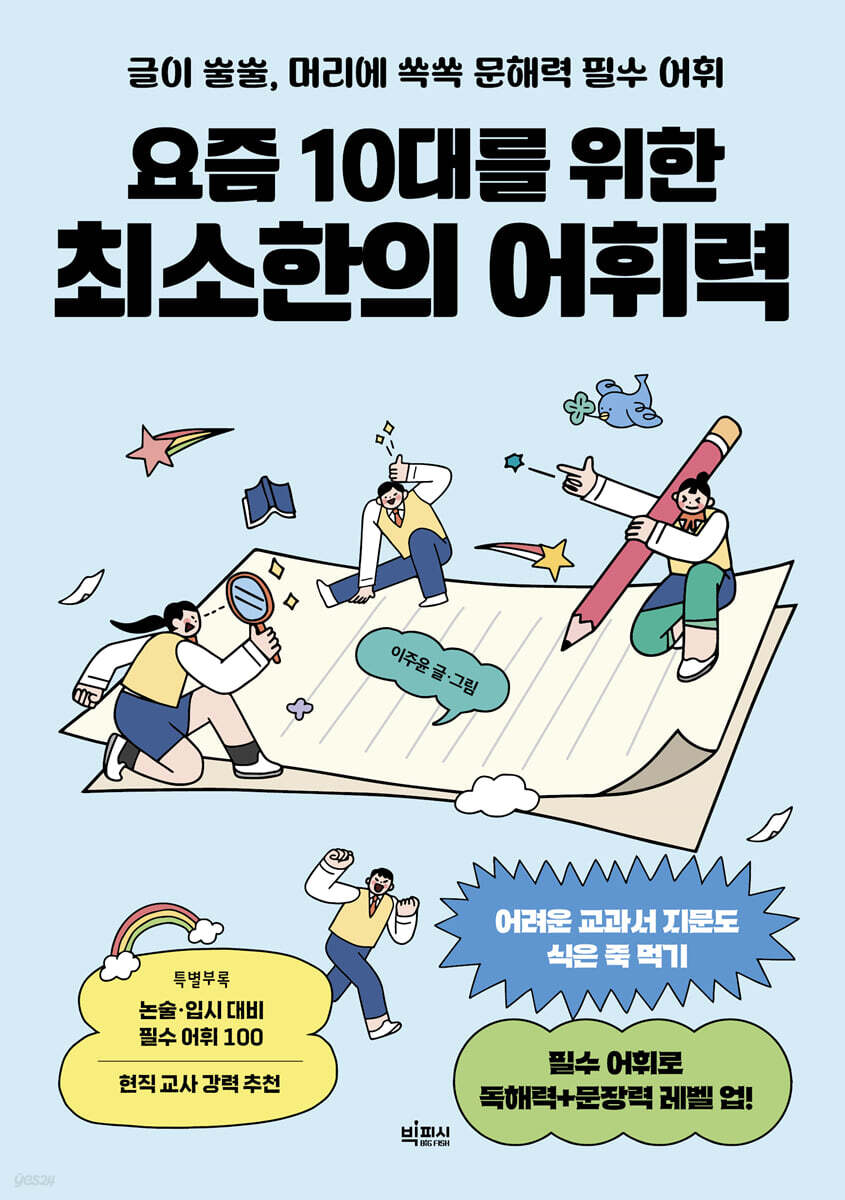
Minimum vocabulary for today's teenagers
 |
Description
Book Introduction
Vocabulary determines your grades in all subjects!
A must-read for today's youth, helping them instantly regain their lost vocabulary.
These days, voices of concern are growing over the decline in literacy skills among teenagers.
One of the reasons for this is said to be a ‘poor’ vocabulary.
For today's teenagers, who are much more familiar with internet slang and abbreviations, confusing and unfamiliar vocabulary is a huge obstacle to overcome in order to get good grades.
"Minimum Vocabulary for Today's Teenagers" carefully selects the vocabulary that today's teenagers must know and organizes it into a book that can be quickly read through with humorous illustrations and interesting storytelling.
From expressions that are often misspelled in everyday life to vocabulary that frequently appears in non-fiction texts and news, this book covers everything.
Highly recommended by current elementary and middle school teachers, this book will serve as a guide to easily and enjoyably building vocabulary for students who have difficulty understanding textbook texts, students who have trouble coming up with the right words when talking with friends, and students who are often confused because they don't know the meaning of words.
A must-read for today's youth, helping them instantly regain their lost vocabulary.
These days, voices of concern are growing over the decline in literacy skills among teenagers.
One of the reasons for this is said to be a ‘poor’ vocabulary.
For today's teenagers, who are much more familiar with internet slang and abbreviations, confusing and unfamiliar vocabulary is a huge obstacle to overcome in order to get good grades.
"Minimum Vocabulary for Today's Teenagers" carefully selects the vocabulary that today's teenagers must know and organizes it into a book that can be quickly read through with humorous illustrations and interesting storytelling.
From expressions that are often misspelled in everyday life to vocabulary that frequently appears in non-fiction texts and news, this book covers everything.
Highly recommended by current elementary and middle school teachers, this book will serve as a guide to easily and enjoyably building vocabulary for students who have difficulty understanding textbook texts, students who have trouble coming up with the right words when talking with friends, and students who are often confused because they don't know the meaning of words.
- You can preview some of the book's contents.
Preview
index
Introduction
PART 1.
Laying the foundation
Essential vocabulary that can be easily confused in everyday life
01 Us and Us
02 Double and Multiply
03 Shell and husk
04 Width and Area
05 When you are upset
06 Renewal and renewal
07 Envelopes, bags, and bags
08 Smell, smell, and fragrance
09 and above and exceeding
10 When to refuse
11 Possible and possible
12th Division and Sadal
13 Personal safety and personal safety
14 Development and Expansion
15 When to Apologize
PART 2.
Literacy Improvement
Top 20 Vocabulary Words That Will Make Reading a Fluent Experience
16 Bold and Thick
17 consecutive losses and consecutive losses?
18 years and years
19 When you feel anxious
20s face-to-face and face-to-face
21 Suitable and suitable
22 Late and Lazy
23 I woke up and it was pretty
24 Clarity and Weaving
25 Admire
26 Quantitative and Qualitative
27 Terms and Conditions
28 Great-grandfather and great-great-grandfather
29 Uncle and uncle
30 When you feel sad
31 Iceberg and Iceberg Hat Awards
32 Altruistic and Reciprocal
33 Changes and retroactivity
34. To look on, to ignore, and to look with a blank stare
35 When you are happy
PART 3.
Vocabulary + Reading Comprehension Improvement
Mastering vocabulary to open your eyes to the world
36 Juvenile offenders and negligent intent
37 Suspended indictment and suspended execution
38 Appeals and Appeals and Appeals and Appeals
39 Evidence and Testimony
40 Deduction, Induction, and Abduction
41 When you're lonely
42 Reappointment, reappointment, and re-appointment
43 Beautiful hands
44 Havruta
45 Clichés
46 When you feel embarrassed
47 Metacognition
48 Bridgehead
49 Golden Pagoda
50 When to admire
Outgoing post
Appendix 1: 100 Essential Vocabulary Words for Essay Writing and Entrance Exam Preparation
Appendix 2: A Table of Confusing Family Relationship Terms
PART 1.
Laying the foundation
Essential vocabulary that can be easily confused in everyday life
01 Us and Us
02 Double and Multiply
03 Shell and husk
04 Width and Area
05 When you are upset
06 Renewal and renewal
07 Envelopes, bags, and bags
08 Smell, smell, and fragrance
09 and above and exceeding
10 When to refuse
11 Possible and possible
12th Division and Sadal
13 Personal safety and personal safety
14 Development and Expansion
15 When to Apologize
PART 2.
Literacy Improvement
Top 20 Vocabulary Words That Will Make Reading a Fluent Experience
16 Bold and Thick
17 consecutive losses and consecutive losses?
18 years and years
19 When you feel anxious
20s face-to-face and face-to-face
21 Suitable and suitable
22 Late and Lazy
23 I woke up and it was pretty
24 Clarity and Weaving
25 Admire
26 Quantitative and Qualitative
27 Terms and Conditions
28 Great-grandfather and great-great-grandfather
29 Uncle and uncle
30 When you feel sad
31 Iceberg and Iceberg Hat Awards
32 Altruistic and Reciprocal
33 Changes and retroactivity
34. To look on, to ignore, and to look with a blank stare
35 When you are happy
PART 3.
Vocabulary + Reading Comprehension Improvement
Mastering vocabulary to open your eyes to the world
36 Juvenile offenders and negligent intent
37 Suspended indictment and suspended execution
38 Appeals and Appeals and Appeals and Appeals
39 Evidence and Testimony
40 Deduction, Induction, and Abduction
41 When you're lonely
42 Reappointment, reappointment, and re-appointment
43 Beautiful hands
44 Havruta
45 Clichés
46 When you feel embarrassed
47 Metacognition
48 Bridgehead
49 Golden Pagoda
50 When to admire
Outgoing post
Appendix 1: 100 Essential Vocabulary Words for Essay Writing and Entrance Exam Preparation
Appendix 2: A Table of Confusing Family Relationship Terms
Detailed image

Into the book
It was a long time ago.
There was a story on the news about the 10,000 won bus.
I didn't know the word 'ten thousand won' which meant that the bus was full, so I asked my sister, "Is the bus fare ten thousand won?" and she still makes fun of me to this day.
It seems like there are quite a few friends like me who have built up an embarrassing past because they didn't know the meaning of the words.
I went to a middle school to give a lecture and received this tip from a student.
“My friend doesn’t even know what a ‘family tree’ is.” I held my stomach and laughed at the student’s next words.
“You know that Jokbo is a ‘pig’s feet and bossam set’?”
--- p.4 From “Introduction”
If the girl group Twice were to perform in North Korea, what would their name be? Incidentally, the group's name, Twice, carries the meaning of "once for the eyes, once for the ears, doubling the emotion."
If I were the leader of Twice, I would greet my North Korean comrades like this.
"This is 'Gapjeol,' a popular dish in South Korea! Nice to meet you!" If "Gapjeol" sounds more appealing than "Gapjeol," then it's fine to introduce it that way.
Because doubling also means doubling.
--- p.23 From “Double and Double”
I would answer that 'quantitative' means counting the amount and expressing it in numbers, and 'qualitative' means expressing the characteristics by describing them in words.
So, '1 tablespoon of minced garlic' is a quantitative expression, while 'a lot of minced garlic' is a qualitative expression.
In this way, quantitative information is objective because it can be quantified, while qualitative information is subjective because it contains the speaker's feelings.
If you know how the two words are different but still find it difficult to tell them apart, think about it this way: 'The middle letter of quantitative means quantity, so it is related to quantity and is expressed in numbers, and the middle letter of qualitative means quality, so it is related to characteristics and is described in letters.'
--- p.136-137 From “Quantitative and Qualitative”
One evening, the woman wanted to eat some rice cakes.
But the man refused.
The woman began to persuade the man.
“You know that delicious food has zero calories, right? Yeop-tteok is delicious, so it has zero calories.” The man shook his head.
“If you eat carbohydrates, you gain weight.
Yeopddeok is a carbohydrate.
So, if you eat rice cakes, you will gain weight.” The man’s premise was so clear that the woman had no choice but to accept his conclusion.
An argument in which the conclusion is 'necessarily' true if the premise is true is called deductive reasoning.
That is, the premise 100 percent guarantees the conclusion.
--- p.209 From “Deduction, Induction, and Abduction”
I believe that those of you who have read this book will feel as if a bucket of water has been poured into your head.
I guess you're ready to unlock your potential literacy skills by studying vocabulary.
You may think you don't have the literacy skills to pull it off, but don't underestimate the value of living in South Korea and speaking Korean.
There was a story on the news about the 10,000 won bus.
I didn't know the word 'ten thousand won' which meant that the bus was full, so I asked my sister, "Is the bus fare ten thousand won?" and she still makes fun of me to this day.
It seems like there are quite a few friends like me who have built up an embarrassing past because they didn't know the meaning of the words.
I went to a middle school to give a lecture and received this tip from a student.
“My friend doesn’t even know what a ‘family tree’ is.” I held my stomach and laughed at the student’s next words.
“You know that Jokbo is a ‘pig’s feet and bossam set’?”
--- p.4 From “Introduction”
If the girl group Twice were to perform in North Korea, what would their name be? Incidentally, the group's name, Twice, carries the meaning of "once for the eyes, once for the ears, doubling the emotion."
If I were the leader of Twice, I would greet my North Korean comrades like this.
"This is 'Gapjeol,' a popular dish in South Korea! Nice to meet you!" If "Gapjeol" sounds more appealing than "Gapjeol," then it's fine to introduce it that way.
Because doubling also means doubling.
--- p.23 From “Double and Double”
I would answer that 'quantitative' means counting the amount and expressing it in numbers, and 'qualitative' means expressing the characteristics by describing them in words.
So, '1 tablespoon of minced garlic' is a quantitative expression, while 'a lot of minced garlic' is a qualitative expression.
In this way, quantitative information is objective because it can be quantified, while qualitative information is subjective because it contains the speaker's feelings.
If you know how the two words are different but still find it difficult to tell them apart, think about it this way: 'The middle letter of quantitative means quantity, so it is related to quantity and is expressed in numbers, and the middle letter of qualitative means quality, so it is related to characteristics and is described in letters.'
--- p.136-137 From “Quantitative and Qualitative”
One evening, the woman wanted to eat some rice cakes.
But the man refused.
The woman began to persuade the man.
“You know that delicious food has zero calories, right? Yeop-tteok is delicious, so it has zero calories.” The man shook his head.
“If you eat carbohydrates, you gain weight.
Yeopddeok is a carbohydrate.
So, if you eat rice cakes, you will gain weight.” The man’s premise was so clear that the woman had no choice but to accept his conclusion.
An argument in which the conclusion is 'necessarily' true if the premise is true is called deductive reasoning.
That is, the premise 100 percent guarantees the conclusion.
--- p.209 From “Deduction, Induction, and Abduction”
I believe that those of you who have read this book will feel as if a bucket of water has been poured into your head.
I guess you're ready to unlock your potential literacy skills by studying vocabulary.
You may think you don't have the literacy skills to pull it off, but don't underestimate the value of living in South Korea and speaking Korean.
--- p.257 From "Outgoing Writing"
Publisher's Review
★Highly recommended by current teachers!★
Just read it once and it will stick in your head!
5 Minutes a Day: A Vocabulary Lesson That Will Build Your Weapon of Lifelong Study
“Isn’t ‘jokbo’ the ‘pig’s feet and bossam set’?” “‘Geumil’ is ‘Friday’, right?” “Where the hell are you? Why are you swearing at me?”
In a recent survey, nine out of ten teachers responded that students' vocabulary is gradually declining compared to the past.
There is a growing number of students who have difficulty following school classes because they do not understand the context of textbook passages or test questions.
People often misunderstand having a high vocabulary as knowing a lot of things.
However, 'real' vocabulary refers to the ability to know the exact meaning of words and to use them appropriately.
If you just know the expressions you often confuse in daily life, the words whose exact meaning you don't know when explaining them to others, and the vocabulary you've been using incorrectly without realizing it, you can increase your understanding of class and reduce mistakes on exams.
《Minimum Vocabulary for Today's Teenagers》 is a book that contains only the vocabulary that today's teenagers must know, from basic but confusing words like 'us and us' and 'ideal and exceeding' to concept words that accurately understand the curriculum, such as 'suspended prosecution and suspended execution' and 'deduction, induction and conclusion'.
Students who have previously considered their limited vocabulary a hindrance to their studies will find that reading this book for just five minutes a day will not only give them a competitive edge in college entrance exams, but will also arm them with a weapon for lifelong study.
A new work by best-selling spelling author Lee Ju-yoon
Upgrade your vocabulary with this super simple and clear 3-step structure!
Author Lee Ju-yoon, who received much love from readers with the praise that “no other author explains spelling so delightfully” in her previous work, “Minimum Spelling Rules for Today’s Teenagers,” has now returned to the topic of vocabulary.
The humorous illustrations and associative techniques that help with intuitive understanding are used in the entertaining storytelling, and the words are imprinted in your mind even after just one reading.
First, you can check your vocabulary level through a vocabulary test presented at the beginning of each chapter.
Through this, readers can see that there are many cases where even commonly used words are used incorrectly.
The text is structured in three steps: 'clear explanation + one-line summary + true/false quiz', and explains only the key points like a lecturer with tongs, helping with repeated learning.
After going through these three stages of training, you will be able to firmly internalize words that were confusing and difficult to learn and remember them for a long time.
Step 1.
'Clear explanation' quantitative = amount
qualitative = characteristic
Step 2.
'One-line summary' 'Quantitative' means expressing the amount in numbers,
'Qualitative' means describing the characteristics in words!
Step 3.
The emotional monetary value created by the 'OX Quiz' company over the past three years is 72.5 billion won.
(O, X)
★Includes a vocabulary list for essay writing and entrance exam preparation★
If you want to have fun and learn at the same time
This is definitely the book
If you're a teenager who has been expressing your emotions using various new words and abbreviations, the "Emotional Vocabulary" section is also worth checking out.
This section introduces vocabulary that can be used depending on the level of intimacy and emotional intensity in a relationship, covering a wide range of vocabulary, from friendly vocabulary for friends to advanced vocabulary that can be used in public settings later on.
Additionally, a vocabulary list for essay writing and entrance exam preparation has been included as a special appendix to help you further upgrade your vocabulary.
The second appendix, which organizes confusing family relationship terms, can help you raise your level of knowledge.
People usually think that to increase vocabulary, you have to just memorize words or study Chinese characters.
So many students find vocabulary study difficult, but this book breaks that preconception.
As you read the cheerful stories and clear, practical examples, as if you were having a fun conversation with a friend who tells stories in an entertaining way rather than with your Korean teacher, 'Eom Geun-jin,' your vocabulary will naturally fill up.
For teenagers who often get lost in front of unfamiliar words and feel embarrassed when they can't find the right word, this book will be a friendly invitation to the world of vocabulary and literacy.
Just read it once and it will stick in your head!
5 Minutes a Day: A Vocabulary Lesson That Will Build Your Weapon of Lifelong Study
“Isn’t ‘jokbo’ the ‘pig’s feet and bossam set’?” “‘Geumil’ is ‘Friday’, right?” “Where the hell are you? Why are you swearing at me?”
In a recent survey, nine out of ten teachers responded that students' vocabulary is gradually declining compared to the past.
There is a growing number of students who have difficulty following school classes because they do not understand the context of textbook passages or test questions.
People often misunderstand having a high vocabulary as knowing a lot of things.
However, 'real' vocabulary refers to the ability to know the exact meaning of words and to use them appropriately.
If you just know the expressions you often confuse in daily life, the words whose exact meaning you don't know when explaining them to others, and the vocabulary you've been using incorrectly without realizing it, you can increase your understanding of class and reduce mistakes on exams.
《Minimum Vocabulary for Today's Teenagers》 is a book that contains only the vocabulary that today's teenagers must know, from basic but confusing words like 'us and us' and 'ideal and exceeding' to concept words that accurately understand the curriculum, such as 'suspended prosecution and suspended execution' and 'deduction, induction and conclusion'.
Students who have previously considered their limited vocabulary a hindrance to their studies will find that reading this book for just five minutes a day will not only give them a competitive edge in college entrance exams, but will also arm them with a weapon for lifelong study.
A new work by best-selling spelling author Lee Ju-yoon
Upgrade your vocabulary with this super simple and clear 3-step structure!
Author Lee Ju-yoon, who received much love from readers with the praise that “no other author explains spelling so delightfully” in her previous work, “Minimum Spelling Rules for Today’s Teenagers,” has now returned to the topic of vocabulary.
The humorous illustrations and associative techniques that help with intuitive understanding are used in the entertaining storytelling, and the words are imprinted in your mind even after just one reading.
First, you can check your vocabulary level through a vocabulary test presented at the beginning of each chapter.
Through this, readers can see that there are many cases where even commonly used words are used incorrectly.
The text is structured in three steps: 'clear explanation + one-line summary + true/false quiz', and explains only the key points like a lecturer with tongs, helping with repeated learning.
After going through these three stages of training, you will be able to firmly internalize words that were confusing and difficult to learn and remember them for a long time.
Step 1.
'Clear explanation' quantitative = amount
qualitative = characteristic
Step 2.
'One-line summary' 'Quantitative' means expressing the amount in numbers,
'Qualitative' means describing the characteristics in words!
Step 3.
The emotional monetary value created by the 'OX Quiz' company over the past three years is 72.5 billion won.
(O, X)
★Includes a vocabulary list for essay writing and entrance exam preparation★
If you want to have fun and learn at the same time
This is definitely the book
If you're a teenager who has been expressing your emotions using various new words and abbreviations, the "Emotional Vocabulary" section is also worth checking out.
This section introduces vocabulary that can be used depending on the level of intimacy and emotional intensity in a relationship, covering a wide range of vocabulary, from friendly vocabulary for friends to advanced vocabulary that can be used in public settings later on.
Additionally, a vocabulary list for essay writing and entrance exam preparation has been included as a special appendix to help you further upgrade your vocabulary.
The second appendix, which organizes confusing family relationship terms, can help you raise your level of knowledge.
People usually think that to increase vocabulary, you have to just memorize words or study Chinese characters.
So many students find vocabulary study difficult, but this book breaks that preconception.
As you read the cheerful stories and clear, practical examples, as if you were having a fun conversation with a friend who tells stories in an entertaining way rather than with your Korean teacher, 'Eom Geun-jin,' your vocabulary will naturally fill up.
For teenagers who often get lost in front of unfamiliar words and feel embarrassed when they can't find the right word, this book will be a friendly invitation to the world of vocabulary and literacy.
GOODS SPECIFICS
- Date of issue: April 23, 2025
- Page count, weight, size: 272 pages | 446g | 148*210*16mm
- ISBN13: 9791194033769
- ISBN10: 1194033768
You may also like
카테고리
korean


korean

![GQ KOREA Mark (Monthly): December [2025]](http://librairie.coreenne.fr/cdn/shop/files/8ef265dbbfbf186523ed75ba7319009d.jpg?v=1765340328&width=3840)


