

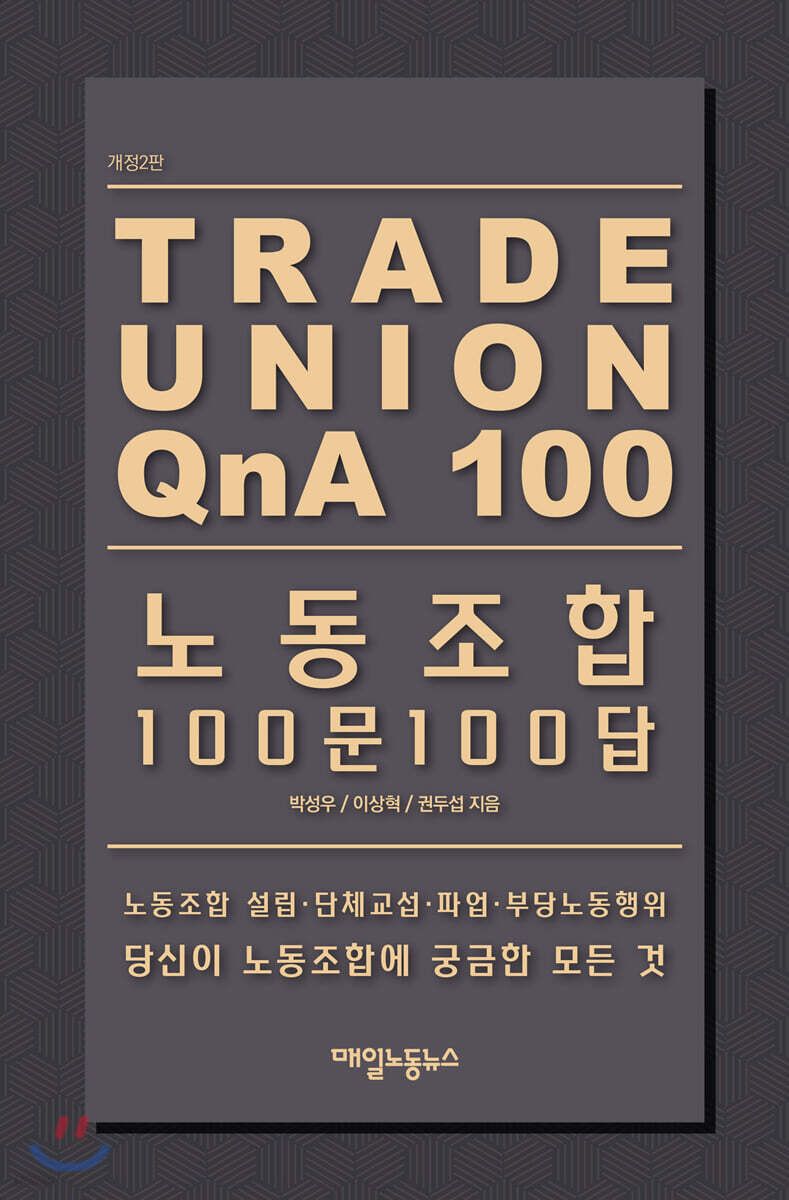
100 Questions and Answers about Labor Unions
 |
Description
Book Introduction
The second revised edition of "100 Questions and Answers on Labor Unions" reflects the labor union law revised in December 2020.
On December 9, 2020, the Trade Union Act, the Teachers' Union Act, and the Civil Servants' Union Act passed the National Assembly plenary session. The government proposed amendments to the Trade Union Act, the Civil Servants' Union Act, and the Teachers' Union Act on June 30, 2020, citing the need for legal revisions to ratify ILO fundamental conventions.
After much debate, on the morning of December 9, 2020, the National Assembly Environment and Labor Committee prepared an alternative plan that partially modified the original government proposal, and it was passed at the plenary session of the National Assembly that afternoon.
The revised law shall enter into force six months after the date of its promulgation.
Since some provisions of the Trade Union Act were revised shortly after the publication of the revised edition, we decided that it would be a good idea to include the relevant content.
Rather than revising the 105 related questions and answers according to the revised law, we chose to organize only the revised law content and include it at the end of the book.
As we look at the revised law, we will indicate the relevant item numbers for each item, so it would be better to look at them together with the corresponding item.
On December 9, 2020, the Trade Union Act, the Teachers' Union Act, and the Civil Servants' Union Act passed the National Assembly plenary session. The government proposed amendments to the Trade Union Act, the Civil Servants' Union Act, and the Teachers' Union Act on June 30, 2020, citing the need for legal revisions to ratify ILO fundamental conventions.
After much debate, on the morning of December 9, 2020, the National Assembly Environment and Labor Committee prepared an alternative plan that partially modified the original government proposal, and it was passed at the plenary session of the National Assembly that afternoon.
The revised law shall enter into force six months after the date of its promulgation.
Since some provisions of the Trade Union Act were revised shortly after the publication of the revised edition, we decided that it would be a good idea to include the relevant content.
Rather than revising the 105 related questions and answers according to the revised law, we chose to organize only the revised law content and include it at the end of the book.
As we look at the revised law, we will indicate the relevant item numbers for each item, so it would be better to look at them together with the corresponding item.
index
Chapter 1: Establishing and Joining a Labor Union 17
001.
Why do workers need unions?
18
002.
Wouldn't it be better to run a labor-management council instead of a labor union?
21
003.
I'm trying to form a labor union.
Please explain the procedure.
23
004.
Can any worker form a labor union?
25
005.
Formally, it is registered as a sole proprietorship.
Can we form a union?
27
006.
What are the decisions made at the union's founding general meeting?
29
007.
Where do I report the establishment of a labor union?
32
008.
The administrative office says there is a problem with the regulations and asks us to correct it.
What should I do?
35
009.
Can't we operate as a labor union without registering our establishment with the administrative office?
37
010.
The company is raising an issue because employees in the accounting department have joined a union.
Can't they join a union?
39
011.
There are employees who were fired during the process of establishing the union.
Will I still be a union member after being fired?
41
012.
Can the form of labor union organization be freely determined?
43
013.
Industrial union, industrial union, what on earth is an industrial union?
45
014.
Because there is no higher-level organization, the company takes the labor union lightly.
Should I join a higher-level organization?
48
015.
We are trying to transition from company-based unions to industry-based union branches.
What procedures do I need to go through?
50
016.
We are trying to merge two unions.
What steps should I take?
53
017.
A large number of union members have resigned from the union.
Can I request division of union property?
55
Chapter 2 Union Management 59
018.
If the union operates and operates according to labor laws, there will be no problems.
60
019.
Applications to join the union are pouring in.
I would like to select eligible applicants and have them sign up.
63
020.
Please explain the rights and obligations of union members.
65
021.
I would like to revise the rules.
What should the regulations contain?
67
022.
There is a dispute over the interpretation of the rules.
What should I do?
69
023.
There are so many members that it is difficult to gather them in one place.
Is it necessary to hold a general meeting of members at least once a year?
71
024.
We are planning to hold a general meeting of members on November 8th.
Would it be okay to make an announcement on November 1st, 7 days in advance?
73
025.
Of the 90 union members, 51 attended the general meeting, 48 voted, and 25 voted in favor.
Is it passed?
75
026.
Since there is no objection, we plan to pass the amendment to the bylaws by applause at the general meeting of members.
Is that okay?
77
027.
The union president is refusing to convene a general meeting.
What should I do?
79
028.
There aren't many members.
Still, do we need to elect delegates and hold a delegate convention?
81
029.
Can a motion rejected at the general meeting of delegates be brought forward for consideration at the general meeting of members?
83
030.
Eligibility for the chairmanship is limited to those who have been members of the labor union for at least one year.
Is it legal?
85
031.
If no candidate for chairman receives a majority of votes in the first round of voting, can a vote be held for or against only the candidates receiving the most votes?
87
032.
We plan to discipline union members who have not paid their union dues for a long period of time.
Is it possible to be expelled?
89
033.
I was disciplined for raising issues about the union's operations.
Please explain the relief procedure.
91
034.
How do you audit the union's accounting situation?
93
035.
Is it absolutely necessary to have a full-time union official?
95
036.
I was injured in an accident while working as a full-time union member.
Is it possible to apply for industrial accident insurance?
97
037.
There are 178 union members.
How many predecessors can you have?
99
038.
Should union members use the paid time to attend general meetings or delegate meetings within the limits of exemption from working hours?
102
039.
How should we respond to the time-off system?
104
Chapter 3 Collective Bargaining and Collective Agreements 107
040.
Can a subcontractor's union request collective bargaining with the main contractor?
108
041.
Can a union leader delegate negotiation rights to a higher-level organization or a third party without going through a general meeting of union members?
110
042.
When the labor union demanded that irregular workers be converted to regular workers, the company said that it could not be included in the negotiations, citing personnel rights as a matter of concern.
Is this a legitimate claim?
112
043.
Is it necessary to go through the unification of negotiation channels procedure in order to engage in collective bargaining?
114
044.
If a new labor union is established while negotiations are being conducted through the single negotiation window procedure, do I have to go through the single negotiation window procedure again?
117
045.
We are in the process of unifying our negotiation channels.
How is the union requesting negotiations determined?
119
046.
Please explain the process for determining the representative union for negotiations.
121
047.
I requested negotiations, but the company is not proceeding with the process of unifying the negotiation window.
What should I do?
125
048.
There is a dispute over which union holds the majority.
How do you judge?
127
049.
Union A has 200 members, and Union B has 180 members.
30 people joined both unions.
How is the number of members in each labor union calculated?
129
050.
After being selected as the representative union for negotiations, the number of union members decreased.
Can the union maintain its status as the representative negotiating union?
131
051.
The representative union is conducting negotiations without taking into account the opinions of minority unions.
How should I respond?
133
052.
When signing a collective agreement, it was agreed that offices would not be provided to minority unions. Isn't this a violation of the duty of fair representation?
135
053.
Isn't the user's violation of the duty of fair representation an unfair labor practice?
137
054.
How do I separate my negotiating unit?
139
055.
Can I request supplementary negotiations with my employer during the term of the collective agreement?
141
056.
We signed a temporary agreement that includes the method and schedule of collective bargaining and the treatment of negotiating committee members.
Is this also a collective agreement?
143
057.
The union leader signed a collective agreement against the will of the union members.
Is it valid?
145
058.
The collective agreement and employment rules are different.
What should I apply first?
147
059.
Labor and management are interpreting differently the collective agreement clause that states, “If a dismissal is determined to be unfair, 100% of the average wage will be added to the equivalent wage during the dismissal period.”
How should I interpret this?
149
060.
They are proposing to change the clause in the collective bargaining agreement that requires the company to "agree" with the union in advance to "negotiation."
What is the difference?
151
061.
If the collective agreement states that “disciplinary action can only be taken for reasons stipulated in the collective agreement,” can’t disciplinary action be taken for reasons stipulated in the employment rules?
153
062.
A collective agreement was signed to reduce the holiday work allowance rate from 100% to 50% of the regular wage, but the employment rules still state that it is 100%.
Which one applies?
155
063.
The union and the company reached an agreement to forgive unpaid wages due to management difficulties.
Is this okay?
157
064.
A wage increase was agreed upon in collective bargaining.
Does this apply to non-union members as well?
159
065.
Twelve of the 14 city bus companies have signed a joint collective agreement.
The rest of the company's workers also want the collective agreement to be applied. Is that possible?
161
066.
If a specific business unit is transferred to another company and employment is transferred, will the collective agreement also be transferred?
163
067.
Is it possible for a collective agreement to be automatically extended, like a global contract?
165
068.
Can a collective agreement be automatically renewed?
167
069.
There is a clause in the collective agreement that the disciplinary committee shall be composed of equal numbers of labor and management members.
What is the disciplinary procedure if a collective agreement is terminated?
169
070.
If a collective agreement is terminated, must the union office and its equipment be returned to the employer?
171
071.
The user has violated the collective agreement.
Can I be subject to criminal punishment?
173
Chapter 4 Group Action 177
072.
I'm curious about the history and meaning of the right to strike.
178
073.
How do you distinguish between daily union activities and industrial action?
181
074.
Can branches and chapters of industrial unions also go on strike?
183
075.
What procedures must I follow to go on strike?
185
076.
When an industrial union decides to go on strike, does the requirement of a majority of union members having the approval of each affiliated company also need to be met?
188
077.
If the Labor Relations Commission makes an administrative guidance decision during the mediation process, can we not go on strike?
190
078.
How should we respond to prevent administrative guidance from the Labor Relations Commission?
193
079.
Is it okay to hold a sit-in protest at the company during the strike period?
195
080.
Is there anything I should know when holding a meeting in the company?
197
081.
Can in-house subcontracted workers also engage in union activities such as rallies or dispute resolution activities at the head office?
199
082.
Can a company forcibly remove a banner that a labor union has posted within the company?
201
083.
The company sued me for defamation based on my union leaflets and posts on the bulletin board.
How should I respond?
203
084.
The company hired 10 contract workers after the union announced a strike.
Isn't this illegal substitute work?
205
085.
Just two days after the strike began, the company is locking out the workers and demanding they vacate the premises.
Is this a legal act?
207
086.
They stopped the strike and returned to work.
If we go on strike again, do we have to go through the arbitration process again?
209
087.
Is a general strike impossible in essential public service workplaces?
211
088.
During the strike, the company filed an injunction with the court to restrict various union activities.
What should the union do?
214
089.
During the strike period, we plan to resolve and settle various civil and criminal issues and disciplinary responsibilities through final negotiations.
What are some things to watch out for?
216
090.
I received a letter from the police station asking me to appear, saying that a complaint had been filed.
Do I have to attend?
218
091.
I received a summary judgment from the court ordering me to pay a fine for something that happened during the strike.
I would like to request a formal trial.
220
092.
I heard that the issue of criminal punishment for strikes is being criticized in the international community.
Please explain in detail.
222
093.
I heard that the Supreme Court changed its position regarding the application of the obstruction of business law to strikes.
What is the content?
224
094.
The media distorts the legitimate strike of the labor union and criticizes it as an aristocratic labor union.
Are there any sanctions?
226
Chapter 5 Unfair Labor Practices 229
095.
The company interferes with union activities.
Can you punish me?
230
096.
The union chairman was absent without leave due to labor-management dispute.
If the company fires the chairman for this reason, is it an unfair labor practice?
233
097.
The company only prohibits union members from working overtime.
Isn't this an unfair labor practice?
235
098.
Upon promotion, he lost his union membership.
Can promotion also be an unfair labor practice?
237
099.
There is a union shop clause in the collective agreement.
Can new employees join a minority union directly without joining the majority union?
239
100.
The employer made the union's strike halt a prerequisite for collective bargaining.
Is this a legitimate refusal to negotiate?
241
101.
Users refuse to bargain collectively.
How should I deal with it?
243
102.
Can a boss who openly says he hates unions be punished?
245
103.
Is it also an unfair labor practice to receive support for union operating expenses from users?
247
104.
What are some examples of unfair labor practices that employers might face in workplaces with multiple labor unions?
249
105.
I have been suspended indefinitely for four months due to union activities.
Can I file a claim for unfair labor practices?
251
Appendix 255: Trade Union Act Amendments, December 2020, at a Glance
001.
Why do workers need unions?
18
002.
Wouldn't it be better to run a labor-management council instead of a labor union?
21
003.
I'm trying to form a labor union.
Please explain the procedure.
23
004.
Can any worker form a labor union?
25
005.
Formally, it is registered as a sole proprietorship.
Can we form a union?
27
006.
What are the decisions made at the union's founding general meeting?
29
007.
Where do I report the establishment of a labor union?
32
008.
The administrative office says there is a problem with the regulations and asks us to correct it.
What should I do?
35
009.
Can't we operate as a labor union without registering our establishment with the administrative office?
37
010.
The company is raising an issue because employees in the accounting department have joined a union.
Can't they join a union?
39
011.
There are employees who were fired during the process of establishing the union.
Will I still be a union member after being fired?
41
012.
Can the form of labor union organization be freely determined?
43
013.
Industrial union, industrial union, what on earth is an industrial union?
45
014.
Because there is no higher-level organization, the company takes the labor union lightly.
Should I join a higher-level organization?
48
015.
We are trying to transition from company-based unions to industry-based union branches.
What procedures do I need to go through?
50
016.
We are trying to merge two unions.
What steps should I take?
53
017.
A large number of union members have resigned from the union.
Can I request division of union property?
55
Chapter 2 Union Management 59
018.
If the union operates and operates according to labor laws, there will be no problems.
60
019.
Applications to join the union are pouring in.
I would like to select eligible applicants and have them sign up.
63
020.
Please explain the rights and obligations of union members.
65
021.
I would like to revise the rules.
What should the regulations contain?
67
022.
There is a dispute over the interpretation of the rules.
What should I do?
69
023.
There are so many members that it is difficult to gather them in one place.
Is it necessary to hold a general meeting of members at least once a year?
71
024.
We are planning to hold a general meeting of members on November 8th.
Would it be okay to make an announcement on November 1st, 7 days in advance?
73
025.
Of the 90 union members, 51 attended the general meeting, 48 voted, and 25 voted in favor.
Is it passed?
75
026.
Since there is no objection, we plan to pass the amendment to the bylaws by applause at the general meeting of members.
Is that okay?
77
027.
The union president is refusing to convene a general meeting.
What should I do?
79
028.
There aren't many members.
Still, do we need to elect delegates and hold a delegate convention?
81
029.
Can a motion rejected at the general meeting of delegates be brought forward for consideration at the general meeting of members?
83
030.
Eligibility for the chairmanship is limited to those who have been members of the labor union for at least one year.
Is it legal?
85
031.
If no candidate for chairman receives a majority of votes in the first round of voting, can a vote be held for or against only the candidates receiving the most votes?
87
032.
We plan to discipline union members who have not paid their union dues for a long period of time.
Is it possible to be expelled?
89
033.
I was disciplined for raising issues about the union's operations.
Please explain the relief procedure.
91
034.
How do you audit the union's accounting situation?
93
035.
Is it absolutely necessary to have a full-time union official?
95
036.
I was injured in an accident while working as a full-time union member.
Is it possible to apply for industrial accident insurance?
97
037.
There are 178 union members.
How many predecessors can you have?
99
038.
Should union members use the paid time to attend general meetings or delegate meetings within the limits of exemption from working hours?
102
039.
How should we respond to the time-off system?
104
Chapter 3 Collective Bargaining and Collective Agreements 107
040.
Can a subcontractor's union request collective bargaining with the main contractor?
108
041.
Can a union leader delegate negotiation rights to a higher-level organization or a third party without going through a general meeting of union members?
110
042.
When the labor union demanded that irregular workers be converted to regular workers, the company said that it could not be included in the negotiations, citing personnel rights as a matter of concern.
Is this a legitimate claim?
112
043.
Is it necessary to go through the unification of negotiation channels procedure in order to engage in collective bargaining?
114
044.
If a new labor union is established while negotiations are being conducted through the single negotiation window procedure, do I have to go through the single negotiation window procedure again?
117
045.
We are in the process of unifying our negotiation channels.
How is the union requesting negotiations determined?
119
046.
Please explain the process for determining the representative union for negotiations.
121
047.
I requested negotiations, but the company is not proceeding with the process of unifying the negotiation window.
What should I do?
125
048.
There is a dispute over which union holds the majority.
How do you judge?
127
049.
Union A has 200 members, and Union B has 180 members.
30 people joined both unions.
How is the number of members in each labor union calculated?
129
050.
After being selected as the representative union for negotiations, the number of union members decreased.
Can the union maintain its status as the representative negotiating union?
131
051.
The representative union is conducting negotiations without taking into account the opinions of minority unions.
How should I respond?
133
052.
When signing a collective agreement, it was agreed that offices would not be provided to minority unions. Isn't this a violation of the duty of fair representation?
135
053.
Isn't the user's violation of the duty of fair representation an unfair labor practice?
137
054.
How do I separate my negotiating unit?
139
055.
Can I request supplementary negotiations with my employer during the term of the collective agreement?
141
056.
We signed a temporary agreement that includes the method and schedule of collective bargaining and the treatment of negotiating committee members.
Is this also a collective agreement?
143
057.
The union leader signed a collective agreement against the will of the union members.
Is it valid?
145
058.
The collective agreement and employment rules are different.
What should I apply first?
147
059.
Labor and management are interpreting differently the collective agreement clause that states, “If a dismissal is determined to be unfair, 100% of the average wage will be added to the equivalent wage during the dismissal period.”
How should I interpret this?
149
060.
They are proposing to change the clause in the collective bargaining agreement that requires the company to "agree" with the union in advance to "negotiation."
What is the difference?
151
061.
If the collective agreement states that “disciplinary action can only be taken for reasons stipulated in the collective agreement,” can’t disciplinary action be taken for reasons stipulated in the employment rules?
153
062.
A collective agreement was signed to reduce the holiday work allowance rate from 100% to 50% of the regular wage, but the employment rules still state that it is 100%.
Which one applies?
155
063.
The union and the company reached an agreement to forgive unpaid wages due to management difficulties.
Is this okay?
157
064.
A wage increase was agreed upon in collective bargaining.
Does this apply to non-union members as well?
159
065.
Twelve of the 14 city bus companies have signed a joint collective agreement.
The rest of the company's workers also want the collective agreement to be applied. Is that possible?
161
066.
If a specific business unit is transferred to another company and employment is transferred, will the collective agreement also be transferred?
163
067.
Is it possible for a collective agreement to be automatically extended, like a global contract?
165
068.
Can a collective agreement be automatically renewed?
167
069.
There is a clause in the collective agreement that the disciplinary committee shall be composed of equal numbers of labor and management members.
What is the disciplinary procedure if a collective agreement is terminated?
169
070.
If a collective agreement is terminated, must the union office and its equipment be returned to the employer?
171
071.
The user has violated the collective agreement.
Can I be subject to criminal punishment?
173
Chapter 4 Group Action 177
072.
I'm curious about the history and meaning of the right to strike.
178
073.
How do you distinguish between daily union activities and industrial action?
181
074.
Can branches and chapters of industrial unions also go on strike?
183
075.
What procedures must I follow to go on strike?
185
076.
When an industrial union decides to go on strike, does the requirement of a majority of union members having the approval of each affiliated company also need to be met?
188
077.
If the Labor Relations Commission makes an administrative guidance decision during the mediation process, can we not go on strike?
190
078.
How should we respond to prevent administrative guidance from the Labor Relations Commission?
193
079.
Is it okay to hold a sit-in protest at the company during the strike period?
195
080.
Is there anything I should know when holding a meeting in the company?
197
081.
Can in-house subcontracted workers also engage in union activities such as rallies or dispute resolution activities at the head office?
199
082.
Can a company forcibly remove a banner that a labor union has posted within the company?
201
083.
The company sued me for defamation based on my union leaflets and posts on the bulletin board.
How should I respond?
203
084.
The company hired 10 contract workers after the union announced a strike.
Isn't this illegal substitute work?
205
085.
Just two days after the strike began, the company is locking out the workers and demanding they vacate the premises.
Is this a legal act?
207
086.
They stopped the strike and returned to work.
If we go on strike again, do we have to go through the arbitration process again?
209
087.
Is a general strike impossible in essential public service workplaces?
211
088.
During the strike, the company filed an injunction with the court to restrict various union activities.
What should the union do?
214
089.
During the strike period, we plan to resolve and settle various civil and criminal issues and disciplinary responsibilities through final negotiations.
What are some things to watch out for?
216
090.
I received a letter from the police station asking me to appear, saying that a complaint had been filed.
Do I have to attend?
218
091.
I received a summary judgment from the court ordering me to pay a fine for something that happened during the strike.
I would like to request a formal trial.
220
092.
I heard that the issue of criminal punishment for strikes is being criticized in the international community.
Please explain in detail.
222
093.
I heard that the Supreme Court changed its position regarding the application of the obstruction of business law to strikes.
What is the content?
224
094.
The media distorts the legitimate strike of the labor union and criticizes it as an aristocratic labor union.
Are there any sanctions?
226
Chapter 5 Unfair Labor Practices 229
095.
The company interferes with union activities.
Can you punish me?
230
096.
The union chairman was absent without leave due to labor-management dispute.
If the company fires the chairman for this reason, is it an unfair labor practice?
233
097.
The company only prohibits union members from working overtime.
Isn't this an unfair labor practice?
235
098.
Upon promotion, he lost his union membership.
Can promotion also be an unfair labor practice?
237
099.
There is a union shop clause in the collective agreement.
Can new employees join a minority union directly without joining the majority union?
239
100.
The employer made the union's strike halt a prerequisite for collective bargaining.
Is this a legitimate refusal to negotiate?
241
101.
Users refuse to bargain collectively.
How should I deal with it?
243
102.
Can a boss who openly says he hates unions be punished?
245
103.
Is it also an unfair labor practice to receive support for union operating expenses from users?
247
104.
What are some examples of unfair labor practices that employers might face in workplaces with multiple labor unions?
249
105.
I have been suspended indefinitely for four months due to union activities.
Can I file a claim for unfair labor practices?
251
Appendix 255: Trade Union Act Amendments, December 2020, at a Glance
Publisher's Review
The 50th Anniversary of Jeon Tae-il's Death: "Everyone Can Unionize" in One Book
“Why do workers need unions?”
“100 Questions and Answers about Labor Unions” begins with this question.
What do you guys think?
In Korea, they say that compliance with labor laws depends on whether “the boss is a good person.”
This means that even if there are legal standards, worker treatment fluctuates depending on the boss's disposition.
The authors therefore argue that the three labor rights are necessary.
The right to organize, the right to collective bargaining, and the right to collective action are the key elements that enable employers and workers to achieve a minimum balance and determine working conditions.
This is why the Constitution guarantees the three labor rights.
The authors answer 105 questions from the perspective of workers, asking why workers form unions, negotiate, and engage in industrial action, what their union activities are for, and what impact their activities should have on the community.
"100 Questions and Answers about Labor Unions" is a practical guide that can be used immediately in the field.
This book is divided into five chapters.
Chapter 1: Establishment and Joining of Labor Unions (17 questions), Chapter 2: Labor Union Operations (22 questions), Chapter 3: Collective Bargaining and Collective Agreements (32 questions), Chapter 4: Collective Action (23 questions), and Chapter 5: Unfair Labor Practices (11 questions).
‘Unionizing’ is an activity that involves facing countless choices at every moment.
Subcontracted workers, special employment workers, and platform workers also have to overcome obstacles created by complex relationships.
There are so many choices to make, from whether to join an industry-level union or establish a company-level union, how to request negotiations, and when and how to stop industrial action.
This book focuses on guiding workers at that time on how to make the best choices and respond to each situation.
The revised edition of “100 Questions and Answers about Labor Unions” has changed significantly.
The authors say, “You could practically think of this as a completely revised edition.”
‘Collective Bargaining and Collective Agreements’ is the chapter with the most changes in this revised edition.
With regard to the negotiation system, including the procedure for unifying the negotiation window, many precedents have been accumulated since the first edition was published, and these have been reflected.
This book clearly contains not only the revised case law but also the revised work manuals of the Ministry of Employment and Labor and the Central Labor Relations Commission.
For example, we introduced and answered issues surrounding negotiations, such as how to calculate the number of members in each union when there are members who are members of multiple unions, and the procedure for determining the representative union for negotiations.
Thanks to this, the number of questions and answers increased from 100 to 105.
The authors of "100 Questions and Answers about Labor Unions" are labor law experts who meet with workers in labor unions, provide consultations, and advise them.
This book contains the extensive labor field experience and extensive knowledge of Park Seong-woo, head of the Labor Law Support Center at the Seoul Headquarters of the Korean Confederation of Trade Unions (representative labor attorney at Labor and Human Rights Law Firm), Lee Sang-hyeok, head of the Central Law Firm (member of the Industrial Accident Compensation Insurance Review Committee), and Kwon Du-seop, head of Workplace Bullying 119 (former head of the Korean Confederation of Trade Unions Legal Center).
The authors avoid simply copying legal provisions or case law, and instead write the legal content in an easy-to-understand manner, providing practical advice from the perspective of workers.
November 13, 2020 marks the 50th anniversary of Jeon Tae-il's death.
I am very pleased to be publishing the revised edition of “100 Questions and Answers about Labor Unions.”
Just as he created the "Fools' Association" and the "Samdong Friendship Association" to demand compliance with the Labor Standards Act, I hope that all workers will form unions and secure their rights.
I hope this book will serve as a small seed.
Preface to the Revised Edition of "100 Questions and Answers on Labor Unions"
Labor unions: A start toward humane work
Five years have passed since the first edition of “100 Questions and Answers about Labor Unions” was published.
In the meantime, there have been many changes in our society.
Above all, the power of citizens holding candles brought about the impeachment of a president for the first time in constitutional history.
That experience of victory is driving calls for more human rights and democracy across society, especially in the workplace.
The number of union members is increasing.
The unionization rate, which was 10.2% (1.938 million people) in 2015 when the first edition was published, increased to 11.8% (2.331 million people) in 2018.
A new 400,000 workers have been able to exercise their three basic labor rights, which are essential for humane work.
This figure, according to statistics from the Ministry of Employment and Labor, excludes members of illegal unions, so the actual number is higher.
As of 2020, the exact figures are not yet available as official statistics have not yet been released, but judging by the continuous news of union membership and establishment in the workplace, it is clear that the unionization rate is much higher than in 2018.
Non-regular workers in the public sector, in-house subcontracted workers, IT workers, workers in various service industries, and workers in various special employment sectors are forming labor unions one after another.
In particular, special employment workers such as delivery drivers, designated drivers, quick service workers, insurance planners, delivery workers, water purifier installers, and after-school instructors also received labor union establishment notification certificates from administrative offices.
The court ruled that private tutors, broadcast actors, train station concessionaire operators, and car salespeople are workers under the Trade Union and Labor Relations Adjustment Act (the Labor Act).
Even Samsung and POSCO, which were synonymous with so-called non-union management, have formed labor unions.
Meaningful changes are beginning to happen.
But it is still very much insufficient.
Although the unionization rate has increased by about 2%, it is still at the bottom among OECD member countries.
Korea has yet to ratify the International Labor Organization (ILO) fundamental conventions related to the right to organize and collective bargaining.
There is much controversy over whether many newly emerging special employment workers, including so-called platform workers, are legally considered workers.
It is also not easy to hold the original users with actual authority accountable under the labor union law.
The single-window system for multiple union negotiations is newly restricting the three labor rights.
Even now, the law of obstruction of business is applied to strikes.
The reality is that labor unions are also concentrated mainly in the public sector and large-scale workplaces.
I can confidently say that the three labor rights are the only means to enable workers to work with dignity.
There can be no labor rights without unions.
For workers, unions are always a necessity, not an option.
While I was finalizing the revision of the manuscript and proofreading, the Supreme Court issued two significant rulings on the same day.
The ruling is that the Ministry of Employment and Labor's notification of an extra-legal union to the Korean Teachers and Education Workers' Union was illegal and therefore invalid, and that the strike by Korea Water Resources Corporation contract workers at the main contractor's workplace did not constitute obstruction of business.
The court's interpretation of the law is also the result of the workers' persistent activities and struggles that transcended the framework of the evil law.
Although it is slow, I believe that our society is making progress toward a world where labor is beautiful through the power of workers.
The revised edition reflects all case law and legal amendments that have occurred since the publication of the first edition.
Key decisions, focusing on Supreme Court decisions, are included, including case numbers, whenever possible.
Since the first edition was published, many rulings have been made regarding the single negotiation window system for multiple unions, so the collective bargaining section in particular has been significantly revised.
The Ministry of Employment and Labor and the Central Labor Relations Commission also changed the various work manuals to reflect the revised edition.
We re-examined the overall question structure.
Some questions were combined, the order changed, and new questions were added, increasing the number of questions to 105.
We have revised the entire question, not just the changed questions.
We rewrote the content for parts that were insufficiently explained or difficult to understand, and added new references and diagrams.
In fact, it seems safe to say that this is a completely revised edition.
As this book is a general legal commentary on labor unions, it must be revised accordingly to maintain its timeliness when laws are revised or new precedents are introduced.
This will also increase its usability.
To meet those demands, we publish a revised edition after several months of review and revision.
As interest in joining and establishing labor unions grows, I hope this book can serve as a small spark to ignite that social atmosphere.
“Why do workers need unions?”
“100 Questions and Answers about Labor Unions” begins with this question.
What do you guys think?
In Korea, they say that compliance with labor laws depends on whether “the boss is a good person.”
This means that even if there are legal standards, worker treatment fluctuates depending on the boss's disposition.
The authors therefore argue that the three labor rights are necessary.
The right to organize, the right to collective bargaining, and the right to collective action are the key elements that enable employers and workers to achieve a minimum balance and determine working conditions.
This is why the Constitution guarantees the three labor rights.
The authors answer 105 questions from the perspective of workers, asking why workers form unions, negotiate, and engage in industrial action, what their union activities are for, and what impact their activities should have on the community.
"100 Questions and Answers about Labor Unions" is a practical guide that can be used immediately in the field.
This book is divided into five chapters.
Chapter 1: Establishment and Joining of Labor Unions (17 questions), Chapter 2: Labor Union Operations (22 questions), Chapter 3: Collective Bargaining and Collective Agreements (32 questions), Chapter 4: Collective Action (23 questions), and Chapter 5: Unfair Labor Practices (11 questions).
‘Unionizing’ is an activity that involves facing countless choices at every moment.
Subcontracted workers, special employment workers, and platform workers also have to overcome obstacles created by complex relationships.
There are so many choices to make, from whether to join an industry-level union or establish a company-level union, how to request negotiations, and when and how to stop industrial action.
This book focuses on guiding workers at that time on how to make the best choices and respond to each situation.
The revised edition of “100 Questions and Answers about Labor Unions” has changed significantly.
The authors say, “You could practically think of this as a completely revised edition.”
‘Collective Bargaining and Collective Agreements’ is the chapter with the most changes in this revised edition.
With regard to the negotiation system, including the procedure for unifying the negotiation window, many precedents have been accumulated since the first edition was published, and these have been reflected.
This book clearly contains not only the revised case law but also the revised work manuals of the Ministry of Employment and Labor and the Central Labor Relations Commission.
For example, we introduced and answered issues surrounding negotiations, such as how to calculate the number of members in each union when there are members who are members of multiple unions, and the procedure for determining the representative union for negotiations.
Thanks to this, the number of questions and answers increased from 100 to 105.
The authors of "100 Questions and Answers about Labor Unions" are labor law experts who meet with workers in labor unions, provide consultations, and advise them.
This book contains the extensive labor field experience and extensive knowledge of Park Seong-woo, head of the Labor Law Support Center at the Seoul Headquarters of the Korean Confederation of Trade Unions (representative labor attorney at Labor and Human Rights Law Firm), Lee Sang-hyeok, head of the Central Law Firm (member of the Industrial Accident Compensation Insurance Review Committee), and Kwon Du-seop, head of Workplace Bullying 119 (former head of the Korean Confederation of Trade Unions Legal Center).
The authors avoid simply copying legal provisions or case law, and instead write the legal content in an easy-to-understand manner, providing practical advice from the perspective of workers.
November 13, 2020 marks the 50th anniversary of Jeon Tae-il's death.
I am very pleased to be publishing the revised edition of “100 Questions and Answers about Labor Unions.”
Just as he created the "Fools' Association" and the "Samdong Friendship Association" to demand compliance with the Labor Standards Act, I hope that all workers will form unions and secure their rights.
I hope this book will serve as a small seed.
Preface to the Revised Edition of "100 Questions and Answers on Labor Unions"
Labor unions: A start toward humane work
Five years have passed since the first edition of “100 Questions and Answers about Labor Unions” was published.
In the meantime, there have been many changes in our society.
Above all, the power of citizens holding candles brought about the impeachment of a president for the first time in constitutional history.
That experience of victory is driving calls for more human rights and democracy across society, especially in the workplace.
The number of union members is increasing.
The unionization rate, which was 10.2% (1.938 million people) in 2015 when the first edition was published, increased to 11.8% (2.331 million people) in 2018.
A new 400,000 workers have been able to exercise their three basic labor rights, which are essential for humane work.
This figure, according to statistics from the Ministry of Employment and Labor, excludes members of illegal unions, so the actual number is higher.
As of 2020, the exact figures are not yet available as official statistics have not yet been released, but judging by the continuous news of union membership and establishment in the workplace, it is clear that the unionization rate is much higher than in 2018.
Non-regular workers in the public sector, in-house subcontracted workers, IT workers, workers in various service industries, and workers in various special employment sectors are forming labor unions one after another.
In particular, special employment workers such as delivery drivers, designated drivers, quick service workers, insurance planners, delivery workers, water purifier installers, and after-school instructors also received labor union establishment notification certificates from administrative offices.
The court ruled that private tutors, broadcast actors, train station concessionaire operators, and car salespeople are workers under the Trade Union and Labor Relations Adjustment Act (the Labor Act).
Even Samsung and POSCO, which were synonymous with so-called non-union management, have formed labor unions.
Meaningful changes are beginning to happen.
But it is still very much insufficient.
Although the unionization rate has increased by about 2%, it is still at the bottom among OECD member countries.
Korea has yet to ratify the International Labor Organization (ILO) fundamental conventions related to the right to organize and collective bargaining.
There is much controversy over whether many newly emerging special employment workers, including so-called platform workers, are legally considered workers.
It is also not easy to hold the original users with actual authority accountable under the labor union law.
The single-window system for multiple union negotiations is newly restricting the three labor rights.
Even now, the law of obstruction of business is applied to strikes.
The reality is that labor unions are also concentrated mainly in the public sector and large-scale workplaces.
I can confidently say that the three labor rights are the only means to enable workers to work with dignity.
There can be no labor rights without unions.
For workers, unions are always a necessity, not an option.
While I was finalizing the revision of the manuscript and proofreading, the Supreme Court issued two significant rulings on the same day.
The ruling is that the Ministry of Employment and Labor's notification of an extra-legal union to the Korean Teachers and Education Workers' Union was illegal and therefore invalid, and that the strike by Korea Water Resources Corporation contract workers at the main contractor's workplace did not constitute obstruction of business.
The court's interpretation of the law is also the result of the workers' persistent activities and struggles that transcended the framework of the evil law.
Although it is slow, I believe that our society is making progress toward a world where labor is beautiful through the power of workers.
The revised edition reflects all case law and legal amendments that have occurred since the publication of the first edition.
Key decisions, focusing on Supreme Court decisions, are included, including case numbers, whenever possible.
Since the first edition was published, many rulings have been made regarding the single negotiation window system for multiple unions, so the collective bargaining section in particular has been significantly revised.
The Ministry of Employment and Labor and the Central Labor Relations Commission also changed the various work manuals to reflect the revised edition.
We re-examined the overall question structure.
Some questions were combined, the order changed, and new questions were added, increasing the number of questions to 105.
We have revised the entire question, not just the changed questions.
We rewrote the content for parts that were insufficiently explained or difficult to understand, and added new references and diagrams.
In fact, it seems safe to say that this is a completely revised edition.
As this book is a general legal commentary on labor unions, it must be revised accordingly to maintain its timeliness when laws are revised or new precedents are introduced.
This will also increase its usability.
To meet those demands, we publish a revised edition after several months of review and revision.
As interest in joining and establishing labor unions grows, I hope this book can serve as a small spark to ignite that social atmosphere.
GOODS SPECIFICS
- Publication date: December 22, 2020
- Page count, weight, size: 268 pages | 152*225*20mm
- ISBN13: 9788997205011
- ISBN10: 8997205013
You may also like
카테고리
korean


korean

![GQ KOREA Mark (Monthly): December [2025]](http://librairie.coreenne.fr/cdn/shop/files/8ef265dbbfbf186523ed75ba7319009d.jpg?v=1765340328&width=3840)


