

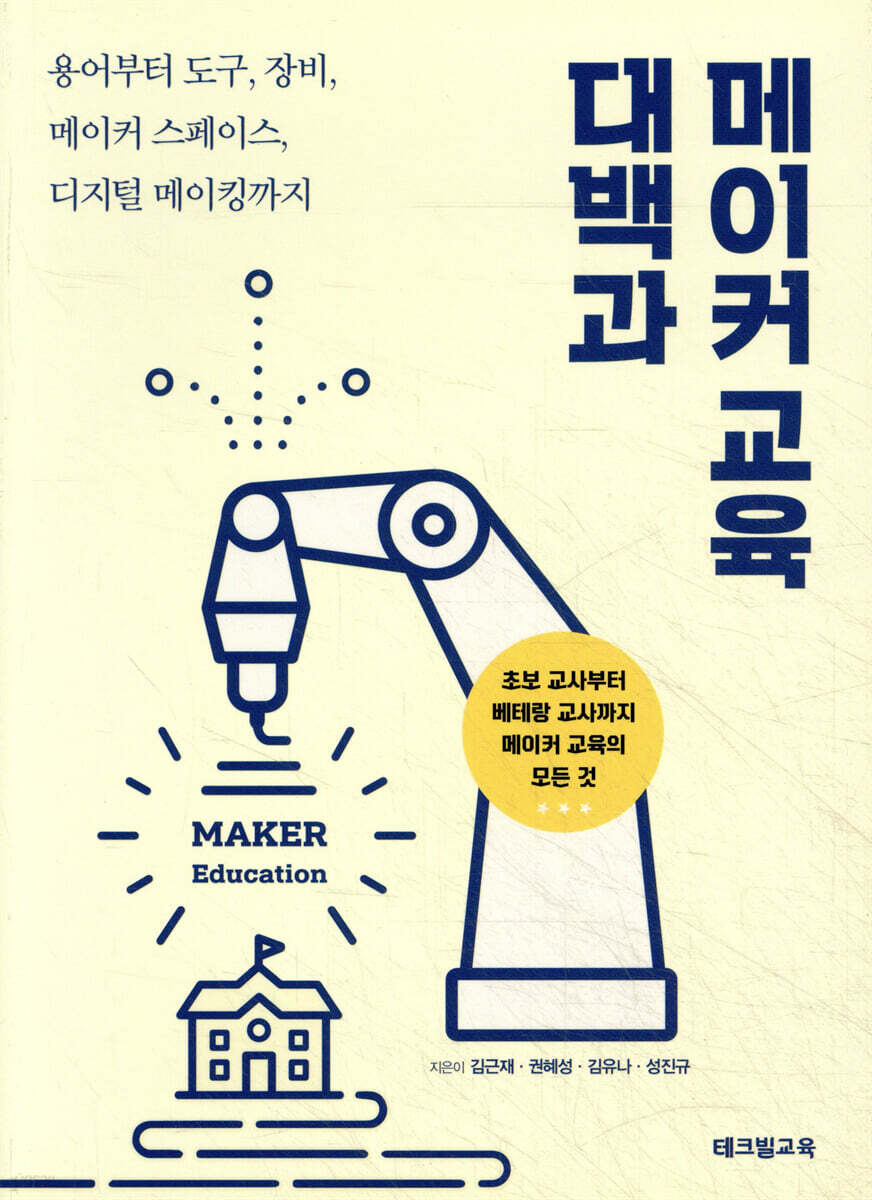
Maker Education Encyclopedia
 |
Description
Book Introduction
Maker Education: Where to Start?
From terminology to tools, equipment, makerspaces, and digital making.
All About Maker Education
Due to COVID-19, not only society as a whole but also school education is shifting its attention to new issues and challenges, such as non-face-to-face education and artificial intelligence education.
In the midst of this, I have been constantly thinking about how to foster students' creative convergence and self-directed abilities in actual educational settings, and the results of my thinking and applying to students in my classes have been published in a book.
That book is the 『Maker Education Encyclopedia』.
The "Maker Education Encyclopedia" shows what maker education is and why it is necessary, with actual class examples.
It also provides information on preparing the equipment and tools essential for maker education, building a maker space, and designing maker classes and resources.
This can be used as an easy and friendly guide for teachers who are starting maker education, and as a more in-depth comprehensive guide for teachers who have some know-how in maker education.
From terminology to tools, equipment, makerspaces, and digital making.
All About Maker Education
Due to COVID-19, not only society as a whole but also school education is shifting its attention to new issues and challenges, such as non-face-to-face education and artificial intelligence education.
In the midst of this, I have been constantly thinking about how to foster students' creative convergence and self-directed abilities in actual educational settings, and the results of my thinking and applying to students in my classes have been published in a book.
That book is the 『Maker Education Encyclopedia』.
The "Maker Education Encyclopedia" shows what maker education is and why it is necessary, with actual class examples.
It also provides information on preparing the equipment and tools essential for maker education, building a maker space, and designing maker classes and resources.
This can be used as an easy and friendly guide for teachers who are starting maker education, and as a more in-depth comprehensive guide for teachers who have some know-how in maker education.
- You can preview some of the book's contents.
Preview
index
Recommendation
Author's Preface
Part 1.
The Need for Maker Education
Chapter 1.
Why do we need maker education?
Chapter 2.
Encyclopedia of Maker Education Terminology
Chapter 3.
Maker Education Class Model and the Teacher's Role
Chapter 4.
Current Status of Maker Education in Educational Settings
Part 2.
Building a makerspace
Chapter 1.
How to Build a Maker Space
Chapter 2.
How to Organize Makerspaces in Schools: Participatory Design
Chapter 3.
Things to Consider When Building a Makerspace
Part 3.
Tools and equipment needed for maker education
Chapter 1.
Traditional making tools and equipment
Chapter 2.
Tools and equipment related to digital making
Part 4.
Lesson Design for Maker Education
Chapter 1.
Focusing on traditional making
Chapter 2.
Focusing on digital making
Part 5.
Maker Education Learning Resources
Chapter 1.
Application
Chapter 2.
Internet site
Chapter 3.
books
Chapter 4.
youtube
supplement
References
Author's Preface
Part 1.
The Need for Maker Education
Chapter 1.
Why do we need maker education?
Chapter 2.
Encyclopedia of Maker Education Terminology
Chapter 3.
Maker Education Class Model and the Teacher's Role
Chapter 4.
Current Status of Maker Education in Educational Settings
Part 2.
Building a makerspace
Chapter 1.
How to Build a Maker Space
Chapter 2.
How to Organize Makerspaces in Schools: Participatory Design
Chapter 3.
Things to Consider When Building a Makerspace
Part 3.
Tools and equipment needed for maker education
Chapter 1.
Traditional making tools and equipment
Chapter 2.
Tools and equipment related to digital making
Part 4.
Lesson Design for Maker Education
Chapter 1.
Focusing on traditional making
Chapter 2.
Focusing on digital making
Part 5.
Maker Education Learning Resources
Chapter 1.
Application
Chapter 2.
Internet site
Chapter 3.
books
Chapter 4.
youtube
supplement
References
Into the book
Maker education increases students' opportunities to experience design and engineering practices, particularly those that intersect with science, technology, engineering, and mathematics (STEM).
We can also shift the focus of school education from the traditional “How can we test students on what they’ve learned?” to “What can students do with what they’ve learned?”
--- p.20~21
Physical computing tools are devices that utilize digital and analog methods to input information in a physical form from the outside, process it, and output the results in a physical form, thereby helping humans interact with the environment.
Simply put, it is a device that helps implement code implemented through a computer into the real world and interact with it.
--- p.28
The micro:bit has LEDs, motion sensors, a compass, a speaker, a Bluetooth sensor, and more built into it, allowing you to easily program it to make things like light up or make sounds.
In addition, you can expand and connect sensors such as motors, servomotors, and switches, which allows you to create various creations such as a trash can that opens when it detects movement, or a fan that turns on automatically when it detects temperature.
It also utilizes a separate platform called MakeCode for programming, but is also compatible with Scratch and Entry.
We can also shift the focus of school education from the traditional “How can we test students on what they’ve learned?” to “What can students do with what they’ve learned?”
--- p.20~21
Physical computing tools are devices that utilize digital and analog methods to input information in a physical form from the outside, process it, and output the results in a physical form, thereby helping humans interact with the environment.
Simply put, it is a device that helps implement code implemented through a computer into the real world and interact with it.
--- p.28
The micro:bit has LEDs, motion sensors, a compass, a speaker, a Bluetooth sensor, and more built into it, allowing you to easily program it to make things like light up or make sounds.
In addition, you can expand and connect sensors such as motors, servomotors, and switches, which allows you to create various creations such as a trash can that opens when it detects movement, or a fan that turns on automatically when it detects temperature.
It also utilizes a separate platform called MakeCode for programming, but is also compatible with Scratch and Entry.
--- p.165
Publisher's Review
Maker Education: The First Step in Educational Change in the New Normal Era
“Children create what they need on their own, learning naturally occurs in the process, and ultimately, applying the knowledge and skills they have learned to solve problems that arise in real life.
“That is the strength of maker education and the ultimate goal of all education.”
These are the words of teachers Geunjae Kim, Hyeseong Kwon, Jinkyu Seong, and Yuna Kim, who have experienced creative, self-directed change and growth in children through maker education both inside and outside of school.
In reality, maker education places great importance on the attempt and application of living, embodied knowledge, rather than on knowledge-centered education in the form of textbooks, and on creating something in the process.
The power of American education, which is leading the Fourth Industrial Revolution, a symbol of the future society, lies right here.
This is an essential education for our students who will become future talents.
In the wake of COVID-19, various blended learning methods, including non-face-to-face education, are being called the new normal, and attempts are being made to change and innovate existing teaching methods. Maker education is an essential education for our children and the first step towards that goal.
Maker Education Bible for Field Teachers
The Maker Education Encyclopedia contains everything you need for maker education, from basic terminology to related knowledge, tools and equipment, maker spaces, and digital making.
And that's not all.
The maker class design and implementation examples that can be used immediately in the classroom are very specific and practical, so anyone can use them.
This will be an easy and friendly guide for teachers who are just starting out with maker education, and a more in-depth and comprehensive guide for teachers who have accumulated their own know-how in maker education.
The "Encyclopedia of Maker Education" consists of five parts. Part 1 examines what maker education is and why it is necessary, and argues for the "necessity of maker education."
Part 2 contains examples of how to create and organize a ‘space for practicing maker education.’
In Part 3, we will learn about the 'equipment and tools needed for maker education'.
In Part 4, we will examine how maker education classes are designed and conducted through actual lesson plans and examples.
The final five sections provide 'Maker Education Learning Resources' for teachers and students to reference.
In addition, it contains a wealth of information, including learning tips to reduce failures that can occur in practical maker classes and examples of writing annual maker education operation plans.
“Children create what they need on their own, learning naturally occurs in the process, and ultimately, applying the knowledge and skills they have learned to solve problems that arise in real life.
“That is the strength of maker education and the ultimate goal of all education.”
These are the words of teachers Geunjae Kim, Hyeseong Kwon, Jinkyu Seong, and Yuna Kim, who have experienced creative, self-directed change and growth in children through maker education both inside and outside of school.
In reality, maker education places great importance on the attempt and application of living, embodied knowledge, rather than on knowledge-centered education in the form of textbooks, and on creating something in the process.
The power of American education, which is leading the Fourth Industrial Revolution, a symbol of the future society, lies right here.
This is an essential education for our students who will become future talents.
In the wake of COVID-19, various blended learning methods, including non-face-to-face education, are being called the new normal, and attempts are being made to change and innovate existing teaching methods. Maker education is an essential education for our children and the first step towards that goal.
Maker Education Bible for Field Teachers
The Maker Education Encyclopedia contains everything you need for maker education, from basic terminology to related knowledge, tools and equipment, maker spaces, and digital making.
And that's not all.
The maker class design and implementation examples that can be used immediately in the classroom are very specific and practical, so anyone can use them.
This will be an easy and friendly guide for teachers who are just starting out with maker education, and a more in-depth and comprehensive guide for teachers who have accumulated their own know-how in maker education.
The "Encyclopedia of Maker Education" consists of five parts. Part 1 examines what maker education is and why it is necessary, and argues for the "necessity of maker education."
Part 2 contains examples of how to create and organize a ‘space for practicing maker education.’
In Part 3, we will learn about the 'equipment and tools needed for maker education'.
In Part 4, we will examine how maker education classes are designed and conducted through actual lesson plans and examples.
The final five sections provide 'Maker Education Learning Resources' for teachers and students to reference.
In addition, it contains a wealth of information, including learning tips to reduce failures that can occur in practical maker classes and examples of writing annual maker education operation plans.
GOODS SPECIFICS
- Publication date: December 15, 2020
- Page count, weight, size: 348 pages | 564g | 152*210*20mm
- ISBN13: 9791163461067
- ISBN10: 1163461067
You may also like
카테고리
korean


korean

![GQ KOREA Mark (Monthly): December [2025]](http://librairie.coreenne.fr/cdn/shop/files/8ef265dbbfbf186523ed75ba7319009d.jpg?v=1765340328&width=3840)


