

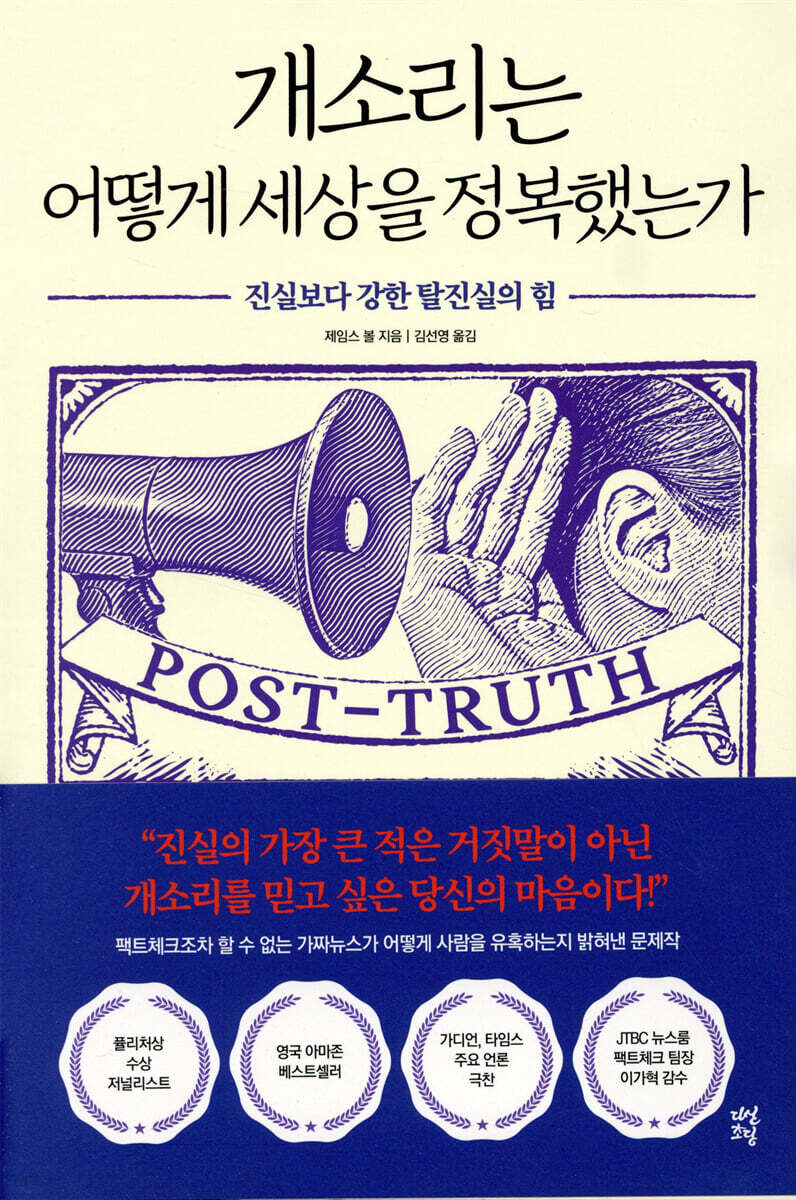
How Dogs Conquered the World
 |
Description
Book Introduction
- A word from MD
- If a lie is a strategically constructed statement with the truth in mind, then bullshit is a statement made without regard for truth.
Recently, politicians and journalists have been spreading fake news that cannot even be fact-checked.
A book that emphasizes how much the media ecosystem has collapsed and the need to fix it now.
- Son Min-gyu, Social and Political MD
A problematic work that reveals how fake news, which cannot even be fact-checked, seduces people.
“The greatest enemy of truth is not lies,
“It’s your heart that wants to believe bullshit!”
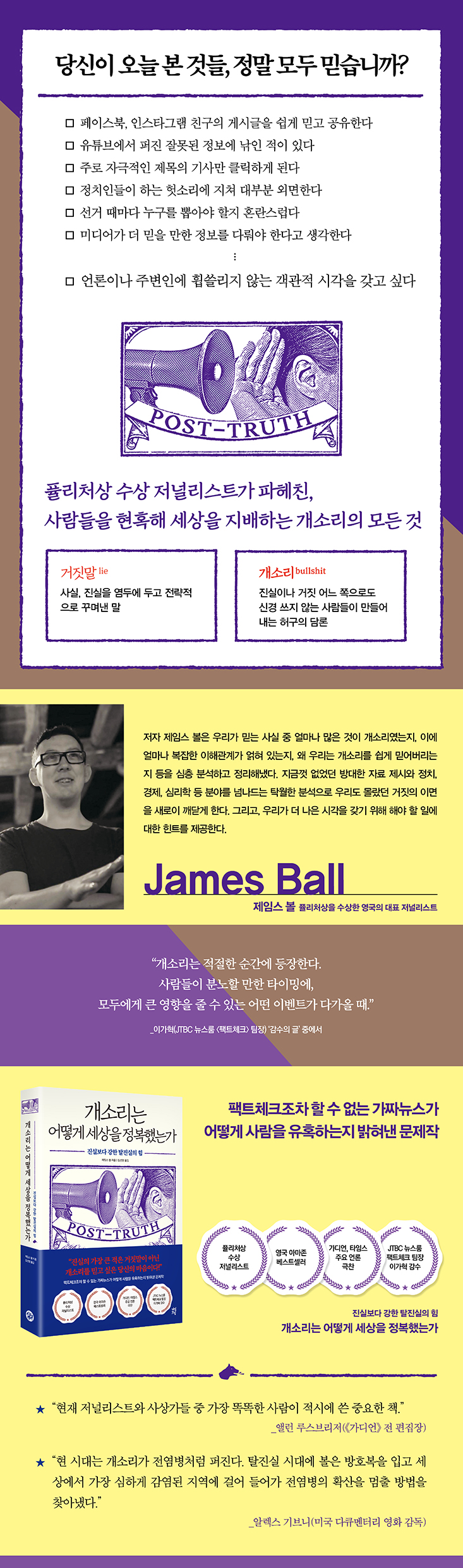
A Pulitzer Prize-winning journalist uncovers all the bullshit that's deceiving people and ruling the world.
As fake news swept the world and the post-truth era arrived, a new threat emerged.
That's just bullshit.
British journalist James Ball, who won the Pulitzer Prize for his reporting on the Edward Snowden revelations, has analyzed and summarized the bullshit that is more powerful than lies.
If lying is something that is done strategically with truth and authority in mind, then bullshit is a fictional discourse that is spewed out without any regard for truth or falsehood.
What's important is that the bullshit penetrates every important area of life, from people's daily lives to major national policies and the selection of leaders.
We 'mistakenly' believe that we are each making rational judgments about news and opinions and making decisions.
But the author exposes how much of what the public believes is nonsense, leading to so many misjudgments.
Bullshit clouds our judgment by precisely touching on our most vulnerable points: what people 'want to believe'.
It targets unconscious desires and makes you want to believe it as fact, even if it is obvious nonsense.
We examine why these covert and pervasive tactics threaten our lives, how deeply and widely they have spread, and how we can address them.
The diverse case studies and exceptional analysis across fields such as politics, economics, and psychology enhance immersion while also fostering a deeper understanding of the media and press ecosystem, prompting readers to reconsider the various ideologies that control the world.
Moreover, JTBC Newsroom fact-checker reporter Lee Ga-hyeok provides hints on the path forward through his review of domestic cases and the Korean media ecosystem.
“The greatest enemy of truth is not lies,
“It’s your heart that wants to believe bullshit!”
A Pulitzer Prize-winning journalist uncovers all the bullshit that's deceiving people and ruling the world.
As fake news swept the world and the post-truth era arrived, a new threat emerged.
That's just bullshit.
British journalist James Ball, who won the Pulitzer Prize for his reporting on the Edward Snowden revelations, has analyzed and summarized the bullshit that is more powerful than lies.
If lying is something that is done strategically with truth and authority in mind, then bullshit is a fictional discourse that is spewed out without any regard for truth or falsehood.
What's important is that the bullshit penetrates every important area of life, from people's daily lives to major national policies and the selection of leaders.
We 'mistakenly' believe that we are each making rational judgments about news and opinions and making decisions.
But the author exposes how much of what the public believes is nonsense, leading to so many misjudgments.
Bullshit clouds our judgment by precisely touching on our most vulnerable points: what people 'want to believe'.
It targets unconscious desires and makes you want to believe it as fact, even if it is obvious nonsense.
We examine why these covert and pervasive tactics threaten our lives, how deeply and widely they have spread, and how we can address them.
The diverse case studies and exceptional analysis across fields such as politics, economics, and psychology enhance immersion while also fostering a deeper understanding of the media and press ecosystem, prompting readers to reconsider the various ideologies that control the world.
Moreover, JTBC Newsroom fact-checker reporter Lee Ga-hyeok provides hints on the path forward through his review of domestic cases and the Korean media ecosystem.
- You can preview some of the book's contents.
Preview
index
Recommendations and Reviews | Do You Really Believe It All?
Entering | A lie is stronger than a lie
Part 1 | Who Controls Us and How?
fake media
social media
new media
Legacy Media
politician
And… you
Part 2 | In the Post-Truth Era, Bullshit Overwhelms Truth
How Trump Took Over America
Britain's decision to regain control
Part 3 | Why We Fall for the Temptation of Bullshit
The human psychological structure vulnerable to temptation
Why Bullshit Makes Money
Why can't we stop the overflowing noise?
Part 4 | The Wisest Way to Protect the Truth
Beyond fact-checking
The smartest way to deal with bullshit
Going Out | Reality is More Complex than Conspiracy Theories
annotation
References
Entering | A lie is stronger than a lie
Part 1 | Who Controls Us and How?
fake media
social media
new media
Legacy Media
politician
And… you
Part 2 | In the Post-Truth Era, Bullshit Overwhelms Truth
How Trump Took Over America
Britain's decision to regain control
Part 3 | Why We Fall for the Temptation of Bullshit
The human psychological structure vulnerable to temptation
Why Bullshit Makes Money
Why can't we stop the overflowing noise?
Part 4 | The Wisest Way to Protect the Truth
Beyond fact-checking
The smartest way to deal with bullshit
Going Out | Reality is More Complex than Conspiracy Theories
annotation
References
Detailed image
Into the book
The dog barking comes at the right moment.
It's just when people are likely to be angry, when an event that could have a major impact on everyone is coming up.
--- p.9, from “Recommendations and Reviews | Do You Really Believe It All?”
To lie, you must care about some form of absolute truth or falsehood.
But increasingly, the political landscape is being dominated by people who don't care much about truth or lies.
What they care about is discourse.
(…) Unlike liars, whiners neither reject nor challenge the authority of truth.
I just don't care at all.
For this reason, the greater enemy of truth is bullshit rather than lies.
--- p.27~29, from “Introduction | Bullshit Stronger Than Lies”
We get media that suits our level.
There is a public that consumes both news media and fake sites, so they create that information.
Politicians act based on what they believe voters will react to.
Social networks only allow us to interact with each other.
When there is a lot of bullshit and no reliable information, we too, as consumers, paying readers, and voters, have a role to play.
Moreover, we are now in an era where we can create and share information almost on par with traditional media.
Our role becomes more prominent.
--- p.156, from “Part 1 | Who Controls Us and How?”
Trump makes aggressive, unsupported claims, then searches for anything to back them up.
Then, when they find something that can be used as evidence, they launch a personal attack on the person who is attacking their claim.
His ultimate goal is faith.
Trump supporters, for the most part, have to believe it all.
We must believe every single claim, every single piece of evidence, every single claim that Trump did not attack the reporter.
--- p.185, from “Part 2 | In the Post-Truth Era, Bullshit Overwhelms the Truth”
We conform to the groups we belong to, signal our membership in those groups, and polarize our tendencies through those groups.
This is why we welcome nonsense information that further solidifies our identity, rather than accurate and verifiable information that shakes the identity of our group.
Another situation in which identity becomes more solid is when there is conflict with another group.
--- p.257, from “Part 3: Why Do We Fall for the Temptation of Bullshit?”
There is another risk with outlets that promote themselves as "quality" journalism.
The point is that the writer cares more about the opinions of other reporters than the readers.
These concerns have been around since at least the 1970s.
At the time, a reporter said anonymously:
“Journalists write for other journalists.
“I care more about the people I have lunch with than the readers.”
--- p.300, from “Part 3: Why Do We Fall for the Temptation of Bullshit?”
In other words, most statements are close to the truth but are somewhat exaggerated, and statements are close to lies but contain a little bit of truth.
Distinguishing between the two is more a matter of judgment and opinion than of fact.
If we reduce our response to bullshit to simply dealing with blatant lies, we will be completely neglecting the majority of bullshit.
--- p.329, from “Part 4 | The Wisest Way to Protect the Truth”
The rise of dog whining is a problem that has no single solution, and all players in the information ecosystem must respond in various ways.
We must start from the reality that the political world and the media face.
Asking media outlets to create new business models or encouraging millions of people who don't pay for news to subscribe voluntarily is a recipe for failure.
It's just when people are likely to be angry, when an event that could have a major impact on everyone is coming up.
--- p.9, from “Recommendations and Reviews | Do You Really Believe It All?”
To lie, you must care about some form of absolute truth or falsehood.
But increasingly, the political landscape is being dominated by people who don't care much about truth or lies.
What they care about is discourse.
(…) Unlike liars, whiners neither reject nor challenge the authority of truth.
I just don't care at all.
For this reason, the greater enemy of truth is bullshit rather than lies.
--- p.27~29, from “Introduction | Bullshit Stronger Than Lies”
We get media that suits our level.
There is a public that consumes both news media and fake sites, so they create that information.
Politicians act based on what they believe voters will react to.
Social networks only allow us to interact with each other.
When there is a lot of bullshit and no reliable information, we too, as consumers, paying readers, and voters, have a role to play.
Moreover, we are now in an era where we can create and share information almost on par with traditional media.
Our role becomes more prominent.
--- p.156, from “Part 1 | Who Controls Us and How?”
Trump makes aggressive, unsupported claims, then searches for anything to back them up.
Then, when they find something that can be used as evidence, they launch a personal attack on the person who is attacking their claim.
His ultimate goal is faith.
Trump supporters, for the most part, have to believe it all.
We must believe every single claim, every single piece of evidence, every single claim that Trump did not attack the reporter.
--- p.185, from “Part 2 | In the Post-Truth Era, Bullshit Overwhelms the Truth”
We conform to the groups we belong to, signal our membership in those groups, and polarize our tendencies through those groups.
This is why we welcome nonsense information that further solidifies our identity, rather than accurate and verifiable information that shakes the identity of our group.
Another situation in which identity becomes more solid is when there is conflict with another group.
--- p.257, from “Part 3: Why Do We Fall for the Temptation of Bullshit?”
There is another risk with outlets that promote themselves as "quality" journalism.
The point is that the writer cares more about the opinions of other reporters than the readers.
These concerns have been around since at least the 1970s.
At the time, a reporter said anonymously:
“Journalists write for other journalists.
“I care more about the people I have lunch with than the readers.”
--- p.300, from “Part 3: Why Do We Fall for the Temptation of Bullshit?”
In other words, most statements are close to the truth but are somewhat exaggerated, and statements are close to lies but contain a little bit of truth.
Distinguishing between the two is more a matter of judgment and opinion than of fact.
If we reduce our response to bullshit to simply dealing with blatant lies, we will be completely neglecting the majority of bullshit.
--- p.329, from “Part 4 | The Wisest Way to Protect the Truth”
The rise of dog whining is a problem that has no single solution, and all players in the information ecosystem must respond in various ways.
We must start from the reality that the political world and the media face.
Asking media outlets to create new business models or encouraging millions of people who don't pay for news to subscribe voluntarily is a recipe for failure.
--- p.359~360, from “Part 4 | The Wisest Way to Protect the Truth”
Publisher's Review
“Is what you saw and heard today true?”
The trap of bullshit that delves into the most vulnerable parts of humanity
During the sudden COVID-19 pandemic, when people were waiting in lines for hours to buy masks, a post went viral claiming that the government was producing and stockpiling 1 million masks to aid North Korea.
This content quickly spread through various online bulletin boards and people became angry.
However, this was not true at all and was nothing more than a clickbait post to sell hand sanitizer.
It was a strategy that exploited human fears and dread.
As such, the noise appears at the right moment.
When people are likely to be angry, when an event that could have a major impact on everyone is approaching.
There are many things you can gain by delving into human emotions.
It doesn't end with simple hand sanitizer fishing, such as economic gain, gaining power, or spreading a specific ideology.
Not only do individuals suffer great and small damages, but the lives of many become inconvenient due to wrong policies, and a country staggers due to the election of a substandard leader, all of this is due to the influence of bullshit.
Author James Ball, who has worked at leading media outlets such as The Guardian and The Washington Post and has been at the forefront of fact-checking, shows step by step how bullshit dominates us.
Trump, the 45th President of the United States, and countless other politicians, businessmen, and celebrities have achieved what they want by constantly spouting nonsense.
The culprits of such nonsense, regardless of genre or subject, are everywhere.
After seeing the vast number of false claims and realizing the truth behind things I had previously believed, I began to doubt how much of what I saw and heard today was true.
Why are we false, narrow-minded,
Are you easily fooled by manipulated information?
The media that spreads rumors are also diverse.
Not only social media, which we breathe freely, but also legacy media such as TV news, newspapers, and magazines criticize fake news, but they are also swayed by it without any verification, or even actively use it.
This is why we use the term 'rag'.
The author points out the limitations of the media environment in which this phenomenon occurs.
The obvious fact that 'dog talk makes money' has the press and media in a bind.
The influence of print newspapers is waning, and the bait for media outlets that must profit from "clickbait" is sensational and sensational fake news.
As newspaper sales decline, the number of journalists also decreases, forcing us to handle more work on an unprecedentedly small budget.
In situations like this, it is far more beneficial to bite the bait of bullshit than to carefully verify the facts.
The attitude of the general public also contributes greatly to this problem.
According to one survey, 59% of people who share article links on social media don't even click on the links.
In other words, they share the article without even checking the content, just by looking at the title.
We, who curse at rags, should also reflect on how much we really paid attention to 'facts'.
Every human being has some bias.
We are more likely to believe information if it matches our existing beliefs.
If you support a particular political party, you are more likely to share and believe articles that positively portray it, but if it's an opposing view, you are more likely to ignore it without even trying to properly inform yourself.
Rather, when faced with opposing opinions, a 'backfire effect' can occur, which reinforces the original belief.
Because the human brain is so illogical, it is necessary to be conscious of this and continually make an effort to verify oneself.
If everyone is the main culprit of the noise
All of this can be a solution to the problem.
You can't stop the rumors that have already spread.
By the time widespread information is revealed to be nonsense or fake news, all interest has already disappeared.
No one reads correction articles.
Moreover, people trust their Facebook, Twitter, and Instagram friends more than the established media, who show them only what they want to see.
While this bizarre phenomenon stems from structural problems, such as social media algorithms and the decline of trust in established media, we must still do our part to prevent the spread of this nonsense.
In this book, the author offers concrete and practical guidance that will benefit politicians, the media, and readers alike.
It's about re-examining my biased beliefs, stopping before rashly sharing information, and paying attention to various fact-checking channels.
All of this can feel annoying.
But the author asks whether we should give up the rights we enjoy as sovereigns, as citizens, and as free individuals just because they are annoying.
I need to keep my eyes wide open so that my daily life and my judgment are not controlled by someone else.
If you truly want to live a life of your own.
If we are all part of the problem, we can all be part of the solution.
The trap of bullshit that delves into the most vulnerable parts of humanity
During the sudden COVID-19 pandemic, when people were waiting in lines for hours to buy masks, a post went viral claiming that the government was producing and stockpiling 1 million masks to aid North Korea.
This content quickly spread through various online bulletin boards and people became angry.
However, this was not true at all and was nothing more than a clickbait post to sell hand sanitizer.
It was a strategy that exploited human fears and dread.
As such, the noise appears at the right moment.
When people are likely to be angry, when an event that could have a major impact on everyone is approaching.
There are many things you can gain by delving into human emotions.
It doesn't end with simple hand sanitizer fishing, such as economic gain, gaining power, or spreading a specific ideology.
Not only do individuals suffer great and small damages, but the lives of many become inconvenient due to wrong policies, and a country staggers due to the election of a substandard leader, all of this is due to the influence of bullshit.
Author James Ball, who has worked at leading media outlets such as The Guardian and The Washington Post and has been at the forefront of fact-checking, shows step by step how bullshit dominates us.
Trump, the 45th President of the United States, and countless other politicians, businessmen, and celebrities have achieved what they want by constantly spouting nonsense.
The culprits of such nonsense, regardless of genre or subject, are everywhere.
After seeing the vast number of false claims and realizing the truth behind things I had previously believed, I began to doubt how much of what I saw and heard today was true.
Why are we false, narrow-minded,
Are you easily fooled by manipulated information?
The media that spreads rumors are also diverse.
Not only social media, which we breathe freely, but also legacy media such as TV news, newspapers, and magazines criticize fake news, but they are also swayed by it without any verification, or even actively use it.
This is why we use the term 'rag'.
The author points out the limitations of the media environment in which this phenomenon occurs.
The obvious fact that 'dog talk makes money' has the press and media in a bind.
The influence of print newspapers is waning, and the bait for media outlets that must profit from "clickbait" is sensational and sensational fake news.
As newspaper sales decline, the number of journalists also decreases, forcing us to handle more work on an unprecedentedly small budget.
In situations like this, it is far more beneficial to bite the bait of bullshit than to carefully verify the facts.
The attitude of the general public also contributes greatly to this problem.
According to one survey, 59% of people who share article links on social media don't even click on the links.
In other words, they share the article without even checking the content, just by looking at the title.
We, who curse at rags, should also reflect on how much we really paid attention to 'facts'.
Every human being has some bias.
We are more likely to believe information if it matches our existing beliefs.
If you support a particular political party, you are more likely to share and believe articles that positively portray it, but if it's an opposing view, you are more likely to ignore it without even trying to properly inform yourself.
Rather, when faced with opposing opinions, a 'backfire effect' can occur, which reinforces the original belief.
Because the human brain is so illogical, it is necessary to be conscious of this and continually make an effort to verify oneself.
If everyone is the main culprit of the noise
All of this can be a solution to the problem.
You can't stop the rumors that have already spread.
By the time widespread information is revealed to be nonsense or fake news, all interest has already disappeared.
No one reads correction articles.
Moreover, people trust their Facebook, Twitter, and Instagram friends more than the established media, who show them only what they want to see.
While this bizarre phenomenon stems from structural problems, such as social media algorithms and the decline of trust in established media, we must still do our part to prevent the spread of this nonsense.
In this book, the author offers concrete and practical guidance that will benefit politicians, the media, and readers alike.
It's about re-examining my biased beliefs, stopping before rashly sharing information, and paying attention to various fact-checking channels.
All of this can feel annoying.
But the author asks whether we should give up the rights we enjoy as sovereigns, as citizens, and as free individuals just because they are annoying.
I need to keep my eyes wide open so that my daily life and my judgment are not controlled by someone else.
If you truly want to live a life of your own.
If we are all part of the problem, we can all be part of the solution.
GOODS SPECIFICS
- Publication date: November 11, 2020
- Page count, weight, size: 400 pages | 640g | 145*215*22mm
- ISBN13: 9791130632476
- ISBN10: 1130632474
You may also like
카테고리
korean


korean

![GQ KOREA Mark (Monthly): December [2025]](http://librairie.coreenne.fr/cdn/shop/files/8ef265dbbfbf186523ed75ba7319009d.jpg?v=1765340328&width=3840)


