

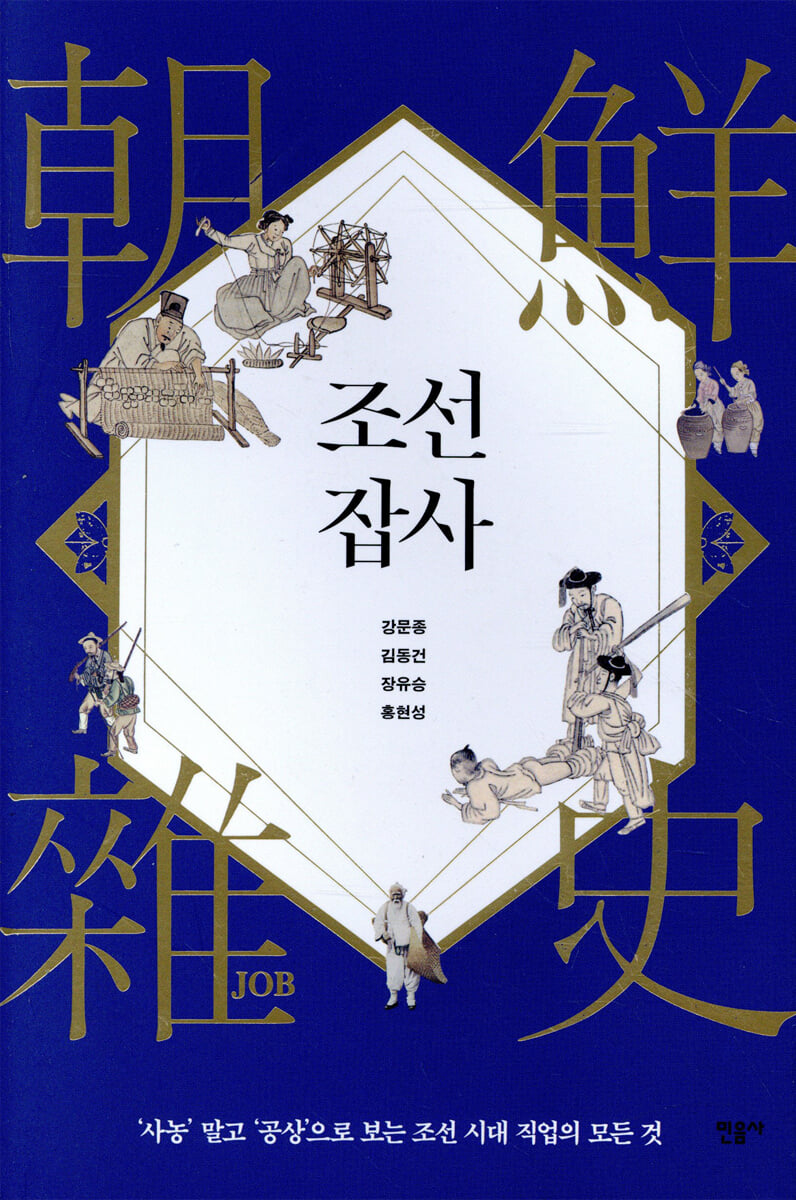
Joseon Miscellaneous History
 |
Description
Book Introduction
A tiger-catching hawk master, a hawk-selling hawk who gets hit instead of a hawk, a novel-reading electrician,
Hair designer Ga Che-jang, cosmetics salesman Mae Bun-gu, scientific investigator Oh Ja-jin… …
Even if you don't know the Thousand Character Classic, you have at least one skill to make a living!
A History of Jobs in Joseon as Seen from the Perspective of Common People, Not the Yangban
In the popular drama [Kingdom], which gained popularity as a 'Joseon zombie drama', 'Yeong-shin' showed off martial arts skills that were no less than those of the main character, the crown prince.
His occupation was tiger-catching armor.
As he was from a special unit that risked his life to catch tigers in the mountains, it was understandable that he would be able to kill zombies without rest.
In this way, 『Joseon Miscellaneous History: Everything About Joseon Dynasty Occupations Seen as ‘Gongsang’ Instead of ‘San’ or ‘Nong’』, which comprehensively covers Joseon’s previously unknown occupations, has been published by Minumsa.
The 67 occupations discovered by young Korean studies researchers naturally evoke a sense of wonder: "Was this even possible?"
This is not a story of the scholars or farmers that usually come to mind when thinking of Joseon, but of ordinary people who lived fiercely in markets, back alleys, bars, and sometimes even from the border to the bottom of the sea.
『Joseon Miscellaneous History』 is a history of jobs, and also a miscellaneous history.
It's a fitting title for a book with a complex mix of occupations.
Even if you call it a 'dad joke', I have nothing to say.
I couldn't find a title that captures the character of this book as well as this one.
In historical studies dominated by grand narratives such as civilization, nation, and people, the history of occupations is still a messy history.
It will be useful to general readers curious about the lives of Joseon people, teachers of history, and those in the cultural industry who create content set in the Joseon Dynasty.
It would be even better if we could predict the future of jobs by examining the birth, death, and change of jobs.
_Entering
Hair designer Ga Che-jang, cosmetics salesman Mae Bun-gu, scientific investigator Oh Ja-jin… …
Even if you don't know the Thousand Character Classic, you have at least one skill to make a living!
A History of Jobs in Joseon as Seen from the Perspective of Common People, Not the Yangban
In the popular drama [Kingdom], which gained popularity as a 'Joseon zombie drama', 'Yeong-shin' showed off martial arts skills that were no less than those of the main character, the crown prince.
His occupation was tiger-catching armor.
As he was from a special unit that risked his life to catch tigers in the mountains, it was understandable that he would be able to kill zombies without rest.
In this way, 『Joseon Miscellaneous History: Everything About Joseon Dynasty Occupations Seen as ‘Gongsang’ Instead of ‘San’ or ‘Nong’』, which comprehensively covers Joseon’s previously unknown occupations, has been published by Minumsa.
The 67 occupations discovered by young Korean studies researchers naturally evoke a sense of wonder: "Was this even possible?"
This is not a story of the scholars or farmers that usually come to mind when thinking of Joseon, but of ordinary people who lived fiercely in markets, back alleys, bars, and sometimes even from the border to the bottom of the sea.
『Joseon Miscellaneous History』 is a history of jobs, and also a miscellaneous history.
It's a fitting title for a book with a complex mix of occupations.
Even if you call it a 'dad joke', I have nothing to say.
I couldn't find a title that captures the character of this book as well as this one.
In historical studies dominated by grand narratives such as civilization, nation, and people, the history of occupations is still a messy history.
It will be useful to general readers curious about the lives of Joseon people, teachers of history, and those in the cultural industry who create content set in the Joseon Dynasty.
It would be even better if we could predict the future of jobs by examining the birth, death, and change of jobs.
_Entering
- You can preview some of the book's contents.
Preview
index
On the publication of 『Joseon Miscellaneous History』ㆍ4
Part 1 | Working Women
Sewing for hire, a means of survival for poor womenㆍ13 | Sumo, a bride's helper and wedding officiantㆍ17 | Hair dyeing, a suitable industry for small business ownersㆍ20 | Weaving, a housekeeper for frontier military officersㆍ24 | Maebungu, a cosmetics saleswomanㆍ28 | Diving women, a arduous seafaring laborerㆍ32 | Vegetable stalls for female business ownersㆍ36
Part 2 | Extreme Job
Hoejasu, the executionerㆍ43 | A despised but free landownerㆍ47 | Bojangsa, the human messengerㆍ51 | The ability to gather herbs is a virtue of a filial sonㆍ55 | Chakhogapsa, the special unit that catches tigersㆍ59 | Baekjeong, the beef supplierㆍ64 | Get on my back! Wolcheonkkunㆍ69 | Mountain beyond the mountain, Simmaniㆍ74 | Sancheok, the outstanding forest manㆍ78 | May you be reborn in paradise, Maegolseungㆍ83 | Sewage disposal worker or Yedeok teacherㆍ88 | Geumhwagun, the Joseon firefighterㆍ93 | Let's make a lot of moneyㆍ96
Part 3 | The World of Art
Gisaeng, Professional Go Playerㆍ103 | Nonghuja, Street Monkey Performerㆍ107 | Jageun, Stand-up Comedianㆍ112 | Jeon Gisu, A Man Who Reads Novelsㆍ117 | Illusionist, Performing the Impossibleㆍ122 | Gagak, I Am a Singer of Joseonㆍ126 | Sadangpae, Selling Laughterㆍ130 | Gwanhyeonmaeng, A Blind Man Who Sees Soundㆍ135 | The Agony of a Professional Haegeum Playerㆍ139
Part 4 | Technicians
Makeup, Joseon's Floristsㆍ145 | Gachejang, the Designer Who Stealth Women's Heartsㆍ150 | Ma Gyeongjang, the Mirror-Sharpening Craftsmanㆍ155 | Joseon's Ultimate Weapon, the Bowmakerㆍ160 | Sagijang, the Dark Shadow of Joseon's White Porcelainㆍ165 | Script Maker, the World's Greatest Brush Makerㆍ169 | Engraver, the Calligrapherㆍ174 | Jijang, the Papermakerㆍ178 | Clockmaker, Creating Time from Nothingㆍ182
Part 5 | Between Legal and Illegal
Pyo Nang Do, a pickpocket on the street, 189 | You have to hit to survive, a peddler, 194 | Geo Byeok, I'll help you pass the civil service examination, 198 | Jo Bang Kun, a banquet expert, 203 | Sik Ri In, a Joseon loan shark, 208 | An Hwa Sang, selling fakes that look like the real thing, 215 | Pyeon Sa, a conman who lives off desire, 219 | Fugitive, a counterfeiter, 223 | Dae Dae Gun, a part-time job instead of the military, 227
Part 6 | Professionals in Joseon
Dormitory, the Tough Live-In Tutorㆍ233 | Old Man Weaving Matsㆍ237 | Sanwon, a Mathematician and Accountantㆍ242 | Interpreter, Let's Go to the Qing Dynasty to Sell Ginsengㆍ247 | Seosu, Do We Need Pretty Handwritingㆍ252 | Ojakin, Joseon's Scientific Investigation Unitㆍ256 | Oejibu, the People's Lawyerㆍ260 | Gyeomin, Joseon's Butlerㆍ264 | Pansu, Eyes Seeing the Futureㆍ268 | Falconer Eungsaㆍ272
Part 7 | The Scholars, Farmers, and Artisans
Salt merchants, a sideline for the common peopleㆍ8279 | Housekeepers, real estate agentsㆍ284 | Car owners, the center of logistics distributionㆍ288 | Semarkkun, general transportation businesspersonㆍ292 | Bookstore owners, publishing planners who led trendsㆍ295 | Chaekkwae, buying and selling used booksㆍ299 | Jeon In and Geulwolbija, Joseon's postmenㆍ303 | The life of a straw sandal tycoonㆍ308 | The organized power of itinerant merchants, peddlersㆍ3314 | Woodcutters who move the cityㆍ318
Week 326
Part 1 | Working Women
Sewing for hire, a means of survival for poor womenㆍ13 | Sumo, a bride's helper and wedding officiantㆍ17 | Hair dyeing, a suitable industry for small business ownersㆍ20 | Weaving, a housekeeper for frontier military officersㆍ24 | Maebungu, a cosmetics saleswomanㆍ28 | Diving women, a arduous seafaring laborerㆍ32 | Vegetable stalls for female business ownersㆍ36
Part 2 | Extreme Job
Hoejasu, the executionerㆍ43 | A despised but free landownerㆍ47 | Bojangsa, the human messengerㆍ51 | The ability to gather herbs is a virtue of a filial sonㆍ55 | Chakhogapsa, the special unit that catches tigersㆍ59 | Baekjeong, the beef supplierㆍ64 | Get on my back! Wolcheonkkunㆍ69 | Mountain beyond the mountain, Simmaniㆍ74 | Sancheok, the outstanding forest manㆍ78 | May you be reborn in paradise, Maegolseungㆍ83 | Sewage disposal worker or Yedeok teacherㆍ88 | Geumhwagun, the Joseon firefighterㆍ93 | Let's make a lot of moneyㆍ96
Part 3 | The World of Art
Gisaeng, Professional Go Playerㆍ103 | Nonghuja, Street Monkey Performerㆍ107 | Jageun, Stand-up Comedianㆍ112 | Jeon Gisu, A Man Who Reads Novelsㆍ117 | Illusionist, Performing the Impossibleㆍ122 | Gagak, I Am a Singer of Joseonㆍ126 | Sadangpae, Selling Laughterㆍ130 | Gwanhyeonmaeng, A Blind Man Who Sees Soundㆍ135 | The Agony of a Professional Haegeum Playerㆍ139
Part 4 | Technicians
Makeup, Joseon's Floristsㆍ145 | Gachejang, the Designer Who Stealth Women's Heartsㆍ150 | Ma Gyeongjang, the Mirror-Sharpening Craftsmanㆍ155 | Joseon's Ultimate Weapon, the Bowmakerㆍ160 | Sagijang, the Dark Shadow of Joseon's White Porcelainㆍ165 | Script Maker, the World's Greatest Brush Makerㆍ169 | Engraver, the Calligrapherㆍ174 | Jijang, the Papermakerㆍ178 | Clockmaker, Creating Time from Nothingㆍ182
Part 5 | Between Legal and Illegal
Pyo Nang Do, a pickpocket on the street, 189 | You have to hit to survive, a peddler, 194 | Geo Byeok, I'll help you pass the civil service examination, 198 | Jo Bang Kun, a banquet expert, 203 | Sik Ri In, a Joseon loan shark, 208 | An Hwa Sang, selling fakes that look like the real thing, 215 | Pyeon Sa, a conman who lives off desire, 219 | Fugitive, a counterfeiter, 223 | Dae Dae Gun, a part-time job instead of the military, 227
Part 6 | Professionals in Joseon
Dormitory, the Tough Live-In Tutorㆍ233 | Old Man Weaving Matsㆍ237 | Sanwon, a Mathematician and Accountantㆍ242 | Interpreter, Let's Go to the Qing Dynasty to Sell Ginsengㆍ247 | Seosu, Do We Need Pretty Handwritingㆍ252 | Ojakin, Joseon's Scientific Investigation Unitㆍ256 | Oejibu, the People's Lawyerㆍ260 | Gyeomin, Joseon's Butlerㆍ264 | Pansu, Eyes Seeing the Futureㆍ268 | Falconer Eungsaㆍ272
Part 7 | The Scholars, Farmers, and Artisans
Salt merchants, a sideline for the common peopleㆍ8279 | Housekeepers, real estate agentsㆍ284 | Car owners, the center of logistics distributionㆍ288 | Semarkkun, general transportation businesspersonㆍ292 | Bookstore owners, publishing planners who led trendsㆍ295 | Chaekkwae, buying and selling used booksㆍ299 | Jeon In and Geulwolbija, Joseon's postmenㆍ303 | The life of a straw sandal tycoonㆍ308 | The organized power of itinerant merchants, peddlersㆍ3314 | Woodcutters who move the cityㆍ318
Week 326
Into the book
Horses are faster than people, but they are expensive.
Maintenance costs are also considerable.
A galloping horse cannot be ridden unless it is ridden by a highly trained rider.
During the Goryeo Dynasty, when the Yuan Dynasty's post station system was adopted, more than 500 post stations were established across the country, but during the Joseon Dynasty, the number was reduced to 200.
Moreover, the Ming Dynasty demanded a huge number of horses as tribute every year, so the horse supply was on the verge of drying up.
In the end, people had to run instead of talk.
A man cannot run faster than a horse, but he can run longer.
Besides, in a country like ours with many mountains and rivers, people are better than horses.
In the Annals of King Sejong, there is a record of warriors who were good at running being assigned to the frontier regions in rotation.
It was to quickly convey urgent news from the border.
There is also a record that after the Byeongja Horan, when horses became scarce, people who were good at running were placed at post stations instead of horses.
Since the post station, which is part of the national trunk communication network, is in this state, the situation of the civilians is obvious.
Yun Bu (尹釜) was appointed as the governor of Gangwon Province and asked an old monk who knew the local affairs well about the people's hardships.
The first thing the monk mentioned was the messenger of reward.
A messenger is a person who travels between counties to deliver official documents.
As usual, poor officials were appointed as guarantors, but they were too cold and hungry to run properly.
Even if you encounter bad weather like heavy snowfall, you will be punished if you delay by just one day.
The monk's first request was that the guarantor not be held accountable for his delay.
--- From "Guarantee, Human Messenger"
The Joseon Dynasty government implemented many policies early on to prevent incompatibility.
One of them was Chakho Gapsa (捉虎甲士) and Chakhoin.
The Chakhogapsa defended the compatibility in Seoul, and the Chakhoiin defended the compatibility in the provinces.
If soldiers fought foreign enemies with bows and spears, Chakhogapsa fought tigers.
The Chakho Gapsa was literally a special force that caught tigers.
The Chakho Gapsa was selected from soldiers with great courage and outstanding martial arts skills.
To become a chakho-gapsa, one had to hit the target with a wooden bow at least once from 180 paces away and walk more than 100 paces at a time while carrying 50 geun (30 kilograms) in each hand.
The Chakho Gapsa, like other units, were armed with bows and spears.
The difference was that while the regular troops used easy-to-carry bows, the Chakho armored personnel carriers used large and heavy wooden bows or crossbows.
Although the crossbow was easy to carry, its killing power was lower than that of the wooden bow and crossbow.
On the other hand, crossbows and bows are heavy and large, but have excellent killing power.
In particular, the wooden bow can shoot large arrows, making it suitable for dealing with large beasts such as tigers.
Daejeon is an arrow with a wide feather and a large tip.
It is also called a large feather arrow, and is long and heavy, so it has high killing power, but its range is short.
The Chakho Gapsa tracked the tiger and shot it at close range with a crossbow or bow.
After wounding him, he approached him and stabbed him in the vital spot with a spear.
There were many tigers that were running towards him with arrows still embedded in them, so the hunter had to be not only brave but also skilled in spearmanship.
--- From "Chakgapsa, a special force to catch tigers"
The Joseon people were splendid.
The man adorned himself with a crystal-studded hat, a jade crown, and earrings.
Women were adorned with rich wigs and ornate hairpins and norigae (oriental ornaments).
The long, ornate straps and the high, rich body were, in today's terms, an 'item you want to have.'
However, Joseon's laws were strict.
Earrings were banned during the reign of King Seonjo, and headdresses were banned during the reign of King Jeongjo.
In the eyes of the rulers, piercing one's ears was an act of disfigurement and an act of filial piety, and wearing a hat was a luxury that undermined the frugal customs and manners of the family.
King Jeongjo issued a law to ban the use of letters, and wrote legal texts in both Chinese and Korean.
To that extent, the style was popular regardless of social status.
Even though crackdowns became more severe, people still used the body armor.
In this situation, a fraudster appeared who claimed to be dispatched by the government and collected fines from the taxpayers.
The craftsman who makes the body was called a body maker.
Before the invention of synthetic hair, human hair had to be used to make the body.
The hair used in the costume belonged to prisoners or monks.
Men's hair was also worn in a topknot.
Joseon men shaved the hair around the crown of their heads to create a stylish topknot.
This was called 'Beko (or Baekho) Chinda'.
Men would add to their beauty by beating their beaks, and the hair they obtained would be transformed into a hairpiece that would add to the beauty of women in the hands of the head of the bodyguard.
--- From "The Designer Who Stole Women's Hearts"
Just as the final destination of all office workers in our country is a chicken restaurant, the final destination of scholars in the Joseon Dynasty was weaving straw sandals or mats.
No capital or skills required.
Anyone can do it with just a little practice.
So, not only the common people who farmed, but also the monks in the temples and the prisoners in the prison all wove mats to make a living.
Nowadays, bamboo mats are widely used, but during the Joseon Dynasty, bamboo was a strategic material used to make arrow shafts.
For this reason, the use of bamboo mats has been banned.
Commoners used mats woven from reeds, cattails, and straw.
The reason why Hwamunseok of Ganghwa Gyodong became a famous specialty product is because this area was one of the best producing areas of Wanggol in the country.
The easiest material to obtain was straw.
The price of a straw mat was about two mal of rice.
There is also a record of two mats being exchanged for five chickens.
This is enough to live on.
Park Gyeong-son, a scholar from Yecheon in Yeongnam, lived in seclusion in the mountains, weaving mats and making straw sandals to make a living. He still had a lot of money left over, so he helped his poor older brother and even took charge of ancestral rites.
--- From "The Old Man Weaving Mats"
In the 『Jajeosilgi』 completed by Sim No-sung in 1830, there is a passage in which Lee Ik-mo (李翊模), after returning from a trip to China as a secretary in 1796, calls the house owners and asks them to introduce the best houses in Namchon and Bukchon.
When a house owner hears a description of the house that Lee Ik-mo wants to buy and says that it is a prince's palace, Lee Ik-mo gives up on buying it.
After some time, he was in the presence of Hong Seon-yang, the pastor of Cheongju, in Sangdong (the area where Bukchang-dong and Namchang-dong were located today).
I bought an old house, and it cost a whopping 7,000 nyang.
Hong Seon-yang's old house, which Lee Ik-mo, known to have been extremely greedy for houses throughout his life, purchased after much deliberation, is estimated to be one of the most expensive houses in Hanyang at the time.
So, how much was the income of the housekeeper, or the brokerage fee? Shin Taek-kwon mentioned in his "Seongsi Jeondosi" that "a thousand nyang was bought and sold, and a hundred nyang was received as payment."
The brokerage fee for a real estate agent is said to be 10 percent of the transaction price, which may seem a bit high, but we must take into account that this was an era when information monopolies were possible and that the annual interest rate on usury loans at the time was usually over 30 percent.
Maintenance costs are also considerable.
A galloping horse cannot be ridden unless it is ridden by a highly trained rider.
During the Goryeo Dynasty, when the Yuan Dynasty's post station system was adopted, more than 500 post stations were established across the country, but during the Joseon Dynasty, the number was reduced to 200.
Moreover, the Ming Dynasty demanded a huge number of horses as tribute every year, so the horse supply was on the verge of drying up.
In the end, people had to run instead of talk.
A man cannot run faster than a horse, but he can run longer.
Besides, in a country like ours with many mountains and rivers, people are better than horses.
In the Annals of King Sejong, there is a record of warriors who were good at running being assigned to the frontier regions in rotation.
It was to quickly convey urgent news from the border.
There is also a record that after the Byeongja Horan, when horses became scarce, people who were good at running were placed at post stations instead of horses.
Since the post station, which is part of the national trunk communication network, is in this state, the situation of the civilians is obvious.
Yun Bu (尹釜) was appointed as the governor of Gangwon Province and asked an old monk who knew the local affairs well about the people's hardships.
The first thing the monk mentioned was the messenger of reward.
A messenger is a person who travels between counties to deliver official documents.
As usual, poor officials were appointed as guarantors, but they were too cold and hungry to run properly.
Even if you encounter bad weather like heavy snowfall, you will be punished if you delay by just one day.
The monk's first request was that the guarantor not be held accountable for his delay.
--- From "Guarantee, Human Messenger"
The Joseon Dynasty government implemented many policies early on to prevent incompatibility.
One of them was Chakho Gapsa (捉虎甲士) and Chakhoin.
The Chakhogapsa defended the compatibility in Seoul, and the Chakhoiin defended the compatibility in the provinces.
If soldiers fought foreign enemies with bows and spears, Chakhogapsa fought tigers.
The Chakho Gapsa was literally a special force that caught tigers.
The Chakho Gapsa was selected from soldiers with great courage and outstanding martial arts skills.
To become a chakho-gapsa, one had to hit the target with a wooden bow at least once from 180 paces away and walk more than 100 paces at a time while carrying 50 geun (30 kilograms) in each hand.
The Chakho Gapsa, like other units, were armed with bows and spears.
The difference was that while the regular troops used easy-to-carry bows, the Chakho armored personnel carriers used large and heavy wooden bows or crossbows.
Although the crossbow was easy to carry, its killing power was lower than that of the wooden bow and crossbow.
On the other hand, crossbows and bows are heavy and large, but have excellent killing power.
In particular, the wooden bow can shoot large arrows, making it suitable for dealing with large beasts such as tigers.
Daejeon is an arrow with a wide feather and a large tip.
It is also called a large feather arrow, and is long and heavy, so it has high killing power, but its range is short.
The Chakho Gapsa tracked the tiger and shot it at close range with a crossbow or bow.
After wounding him, he approached him and stabbed him in the vital spot with a spear.
There were many tigers that were running towards him with arrows still embedded in them, so the hunter had to be not only brave but also skilled in spearmanship.
--- From "Chakgapsa, a special force to catch tigers"
The Joseon people were splendid.
The man adorned himself with a crystal-studded hat, a jade crown, and earrings.
Women were adorned with rich wigs and ornate hairpins and norigae (oriental ornaments).
The long, ornate straps and the high, rich body were, in today's terms, an 'item you want to have.'
However, Joseon's laws were strict.
Earrings were banned during the reign of King Seonjo, and headdresses were banned during the reign of King Jeongjo.
In the eyes of the rulers, piercing one's ears was an act of disfigurement and an act of filial piety, and wearing a hat was a luxury that undermined the frugal customs and manners of the family.
King Jeongjo issued a law to ban the use of letters, and wrote legal texts in both Chinese and Korean.
To that extent, the style was popular regardless of social status.
Even though crackdowns became more severe, people still used the body armor.
In this situation, a fraudster appeared who claimed to be dispatched by the government and collected fines from the taxpayers.
The craftsman who makes the body was called a body maker.
Before the invention of synthetic hair, human hair had to be used to make the body.
The hair used in the costume belonged to prisoners or monks.
Men's hair was also worn in a topknot.
Joseon men shaved the hair around the crown of their heads to create a stylish topknot.
This was called 'Beko (or Baekho) Chinda'.
Men would add to their beauty by beating their beaks, and the hair they obtained would be transformed into a hairpiece that would add to the beauty of women in the hands of the head of the bodyguard.
--- From "The Designer Who Stole Women's Hearts"
Just as the final destination of all office workers in our country is a chicken restaurant, the final destination of scholars in the Joseon Dynasty was weaving straw sandals or mats.
No capital or skills required.
Anyone can do it with just a little practice.
So, not only the common people who farmed, but also the monks in the temples and the prisoners in the prison all wove mats to make a living.
Nowadays, bamboo mats are widely used, but during the Joseon Dynasty, bamboo was a strategic material used to make arrow shafts.
For this reason, the use of bamboo mats has been banned.
Commoners used mats woven from reeds, cattails, and straw.
The reason why Hwamunseok of Ganghwa Gyodong became a famous specialty product is because this area was one of the best producing areas of Wanggol in the country.
The easiest material to obtain was straw.
The price of a straw mat was about two mal of rice.
There is also a record of two mats being exchanged for five chickens.
This is enough to live on.
Park Gyeong-son, a scholar from Yecheon in Yeongnam, lived in seclusion in the mountains, weaving mats and making straw sandals to make a living. He still had a lot of money left over, so he helped his poor older brother and even took charge of ancestral rites.
--- From "The Old Man Weaving Mats"
In the 『Jajeosilgi』 completed by Sim No-sung in 1830, there is a passage in which Lee Ik-mo (李翊模), after returning from a trip to China as a secretary in 1796, calls the house owners and asks them to introduce the best houses in Namchon and Bukchon.
When a house owner hears a description of the house that Lee Ik-mo wants to buy and says that it is a prince's palace, Lee Ik-mo gives up on buying it.
After some time, he was in the presence of Hong Seon-yang, the pastor of Cheongju, in Sangdong (the area where Bukchang-dong and Namchang-dong were located today).
I bought an old house, and it cost a whopping 7,000 nyang.
Hong Seon-yang's old house, which Lee Ik-mo, known to have been extremely greedy for houses throughout his life, purchased after much deliberation, is estimated to be one of the most expensive houses in Hanyang at the time.
So, how much was the income of the housekeeper, or the brokerage fee? Shin Taek-kwon mentioned in his "Seongsi Jeondosi" that "a thousand nyang was bought and sold, and a hundred nyang was received as payment."
The brokerage fee for a real estate agent is said to be 10 percent of the transaction price, which may seem a bit high, but we must take into account that this was an era when information monopolies were possible and that the annual interest rate on usury loans at the time was usually over 30 percent.
--- From "House Wrinkles, Real Estate Broker"
Publisher's Review
Not a nobleman, not a scholar
Ordinary people in the Joseon Dynasty
67 Ways to Make a Living
It's so fun... ... but why am I crying?
A History of Earning a Living: A Journey Through Laughter and Touch
In historical dramas, there are many depictions of horses being ridden to convey important information, but in real Joseon, horses were very expensive and precious.
Instead of horses that were always in short supply to be used in war and paid as tribute, those who were 'cheap' ended up running.
This is the background to the activity of 'human messengers', messengers, from the national trunk communication network to the private sector.
While the nobles who had slaves who could run well wielded power through their information power, the commoners who worked as guarantors had their legs swollen from having to relay news of those in power day and night.
The 'extreme jobs' of Joseon, such as the Wolcheon-gun, who carried people across the stream, the Maegol-seung, who buried the bodies of those who died on the road from famine or disease, and the Dae-lae-gun, who served in the military on behalf of others, are closely related to the socio-economic situation of the time.
This book, "Joseon Miscellaneous History," examines the precise reality of occupations during the Joseon Dynasty, drawing on documentary evidence, and carefully examines the historical context in which such events took place.
The included color illustrations help to facilitate a vivid understanding.
『Joseon Miscellaneous History』, which begins with Part 1, "Working Women," which corrects the prejudice that Joseon women only did housework, is compiled into a total of 7 parts: "Extreme Jobs," "The World of Art," "Technicians," "Between Legal and Illegal," "Joseon Professionals," and "Scholars, Farmers, and Artisans."
While some jobs no longer exist and others remain in almost the same form, what remains constant is the joys and sorrows surrounding making a living.
A book that provides comfort and encouragement to all professionals who are carrying on a difficult and arduous career.
Ordinary people in the Joseon Dynasty
67 Ways to Make a Living
It's so fun... ... but why am I crying?
A History of Earning a Living: A Journey Through Laughter and Touch
In historical dramas, there are many depictions of horses being ridden to convey important information, but in real Joseon, horses were very expensive and precious.
Instead of horses that were always in short supply to be used in war and paid as tribute, those who were 'cheap' ended up running.
This is the background to the activity of 'human messengers', messengers, from the national trunk communication network to the private sector.
While the nobles who had slaves who could run well wielded power through their information power, the commoners who worked as guarantors had their legs swollen from having to relay news of those in power day and night.
The 'extreme jobs' of Joseon, such as the Wolcheon-gun, who carried people across the stream, the Maegol-seung, who buried the bodies of those who died on the road from famine or disease, and the Dae-lae-gun, who served in the military on behalf of others, are closely related to the socio-economic situation of the time.
This book, "Joseon Miscellaneous History," examines the precise reality of occupations during the Joseon Dynasty, drawing on documentary evidence, and carefully examines the historical context in which such events took place.
The included color illustrations help to facilitate a vivid understanding.
『Joseon Miscellaneous History』, which begins with Part 1, "Working Women," which corrects the prejudice that Joseon women only did housework, is compiled into a total of 7 parts: "Extreme Jobs," "The World of Art," "Technicians," "Between Legal and Illegal," "Joseon Professionals," and "Scholars, Farmers, and Artisans."
While some jobs no longer exist and others remain in almost the same form, what remains constant is the joys and sorrows surrounding making a living.
A book that provides comfort and encouragement to all professionals who are carrying on a difficult and arduous career.
GOODS SPECIFICS
- Publication date: October 23, 2020
- Page count, weight, size: 348 pages | 542g | 140*210*20mm
- ISBN13: 9788937417801
- ISBN10: 8937417804
You may also like
카테고리
korean


korean

![GQ KOREA Mark (Monthly): December [2025]](http://librairie.coreenne.fr/cdn/shop/files/8ef265dbbfbf186523ed75ba7319009d.jpg?v=1765340328&width=3840)


