

Smart Civil Servant Life
 |
Description
Book Introduction
A surprisingly dynamic public service society
The mindset and skills needed to survive there
In this era of job instability, a new 9th grade civil servant is the envy of many.
However, the number of new civil servants who resign within three years of joining the company and the number of civil servants who make extreme choices are increasing every year.
The main reasons are analyzed to be strict hierarchical relationships, rigid and backward organizational culture, strong and emotional complaints, low base pay, and surprisingly high work intensity.
Simply put, new 9th grade civil service exam candidates of this era are having a hard time adapting to the organizational culture or work.
Because they have jobs that many people envy, they have nowhere to vent their frustrations.
Their suffering should not be taken for granted simply because they have good jobs.
This book first empathizes with the difficulties that new recruits are currently experiencing, and calmly explains why they are experiencing these difficulties at this point in time.
And it introduces specific skills that will be helpful to new civil servants in their public service careers, from how to quietly disappear during a company dinner and go home, to how to effectively respond to a harsh complaint, to the superficial art of interpersonal skills to the heart of understanding others.
This book aims primarily to help new recruits leave work on time and lead a peaceful work life, but it also aims to provide an opportunity to reflect on a meaningful life as a public servant and a valuable individual.
Additionally, it can provide good information to those considering a career as a 9th-grade civil servant.
Research results show that when deciding on their preparation for the civil service exam, those preparing for it prioritize whether they can endure the long exam period, whether they can truly pass, and the likelihood of passing, over the nature of the civil service work or their interest in the job.
This book will help young people make valuable career decisions by providing insights into what civil servants do, the culture of government organizations, and reflecting on their own personalities and aptitudes.
The mindset and skills needed to survive there
In this era of job instability, a new 9th grade civil servant is the envy of many.
However, the number of new civil servants who resign within three years of joining the company and the number of civil servants who make extreme choices are increasing every year.
The main reasons are analyzed to be strict hierarchical relationships, rigid and backward organizational culture, strong and emotional complaints, low base pay, and surprisingly high work intensity.
Simply put, new 9th grade civil service exam candidates of this era are having a hard time adapting to the organizational culture or work.
Because they have jobs that many people envy, they have nowhere to vent their frustrations.
Their suffering should not be taken for granted simply because they have good jobs.
This book first empathizes with the difficulties that new recruits are currently experiencing, and calmly explains why they are experiencing these difficulties at this point in time.
And it introduces specific skills that will be helpful to new civil servants in their public service careers, from how to quietly disappear during a company dinner and go home, to how to effectively respond to a harsh complaint, to the superficial art of interpersonal skills to the heart of understanding others.
This book aims primarily to help new recruits leave work on time and lead a peaceful work life, but it also aims to provide an opportunity to reflect on a meaningful life as a public servant and a valuable individual.
Additionally, it can provide good information to those considering a career as a 9th-grade civil servant.
Research results show that when deciding on their preparation for the civil service exam, those preparing for it prioritize whether they can endure the long exam period, whether they can truly pass, and the likelihood of passing, over the nature of the civil service work or their interest in the job.
This book will help young people make valuable career decisions by providing insights into what civil servants do, the culture of government organizations, and reflecting on their own personalities and aptitudes.
- You can preview some of the book's contents.
Preview
index
At the beginning of the book
Chief Secretary Choi
The reality that level 9 students will face in Part 1
Chapter 1: It's harder than you think
There is no flower path
There are too many things to take responsibility for
No one comforts a 9th-grade civil service exam candidate.
*Youth who break out of the iron rice bowl, why are they…
Chapter 2: Youth in an Era of Job Insecurity
Stable jobs, what workers around the world want
A liberal arts student's first job
A delayed salary and a tangled mind
Grade 9 Civil Service Exam: A Path Open to Everyone
Chapter 3: Becoming a Civil Servant in an Era of Job Insecurity
Why Grade 9 Work is Hard #1: Having a Stable Job in an Age of Job Insecurity
Reason #2: Grade 9 jobs are difficult: Citizens have high expectations.
Why Grade 9 Work is Hard #3: We're in a Transitional Era: Agricultural Culture in the Age of the Fourth Industrial Revolution
Chapter 4: What New Civil Servants Do I
What civil servants do
A simple task that anyone can do? Not at all!
Heavy decision-making is also a public servant's job.
Chapter 5: What New Civil Servants Do II
Division of Work: Specific Duties of Civil Servants
COVID-19, who could have imagined it?
There is nothing a public servant cannot do.
*The success or failure of welfare policies depends on frontline civil servants.
The organizations and members that the 9th graders in Part 2 will encounter
Chapter 6 How much is your salary?
The only profession that understates the salary
A complex compensation system: base salary and 18 types of allowances.
Oh, so how much do you get paid?
Civil servant pensions are always a target for reform.
Chapter 7 Government Organizations Want These Talents
Three Virtues That Veterans Want in Newcomers
The psychology of reward or recovery of principal among veterans
Sharp generational conflict
What do you think of seniors and managers?
*Virtual blog of Mr. ○○, a 9-year veteran
Chapter 8: The All-too-Clear Hierarchy
Power concentrated in the hands of the top decision maker
Vertical? Rigid organizational culture
Can you say "I can't do it"?
*Wise disobedience
Chapter 9: The Valuable Accessories of a Giant Bureaucracy
‘What would a newbie know… …’ A condescending attitude
The mentality of looking down on others but believing that 'as a person in charge, you must have a clear opinion'
Office politics
There are many good points too.
Chapter 10: How to Get Along with Seniors
Greetings, almost everything in good human relations
Saying thank you and saying sorry
Analysis of senior and manager types
*Thank you, Director Kwon
*I praise Director Kwon of the Tourism Department.
Chapter 11: The Pinnacle of Human Relationships: Company Dinners
The importance of company dinners
Timing to leave during a company dinner
A wedding, the beginning of a new relationship
Part 3, Level 9: What to Expect and What Guests to Expect
Chapter 12: Familiarity with the Regulations, Almost Everything About Government Work
Do civil servants really leave work at 6 o'clock?
Read it three times and you'll become a "god of the workplace."
“Show me the rules that say no!”
*Let's step away from the power struggle with the complainant.
Chapter 13 Documents, the official language of government organizations
Civil servants speak in writing
If you need to create a new document that did not exist before,
Example Plan: Strengthening Self-Reliance in Source Technology
Chapter 14: Make a Decision You Won't Regret
Sensitive issues require decisions you won't regret.
If you're quick with your hands, you can leave work early.
Chapter 15: Treat Special Customers Specially
What is a special customer?
A special customer I've had
Let's record and leave a document
Let's take good care of our wounded hearts.
Chapter 16 If it's so hard that you die
What is bothering you
Seek formal help: counseling, personnel grievances, leave of absence
Chapter 17: Still, you shouldn't just leave a struggling colleague alone.
Is it only my ability that makes me leave work early?
Let's help a colleague who is having a hard time.
Part 4: A Meaningful Life
Chapter 18: What is a Meaningful Life for a Public Official?
Bureaucrats who left their own brands
Local government officials who left their own brands
Do we feel the rewards of public service?
The rewards of public service I felt
*'Extreme Job' Social Worker... A Day in the Life of a Grade 9 Civil Servant
Chapter 19: Life as a Public Official and Myself
Let's accept the harsh reality
The future of the civil service profession
Let's create specialties and special moves within the organization.
The Third Way: From Manager to Expert
If you are a public servant thinking about retirement
A life that contributes to the community
Chief Inspector Choi Jong-jang
Recommendation
supplement
source
Chief Secretary Choi
The reality that level 9 students will face in Part 1
Chapter 1: It's harder than you think
There is no flower path
There are too many things to take responsibility for
No one comforts a 9th-grade civil service exam candidate.
*Youth who break out of the iron rice bowl, why are they…
Chapter 2: Youth in an Era of Job Insecurity
Stable jobs, what workers around the world want
A liberal arts student's first job
A delayed salary and a tangled mind
Grade 9 Civil Service Exam: A Path Open to Everyone
Chapter 3: Becoming a Civil Servant in an Era of Job Insecurity
Why Grade 9 Work is Hard #1: Having a Stable Job in an Age of Job Insecurity
Reason #2: Grade 9 jobs are difficult: Citizens have high expectations.
Why Grade 9 Work is Hard #3: We're in a Transitional Era: Agricultural Culture in the Age of the Fourth Industrial Revolution
Chapter 4: What New Civil Servants Do I
What civil servants do
A simple task that anyone can do? Not at all!
Heavy decision-making is also a public servant's job.
Chapter 5: What New Civil Servants Do II
Division of Work: Specific Duties of Civil Servants
COVID-19, who could have imagined it?
There is nothing a public servant cannot do.
*The success or failure of welfare policies depends on frontline civil servants.
The organizations and members that the 9th graders in Part 2 will encounter
Chapter 6 How much is your salary?
The only profession that understates the salary
A complex compensation system: base salary and 18 types of allowances.
Oh, so how much do you get paid?
Civil servant pensions are always a target for reform.
Chapter 7 Government Organizations Want These Talents
Three Virtues That Veterans Want in Newcomers
The psychology of reward or recovery of principal among veterans
Sharp generational conflict
What do you think of seniors and managers?
*Virtual blog of Mr. ○○, a 9-year veteran
Chapter 8: The All-too-Clear Hierarchy
Power concentrated in the hands of the top decision maker
Vertical? Rigid organizational culture
Can you say "I can't do it"?
*Wise disobedience
Chapter 9: The Valuable Accessories of a Giant Bureaucracy
‘What would a newbie know… …’ A condescending attitude
The mentality of looking down on others but believing that 'as a person in charge, you must have a clear opinion'
Office politics
There are many good points too.
Chapter 10: How to Get Along with Seniors
Greetings, almost everything in good human relations
Saying thank you and saying sorry
Analysis of senior and manager types
*Thank you, Director Kwon
*I praise Director Kwon of the Tourism Department.
Chapter 11: The Pinnacle of Human Relationships: Company Dinners
The importance of company dinners
Timing to leave during a company dinner
A wedding, the beginning of a new relationship
Part 3, Level 9: What to Expect and What Guests to Expect
Chapter 12: Familiarity with the Regulations, Almost Everything About Government Work
Do civil servants really leave work at 6 o'clock?
Read it three times and you'll become a "god of the workplace."
“Show me the rules that say no!”
*Let's step away from the power struggle with the complainant.
Chapter 13 Documents, the official language of government organizations
Civil servants speak in writing
If you need to create a new document that did not exist before,
Example Plan: Strengthening Self-Reliance in Source Technology
Chapter 14: Make a Decision You Won't Regret
Sensitive issues require decisions you won't regret.
If you're quick with your hands, you can leave work early.
Chapter 15: Treat Special Customers Specially
What is a special customer?
A special customer I've had
Let's record and leave a document
Let's take good care of our wounded hearts.
Chapter 16 If it's so hard that you die
What is bothering you
Seek formal help: counseling, personnel grievances, leave of absence
Chapter 17: Still, you shouldn't just leave a struggling colleague alone.
Is it only my ability that makes me leave work early?
Let's help a colleague who is having a hard time.
Part 4: A Meaningful Life
Chapter 18: What is a Meaningful Life for a Public Official?
Bureaucrats who left their own brands
Local government officials who left their own brands
Do we feel the rewards of public service?
The rewards of public service I felt
*'Extreme Job' Social Worker... A Day in the Life of a Grade 9 Civil Servant
Chapter 19: Life as a Public Official and Myself
Let's accept the harsh reality
The future of the civil service profession
Let's create specialties and special moves within the organization.
The Third Way: From Manager to Expert
If you are a public servant thinking about retirement
A life that contributes to the community
Chief Inspector Choi Jong-jang
Recommendation
supplement
source
Detailed image
Into the book
"I studied hard to become a civil servant, so now I should just get off work on time, enjoy my free time after work, and walk a path of flowers." It's quite natural and human for a student who has been studying for a long time to have such thoughts after passing the exam.
But human psychology is strange.
It's frustrating when you think you're almost done with work, only to find out there's still a lot of work left.
I thought 'there's still a long way to go', but I'm glad to know that there isn't much work left.
So, to help you walk the real flower path, I want to tell you this.
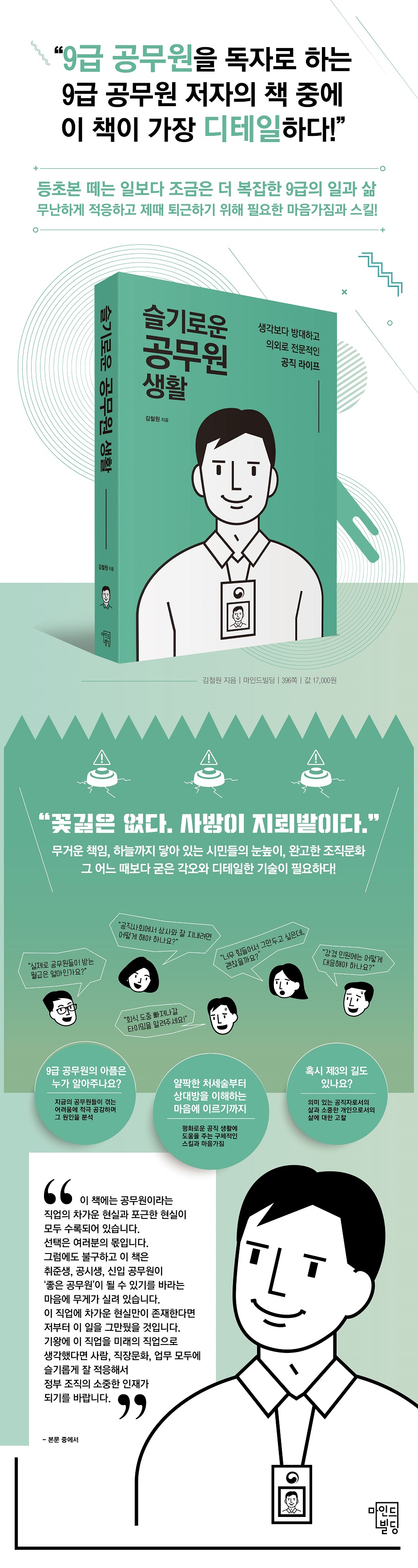
There is no flower path.
There are minefields everywhere.
--- p.31
Those who have been working for 20 or 30 years and say that public service is not easy have vague memories of arguing with a complainant at the counter and jumping over the complaint desk to engage in a physical fight.
The tales of bravery of veterans from the days of tiger smoking are of no practical help to the new 9th-grade civil service exam takers of 2020.
They must have done their best under difficult conditions, but the working conditions in their time and today are very different.
It's true that you have to overcome the difficult situations you face on your own, but no one empathizes with the difficulties of public service, and no one offers specific solutions on how to overcome them.
--- p.37
The civil servants that citizens expect are a mixture of the ideal civil servant of the Eastern concept and the stereotypical office worker of the Western concept.
This mixed ideal type can be summarized as follows:
'A person who is honest, strict with himself, warm like a spring breeze to the people, but cold and firm like frost when it comes to injustice.
A specialist with the highest level of expertise and knowledge in his or her field.
A dedicated person who does not hesitate to work overtime and stay up all night to complete the assigned task.
And someone who listens to the opinions of each and every citizen, empathizes with them, and uses their discretion to resolve civil complaints amicably even when there are minor obstacles in administrative procedures.' With this level of character, it would not be strange to be called a saint or a gentleman.
--- p.64
An adult, a gentleman, would have thought, 'Oh, you must be having trouble with the bank loan. Things are really going badly for you,' but as an ordinary 9th grade civil service exam taker, I thought this to myself.
'I'm almost done now,' he said cautiously after a brief moment of silence.
“I know it’s a bit of a hassle, but I think you’ll need additional documents, like a court order.” Something like this would be a good closing line.
It would be better if you showed an expression of sympathy for the complainant along with your closing remarks.
This is roughly what an empathetic expression looks like.
A somewhat regretful expression, a slightly worried expression, a cautious expression, a hazy expression… … .
--- p.85
I disagree with the perception that level 9 work is simple, repetitive work like running on a hamster wheel.
Korean society is dynamic.
Various policies are being discussed to address complex social issues.
Once a policy is decided and implemented, 9th-grade civil servants will be on the front lines of administration, directly facing numerous policy targets, each with their own unique and special circumstances, and executing the policy.
The working life of a 9th-grade civil servant is also bound to be dynamic due to rapid social changes and the diverse circumstances of policy targets.
Therefore, as a public official in this complex and dynamic Korean society, it is necessary to maintain a sense of alertness.
--- p.109
If you have a senior or friend who works at a private company, ask them how much their salary is.
Although not everyone will be like this, most will be talking about the annual salary before taxes are taken out, not the actual amount that is directly received by the person.
In reality, the annual salary is determined as a pre-tax amount including taxes after negotiations between the worker and the employer.
And it is a natural psychology of a salaryman to try to say a larger amount of salary if possible.
But the civil servant's answer is quite different.
When asked how much their salary is, no low-level civil servant tells you their total annual salary.
The actual amount I receive in my hand is called my salary.
In addition, only the actual amount of basic salary is disclosed, excluding various allowances.
If there's one profession in Korea where people talk about lower salaries, it's probably civil servants.
--- p.118
There are three main instances when your superiors will ask for your opinion.
First, if you have a solution.
At this point, your superiors are not very interested in your opinions.
After hearing your opinions, which are not of interest, I will tell you what solution I have.
Second, if you encounter an inconvenient problem and cannot come up with a solution.
At that time, they pressured him by saying, "As the person in charge, are you saying you have no thoughts on this matter?"
Third, there are cases where you humbly seek wisdom from the person in charge to solve the problem (I wrote it down, but I wonder if such a case really exists).
--- p.185
Some people might think it's an exaggeration to say that company dinners are the pinnacle of human relationships.
However, it is certain that company dinners are a place of life where the complexities of human emotions overflow and overflow.
New encounters, excitement, nervousness, wariness, nervousness, pride in one's position, the desire to exert influence, the expectation of recognition, the desire to do one's best, disappointment, alienation, frustration, resentment, hassle, boredom, appetite, and love and ambition.
So, people open their hearts in this place, close their hearts, and hurt each other.
What kind of mindset should 9th grade civil service exam takers who find it difficult to attend company dinners have when participating in this event?
--- p.216
Who are the special customers? The special customers this book refers to are, to put it simply, "malicious complainers" and "chronic complainers."
The National Human Rights Commission of Korea does not use negative expressions such as “malicious complaints” or “chronic complaints,” but instead calls them “special complaints” to indicate that they require special attention and consideration.
The reality is that we can't even attach negative expressions to negative content.
The sorrow of Hong Gil-dong, an illegitimate son who could not call his father ‘father’ or his older brother ‘older brother.’
This is the current administrative environment surrounding 9th grade civil service exam candidates.
In fact, it is a situation where emotional workers suffering from malicious complaints need special attention and care.
--- p.278
Although you are currently a junior civil servant, you will soon be transferred to another department and gain experience through various assignments.
You will suddenly become a junior at a time sooner than you expected, one day you will suddenly become a candidate for a promotion to the 8th grade, and after experiencing both the bitter and sweet of the organization, you will become a senior member, which is all too vain.
Before you become so disillusioned as a senior, I hope you take some time to think about how you will manage your life within the organization and your own life.
But human psychology is strange.
It's frustrating when you think you're almost done with work, only to find out there's still a lot of work left.
I thought 'there's still a long way to go', but I'm glad to know that there isn't much work left.
So, to help you walk the real flower path, I want to tell you this.
There is no flower path.
There are minefields everywhere.
--- p.31
Those who have been working for 20 or 30 years and say that public service is not easy have vague memories of arguing with a complainant at the counter and jumping over the complaint desk to engage in a physical fight.
The tales of bravery of veterans from the days of tiger smoking are of no practical help to the new 9th-grade civil service exam takers of 2020.
They must have done their best under difficult conditions, but the working conditions in their time and today are very different.
It's true that you have to overcome the difficult situations you face on your own, but no one empathizes with the difficulties of public service, and no one offers specific solutions on how to overcome them.
--- p.37
The civil servants that citizens expect are a mixture of the ideal civil servant of the Eastern concept and the stereotypical office worker of the Western concept.
This mixed ideal type can be summarized as follows:
'A person who is honest, strict with himself, warm like a spring breeze to the people, but cold and firm like frost when it comes to injustice.
A specialist with the highest level of expertise and knowledge in his or her field.
A dedicated person who does not hesitate to work overtime and stay up all night to complete the assigned task.
And someone who listens to the opinions of each and every citizen, empathizes with them, and uses their discretion to resolve civil complaints amicably even when there are minor obstacles in administrative procedures.' With this level of character, it would not be strange to be called a saint or a gentleman.
--- p.64
An adult, a gentleman, would have thought, 'Oh, you must be having trouble with the bank loan. Things are really going badly for you,' but as an ordinary 9th grade civil service exam taker, I thought this to myself.
'I'm almost done now,' he said cautiously after a brief moment of silence.
“I know it’s a bit of a hassle, but I think you’ll need additional documents, like a court order.” Something like this would be a good closing line.
It would be better if you showed an expression of sympathy for the complainant along with your closing remarks.
This is roughly what an empathetic expression looks like.
A somewhat regretful expression, a slightly worried expression, a cautious expression, a hazy expression… … .
--- p.85
I disagree with the perception that level 9 work is simple, repetitive work like running on a hamster wheel.
Korean society is dynamic.
Various policies are being discussed to address complex social issues.
Once a policy is decided and implemented, 9th-grade civil servants will be on the front lines of administration, directly facing numerous policy targets, each with their own unique and special circumstances, and executing the policy.
The working life of a 9th-grade civil servant is also bound to be dynamic due to rapid social changes and the diverse circumstances of policy targets.
Therefore, as a public official in this complex and dynamic Korean society, it is necessary to maintain a sense of alertness.
--- p.109
If you have a senior or friend who works at a private company, ask them how much their salary is.
Although not everyone will be like this, most will be talking about the annual salary before taxes are taken out, not the actual amount that is directly received by the person.
In reality, the annual salary is determined as a pre-tax amount including taxes after negotiations between the worker and the employer.
And it is a natural psychology of a salaryman to try to say a larger amount of salary if possible.
But the civil servant's answer is quite different.
When asked how much their salary is, no low-level civil servant tells you their total annual salary.
The actual amount I receive in my hand is called my salary.
In addition, only the actual amount of basic salary is disclosed, excluding various allowances.
If there's one profession in Korea where people talk about lower salaries, it's probably civil servants.
--- p.118
There are three main instances when your superiors will ask for your opinion.
First, if you have a solution.
At this point, your superiors are not very interested in your opinions.
After hearing your opinions, which are not of interest, I will tell you what solution I have.
Second, if you encounter an inconvenient problem and cannot come up with a solution.
At that time, they pressured him by saying, "As the person in charge, are you saying you have no thoughts on this matter?"
Third, there are cases where you humbly seek wisdom from the person in charge to solve the problem (I wrote it down, but I wonder if such a case really exists).
--- p.185
Some people might think it's an exaggeration to say that company dinners are the pinnacle of human relationships.
However, it is certain that company dinners are a place of life where the complexities of human emotions overflow and overflow.
New encounters, excitement, nervousness, wariness, nervousness, pride in one's position, the desire to exert influence, the expectation of recognition, the desire to do one's best, disappointment, alienation, frustration, resentment, hassle, boredom, appetite, and love and ambition.
So, people open their hearts in this place, close their hearts, and hurt each other.
What kind of mindset should 9th grade civil service exam takers who find it difficult to attend company dinners have when participating in this event?
--- p.216
Who are the special customers? The special customers this book refers to are, to put it simply, "malicious complainers" and "chronic complainers."
The National Human Rights Commission of Korea does not use negative expressions such as “malicious complaints” or “chronic complaints,” but instead calls them “special complaints” to indicate that they require special attention and consideration.
The reality is that we can't even attach negative expressions to negative content.
The sorrow of Hong Gil-dong, an illegitimate son who could not call his father ‘father’ or his older brother ‘older brother.’
This is the current administrative environment surrounding 9th grade civil service exam candidates.
In fact, it is a situation where emotional workers suffering from malicious complaints need special attention and care.
--- p.278
Although you are currently a junior civil servant, you will soon be transferred to another department and gain experience through various assignments.
You will suddenly become a junior at a time sooner than you expected, one day you will suddenly become a candidate for a promotion to the 8th grade, and after experiencing both the bitter and sweet of the organization, you will become a senior member, which is all too vain.
Before you become so disillusioned as a senior, I hope you take some time to think about how you will manage your life within the organization and your own life.
--- p.336
Publisher's Review
“There is no flower path
“There are minefields everywhere.”
Heavy responsibility, citizens' expectations reaching to the sky, and a stubborn organizational culture
More than ever, we need strong determination and detailed skills!
To young people and 9th grade civil service exam takers in an era of job insecurity
In today's Korean society, the most important factor in choosing a career is probably 'employment stability.'
Otherwise, there is no way to explain the preference and concentration of job seekers in this era toward civil service.
The expectation that I would be able to leave work on time and enjoy a life with evenings, the recognition that the labor intensity would not be as intense as in private companies, the belief that I would be able to continue on a long and slender path, even if I could not blossom brilliantly, and the belief that providing good services to citizens would be more socially meaningful than engaging in endless competition obsessed with performance.
This is a common thought among young people who want to become civil servants.
However, if you look closely, the environment surrounding 9th grade civil service exam candidates is not that easy.
A rigid organizational culture, the sharp gaze of citizens, an endless barrage of work instructions, people demanding too much of me, people who are upset by my words and attitude…
Civil servants who enter the workforce expecting a bright future face a minefield far beyond their expectations, and some even choose extreme measures beyond resignation.
Why do new 9th-grade civil service exam candidates struggle to adapt to the workplace culture and work of government organizations? The author cites "lack of information" as one reason.
There are many stories of people passing the civil service exam in online communities.
However, it is true that the personal stories of current civil servants working in actual government organizations, which young job seekers and new recruits are truly curious about, are not widely disclosed.
Therefore, this book aims to provide detailed information that prospective civil servants are curious about at a time when the popularity of the 9th grade civil service as a career is at its peak.
The author's wish that civil servants and new recruits will wisely adapt to the people, workplace culture, and work to become "good civil servants" will be conveyed naturally to readers without them having to think about it in particular.
To the newbies who are struggling with tough complaints, organizational culture, and interpersonal relationships,
Information that young job seekers and new recruits are really curious about.
For example, this might include things like a civil servant's actual salary and pension, how to maintain good relationships with senior employees, how to quietly disappear from a company dinner and go home, and how to effectively respond to harsh complaints.
This book offers detailed analysis of the complex compensation system, providing representative figures. It also offers suggestions for the ideal candidate for government organizations, how to get along with senior employees, when to leave a company dinner, and the appropriate facial expressions and comments to use when dealing with a complainant. It delivers highly specific and practical information without any exaggeration.
Furthermore, it meticulously organizes the mindset and practical knowledge that will help you adapt to the work culture and duties of government organizations, as well as the higher-level virtues that public officials should possess.
This will undoubtedly be useful information not only for new 9th-grade civil service exam takers, but also for job seekers and 9th-grade civil service exam takers considering a 9th-grade civil service career in this era of employment insecurity.
For public officials and individuals seeking meaning in life
Do public officials, especially those newly hired at the 9th level, feel a sense of fulfillment in their public service after joining the government? Working for the public in a government organization, if viewed solely for the sake of a greater cause, is incredibly rewarding.
The satisfaction of working for the public good and the socially disadvantaged, and the satisfaction of contributing to social development, are certainly not given to just anyone.
But in reality, the author says, it is not that easy to feel fulfilled while living as a 9th-grade civil servant.
The heavy work of processing birth and death reports and issuing seal certificates at the civil affairs office requires careful review, and if the regulations are not met, the applicant may have no choice but to be turned away.
As a result, the things that the civil affairs office staff often hear are things like, “Other districts do it, so why can’t they do it here?” and “Why are the people who live off my taxes complaining so much?”
Can those who work every day accepting the negative emotions of citizens easily find fulfillment in their public service?
Are social welfare workers, who are perceived as more altruistic than general administrative workers, any different? Social welfare workers clearly take pride in their work caring for the socially vulnerable.
However, their working conditions are extremely poor.
Not all welfare recipients are as kind to them as the grandmothers in the public service announcements, and powerless female social workers are exposed to physical and psychological dangers both in the office and outside.
Moreover, the documents that need to be reported to higher authorities are endless, and welfare work is always on the rise.
Given this reality, it is truly difficult for even those with pride to feel the rewards of public service.
Where should these low-level civil servants, who find no fulfillment in their daily lives, find meaning? Now that public power has fallen to the ground and citizens' expectations are skyrocketing, what attitude should they adopt in a government organization that doesn't respect its subordinates as independent individuals? The author suggests we first accept the harsh reality we face, while simultaneously urging us to develop our own unique specialties and secret skills within the organization.
If you are satisfied with your job security and are content with the present, one day when you become a senior employee, you will find yourself accustomed to the organizational culture that you did not like when you were a newbie.
The author believes that by considering what kind of talent we will become within this organization and what kind of person we will become in the wider world beyond this organization, we can look to the larger community outside of government organizations.
Public officials who read this book will have the opportunity to explore the meaning of life as individuals and a "third way" at this point in time, when the age of centenarians has arrived.
“There are minefields everywhere.”
Heavy responsibility, citizens' expectations reaching to the sky, and a stubborn organizational culture
More than ever, we need strong determination and detailed skills!
To young people and 9th grade civil service exam takers in an era of job insecurity
In today's Korean society, the most important factor in choosing a career is probably 'employment stability.'
Otherwise, there is no way to explain the preference and concentration of job seekers in this era toward civil service.
The expectation that I would be able to leave work on time and enjoy a life with evenings, the recognition that the labor intensity would not be as intense as in private companies, the belief that I would be able to continue on a long and slender path, even if I could not blossom brilliantly, and the belief that providing good services to citizens would be more socially meaningful than engaging in endless competition obsessed with performance.
This is a common thought among young people who want to become civil servants.
However, if you look closely, the environment surrounding 9th grade civil service exam candidates is not that easy.
A rigid organizational culture, the sharp gaze of citizens, an endless barrage of work instructions, people demanding too much of me, people who are upset by my words and attitude…
Civil servants who enter the workforce expecting a bright future face a minefield far beyond their expectations, and some even choose extreme measures beyond resignation.
Why do new 9th-grade civil service exam candidates struggle to adapt to the workplace culture and work of government organizations? The author cites "lack of information" as one reason.
There are many stories of people passing the civil service exam in online communities.
However, it is true that the personal stories of current civil servants working in actual government organizations, which young job seekers and new recruits are truly curious about, are not widely disclosed.
Therefore, this book aims to provide detailed information that prospective civil servants are curious about at a time when the popularity of the 9th grade civil service as a career is at its peak.
The author's wish that civil servants and new recruits will wisely adapt to the people, workplace culture, and work to become "good civil servants" will be conveyed naturally to readers without them having to think about it in particular.
To the newbies who are struggling with tough complaints, organizational culture, and interpersonal relationships,
Information that young job seekers and new recruits are really curious about.
For example, this might include things like a civil servant's actual salary and pension, how to maintain good relationships with senior employees, how to quietly disappear from a company dinner and go home, and how to effectively respond to harsh complaints.
This book offers detailed analysis of the complex compensation system, providing representative figures. It also offers suggestions for the ideal candidate for government organizations, how to get along with senior employees, when to leave a company dinner, and the appropriate facial expressions and comments to use when dealing with a complainant. It delivers highly specific and practical information without any exaggeration.
Furthermore, it meticulously organizes the mindset and practical knowledge that will help you adapt to the work culture and duties of government organizations, as well as the higher-level virtues that public officials should possess.
This will undoubtedly be useful information not only for new 9th-grade civil service exam takers, but also for job seekers and 9th-grade civil service exam takers considering a 9th-grade civil service career in this era of employment insecurity.
For public officials and individuals seeking meaning in life
Do public officials, especially those newly hired at the 9th level, feel a sense of fulfillment in their public service after joining the government? Working for the public in a government organization, if viewed solely for the sake of a greater cause, is incredibly rewarding.
The satisfaction of working for the public good and the socially disadvantaged, and the satisfaction of contributing to social development, are certainly not given to just anyone.
But in reality, the author says, it is not that easy to feel fulfilled while living as a 9th-grade civil servant.
The heavy work of processing birth and death reports and issuing seal certificates at the civil affairs office requires careful review, and if the regulations are not met, the applicant may have no choice but to be turned away.
As a result, the things that the civil affairs office staff often hear are things like, “Other districts do it, so why can’t they do it here?” and “Why are the people who live off my taxes complaining so much?”
Can those who work every day accepting the negative emotions of citizens easily find fulfillment in their public service?
Are social welfare workers, who are perceived as more altruistic than general administrative workers, any different? Social welfare workers clearly take pride in their work caring for the socially vulnerable.
However, their working conditions are extremely poor.
Not all welfare recipients are as kind to them as the grandmothers in the public service announcements, and powerless female social workers are exposed to physical and psychological dangers both in the office and outside.
Moreover, the documents that need to be reported to higher authorities are endless, and welfare work is always on the rise.
Given this reality, it is truly difficult for even those with pride to feel the rewards of public service.
Where should these low-level civil servants, who find no fulfillment in their daily lives, find meaning? Now that public power has fallen to the ground and citizens' expectations are skyrocketing, what attitude should they adopt in a government organization that doesn't respect its subordinates as independent individuals? The author suggests we first accept the harsh reality we face, while simultaneously urging us to develop our own unique specialties and secret skills within the organization.
If you are satisfied with your job security and are content with the present, one day when you become a senior employee, you will find yourself accustomed to the organizational culture that you did not like when you were a newbie.
The author believes that by considering what kind of talent we will become within this organization and what kind of person we will become in the wider world beyond this organization, we can look to the larger community outside of government organizations.
Public officials who read this book will have the opportunity to explore the meaning of life as individuals and a "third way" at this point in time, when the age of centenarians has arrived.
GOODS SPECIFICS
- Date of issue: September 25, 2020
- Page count, weight, size: 396 pages | 534g | 147*217*19mm
- ISBN13: 9791190015189
- ISBN10: 1190015188
You may also like
카테고리
korean


korean

![GQ KOREA Mark (Monthly): December [2025]](http://librairie.coreenne.fr/cdn/shop/files/8ef265dbbfbf186523ed75ba7319009d.jpg?v=1765340328&width=3840)


