

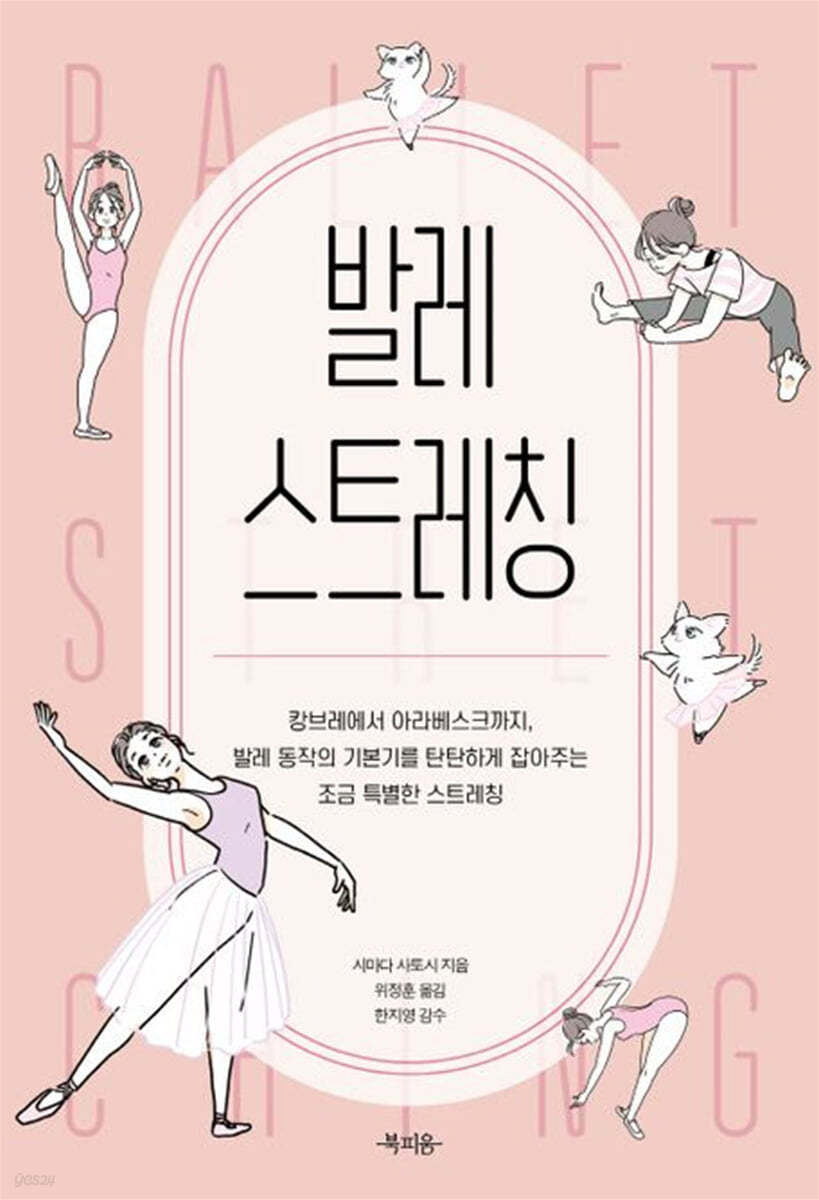
ballet stretching
 |
Description
Book Introduction
We support your ballet!
Ballet x Correction for increased stretching effects! Ballet movements also improve!
Read before going to the ballet, and read again after going to the ballet.
The world's most friendly 'ballet stretching' textbook!
Wet the back of the cambrai a little more,
Lift the Devloper a little higher,
You can make the arabesque a little longer!
A book introducing stretching methods that create a flexible body specialized for ballet.
This course explains the principles of ballet movements and teaches stretching techniques that focus on the muscles and joints that allow you to perform the three iconic ballet movements—cambrai, arabesque, and debloffe—elegantly and beautifully, stretching your arms and legs forward, sideways, and backward, more easily.
It is a unique concept that combines ballet movements and correction from an orthopedic perspective, and presents practical methods to help you create the right posture and perform ballet movements accurately.
Ballet x Correction for increased stretching effects! Ballet movements also improve!
Read before going to the ballet, and read again after going to the ballet.
The world's most friendly 'ballet stretching' textbook!
Wet the back of the cambrai a little more,
Lift the Devloper a little higher,
You can make the arabesque a little longer!
A book introducing stretching methods that create a flexible body specialized for ballet.
This course explains the principles of ballet movements and teaches stretching techniques that focus on the muscles and joints that allow you to perform the three iconic ballet movements—cambrai, arabesque, and debloffe—elegantly and beautifully, stretching your arms and legs forward, sideways, and backward, more easily.
It is a unique concept that combines ballet movements and correction from an orthopedic perspective, and presents practical methods to help you create the right posture and perform ballet movements accurately.
- You can preview some of the book's contents.
Preview
index
The amazing power of flexible ballet stretching that can transform even a body as stiff as a log!
preface
Flexible Ballet Stretching Experience
Muscle and skeletal maps useful to know for self-tuning
Book User Manual
CHAPTER 1 Flexible Ballet Stretches to Start Right Now
Self-tuning ① Twist
Self-tuning ② Increase
Spiral, the most basic of ballet stretching
Lesson 〈Twist × Stretch〉 Spiral Forward Lean [Level 1]
Lesson 〈Twist × Stretch〉 Spiral Twist [Level 1]
Self-Tuning ③ Breathing
Lesson 〈Breathing〉 Diaphragm Stretching
Column - Make sure to do the other side too, don't miss the order
CHAPTER 2 This is how your body changes when you do flexible ballet stretching!
The pelvis is corrected
Makes joints easier to move
Become flexible without overdoing it
Your posture becomes more beautiful
Column - Take it one step at a time, don't rush, and stretch consistently.
CHAPTER 3 Challenge the ballet movements of your dreams with flexible ballet stretching!
(POSING-1) I want to release my shoulder blades and place my hands behind my back.
CHECK CHECK the right way! How far can you go without overdoing it?
If your shoulders are stiff, you can't turn your arms back.
Stretching your shoulders and back with a towel
Input Movement of the scapula is linked to flexibility of the back.
Output Spiral Forward Lean [Level 2]
Put your hands together behind your back with the force of the input bit
output spiral bend
(POSING-2) I want to reset my pelvis and bend forward 180 degrees from the hip joint.
CHECK the flexibility points needed to lean forward!
If your hip joints are stiff, your body will not bend forward.
You can bend forward a lot by using your lower back
The action of the deep muscles increases the force of forward bending.
The power of breathing makes your body flexible from the inside out.
Output Spiral Forward Lean [Level 1 Hard Mode]
Twist output to stretch the diaphragm
Output Bend your legs and lean forward
(POSING-3) I want to stretch my adductor muscles by straightening my torso at a 180-degree angle.
A weak core limits hip joint movement.
input Use the force of twisting your arms to straighten your torso
Output Spiral Twist [Adductor Stretch Version]
Output Spiral Twist [Ballet 5th Foot Position]
(POSING-4) I want to gently lean back like a bow while maintaining abdominal pressure.
CHECK CHECK the right way! How far can you go without overdoing it?
CHECK: Focus on your pelvis! Tips for flexibly leaning back
Output back twist method
Maintaining abdominal pressure stabilizes the torso
Releasing your thoracic spine allows you to arch your back more.
Output Thoracic Spine Stretching
Input Stretch your body up and down by pressing the ground
Stretching the diaphragm by stretching the sides
output spiral twist stretching
Ballet Stretching Prescription
Neck and shoulder concerns - If you want to relieve stiffness in your neck and shoulders / If you want to straighten your forward-hunched shoulders / If your shoulder heights are different on both sides
Torso-related concerns - If you want to create a beautiful posture / If you want to correct your torso
Back-related concerns - If you want to make your hip joints more flexible / If you want to correct a stiff or hunched back
Leg Concerns - If you want to make the back of your thighs (hamstrings) more flexible
Sleep-related concerns - If you want to sleep soundly / If you want to wake up refreshed
Ballet-related concerns - If you want to do well in turn out (positions 4 and 5) / If you want to stand well in relevé / If you have trouble keeping your back straight when doing arabesque / If you want to do well in cambrai
preface
Flexible Ballet Stretching Experience
Muscle and skeletal maps useful to know for self-tuning
Book User Manual
CHAPTER 1 Flexible Ballet Stretches to Start Right Now
Self-tuning ① Twist
Self-tuning ② Increase
Spiral, the most basic of ballet stretching
Lesson 〈Twist × Stretch〉 Spiral Forward Lean [Level 1]
Lesson 〈Twist × Stretch〉 Spiral Twist [Level 1]
Self-Tuning ③ Breathing
Lesson 〈Breathing〉 Diaphragm Stretching
Column - Make sure to do the other side too, don't miss the order
CHAPTER 2 This is how your body changes when you do flexible ballet stretching!
The pelvis is corrected
Makes joints easier to move
Become flexible without overdoing it
Your posture becomes more beautiful
Column - Take it one step at a time, don't rush, and stretch consistently.
CHAPTER 3 Challenge the ballet movements of your dreams with flexible ballet stretching!
(POSING-1) I want to release my shoulder blades and place my hands behind my back.
CHECK CHECK the right way! How far can you go without overdoing it?
If your shoulders are stiff, you can't turn your arms back.
Stretching your shoulders and back with a towel
Input Movement of the scapula is linked to flexibility of the back.
Output Spiral Forward Lean [Level 2]
Put your hands together behind your back with the force of the input bit
output spiral bend
(POSING-2) I want to reset my pelvis and bend forward 180 degrees from the hip joint.
CHECK the flexibility points needed to lean forward!
If your hip joints are stiff, your body will not bend forward.
You can bend forward a lot by using your lower back
The action of the deep muscles increases the force of forward bending.
The power of breathing makes your body flexible from the inside out.
Output Spiral Forward Lean [Level 1 Hard Mode]
Twist output to stretch the diaphragm
Output Bend your legs and lean forward
(POSING-3) I want to stretch my adductor muscles by straightening my torso at a 180-degree angle.
A weak core limits hip joint movement.
input Use the force of twisting your arms to straighten your torso
Output Spiral Twist [Adductor Stretch Version]
Output Spiral Twist [Ballet 5th Foot Position]
(POSING-4) I want to gently lean back like a bow while maintaining abdominal pressure.
CHECK CHECK the right way! How far can you go without overdoing it?
CHECK: Focus on your pelvis! Tips for flexibly leaning back
Output back twist method
Maintaining abdominal pressure stabilizes the torso
Releasing your thoracic spine allows you to arch your back more.
Output Thoracic Spine Stretching
Input Stretch your body up and down by pressing the ground
Stretching the diaphragm by stretching the sides
output spiral twist stretching
Ballet Stretching Prescription
Neck and shoulder concerns - If you want to relieve stiffness in your neck and shoulders / If you want to straighten your forward-hunched shoulders / If your shoulder heights are different on both sides
Torso-related concerns - If you want to create a beautiful posture / If you want to correct your torso
Back-related concerns - If you want to make your hip joints more flexible / If you want to correct a stiff or hunched back
Leg Concerns - If you want to make the back of your thighs (hamstrings) more flexible
Sleep-related concerns - If you want to sleep soundly / If you want to wake up refreshed
Ballet-related concerns - If you want to do well in turn out (positions 4 and 5) / If you want to stand well in relevé / If you have trouble keeping your back straight when doing arabesque / If you want to do well in cambrai
Detailed image
.jpg)
Into the book
The cause of stiffness is 'the body is not aligned properly'.
To use an analogy, it's like an umbrella whose handle is twisted and won't open properly.
The joints and muscles are not functioning properly, which puts the brakes on the body's movements.
Flexible ballet stretching is what helps your body adjust to the correct position.
The fundamental movements of ballet encapsulate the postures that allow the human body to perform the best movements it can anatomically.
I've reimagined this as a stretch anyone can follow.
This stretch will help you build flexible and balanced muscles around your torso, giving you a beautiful body.
Your joints will be straightened and your muscles will be more flexible, making your body easier to move and less prone to fatigue.
--- p.8~9
Twisting your body tightly increases the stability of the axis.
In ballet, there is a movement called 'en d'or'.
It is a movement that twists the body to increase joint mobility and body strength.
The power to twist the body is, in other words, like a shape memory that maintains posture.
The stronger this force, the longer you can hold one posture.
For example, in a move like the Deblophe where you stand on one leg and lift the other, your body will collapse to the side with the weaker bit.
A stable posture can only be maintained if the left and right sides are twisted evenly.
Flexibility of the shoulders, back, and hip joints is closely related to the 'twisting power' of the upper arms and torso.
The more you twist your body, the more mobility you have, allowing you to maintain a beautiful posture.
--- p.22
A weak core limits hip joint movement.
When doing adductor stretches (180-degree leg splits), it's easy to focus on your hips, but the reason your hips are stiff is actually because your torso is weak.
As you take on an awkward posture, the mobility of your hip joints decreases, making it impossible to split your legs.
If your core is weak, you won't be able to keep your upper body upright when stretching your adductor muscles.
This causes the ischium in the lower pelvis to rise, tilting the pelvis backwards.
Because the center of gravity is shifted back so much, the body falls forward to regain balance, causing the thighs to turn inward and the legs to come together.
This causes the muscles on the inside of the leg to contract, which in turn reduces the range of motion of the hip joint.
In other words, if you can keep your pelvis upright, your hip joints will also be able to move more easily.
The key to keeping your pelvis upright is core strength.
To increase hip flexibility and range of motion, it is essential to strengthen the core muscles to stabilize the torso.
--- p.84
Stretch your body up and down by pressing down on the ground
When leaning back and maintaining your posture, the strength to stretch your body up and down is also very important.
In ballet, the arms are used to guide the lengthening of the body and legs.
For example, when doing a push-up on your toes, which is easier to stretch upwards: en bas (arms down) or en haut (hands up)? If you compare, you'll see that your body goes up more easily in en haut.
This is because it helps to elongate the body up and down as the upper body stretches upward from the elbows.
When you plug this into leaning back, the key is the strength to stretch your upper body up and down while leaning back.
If this strength is weak, the body will judge that there is 'danger' and apply the brakes, so the strength of the back cannot be used properly because it cannot support the neck.
Also, the power of 'pressing the floor' is very important to stretch the body up and down.
Pushing off the floor with your feet and extending your arms behind you will further elongate your body and increase spinal mobility.
This will allow you to lean back further.
To use an analogy, it's like an umbrella whose handle is twisted and won't open properly.
The joints and muscles are not functioning properly, which puts the brakes on the body's movements.
Flexible ballet stretching is what helps your body adjust to the correct position.
The fundamental movements of ballet encapsulate the postures that allow the human body to perform the best movements it can anatomically.
I've reimagined this as a stretch anyone can follow.
This stretch will help you build flexible and balanced muscles around your torso, giving you a beautiful body.
Your joints will be straightened and your muscles will be more flexible, making your body easier to move and less prone to fatigue.
--- p.8~9
Twisting your body tightly increases the stability of the axis.
In ballet, there is a movement called 'en d'or'.
It is a movement that twists the body to increase joint mobility and body strength.
The power to twist the body is, in other words, like a shape memory that maintains posture.
The stronger this force, the longer you can hold one posture.
For example, in a move like the Deblophe where you stand on one leg and lift the other, your body will collapse to the side with the weaker bit.
A stable posture can only be maintained if the left and right sides are twisted evenly.
Flexibility of the shoulders, back, and hip joints is closely related to the 'twisting power' of the upper arms and torso.
The more you twist your body, the more mobility you have, allowing you to maintain a beautiful posture.
--- p.22
A weak core limits hip joint movement.
When doing adductor stretches (180-degree leg splits), it's easy to focus on your hips, but the reason your hips are stiff is actually because your torso is weak.
As you take on an awkward posture, the mobility of your hip joints decreases, making it impossible to split your legs.
If your core is weak, you won't be able to keep your upper body upright when stretching your adductor muscles.
This causes the ischium in the lower pelvis to rise, tilting the pelvis backwards.
Because the center of gravity is shifted back so much, the body falls forward to regain balance, causing the thighs to turn inward and the legs to come together.
This causes the muscles on the inside of the leg to contract, which in turn reduces the range of motion of the hip joint.
In other words, if you can keep your pelvis upright, your hip joints will also be able to move more easily.
The key to keeping your pelvis upright is core strength.
To increase hip flexibility and range of motion, it is essential to strengthen the core muscles to stabilize the torso.
--- p.84
Stretch your body up and down by pressing down on the ground
When leaning back and maintaining your posture, the strength to stretch your body up and down is also very important.
In ballet, the arms are used to guide the lengthening of the body and legs.
For example, when doing a push-up on your toes, which is easier to stretch upwards: en bas (arms down) or en haut (hands up)? If you compare, you'll see that your body goes up more easily in en haut.
This is because it helps to elongate the body up and down as the upper body stretches upward from the elbows.
When you plug this into leaning back, the key is the strength to stretch your upper body up and down while leaning back.
If this strength is weak, the body will judge that there is 'danger' and apply the brakes, so the strength of the back cannot be used properly because it cannot support the neck.
Also, the power of 'pressing the floor' is very important to stretch the body up and down.
Pushing off the floor with your feet and extending your arms behind you will further elongate your body and increase spinal mobility.
This will allow you to lean back further.
--- p.106
Publisher's Review
There are special stretches that are good for ballet!
The ballet boom is strong.
Many people start ballet as a hobby as adults and then become completely captivated by its charm. Many toddlers and elementary school students also learn ballet because it helps them develop a beautiful body, correct their posture, and grow taller.
Ballet, an art form symbolizing the extremes of beauty, has come down to earth and come to us from heaven.
However, before doing ballet, it is essential to do a stretching process to loosen up the body and make it soft and flexible.
Because flexibility is the most important part of ballet, along with strength.
That's why most ballet classes include a stretching program before full-fledged ballet practice.
"Ballet Stretching" is a book that intensively introduces the principles and methods of the most effective stretching that combines ballet and posture correction to create a body optimized for ballet movements.
Among ballet movements, movements such as the arabesque, which stretches the limbs forward and backward, the cambrai, which bends or leans the body like a bow, and the debloffe, which raises the legs almost 180 degrees, are beautiful postures that show the extreme limits of human movement.
What kind of training do ballerinas undergo to achieve such beautiful postures? Ballet movements may appear as light as a butterfly, but they are actually an extreme art form that requires tremendous strength and flexibility.
To perform ballet movements that challenge the limits of the human body, ballerinas create beautiful flexibility by adjusting their muscles and joints into a 'form' that is easy to move.
"Ballet Stretching" applies this very concept to corrective stretching.
There are three points to note in ballet stretching.
This is a self-tuning method called 'twisting', 'stretching', and 'breathing'. It is a solution that anyone who wants to make their stiff body flexible should definitely try. It is introduced in an easy-to-understand manner through photos and illustrations.
Improve your ballet movements with the three beats of ‘twisting’, ‘stretching’, and ‘breathing’!
Many ballet students have wishes such as, 'I want to do more of the du cambrai,' 'I want to lift my legs higher when doing the debloffe,' and 'I want to extend my arms and legs in the arabesque.'
However, this movement absolutely requires flexibility.
Leaning forward to stretch your adductor muscles at a 180-degree angle or placing your hands behind your back are all symbolic movements of the flexibility that everyone dreams of.
So how can we improve flexibility? First, we need to understand why our bodies are stiff.
According to the author, the cause of stiffness is “because the body is not aligned properly.”
To use an analogy, it is like an umbrella whose shaft is twisted and cannot be opened properly, and the joints and muscles are not functioning properly, which puts the brakes on the body's movements.
Flexible ballet stretching is what helps to correct the body's misalignment.
"Ballet Stretching" is divided into three parts.
Part 1, 'Flexible Ballet Stretching to Start Right Now', introduces the principles and methods of stretching that maximize flexibility.
The three methods suggested by the author are 'twisting', 'stretching', and 'diaphragmatic breathing', and the book provides friendly instructions so that you can practice on your own, from basic stretching to more difficult levels, and is structured so that you can gradually increase the intensity of the stretching.
Part 2, "This is how your body changes when you do flexible ballet stretching!" explains, with illustrations and anatomy, why proper ballet stretching corrects the pelvis, allows for easier joint movement, and improves flexibility and posture from an anatomical and orthopedic perspective.
It is also a chapter that motivates you to want to get better at ballet.
Part 3, "Challenge the ballet movements you've always dreamed of with flexible ballet stretching!" introduces authentic ballet stretching that increases flexibility in specific areas, including the shoulders, scapula, thoracic spine, and hip joints.
While doing ballet, you may have experienced various problems, such as having difficulty stretching your adductor muscles (splitting your legs) or your shoulders going up when you do sit-ups.
It would be even better if you looked at the book and chose the stretches you think are most necessary for you based on the movements and focused on doing them.
Beautiful ballet movements in a flexible body!
It is difficult for amateur ballet dancers to follow ballet movements precisely.
This is because ballet movements require the use of muscles and joints that are not normally used, and the difficulty of the movements themselves is high, so they develop in a spiral pattern only after the strength and flexibility have been built up step by step like a pyramid over a long period of time.
So, is there any way to learn ballet movements even a little faster? The author advises, "If you want to master difficult movements or postures, the shortcut is to break down each part of the body and how it moves."
A journey of a thousand miles begins with a single step.
If you want to be good at ballet, it goes without saying that you have to be good at stretching.
Slow and steady like a turtle is the shortcut to becoming good at ballet.
"Ballet Stretching" teaches the principles of stretching to increase flexibility for ballet, as well as effective techniques for stretching well. This will help beginners learn accurate ballet movements more quickly, and those with more than 2-3 years of ballet experience will find their ballet movements much more beautiful.
It can be a very helpful teaching material not only for ballet learners but also for teachers.
If you stretch well, you will be able to perform barre and center walks with much more grace.
Be sure to pack 『Ballet Stretching』 in your ballet bag along with your leotard, tights, and shoes.
This is another essential ballet book that you can read before going to the ballet and read again afterward.
Until the day comes when you can do a 180-degree split, place your hands behind your back, and bend your upper body forward completely, let's gradually increase the adductors, move your shoulder blades, and place your hands behind your back little by little with "ballet stretching."
Because beautiful ballet movements are created through a flexible body.
The ballet boom is strong.
Many people start ballet as a hobby as adults and then become completely captivated by its charm. Many toddlers and elementary school students also learn ballet because it helps them develop a beautiful body, correct their posture, and grow taller.
Ballet, an art form symbolizing the extremes of beauty, has come down to earth and come to us from heaven.
However, before doing ballet, it is essential to do a stretching process to loosen up the body and make it soft and flexible.
Because flexibility is the most important part of ballet, along with strength.
That's why most ballet classes include a stretching program before full-fledged ballet practice.
"Ballet Stretching" is a book that intensively introduces the principles and methods of the most effective stretching that combines ballet and posture correction to create a body optimized for ballet movements.
Among ballet movements, movements such as the arabesque, which stretches the limbs forward and backward, the cambrai, which bends or leans the body like a bow, and the debloffe, which raises the legs almost 180 degrees, are beautiful postures that show the extreme limits of human movement.
What kind of training do ballerinas undergo to achieve such beautiful postures? Ballet movements may appear as light as a butterfly, but they are actually an extreme art form that requires tremendous strength and flexibility.
To perform ballet movements that challenge the limits of the human body, ballerinas create beautiful flexibility by adjusting their muscles and joints into a 'form' that is easy to move.
"Ballet Stretching" applies this very concept to corrective stretching.
There are three points to note in ballet stretching.
This is a self-tuning method called 'twisting', 'stretching', and 'breathing'. It is a solution that anyone who wants to make their stiff body flexible should definitely try. It is introduced in an easy-to-understand manner through photos and illustrations.
Improve your ballet movements with the three beats of ‘twisting’, ‘stretching’, and ‘breathing’!
Many ballet students have wishes such as, 'I want to do more of the du cambrai,' 'I want to lift my legs higher when doing the debloffe,' and 'I want to extend my arms and legs in the arabesque.'
However, this movement absolutely requires flexibility.
Leaning forward to stretch your adductor muscles at a 180-degree angle or placing your hands behind your back are all symbolic movements of the flexibility that everyone dreams of.
So how can we improve flexibility? First, we need to understand why our bodies are stiff.
According to the author, the cause of stiffness is “because the body is not aligned properly.”
To use an analogy, it is like an umbrella whose shaft is twisted and cannot be opened properly, and the joints and muscles are not functioning properly, which puts the brakes on the body's movements.
Flexible ballet stretching is what helps to correct the body's misalignment.
"Ballet Stretching" is divided into three parts.
Part 1, 'Flexible Ballet Stretching to Start Right Now', introduces the principles and methods of stretching that maximize flexibility.
The three methods suggested by the author are 'twisting', 'stretching', and 'diaphragmatic breathing', and the book provides friendly instructions so that you can practice on your own, from basic stretching to more difficult levels, and is structured so that you can gradually increase the intensity of the stretching.
Part 2, "This is how your body changes when you do flexible ballet stretching!" explains, with illustrations and anatomy, why proper ballet stretching corrects the pelvis, allows for easier joint movement, and improves flexibility and posture from an anatomical and orthopedic perspective.
It is also a chapter that motivates you to want to get better at ballet.
Part 3, "Challenge the ballet movements you've always dreamed of with flexible ballet stretching!" introduces authentic ballet stretching that increases flexibility in specific areas, including the shoulders, scapula, thoracic spine, and hip joints.
While doing ballet, you may have experienced various problems, such as having difficulty stretching your adductor muscles (splitting your legs) or your shoulders going up when you do sit-ups.
It would be even better if you looked at the book and chose the stretches you think are most necessary for you based on the movements and focused on doing them.
Beautiful ballet movements in a flexible body!
It is difficult for amateur ballet dancers to follow ballet movements precisely.
This is because ballet movements require the use of muscles and joints that are not normally used, and the difficulty of the movements themselves is high, so they develop in a spiral pattern only after the strength and flexibility have been built up step by step like a pyramid over a long period of time.
So, is there any way to learn ballet movements even a little faster? The author advises, "If you want to master difficult movements or postures, the shortcut is to break down each part of the body and how it moves."
A journey of a thousand miles begins with a single step.
If you want to be good at ballet, it goes without saying that you have to be good at stretching.
Slow and steady like a turtle is the shortcut to becoming good at ballet.
"Ballet Stretching" teaches the principles of stretching to increase flexibility for ballet, as well as effective techniques for stretching well. This will help beginners learn accurate ballet movements more quickly, and those with more than 2-3 years of ballet experience will find their ballet movements much more beautiful.
It can be a very helpful teaching material not only for ballet learners but also for teachers.
If you stretch well, you will be able to perform barre and center walks with much more grace.
Be sure to pack 『Ballet Stretching』 in your ballet bag along with your leotard, tights, and shoes.
This is another essential ballet book that you can read before going to the ballet and read again afterward.
Until the day comes when you can do a 180-degree split, place your hands behind your back, and bend your upper body forward completely, let's gradually increase the adductors, move your shoulder blades, and place your hands behind your back little by little with "ballet stretching."
Because beautiful ballet movements are created through a flexible body.
GOODS SPECIFICS
- Date of issue: July 4, 2024
- Page count, weight, size: 128 pages | 252g | 150*220*9mm
- ISBN13: 9791197404399
- ISBN10: 1197404392
You may also like
카테고리
korean


korean

![GQ KOREA Mark (Monthly): December [2025]](http://librairie.coreenne.fr/cdn/shop/files/8ef265dbbfbf186523ed75ba7319009d.jpg?v=1765340328&width=3840)


