

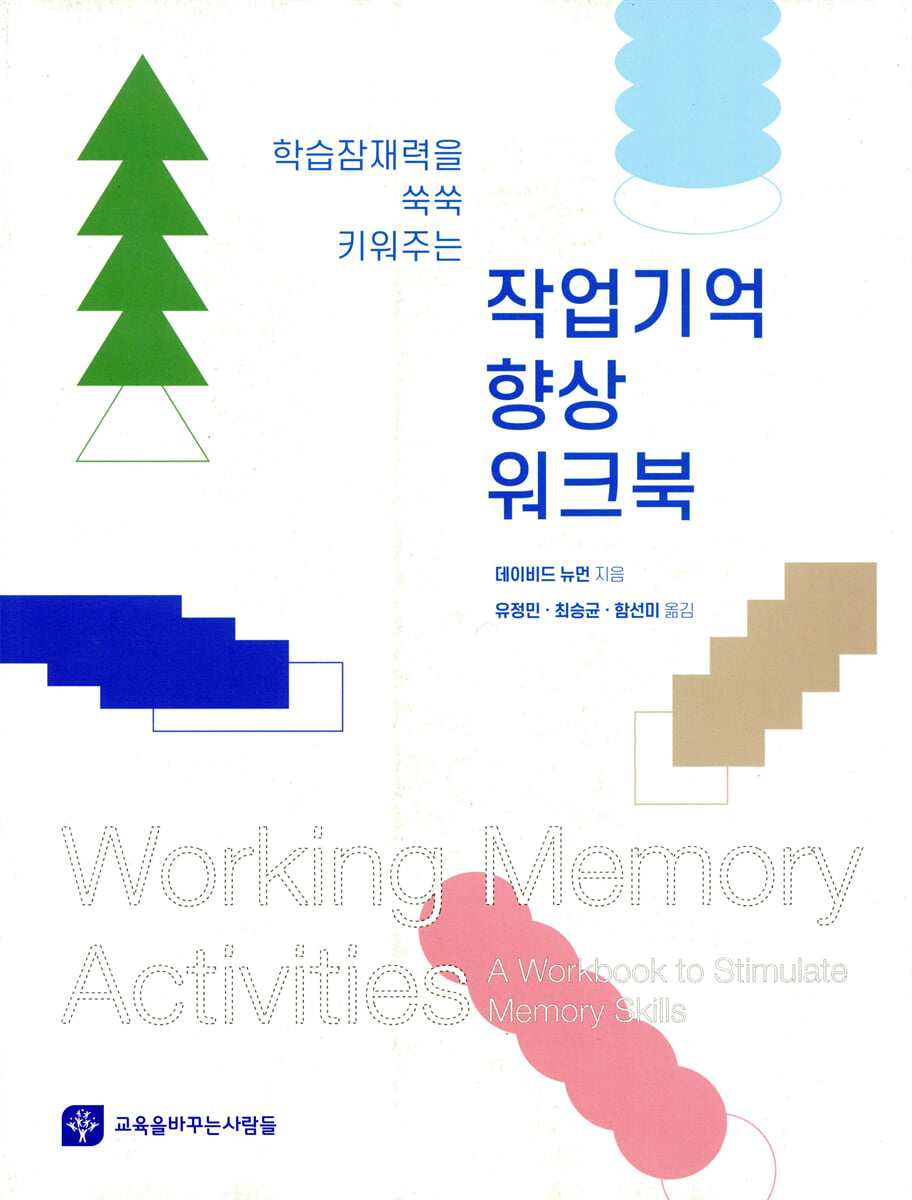
Working Memory Improvement Workbook
 |
Description
Book Introduction
The secret to improving learning ability, working memory!
To prevent learning difficulties from accumulating, increase your working memory now!
Working memory is the brain's ability to remember necessary information while performing a task, and is also called working memory.
Working memory, like a memo pad in the brain, is a major driving force in cognitive development in childhood.
If your working memory is poor, you will not be able to remember the information needed to solve a task, making it difficult to focus on the task and learning difficult.
Because learning difficulties due to working memory deficiency accumulate over time, early diagnosis of working memory problems and appropriate support accordingly are key to resolving learning difficulties.
The previous work, 『Understanding and Overcoming Learning Difficulties Depends on Working Memory』, was the first book to present a diagnostic method for childhood working memory and a corresponding support strategy at a time when the importance of working memory was not widely known in Korea.
As the book gained popularity, experts' voices grew louder, saying that a working memory training workbook was desperately needed in Korea.
The "Working Memory Improvement Workbook that Increases Learning Potential" is the result of listening carefully to such voices, and is a workbook that intensively trains the working memory of children aged 7 to 12.
It is designed to allow for easy and fun working memory training at home as well as in specialized institutions such as cognitive therapy and developmental therapy centers and learning clinics.
It is particularly excellent for increasing the learning potential of children who have difficulties such as inattentiveness, clumsiness, ADHD, dyslexia, dyscalculia, autism, and lack of concentration.
It is designed to increase working memory through fun and diverse activities such as remembering numbers and saying them, arranging words by attributes, coloring, arranging furniture/shapes, and finding directions.
This working memory improvement workbook will be a great help in allowing children with different abilities to fully demonstrate their abilities.
To prevent learning difficulties from accumulating, increase your working memory now!
Working memory is the brain's ability to remember necessary information while performing a task, and is also called working memory.
Working memory, like a memo pad in the brain, is a major driving force in cognitive development in childhood.
If your working memory is poor, you will not be able to remember the information needed to solve a task, making it difficult to focus on the task and learning difficult.
Because learning difficulties due to working memory deficiency accumulate over time, early diagnosis of working memory problems and appropriate support accordingly are key to resolving learning difficulties.
The previous work, 『Understanding and Overcoming Learning Difficulties Depends on Working Memory』, was the first book to present a diagnostic method for childhood working memory and a corresponding support strategy at a time when the importance of working memory was not widely known in Korea.
As the book gained popularity, experts' voices grew louder, saying that a working memory training workbook was desperately needed in Korea.
The "Working Memory Improvement Workbook that Increases Learning Potential" is the result of listening carefully to such voices, and is a workbook that intensively trains the working memory of children aged 7 to 12.
It is designed to allow for easy and fun working memory training at home as well as in specialized institutions such as cognitive therapy and developmental therapy centers and learning clinics.
It is particularly excellent for increasing the learning potential of children who have difficulties such as inattentiveness, clumsiness, ADHD, dyslexia, dyscalculia, autism, and lack of concentration.
It is designed to increase working memory through fun and diverse activities such as remembering numbers and saying them, arranging words by attributes, coloring, arranging furniture/shapes, and finding directions.
This working memory improvement workbook will be a great help in allowing children with different abilities to fully demonstrate their abilities.
- You can preview some of the book's contents.
Preview
index
Entering 5
Structure of this book 6
8 Ways to Use Books
Chapter 1: Brain-Waking Memory Test 11
Memory Test PART 1 13
Memory Test PART 2 14
Chapter 2: Remembering Numbers and Saying Them 15
Chapter 3: Arranging Words by Attribute 21
Coloring Page 4 35
House Coloring Pages 37
Animal Coloring Pages 41
Train Coloring Pages 45
Chapter 5: Arranging Furniture 51
Chapter 6: Placing Shapes 89
Chapter 7: Finding Your Way 127
Appendix 173
Reference 183
Structure of this book 6
8 Ways to Use Books
Chapter 1: Brain-Waking Memory Test 11
Memory Test PART 1 13
Memory Test PART 2 14
Chapter 2: Remembering Numbers and Saying Them 15
Chapter 3: Arranging Words by Attribute 21
Coloring Page 4 35
House Coloring Pages 37
Animal Coloring Pages 41
Train Coloring Pages 45
Chapter 5: Arranging Furniture 51
Chapter 6: Placing Shapes 89
Chapter 7: Finding Your Way 127
Appendix 173
Reference 183
Into the book
Working memory requires the ability to store information for just enough time to allow you to process or manipulate that information before it disappears.
Children with poor working memory have difficulty retaining new information long enough to process it.
If new information is not processed quickly, it will soon disappear.
--- p.5
In this book, working memory activities are introduced in seven chapters.
Each chapter features challenging tasks designed to stimulate children's use of their memory systems.
Before performing complex tasks, children must use working memory to organize and sort information in their minds.
Children with poor working memory have difficulty retaining new information long enough to process it.
If new information is not processed quickly, it will soon disappear.
--- p.5
In this book, working memory activities are introduced in seven chapters.
Each chapter features challenging tasks designed to stimulate children's use of their memory systems.
Before performing complex tasks, children must use working memory to organize and sort information in their minds.
--- p.6
Publisher's Review
Working memory is the key to overcoming learning disabilities.
Working memory plays a crucial role in helping children perform a variety of activities at school.
From following the teacher's directions to writing down and solving problems written on the board, almost every activity that takes place in class requires information processing skills that utilize working memory.
In particular, in the classroom, situations frequently arise where the two basic elements of working memory must be used: verbal working memory (words/language/numbers) and visuospatial working memory (shapes/patterns/number lines). However, some children have difficulty keeping up with their studies because they are unable to properly utilize their working memory.
It is known that approximately 10 percent of children in a class have working memory impairment.
Working memory deficits lead to learning difficulties.
Working memory, early diagnosis, and early intervention are important.
Working memory capacity continues to increase until age 30, but increases most significantly during the first decade of life.
Increasing working memory capacity means that more information can be processed in our mental memo.
However, if working memory is not properly developed during the first 10 years of life, that is, during infancy and childhood, the resulting learning deficits accumulate and become uncontrollable.
Research has also shown that without intervention and support in this area from a young age, academic achievement declines as children get older.
The authors of the previous work, “Understanding and Overcoming Learning Difficulties Depend on Working Memory,” argued that early diagnosis of working memory is necessary to prevent learning difficulties caused by working memory deficits.
Unlike IQ, which is influenced by parents' education level and home environment, working memory can be improved by anyone. Therefore, if working memory is corrected and capacity is increased through early diagnosis and intervention, even children with learning difficulties can easily keep up with their studies.
The growing number of teachers and parents reporting improved academic performance after receiving working memory support offers new hope and hope to those who have been working to help children with learning difficulties and disabilities.
A workbook that utilizes various elements of working memory.
The "Working Memory Improvement Workbook to Increase Learning Potential" contains six activities that help improve working memory in children ages 7 to 12.
'Number recall', which involves hearing a series of numbers and then saying them in reverse order, allows you to train both verbal short-term memory and verbal working memory.
Listening to words and arranging them in order by attribute, from largest to smallest and from longest to short, improves the ability to store and utilize auditory information for a short period of time.
We also designed the coloring activity that children enjoy to be combined with working memory so that children can train in stages with increasing difficulty.
Through playful arrangements of furniture and shapes, children practice paying attention and processing multiple instructions.
Additionally, through activities such as navigating the road using cars and motorcycles, children develop their ability to store information in their heads while also acquiring a sense of direction and distance.
This book was born from listening to the sorrows and complaints of domestic experts who complained that there were few working memory training books for children.
This book, which contains the efforts of author David Newman, who has personally created working memory activity materials for many years and met children in the field, provides a time for reflection for adults who have blamed their children for their inattention, and gives confidence to children who have blamed themselves, saying, "Why can't I do this?" that "I can do it too."
The "Working Memory Improvement Workbook that Increases Learning Potential" will provide valuable time to develop your child's learning ability.
Working memory plays a crucial role in helping children perform a variety of activities at school.
From following the teacher's directions to writing down and solving problems written on the board, almost every activity that takes place in class requires information processing skills that utilize working memory.
In particular, in the classroom, situations frequently arise where the two basic elements of working memory must be used: verbal working memory (words/language/numbers) and visuospatial working memory (shapes/patterns/number lines). However, some children have difficulty keeping up with their studies because they are unable to properly utilize their working memory.
It is known that approximately 10 percent of children in a class have working memory impairment.
Working memory deficits lead to learning difficulties.
Working memory, early diagnosis, and early intervention are important.
Working memory capacity continues to increase until age 30, but increases most significantly during the first decade of life.
Increasing working memory capacity means that more information can be processed in our mental memo.
However, if working memory is not properly developed during the first 10 years of life, that is, during infancy and childhood, the resulting learning deficits accumulate and become uncontrollable.
Research has also shown that without intervention and support in this area from a young age, academic achievement declines as children get older.
The authors of the previous work, “Understanding and Overcoming Learning Difficulties Depend on Working Memory,” argued that early diagnosis of working memory is necessary to prevent learning difficulties caused by working memory deficits.
Unlike IQ, which is influenced by parents' education level and home environment, working memory can be improved by anyone. Therefore, if working memory is corrected and capacity is increased through early diagnosis and intervention, even children with learning difficulties can easily keep up with their studies.
The growing number of teachers and parents reporting improved academic performance after receiving working memory support offers new hope and hope to those who have been working to help children with learning difficulties and disabilities.
A workbook that utilizes various elements of working memory.
The "Working Memory Improvement Workbook to Increase Learning Potential" contains six activities that help improve working memory in children ages 7 to 12.
'Number recall', which involves hearing a series of numbers and then saying them in reverse order, allows you to train both verbal short-term memory and verbal working memory.
Listening to words and arranging them in order by attribute, from largest to smallest and from longest to short, improves the ability to store and utilize auditory information for a short period of time.
We also designed the coloring activity that children enjoy to be combined with working memory so that children can train in stages with increasing difficulty.
Through playful arrangements of furniture and shapes, children practice paying attention and processing multiple instructions.
Additionally, through activities such as navigating the road using cars and motorcycles, children develop their ability to store information in their heads while also acquiring a sense of direction and distance.
This book was born from listening to the sorrows and complaints of domestic experts who complained that there were few working memory training books for children.
This book, which contains the efforts of author David Newman, who has personally created working memory activity materials for many years and met children in the field, provides a time for reflection for adults who have blamed their children for their inattention, and gives confidence to children who have blamed themselves, saying, "Why can't I do this?" that "I can do it too."
The "Working Memory Improvement Workbook that Increases Learning Potential" will provide valuable time to develop your child's learning ability.
GOODS SPECIFICS
- Date of issue: July 25, 2020
- Page count, weight, size: 184 pages | 215*280*20mm
- ISBN13: 9788997724062
- ISBN10: 8997724061
You may also like
카테고리
korean


korean

![GQ KOREA Mark (Monthly): December [2025]](http://librairie.coreenne.fr/cdn/shop/files/8ef265dbbfbf186523ed75ba7319009d.jpg?v=1765340328&width=3840)


