

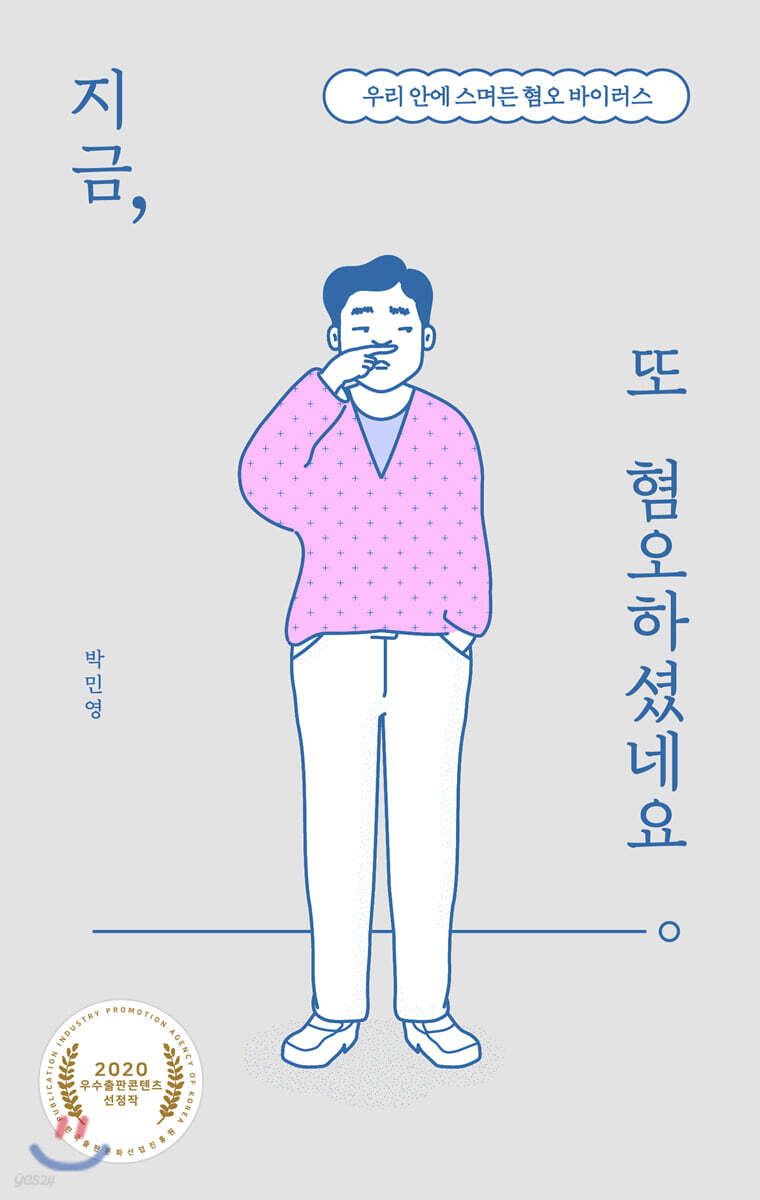
Now, you hate me again
 |
Description
Book Introduction
Hate and be hated on a daily basis
A book for all of us
When we talk about hate, we tend to think of it as someone else's story, not our own.
That is, I tend to think that I neither hate nor am hated by anyone.
But is that really true? Park Min-young, a humanist of our time, delivers a provocative message to modern people who seek to distance themselves from hatred: discrimination, exclusion, and prejudice are always with us, and we are both the perpetrators and the victims.
Without even realizing it, I am discriminating against or excluding someone, and this ultimately comes back to bite me.
The author explains the moments of discrimination, exclusion, and prejudice occurring in our society by dividing them into four categories: 'generation,' 'neighbor,' 'other,' and 'ideology.'
Chapter 1, “Hating ‘Generations,’” discusses hatred toward “youth, young people in their 20s, housewives, and the elderly,” and Chapter 2, “Hating ‘Neighbors,’” deals with hatred toward “women, the disabled, homosexuals, and victims of the Sewol ferry disaster.”
In Chapter 3, “Hating the ‘Other,’” the author discusses hatred toward “migrant workers, ethnic Koreans of China, refugees, and North Korean defectors,” and in Chapter 4, “Hating ‘Ideology,’” the author examines Japan’s hatred toward Korea, politics, Islam, and communists.
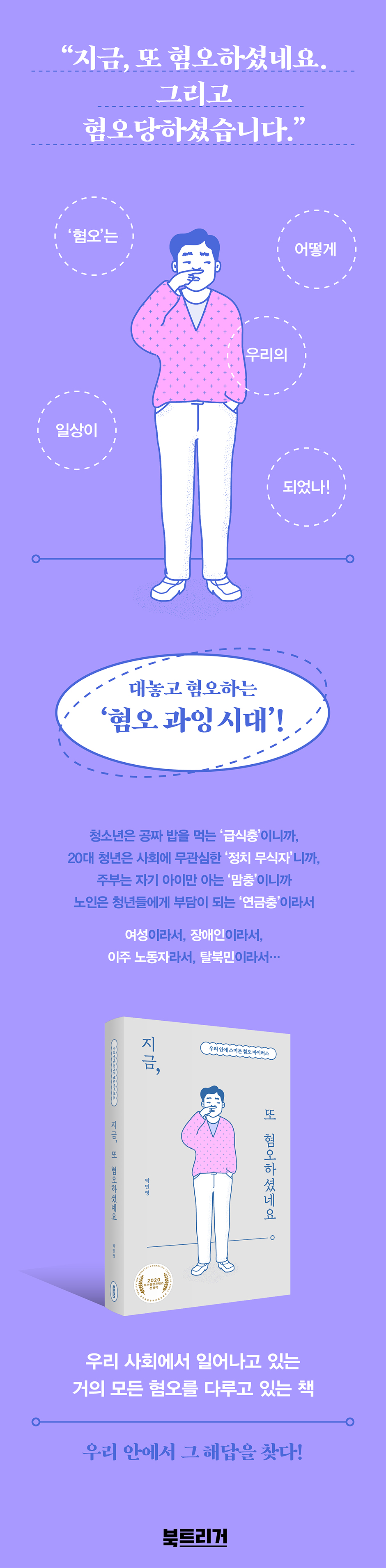
"You Hate Me Again," a comprehensive examination of all forms of discrimination, exclusion, and prejudice occurring in our society, starkly exposes the true face of our society, where hate has become a daily occurrence.
A book for all of us
When we talk about hate, we tend to think of it as someone else's story, not our own.
That is, I tend to think that I neither hate nor am hated by anyone.
But is that really true? Park Min-young, a humanist of our time, delivers a provocative message to modern people who seek to distance themselves from hatred: discrimination, exclusion, and prejudice are always with us, and we are both the perpetrators and the victims.
Without even realizing it, I am discriminating against or excluding someone, and this ultimately comes back to bite me.
The author explains the moments of discrimination, exclusion, and prejudice occurring in our society by dividing them into four categories: 'generation,' 'neighbor,' 'other,' and 'ideology.'
Chapter 1, “Hating ‘Generations,’” discusses hatred toward “youth, young people in their 20s, housewives, and the elderly,” and Chapter 2, “Hating ‘Neighbors,’” deals with hatred toward “women, the disabled, homosexuals, and victims of the Sewol ferry disaster.”
In Chapter 3, “Hating the ‘Other,’” the author discusses hatred toward “migrant workers, ethnic Koreans of China, refugees, and North Korean defectors,” and in Chapter 4, “Hating ‘Ideology,’” the author examines Japan’s hatred toward Korea, politics, Islam, and communists.
"You Hate Me Again," a comprehensive examination of all forms of discrimination, exclusion, and prejudice occurring in our society, starkly exposes the true face of our society, where hate has become a daily occurrence.
- You can preview some of the book's contents.
Preview
index
Chapter 1: Hating 'Generation'
1.
Youth hate
When did the term "school meal bug" originate? / "Why do we have to be cursed at?" / Double hatred toward female youth / Replacing social problems with adolescent issues / Why people in their 20s and 30s hate youth more
2.
Hatred of people in their 20s
Why did the "Fear Generation" become a target of hatred? / The rise of young conservatives / When economic hardship is too great, resistance is not even possible / The impact of the collapse of the university community / The hatred of the "86 Generation" is also neoliberal.
3.
Housewife hate
Are there really so many mothers who are nuisances? / Why do teenagers curse their mothers? / It's a problem if there's no maternal love, and it's a problem if there's a lot of it / Exploited by corporations and ignored by husbands / Mothers who are captives of consumerism / Hatred of mothers is the basis of all hatred
4.
Ageism
As the status of the elderly declines, hatred intensifies. / Who is fueling ageism? / Are the elderly preying on the young? / Youth's self-insecurity and ageism / Why do older people sympathize with the far right?
Chapter 2: Hating 'Neighbors'
1.
misogyny
The Long History of Misogyny / Media That Promotes Misogyny / Misogyny Is Like Air / A Society That Forces Self-Loathing / Misogyny Based on Men's Illusions / "I Like Women, But?"
2.
ableism
Candidacy is the order of the day / Disability is a unique way of being / Why are people with disabilities seen as free riders / Is violent crime caused by schizophrenia? / A society that produces disability
3.
homophobia
"Supporting homosexuality" is also discrimination / Why the state hates homosexuality / Homosexuality is not a subject for healing / Homosocial's homophobia / Christianity's homophobia / The merciless hatred of a compassionate religion
4.
Sewol Ferry hate
Labeling bereaved families pro-North Korea / Are bereaved families demanding excessive compensation? / Controversy over special admissions sparks hatred / Are bereaved families holding back the economy and people's livelihoods? / What kind of environment breeds hatred?
Chapter 3: Hating the 'Other'
1.
Migrant worker hatred
“They’ve all become Koreans.” / Migrant workers are stealing jobs? / They get cursed at, beaten, and injured on the job / Illegal immigrants are potential criminals? / Why is racism so bad?
2.
anti-Korean hatred
If Yun Dong-ju is called a Korean-Chinese poet, / Knowing the history of Chinese compatriots makes it difficult to hate them / Chinese compatriots treated worse than Chinese / “If war breaks out, I’ll be the first to come and shoot and kill Koreans” / The main culprits of hatred against Chinese compatriots, movies and the media
3.
anti-refugee sentiment
South Korea's Response to Yemeni Refugees with Hatred / Why Yemeni Refugees Came to Jeju Island / Refugees in Korea with Worse Mental Health / Refugee Children Treated Worse Than Cattle / A Stranger View of Refugee Hatred
4.
Hatred of North Korean defectors
Is the maladjustment of North Korean defectors only a bad thing? / North Korean defectors isolated and excluded from society / Why do North Korean defectors engage in anti-communist activities? / Anti-communist activities of North Korean defectors as a struggle for recognition / North Korean defectors who are not accepted as democratic citizens
Chapter 4: Hating 'Ideology'
1.
Japan's hatred of Korea
Why the "Hate Korea"? / The Desolate Psychology of Japanese Youth and Anti-Koreanism / Anti-Koreanism as a Sign of the Revival of Fascism / Controversy over Special Permanent Residency and the Korean Identification System / Zainichi Koreans Used by Both the South and the North
2.
Political disgust
The media promotes political hatred / Political hatred that is eating away at democracy / Why does political hatred benefit conservatives? / Do you know about the 'gamification of politics'?
3.
Islamophobia
Why Muslim terror attacks are on the rise in France? / Is Islam oppressive to women? / Is it right to force people to remove the hijab? / Why the far right is on the rise in Northern Europe / "Esther," the epicenter of fake news
4.
communist hatred
"All you have to do is acknowledge 'Long Live Kim Il-sung'" / If you look closely, it's not unrelated to communist hatred / The real reason Syngman Rhee made anti-communism a national policy / Park Chung-hee's red complex and communist hatred / The conflict between Northwestern Christianity and communism / The roots of anti-communist Christianity, the Northwestern Youth Association
1.
Youth hate
When did the term "school meal bug" originate? / "Why do we have to be cursed at?" / Double hatred toward female youth / Replacing social problems with adolescent issues / Why people in their 20s and 30s hate youth more
2.
Hatred of people in their 20s
Why did the "Fear Generation" become a target of hatred? / The rise of young conservatives / When economic hardship is too great, resistance is not even possible / The impact of the collapse of the university community / The hatred of the "86 Generation" is also neoliberal.
3.
Housewife hate
Are there really so many mothers who are nuisances? / Why do teenagers curse their mothers? / It's a problem if there's no maternal love, and it's a problem if there's a lot of it / Exploited by corporations and ignored by husbands / Mothers who are captives of consumerism / Hatred of mothers is the basis of all hatred
4.
Ageism
As the status of the elderly declines, hatred intensifies. / Who is fueling ageism? / Are the elderly preying on the young? / Youth's self-insecurity and ageism / Why do older people sympathize with the far right?
Chapter 2: Hating 'Neighbors'
1.
misogyny
The Long History of Misogyny / Media That Promotes Misogyny / Misogyny Is Like Air / A Society That Forces Self-Loathing / Misogyny Based on Men's Illusions / "I Like Women, But?"
2.
ableism
Candidacy is the order of the day / Disability is a unique way of being / Why are people with disabilities seen as free riders / Is violent crime caused by schizophrenia? / A society that produces disability
3.
homophobia
"Supporting homosexuality" is also discrimination / Why the state hates homosexuality / Homosexuality is not a subject for healing / Homosocial's homophobia / Christianity's homophobia / The merciless hatred of a compassionate religion
4.
Sewol Ferry hate
Labeling bereaved families pro-North Korea / Are bereaved families demanding excessive compensation? / Controversy over special admissions sparks hatred / Are bereaved families holding back the economy and people's livelihoods? / What kind of environment breeds hatred?
Chapter 3: Hating the 'Other'
1.
Migrant worker hatred
“They’ve all become Koreans.” / Migrant workers are stealing jobs? / They get cursed at, beaten, and injured on the job / Illegal immigrants are potential criminals? / Why is racism so bad?
2.
anti-Korean hatred
If Yun Dong-ju is called a Korean-Chinese poet, / Knowing the history of Chinese compatriots makes it difficult to hate them / Chinese compatriots treated worse than Chinese / “If war breaks out, I’ll be the first to come and shoot and kill Koreans” / The main culprits of hatred against Chinese compatriots, movies and the media
3.
anti-refugee sentiment
South Korea's Response to Yemeni Refugees with Hatred / Why Yemeni Refugees Came to Jeju Island / Refugees in Korea with Worse Mental Health / Refugee Children Treated Worse Than Cattle / A Stranger View of Refugee Hatred
4.
Hatred of North Korean defectors
Is the maladjustment of North Korean defectors only a bad thing? / North Korean defectors isolated and excluded from society / Why do North Korean defectors engage in anti-communist activities? / Anti-communist activities of North Korean defectors as a struggle for recognition / North Korean defectors who are not accepted as democratic citizens
Chapter 4: Hating 'Ideology'
1.
Japan's hatred of Korea
Why the "Hate Korea"? / The Desolate Psychology of Japanese Youth and Anti-Koreanism / Anti-Koreanism as a Sign of the Revival of Fascism / Controversy over Special Permanent Residency and the Korean Identification System / Zainichi Koreans Used by Both the South and the North
2.
Political disgust
The media promotes political hatred / Political hatred that is eating away at democracy / Why does political hatred benefit conservatives? / Do you know about the 'gamification of politics'?
3.
Islamophobia
Why Muslim terror attacks are on the rise in France? / Is Islam oppressive to women? / Is it right to force people to remove the hijab? / Why the far right is on the rise in Northern Europe / "Esther," the epicenter of fake news
4.
communist hatred
"All you have to do is acknowledge 'Long Live Kim Il-sung'" / If you look closely, it's not unrelated to communist hatred / The real reason Syngman Rhee made anti-communism a national policy / Park Chung-hee's red complex and communist hatred / The conflict between Northwestern Christianity and communism / The roots of anti-communist Christianity, the Northwestern Youth Association
Detailed image
Into the book
The 86 generation is a generation that has been armed with a strong sense of community since their youth.
Self-identity is also strong.
When that generation criticizes themselves for being scattered like grains of sand, I wonder if the generation of fear won't feel like another round of collective lynching.
Of course, it can be argued that the 86 generation brought up the '20s bastard theory' in the hope that the fear generation would come to their senses.
But is that possible with hate speech? Sociologist Kim Chan-ho asks:
“If you truly want someone to change, you have to point out their flaws and scold them, but also make them feel respected.”
---From "Chapter 1: Hating 'Generation' - Hatred of Youth"
What older people need is not just personal space like a home.
Social space is also needed.
Where can impoverished seniors find a place to affirm themselves as social beings without spending money or compromising their dignity? There are few.
Because every space in our daily lives has become marketized.
For urban seniors, the subway is the only social space left.
The elderly spending time on the subway should be understood in this context.
---From "Chapter 1: Hating 'Generation' - Hatred of the Elderly"
People with disabilities are often defined as 'people who can't do something or can't do something.'
But even with disabilities, they can do things their own way as long as the conditions are met.
The reason people with disabilities are seen as incompetent, freeloaders, dependents, and even less human is because society was designed from the beginning only for non-disabled people.
It is not because of their disability that people with disabilities become incompetent, freeloaders, or dependents, but because society was designed from the beginning to exclude people with disabilities.
---From Chapter 2, Hating 'Neighbors' - Hatred of the Disabled
Most of the Sewol ferry victims were students.
There was bound to be greater empathy for the deceased and their bereaved families.
There is something more universal about the grief and pain of parents who have lost a child.
In such cases, it is not easy to detach the public from that empathy.
Because of this, passport officials seem to have become even more obsessed with color theory.
If the Sewol ferry disaster becomes a political issue, that is, a left-right issue, it could initially free conservatives from public criticism of the government.
It was a kind of 'split'.
---From "Chapter 2: Hating 'Neighbors' - Hating the Sewol Ferry"
There is another reason why we should not treat Yemenis carelessly.
Because Yemen's history is very similar to ours.
After the unification of East and West Germany, Yemen was one of only two divided countries in the world, along with Korea.
South and North Yemen were unified in 1990, but unfortunately, war broke out again.
Yemen's history is very similar to ours, with foreign powers like the Arab League intervening in the war.
Now that we are somewhat better off, that the South and the North are at odds, but things are okay for now, can we hate the Yemeni refugees coming into our country?
---From Chapter 3, Hating the 'Other' - Hatred of Refugees
If I had to pick just one reason why anti-Korean sentiment is rampant in Japan, it would be because the history of imperialist invasion has not been properly resolved.
In Japan, even after the defeat, the police and politicians who implemented militarism were not properly liquidated.
There was no deep reflection on colonial rule either.
Rather, the war criminals have been resurrected and have seized political power.
… Even after the defeat, the imperial system continued, and the political landscape revolved around the Liberal Democratic Party for 60 years.
Moreover, many politicians, including Abe, have become members of the National Assembly through third-generation hereditary succession.
---From Chapter 4, Hating 'Ideology' - Japan's Hatred of Korea
Political hatred also seriously harms democracy.
When political aversion becomes the dominant culture, people become more apathetic about politics.
Democracy is based on the political consciousness of the people.
The higher the level of political awareness of the people, the better democracy works; the lower the level, the more difficult it is to implement democracy.
Political consciousness doesn't just happen; it requires learning.
However, political aversion makes people less willing to learn about politics.
Self-identity is also strong.
When that generation criticizes themselves for being scattered like grains of sand, I wonder if the generation of fear won't feel like another round of collective lynching.
Of course, it can be argued that the 86 generation brought up the '20s bastard theory' in the hope that the fear generation would come to their senses.
But is that possible with hate speech? Sociologist Kim Chan-ho asks:
“If you truly want someone to change, you have to point out their flaws and scold them, but also make them feel respected.”
---From "Chapter 1: Hating 'Generation' - Hatred of Youth"
What older people need is not just personal space like a home.
Social space is also needed.
Where can impoverished seniors find a place to affirm themselves as social beings without spending money or compromising their dignity? There are few.
Because every space in our daily lives has become marketized.
For urban seniors, the subway is the only social space left.
The elderly spending time on the subway should be understood in this context.
---From "Chapter 1: Hating 'Generation' - Hatred of the Elderly"
People with disabilities are often defined as 'people who can't do something or can't do something.'
But even with disabilities, they can do things their own way as long as the conditions are met.
The reason people with disabilities are seen as incompetent, freeloaders, dependents, and even less human is because society was designed from the beginning only for non-disabled people.
It is not because of their disability that people with disabilities become incompetent, freeloaders, or dependents, but because society was designed from the beginning to exclude people with disabilities.
---From Chapter 2, Hating 'Neighbors' - Hatred of the Disabled
Most of the Sewol ferry victims were students.
There was bound to be greater empathy for the deceased and their bereaved families.
There is something more universal about the grief and pain of parents who have lost a child.
In such cases, it is not easy to detach the public from that empathy.
Because of this, passport officials seem to have become even more obsessed with color theory.
If the Sewol ferry disaster becomes a political issue, that is, a left-right issue, it could initially free conservatives from public criticism of the government.
It was a kind of 'split'.
---From "Chapter 2: Hating 'Neighbors' - Hating the Sewol Ferry"
There is another reason why we should not treat Yemenis carelessly.
Because Yemen's history is very similar to ours.
After the unification of East and West Germany, Yemen was one of only two divided countries in the world, along with Korea.
South and North Yemen were unified in 1990, but unfortunately, war broke out again.
Yemen's history is very similar to ours, with foreign powers like the Arab League intervening in the war.
Now that we are somewhat better off, that the South and the North are at odds, but things are okay for now, can we hate the Yemeni refugees coming into our country?
---From Chapter 3, Hating the 'Other' - Hatred of Refugees
If I had to pick just one reason why anti-Korean sentiment is rampant in Japan, it would be because the history of imperialist invasion has not been properly resolved.
In Japan, even after the defeat, the police and politicians who implemented militarism were not properly liquidated.
There was no deep reflection on colonial rule either.
Rather, the war criminals have been resurrected and have seized political power.
… Even after the defeat, the imperial system continued, and the political landscape revolved around the Liberal Democratic Party for 60 years.
Moreover, many politicians, including Abe, have become members of the National Assembly through third-generation hereditary succession.
---From Chapter 4, Hating 'Ideology' - Japan's Hatred of Korea
Political hatred also seriously harms democracy.
When political aversion becomes the dominant culture, people become more apathetic about politics.
Democracy is based on the political consciousness of the people.
The higher the level of political awareness of the people, the better democracy works; the lower the level, the more difficult it is to implement democracy.
Political consciousness doesn't just happen; it requires learning.
However, political aversion makes people less willing to learn about politics.
---From Chapter 4, Hating 'Ideology' - Hatred of Politics
Publisher's Review
In an age of excessive hate,
Hatred returns to more hatred
We are now in an 'age of excessive hate'.
They say that teenagers deserve to be hated because they are 'free lunch junkies', that young people in their 20s are 'politically illiterate' who are indifferent to society, and that housewives are 'mom junkies' who only care about their children.
Also, the old man is a 'dog man' who bullies the weak, and the old man is a 'pensioner' who is a burden to the young.
How many people can truly escape this category? Small mistakes escalate into massive criticism, and those who are hypersensitive lash out at those outside their own category.
Most people think of themselves as the standard.
And they look at people outside of their group with wary eyes, measuring them with inflated standards.
Those who do not meet my standards become the object of hatred.
What's even more tragic is that the other person is also measuring me by the same standards.
So we all live, hating and being hated by each other.
The state of our society consumed by hatred
"Now, You Hate Me Again" sharply diagnoses our society, where hate has become a daily occurrence.
We criticize the current state of affairs, which absorbs all issues and reduces them to 'hate', and hope that members of our society will objectively judge reality and, through this, bring about a change in perception.
The author divides the nature of hatred in our society into four categories: 'generation,' 'neighbor,' 'other,' and 'ideology,' and examines in detail how hatred operates in our society.
The author exposes the reality that in an era where survival of the fittest and winner-take-all rule prevail, people discriminate against those weaker than themselves to relieve stress and feel a sense of relative superiority.
When people think of targets of discrimination, they usually think of women, people with disabilities, sexual minorities, and migrant workers.
But in our society today, people of all generations, from children to the elderly, are subject to discrimination and prejudice.
In our society, dominated by the ideology of neoliberalism, it is not easy to avoid the blade of hatred directed at the weak.
Chapter 1, “Hating ‘Generations’,” talks about the unfortunate situation in our society where all generations are hated.
Chapter 2, “Hatting ‘Neighbors,’” discusses the hatred felt by victims of the Sewol Ferry disaster, along with women, the disabled, and homosexuals, who have traditionally suffered discrimination and exclusion.
Misogyny, ableism, and transphobia are so commonplace that we don't even realize what's wrong.
The media casually spews out discriminatory language like "comparing women's bodies" and "degrading the disabled," and the internalized hatred through this becomes as familiar as the air and circulates around us.
A more serious problem is that they are also targeting the victims of the Sewol Ferry disaster with hatred, thereby helping to cover up the ‘truth.’
It is regrettable that the fundamental problems exposed by the Sewol Ferry disaster – injustice, corruption, and inequality – remain unresolved.
Chapter 3, “Hating the ‘Other,’” discusses migrant workers, ethnic Koreans of China, refugees, and North Korean defectors, who are representative groups discriminated against in our society.
Our society is particularly reluctant to accept strangers.
There are many reasons for this, but the most representative one is that ‘Korea is an extremely competitive society.’
In this regard, the author says, “People living in such a society easily agree with discriminatory codes to confirm their own superiority.”
And it coldly criticizes our attitude, which is heavily imbued with class and racial superiority.
Chapter 4, “Abhorring ‘Ideology,’” deals with the widespread hatred of Korea in Japan, political hatred, Islamophobia, and communism in our society.
The anti-Korean sentiment that began to spread widely in Japanese society around 2005 is now reaching its peak.
Japan, which has failed to properly come to terms with its history of imperialist invasion, has also not deeply reflected on its colonial rule.
It may be natural that some Japanese people who still dream of a revival of militarism still cry out anti-Korean sentiments.
The author then delves into the widespread political hatred, Islamophobia, and communist hatred in our society.
Due to various fake news, media, and political circles, our citizens are becoming increasingly indifferent to politics and ideology.
The reality is that the damage from this will inevitably be passed on to our people.
In an era where discrimination and hatred have become the norm,
Finding the answer within ourselves
“Hate is like a giant sponge.
It absorbs all the issues in our society.
“All issues boil down to ‘hate.’” In a society where discrimination and exclusion are the norm, all social problems are trapped within the frame of ‘hate.’
A representative example is COVID-19, which plunged the world into fear in 2020.
The hatred in our society began with ‘Chinese people, Chinese compatriots,’ then spread to sexual minorities and ultimately to all of us.
The fact that hate has become commonplace in our society means, in a way, that the suffering and anxiety of the people are great.
"Now, You Hate Me Again" is a book that coolly criticizes our current reality and talks about practical solutions.
In fact, we already know the best answer to that problem.
'I must look back at myself from the perspective of those I have been limiting and excluding, those I have considered different from me, and treat them with understanding, consideration, and respect.
'All people in the world are equal!'
But we also know that this is not as easy as it sounds.
In a society where no matter how hard we work and earn money, we cannot keep up with the rising real estate prices, and no matter how hard we try, it is difficult to dream of social mobility. We often become victims and perpetrators of hatred without even realizing it.
This book tells us to face our current reality.
He says we need to understand why the hate virus is so prevalent in our society, what role it plays in politics and society, and what logical context it exists within.
Knowing the facts enables us to make objective judgments and change our perceptions.
This book, which covers almost all the hate that occurs in our society, will be of great help in objectively judging hate and changing our perceptions.
Hatred returns to more hatred
We are now in an 'age of excessive hate'.
They say that teenagers deserve to be hated because they are 'free lunch junkies', that young people in their 20s are 'politically illiterate' who are indifferent to society, and that housewives are 'mom junkies' who only care about their children.
Also, the old man is a 'dog man' who bullies the weak, and the old man is a 'pensioner' who is a burden to the young.
How many people can truly escape this category? Small mistakes escalate into massive criticism, and those who are hypersensitive lash out at those outside their own category.
Most people think of themselves as the standard.
And they look at people outside of their group with wary eyes, measuring them with inflated standards.
Those who do not meet my standards become the object of hatred.
What's even more tragic is that the other person is also measuring me by the same standards.
So we all live, hating and being hated by each other.
The state of our society consumed by hatred
"Now, You Hate Me Again" sharply diagnoses our society, where hate has become a daily occurrence.
We criticize the current state of affairs, which absorbs all issues and reduces them to 'hate', and hope that members of our society will objectively judge reality and, through this, bring about a change in perception.
The author divides the nature of hatred in our society into four categories: 'generation,' 'neighbor,' 'other,' and 'ideology,' and examines in detail how hatred operates in our society.
The author exposes the reality that in an era where survival of the fittest and winner-take-all rule prevail, people discriminate against those weaker than themselves to relieve stress and feel a sense of relative superiority.
When people think of targets of discrimination, they usually think of women, people with disabilities, sexual minorities, and migrant workers.
But in our society today, people of all generations, from children to the elderly, are subject to discrimination and prejudice.
In our society, dominated by the ideology of neoliberalism, it is not easy to avoid the blade of hatred directed at the weak.
Chapter 1, “Hating ‘Generations’,” talks about the unfortunate situation in our society where all generations are hated.
Chapter 2, “Hatting ‘Neighbors,’” discusses the hatred felt by victims of the Sewol Ferry disaster, along with women, the disabled, and homosexuals, who have traditionally suffered discrimination and exclusion.
Misogyny, ableism, and transphobia are so commonplace that we don't even realize what's wrong.
The media casually spews out discriminatory language like "comparing women's bodies" and "degrading the disabled," and the internalized hatred through this becomes as familiar as the air and circulates around us.
A more serious problem is that they are also targeting the victims of the Sewol Ferry disaster with hatred, thereby helping to cover up the ‘truth.’
It is regrettable that the fundamental problems exposed by the Sewol Ferry disaster – injustice, corruption, and inequality – remain unresolved.
Chapter 3, “Hating the ‘Other,’” discusses migrant workers, ethnic Koreans of China, refugees, and North Korean defectors, who are representative groups discriminated against in our society.
Our society is particularly reluctant to accept strangers.
There are many reasons for this, but the most representative one is that ‘Korea is an extremely competitive society.’
In this regard, the author says, “People living in such a society easily agree with discriminatory codes to confirm their own superiority.”
And it coldly criticizes our attitude, which is heavily imbued with class and racial superiority.
Chapter 4, “Abhorring ‘Ideology,’” deals with the widespread hatred of Korea in Japan, political hatred, Islamophobia, and communism in our society.
The anti-Korean sentiment that began to spread widely in Japanese society around 2005 is now reaching its peak.
Japan, which has failed to properly come to terms with its history of imperialist invasion, has also not deeply reflected on its colonial rule.
It may be natural that some Japanese people who still dream of a revival of militarism still cry out anti-Korean sentiments.
The author then delves into the widespread political hatred, Islamophobia, and communist hatred in our society.
Due to various fake news, media, and political circles, our citizens are becoming increasingly indifferent to politics and ideology.
The reality is that the damage from this will inevitably be passed on to our people.
In an era where discrimination and hatred have become the norm,
Finding the answer within ourselves
“Hate is like a giant sponge.
It absorbs all the issues in our society.
“All issues boil down to ‘hate.’” In a society where discrimination and exclusion are the norm, all social problems are trapped within the frame of ‘hate.’
A representative example is COVID-19, which plunged the world into fear in 2020.
The hatred in our society began with ‘Chinese people, Chinese compatriots,’ then spread to sexual minorities and ultimately to all of us.
The fact that hate has become commonplace in our society means, in a way, that the suffering and anxiety of the people are great.
"Now, You Hate Me Again" is a book that coolly criticizes our current reality and talks about practical solutions.
In fact, we already know the best answer to that problem.
'I must look back at myself from the perspective of those I have been limiting and excluding, those I have considered different from me, and treat them with understanding, consideration, and respect.
'All people in the world are equal!'
But we also know that this is not as easy as it sounds.
In a society where no matter how hard we work and earn money, we cannot keep up with the rising real estate prices, and no matter how hard we try, it is difficult to dream of social mobility. We often become victims and perpetrators of hatred without even realizing it.
This book tells us to face our current reality.
He says we need to understand why the hate virus is so prevalent in our society, what role it plays in politics and society, and what logical context it exists within.
Knowing the facts enables us to make objective judgments and change our perceptions.
This book, which covers almost all the hate that occurs in our society, will be of great help in objectively judging hate and changing our perceptions.
GOODS SPECIFICS
- Date of issue: July 30, 2020
- Page count, weight, size: 368 pages | 514g | 130*205*30mm
- ISBN13: 9791189799298
- ISBN10: 1189799294
You may also like
카테고리
korean


korean

![GQ KOREA Mark (Monthly): December [2025]](http://librairie.coreenne.fr/cdn/shop/files/8ef265dbbfbf186523ed75ba7319009d.jpg?v=1765340328&width=3840)


