

Steel
 |
Description
Book Introduction
- A word from MD
- [A Drama Writing Guide Filled with Experience and Know-How] The only writing guide for aspiring drama writers.
It is the culmination of 30 years of field experience and expertise of director Park Sung-soo, who has served as a drama director, drama director, and co-CEO of a production company.
From character creation to script revision and collaboration, this book serves as a landmark for anyone who puts story at the center of their work.
- Ahn Hyun-jae, art producer
Director Park Sung-soo's "Do as You Like"
A drama writing guide filled with 30 years of experience and know-how
“I dare say that whoever reads this book will be the winner!”
Highly recommended by author Song Jae-jeong!
With the rise of OTT, several new dramas are being released every week.
There are more places for new writers to stand, and there are more and more people who dream of becoming drama writers.
But what is the reality?
It is difficult to find a proper domestic writing guide to help drama writers get started.
Most aspiring writers are lost, reading abstract writing books or foreign film script-writing books that are out of touch with today's reality.
In the midst of the golden age when K-dramas captivated the world, they are going down the wrong path.
The author of this book took up his pen at this very point.
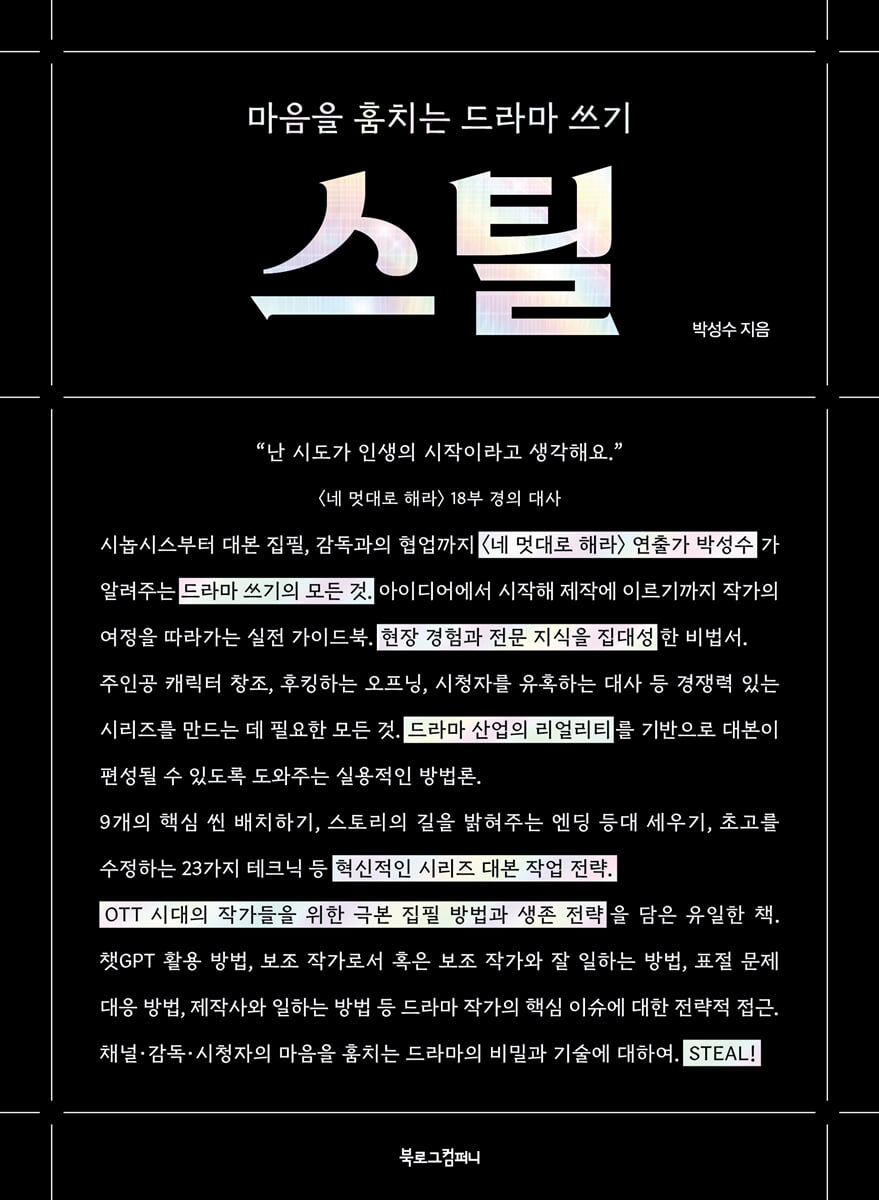
"Steel" is a drama writing guide compiled by director Park Sung-soo, who has served as a drama director, MBC drama director, and co-CEO of a production company, and has accumulated 30 years of field experience and expertise.
It's packed with useful information that will instantly transform even the most inexperienced writers into skilled writers, including how to create compelling characters, how to structure an episode with nine key scenes, how to write dialogue that captivates viewers, and 23 ways to objectively revise a script.
Because it covers how to create compositions, characters, and dialogue that will captivate the audience, it is a must-read for anyone who works on story-centered content, not just dramas, but also web novels, webtoons, and movie scripts.
It is very useful not only for writers, but also for directors, planners, and producers.
Song Jae-jung, the author of 『Yumi's Cells』, 『Memories of the Alhambra』, and 『W』, said of this book, "It is no exaggeration to say that the author knows almost everything about the Korean drama market, and all of his experience and know-how are contained in this one book.
I dare say that anyone who reads ‘Steel’ will be a winner,” he said, strongly recommending it.
A drama writing guide filled with 30 years of experience and know-how
“I dare say that whoever reads this book will be the winner!”
Highly recommended by author Song Jae-jeong!
With the rise of OTT, several new dramas are being released every week.
There are more places for new writers to stand, and there are more and more people who dream of becoming drama writers.
But what is the reality?
It is difficult to find a proper domestic writing guide to help drama writers get started.
Most aspiring writers are lost, reading abstract writing books or foreign film script-writing books that are out of touch with today's reality.
In the midst of the golden age when K-dramas captivated the world, they are going down the wrong path.
The author of this book took up his pen at this very point.
"Steel" is a drama writing guide compiled by director Park Sung-soo, who has served as a drama director, MBC drama director, and co-CEO of a production company, and has accumulated 30 years of field experience and expertise.
It's packed with useful information that will instantly transform even the most inexperienced writers into skilled writers, including how to create compelling characters, how to structure an episode with nine key scenes, how to write dialogue that captivates viewers, and 23 ways to objectively revise a script.
Because it covers how to create compositions, characters, and dialogue that will captivate the audience, it is a must-read for anyone who works on story-centered content, not just dramas, but also web novels, webtoons, and movie scripts.
It is very useful not only for writers, but also for directors, planners, and producers.
Song Jae-jung, the author of 『Yumi's Cells』, 『Memories of the Alhambra』, and 『W』, said of this book, "It is no exaggeration to say that the author knows almost everything about the Korean drama market, and all of his experience and know-how are contained in this one book.
I dare say that anyone who reads ‘Steel’ will be a winner,” he said, strongly recommending it.
- You can preview some of the book's contents.
Preview
index
prolog
PART 1.
Basics
Chapter 1.
Are drama writers born?
Twenty Elements of a Writer's DNA
Eight Steps to Becoming a Writer
Lucky Seven for Writers: Luck Makes Writers
Consistency ultimately makes a writer.
Chapter 2.
The Path to Becoming a Drama Writer: Script Contest
Contest Judging Criteria
Fairness of contest judging
Objectivity in channel lineup review
Chapter 3.
The Beginning of Planning: Developing a Concept
Capture problematic characters
An image that suddenly came to me
A hot issue that captured my heart
Challenge yourself with a variety of genres and materials.
Adaptation of the original work
Chapter 4.
Creating a main character
Ten Characteristics of the Protagonist
Can a villain also be a protagonist?
The author himself as the protagonist
Creating supporting characters
Which comes first: narrative or character?
Chapter 5.
Creating a synopsis
Prepare thoroughly in advance
The synopsis comes in two versions.
The plot is full of twists and turns
The logline is clear
PART 2.
Practical Edition
Chapter 6.
Script Composition: 9 Key Scenes and the Ending Lighthouse
The limitations of the classic three-act structure
The Four Stages of Storytelling and Audience Transformation
The newly proposed '9 Core Scenes and Ending Lighthouse' framework
Key scenes of Act 1: Opening + Issues + Key Dilemma
Key scenes of Act 2: Failure of effort + turning point + escalation of crisis
Key scenes of Act 3: Climax of crisis + climax + catharsis of the ending
Ending Lighthouse
Chapter 7.
Planning and composition of the series
Key characteristics of a series drama
The beginning of the series planning
Checkpoints before working on a series
Strategies for the beginning and end of the series
One series of meetings
The process after that
Chapter 8.
Writing dialogue
What makes a good ambassador
Chapter 9.
Writing fingerprints
Action scene fingerprint
Parenthesized fingerprints with acting instructions
Technically Directed Fingerprints
Chapter 10.
Writing a first draft
13 Guides to Writing a First Draft
Time spent writing and revising the first draft
Chapter 11.
Edit
Revision work is more important than the first draft
Self-objectification, essential for revision work
Improving Perfection with 'I Edit Alone'
Step 1 of My Own Edit: Review
Step 2 of Editing Alone: Delete
Step 3 of My Alone Edit: Rewrite
Review of the script
PART 3.
Challenge Edition
Chapter 12.
Collaboration with channels and directors
Feedback on the draft and the author's response
A writer's attitude toward script meetings
When and how does a writer's ability develop?
Chapter 13.
Reality in the drama industry
The flow of the drama industry
Characteristics of the drama industry
Chapter 14.
ChatGPT and the Future of Drama Writers
Hollywood Takes on ChatGPT
How to deal with ChatGPT?
Chapter 15.
The working environment of a new writer
Working as an assistant writer
Working with an Assistant Writer
Working together as co-writers
plagiarism issue
Conflict with the production company
Chapter 16.
Taking care of the drama writer's mind
Epilogue
Acknowledgements
References
PART 1.
Basics
Chapter 1.
Are drama writers born?
Twenty Elements of a Writer's DNA
Eight Steps to Becoming a Writer
Lucky Seven for Writers: Luck Makes Writers
Consistency ultimately makes a writer.
Chapter 2.
The Path to Becoming a Drama Writer: Script Contest
Contest Judging Criteria
Fairness of contest judging
Objectivity in channel lineup review
Chapter 3.
The Beginning of Planning: Developing a Concept
Capture problematic characters
An image that suddenly came to me
A hot issue that captured my heart
Challenge yourself with a variety of genres and materials.
Adaptation of the original work
Chapter 4.
Creating a main character
Ten Characteristics of the Protagonist
Can a villain also be a protagonist?
The author himself as the protagonist
Creating supporting characters
Which comes first: narrative or character?
Chapter 5.
Creating a synopsis
Prepare thoroughly in advance
The synopsis comes in two versions.
The plot is full of twists and turns
The logline is clear
PART 2.
Practical Edition
Chapter 6.
Script Composition: 9 Key Scenes and the Ending Lighthouse
The limitations of the classic three-act structure
The Four Stages of Storytelling and Audience Transformation
The newly proposed '9 Core Scenes and Ending Lighthouse' framework
Key scenes of Act 1: Opening + Issues + Key Dilemma
Key scenes of Act 2: Failure of effort + turning point + escalation of crisis
Key scenes of Act 3: Climax of crisis + climax + catharsis of the ending
Ending Lighthouse
Chapter 7.
Planning and composition of the series
Key characteristics of a series drama
The beginning of the series planning
Checkpoints before working on a series
Strategies for the beginning and end of the series
One series of meetings
The process after that
Chapter 8.
Writing dialogue
What makes a good ambassador
Chapter 9.
Writing fingerprints
Action scene fingerprint
Parenthesized fingerprints with acting instructions
Technically Directed Fingerprints
Chapter 10.
Writing a first draft
13 Guides to Writing a First Draft
Time spent writing and revising the first draft
Chapter 11.
Edit
Revision work is more important than the first draft
Self-objectification, essential for revision work
Improving Perfection with 'I Edit Alone'
Step 1 of My Own Edit: Review
Step 2 of Editing Alone: Delete
Step 3 of My Alone Edit: Rewrite
Review of the script
PART 3.
Challenge Edition
Chapter 12.
Collaboration with channels and directors
Feedback on the draft and the author's response
A writer's attitude toward script meetings
When and how does a writer's ability develop?
Chapter 13.
Reality in the drama industry
The flow of the drama industry
Characteristics of the drama industry
Chapter 14.
ChatGPT and the Future of Drama Writers
Hollywood Takes on ChatGPT
How to deal with ChatGPT?
Chapter 15.
The working environment of a new writer
Working as an assistant writer
Working with an Assistant Writer
Working together as co-writers
plagiarism issue
Conflict with the production company
Chapter 16.
Taking care of the drama writer's mind
Epilogue
Acknowledgements
References
Detailed image

Into the book
This book aims not simply to write a good script, but to create a script that can be broadcast.
A drama writer's goal is to have his or her script produced and broadcast.
How can a writer determine whether his or her script is competitive and complete enough to be broadcast? Furthermore, how can he or she revise his or her draft into a broadcast-ready script? And even before submitting it to a channel, through your own efforts and methods! Without relying on luck, fortune, or connections! This book aims to answer these questions.
---From the "Prologue"
The author must clearly show the psychological, personality, situational, and relational reasons for the protagonist's judgments and decisions.
Only by knowing the protagonist's reasons for his actions can the viewer accompany him on his journey.
This journey begins by clearly revealing what the protagonist's 'desired purpose' is.
It's not easy to empathize with a protagonist who doesn't have a clear goal.
---「Chapter 4.
From "Creating a Main Character"
Villains never see themselves as villains.
Furthermore, 'a truly great actor never judges his characters.' Therefore, when creating a villain, a writer must pour in as much affection and sincerity as he does the protagonist.
The reason a villain adds tension to a drama isn't because he's evil.
Because he is competent.
Add some human charm to this and the villain becomes much more dangerous.
The conflict between the weak protagonist and the capable villain increases the tension.
---「Chapter 4.
From "Creating a Main Character"
Another one is a synopsis for submission, which is essentially a promotional pamphlet and business proposal.
The series plan must be written from this perspective.
A synopsis to be shown to judges, directors, directors, actors, and advertisers, containing the work's strengths, characteristics, and selling points.
---「Chapter 5.
From “Creating a Synopsis”
I propose a framework called '9 Key Scenes and Ending Lighthouse' as a way to help structure drama today.
This framework can be used to structure a single short story or a single episode of a series.
The crucial difference between the Hollywood film theory, which has six key scenes in 120 minutes, and the new framework is that nine key scenes are set in a drama running time of 60 to 70 minutes.
---「Chapter 6.
From "Composing a Script: 9 Key Scenes and the Ending Lighthouse"
The extreme line is said to be the importance of the play, and the emotional line is said to represent the sadness and joy of the main character.
Of these two, the emotional line is far more important.
No matter how big an event occurs or how much of a crisis awaits, if the protagonist's inner self and emotions do not respond, all dramatic devices are in vain.
Viewers pay more attention to the characters' emotional reactions than to the events themselves.
---「Chapter 6.
From "Composing a Script: 9 Key Scenes and the Ending Lighthouse"
What are the most important scenes in your drama, from opening to ending? Connect those scenes to create a story outline.
Even then, use the '9 Key Scenes and Ending Lighthouse' framework.
It is a story outline in itself and a method of story composition, and if expanded upon, it is a scene composition table.
---「Chapter 10.
From "Writing a First Draft"
The most time- and energy-consuming part of the entire script writing process is editing.
Revision is the essence of a writer's life.
You must allocate sufficient time for the revision work.
Revision doesn't end with two or three times.
Since we presented 23 different ways to fix it, let's try a total of 23 fixes from different perspectives.
Some sessions will take just an hour or two, while others will take three or four days.
Applying these 23 revision methods and working on your own draft is one way to improve a 50-point script into an 80-point one.
---「Chapter 11.
Among the "Edit"
Collaborating through meetings is a completely different kind of work with others.
Because other people's worldviews, dramas, intellect, and skills are intruding into your script and mind, you will expend a lot of emotion and energy.
Often, the revision process is very slow or at a standstill.
Their point seems right, so when I try to reflect it in the script, it feels a bit out of place.
Sometimes emotions like confusion, disappointment, frustration, and anger come to mind.
The best thing to do in this situation is not to react.
Let's create a gap between stimulus and response.
It's time to unleash your astral projection abilities.
A drama writer's goal is to have his or her script produced and broadcast.
How can a writer determine whether his or her script is competitive and complete enough to be broadcast? Furthermore, how can he or she revise his or her draft into a broadcast-ready script? And even before submitting it to a channel, through your own efforts and methods! Without relying on luck, fortune, or connections! This book aims to answer these questions.
---From the "Prologue"
The author must clearly show the psychological, personality, situational, and relational reasons for the protagonist's judgments and decisions.
Only by knowing the protagonist's reasons for his actions can the viewer accompany him on his journey.
This journey begins by clearly revealing what the protagonist's 'desired purpose' is.
It's not easy to empathize with a protagonist who doesn't have a clear goal.
---「Chapter 4.
From "Creating a Main Character"
Villains never see themselves as villains.
Furthermore, 'a truly great actor never judges his characters.' Therefore, when creating a villain, a writer must pour in as much affection and sincerity as he does the protagonist.
The reason a villain adds tension to a drama isn't because he's evil.
Because he is competent.
Add some human charm to this and the villain becomes much more dangerous.
The conflict between the weak protagonist and the capable villain increases the tension.
---「Chapter 4.
From "Creating a Main Character"
Another one is a synopsis for submission, which is essentially a promotional pamphlet and business proposal.
The series plan must be written from this perspective.
A synopsis to be shown to judges, directors, directors, actors, and advertisers, containing the work's strengths, characteristics, and selling points.
---「Chapter 5.
From “Creating a Synopsis”
I propose a framework called '9 Key Scenes and Ending Lighthouse' as a way to help structure drama today.
This framework can be used to structure a single short story or a single episode of a series.
The crucial difference between the Hollywood film theory, which has six key scenes in 120 minutes, and the new framework is that nine key scenes are set in a drama running time of 60 to 70 minutes.
---「Chapter 6.
From "Composing a Script: 9 Key Scenes and the Ending Lighthouse"
The extreme line is said to be the importance of the play, and the emotional line is said to represent the sadness and joy of the main character.
Of these two, the emotional line is far more important.
No matter how big an event occurs or how much of a crisis awaits, if the protagonist's inner self and emotions do not respond, all dramatic devices are in vain.
Viewers pay more attention to the characters' emotional reactions than to the events themselves.
---「Chapter 6.
From "Composing a Script: 9 Key Scenes and the Ending Lighthouse"
What are the most important scenes in your drama, from opening to ending? Connect those scenes to create a story outline.
Even then, use the '9 Key Scenes and Ending Lighthouse' framework.
It is a story outline in itself and a method of story composition, and if expanded upon, it is a scene composition table.
---「Chapter 10.
From "Writing a First Draft"
The most time- and energy-consuming part of the entire script writing process is editing.
Revision is the essence of a writer's life.
You must allocate sufficient time for the revision work.
Revision doesn't end with two or three times.
Since we presented 23 different ways to fix it, let's try a total of 23 fixes from different perspectives.
Some sessions will take just an hour or two, while others will take three or four days.
Applying these 23 revision methods and working on your own draft is one way to improve a 50-point script into an 80-point one.
---「Chapter 11.
Among the "Edit"
Collaborating through meetings is a completely different kind of work with others.
Because other people's worldviews, dramas, intellect, and skills are intruding into your script and mind, you will expend a lot of emotion and energy.
Often, the revision process is very slow or at a standstill.
Their point seems right, so when I try to reflect it in the script, it feels a bit out of place.
Sometimes emotions like confusion, disappointment, frustration, and anger come to mind.
The best thing to do in this situation is not to react.
Let's create a gap between stimulus and response.
It's time to unleash your astral projection abilities.
---「Chapter 12.
From “Collaboration with Channels and Directors”
From “Collaboration with Channels and Directors”
Publisher's Review
Increasing the possibility of formation
A very practical and powerful guide!
How to Become a Drama Writer Who Steals Viewers' Hearts
The author made the following principles clear when writing this book:
1) It aims to write scripts worthy of being broadcast, 2) It provides a very practical and powerful framework, 3) It boldly and honestly reveals the reality of the field without lies, and 4) It covers the entire process of drama production from planning to broadcast.
It is a principle that is impossible without a certain amount of experience, know-how, and love.
This is possible because I have spent 30 years diligently reading and analyzing scripts as a drama director, production company CEO, instructor for aspiring drama writers, and judge for various contests.
He even personally planned several mini-series, including [Do as You Like], and even wrote synopses, showing his keen eye and interest in discovering planning items and composing stories.
With this book, even those who are new to scriptwriting will gain the confidence to work systematically on their own.
If you're a new writer who's already written a few scripts, you'll be eager to open your laptop and get started right away.
To that extent, this book is extremely realistic and practical.
For writers in the global OTT era
The only book on scriptwriting and survival strategies
These days, dramas shouldn't just target Korean living rooms.
You can easily and conveniently enjoy content from other countries from anywhere in the world, and short-form content that will give you a dopamine rush is always waiting on YouTube and social media.
The point is that you shouldn't write a script using existing grammar.
The author of this book presents a new method of script writing suited to today's fast-paced and diverse era.
The author rebels against the classic 'three-act structure' and suggests 'arranging nine key scenes per episode'.
It clearly presents nine key scenes that will captivate viewers with specific words such as 'opening', 'issue occurrence', 'key dilemma highlighted', and 'failure of effort', helping anyone to make their own story more dramatic.
In addition, it explains 13 guidelines for writing a good first draft, the characteristics of good dialogue, and various methods to improve the quality of your script on your own.
The advice to prepare two versions of your synopsis is also very practical.
One is for script writing, the other is for showing to channels, advertisers, or actors.
This book is full of strategies for writing high-quality scripts and surviving by collaborating with channels, production companies, directors, actors, etc. using those scripts.
The structure of the drama industry, the working environment of new writers,
The future of drama writers who must compete with ChatGPT
Full of on-site reality
The author of this book has struggled in the drama industry for 30 years, experiencing both success and failure, and has also worked at the forefront of the industry as a 'terrestrial drama director.'
Based on these experiences, the author provides a more realistic account of the drama industry.
These are specific measures that will allow writers to confidently collaborate and focus on script work, such as the current state and characteristics of the drama industry, what attitude writers should have during script revision meetings to help each other, what to keep in mind first when working with assistant writers, and how to deal with conflicts that arise with production companies due to slow script work and continuous delays in scheduling.
Going further, he offers advice from a future perspective on how drama writers should respond to ChatGPT, which led to a 118-day strike by the Writers Guild of America and the Screen Actors Guild, and how they can best utilize it.
If the path to becoming a drama writer feels daunting and lonely, open 『Still』.
The path to what to do right now will be clear.
A very practical and powerful guide!
How to Become a Drama Writer Who Steals Viewers' Hearts
The author made the following principles clear when writing this book:
1) It aims to write scripts worthy of being broadcast, 2) It provides a very practical and powerful framework, 3) It boldly and honestly reveals the reality of the field without lies, and 4) It covers the entire process of drama production from planning to broadcast.
It is a principle that is impossible without a certain amount of experience, know-how, and love.
This is possible because I have spent 30 years diligently reading and analyzing scripts as a drama director, production company CEO, instructor for aspiring drama writers, and judge for various contests.
He even personally planned several mini-series, including [Do as You Like], and even wrote synopses, showing his keen eye and interest in discovering planning items and composing stories.
With this book, even those who are new to scriptwriting will gain the confidence to work systematically on their own.
If you're a new writer who's already written a few scripts, you'll be eager to open your laptop and get started right away.
To that extent, this book is extremely realistic and practical.
For writers in the global OTT era
The only book on scriptwriting and survival strategies
These days, dramas shouldn't just target Korean living rooms.
You can easily and conveniently enjoy content from other countries from anywhere in the world, and short-form content that will give you a dopamine rush is always waiting on YouTube and social media.
The point is that you shouldn't write a script using existing grammar.
The author of this book presents a new method of script writing suited to today's fast-paced and diverse era.
The author rebels against the classic 'three-act structure' and suggests 'arranging nine key scenes per episode'.
It clearly presents nine key scenes that will captivate viewers with specific words such as 'opening', 'issue occurrence', 'key dilemma highlighted', and 'failure of effort', helping anyone to make their own story more dramatic.
In addition, it explains 13 guidelines for writing a good first draft, the characteristics of good dialogue, and various methods to improve the quality of your script on your own.
The advice to prepare two versions of your synopsis is also very practical.
One is for script writing, the other is for showing to channels, advertisers, or actors.
This book is full of strategies for writing high-quality scripts and surviving by collaborating with channels, production companies, directors, actors, etc. using those scripts.
The structure of the drama industry, the working environment of new writers,
The future of drama writers who must compete with ChatGPT
Full of on-site reality
The author of this book has struggled in the drama industry for 30 years, experiencing both success and failure, and has also worked at the forefront of the industry as a 'terrestrial drama director.'
Based on these experiences, the author provides a more realistic account of the drama industry.
These are specific measures that will allow writers to confidently collaborate and focus on script work, such as the current state and characteristics of the drama industry, what attitude writers should have during script revision meetings to help each other, what to keep in mind first when working with assistant writers, and how to deal with conflicts that arise with production companies due to slow script work and continuous delays in scheduling.
Going further, he offers advice from a future perspective on how drama writers should respond to ChatGPT, which led to a 118-day strike by the Writers Guild of America and the Screen Actors Guild, and how they can best utilize it.
If the path to becoming a drama writer feels daunting and lonely, open 『Still』.
The path to what to do right now will be clear.
GOODS SPECIFICS
- Date of issue: March 19, 2024
- Format: Hardcover book binding method guide
- Page count, weight, size: 340 pages | 534g | 148*202*25mm
- ISBN13: 9791168030091
- ISBN10: 1168030099
You may also like
카테고리
korean


korean

![GQ KOREA Mark (Monthly): December [2025]](http://librairie.coreenne.fr/cdn/shop/files/8ef265dbbfbf186523ed75ba7319009d.jpg?v=1765340328&width=3840)


