

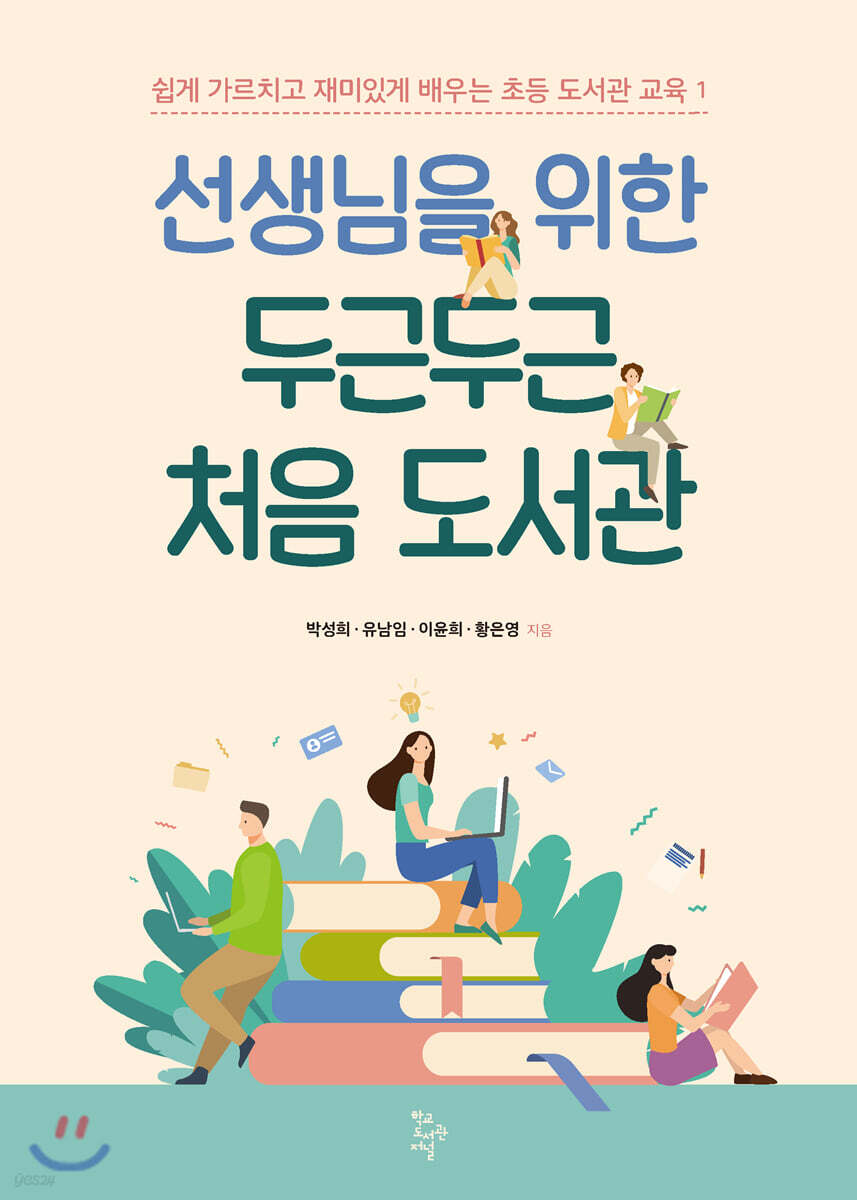
A thrilling first library for teachers
 |
Description
Book Introduction
A library education guide created by teacher librarians, carefully selecting the content essential for class, to provide direct assistance to those who must provide grade-level library education without textbooks or curricula.
We present systematic library education linked to the curriculum by examining what classes are offered by grade level and what classes are designed to develop children's information utilization and problem-solving skills.
We also introduce how to use the elementary school library education workbook, “Exciting First Library,” fun library activities, and a library education Q&A that answers questions new teachers have.
We present systematic library education linked to the curriculum by examining what classes are offered by grade level and what classes are designed to develop children's information utilization and problem-solving skills.
We also introduce how to use the elementary school library education workbook, “Exciting First Library,” fun library activities, and a library education Q&A that answers questions new teachers have.
index
Opening Remarks | Sharing Experience and Wisdom in Library Education
Chapter 1.
Knock knock, this is my first time at the school library.
The school library, the first venue for "democratic citizenship education."
? The school library has everything in the world.
? Learn it in first grade and use it until you're 100.
? A special meeting with children
What will you learn in the school library?
? Keywords for library education by grade level
Achievement standards by educational area
? Library Education Lesson Design
Chapter 2.
This is how library use education begins.
The first step toward establishing lifelong habits
What is a library? : Understanding libraries
How to Use the Library: Knowing Library Etiquette and Rules
Library etiquette that must be observed for everyone
? Understanding Library Rules
? Try borrowing and returning it yourself
There is important information on the book cover.
? Are there books like this in the school library?
Where can I find the books I want to read?
? Read the book cover
· You can also do these activities: Complete the book cover puzzle / Find commonalities
Library Blue Marble: Reviewing What You've Learned Through Board Games
· You can also do this activity: Reading event using Blue Marble
Chapter 3.
Library education that fosters information utilization skills
Introducing Our Library: Promoting Your Library
Open your heart with picture books
Library Golden Bell Quiz
? Let's promote our school library!
· You can also do this activity: Memorize the library spells!
Let's learn about the structure of the book.
? What is a book spine?
? Find commonalities
? Various belt designs
? Create a book introduction by making a badge
· You can also do these activities: I recommend this book
Look at the title page and copyright page
? You can find detailed information about the book.
? Try writing it according to the copyright notice
· You can also do this activity: Copyright game
There are rules for classifying books.
? Uncover the secrets of the books in the library.
? Understanding the decimal system easily
? Similar but slightly different numbers
· You can also do this activity: KDC Book Bingo
Let's learn about decimal system
? Find the classification number on the spine of the book.
How are call numbers created?
? Advanced Decimal Classification Activities
· You can also do this activity: Gather by topic
What is the difference between literature and non-literature?
Distinguishing between literature and non-literature
Reading expression activities suitable for literature and non-literature
? Thematic reading activities using literary picture books
Make a library treasure map
? Who is the dreaded pirate Dewey?
? Read and discuss picture books
? Looking back at KDC
- Become Pirate Dewey and Create Your Own Library Treasure Map
· You can also do this activity: Treasure hunt at the library
Research topics that interest you
? Call number that indicates the address of the book
? Try out the 4-step research activity
? Curriculum-linked research activities [Natural Science]
- Curriculum-linked research activities [Humanities]
- Individual research activities [autonomous topics]
Chapter 4.
Library Education Q&A
Closing Remarks | May the Library Be a Wonderful Treasure Island for Children
Appendix | List of Books by Subject, Linked to Grades 1-2
Family, seasons, various book shapes, library use, the joy of reading, holidays, respect for life,
Safety, Admission, Friends
Chapter 1.
Knock knock, this is my first time at the school library.
The school library, the first venue for "democratic citizenship education."
? The school library has everything in the world.
? Learn it in first grade and use it until you're 100.
? A special meeting with children
What will you learn in the school library?
? Keywords for library education by grade level
Achievement standards by educational area
? Library Education Lesson Design
Chapter 2.
This is how library use education begins.
The first step toward establishing lifelong habits
What is a library? : Understanding libraries
How to Use the Library: Knowing Library Etiquette and Rules
Library etiquette that must be observed for everyone
? Understanding Library Rules
? Try borrowing and returning it yourself
There is important information on the book cover.
? Are there books like this in the school library?
Where can I find the books I want to read?
? Read the book cover
· You can also do these activities: Complete the book cover puzzle / Find commonalities
Library Blue Marble: Reviewing What You've Learned Through Board Games
· You can also do this activity: Reading event using Blue Marble
Chapter 3.
Library education that fosters information utilization skills
Introducing Our Library: Promoting Your Library
Open your heart with picture books
Library Golden Bell Quiz
? Let's promote our school library!
· You can also do this activity: Memorize the library spells!
Let's learn about the structure of the book.
? What is a book spine?
? Find commonalities
? Various belt designs
? Create a book introduction by making a badge
· You can also do these activities: I recommend this book
Look at the title page and copyright page
? You can find detailed information about the book.
? Try writing it according to the copyright notice
· You can also do this activity: Copyright game
There are rules for classifying books.
? Uncover the secrets of the books in the library.
? Understanding the decimal system easily
? Similar but slightly different numbers
· You can also do this activity: KDC Book Bingo
Let's learn about decimal system
? Find the classification number on the spine of the book.
How are call numbers created?
? Advanced Decimal Classification Activities
· You can also do this activity: Gather by topic
What is the difference between literature and non-literature?
Distinguishing between literature and non-literature
Reading expression activities suitable for literature and non-literature
? Thematic reading activities using literary picture books
Make a library treasure map
? Who is the dreaded pirate Dewey?
? Read and discuss picture books
? Looking back at KDC
- Become Pirate Dewey and Create Your Own Library Treasure Map
· You can also do this activity: Treasure hunt at the library
Research topics that interest you
? Call number that indicates the address of the book
? Try out the 4-step research activity
? Curriculum-linked research activities [Natural Science]
- Curriculum-linked research activities [Humanities]
- Individual research activities [autonomous topics]
Chapter 4.
Library Education Q&A
Closing Remarks | May the Library Be a Wonderful Treasure Island for Children
Appendix | List of Books by Subject, Linked to Grades 1-2
Family, seasons, various book shapes, library use, the joy of reading, holidays, respect for life,
Safety, Admission, Friends
Detailed image

Into the book
This book began with the hope of helping new librarians who must begin grade-level library instruction without textbooks or curricula.
Senior librarians who have worked in school libraries for over 10 years have published a book containing the lessons and materials they have implemented through trial and error.
First, we discussed and organized what classes were taught by grade level and what classes were taught to develop children's information utilization and problem-solving skills.
Next, we selected class keywords for each grade level and created achievement standards based on those keywords, thereby establishing a system for library education.
For lower grades, keywords were selected to learn library use skills, while for upper grades, content was structured to learn research methods using the library.
--- p.5~6
If you are a teacher who is teaching a library class for the first time in a school library, you may feel overwhelmed by everything, including the structure and preparation of the class content.
While diverse motivational materials and engaging teaching methods are important, library education should focus on the special encounters with children that take place in the school library.
When teachers first consider how to operate the school library and set class goals to help children grow into creative democratic citizens, their teaching methodology will become more effective.
--- p.18~19
First-grade library education is also the first step in democratic citizenship education.
Knowing that you are the owner of the library, you actively use the library and follow the library rules to be considerate of others who use it.
Through these experiences, children learn the attitude and mindset of democratic citizens.
--- p.34
Second-grade library education is a stepping stone to information utilization, where students learn how to find and use necessary information on their own.
It is good for children to read books recommended by adults, but it is also very important for them to have the experience of finding books on their own that are related to their interests or that provide the necessary information, depending on their reading purpose.
A child's ability to utilize information grows as they recognize whether the purpose of reading is for enjoyment or problem solving, define what information is needed to solve the problem, access the necessary information, and go through the experience of obtaining information by determining whether it is useful to them.
--- p.58
While children may enjoy the ease of finding information online, elementary school children often struggle to sort through the vast amount of information to find verified, valid information, so research activities using books are recommended.
If you consistently research topics using books written by experts, it will help you learn more about the library and you will be able to utilize the library effectively by conducting your own research and exploration activities, knowing that the library has a wide range of materials on various topics.
--- p.129
Children learn library rules and etiquette, various information sources, and classification from the librarian.
Research topics of interest on your own, and if you can't do it alone, experience the process of planning and sharing with others.
Children who accumulate these experiences one by one will grow into information producers and users with proper civic consciousness.
To achieve this, school libraries and librarians must continuously stimulate children's curiosity and create an environment that allows them to express themselves in various ways.
--- p.151
The library is a place of enriching encounters and a creative space where new ideas and challenges are constantly emerging.
That is why the ‘school library’, which is the first library children encounter, is even more important.
The proper library use and information utilization education received at the school library gives children a lifelong friend in the library.
Senior librarians who have worked in school libraries for over 10 years have published a book containing the lessons and materials they have implemented through trial and error.
First, we discussed and organized what classes were taught by grade level and what classes were taught to develop children's information utilization and problem-solving skills.
Next, we selected class keywords for each grade level and created achievement standards based on those keywords, thereby establishing a system for library education.
For lower grades, keywords were selected to learn library use skills, while for upper grades, content was structured to learn research methods using the library.
--- p.5~6
If you are a teacher who is teaching a library class for the first time in a school library, you may feel overwhelmed by everything, including the structure and preparation of the class content.
While diverse motivational materials and engaging teaching methods are important, library education should focus on the special encounters with children that take place in the school library.
When teachers first consider how to operate the school library and set class goals to help children grow into creative democratic citizens, their teaching methodology will become more effective.
--- p.18~19
First-grade library education is also the first step in democratic citizenship education.
Knowing that you are the owner of the library, you actively use the library and follow the library rules to be considerate of others who use it.
Through these experiences, children learn the attitude and mindset of democratic citizens.
--- p.34
Second-grade library education is a stepping stone to information utilization, where students learn how to find and use necessary information on their own.
It is good for children to read books recommended by adults, but it is also very important for them to have the experience of finding books on their own that are related to their interests or that provide the necessary information, depending on their reading purpose.
A child's ability to utilize information grows as they recognize whether the purpose of reading is for enjoyment or problem solving, define what information is needed to solve the problem, access the necessary information, and go through the experience of obtaining information by determining whether it is useful to them.
--- p.58
While children may enjoy the ease of finding information online, elementary school children often struggle to sort through the vast amount of information to find verified, valid information, so research activities using books are recommended.
If you consistently research topics using books written by experts, it will help you learn more about the library and you will be able to utilize the library effectively by conducting your own research and exploration activities, knowing that the library has a wide range of materials on various topics.
--- p.129
Children learn library rules and etiquette, various information sources, and classification from the librarian.
Research topics of interest on your own, and if you can't do it alone, experience the process of planning and sharing with others.
Children who accumulate these experiences one by one will grow into information producers and users with proper civic consciousness.
To achieve this, school libraries and librarians must continuously stimulate children's curiosity and create an environment that allows them to express themselves in various ways.
--- p.151
The library is a place of enriching encounters and a creative space where new ideas and challenges are constantly emerging.
That is why the ‘school library’, which is the first library children encounter, is even more important.
The proper library use and information utilization education received at the school library gives children a lifelong friend in the library.
--- p.152
Publisher's Review
Sharing experiences and know-how in library education
This book contains lessons and materials that have been implemented through trial and error by school librarians who have worked in school libraries for over 10 years.
Most school librarians, who are in charge of school libraries on a one-person basis and are responsible for library education for all grades, often struggle in the educational field.
Four teachers who had shared similar concerns gathered together to connect their experiences and share the results of their efforts, taking the first step toward laying the foundation for elementary school library education.
Beyond simply sharing class content, they sought to establish a system for elementary library education based on various research materials and school experiences.
What and how should school libraries teach?
When you first become a teacher-librarian and try to plan your lessons, you will often find yourself feeling overwhelmed.
This is because, in a situation where there is no senior teacher to advise on the work or class preparation and operation, it is difficult and confusing to know not only how to run the library but also what content to teach.
This book focuses on the content and methods of library use and information utilization education for first and second graders, and also provides specific answers to the questions that librarians frequently ask.
How to use the workbook to learn in a fun way with various activities and games
We introduce lesson plans and various activities appropriate for each grade level so that first and second graders who are using the school library for the first time can participate in classes in a fun way.
In particular, the use of the elementary school library education workbook 『Exciting First Library』 (written by Park Seong-hee, Yoo Nam-im, Lee Yun-hee, and Hwang Eun-young, published by School Library Journal) planned together with this book was covered in detail from the teacher's perspective so that it can be applied directly to classes.
Through library education, children will become lifelong friends with books, and through books they will develop their dreams and grow.
List of books by subject related to the 1st and 2nd grade curriculum
We have carefully selected and introduced books that are good to read with children for each library education period, and included a list of books by subject related to the 1st and 2nd grade curriculum as an appendix.
We have organized related subjects and units by topic, such as family, seasons, various book shapes, library use, the joy of reading, holidays, respect for life, safety, admission, and friends, to increase class utilization.
This book contains lessons and materials that have been implemented through trial and error by school librarians who have worked in school libraries for over 10 years.
Most school librarians, who are in charge of school libraries on a one-person basis and are responsible for library education for all grades, often struggle in the educational field.
Four teachers who had shared similar concerns gathered together to connect their experiences and share the results of their efforts, taking the first step toward laying the foundation for elementary school library education.
Beyond simply sharing class content, they sought to establish a system for elementary library education based on various research materials and school experiences.
What and how should school libraries teach?
When you first become a teacher-librarian and try to plan your lessons, you will often find yourself feeling overwhelmed.
This is because, in a situation where there is no senior teacher to advise on the work or class preparation and operation, it is difficult and confusing to know not only how to run the library but also what content to teach.
This book focuses on the content and methods of library use and information utilization education for first and second graders, and also provides specific answers to the questions that librarians frequently ask.
How to use the workbook to learn in a fun way with various activities and games
We introduce lesson plans and various activities appropriate for each grade level so that first and second graders who are using the school library for the first time can participate in classes in a fun way.
In particular, the use of the elementary school library education workbook 『Exciting First Library』 (written by Park Seong-hee, Yoo Nam-im, Lee Yun-hee, and Hwang Eun-young, published by School Library Journal) planned together with this book was covered in detail from the teacher's perspective so that it can be applied directly to classes.
Through library education, children will become lifelong friends with books, and through books they will develop their dreams and grow.
List of books by subject related to the 1st and 2nd grade curriculum
We have carefully selected and introduced books that are good to read with children for each library education period, and included a list of books by subject related to the 1st and 2nd grade curriculum as an appendix.
We have organized related subjects and units by topic, such as family, seasons, various book shapes, library use, the joy of reading, holidays, respect for life, safety, admission, and friends, to increase class utilization.
GOODS SPECIFICS
- Date of issue: May 4, 2020
- Page count, weight, size: 168 pages | 296g | 152*210*20mm
- ISBN13: 9788969150790
- ISBN10: 896915079X
You may also like
카테고리
korean


korean

![GQ KOREA Mark (Monthly): December [2025]](http://librairie.coreenne.fr/cdn/shop/files/8ef265dbbfbf186523ed75ba7319009d.jpg?v=1765340328&width=3840)


