

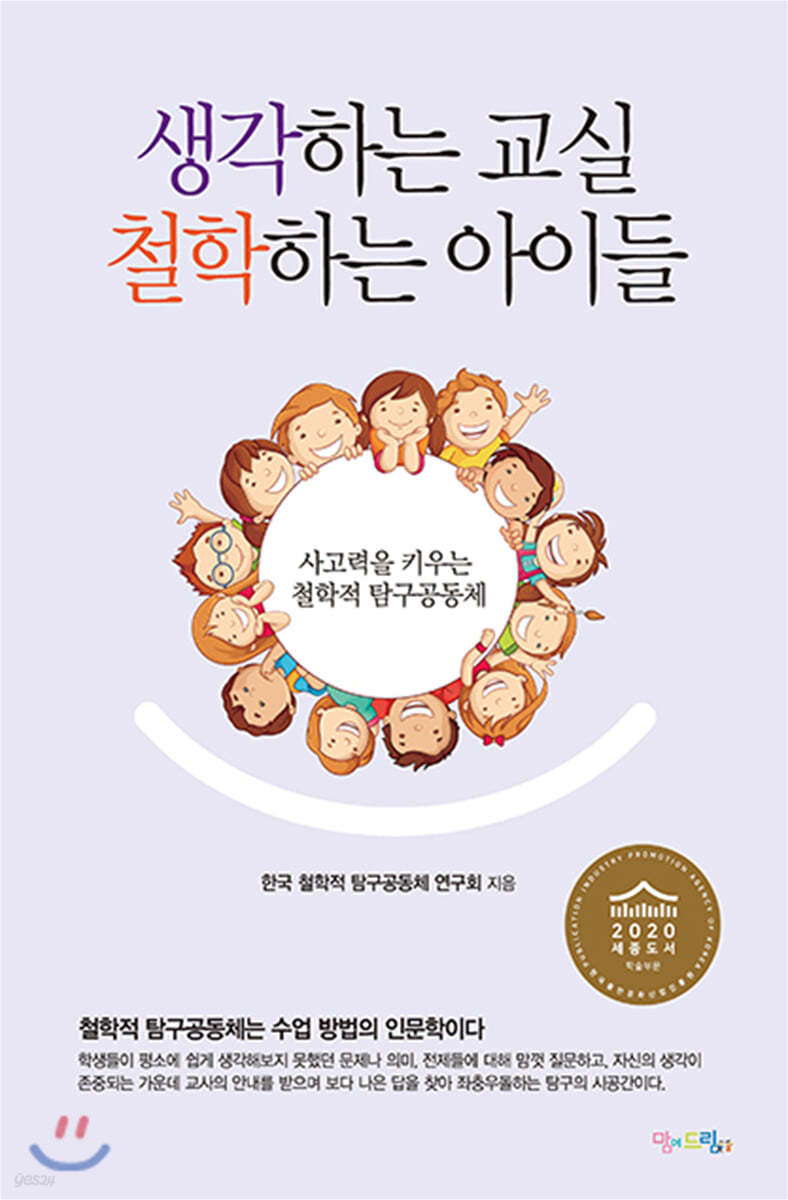
Thinking Classroom, Philosophizing Children
 |
Description
Book Introduction
The power of children's philosophy
Is it possible for children from kindergarten through high school to develop abstract thinking skills through school classes? As Matthew Lipman, a pioneer in children's philosophy, noted, it's common sense that young children, just beginning their education in kindergarten, are brimming with liveliness, curiosity, imagination, and inquisitiveness.
This book is the first joint work of the Korean Philosophical Inquiry Community Research Group, which aims to develop children's philosophical abilities and multidimensional thinking skills.
It contains both philosophical understanding and practical examples of classroom practice.
Philosophy is derived from an ancient Greek word meaning the love of wisdom. It does not refer to a certain academic discipline, but rather to philosophizing, that is, the act of loving wisdom, and striving to understand nature and society and solve problems.
Is it possible for children from kindergarten through high school to develop abstract thinking skills through school classes? As Matthew Lipman, a pioneer in children's philosophy, noted, it's common sense that young children, just beginning their education in kindergarten, are brimming with liveliness, curiosity, imagination, and inquisitiveness.
This book is the first joint work of the Korean Philosophical Inquiry Community Research Group, which aims to develop children's philosophical abilities and multidimensional thinking skills.
It contains both philosophical understanding and practical examples of classroom practice.
Philosophy is derived from an ancient Greek word meaning the love of wisdom. It does not refer to a certain academic discipline, but rather to philosophizing, that is, the act of loving wisdom, and striving to understand nature and society and solve problems.
- You can preview some of the book's contents.
Preview
index
preface
Part 1.
Understanding the Community of Philosophical Inquiry
What is a Philosophical Inquiry Community Class?
Is a community of philosophical inquiry possible in all subjects?
How does multidimensional thinking work?
Part 2.
A class where curiosity becomes questions, and questions become philosophy.
Is this world a theater stage?
Should we sacrifice private interests for the public good?
How to become a beautiful person?
Is it okay to break one rule to keep another?
Is it okay to break one rule to keep another? Reviewing the lesson
Part 3.
A class that explores and grows through thought
The Unbearable Lightness of Being: My Lecture: Family
A word exploration that goes as far as it can go
If you think about it! Do you want to become a social being?
An Exploration of the Nonviolence of Violence and the Violence of Nonviolence
Exploring the Basis of Action: My Will, the Will of the Brain
The Unbearable Lightness of Being: A Look Back at My "Home Economics" Class
Part 4.
A class where the story changes depending on the context
We in a world that only wants to dominate science and technology
An open society that tolerates differences and a community of philosophical inquiry
A literature class that explores the "unsaid" beyond the "said."
A look back at a literature class that explores the "unsaid" beyond the "said."
References
Part 1.
Understanding the Community of Philosophical Inquiry
What is a Philosophical Inquiry Community Class?
Is a community of philosophical inquiry possible in all subjects?
How does multidimensional thinking work?
Part 2.
A class where curiosity becomes questions, and questions become philosophy.
Is this world a theater stage?
Should we sacrifice private interests for the public good?
How to become a beautiful person?
Is it okay to break one rule to keep another?
Is it okay to break one rule to keep another? Reviewing the lesson
Part 3.
A class that explores and grows through thought
The Unbearable Lightness of Being: My Lecture: Family
A word exploration that goes as far as it can go
If you think about it! Do you want to become a social being?
An Exploration of the Nonviolence of Violence and the Violence of Nonviolence
Exploring the Basis of Action: My Will, the Will of the Brain
The Unbearable Lightness of Being: A Look Back at My "Home Economics" Class
Part 4.
A class where the story changes depending on the context
We in a world that only wants to dominate science and technology
An open society that tolerates differences and a community of philosophical inquiry
A literature class that explores the "unsaid" beyond the "said."
A look back at a literature class that explores the "unsaid" beyond the "said."
References
Into the book
It should be noted that the discussions on future capabilities presented above are centered around business and economic experts.
If we approach it solely from the perspective of human development, that is, without philosophy, we risk reductionism, homogenization, competition, the gap between rich and poor, and environmental destruction in regard to humans, society, and their unique capacities.
That is why we need the humanities and a philosophical approach to reflection is essential.
--- p.15
Let's summarize.
Philosophy asks questions.
Philosophy questions important concepts.
Philosophy questions the essential meaning (origin, premise, etc.).
Philosophy questions values.
Philosophy questions the process of thought.
Philosophy asks questions again about the answer.
Because philosophy is often controversial, both questions and answers are open-ended.
--- p.30
Studying should not be a means to external success, but rather its purpose should be self-reflection and a deep understanding of life and society.
However, most classes often lose this sense of purpose.
The philosophical approach is concerned with this fundamental sense of purpose.
This is why teachers need to think philosophically and why children need to think philosophically in their classes.
--- pp.47-48
Critical thinking, creative thinking, and considerate thinking work together in inquiry, and making sound judgments through this multidimensional thinking is what makes us good thinkers and good thinkers.
To be able to think multidimensionally, community exploration must occur actively and frequently, and appropriate thinking skills must be applied during the exploration process.
The role of the inquiry community can also be said to be a place where each person's thinking can be trained to become a high-level skill.
As the community explores, questions are asked, discussions are held, and in-depth activities are conducted, each thought develops into a skill and, furthermore, the capacity to become a democratic citizen is acquired.
Teachers must play an appropriate role to ensure that inquiry proceeds smoothly, and students must also manage each thought well so that it becomes embedded into skills for successful inquiry.
--- p.68
Through this process, the question to be explored (topic of discussion) was decided as, “Is this world a theater stage?”
And the remaining questions that were not selected at this time were decided to be dealt with separately later.
This one-sentence question, 'Is this world a theater stage?', was selected and refined through a considerable process of discussion.
In other words, it is a ‘product of deliberation’ that has gone through a process of inquiry into the question.
--- p.90
Sartre does not end with simply defining ‘the other as hell.’
It emphasizes that each person is responsible for his or her own choices as a free agent.
There are philosophers who, compared to Sartre, advocate a philosophy of hospitality that embraces others more actively.
His name is Emmanuel Levinas.
I emphasized that it is justice to hear his pain and screams through the 'face of the other' that I am now facing, and to accept and 'welcome' him.
--- p.125
In cases like this, where the meaning of the question needs to be explored, it may mean that the question is a difficult problem to answer, that is, an aporia.
The difficulty is one factor that makes our inquiry a philosophical inquiry.
Such situations may be more effective in stimulating motivation for inquiry, such as intellectual curiosity.
If we could immediately think of our own answers when we heard the questions, we might not feel the need for further discussion.
--- pp.151-152
I learned that in order for children to think for themselves, make judgments, and modify their own behavior, and to make their own decisions about behavioral changes and practices, they need to go through a process of thinking, talking, sharing opinions with other friends, exploring, and self-correction.
--- p.180
But, as time passed, I kept thinking about the discussions in the philosophical inquiry community.
1. We create the problem, 2.
Think about that problem, 3.
The class that sought to find the answer to that question was exactly the class I wanted.
--- p.219
We refined the questions to focus on what should be discussed in the overall question.
The question refinement was carried out in three stages.
First, what are the core terms of the question? Second, what is the higher-level value of the question? Third, what are the core issues? The overall question posed for the exhibition was, "Are Gyeongtae's survival rules truly survival rules?"
Here, students talked about the key term being survival.
The students then said that the higher value was violence.
Finally, the core issue was resolved to the question, 'Is violence for survival justifiable?'
--- p.240
The children basically responded that they were more focused and participated more enjoyably than in lecture-style classes, and most of all, they enjoyed being able to hear various stories from their friends.
In this process, some students expanded their existing ideas through self-corrective thinking, while others came up with completely new ideas.
Also, as can be seen in Yunhee's reflections, there were students who clearly recognized how serious a problem plastic waste is in society, and many students realized that plastic can be separated and collected, even though they thought it was disposable.
If we approach it solely from the perspective of human development, that is, without philosophy, we risk reductionism, homogenization, competition, the gap between rich and poor, and environmental destruction in regard to humans, society, and their unique capacities.
That is why we need the humanities and a philosophical approach to reflection is essential.
--- p.15
Let's summarize.
Philosophy asks questions.
Philosophy questions important concepts.
Philosophy questions the essential meaning (origin, premise, etc.).
Philosophy questions values.
Philosophy questions the process of thought.
Philosophy asks questions again about the answer.
Because philosophy is often controversial, both questions and answers are open-ended.
--- p.30
Studying should not be a means to external success, but rather its purpose should be self-reflection and a deep understanding of life and society.
However, most classes often lose this sense of purpose.
The philosophical approach is concerned with this fundamental sense of purpose.
This is why teachers need to think philosophically and why children need to think philosophically in their classes.
--- pp.47-48
Critical thinking, creative thinking, and considerate thinking work together in inquiry, and making sound judgments through this multidimensional thinking is what makes us good thinkers and good thinkers.
To be able to think multidimensionally, community exploration must occur actively and frequently, and appropriate thinking skills must be applied during the exploration process.
The role of the inquiry community can also be said to be a place where each person's thinking can be trained to become a high-level skill.
As the community explores, questions are asked, discussions are held, and in-depth activities are conducted, each thought develops into a skill and, furthermore, the capacity to become a democratic citizen is acquired.
Teachers must play an appropriate role to ensure that inquiry proceeds smoothly, and students must also manage each thought well so that it becomes embedded into skills for successful inquiry.
--- p.68
Through this process, the question to be explored (topic of discussion) was decided as, “Is this world a theater stage?”
And the remaining questions that were not selected at this time were decided to be dealt with separately later.
This one-sentence question, 'Is this world a theater stage?', was selected and refined through a considerable process of discussion.
In other words, it is a ‘product of deliberation’ that has gone through a process of inquiry into the question.
--- p.90
Sartre does not end with simply defining ‘the other as hell.’
It emphasizes that each person is responsible for his or her own choices as a free agent.
There are philosophers who, compared to Sartre, advocate a philosophy of hospitality that embraces others more actively.
His name is Emmanuel Levinas.
I emphasized that it is justice to hear his pain and screams through the 'face of the other' that I am now facing, and to accept and 'welcome' him.
--- p.125
In cases like this, where the meaning of the question needs to be explored, it may mean that the question is a difficult problem to answer, that is, an aporia.
The difficulty is one factor that makes our inquiry a philosophical inquiry.
Such situations may be more effective in stimulating motivation for inquiry, such as intellectual curiosity.
If we could immediately think of our own answers when we heard the questions, we might not feel the need for further discussion.
--- pp.151-152
I learned that in order for children to think for themselves, make judgments, and modify their own behavior, and to make their own decisions about behavioral changes and practices, they need to go through a process of thinking, talking, sharing opinions with other friends, exploring, and self-correction.
--- p.180
But, as time passed, I kept thinking about the discussions in the philosophical inquiry community.
1. We create the problem, 2.
Think about that problem, 3.
The class that sought to find the answer to that question was exactly the class I wanted.
--- p.219
We refined the questions to focus on what should be discussed in the overall question.
The question refinement was carried out in three stages.
First, what are the core terms of the question? Second, what is the higher-level value of the question? Third, what are the core issues? The overall question posed for the exhibition was, "Are Gyeongtae's survival rules truly survival rules?"
Here, students talked about the key term being survival.
The students then said that the higher value was violence.
Finally, the core issue was resolved to the question, 'Is violence for survival justifiable?'
--- p.240
The children basically responded that they were more focused and participated more enjoyably than in lecture-style classes, and most of all, they enjoyed being able to hear various stories from their friends.
In this process, some students expanded their existing ideas through self-corrective thinking, while others came up with completely new ideas.
Also, as can be seen in Yunhee's reflections, there were students who clearly recognized how serious a problem plastic waste is in society, and many students realized that plastic can be separated and collected, even though they thought it was disposable.
--- p.280
Publisher's Review
Questions and Inquiry: The Beginning of All Philosophical Thought
At the foundation of all learning and discipline is philosophy.
So how can we challenge philosophizing? How can we begin to philosophize? That's the question.
Questions allow us to question things, phenomena, or ourselves, and transform that curiosity into a collaborative exploration within the community.
As mentioned in this book, questions like “What is it?”, “Why?”, and “What should I do?” and the passion for asking them open our minds and lead us to explore the answers.
And for exploration, we absolutely need a community that respects each other, listens to us, critiques us, and helps us self-correct.
These communities of inquiry approach fundamental questions about nature and humanity through continuous questioning and dialogue between teachers and children.
Core Competencies and Multidimensional Thinking
Competency-based education is receiving great attention worldwide.
This is the same in our country.
There still seems to be a lack of clear logic regarding what competency-based education is and how it relates to the curriculum.
Nonetheless, the OECD's DeCeCo, the World Economic Forum's 4Cs, and the six core competencies of the 2015 revised curriculum created by the Ministry of Education reflect this trend.
The six core competencies developed by the Ministry of Education function very similarly to the multidimensional thinking (creative thinking, critical thinking, and considerate thinking) pursued by the philosophical inquiry community.
Taking this into account, this book emphasizes that in order to cultivate core competencies in a subject, lesson design must be based on multidimensional thinking.
Moreover, in a pluralistic reality, multidimensional thinking can help foster public reason and discussion as the core of deliberative democracy, helping children develop the qualities of democratic citizens and grow into worthy citizens.
At the foundation of all learning and discipline is philosophy.
So how can we challenge philosophizing? How can we begin to philosophize? That's the question.
Questions allow us to question things, phenomena, or ourselves, and transform that curiosity into a collaborative exploration within the community.
As mentioned in this book, questions like “What is it?”, “Why?”, and “What should I do?” and the passion for asking them open our minds and lead us to explore the answers.
And for exploration, we absolutely need a community that respects each other, listens to us, critiques us, and helps us self-correct.
These communities of inquiry approach fundamental questions about nature and humanity through continuous questioning and dialogue between teachers and children.
Core Competencies and Multidimensional Thinking
Competency-based education is receiving great attention worldwide.
This is the same in our country.
There still seems to be a lack of clear logic regarding what competency-based education is and how it relates to the curriculum.
Nonetheless, the OECD's DeCeCo, the World Economic Forum's 4Cs, and the six core competencies of the 2015 revised curriculum created by the Ministry of Education reflect this trend.
The six core competencies developed by the Ministry of Education function very similarly to the multidimensional thinking (creative thinking, critical thinking, and considerate thinking) pursued by the philosophical inquiry community.
Taking this into account, this book emphasizes that in order to cultivate core competencies in a subject, lesson design must be based on multidimensional thinking.
Moreover, in a pluralistic reality, multidimensional thinking can help foster public reason and discussion as the core of deliberative democracy, helping children develop the qualities of democratic citizens and grow into worthy citizens.
GOODS SPECIFICS
- Date of issue: July 19, 2019
- Page count, weight, size: 344 pages | 522g | 153*224*22mm
- ISBN13: 9791189404222
- ISBN10: 1189404222
You may also like
카테고리
korean


korean

![GQ KOREA Mark (Monthly): December [2025]](http://librairie.coreenne.fr/cdn/shop/files/8ef265dbbfbf186523ed75ba7319009d.jpg?v=1765340328&width=3840)


