

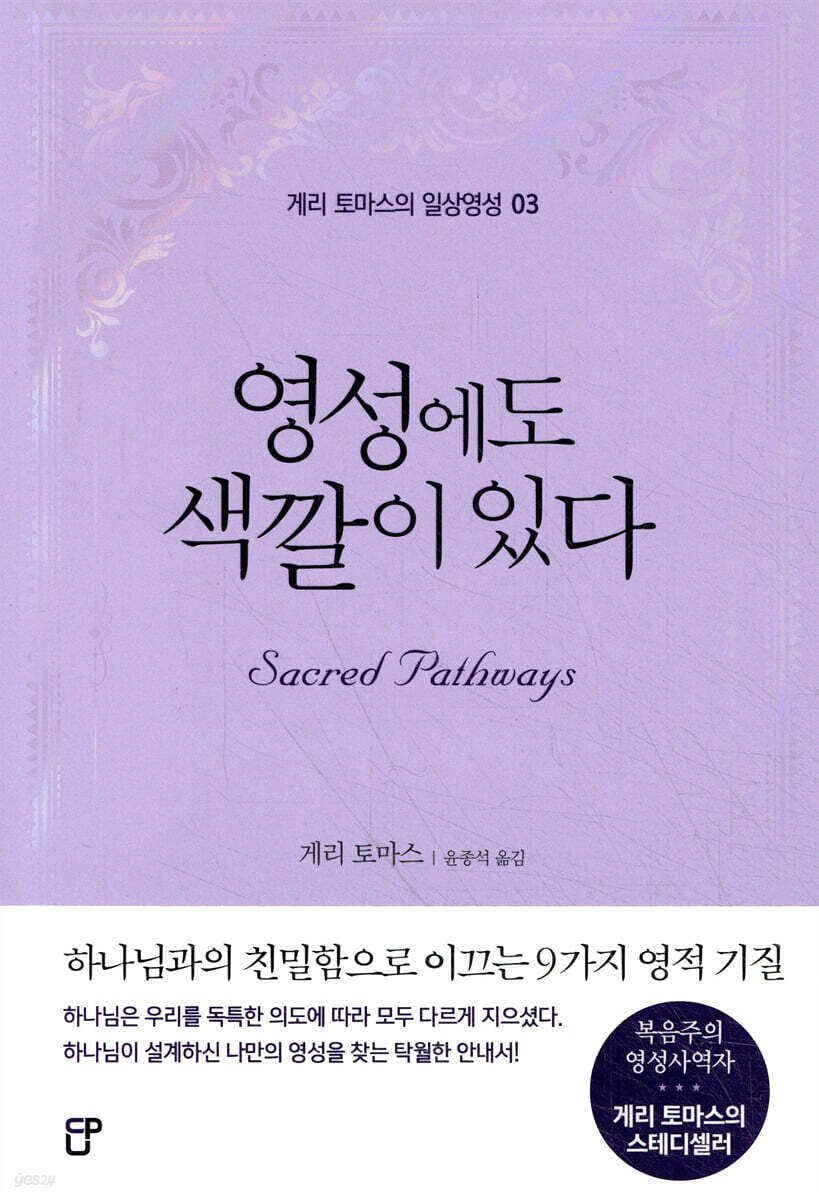
Spirituality also has colors
 |
Description
Book Introduction
Nine Spiritual Dispositions That Lead to Intimacy with God
God created us all differently with unique intentions.
A steady seller by evangelical spiritual minister Gary Thomas
* How to find your own spirituality designed by God
Some Christians spend hours in silent prayer without much difficulty.
Just being around them makes you wish you were like that.
There are people who are much better at expressing God's love in a practical way or standing up for God's kingdom.
Why can't you be like them? Because the design is different. Gary Thomas guides you through the frustrations of standardized spirituality and onto a path of worship that allows you to become truly yourself.
This book breaks down many of the barriers that keep Christians confined to rigid worship and praise practices.
The nine categories of spirituality serve as a guide to intimacy with God, based on examples from the Bible and practical experiences.
The goal of this book is to help you understand the Holy Spirit we receive from God.
Good faith counselors don't try to fix people.
They enter into God's presence, stripping away the deceptions and confusion of sin and self, and giving the Holy Spirit the opportunity to work freely.
That's what this book attempts to do.
You may be a naturalist spirituality, with prayer and praise welling up within you as you walk along a forest path or take in the beauty of the winding mountain slopes.
Or it could be an activist spirituality where representing God's way becomes food and drink.
Whatever spirituality or blend of spiritualities is closest to you, rest assured that it is not a coincidence.
It is the Creator's design.
Didn't He create you with His unique purpose, knowing full well that you would be? If your faith journey doesn't seem to be what you want, you can start now to change it.
This book will show you the spiritual path you were created to walk.
That path is the path of growth and abundance, a path of walking closely with God.
God created us all differently with unique intentions.
A steady seller by evangelical spiritual minister Gary Thomas
* How to find your own spirituality designed by God
Some Christians spend hours in silent prayer without much difficulty.
Just being around them makes you wish you were like that.
There are people who are much better at expressing God's love in a practical way or standing up for God's kingdom.
Why can't you be like them? Because the design is different. Gary Thomas guides you through the frustrations of standardized spirituality and onto a path of worship that allows you to become truly yourself.
This book breaks down many of the barriers that keep Christians confined to rigid worship and praise practices.
The nine categories of spirituality serve as a guide to intimacy with God, based on examples from the Bible and practical experiences.
The goal of this book is to help you understand the Holy Spirit we receive from God.
Good faith counselors don't try to fix people.
They enter into God's presence, stripping away the deceptions and confusion of sin and self, and giving the Holy Spirit the opportunity to work freely.
That's what this book attempts to do.
You may be a naturalist spirituality, with prayer and praise welling up within you as you walk along a forest path or take in the beauty of the winding mountain slopes.
Or it could be an activist spirituality where representing God's way becomes food and drink.
Whatever spirituality or blend of spiritualities is closest to you, rest assured that it is not a coincidence.
It is the Creator's design.
Didn't He create you with His unique purpose, knowing full well that you would be? If your faith journey doesn't seem to be what you want, you can start now to change it.
This book will show you the spiritual path you were created to walk.
That path is the path of growth and abundance, a path of walking closely with God.
- You can preview some of the book's contents.
Preview
index
Recommendation
Part 1: The Path to Spirituality
God's way of loving
Part 2: The Nine Colors of Spirituality
1.
Naturalistic Spirituality - Loving God Outdoors
2.
Sensual Spirituality: Loving God with All Your Senses
3.
Traditionalist Spirituality: Loving God Through Ritual and Symbol
4.
Ascetic Spirituality: Loving God in Solitude and Simplicity
5.
Activist Spirituality: Loving God Through Participation and Confrontation
6.
The Spirit of Philanthropy: Loving God by Loving Your Neighbor
7.
Passionate Spirituality: Loving God with Mystery and Celebration
8.
Contemplative Spirituality - Loving God with Longing
9.
Intellectual Spirituality - Loving God with Thought
Part 3: Finding My Spirituality Designed by God
Gardening the Soul
Part 1: The Path to Spirituality
God's way of loving
Part 2: The Nine Colors of Spirituality
1.
Naturalistic Spirituality - Loving God Outdoors
2.
Sensual Spirituality: Loving God with All Your Senses
3.
Traditionalist Spirituality: Loving God Through Ritual and Symbol
4.
Ascetic Spirituality: Loving God in Solitude and Simplicity
5.
Activist Spirituality: Loving God Through Participation and Confrontation
6.
The Spirit of Philanthropy: Loving God by Loving Your Neighbor
7.
Passionate Spirituality: Loving God with Mystery and Celebration
8.
Contemplative Spirituality - Loving God with Longing
9.
Intellectual Spirituality - Loving God with Thought
Part 3: Finding My Spirituality Designed by God
Gardening the Soul
Detailed image

Into the book
I have found that many people face the same dilemma in their relationship with God.
That doesn't mean that our love for God has become blurred.
It's just that I've become so caught up in the hamster wheel of life that my soul has become numb.
Their religious life seems to be nothing more than a habit ingrained in them over many years.
I've been doing the same work for so long that I can practically do it while sleeping.
It seems that no one in their small group has had an original idea in the past three years.
Finally, one morning they wake up and ask:
“Is this really all there is to knowing God?”
--- p.24
What is "spirituality"? Simply put, it refers to the way we relate to God, the way we grow closer to Him.
Is there only one way? Not necessarily.
But most of us naturally approach God according to a certain inclination.
That is each person's distinctive spiritual temperament.
--- p.36
The 'ideal' Christian may exhibit many, if not all, spiritual qualities.
As we examine each temperament in detail, I have chosen Jesus as the model for all temperaments.
Regardless of our own distinctive spiritual dispositions, we can all learn much from how others receive nourishment from God and how they encounter and love God.
--- p.49
By understanding our spiritual temperament, we can develop the tools we need to grow spiritually.
Of course, the tool is different for each person.
A ten-year-old girl who loves to sing and draw for Jesus cannot possibly relate to God in a way that is different from a builder who spends 10 to 12 hours a day trying to make building a house a Christian.
--- p.51
Luther said that the miracles that abound in nature can only be seen with the 'eyes of faith.'
He believed that the miracles of nature were greater than the miracles of the sacraments.
He says that if we just know the growth of a single grain of wheat, we can be breathtaking in its wonder.
--- p.72
Instead of living in a vast museum of spiritual opportunity, we evangelical Christians have confined ourselves to a narrow corner of our room.
That doesn't mean that our love for God has become blurred.
It's just that I've become so caught up in the hamster wheel of life that my soul has become numb.
Their religious life seems to be nothing more than a habit ingrained in them over many years.
I've been doing the same work for so long that I can practically do it while sleeping.
It seems that no one in their small group has had an original idea in the past three years.
Finally, one morning they wake up and ask:
“Is this really all there is to knowing God?”
--- p.24
What is "spirituality"? Simply put, it refers to the way we relate to God, the way we grow closer to Him.
Is there only one way? Not necessarily.
But most of us naturally approach God according to a certain inclination.
That is each person's distinctive spiritual temperament.
--- p.36
The 'ideal' Christian may exhibit many, if not all, spiritual qualities.
As we examine each temperament in detail, I have chosen Jesus as the model for all temperaments.
Regardless of our own distinctive spiritual dispositions, we can all learn much from how others receive nourishment from God and how they encounter and love God.
--- p.49
By understanding our spiritual temperament, we can develop the tools we need to grow spiritually.
Of course, the tool is different for each person.
A ten-year-old girl who loves to sing and draw for Jesus cannot possibly relate to God in a way that is different from a builder who spends 10 to 12 hours a day trying to make building a house a Christian.
--- p.51
Luther said that the miracles that abound in nature can only be seen with the 'eyes of faith.'
He believed that the miracles of nature were greater than the miracles of the sacraments.
He says that if we just know the growth of a single grain of wheat, we can be breathtaking in its wonder.
--- p.72
Instead of living in a vast museum of spiritual opportunity, we evangelical Christians have confined ourselves to a narrow corner of our room.
--- p.93
Publisher's Review
Nine Spiritualities
1.
Naturalistic Spirituality: Loving God Outdoors
No matter how beautiful or simple the building, naturalists prefer to go outside and pray to God by the river.
When dealing with them, close the book.
There's no need to show an example.
Just let me walk in the forest, on the mountain, or in a wide field.
2.
Sensual Spirituality: Loving God with All Five Senses
Sensationalists want to be immersed in the majesty, beauty, and splendor of God.
They are particularly drawn to ritual worship and the solemn and majestic.
These Christians want to be immersed in visuals, sounds, and smells when they worship.
Incense, elaborate architecture, classical music, and formal language elevate their spirits.
3.
Traditionalist Spirituality: Loving God Through Ritual and Symbol
Traditionalists often draw their nourishment from things that belong to the historical dimension of faith: rituals, symbols, sacraments, and sacrifices.
These Christians tend to have a disciplined religious life.
Usually, they like to attend regular church services, pay tithes, and keep the Sabbath.
4.
Ascetic Spirituality: Loving God in Solitude and Simplicity
Ascetics desire nothing more than to be left alone and pray.
When dealing with them, put aside all rituals, religious attachments, and the noise of the outside world.
Clear away all distractions - no pictures, no loud music - and let yourself pray in simplicity.
5.
Activist Spirituality: Loving God Through Participation and Confrontation
Activists serve a God of justice.
Their favorite Bible verse is often the account of Jesus cleansing the temple.
Worship, as they define it, is about confronting evil and calling sinners to repentance.
These Christians often see the church as a place to recharge before going out into the world again to fight injustice.
6.
Philanthropic Spirituality: Loving God by Loving Your Neighbor
Philanthropists serve God by serving others.
They often confess that they see Christ in the poor and the wretched.
They are built on relationships with others.
While caring for others can be tiring for most people, for philanthropists it can be recharging.
7.
Passionate Spirituality: Loving God with Mystery and Festival
The spiritual life of the enthusiasts is the excitement and mystery of worship.
Just as the sensualist wants to be surrounded by beauty and the intellectualist wants to wrestle with concepts, the passionateist is thrilled by a joyful festival.
These Christians are the cheerleaders for God and the Christian life.
8.
Contemplative Spirituality: Loving God with Longing
Contemplatives refer to God as a lover.
The images of a loving father and groom dominate their view of God.
The Song of Solomon, which is a 'holy romance', may be their favorite Bible text.
These Christians want to love God with the purest, deepest, and brightest love in the world.
9.
Intellectual Spirituality: Loving God with Your Thoughts
Intellectuals may be skeptics or committed believers, but in either case, they often study doctrines such as Calvinism, infant baptism, female ordination, and predestination.
For them, ‘faith’ is an object of understanding as much as an experience.
They can feel closest to God when they realize something new about Him.
→A complete Christian is someone who possesses all nine spiritual qualities.
The purpose of this book is to help you understand your own spirituality and develop it more effectively, as well as to develop the areas you lack so that you can love God more holistically.
Discover the spirituality designed by God
It offers a path to spiritual recharge that won't be exhausted even in your 80s.
“Spirituality Has Color” is a book that opens up new horizons on spirituality.
Author Gary Thomas compellingly illustrates the many ways we can grow closer to God and serve and love Him.
He introduces nine different paths of spirituality and encourages you to discover the spiritual path that suits your own color as designed by God.
Each chapter includes a checklist to help you discover your own spirituality, and a score for each spirituality helps you understand your spiritual temperament.
Understanding your own spirituality can help you connect more intimately with God and discover a path to spiritual recharge that won't be depleted even in your 70s or 80s.
In particular, spiritual leaders will be able to break free from the standardized framework of "spiritual care" and develop spiritual discernment that recognizes each person's differences, thereby adding dynamism and vitality to healthy communities.
This book shows that each person can reach a turning point in their spirituality depending on their experience and growth in faith.
For example, one may initially start out with an ascetic spirituality, but then, at a special moment, one's intellectual spirituality may become stronger, and then one may transition back to a contemplative spirituality.
According to the author, a perfect Christian is someone who possesses all nine spiritual qualities, and the perfect model is Jesus Christ.
《Spirituality Has Colors》 is a full-color book with a harmonious blend of illustrations and content.
As Pastor Seong-gyeong Seong said in his review of this book, “I was so overcome with spiritual ecstasy that it felt as if I had just walked with the Lord through a garden of colorful flowers,” this book is an engaging book that makes you feel as if you are traveling through the beautiful and vast world of spirituality with its excellent sense of language.
A must-read for all Christians who desire a holistic and intimate encounter with God and who wish to better understand others.
Opinion Leader's Book Review
*Not everyone needs to love God in the same way.
- Song Eun-ju (Book Curator)
The question of 'fruit' is probably a topic that many Christians have questioned at least once.
If we attain salvation through faith and the Holy Spirit is poured out upon us simultaneously, isn't it a natural Christian principle that, just as branches bear fruit from the tree, the fruit of the Spirit will be borne in our lives? So why do so many Christians still feel discouraged by the lack of fruit in their lives, face ridicule from the world for their faulty fruit, and even within the Christian community, factions split and question each other's faith?
What Christian truths must we hold on to, and to what extent should we acknowledge the individual gifts and roles of each member?
In that sense, this book deals with the ‘diversity of Christians’ more than any other book.
The author assumes that while there is certainly one way to salvation, there can be different ways to worship and adore God.
It is rather strange that God created each person differently, yet the way we worship and relate to him must all be the same.
The basis of this premise was analyzed through biblical figures who met and worshipped God in different times and backgrounds, and their spiritual temperaments were classified into nine types.
For example, for those who find regular QT in a small group difficult, it is pointed out that a one-hour walk on a quiet path can be much more beneficial for communing with God (naturalistic spirituality).
Some people may enjoy absolutely outstanding art and realize the relative futility of human life and the greatness of God (sensationalist spirituality).
Even with regard to various Christian symbols, it is clear that what is distorted is the way the symbols are used, not the symbols themselves (traditionalist spirituality).
What about the case of contemplative spirituality, which can easily flow into mystery?
The author says that this too can be a valuable channel for maintaining a relationship with God if we focus on a yearning heart rather than a mystical experience and appropriately combine 'active meditation' and 'infused meditation.'
In each chapter, the author delves into the characteristics and various aspects of each of the nine temperaments, while also advising us to be careful about the temptations and distorted forms that each temperament can easily fall into.
Passionists warn us not to confuse good feelings with good worship, intellectualists warn us to be wary of loveless arguments, and above all else, to love God with all our heart, soul, and mind.
As the book's preface suggests, if Richard Foster teaches us about "methods we should try at least once," Gary Thomas, the author of this book, teaches us how to "accept even if we can't."
Those who were born and raised in the Korean Christian culture, which is particularly sensitive to 'other things,' should read this at least once and confirm it for themselves in light of the Word.
Another freedom can be gained regarding faith and the fruits and duties of a Christian.
*An excellent guide to understanding and training spirituality.
- Song Gwang-taek (reading activist, writer)
In "Spirituality in Color," an excellent guide to understanding and developing spirituality, Gary Thomas compellingly illustrates the many paths to God and to serving and loving Him.
This book, brimming with surprising insights, offers clear answers and guidance to those lost in the confusion and misunderstanding surrounding spirituality.
First, this book details the different shades of spirituality among Christians.
These are naturalistic spirituality, sensualistic spirituality, traditionalistic spirituality, ascetic spirituality, activist spirituality, philanthropic spirituality, passionate spirituality, contemplative spirituality, and intellectualistic spirituality.
It may feel like a somewhat schematic classification, but the author's point is clear.
Christian spirituality is diverse, and therefore each person's path to spiritual maturity is not the same.
The author discusses the many ways in which Christians receive spiritual nourishment, drawing on the Bible, church history, Christian classics, and his own experience.
By reading the classics of the Christian faith and sharing his journey with others, he discovered many ways to become more intimate with God.
"Studying church history or theology, reading or singing hymns, dancing, and walking in the woods are good ways" (p. 28).
According to the author, people have different “spiritual temperaments,” and therefore, the way they love God and express their faith also varies from person to person.
Second, in this book we can experience the joy of discovering each of our own distinctive spiritualities.
Each chapter has a checklist to help you discover your own spirituality.
The scores for each spirituality can help readers understand their spiritual temperament, and based on this, they can create a 'comprehensive spiritual growth plan.'
Knowing your own distinct spiritual tendencies or spirituality can help you care for your faith in the long term.
In particular, spiritual leaders will be able to break free from the standardized framework of 'spiritual care' and have the discernment to recognize each person's differences.
When readers have this insight, they will experience the joy of new spiritual horizons opening up.
Moreover, such discernment and insight will undoubtedly add dynamism and vitality to a healthy church community.
Third, this book broadens our understanding of complete spirituality.
Today, the term 'spirituality' seems to be inadequately defined and overused.
Even books containing unbiblical claims try to attract readers' attention with the title "spirituality."
In fact, it is also true that there has been no systematic discussion about ‘spirituality.’
At this point, this book will serve as a very useful 'spiritual guide'.
According to the author, a complete Christian is someone who possesses all nine spiritual qualities.
I recommend this book to all Christians, pastors, and leaders in all fields who wish to understand their own spiritual colors for a mature life of faith.
1.
Naturalistic Spirituality: Loving God Outdoors
No matter how beautiful or simple the building, naturalists prefer to go outside and pray to God by the river.
When dealing with them, close the book.
There's no need to show an example.
Just let me walk in the forest, on the mountain, or in a wide field.
2.
Sensual Spirituality: Loving God with All Five Senses
Sensationalists want to be immersed in the majesty, beauty, and splendor of God.
They are particularly drawn to ritual worship and the solemn and majestic.
These Christians want to be immersed in visuals, sounds, and smells when they worship.
Incense, elaborate architecture, classical music, and formal language elevate their spirits.
3.
Traditionalist Spirituality: Loving God Through Ritual and Symbol
Traditionalists often draw their nourishment from things that belong to the historical dimension of faith: rituals, symbols, sacraments, and sacrifices.
These Christians tend to have a disciplined religious life.
Usually, they like to attend regular church services, pay tithes, and keep the Sabbath.
4.
Ascetic Spirituality: Loving God in Solitude and Simplicity
Ascetics desire nothing more than to be left alone and pray.
When dealing with them, put aside all rituals, religious attachments, and the noise of the outside world.
Clear away all distractions - no pictures, no loud music - and let yourself pray in simplicity.
5.
Activist Spirituality: Loving God Through Participation and Confrontation
Activists serve a God of justice.
Their favorite Bible verse is often the account of Jesus cleansing the temple.
Worship, as they define it, is about confronting evil and calling sinners to repentance.
These Christians often see the church as a place to recharge before going out into the world again to fight injustice.
6.
Philanthropic Spirituality: Loving God by Loving Your Neighbor
Philanthropists serve God by serving others.
They often confess that they see Christ in the poor and the wretched.
They are built on relationships with others.
While caring for others can be tiring for most people, for philanthropists it can be recharging.
7.
Passionate Spirituality: Loving God with Mystery and Festival
The spiritual life of the enthusiasts is the excitement and mystery of worship.
Just as the sensualist wants to be surrounded by beauty and the intellectualist wants to wrestle with concepts, the passionateist is thrilled by a joyful festival.
These Christians are the cheerleaders for God and the Christian life.
8.
Contemplative Spirituality: Loving God with Longing
Contemplatives refer to God as a lover.
The images of a loving father and groom dominate their view of God.
The Song of Solomon, which is a 'holy romance', may be their favorite Bible text.
These Christians want to love God with the purest, deepest, and brightest love in the world.
9.
Intellectual Spirituality: Loving God with Your Thoughts
Intellectuals may be skeptics or committed believers, but in either case, they often study doctrines such as Calvinism, infant baptism, female ordination, and predestination.
For them, ‘faith’ is an object of understanding as much as an experience.
They can feel closest to God when they realize something new about Him.
→A complete Christian is someone who possesses all nine spiritual qualities.
The purpose of this book is to help you understand your own spirituality and develop it more effectively, as well as to develop the areas you lack so that you can love God more holistically.
Discover the spirituality designed by God
It offers a path to spiritual recharge that won't be exhausted even in your 80s.
“Spirituality Has Color” is a book that opens up new horizons on spirituality.
Author Gary Thomas compellingly illustrates the many ways we can grow closer to God and serve and love Him.
He introduces nine different paths of spirituality and encourages you to discover the spiritual path that suits your own color as designed by God.
Each chapter includes a checklist to help you discover your own spirituality, and a score for each spirituality helps you understand your spiritual temperament.
Understanding your own spirituality can help you connect more intimately with God and discover a path to spiritual recharge that won't be depleted even in your 70s or 80s.
In particular, spiritual leaders will be able to break free from the standardized framework of "spiritual care" and develop spiritual discernment that recognizes each person's differences, thereby adding dynamism and vitality to healthy communities.
This book shows that each person can reach a turning point in their spirituality depending on their experience and growth in faith.
For example, one may initially start out with an ascetic spirituality, but then, at a special moment, one's intellectual spirituality may become stronger, and then one may transition back to a contemplative spirituality.
According to the author, a perfect Christian is someone who possesses all nine spiritual qualities, and the perfect model is Jesus Christ.
《Spirituality Has Colors》 is a full-color book with a harmonious blend of illustrations and content.
As Pastor Seong-gyeong Seong said in his review of this book, “I was so overcome with spiritual ecstasy that it felt as if I had just walked with the Lord through a garden of colorful flowers,” this book is an engaging book that makes you feel as if you are traveling through the beautiful and vast world of spirituality with its excellent sense of language.
A must-read for all Christians who desire a holistic and intimate encounter with God and who wish to better understand others.
Opinion Leader's Book Review
*Not everyone needs to love God in the same way.
- Song Eun-ju (Book Curator)
The question of 'fruit' is probably a topic that many Christians have questioned at least once.
If we attain salvation through faith and the Holy Spirit is poured out upon us simultaneously, isn't it a natural Christian principle that, just as branches bear fruit from the tree, the fruit of the Spirit will be borne in our lives? So why do so many Christians still feel discouraged by the lack of fruit in their lives, face ridicule from the world for their faulty fruit, and even within the Christian community, factions split and question each other's faith?
What Christian truths must we hold on to, and to what extent should we acknowledge the individual gifts and roles of each member?
In that sense, this book deals with the ‘diversity of Christians’ more than any other book.
The author assumes that while there is certainly one way to salvation, there can be different ways to worship and adore God.
It is rather strange that God created each person differently, yet the way we worship and relate to him must all be the same.
The basis of this premise was analyzed through biblical figures who met and worshipped God in different times and backgrounds, and their spiritual temperaments were classified into nine types.
For example, for those who find regular QT in a small group difficult, it is pointed out that a one-hour walk on a quiet path can be much more beneficial for communing with God (naturalistic spirituality).
Some people may enjoy absolutely outstanding art and realize the relative futility of human life and the greatness of God (sensationalist spirituality).
Even with regard to various Christian symbols, it is clear that what is distorted is the way the symbols are used, not the symbols themselves (traditionalist spirituality).
What about the case of contemplative spirituality, which can easily flow into mystery?
The author says that this too can be a valuable channel for maintaining a relationship with God if we focus on a yearning heart rather than a mystical experience and appropriately combine 'active meditation' and 'infused meditation.'
In each chapter, the author delves into the characteristics and various aspects of each of the nine temperaments, while also advising us to be careful about the temptations and distorted forms that each temperament can easily fall into.
Passionists warn us not to confuse good feelings with good worship, intellectualists warn us to be wary of loveless arguments, and above all else, to love God with all our heart, soul, and mind.
As the book's preface suggests, if Richard Foster teaches us about "methods we should try at least once," Gary Thomas, the author of this book, teaches us how to "accept even if we can't."
Those who were born and raised in the Korean Christian culture, which is particularly sensitive to 'other things,' should read this at least once and confirm it for themselves in light of the Word.
Another freedom can be gained regarding faith and the fruits and duties of a Christian.
*An excellent guide to understanding and training spirituality.
- Song Gwang-taek (reading activist, writer)
In "Spirituality in Color," an excellent guide to understanding and developing spirituality, Gary Thomas compellingly illustrates the many paths to God and to serving and loving Him.
This book, brimming with surprising insights, offers clear answers and guidance to those lost in the confusion and misunderstanding surrounding spirituality.
First, this book details the different shades of spirituality among Christians.
These are naturalistic spirituality, sensualistic spirituality, traditionalistic spirituality, ascetic spirituality, activist spirituality, philanthropic spirituality, passionate spirituality, contemplative spirituality, and intellectualistic spirituality.
It may feel like a somewhat schematic classification, but the author's point is clear.
Christian spirituality is diverse, and therefore each person's path to spiritual maturity is not the same.
The author discusses the many ways in which Christians receive spiritual nourishment, drawing on the Bible, church history, Christian classics, and his own experience.
By reading the classics of the Christian faith and sharing his journey with others, he discovered many ways to become more intimate with God.
"Studying church history or theology, reading or singing hymns, dancing, and walking in the woods are good ways" (p. 28).
According to the author, people have different “spiritual temperaments,” and therefore, the way they love God and express their faith also varies from person to person.
Second, in this book we can experience the joy of discovering each of our own distinctive spiritualities.
Each chapter has a checklist to help you discover your own spirituality.
The scores for each spirituality can help readers understand their spiritual temperament, and based on this, they can create a 'comprehensive spiritual growth plan.'
Knowing your own distinct spiritual tendencies or spirituality can help you care for your faith in the long term.
In particular, spiritual leaders will be able to break free from the standardized framework of 'spiritual care' and have the discernment to recognize each person's differences.
When readers have this insight, they will experience the joy of new spiritual horizons opening up.
Moreover, such discernment and insight will undoubtedly add dynamism and vitality to a healthy church community.
Third, this book broadens our understanding of complete spirituality.
Today, the term 'spirituality' seems to be inadequately defined and overused.
Even books containing unbiblical claims try to attract readers' attention with the title "spirituality."
In fact, it is also true that there has been no systematic discussion about ‘spirituality.’
At this point, this book will serve as a very useful 'spiritual guide'.
According to the author, a complete Christian is someone who possesses all nine spiritual qualities.
I recommend this book to all Christians, pastors, and leaders in all fields who wish to understand their own spiritual colors for a mature life of faith.
GOODS SPECIFICS
- Date of issue: June 3, 2022
- Page count, weight, size: 356 pages | 143*210*30mm
- ISBN13: 9791190564380
- ISBN10: 1190564386
You may also like
카테고리
korean


korean

![GQ KOREA Mark (Monthly): December [2025]](http://librairie.coreenne.fr/cdn/shop/files/8ef265dbbfbf186523ed75ba7319009d.jpg?v=1765340328&width=3840)


