

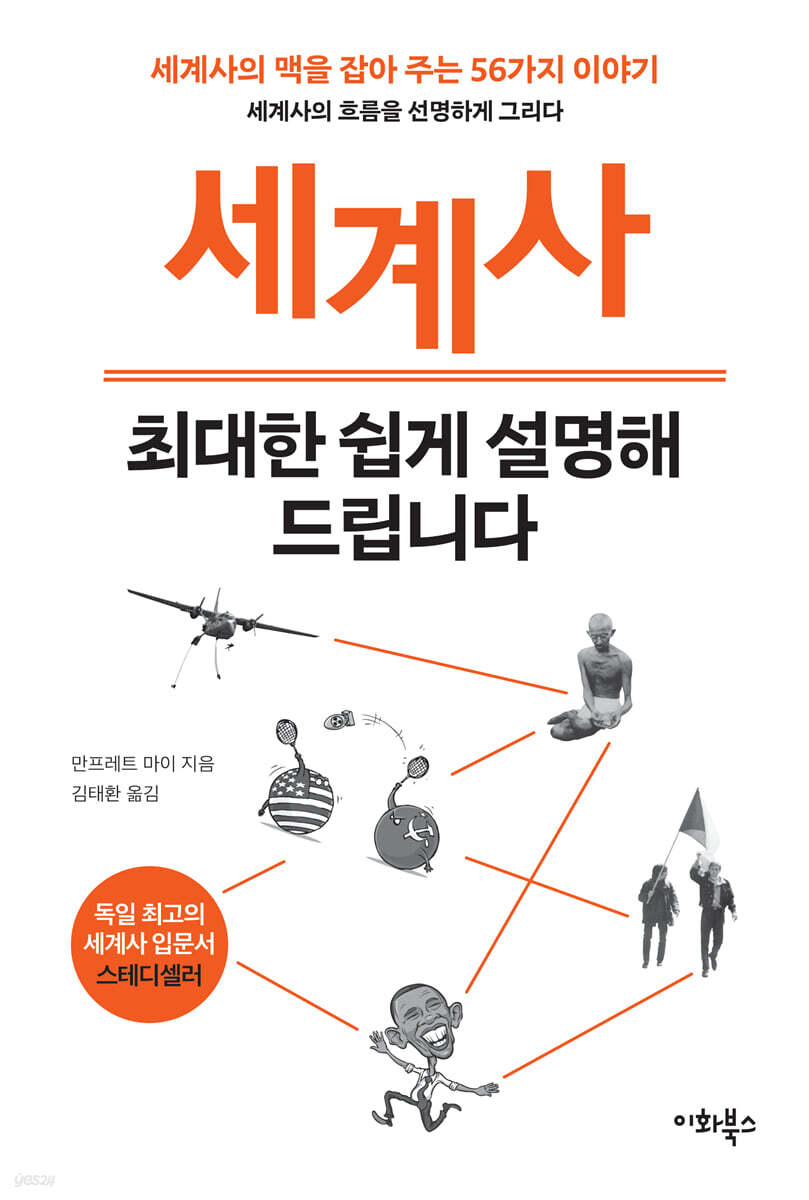
World history explained as simply as possible
 |
Description
Book Introduction
A book that naturally draws the flow of world history in your mind!
A world history textbook that explains the causal relationships of events and adds interpretations.
This is a 'national history book' published by Manfred May, Germany's greatest historical storyteller.
It covers everything from the first humans to the conflicts and solutions on the road to European integration, China's rapid rise as a new superpower, and environmental issues, a common global issue.
The author's insight, which compresses world history into a single volume while meticulously examining and analyzing the zeitgeist and social challenges of the time, is a unique strength of this book that cannot be found in other history books.
It is also a virtue that it avoids the one-sided narrative that encourages selective eating or the vast number of techniques that are useless.
Using 56 topics that have become turning points and branching points in the world's flow as stepping stones, we guide you step by step through the complex flow of world history.
Beyond simply remembering events and scenes, it will be of great help in understanding the meaning and causal relationships of historical events in each era.
A world history textbook that explains the causal relationships of events and adds interpretations.
This is a 'national history book' published by Manfred May, Germany's greatest historical storyteller.
It covers everything from the first humans to the conflicts and solutions on the road to European integration, China's rapid rise as a new superpower, and environmental issues, a common global issue.
The author's insight, which compresses world history into a single volume while meticulously examining and analyzing the zeitgeist and social challenges of the time, is a unique strength of this book that cannot be found in other history books.
It is also a virtue that it avoids the one-sided narrative that encourages selective eating or the vast number of techniques that are useless.
Using 56 topics that have become turning points and branching points in the world's flow as stepping stones, we guide you step by step through the complex flow of world history.
Beyond simply remembering events and scenes, it will be of great help in understanding the meaning and causal relationships of historical events in each era.
- You can preview some of the book's contents.
Preview
index
Introduction _ Drawing a general picture of world history
1.
The first human
2.
From hunter-gatherer nomads to farmers
3.
Great inventions and discoveries
4.
mankind's first advanced civilization
5.
The world's first miracle
6.
Advanced civilization of the Indus River
7.
The Roots of East Asian Culture - China
8.
The great legacy left behind by the ancient Greeks
9.
All roads lead to Rome
10.
Two New Religions - Christianity and Islam
11.
The Frankish Kingdom is born
12.
feudalism
13.
The world in 1000 AD
14.
The confrontation between the Pope and the Emperor
15.
Crusades
16.
urban development
17.
Renaissance
18.
The 'Discovery' of the 'New World'
19.
Reformation
20.
European Wars of Religion
21.
China and Japan's isolationist policies
22.
Jim is the country!
23.
Limit the king's power by law
24.
Modernization achieved through violence
25.
House of Habsburg and House of Hohenzollern
26.
The Age of Reason Begins
27.
The philosopher who became the king of Prussia?
28.
To America!
29.
Liberty? Equality? Fraternity
30.
Europe under Napoleon
31.
Industrial Revolution
32.
Dreaming of a world where everyone is happy
33.
America is for Americans
34.
Colonial scramble
35.
German things will heal the world
36.
The first disaster of the 20th century - World War I
37.
The first socialist country
38.
Two Paths to Independence
39.
The enemy is on the right!
40.
Hitler's rise to power
41.
Hitler's madness
42.
The Second Disaster of the 20th Century - World War II
43.
The era of the Cold War between the East and the West begins
44.
precarious peace
45.
The Challenge of the Last Places: The Emergence of the Third World
46.
Middle East conflict
47.
China - the new superpower
48.
Japan, an economic powerhouse
49.
dissolution of Eastern European countries
50.
The Road to European Integration
51.
The United States, the 'world's policeman'
52.
A distant peace
53.
Financial crisis? Global economic crisis? National debt crisis
54.
Euro crisis
55.
A New Beginning for Africa
56.
climate change
Translator's Note _ A Plot of World History in a Glance
Search
1.
The first human
2.
From hunter-gatherer nomads to farmers
3.
Great inventions and discoveries
4.
mankind's first advanced civilization
5.
The world's first miracle
6.
Advanced civilization of the Indus River
7.
The Roots of East Asian Culture - China
8.
The great legacy left behind by the ancient Greeks
9.
All roads lead to Rome
10.
Two New Religions - Christianity and Islam
11.
The Frankish Kingdom is born
12.
feudalism
13.
The world in 1000 AD
14.
The confrontation between the Pope and the Emperor
15.
Crusades
16.
urban development
17.
Renaissance
18.
The 'Discovery' of the 'New World'
19.
Reformation
20.
European Wars of Religion
21.
China and Japan's isolationist policies
22.
Jim is the country!
23.
Limit the king's power by law
24.
Modernization achieved through violence
25.
House of Habsburg and House of Hohenzollern
26.
The Age of Reason Begins
27.
The philosopher who became the king of Prussia?
28.
To America!
29.
Liberty? Equality? Fraternity
30.
Europe under Napoleon
31.
Industrial Revolution
32.
Dreaming of a world where everyone is happy
33.
America is for Americans
34.
Colonial scramble
35.
German things will heal the world
36.
The first disaster of the 20th century - World War I
37.
The first socialist country
38.
Two Paths to Independence
39.
The enemy is on the right!
40.
Hitler's rise to power
41.
Hitler's madness
42.
The Second Disaster of the 20th Century - World War II
43.
The era of the Cold War between the East and the West begins
44.
precarious peace
45.
The Challenge of the Last Places: The Emergence of the Third World
46.
Middle East conflict
47.
China - the new superpower
48.
Japan, an economic powerhouse
49.
dissolution of Eastern European countries
50.
The Road to European Integration
51.
The United States, the 'world's policeman'
52.
A distant peace
53.
Financial crisis? Global economic crisis? National debt crisis
54.
Euro crisis
55.
A New Beginning for Africa
56.
climate change
Translator's Note _ A Plot of World History in a Glance
Search
Detailed image

Into the book
It is clear that the knowledge and work skills they possessed were passed down from generation to generation.
This suggests that they already possessed a developed language.
How exactly human language developed remains a mystery that science has yet to solve.
What can be said with certainty is that for them too, language was a prerequisite for governing the order of group life and creating a more effective cooperative system among its members.
---From "The First Human"
The Nile River was also an object of careful observation because it was of absolute importance to survival.
Long-term observations have shown that the Nile floods occur on average every 365 days.
The Egyptians divided the year into twelve months of 365 days based on the Nile River's flood cycle.
Since there were 30 days in a month, there were 5 days left, which were inserted between one year and the next.
Thus, around 3000 BC, the Egyptians created a calendar that is still used around the world today with little change.
---From "The World's First Miracle"
Confucius's thought is based on the theory of human nature being good.
Humans just have to make an effort to maintain this good nature.
First of all, it is important to improve the living environment within the family.
Because family is where children learn to respect and care for one another.
For Confucius, the family was the 'root of humanity.'
Just as a father sets an example for his family, so too should princes set an example of a virtuous life for their subjects.
---From "The Roots of East Asian Culture - China"
Rome's new rulers soon became dissatisfied with the fact that Rome was just one city among many.
Rome was supposed to be the greatest city in Italy.
To achieve this goal, they mobilized a powerful army and waged war to expand their territory.
Finally, around 270 BC, Rome ruled most of Italy, with a population of about 3 million.
Occupied cities usually had autonomy in their internal affairs and were able to retain their own customs and religion.
---From "All roads lead to Rome"
Before his death (632), Muhammad was able to bring all the tribes of Arabia under his doctrine.
This doctrine, recorded in the Quran, is called Islam, which means 'submission to the will of God' or 'devotion to God'.
The Quran is the 'holy book' of Islam, and it provides very detailed and precise guidance for the lives of believers, even down to everyday matters.
The Quran contains not only the prayers, but also the frequency and method of prayer, what food to eat and what not to eat, when and how to fast, what actions to avoid, and what punishments will be incurred for such actions.
---From "Two New Religions - Christianity and Islam"
The feudal order was hierarchical, with several 'statuses' stacked in a pyramidal shape.
At the top of the pyramid was the emperor, and below him were the imperial princes who received their fiefs directly from the emperor.
Together with other nobles, bishops, and abbots, they formed the highest stratum of society.
Next came the knights, officials, wealthy citizens, and artisans.
The lowest positions were occupied by serfs and farmhands.
---From "Feudalism"
At that time, the Earth's population was approximately 260 million, of which about 65 million were Chinese.
This great eastern country has already made great progress in technology and culture.
The Chinese knew how to make silk and porcelain, had printing technology, and used the abacus, which could be considered the first calculator.
He also used water power to operate machines and invented gunpowder.
Trade of goods took place along the Silk Road, which stretched across Asia to Palestine.
Not only trade but also spiritual exchanges became active.
Japan, a small country to the east of China, looked entirely to its "big brother" country, China, as a model in politics, administration, art, and culture.
This suggests that they already possessed a developed language.
How exactly human language developed remains a mystery that science has yet to solve.
What can be said with certainty is that for them too, language was a prerequisite for governing the order of group life and creating a more effective cooperative system among its members.
---From "The First Human"
The Nile River was also an object of careful observation because it was of absolute importance to survival.
Long-term observations have shown that the Nile floods occur on average every 365 days.
The Egyptians divided the year into twelve months of 365 days based on the Nile River's flood cycle.
Since there were 30 days in a month, there were 5 days left, which were inserted between one year and the next.
Thus, around 3000 BC, the Egyptians created a calendar that is still used around the world today with little change.
---From "The World's First Miracle"
Confucius's thought is based on the theory of human nature being good.
Humans just have to make an effort to maintain this good nature.
First of all, it is important to improve the living environment within the family.
Because family is where children learn to respect and care for one another.
For Confucius, the family was the 'root of humanity.'
Just as a father sets an example for his family, so too should princes set an example of a virtuous life for their subjects.
---From "The Roots of East Asian Culture - China"
Rome's new rulers soon became dissatisfied with the fact that Rome was just one city among many.
Rome was supposed to be the greatest city in Italy.
To achieve this goal, they mobilized a powerful army and waged war to expand their territory.
Finally, around 270 BC, Rome ruled most of Italy, with a population of about 3 million.
Occupied cities usually had autonomy in their internal affairs and were able to retain their own customs and religion.
---From "All roads lead to Rome"
Before his death (632), Muhammad was able to bring all the tribes of Arabia under his doctrine.
This doctrine, recorded in the Quran, is called Islam, which means 'submission to the will of God' or 'devotion to God'.
The Quran is the 'holy book' of Islam, and it provides very detailed and precise guidance for the lives of believers, even down to everyday matters.
The Quran contains not only the prayers, but also the frequency and method of prayer, what food to eat and what not to eat, when and how to fast, what actions to avoid, and what punishments will be incurred for such actions.
---From "Two New Religions - Christianity and Islam"
The feudal order was hierarchical, with several 'statuses' stacked in a pyramidal shape.
At the top of the pyramid was the emperor, and below him were the imperial princes who received their fiefs directly from the emperor.
Together with other nobles, bishops, and abbots, they formed the highest stratum of society.
Next came the knights, officials, wealthy citizens, and artisans.
The lowest positions were occupied by serfs and farmhands.
---From "Feudalism"
At that time, the Earth's population was approximately 260 million, of which about 65 million were Chinese.
This great eastern country has already made great progress in technology and culture.
The Chinese knew how to make silk and porcelain, had printing technology, and used the abacus, which could be considered the first calculator.
He also used water power to operate machines and invented gunpowder.
Trade of goods took place along the Silk Road, which stretched across Asia to Palestine.
Not only trade but also spiritual exchanges became active.
Japan, a small country to the east of China, looked entirely to its "big brother" country, China, as a model in politics, administration, art, and culture.
---From "The World in 1000 AD"
Publisher's Review
"Spoiler": A concise overview of world history, condensed through 56 key events.
Most media and cultural content that centers on narratives, such as movies, plays, and novels, are reluctant to have their entire content publicly distributed if possible.
Because once you know the ending, it becomes trivial.
History, on the other hand, is almost the only genre that actively encourages 'spoilers'.
Only by grasping the 'whole plot' and approaching it can one increase understanding and connect events with time differences.
However, this does not mean that a chronological list of events is necessarily helpful in studying history.
Memorizing a vast array of historical events and figures in order is not only impossible, but also not desirable.
This book, "World History Explained as Easily as Possible," unfolds the story by using 56 essential events as stepping stones to reveal the causal relationships between preceding and subsequent events.
If you follow the flow of world history in this way, events will naturally be engraved in your mind and the overall context will be grasped.
This is why this book is known as the 'national history book' among Germans.
A world history commentary with sharp interpretation and analysis of history.
The biggest reason this book has been consistently loved for a long time, despite repeated revisions and expansions, is because of the author's kind commentary and sharp insight.
Rather than simply showing an event, it meticulously examines why it happened and the historical environment and ideological trends that made it inevitable.
Yet, the delivery method is very simple.
It is thanks to the author's exceptional talent as a natural storyteller that he was able to compress the vast world history into a single book while broadening the horizons of history.
The author's eloquence, which allows us to feel a vivid sense of presence, leads us beyond just 'knowing' history to 'experiencing' it.
A new look at world history through an integrated perspective
Author Manfred May breaks away from the notion that "world history = European history" and examines the various layers of world history, and does not lose sight of a critical stance even when dealing with Western history.
This critical perspective provides important clues to uncovering the roots of the conflicts and disputes taking place around the world today.
The author's sharp interpretation of historical events leads us to look into current knowledge and information about various issues we are currently facing.
This book, which approaches history from an integrated perspective and diverse perspectives, prides itself on being a "world history book" that opens up a new world through the window of history.
Most media and cultural content that centers on narratives, such as movies, plays, and novels, are reluctant to have their entire content publicly distributed if possible.
Because once you know the ending, it becomes trivial.
History, on the other hand, is almost the only genre that actively encourages 'spoilers'.
Only by grasping the 'whole plot' and approaching it can one increase understanding and connect events with time differences.
However, this does not mean that a chronological list of events is necessarily helpful in studying history.
Memorizing a vast array of historical events and figures in order is not only impossible, but also not desirable.
This book, "World History Explained as Easily as Possible," unfolds the story by using 56 essential events as stepping stones to reveal the causal relationships between preceding and subsequent events.
If you follow the flow of world history in this way, events will naturally be engraved in your mind and the overall context will be grasped.
This is why this book is known as the 'national history book' among Germans.
A world history commentary with sharp interpretation and analysis of history.
The biggest reason this book has been consistently loved for a long time, despite repeated revisions and expansions, is because of the author's kind commentary and sharp insight.
Rather than simply showing an event, it meticulously examines why it happened and the historical environment and ideological trends that made it inevitable.
Yet, the delivery method is very simple.
It is thanks to the author's exceptional talent as a natural storyteller that he was able to compress the vast world history into a single book while broadening the horizons of history.
The author's eloquence, which allows us to feel a vivid sense of presence, leads us beyond just 'knowing' history to 'experiencing' it.
A new look at world history through an integrated perspective
Author Manfred May breaks away from the notion that "world history = European history" and examines the various layers of world history, and does not lose sight of a critical stance even when dealing with Western history.
This critical perspective provides important clues to uncovering the roots of the conflicts and disputes taking place around the world today.
The author's sharp interpretation of historical events leads us to look into current knowledge and information about various issues we are currently facing.
This book, which approaches history from an integrated perspective and diverse perspectives, prides itself on being a "world history book" that opens up a new world through the window of history.
GOODS SPECIFICS
- Date of publication: December 24, 2018
- Page count, weight, size: 352 pages | 472g | 146*215*18mm
- ISBN13: 9791196558109
- ISBN10: 1196558108
You may also like
카테고리
korean


korean

![GQ KOREA Mark (Monthly): December [2025]](http://librairie.coreenne.fr/cdn/shop/files/8ef265dbbfbf186523ed75ba7319009d.jpg?v=1765340328&width=3840)


