

Democracy and Patriotism
 |
Description
Book Introduction
An epic tale of post-war Japanese intellectual history!
Translated by Eiji Oguma, a leading Japanese sociologist
Even after Hirohito's surrender declaration on August 15, 1945, the Japanese people could not easily escape the system of war.
Although they shouted "Long Live the Emperor" and "Long Live Democracy and the New Constitution" on behalf of the Greater East Asia Co-Prosperity Sphere, the language system through which the Japanese ruling class and people thought about democracy and the new constitution, and the way they put them into practice, were still in the shadow of wartime.
This book explores the linguistic trajectories of leading modern Japanese thinkers such as Masao Maruyama, Hisao Otsuka, Jun Eto, Takaaki Yoshimoto, and Shunsuke Tsurumi, and thoroughly examines how the language of militarism and imperialism survived as the language of democracy and postwar thought.
Translated by Eiji Oguma, a leading Japanese sociologist
Even after Hirohito's surrender declaration on August 15, 1945, the Japanese people could not easily escape the system of war.
Although they shouted "Long Live the Emperor" and "Long Live Democracy and the New Constitution" on behalf of the Greater East Asia Co-Prosperity Sphere, the language system through which the Japanese ruling class and people thought about democracy and the new constitution, and the way they put them into practice, were still in the shadow of wartime.
This book explores the linguistic trajectories of leading modern Japanese thinkers such as Masao Maruyama, Hisao Otsuka, Jun Eto, Takaaki Yoshimoto, and Shunsuke Tsurumi, and thoroughly examines how the language of militarism and imperialism survived as the language of democracy and postwar thought.
index
Preface to the Korean edition
letter
On the language/discourse and sentiment of two post-war/post-war democracies
Part 1
Chapter 1: The Scorched Earth War and the Social Situation of Ethics
Factionalism and Irresponsibility / The Reality of Military Factories / Organizational Life and the Controlled Economy / Intellectuals / The Student Soldier Experience / The Beginning of the Postwar Era
Chapter 2: Total War and Democracy by Masao Maruyama and Hisao Otsuka
Democracy as Patriotism / Reevaluation of Modernity / The Idea of Nationalism / Transnationalism and Nationalism / The Creation of the Modern Type of Human / Hatred of the Masses / Memories of Humiliation
Chapter 3: Loyalty and Treason: The Emperor's System Immediately After Defeat
The pursuit of war responsibility / A boy soldier's view of the emperor / The rise of the theory of the emperor's abdication / The patriotism of the Communist Party / Juche and the imperial system / Bushido and the liberation of the emperor / The abdication of the emperor and the constitution / The end of the theory of abdication
Chapter 4: Constitutional Patriotism, Article 9, and Nationalism
Peace as Nationalism / The Welcomed Article 9 / Pacifism as Conformity / The Communist Party's Opposition / The Question of International Contribution
Chapter 5: The Left's "Nation" and the Conservatives' "Individual": Communist Party and Conservative Intellectuals
Regret and the Communist Party/Communist Patriotism/War and Liberalism/Old Liberals/Conservatism Emphasizing the Individual/Generational Differences
Chapter 6: National and Civic Politics and Literary Debates
The Argument for Individualism / War Experience and Egoism / Reevaluation of Modernity / Communist Criticism of Modernism / Kobayashi Hideo and Fukuda Tsuneari / Citizens and Refugees
Part 2
Chapter 7: Poverty and a Single Nation: Nationalism in the 1950s
Gap and Nationalism / Reassessing Asia / Anti-American Nationalism / Communist Nationalism / The 1955 Turn / The Transformation of History / The Meaning of a Beloved Homeland
Chapter 8: The National History Movement: Ishimoda Sho, Inoue Kiyoshi, Amino Yoshihiko, and others
Escaping Isolation/The Beginning of Postwar History/From Enlightenment to Nation/The Rise of Nationalism/The Revolution in History/The End of the Movement
Chapter 9: Pre- and Post-war Education and National Education Scholars and the Japanese Teachers' Union
The Beginning of Postwar Education/Postwar Left Criticism of New Education/A Perspective on Asia/The Spread of a Common Language and Nationalism/The Continuity of Patriotism/The Coming of a Period of Stagnation
Chapter 10: Memories of Nationalism Drenched in Blood Takeuchi Yoshimi
The Relationship between Politics and Literature / December 8th as Resistance / The Nightmare of the Battlefield / Two Moderns / The Fate of National Literature
Chapter 11: From the Issue of Strengthening Independence and Unarmed Neutrality to the 1955 System
The 1950 Transition / Pressure from the United States / Unarmed Neutrality as Nationalism / Focus on Asia / UN Accession and the Issue of Reparations / Establishment of the 1955 System
Chapter 12: Turning Points Before and After the 60-Year Security Struggle
The Shackles of the San Francisco System / The Forced Decision of May 19th / Memories of War and Patriotism / A New Social Movement / The Emergence of the Citizen / A Selfless Movement / The End of Struggle
Chapter 13: 19th-Century Globalization Achieved by Capitalism
Chapter 8: Reconstructing Globalization
Chapter 9: Is there a future for capitalism?
Chapter 10 Conclusion
Part 3
Chapter 13: Mass Society and Nationalism: The 1960s and the Student Struggle
High economic growth and mass nationalism/the erosion of war experience/criticism of peace and democracy/criticism of nationalism by the New Left/the rise of the Jeon Gong-tae movement/anti-Vietnam War movements and their perpetrators
Chapter 14: The Deconstruction of the "Public" by Takaaki Yoshimoto
The Heart of the Jeonjungpa/The Transcendent and the Family/Hatred of God/The Pursuit of Responsibility for the War/The Structure of Distortion and the Masses/The Struggle for Security and the War Dead/Family Against the State/Departure from the Warrior
Chapter 15: Longing for the Poetry of the Year by Jun Eto
The Death Generation / A Boy from the Fallen Middle Class / Death and the Living / The Scent of 1960 Security / The Discovery of Meiji in America / The Lions of Illusion
Chapter 16: Menstruation of the Dead by Shunsuke Tsurumi and Makoto Oda
Experiences of War as a Comfort Woman / Aspirations for the Roots / Discovery of a New Theory of Organization / The Thoughts of Nansa / Amorphous Movements / The State and Escape
conclusion
War Experience and Postwar Thought/The Limitations of Postwar Thought/The Diversity of War Experience/The Third Postwar/On Constitutional Protection/The Evolution of Speech and the Nameless
circumference
Reviews
Translator's Note
Find a person's name
letter
On the language/discourse and sentiment of two post-war/post-war democracies
Part 1
Chapter 1: The Scorched Earth War and the Social Situation of Ethics
Factionalism and Irresponsibility / The Reality of Military Factories / Organizational Life and the Controlled Economy / Intellectuals / The Student Soldier Experience / The Beginning of the Postwar Era
Chapter 2: Total War and Democracy by Masao Maruyama and Hisao Otsuka
Democracy as Patriotism / Reevaluation of Modernity / The Idea of Nationalism / Transnationalism and Nationalism / The Creation of the Modern Type of Human / Hatred of the Masses / Memories of Humiliation
Chapter 3: Loyalty and Treason: The Emperor's System Immediately After Defeat
The pursuit of war responsibility / A boy soldier's view of the emperor / The rise of the theory of the emperor's abdication / The patriotism of the Communist Party / Juche and the imperial system / Bushido and the liberation of the emperor / The abdication of the emperor and the constitution / The end of the theory of abdication
Chapter 4: Constitutional Patriotism, Article 9, and Nationalism
Peace as Nationalism / The Welcomed Article 9 / Pacifism as Conformity / The Communist Party's Opposition / The Question of International Contribution
Chapter 5: The Left's "Nation" and the Conservatives' "Individual": Communist Party and Conservative Intellectuals
Regret and the Communist Party/Communist Patriotism/War and Liberalism/Old Liberals/Conservatism Emphasizing the Individual/Generational Differences
Chapter 6: National and Civic Politics and Literary Debates
The Argument for Individualism / War Experience and Egoism / Reevaluation of Modernity / Communist Criticism of Modernism / Kobayashi Hideo and Fukuda Tsuneari / Citizens and Refugees
Part 2
Chapter 7: Poverty and a Single Nation: Nationalism in the 1950s
Gap and Nationalism / Reassessing Asia / Anti-American Nationalism / Communist Nationalism / The 1955 Turn / The Transformation of History / The Meaning of a Beloved Homeland
Chapter 8: The National History Movement: Ishimoda Sho, Inoue Kiyoshi, Amino Yoshihiko, and others
Escaping Isolation/The Beginning of Postwar History/From Enlightenment to Nation/The Rise of Nationalism/The Revolution in History/The End of the Movement
Chapter 9: Pre- and Post-war Education and National Education Scholars and the Japanese Teachers' Union
The Beginning of Postwar Education/Postwar Left Criticism of New Education/A Perspective on Asia/The Spread of a Common Language and Nationalism/The Continuity of Patriotism/The Coming of a Period of Stagnation
Chapter 10: Memories of Nationalism Drenched in Blood Takeuchi Yoshimi
The Relationship between Politics and Literature / December 8th as Resistance / The Nightmare of the Battlefield / Two Moderns / The Fate of National Literature
Chapter 11: From the Issue of Strengthening Independence and Unarmed Neutrality to the 1955 System
The 1950 Transition / Pressure from the United States / Unarmed Neutrality as Nationalism / Focus on Asia / UN Accession and the Issue of Reparations / Establishment of the 1955 System
Chapter 12: Turning Points Before and After the 60-Year Security Struggle
The Shackles of the San Francisco System / The Forced Decision of May 19th / Memories of War and Patriotism / A New Social Movement / The Emergence of the Citizen / A Selfless Movement / The End of Struggle
Chapter 13: 19th-Century Globalization Achieved by Capitalism
Chapter 8: Reconstructing Globalization
Chapter 9: Is there a future for capitalism?
Chapter 10 Conclusion
Part 3
Chapter 13: Mass Society and Nationalism: The 1960s and the Student Struggle
High economic growth and mass nationalism/the erosion of war experience/criticism of peace and democracy/criticism of nationalism by the New Left/the rise of the Jeon Gong-tae movement/anti-Vietnam War movements and their perpetrators
Chapter 14: The Deconstruction of the "Public" by Takaaki Yoshimoto
The Heart of the Jeonjungpa/The Transcendent and the Family/Hatred of God/The Pursuit of Responsibility for the War/The Structure of Distortion and the Masses/The Struggle for Security and the War Dead/Family Against the State/Departure from the Warrior
Chapter 15: Longing for the Poetry of the Year by Jun Eto
The Death Generation / A Boy from the Fallen Middle Class / Death and the Living / The Scent of 1960 Security / The Discovery of Meiji in America / The Lions of Illusion
Chapter 16: Menstruation of the Dead by Shunsuke Tsurumi and Makoto Oda
Experiences of War as a Comfort Woman / Aspirations for the Roots / Discovery of a New Theory of Organization / The Thoughts of Nansa / Amorphous Movements / The State and Escape
conclusion
War Experience and Postwar Thought/The Limitations of Postwar Thought/The Diversity of War Experience/The Third Postwar/On Constitutional Protection/The Evolution of Speech and the Nameless
circumference
Reviews
Translator's Note
Find a person's name
Publisher's Review
The language of war shaped postwar Japan, and the Japan of today.
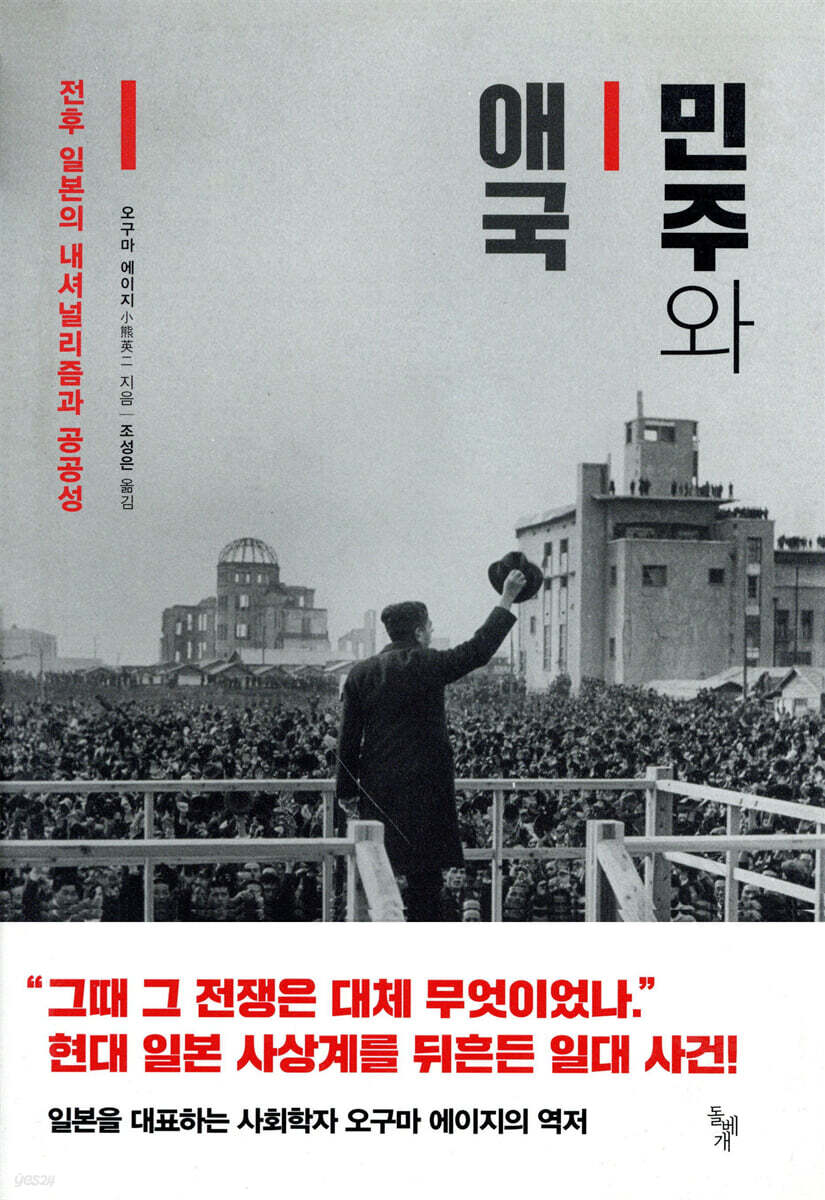
On the cover of this book, a gentleman is waving his hat and greeting a seemingly endless crowd.
Who gathered all these people together, and who is that person that stands so proudly before the countless crowd?
This is Hirohito and the Japanese people welcoming him as he visits Hiroshima, a city devastated by the atomic bomb, on December 7, 1947.
Even after defeat, the Japanese were still subjects of the Emperor.
This is one of the historical scenes that best shows how deeply intertwined modern Japan and the 'system' of war are.
Even after the war, Japan remained in wartime.
Eiji Oguma, currently Japan's leading sociologist and an intellectual who remains silent on the contradictions of Japanese society, has already met Korean readers with several books, but it is no exaggeration to say that this is the first time that his widely recognized main work has been introduced in Korea.
In his masterpiece, Democracy and Patriotism, Eiji Oguma gathered the voices of a diverse range of people who lived in postwar Japan, from thinkers such as Masao Maruyama and Shunsuke Tsurumi, to former Japanese military personnel like pilot Saburo Sakai, and even ordinary student Satsuki Ishikawa. By doing so, he established a new path for understanding modern Japan.
On May 1st, Emperor Akihito, who had reigned for 30 years, abdicated and Naruhito ascended to the throne as the new emperor, and the unique calendar system, the era name, changed from Heisei to Reiwa.
At the enthronement ceremony, Prime Minister Shinzo Abe stated, “(This event) is a declaration of our determination to create a bright future for Japan that is peaceful, hopeful, and proud amidst the turbulent international situation.”
While claiming to create a peaceful future under a new era name meaning “beautiful peace,” it is clearly contradictory to push for a constitutional amendment that would justify the Self-Defense Forces’ use of force.
Using the language of thought as a foundation, "Democracy and Patriotism" meticulously examines the simple yet complex process by which Japan's wartime system was reconstructed into a postwar system.
According to this book, the political contradictions between the Liberal Democratic Party and Prime Minister Abe are a kind of inevitability.
Shigeru Yoshida, a leader of Japan's conservative forces after the war, accepted demilitarism into the postwar constitution under pressure from the United States as prime minister immediately after the war, and actively promoted the excellence of that ideal to the people.
However, the book points out that Yoshida had already judged at that time that Japan would eventually have to arm itself.
Ultimately, to properly understand the current Japanese society and government, which emphasizes world peace while failing to confront and apologize for its past colonial rule and instead promotes political and military conflict, we must understand Japan immediately after its defeat some 70 years ago.
Furthermore, as this book argues, only by understanding Japan during the war can we understand Japan immediately after its defeat, which had no choice but to transform into a democratic nation using the language and system left behind by militarism.
Therefore, to gain a three-dimensional perspective on Japan, which currently insists on its own unilateral nationalism while ignoring the realities of its neighbors, we cannot help but refer to this book, which compiles the language of modern Japanese thought as it has evolved throughout the wartime and postwar eras.
Despite its extensive academic scope, the author's writing style is impressive, as it appropriately blends the interesting aspects of various figures who left their mark on post-war Japanese history with the flow of post-war thought, adding to the enjoyment of reading.
“I can confidently say that if you want to know about post-war Japan, you must first read this book.
This is especially true for people interested in politics, history, and ideology.
“It is not because the views of this book are perfect, but because the historical flow, including the characters, debates, and events that appear here, serves as a basic foundation for discussing postwar Japan.” ―From the “Translator’s Afterword”
The languages of the postwar period were similar yet different. Is the postwar era over?
This book begins with an introduction that explains the two postwar periods—the first postwar and the second postwar—the language of postwar democracy, and the rhetoric and sentiments that are key concepts for understanding postwar Japanese thought.
This is also a passage that reveals the author's meticulousness in systematically reconstructing Japan's postwar ideological history.
The key among them is the ‘two before and after.’
This concept divides the period before 1955 into the first post-war period and the second post-war period after 1955.
Before 1955, Japan was an underdeveloped country like any other newly independent nation that gained independence immediately after World War II. The collapse of the existing system following defeat in the war led to repeated political, economic, and social turmoil.
In contrast, during the second postwar period, the Japanese economy rapidly recovered to its pre-war level thanks to the Korean War and the Vietnam War.
Furthermore, with the conclusion of the San Francisco Peace Treaty and the establishment of the 1955 system, represented by the conservative Liberal Democratic Party and the progressive Socialist Party, Japan achieved political and social stability.
National identity was also considered to have reached the same level as that of advanced Western countries.
With rapid changes occurring in just over a decade since the war's defeat, the second post-war period was distinct from the previous one.
Because of these differences, the book explains that key concepts in modern society, including democracy and patriotism, have come to represent different sentiments and experiences depending on the era.
Moreover, postwar Japanese still considered their experiences before and during the war as important standards for their lives.
Therefore, their war experiences were also reflected in the language that changed across the two periods.
This book traces the discourse surrounding publicness—democracy, patriotism, modernity, citizenship, and the nation—and the flow of emotions contained within them because it is the best indicator of postwar changes in Japan.
This book takes the position that the thoughts of intellectuals cannot be unrelated to the collective sentiments shared by the contemporary society.
Intellectuals, who contribute to the change in the structure of speech, play a role as experts in the use of language and create language that expresses collective sentiments.
This book will examine the arguments of prominent postwar intellectuals alongside the voices of politicians and ordinary citizens, often noting that both emerged from a common ground of their time.
-In the text
A Constitution of Peace and Anti-War that Replaces "Long Live the Emperor"
Part 1 examines the circumstances surrounding the emergence of the language system in the immediate post-war period, the 'first post-war period.'
Chapter 1, “The Scorched Earth of Ethics,” outlines the social situation of the wartime period that became the source of postwar thought encompassing the two periods before and after.
From the inefficiency and chaos of the upper echelons of the Japanese Empire, to the absurd barracks life experienced by young intellectuals, to the hardships endured by common people and children in munitions factories and rural evacuation centers, it vividly portrays the root of the emotions that postwar Japanese sought to convey through language.
From the next two chapters onwards, we will focus on the efforts to transform the discourse of the exhibition thought and construct new ideas in the postwar period.
The author calls this “paraphrasing.”
Chapter 2, “Total War and Democracy,” features Masao Maruyama, who sought to establish democracy in postwar politics by “rereading” the wartime language that defended the imperial system, and Hisao Otsuka, who sought to establish a “type of modern human” in the postwar economy by “rereading” the logic of the wartime total war system that emphasized efficiency.
These two thinkers, representative of postwar Japan, are the best examples of the author's argument that humans cannot completely discard the language they have acquired in the society they belong to and replace it with something new.
Chapter 3, “Loyalty and Betrayal,” deals with the rapidly changing sentiments of the Japanese people toward the imperial system immediately after the defeat in the war and the flow of arguments for Hirohito’s abdication.
In today's Japanese society, we can also see the resentment of the people who were soldiers against the emperor, which is hard to imagine.
In addition, the point where the abdication argument raised by Shigeru Nanbara, who was Masao Maruyama's teacher and a representative political philosopher and politician of the period, intersected with the nationalism of the wartime is also described in detail.
The Emperor's responsibility for the war that they raised stemmed entirely from the Japanese who sacrificed themselves for the nation at the Emperor's command.
At that time, even Japan's progressive intellectuals were unaware of the Asian countries that had fallen victim to their own imperialism.
Chapter 4, “Constitutional Patriotism,” discusses Article 9 of the Constitution, which renounces war and disarmament.
Even before the first war, this provision was not a subject of public interest, but rather a topic of discussion within the Japanese government and parliament.
Although this anti-war peace clause was established under pressure from the United States, conservatives, led by Prime Minister Shigeru Yoshida, promoted it as a symbol of Japan that could be proud of the world.
The way of speaking that established the anti-war peace as a post-war nationalism was similar to the defense of the imperial system during wartime.
Chapter 5, “The Left’s ‘Nation’ and the Conservative’s ‘Individual’,” contrasts and analyzes the remarks made by intellectuals belonging to the Communist Party and conservative intellectuals.
The Communist Party was virtually the only force opposing the war during the war, and thus came to exert great influence in the first postwar period.
The basis of this influence was the sense of guilt felt by intellectuals who had opposed the war but eventually converted under government pressure after the war.
It also served as a justification for the conservatives, who either favored the war or were much more passively opposed to it, to oppose the Communists, who insisted on preserving individual lives and emphasized individual sacrifice for social change.
The theme of Chapter 6, “Nation and Citizen,” “Politics and Literature Debate,” is also based on the problem awareness that continues from Chapter 5.
The Communist Party, which advocated the establishment of a new post-war system while comprehensively criticizing the exhibition system, also valued ideology over emotion in artistic activities.
On the other hand, the members of the magazine "Kindai Bungaku" (Modern Literature), led by Ara Masahito, held the writers who had supported the war accountable, while also exploring the possibilities of individuals and literature that were not subordinate to ideologies such as communism.
An issue that Hirano Gen particularly valued was the status of women within the left-wing movement.
In the pre-war Communist Party, female activists were collectively called “housekeepers” and were made to live with male activists. Hirano cited this as an example of the ruthlessness of “politics” that “does not care about the means to achieve the end,” and said, “Even if those engaged in literature often make a blunt statement that they no longer want to do politics, that is not necessarily something to be condemned.”
-In the text
A new nationalism attempt to overcome war
Part 2 depicts the development of various post-war ideologies from the 1950s to the 1960s security struggle, the trial and error they went through, and the process by which these ideologies became meaningless after 1955.
First, Chapter 7, “Poverty and a Single Nation,” provides an overview of nationalism in the 1950s.
Among them, it vividly portrays the fact that Japan's class gap, which has yet to fully escape poverty, was an obstacle to nationalism encompassing all of its citizens.
Chapter 8, “The National History Movement,” shows the process from its inception to its decline of the “National History Movement,” which aimed to form a new national identity after the war.
Historian Sho Ishimoda led this movement out of a sense of responsibility for the younger generations who were mainly conscripted and killed in the war.
It was an attempt to reexamine Japanese history as a process led by the people, and to break away from the pre-war and wartime historiography and nationalism that had been used as tools of nationalism and militarism.
Chapter 9, “Postwar Education and the Nation,” discusses how pedagogy, which played a key role in the formation of wartime nationalism along with history, changed after the war.
The feeling of guilt at having ultimately sided with the war during the war was a sentiment shared by many educational scholars and educators before and after the war.
Post-war education also became closely linked to the Communist Party, which had opposed the war since the war.
The spread of a common language for all the people and the criticism of postwar education that followed the American model were educational attempts to achieve postwar nationalism that would unite the Japanese people.
However, because the awareness and pursuit of war responsibility in the pedagogy of the exhibition were weak, the new nationalist education could not help but bear similarities to the education of imperial subjects before the war.
Chapter 10, “Memories of a Blood-Stained Democracy,” reconstructs Takeuchi Yoshimi, a representative thinker of this period, as a figure who sought Japan’s path forward after the war, comparing China, a pioneer of voluntary, critical modernization, with Japan, a model student of passive, dependent modernization.
Chapter 11, “Independence and Unarmed Neutrality,” focuses on the political changes in the latter half of the first postwar period.
In other words, with the outbreak of the Korean War in 1950, the United States demanded that Japan rearm instead of renounce the war and disarmament, and the existing political landscape, with conservatives supporting disarmament and progressives opposing a complete abandonment of military power dependent on the United States, was transformed.
Conservatives used the Peace Constitution as a means of negotiating rearmament with the United States, while progressives insisted on observing the Peace Constitution.
Chapter 12, “60 Years of Security Struggle,” as the title suggests, deals with the large-scale opposition movement against the New US-Japan Security Agreement of 1960.
At the time, 15 years after Japan's defeat, Japanese students and the public still remembered the suffering of war and were vehemently opposed to the agreement, fearing that it would subordinate Japan and Okinawa to American global strategy and drag them into another war.
What restricted educational theory after the defeat was the behavioral patterns imprinted by the war.
Even as the language changed from Imperial Japan to a sovereign nation of the people, the behavior patterns of promoting a common language, calling for teacher leadership, advocating anti-Americanism, praising the nation and its traditions, and pursuing national goals did not change easily.
In contrast to the ideological conflict, this was also the reason why there was common ground with the conservatives.
Postwar educators and teachers, perhaps unconsciously, remained bound by ingrained patterns of behavior, searching for substitutes for the lost national goals for over a decade after the war.
-In the text
Japan's postwar nationalism, which came with rapid economic growth
Part 3 examines the circumstances surrounding the emergence of the second post-war discourse, as the first post-war discourse was questioned due to attacks on the Peace Constitution and the failure of the national history movement.
Chapter 13, “Mass Society and Nationalism,” first analyzes the core characteristics of the second postwar period: mass society and its establishment, and the oblivion and glorification of war memories.
And as a result, we will briefly look at the Zenkokuto (All-Communist?) movement that swept Japanese society in 1968-1969.
Beginning in the mid-1950s, as the United States and Japan began to unite politically and economically, the Japanese economy began to enter a period of rapid growth.
As the economic gap between people narrows, a mass society is formed that enjoys a relatively homogeneous lifestyle and culture.
This meant that mass nationalism had been established to replace the total mobilization system of the wartime period.
The following chapters, Chapter 14, “The Deconstruction of the ‘Public’” (Takaaki Yoshimoto), Chapter 15, “The Longing for the Smell of Corpses” (Jun Eto), and Chapter 16, “Menstruation of the Dead” (Shunsuke Tsurumi, Makoto Oda), deal with the process by which four thinkers responded to the second postwar period based on their respective wartime experiences.
But the way they experienced war was very different.
The war had a completely different meaning for Takaaki Yoshimoto, who avoided conscription by going to a science and engineering school; Jun Eto, who came from an upper-middle-class family and suffered economic decline after Japan's defeat; Shunsuke Tsurumi, who grew up in an upper-class family and graduated from Harvard University in the United States during the war but voluntarily returned to Japan and served as a military employee supervising comfort women in Southeast Asia; and Makoto Oda, who experienced a life-or-death experience at a young age during the Allied Air Raid on Osaka.
For this reason, Yoshimoto Takaaki emphasized personal life and family in order to shake off the guilt of having evaded conscription, and Eto Jun resisted the first postwar rhetoric that sought to make defeat the foundation of a new nationalism, and attempted to affirm the pre-war social order by highlighting the Japanese who sacrificed themselves in the war.
On the other hand, Shunsuke Tsurumi and Makoto Oda founded the Citizens' Coalition for Peace in Vietnam (Beheren) in 1965 to unite citizens opposing the US-led Vietnam War.
These two men believed that the voluntary participation of citizens was important in overcoming the limitations of the Japanese nation and nationalism experienced during the war, and so they made various efforts to achieve this.
In the "Conclusion," it is emphasized again that the war experience formed the foundation for a new nationalism in postwar thought.
The material and conscious foundation that united the entire nation into a single community originated from the total mobilization system of war.
So, as this experience, which is difficult to convey in words, became scarce, the value of the post-war thought also became diluted.
As the background of post-war ideology was not passed down through generations and only the form was instilled, the first post-war discourse emphasizing democracy and peace was dismissed as an authoritarian order and ended up being unilaterally criticized in the second post-war period.
The author concludes the book by recalling the meaning of war and the postwar period and pointing out the need to explore discourse for a third postwar period following ideological conflict.
It is no exaggeration to say that post-war thought was the ideology of the war experience.
Talking about post-war history is almost the same as talking about “what the memories of the war were to the ‘Japanese’.”
-In the text
On the cover of this book, a gentleman is waving his hat and greeting a seemingly endless crowd.
Who gathered all these people together, and who is that person that stands so proudly before the countless crowd?
This is Hirohito and the Japanese people welcoming him as he visits Hiroshima, a city devastated by the atomic bomb, on December 7, 1947.
Even after defeat, the Japanese were still subjects of the Emperor.
This is one of the historical scenes that best shows how deeply intertwined modern Japan and the 'system' of war are.
Even after the war, Japan remained in wartime.
Eiji Oguma, currently Japan's leading sociologist and an intellectual who remains silent on the contradictions of Japanese society, has already met Korean readers with several books, but it is no exaggeration to say that this is the first time that his widely recognized main work has been introduced in Korea.
In his masterpiece, Democracy and Patriotism, Eiji Oguma gathered the voices of a diverse range of people who lived in postwar Japan, from thinkers such as Masao Maruyama and Shunsuke Tsurumi, to former Japanese military personnel like pilot Saburo Sakai, and even ordinary student Satsuki Ishikawa. By doing so, he established a new path for understanding modern Japan.
On May 1st, Emperor Akihito, who had reigned for 30 years, abdicated and Naruhito ascended to the throne as the new emperor, and the unique calendar system, the era name, changed from Heisei to Reiwa.
At the enthronement ceremony, Prime Minister Shinzo Abe stated, “(This event) is a declaration of our determination to create a bright future for Japan that is peaceful, hopeful, and proud amidst the turbulent international situation.”
While claiming to create a peaceful future under a new era name meaning “beautiful peace,” it is clearly contradictory to push for a constitutional amendment that would justify the Self-Defense Forces’ use of force.
Using the language of thought as a foundation, "Democracy and Patriotism" meticulously examines the simple yet complex process by which Japan's wartime system was reconstructed into a postwar system.
According to this book, the political contradictions between the Liberal Democratic Party and Prime Minister Abe are a kind of inevitability.
Shigeru Yoshida, a leader of Japan's conservative forces after the war, accepted demilitarism into the postwar constitution under pressure from the United States as prime minister immediately after the war, and actively promoted the excellence of that ideal to the people.
However, the book points out that Yoshida had already judged at that time that Japan would eventually have to arm itself.
Ultimately, to properly understand the current Japanese society and government, which emphasizes world peace while failing to confront and apologize for its past colonial rule and instead promotes political and military conflict, we must understand Japan immediately after its defeat some 70 years ago.
Furthermore, as this book argues, only by understanding Japan during the war can we understand Japan immediately after its defeat, which had no choice but to transform into a democratic nation using the language and system left behind by militarism.
Therefore, to gain a three-dimensional perspective on Japan, which currently insists on its own unilateral nationalism while ignoring the realities of its neighbors, we cannot help but refer to this book, which compiles the language of modern Japanese thought as it has evolved throughout the wartime and postwar eras.
Despite its extensive academic scope, the author's writing style is impressive, as it appropriately blends the interesting aspects of various figures who left their mark on post-war Japanese history with the flow of post-war thought, adding to the enjoyment of reading.
“I can confidently say that if you want to know about post-war Japan, you must first read this book.
This is especially true for people interested in politics, history, and ideology.
“It is not because the views of this book are perfect, but because the historical flow, including the characters, debates, and events that appear here, serves as a basic foundation for discussing postwar Japan.” ―From the “Translator’s Afterword”
The languages of the postwar period were similar yet different. Is the postwar era over?
This book begins with an introduction that explains the two postwar periods—the first postwar and the second postwar—the language of postwar democracy, and the rhetoric and sentiments that are key concepts for understanding postwar Japanese thought.
This is also a passage that reveals the author's meticulousness in systematically reconstructing Japan's postwar ideological history.
The key among them is the ‘two before and after.’
This concept divides the period before 1955 into the first post-war period and the second post-war period after 1955.
Before 1955, Japan was an underdeveloped country like any other newly independent nation that gained independence immediately after World War II. The collapse of the existing system following defeat in the war led to repeated political, economic, and social turmoil.
In contrast, during the second postwar period, the Japanese economy rapidly recovered to its pre-war level thanks to the Korean War and the Vietnam War.
Furthermore, with the conclusion of the San Francisco Peace Treaty and the establishment of the 1955 system, represented by the conservative Liberal Democratic Party and the progressive Socialist Party, Japan achieved political and social stability.
National identity was also considered to have reached the same level as that of advanced Western countries.
With rapid changes occurring in just over a decade since the war's defeat, the second post-war period was distinct from the previous one.
Because of these differences, the book explains that key concepts in modern society, including democracy and patriotism, have come to represent different sentiments and experiences depending on the era.
Moreover, postwar Japanese still considered their experiences before and during the war as important standards for their lives.
Therefore, their war experiences were also reflected in the language that changed across the two periods.
This book traces the discourse surrounding publicness—democracy, patriotism, modernity, citizenship, and the nation—and the flow of emotions contained within them because it is the best indicator of postwar changes in Japan.
This book takes the position that the thoughts of intellectuals cannot be unrelated to the collective sentiments shared by the contemporary society.
Intellectuals, who contribute to the change in the structure of speech, play a role as experts in the use of language and create language that expresses collective sentiments.
This book will examine the arguments of prominent postwar intellectuals alongside the voices of politicians and ordinary citizens, often noting that both emerged from a common ground of their time.
-In the text
A Constitution of Peace and Anti-War that Replaces "Long Live the Emperor"
Part 1 examines the circumstances surrounding the emergence of the language system in the immediate post-war period, the 'first post-war period.'
Chapter 1, “The Scorched Earth of Ethics,” outlines the social situation of the wartime period that became the source of postwar thought encompassing the two periods before and after.
From the inefficiency and chaos of the upper echelons of the Japanese Empire, to the absurd barracks life experienced by young intellectuals, to the hardships endured by common people and children in munitions factories and rural evacuation centers, it vividly portrays the root of the emotions that postwar Japanese sought to convey through language.
From the next two chapters onwards, we will focus on the efforts to transform the discourse of the exhibition thought and construct new ideas in the postwar period.
The author calls this “paraphrasing.”
Chapter 2, “Total War and Democracy,” features Masao Maruyama, who sought to establish democracy in postwar politics by “rereading” the wartime language that defended the imperial system, and Hisao Otsuka, who sought to establish a “type of modern human” in the postwar economy by “rereading” the logic of the wartime total war system that emphasized efficiency.
These two thinkers, representative of postwar Japan, are the best examples of the author's argument that humans cannot completely discard the language they have acquired in the society they belong to and replace it with something new.
Chapter 3, “Loyalty and Betrayal,” deals with the rapidly changing sentiments of the Japanese people toward the imperial system immediately after the defeat in the war and the flow of arguments for Hirohito’s abdication.
In today's Japanese society, we can also see the resentment of the people who were soldiers against the emperor, which is hard to imagine.
In addition, the point where the abdication argument raised by Shigeru Nanbara, who was Masao Maruyama's teacher and a representative political philosopher and politician of the period, intersected with the nationalism of the wartime is also described in detail.
The Emperor's responsibility for the war that they raised stemmed entirely from the Japanese who sacrificed themselves for the nation at the Emperor's command.
At that time, even Japan's progressive intellectuals were unaware of the Asian countries that had fallen victim to their own imperialism.
Chapter 4, “Constitutional Patriotism,” discusses Article 9 of the Constitution, which renounces war and disarmament.
Even before the first war, this provision was not a subject of public interest, but rather a topic of discussion within the Japanese government and parliament.
Although this anti-war peace clause was established under pressure from the United States, conservatives, led by Prime Minister Shigeru Yoshida, promoted it as a symbol of Japan that could be proud of the world.
The way of speaking that established the anti-war peace as a post-war nationalism was similar to the defense of the imperial system during wartime.
Chapter 5, “The Left’s ‘Nation’ and the Conservative’s ‘Individual’,” contrasts and analyzes the remarks made by intellectuals belonging to the Communist Party and conservative intellectuals.
The Communist Party was virtually the only force opposing the war during the war, and thus came to exert great influence in the first postwar period.
The basis of this influence was the sense of guilt felt by intellectuals who had opposed the war but eventually converted under government pressure after the war.
It also served as a justification for the conservatives, who either favored the war or were much more passively opposed to it, to oppose the Communists, who insisted on preserving individual lives and emphasized individual sacrifice for social change.
The theme of Chapter 6, “Nation and Citizen,” “Politics and Literature Debate,” is also based on the problem awareness that continues from Chapter 5.
The Communist Party, which advocated the establishment of a new post-war system while comprehensively criticizing the exhibition system, also valued ideology over emotion in artistic activities.
On the other hand, the members of the magazine "Kindai Bungaku" (Modern Literature), led by Ara Masahito, held the writers who had supported the war accountable, while also exploring the possibilities of individuals and literature that were not subordinate to ideologies such as communism.
An issue that Hirano Gen particularly valued was the status of women within the left-wing movement.
In the pre-war Communist Party, female activists were collectively called “housekeepers” and were made to live with male activists. Hirano cited this as an example of the ruthlessness of “politics” that “does not care about the means to achieve the end,” and said, “Even if those engaged in literature often make a blunt statement that they no longer want to do politics, that is not necessarily something to be condemned.”
-In the text
A new nationalism attempt to overcome war
Part 2 depicts the development of various post-war ideologies from the 1950s to the 1960s security struggle, the trial and error they went through, and the process by which these ideologies became meaningless after 1955.
First, Chapter 7, “Poverty and a Single Nation,” provides an overview of nationalism in the 1950s.
Among them, it vividly portrays the fact that Japan's class gap, which has yet to fully escape poverty, was an obstacle to nationalism encompassing all of its citizens.
Chapter 8, “The National History Movement,” shows the process from its inception to its decline of the “National History Movement,” which aimed to form a new national identity after the war.
Historian Sho Ishimoda led this movement out of a sense of responsibility for the younger generations who were mainly conscripted and killed in the war.
It was an attempt to reexamine Japanese history as a process led by the people, and to break away from the pre-war and wartime historiography and nationalism that had been used as tools of nationalism and militarism.
Chapter 9, “Postwar Education and the Nation,” discusses how pedagogy, which played a key role in the formation of wartime nationalism along with history, changed after the war.
The feeling of guilt at having ultimately sided with the war during the war was a sentiment shared by many educational scholars and educators before and after the war.
Post-war education also became closely linked to the Communist Party, which had opposed the war since the war.
The spread of a common language for all the people and the criticism of postwar education that followed the American model were educational attempts to achieve postwar nationalism that would unite the Japanese people.
However, because the awareness and pursuit of war responsibility in the pedagogy of the exhibition were weak, the new nationalist education could not help but bear similarities to the education of imperial subjects before the war.
Chapter 10, “Memories of a Blood-Stained Democracy,” reconstructs Takeuchi Yoshimi, a representative thinker of this period, as a figure who sought Japan’s path forward after the war, comparing China, a pioneer of voluntary, critical modernization, with Japan, a model student of passive, dependent modernization.
Chapter 11, “Independence and Unarmed Neutrality,” focuses on the political changes in the latter half of the first postwar period.
In other words, with the outbreak of the Korean War in 1950, the United States demanded that Japan rearm instead of renounce the war and disarmament, and the existing political landscape, with conservatives supporting disarmament and progressives opposing a complete abandonment of military power dependent on the United States, was transformed.
Conservatives used the Peace Constitution as a means of negotiating rearmament with the United States, while progressives insisted on observing the Peace Constitution.
Chapter 12, “60 Years of Security Struggle,” as the title suggests, deals with the large-scale opposition movement against the New US-Japan Security Agreement of 1960.
At the time, 15 years after Japan's defeat, Japanese students and the public still remembered the suffering of war and were vehemently opposed to the agreement, fearing that it would subordinate Japan and Okinawa to American global strategy and drag them into another war.
What restricted educational theory after the defeat was the behavioral patterns imprinted by the war.
Even as the language changed from Imperial Japan to a sovereign nation of the people, the behavior patterns of promoting a common language, calling for teacher leadership, advocating anti-Americanism, praising the nation and its traditions, and pursuing national goals did not change easily.
In contrast to the ideological conflict, this was also the reason why there was common ground with the conservatives.
Postwar educators and teachers, perhaps unconsciously, remained bound by ingrained patterns of behavior, searching for substitutes for the lost national goals for over a decade after the war.
-In the text
Japan's postwar nationalism, which came with rapid economic growth
Part 3 examines the circumstances surrounding the emergence of the second post-war discourse, as the first post-war discourse was questioned due to attacks on the Peace Constitution and the failure of the national history movement.
Chapter 13, “Mass Society and Nationalism,” first analyzes the core characteristics of the second postwar period: mass society and its establishment, and the oblivion and glorification of war memories.
And as a result, we will briefly look at the Zenkokuto (All-Communist?) movement that swept Japanese society in 1968-1969.
Beginning in the mid-1950s, as the United States and Japan began to unite politically and economically, the Japanese economy began to enter a period of rapid growth.
As the economic gap between people narrows, a mass society is formed that enjoys a relatively homogeneous lifestyle and culture.
This meant that mass nationalism had been established to replace the total mobilization system of the wartime period.
The following chapters, Chapter 14, “The Deconstruction of the ‘Public’” (Takaaki Yoshimoto), Chapter 15, “The Longing for the Smell of Corpses” (Jun Eto), and Chapter 16, “Menstruation of the Dead” (Shunsuke Tsurumi, Makoto Oda), deal with the process by which four thinkers responded to the second postwar period based on their respective wartime experiences.
But the way they experienced war was very different.
The war had a completely different meaning for Takaaki Yoshimoto, who avoided conscription by going to a science and engineering school; Jun Eto, who came from an upper-middle-class family and suffered economic decline after Japan's defeat; Shunsuke Tsurumi, who grew up in an upper-class family and graduated from Harvard University in the United States during the war but voluntarily returned to Japan and served as a military employee supervising comfort women in Southeast Asia; and Makoto Oda, who experienced a life-or-death experience at a young age during the Allied Air Raid on Osaka.
For this reason, Yoshimoto Takaaki emphasized personal life and family in order to shake off the guilt of having evaded conscription, and Eto Jun resisted the first postwar rhetoric that sought to make defeat the foundation of a new nationalism, and attempted to affirm the pre-war social order by highlighting the Japanese who sacrificed themselves in the war.
On the other hand, Shunsuke Tsurumi and Makoto Oda founded the Citizens' Coalition for Peace in Vietnam (Beheren) in 1965 to unite citizens opposing the US-led Vietnam War.
These two men believed that the voluntary participation of citizens was important in overcoming the limitations of the Japanese nation and nationalism experienced during the war, and so they made various efforts to achieve this.
In the "Conclusion," it is emphasized again that the war experience formed the foundation for a new nationalism in postwar thought.
The material and conscious foundation that united the entire nation into a single community originated from the total mobilization system of war.
So, as this experience, which is difficult to convey in words, became scarce, the value of the post-war thought also became diluted.
As the background of post-war ideology was not passed down through generations and only the form was instilled, the first post-war discourse emphasizing democracy and peace was dismissed as an authoritarian order and ended up being unilaterally criticized in the second post-war period.
The author concludes the book by recalling the meaning of war and the postwar period and pointing out the need to explore discourse for a third postwar period following ideological conflict.
It is no exaggeration to say that post-war thought was the ideology of the war experience.
Talking about post-war history is almost the same as talking about “what the memories of the war were to the ‘Japanese’.”
-In the text
GOODS SPECIFICS
- Date of issue: May 10, 2019
- Format: Hardcover book binding method guide
- Page count, weight, size: 1,143 pages | 1,710g | 160*230*56mm
- ISBN13: 9788971999264
- ISBN10: 8971999268
You may also like
카테고리
korean


korean

![GQ KOREA Mark (Monthly): December [2025]](http://librairie.coreenne.fr/cdn/shop/files/8ef265dbbfbf186523ed75ba7319009d.jpg?v=1765340328&width=3840)


