

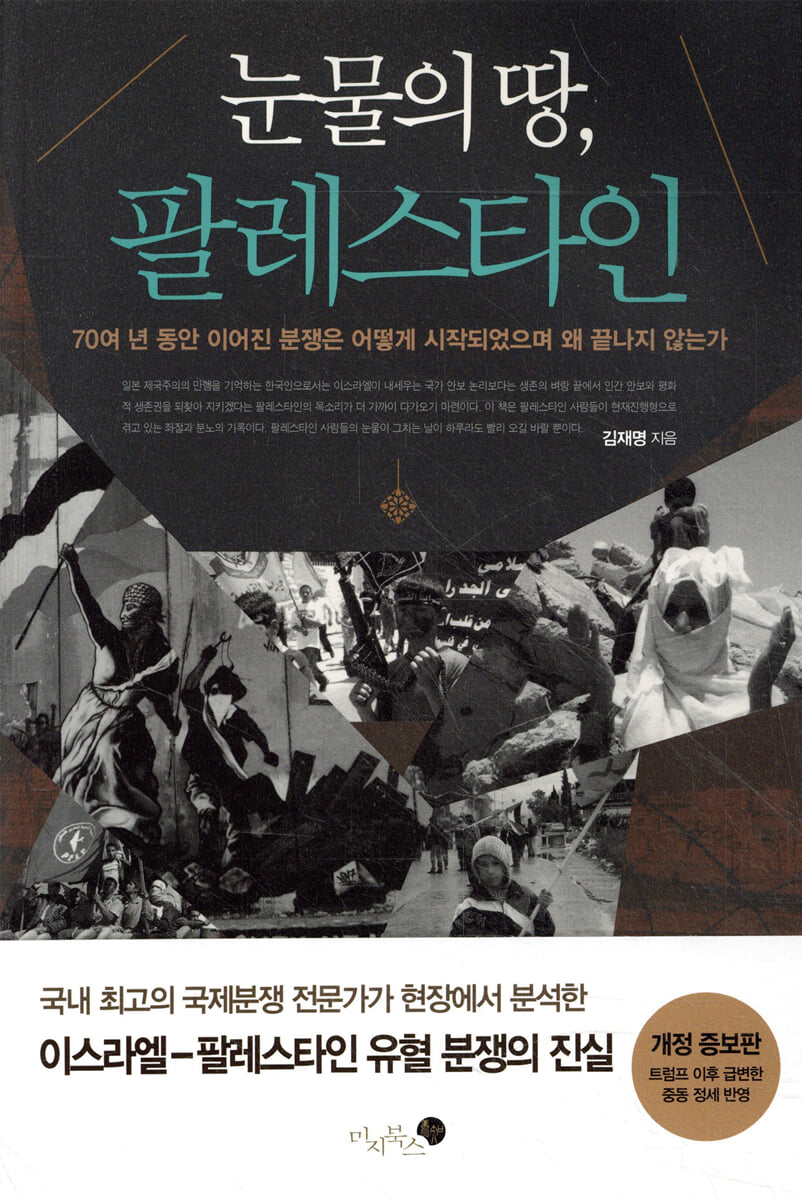
Palestine, the land of tears
 |
Description
Book Introduction
The truth behind the bloody Israeli-Palestinian conflict, analyzed on-site by Korea's top international conflict expert.
If the Balkan Peninsula, which sparked World War I and suffered from civil war throughout the 1990s, was the 'powder keg of the 20th century,' the Middle East is the 'powder keg of the 21st century.'
The Israeli-Palestinian conflict is a detonator that shakes peace not only in the Middle East but also around the world.
Even now, the vicious cycle of violence continues there, with Israel's military offensive and the fierce resistance of Palestinian armed groups, including Hamas, and ordinary citizens, who risk their lives.
This book, "Palestine, the Land of Tears," introduces the reality of the decades-long Israeli-Palestinian conflict and analyzes the deep-rooted causes of the conflict by outlining the history and politics of the Middle East.
Author Dr. Jaemyung Kim is a leading expert on international conflicts who has covered conflict sites around the world for nearly 20 years. He has visited Palestine and Israel more than ten times since 2000.
The author has also conducted numerous interviews with legendary Palestinian leaders, such as Arafat (PLO) and Yassin (Hamas), who were difficult for even Western journalists to cover.
This revised and expanded edition includes over 100 vivid field photos and details on the changing situation in the Middle East since the Trump administration took office.
If the Balkan Peninsula, which sparked World War I and suffered from civil war throughout the 1990s, was the 'powder keg of the 20th century,' the Middle East is the 'powder keg of the 21st century.'
The Israeli-Palestinian conflict is a detonator that shakes peace not only in the Middle East but also around the world.
Even now, the vicious cycle of violence continues there, with Israel's military offensive and the fierce resistance of Palestinian armed groups, including Hamas, and ordinary citizens, who risk their lives.
This book, "Palestine, the Land of Tears," introduces the reality of the decades-long Israeli-Palestinian conflict and analyzes the deep-rooted causes of the conflict by outlining the history and politics of the Middle East.
Author Dr. Jaemyung Kim is a leading expert on international conflicts who has covered conflict sites around the world for nearly 20 years. He has visited Palestine and Israel more than ten times since 2000.
The author has also conducted numerous interviews with legendary Palestinian leaders, such as Arafat (PLO) and Yassin (Hamas), who were difficult for even Western journalists to cover.
This revised and expanded edition includes over 100 vivid field photos and details on the changing situation in the Middle East since the Trump administration took office.
- You can preview some of the book's contents.
Preview
index
Chronology
To the revised and expanded edition
Part 1: Why the Land of Tears?
Chapter 1: Palestinian Anger, Frustration, and Resistance
Chapter 2: Why Jerusalem: A City of Conflict or a City of Peace?
Part 2: A Scene of Frustration and Anger
Chapter 3: Gaza Strip, a giant prison with only the sky open to it
Chapter 4: Palestine on the Brink of Survival
Chapter 5: Palestinian Children and Women
Chapter 6: A Grim Portrait of the Middle East: Palestinian Refugees
Chapter 7: The Separation Wall, Revealing the Jewish Ghetto
Chapter 8: Jewish Settlers: "This is God's Promised Land"
Chapter 9: Long-term Prisoners in Palestine
Chapter 10: Israeli Intelligence Agencies Fuel Internal Conflict in Palestine
Chapter 11: Israel's War Crimes
Part 3: Israel and Palestine: Past and Present
Chapter 12: Diaspora, Zionism, and the Balfour Declaration
Chapter 13: The Dark Shadow of Nation-building and Terror
Chapter 14: Why Hamas Raises the Flag of Struggle
Chapter 15: Other Anti-Israeli Struggle Organizations: PFLP, Jihad, and Hezbollah
Chapter 16: Israel's Concerns: Arab Citizens
Chapter 17: Is Israel a Democracy?
Chapter 18: The Arab Spring is a Winter for Israel
Part 4: The Middle East, the United States, and the Prospects for Peace
Chapter 19: The Missing Middle East Peace Milestone
Chapter 20: Hot Potatoes in Middle East Negotiations
Chapter 21: Collusion between the United States and Israel
Chapter 22: Comparing Israel's Military Power with That of the Middle East
Chapter 23: Nuclear Weapons Permitted Only to Israel
Chapter 24: Conscientious Objectors in Israel
Chapter 25: Israel's Pacifists
Part 5: Palestine's Tears Are Still In Progress
Chapter 26: The Light of Hope in Small Changes
Chapter 27 The Day When Palestine's Tears Will Stop
References
Search
To the revised and expanded edition
Part 1: Why the Land of Tears?
Chapter 1: Palestinian Anger, Frustration, and Resistance
Chapter 2: Why Jerusalem: A City of Conflict or a City of Peace?
Part 2: A Scene of Frustration and Anger
Chapter 3: Gaza Strip, a giant prison with only the sky open to it
Chapter 4: Palestine on the Brink of Survival
Chapter 5: Palestinian Children and Women
Chapter 6: A Grim Portrait of the Middle East: Palestinian Refugees
Chapter 7: The Separation Wall, Revealing the Jewish Ghetto
Chapter 8: Jewish Settlers: "This is God's Promised Land"
Chapter 9: Long-term Prisoners in Palestine
Chapter 10: Israeli Intelligence Agencies Fuel Internal Conflict in Palestine
Chapter 11: Israel's War Crimes
Part 3: Israel and Palestine: Past and Present
Chapter 12: Diaspora, Zionism, and the Balfour Declaration
Chapter 13: The Dark Shadow of Nation-building and Terror
Chapter 14: Why Hamas Raises the Flag of Struggle
Chapter 15: Other Anti-Israeli Struggle Organizations: PFLP, Jihad, and Hezbollah
Chapter 16: Israel's Concerns: Arab Citizens
Chapter 17: Is Israel a Democracy?
Chapter 18: The Arab Spring is a Winter for Israel
Part 4: The Middle East, the United States, and the Prospects for Peace
Chapter 19: The Missing Middle East Peace Milestone
Chapter 20: Hot Potatoes in Middle East Negotiations
Chapter 21: Collusion between the United States and Israel
Chapter 22: Comparing Israel's Military Power with That of the Middle East
Chapter 23: Nuclear Weapons Permitted Only to Israel
Chapter 24: Conscientious Objectors in Israel
Chapter 25: Israel's Pacifists
Part 5: Palestine's Tears Are Still In Progress
Chapter 26: The Light of Hope in Small Changes
Chapter 27 The Day When Palestine's Tears Will Stop
References
Search
Into the book
Palestinians' freedom of movement was restricted by checkpoints and separation barriers manned by Israeli soldiers, and farmers were unable to easily access the land they had cultivated for generations.
The Gaza Strip has long been surrounded by concrete and barbed wire.
The only open exit is the Mediterranean Sea, but even the sea is under the surveillance of the Israeli Navy.
This Israeli blockade has brought the Palestinian economy to the brink of collapse, leaving only hatred and despair toward the Jews.
--- pp.42~43
By the standards of Jerusalem's pious Jewish clergy, Tel Aviv is the Sodom and Gomorrah of the 21st century.
Of course, not all Tel Aviv citizens will nod their heads to this point.
Doesn't Seoul alone have the diversity of a large city?
It's like saying that it's hard to say anything about Seoul just by looking around Itaewon, Apgujeong-dong, and Hongdae.
--- p.55
Hardline Israeli politicians insist that “Jerusalem is Israel’s eternal capital, which can never be divided or shared.”
Israeli Prime Minister Benjamin Netanyahu has also made such public statements whenever he has the opportunity.
He said, “United Jerusalem is the capital of Israel.
“Jerusalem was, is and will always be ours, and will never be divided or separated,” he said.
--- p57
When we got to the scene, the relief supplies that had been left behind were still emitting smoke.
Then-UN Secretary-General Ban Ki-moon, who visited the Gaza Strip immediately after the ceasefire was reached, also strongly condemned Israel's indiscriminate bombing.
A UN official who met at the scene said, “Secretary-General Ban’s face was very dark as he looked at the vehicles that had been destroyed by Israeli gunfire, even though they clearly had the UN mark on them.”
--- p78
Ariel Sharon's comments to Israeli media around that time clearly reveal his militant worldview.
“You can call me a monster or a murderer.
You can call Israel a Jewish Nazi state.
“That’s better than being a dead saint.” Far from being punished as a war criminal, Sharon’s political career persisted, and in 2002, 20 years after the Lebanese massacre, he became the Prime Minister of Israel and took the lead in strangling Palestinians.
--- p121
The central figures of Hamas were Sheikh Ahmed Yassin, the founder and spiritual leader of the organization, and Abdul Aziz Rantisi, a former doctor.
However, these two men were killed by Israeli helicopter missiles in the spring of 2004.
I had two interviews with Yasin before he died.
It was at his house in downtown Gaza.
Yassin suffered a neck injury in an accident at age 15, and was arrested by Israel in 1989, early in the founding of Hamas, and spent seven years in prison, leaving him paralyzed from the waist down and with fingers.
The Gaza Strip has long been surrounded by concrete and barbed wire.
The only open exit is the Mediterranean Sea, but even the sea is under the surveillance of the Israeli Navy.
This Israeli blockade has brought the Palestinian economy to the brink of collapse, leaving only hatred and despair toward the Jews.
--- pp.42~43
By the standards of Jerusalem's pious Jewish clergy, Tel Aviv is the Sodom and Gomorrah of the 21st century.
Of course, not all Tel Aviv citizens will nod their heads to this point.
Doesn't Seoul alone have the diversity of a large city?
It's like saying that it's hard to say anything about Seoul just by looking around Itaewon, Apgujeong-dong, and Hongdae.
--- p.55
Hardline Israeli politicians insist that “Jerusalem is Israel’s eternal capital, which can never be divided or shared.”
Israeli Prime Minister Benjamin Netanyahu has also made such public statements whenever he has the opportunity.
He said, “United Jerusalem is the capital of Israel.
“Jerusalem was, is and will always be ours, and will never be divided or separated,” he said.
--- p57
When we got to the scene, the relief supplies that had been left behind were still emitting smoke.
Then-UN Secretary-General Ban Ki-moon, who visited the Gaza Strip immediately after the ceasefire was reached, also strongly condemned Israel's indiscriminate bombing.
A UN official who met at the scene said, “Secretary-General Ban’s face was very dark as he looked at the vehicles that had been destroyed by Israeli gunfire, even though they clearly had the UN mark on them.”
--- p78
Ariel Sharon's comments to Israeli media around that time clearly reveal his militant worldview.
“You can call me a monster or a murderer.
You can call Israel a Jewish Nazi state.
“That’s better than being a dead saint.” Far from being punished as a war criminal, Sharon’s political career persisted, and in 2002, 20 years after the Lebanese massacre, he became the Prime Minister of Israel and took the lead in strangling Palestinians.
--- p121
The central figures of Hamas were Sheikh Ahmed Yassin, the founder and spiritual leader of the organization, and Abdul Aziz Rantisi, a former doctor.
However, these two men were killed by Israeli helicopter missiles in the spring of 2004.
I had two interviews with Yasin before he died.
It was at his house in downtown Gaza.
Yassin suffered a neck injury in an accident at age 15, and was arrested by Israel in 1989, early in the founding of Hamas, and spent seven years in prison, leaving him paralyzed from the waist down and with fingers.
--- p291
Publisher's Review
Palestine, the land of tears and lamentation
The miserable collapse of houses and mosques where the smoke still lingers, the 8-meter-high separation wall that has taken away even the freedoms that once existed, the luxuriously built Jewish settlements in front of the Palestinians who have no home and are wandering in refugee camps, the tears of Palestinians who have lost their parents and children to Israeli shelling, the farmer kneeling in front of the olive grove where the hope for their family's livelihood has turned to ashes, the Arab youth who live without hope, enduring all kinds of inequality as second-class citizens...
This is Palestine, the site of so-called 'terrorism' and 'retaliation' as seen through the eyes of the author who visited Palestine more than ten times.
Israel has been labeling Palestinian resistance as "terrorism."
Why do they commit terrorism? Why does the bloody conflict, which has continued for over 70 years, continue unabated? The author argues that before analyzing these questions, we must first look at the Palestinian land itself, the tears and cries flowing amid the ruins of brutal destruction.
The Root of Conflict: Zionism
The Jews, who had been scattered by the Roman Empire 2,000 years ago, established Israel in the land of Palestine in 1948.
This new nation was the fruit of the Jewish nationalist movement (Zionism) in the late 19th century.
Zion is the name of a hill in ancient Jerusalem in Palestine.
Zionism is a movement to establish an independent state in Palestine for Jews scattered around the world, using the hill in ancient Jerusalem as a symbolic goal.
Theodor Herzl, the founder of the Zionist movement, was a 19th-century Austrian journalist who, far from being religiously strict like a Jewish rabbi, lived a very secular life.
Herzl saw the spread of anti-Jewish sentiment following the Dreyfus Affair in 1894 (the case in which a Jewish French officer was accused of being a German spy without evidence), and he believed that an independent Jewish state should be established.
The state-building movement initiated by Herzl led to the First Zionist Congress in Basel, Switzerland in 1897, where a declaration calling for the creation of a Jewish state in Palestine was issued.
Palestine was not a no-man's-land
The promised land flowing with milk and honey that the Zionists wanted to go to was not a no-man's land.
At the end of World War I, Palestine was home to 700,000 to 800,000 Arabs and 50,000 to 60,000 indigenous Jews.
If Jews were to immigrate in large numbers, conflicts over land would inevitably arise.
During World War I, Britain promised the Rothschilds, the financial magnates who had been financially supporting the Zionist movement, the creation of a Jewish state in exchange for war support.
This is the Balfour Declaration (1917), named after British Foreign Secretary Arthur James Balfour.
However, Britain also needed the support of the Arabs to fight the Ottoman Empire and promised them an independent state.
This is the McMahon-Hussein Agreement (1915) between a senior British official and the Caliph of Saudi Arabia.
These two promises conflicted with each other.
As a result, other Arab countries under the rule of the Ottoman Empire gained independence, but only the Arabs in the places where the Jewish state was established lost their homes and land and were forcibly driven out.
One land, two nations
As the wave of Jewish immigration continued, the number of Jews in Palestine reached 450,000 in 1940.
Arabs waged an armed struggle against Britain's pro-Jewish policies.
At that time, Jews were often engaged in gun battles with the native Arabs, and when the Jews took up arms to defend themselves, Britain supported them.
The Jewish militia organizations formed at this time were the Haganah and the Irgun.
By 1944, the Haganah numbered nearly 100,000 members and became the main force in the Israeli War of Independence a few years later.
They threw grenades into empty houses to drive out the indigenous people and terrorized Palestinians.
When necessary, they even carried out terrorist attacks against British forces.
In the midst of the chaos and violence over a single piece of land, the United Nations decided to divide the Palestinian territory into 6 to 4 parts, each to establish a Jewish state and an Arab state (UN General Assembly Resolution 181, 1947).
Jerusalem was to remain an open city, not fully annexed by either side, and placed under a trusteeship.
The founding of Israel and the four Middle East wars
However, by then, the Israeli armed groups Haganah and Irgun had already occupied three-quarters of Palestinian land.
And when Israel was established in May 1948, a whopping 870,000 Arabs were driven out of the land.
As a result, the Arab coalition attacked Israel, leading to the First Middle East War, but Israel won and acquired much more land than had been decided upon by the United Nations.
Israel's victory in the three subsequent wars left it with more occupied territory, while Palestine was left with a semi-autonomous state in a dwarfed territory confined to the West Bank and Gaza Strip.
Thus, a situation was created where both sides exchanged violence under Israeli oppression, which is no different from colonial rule today.
The emergence of Israel, a country that did not exist on world maps until the first half of the 20th century, in the Middle East resulted in enormous sacrifices for the Palestinian people, and the situation in which they live to this day has become one of tears.
Palestinian resistance, the intifada
The two intifadas were an outburst of long-standing anger among the Palestinians who had endured years of sorrow and frustration under Israeli oppression.
Intifada translates to uprising or resistance.
The first uprising, triggered by the deaths of four Palestinians in 1987 when a jeep struck them in Israeli-occupied territories, lasted for more than six years and resulted in the deaths of more than 1,000 Palestinians and 90 Jews.
The incident attracted international attention, and the bloodshed was temporarily calmed by the Oslo Peace Accords (1993), which established a limited Palestinian self-government under active mediation by the United States and Europe.
However, in 2000, when Israeli right-wing politician Ariel Sharon stormed the Al-Aqsa Mosque in East Jerusalem, a holy site for Muslims, Palestinians protested by throwing stones, and the Israeli army suppressed the protests with blood, starting the Second Intifada.
During this process, over 5,000 Palestinians and 1,000 Israelis were killed over seven years.
The reason there were more casualties in the Second Intifada was because the Palestinians were fully armed.
Between 2000 and 2018, there were over 10,000 Palestinian casualties and just over 1,000 Israeli casualties.
In terms of death rate, there are 10 Arabs for every 1 Jew.
This extreme asymmetry has led to constant international condemnation of Israel for not simply conducting military operations in conflict zones, but also for committing inhumane war crimes and massacres.
The Gaza Invasion and Israel's War Crimes
Israel is alternating between temporary occupation and retreat in the West Bank and Gaza Strip.
After the Oslo Accords, the Palestine Liberation Organization (PLO) led by Arafat moderated, and Hamas, an Islamist force based in the Gaza Strip, emerged in Palestinian politics.
Israel invaded the Gaza Strip three times in 2009, 2012, and 2014, using Hamas' terror attacks as a pretext.
According to a 2009 UN report, Israeli forces used an 11-year-old Palestinian boy as a human shield during the Gaza invasion, bulldozed houses containing women and children, and shelled houses containing civilians.
The Israeli army bulldozed olive groves, the livelihood of local farmers, claiming to have a clear view, and bombed numerous homes under the pretext of searching for underground arms-smuggling tunnels leading to Egypt.
In one household in the Gaza Strip that the author visited, Asma, a 15-year-old girl hanging laundry on the roof of her house, and her 11-year-old brother Ahmed, who was feeding pigeons right next to her, were shot dead by an Israeli sniper in broad daylight.
Why did the sniper kill these sisters? One in three Palestinian children say they will grow up to be martyrs.
The growing intensity of their resistance is also evidence of their deepening frustration and anger.
a huge separation barrier
Since 2002, Israel has been pushing for the construction of a separation barrier totaling 710 kilometers.
By the end of 2014, approximately 500 kilometers had been completed.
The nominal reason for building the wall is 'security', but in reality, the purpose is to annex Jewish settlements in the West Bank, which have been illegally occupied since the Six-Day War in 1967, to Israeli territory and make the territory of the Palestinian independent state that will one day be established even smaller.
The separation barrier extends further into Palestinian territory than the Green Line, which served as the border for 19 years before the Six-Day War, leaving 240,000 Palestinians trapped between them with nowhere to go.
Palestinians trapped inside the wall lack the basic freedoms of movement that every human being should enjoy, including the freedom to visit family and friends.
They are in a situation where they cannot find jobs or basic necessities, cannot farm because waterways are blocked, and it is difficult to even obtain drinking water.
To make matters worse, Palestinians suffer daily from violence, both large and small, from Jewish settlers and Israeli soldiers.
These trapped Palestinians living within the wall are living in a 21st-century ghetto, with restrictions on their residence, much like the Jews did during Hitler's Nazi era.
Israel's goal is to divide Palestine into the West Bank and the Gaza Strip and then isolate its cities and towns by building a wall.
In addition to the separation barrier, Palestinians are suffering from extreme poverty due to Israel's harsh economic blockade.
Israel's per capita income is around $35,000, while Palestine's per capita income is only $3,000.
One in two Palestinians lives in absolute poverty.
Israel's blockade policy is an economic war aimed at paralyzing the Palestinian economy and forcing its surrender.
The calculation is that even if Israel cannot destroy Palestine militarily due to international condemnation, it can economically destroy it.
The brutal forced migration and massacre of Native Americans by white Americans in the 19th century, and the infamous apartheid system of the white South African regime in the 20th century, are now distant legends, but in the Middle East, a 21st-century version of Israel's ethnic cleansing and discrimination is taking place.
Jewish settlements, the vanguard of colonization
600,000 Jews live in settlements in the Palestinian territories.
Settlements are a right-wing political project aimed at expanding Israel's territory.
The Israeli government encouraged settlement construction and resettlement in the occupied territories by providing financial support to construction companies and residents.
Because the area where the settlements are built is Palestinian territory under international law, the settlement apartments are built to resemble fortresses on a battlefield.
Also, around the settlement, it is not uncommon to see fathers carrying automatic rifles taking walks with their families.
Jewish settlers legally carry guns.
Under the pretext of protecting themselves from Palestinian terrorists.
As friction with local Palestinian residents increased as settlements were built after the Six-Day War, the Israeli Ministry of Defense allowed settlers to arm themselves in 1973.
In 1981, Jewish settlers were even given the power to search and arrest Palestinians without warrants (Israeli Military Order No. 898).
When the Intifada broke out in 2000, the Jewish settlers' power grew even more, allowing them to shoot at Palestinians!
The strategy of Israeli hardliners to dominate the Middle East boils down to maintaining the status quo based on military superiority.
The idea is to maintain the existing situation of military occupation of Palestine as is, while prolonging the period as much as possible and expanding Israeli territory by establishing more Jewish settlements in Palestinian territories.
Even today, Jewish settlers routinely harass and threaten the surrounding Palestinian population, creating a climate of fear and encouraging the indigenous people to leave.
Whose land is Jerusalem?
In 2018, US President Trump caused a stir by moving the US embassy to Jerusalem.
The international community has not recognized Jerusalem as the capital of Israel.
This is because Jerusalem was declared an international city under the UN trusteeship through UN General Assembly Resolution 181 in 1947.
Most countries also have their embassies in Tel Aviv, not Jerusalem.
However, hard-line Israeli politicians insist that “Jerusalem is the eternal capital of Israel, which can never be divided or shared” (Palestinians, on the other hand, claim that East Jerusalem is the capital of an independent Palestinian state).
Jerusalem has a population of 900,000.
West Jerusalem is predominantly Jewish, while East Jerusalem is home to 6 Arabs and 4 Jews.
The problem is that the Israeli government is implementing various policies that disadvantage Arabs in order to reduce the proportion of Arabs in East Jerusalem, such as forced evictions and bans on new housing construction.
As a result, the proportion of Arabs is decreasing year by year.
The massive Jewish settlements surrounding East Jerusalem are effectively Israeli colonies embedded in Palestinian territory.
If you look at a map of the West Bank, you can see that Jewish settlements are scattered everywhere like countless dots.
It means that all of Jerusalem will become Israeli territory.
President Trump's recent decision to move the embassy recognizes Jerusalem as the official capital of Israel and, furthermore, acknowledges Israel's current military occupation of Palestine.
This also means throwing away the two-state solution card.
Instead of establishing two independent states of Israel and Palestine on the land of the Middle East, it is a one-state solution, that is, recognizing only Israel.
Israel's military superiority and Iran's nuclear weapons
After four wars, the military balance between the Arab states of the Middle East and Israel has increasingly shifted toward Israel.
Israel currently has a strategy of using its military superiority in the Middle East to prevent and thwart the establishment of an independent Palestinian state.
The reason for the military imbalance is that the burden of defense on Israel's southwestern front was reduced by the peace agreement with Egypt in 1979, brokered by U.S. President Jimmy Carter.
The 1994 peace agreement with King Hussein of Jordan is in the same vein.
In particular, the removal of the Egyptian threat is a great advantage for Israel, as Egypt is the largest Arab country and has already fought several wars with Israel.
In exchange for the peace agreement, Egypt and Jordan received massive annual economic and military aid from the United States.
In addition, the division of the Arab world caused by the eight-year Iran-Iraq War in the 1980s also worked to Israel's advantage.
Then, in the 1990s, the Gulf War weakened Iraq's military power, and the collapse of the Soviet Union, which had been providing military aid to the Arab world, disrupted the military balance between Israel and Arab countries.
The 2003 Iraq War toppled Saddam Hussein's regime, disbanding the 400,000-strong Iraqi army and solidifying Israel's military superiority.
Israel's military power is now balanced quantitatively with that of its neighbors, while maintaining a qualitative advantage.
The only country Israel now has to worry about is Iran, which is developing nuclear weapons.
If Israel were to launch a surprise attack on Iran's nuclear facilities, the flames of war would likely spread throughout the Middle East.
A place that everyone in the world should pay attention to until the end.
The author, who has covered the Middle East more than ten times since 2000, says that now is the time to listen to the cries of the Palestinian people who say, "We want to live like human beings too."
He says that when gunfire is heard in the Middle East, it should not be simply dismissed as the work of some extreme terrorists.
This is not because of concerns about international oil prices, nor because of the complexities of international diplomacy, such as having to send troops under the pretext of peacekeeping forces at the request of the United States.
Rather, the Palestinian issue poses fundamental questions to us about what peace and justice mean.
The miserable collapse of houses and mosques where the smoke still lingers, the 8-meter-high separation wall that has taken away even the freedoms that once existed, the luxuriously built Jewish settlements in front of the Palestinians who have no home and are wandering in refugee camps, the tears of Palestinians who have lost their parents and children to Israeli shelling, the farmer kneeling in front of the olive grove where the hope for their family's livelihood has turned to ashes, the Arab youth who live without hope, enduring all kinds of inequality as second-class citizens...
This is Palestine, the site of so-called 'terrorism' and 'retaliation' as seen through the eyes of the author who visited Palestine more than ten times.
Israel has been labeling Palestinian resistance as "terrorism."
Why do they commit terrorism? Why does the bloody conflict, which has continued for over 70 years, continue unabated? The author argues that before analyzing these questions, we must first look at the Palestinian land itself, the tears and cries flowing amid the ruins of brutal destruction.
The Root of Conflict: Zionism
The Jews, who had been scattered by the Roman Empire 2,000 years ago, established Israel in the land of Palestine in 1948.
This new nation was the fruit of the Jewish nationalist movement (Zionism) in the late 19th century.
Zion is the name of a hill in ancient Jerusalem in Palestine.
Zionism is a movement to establish an independent state in Palestine for Jews scattered around the world, using the hill in ancient Jerusalem as a symbolic goal.
Theodor Herzl, the founder of the Zionist movement, was a 19th-century Austrian journalist who, far from being religiously strict like a Jewish rabbi, lived a very secular life.
Herzl saw the spread of anti-Jewish sentiment following the Dreyfus Affair in 1894 (the case in which a Jewish French officer was accused of being a German spy without evidence), and he believed that an independent Jewish state should be established.
The state-building movement initiated by Herzl led to the First Zionist Congress in Basel, Switzerland in 1897, where a declaration calling for the creation of a Jewish state in Palestine was issued.
Palestine was not a no-man's-land
The promised land flowing with milk and honey that the Zionists wanted to go to was not a no-man's land.
At the end of World War I, Palestine was home to 700,000 to 800,000 Arabs and 50,000 to 60,000 indigenous Jews.
If Jews were to immigrate in large numbers, conflicts over land would inevitably arise.
During World War I, Britain promised the Rothschilds, the financial magnates who had been financially supporting the Zionist movement, the creation of a Jewish state in exchange for war support.
This is the Balfour Declaration (1917), named after British Foreign Secretary Arthur James Balfour.
However, Britain also needed the support of the Arabs to fight the Ottoman Empire and promised them an independent state.
This is the McMahon-Hussein Agreement (1915) between a senior British official and the Caliph of Saudi Arabia.
These two promises conflicted with each other.
As a result, other Arab countries under the rule of the Ottoman Empire gained independence, but only the Arabs in the places where the Jewish state was established lost their homes and land and were forcibly driven out.
One land, two nations
As the wave of Jewish immigration continued, the number of Jews in Palestine reached 450,000 in 1940.
Arabs waged an armed struggle against Britain's pro-Jewish policies.
At that time, Jews were often engaged in gun battles with the native Arabs, and when the Jews took up arms to defend themselves, Britain supported them.
The Jewish militia organizations formed at this time were the Haganah and the Irgun.
By 1944, the Haganah numbered nearly 100,000 members and became the main force in the Israeli War of Independence a few years later.
They threw grenades into empty houses to drive out the indigenous people and terrorized Palestinians.
When necessary, they even carried out terrorist attacks against British forces.
In the midst of the chaos and violence over a single piece of land, the United Nations decided to divide the Palestinian territory into 6 to 4 parts, each to establish a Jewish state and an Arab state (UN General Assembly Resolution 181, 1947).
Jerusalem was to remain an open city, not fully annexed by either side, and placed under a trusteeship.
The founding of Israel and the four Middle East wars
However, by then, the Israeli armed groups Haganah and Irgun had already occupied three-quarters of Palestinian land.
And when Israel was established in May 1948, a whopping 870,000 Arabs were driven out of the land.
As a result, the Arab coalition attacked Israel, leading to the First Middle East War, but Israel won and acquired much more land than had been decided upon by the United Nations.
Israel's victory in the three subsequent wars left it with more occupied territory, while Palestine was left with a semi-autonomous state in a dwarfed territory confined to the West Bank and Gaza Strip.
Thus, a situation was created where both sides exchanged violence under Israeli oppression, which is no different from colonial rule today.
The emergence of Israel, a country that did not exist on world maps until the first half of the 20th century, in the Middle East resulted in enormous sacrifices for the Palestinian people, and the situation in which they live to this day has become one of tears.
Palestinian resistance, the intifada
The two intifadas were an outburst of long-standing anger among the Palestinians who had endured years of sorrow and frustration under Israeli oppression.
Intifada translates to uprising or resistance.
The first uprising, triggered by the deaths of four Palestinians in 1987 when a jeep struck them in Israeli-occupied territories, lasted for more than six years and resulted in the deaths of more than 1,000 Palestinians and 90 Jews.
The incident attracted international attention, and the bloodshed was temporarily calmed by the Oslo Peace Accords (1993), which established a limited Palestinian self-government under active mediation by the United States and Europe.
However, in 2000, when Israeli right-wing politician Ariel Sharon stormed the Al-Aqsa Mosque in East Jerusalem, a holy site for Muslims, Palestinians protested by throwing stones, and the Israeli army suppressed the protests with blood, starting the Second Intifada.
During this process, over 5,000 Palestinians and 1,000 Israelis were killed over seven years.
The reason there were more casualties in the Second Intifada was because the Palestinians were fully armed.
Between 2000 and 2018, there were over 10,000 Palestinian casualties and just over 1,000 Israeli casualties.
In terms of death rate, there are 10 Arabs for every 1 Jew.
This extreme asymmetry has led to constant international condemnation of Israel for not simply conducting military operations in conflict zones, but also for committing inhumane war crimes and massacres.
The Gaza Invasion and Israel's War Crimes
Israel is alternating between temporary occupation and retreat in the West Bank and Gaza Strip.
After the Oslo Accords, the Palestine Liberation Organization (PLO) led by Arafat moderated, and Hamas, an Islamist force based in the Gaza Strip, emerged in Palestinian politics.
Israel invaded the Gaza Strip three times in 2009, 2012, and 2014, using Hamas' terror attacks as a pretext.
According to a 2009 UN report, Israeli forces used an 11-year-old Palestinian boy as a human shield during the Gaza invasion, bulldozed houses containing women and children, and shelled houses containing civilians.
The Israeli army bulldozed olive groves, the livelihood of local farmers, claiming to have a clear view, and bombed numerous homes under the pretext of searching for underground arms-smuggling tunnels leading to Egypt.
In one household in the Gaza Strip that the author visited, Asma, a 15-year-old girl hanging laundry on the roof of her house, and her 11-year-old brother Ahmed, who was feeding pigeons right next to her, were shot dead by an Israeli sniper in broad daylight.
Why did the sniper kill these sisters? One in three Palestinian children say they will grow up to be martyrs.
The growing intensity of their resistance is also evidence of their deepening frustration and anger.
a huge separation barrier
Since 2002, Israel has been pushing for the construction of a separation barrier totaling 710 kilometers.
By the end of 2014, approximately 500 kilometers had been completed.
The nominal reason for building the wall is 'security', but in reality, the purpose is to annex Jewish settlements in the West Bank, which have been illegally occupied since the Six-Day War in 1967, to Israeli territory and make the territory of the Palestinian independent state that will one day be established even smaller.
The separation barrier extends further into Palestinian territory than the Green Line, which served as the border for 19 years before the Six-Day War, leaving 240,000 Palestinians trapped between them with nowhere to go.
Palestinians trapped inside the wall lack the basic freedoms of movement that every human being should enjoy, including the freedom to visit family and friends.
They are in a situation where they cannot find jobs or basic necessities, cannot farm because waterways are blocked, and it is difficult to even obtain drinking water.
To make matters worse, Palestinians suffer daily from violence, both large and small, from Jewish settlers and Israeli soldiers.
These trapped Palestinians living within the wall are living in a 21st-century ghetto, with restrictions on their residence, much like the Jews did during Hitler's Nazi era.
Israel's goal is to divide Palestine into the West Bank and the Gaza Strip and then isolate its cities and towns by building a wall.
In addition to the separation barrier, Palestinians are suffering from extreme poverty due to Israel's harsh economic blockade.
Israel's per capita income is around $35,000, while Palestine's per capita income is only $3,000.
One in two Palestinians lives in absolute poverty.
Israel's blockade policy is an economic war aimed at paralyzing the Palestinian economy and forcing its surrender.
The calculation is that even if Israel cannot destroy Palestine militarily due to international condemnation, it can economically destroy it.
The brutal forced migration and massacre of Native Americans by white Americans in the 19th century, and the infamous apartheid system of the white South African regime in the 20th century, are now distant legends, but in the Middle East, a 21st-century version of Israel's ethnic cleansing and discrimination is taking place.
Jewish settlements, the vanguard of colonization
600,000 Jews live in settlements in the Palestinian territories.
Settlements are a right-wing political project aimed at expanding Israel's territory.
The Israeli government encouraged settlement construction and resettlement in the occupied territories by providing financial support to construction companies and residents.
Because the area where the settlements are built is Palestinian territory under international law, the settlement apartments are built to resemble fortresses on a battlefield.
Also, around the settlement, it is not uncommon to see fathers carrying automatic rifles taking walks with their families.
Jewish settlers legally carry guns.
Under the pretext of protecting themselves from Palestinian terrorists.
As friction with local Palestinian residents increased as settlements were built after the Six-Day War, the Israeli Ministry of Defense allowed settlers to arm themselves in 1973.
In 1981, Jewish settlers were even given the power to search and arrest Palestinians without warrants (Israeli Military Order No. 898).
When the Intifada broke out in 2000, the Jewish settlers' power grew even more, allowing them to shoot at Palestinians!
The strategy of Israeli hardliners to dominate the Middle East boils down to maintaining the status quo based on military superiority.
The idea is to maintain the existing situation of military occupation of Palestine as is, while prolonging the period as much as possible and expanding Israeli territory by establishing more Jewish settlements in Palestinian territories.
Even today, Jewish settlers routinely harass and threaten the surrounding Palestinian population, creating a climate of fear and encouraging the indigenous people to leave.
Whose land is Jerusalem?
In 2018, US President Trump caused a stir by moving the US embassy to Jerusalem.
The international community has not recognized Jerusalem as the capital of Israel.
This is because Jerusalem was declared an international city under the UN trusteeship through UN General Assembly Resolution 181 in 1947.
Most countries also have their embassies in Tel Aviv, not Jerusalem.
However, hard-line Israeli politicians insist that “Jerusalem is the eternal capital of Israel, which can never be divided or shared” (Palestinians, on the other hand, claim that East Jerusalem is the capital of an independent Palestinian state).
Jerusalem has a population of 900,000.
West Jerusalem is predominantly Jewish, while East Jerusalem is home to 6 Arabs and 4 Jews.
The problem is that the Israeli government is implementing various policies that disadvantage Arabs in order to reduce the proportion of Arabs in East Jerusalem, such as forced evictions and bans on new housing construction.
As a result, the proportion of Arabs is decreasing year by year.
The massive Jewish settlements surrounding East Jerusalem are effectively Israeli colonies embedded in Palestinian territory.
If you look at a map of the West Bank, you can see that Jewish settlements are scattered everywhere like countless dots.
It means that all of Jerusalem will become Israeli territory.
President Trump's recent decision to move the embassy recognizes Jerusalem as the official capital of Israel and, furthermore, acknowledges Israel's current military occupation of Palestine.
This also means throwing away the two-state solution card.
Instead of establishing two independent states of Israel and Palestine on the land of the Middle East, it is a one-state solution, that is, recognizing only Israel.
Israel's military superiority and Iran's nuclear weapons
After four wars, the military balance between the Arab states of the Middle East and Israel has increasingly shifted toward Israel.
Israel currently has a strategy of using its military superiority in the Middle East to prevent and thwart the establishment of an independent Palestinian state.
The reason for the military imbalance is that the burden of defense on Israel's southwestern front was reduced by the peace agreement with Egypt in 1979, brokered by U.S. President Jimmy Carter.
The 1994 peace agreement with King Hussein of Jordan is in the same vein.
In particular, the removal of the Egyptian threat is a great advantage for Israel, as Egypt is the largest Arab country and has already fought several wars with Israel.
In exchange for the peace agreement, Egypt and Jordan received massive annual economic and military aid from the United States.
In addition, the division of the Arab world caused by the eight-year Iran-Iraq War in the 1980s also worked to Israel's advantage.
Then, in the 1990s, the Gulf War weakened Iraq's military power, and the collapse of the Soviet Union, which had been providing military aid to the Arab world, disrupted the military balance between Israel and Arab countries.
The 2003 Iraq War toppled Saddam Hussein's regime, disbanding the 400,000-strong Iraqi army and solidifying Israel's military superiority.
Israel's military power is now balanced quantitatively with that of its neighbors, while maintaining a qualitative advantage.
The only country Israel now has to worry about is Iran, which is developing nuclear weapons.
If Israel were to launch a surprise attack on Iran's nuclear facilities, the flames of war would likely spread throughout the Middle East.
A place that everyone in the world should pay attention to until the end.
The author, who has covered the Middle East more than ten times since 2000, says that now is the time to listen to the cries of the Palestinian people who say, "We want to live like human beings too."
He says that when gunfire is heard in the Middle East, it should not be simply dismissed as the work of some extreme terrorists.
This is not because of concerns about international oil prices, nor because of the complexities of international diplomacy, such as having to send troops under the pretext of peacekeeping forces at the request of the United States.
Rather, the Palestinian issue poses fundamental questions to us about what peace and justice mean.
GOODS SPECIFICS
- Date of issue: May 10, 2019
- Page count, weight, size: 548 pages | 824g | 152*224*34mm
- ISBN13: 9788994142968
- ISBN10: 8994142967
You may also like
카테고리
korean


korean

![GQ KOREA Mark (Monthly): December [2025]](http://librairie.coreenne.fr/cdn/shop/files/8ef265dbbfbf186523ed75ba7319009d.jpg?v=1765340328&width=3840)


