

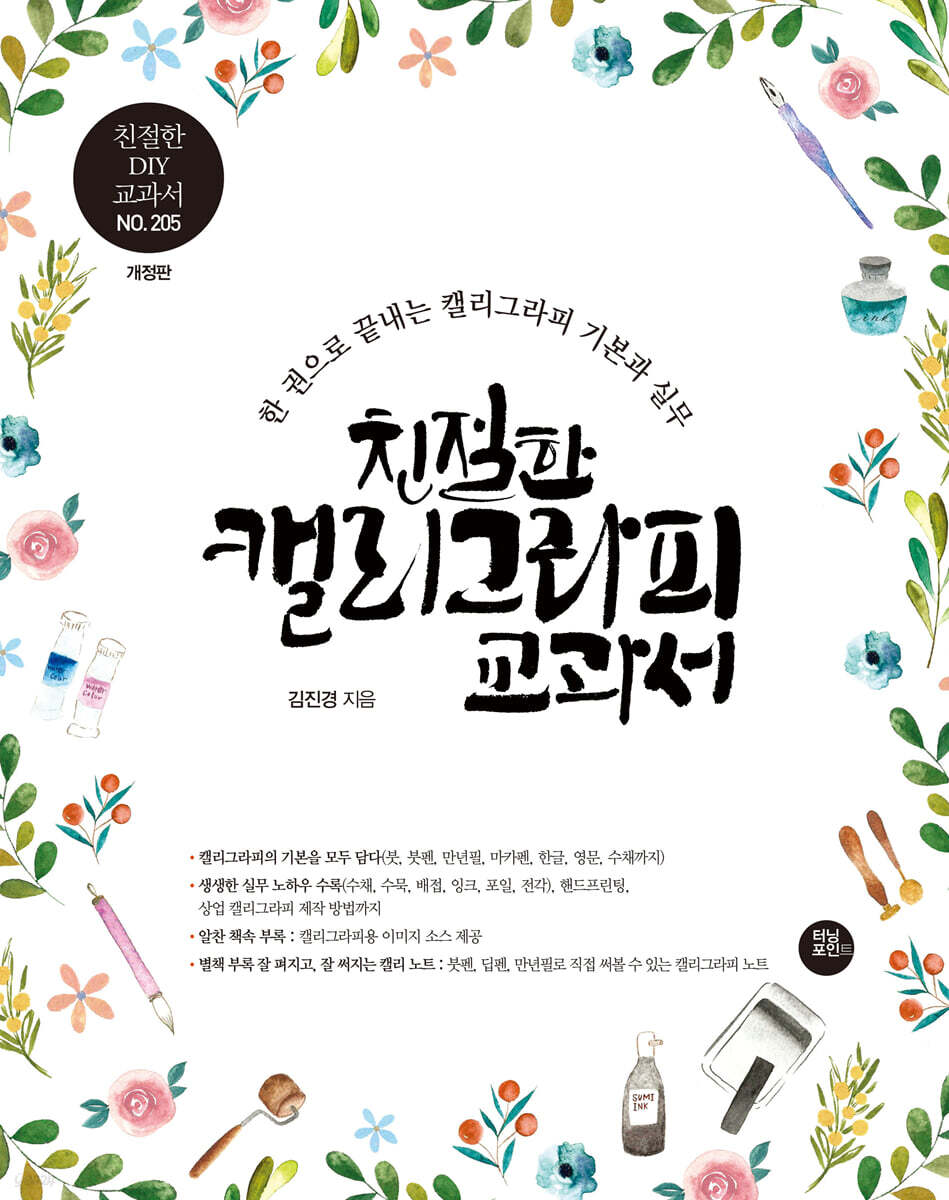
Friendly calligraphy textbook
 |
Description
Book Introduction
A calligraphy textbook that combines 10 years of expertise with practical and basic skills (with a separate appendix: a writing notebook that opens easily and writes well).
The revised edition of [Friendly Calligraphy Textbook], written by Harang Kim Jin-kyung of Hongdae Harangbang Calligraphy, a popular instructor who continued to teach even during the COVID-19 era, after three years of preparation, has been published.
This book is a calligraphy textbook that compiles into one volume the diverse practical knowledge gained through majoring in calligraphy and over ten years of calligraphy work and teaching experience.
From calligraphy's basics, brush writing, to brush pens, dip pens, fountain pens, and marker pens, it explains the basics of almost all calligraphy in a friendly and easy way, including Korean, English, and even watercolor and ink calligraphy.
It also contains vivid calligraphy practical know-how acquired through various techniques and practice, such as watercolor, sumi-e, back-printing, ink, foil, seal engraving, hand printing, and commercial calligraphy.
By following the 15 chapters of this extensive book, you will not only learn to copy but also discover the path to creativity, creating your own unique handwriting and works of art using various methods.
The 196-page [Well-Opened, Well-Written Writing Notebook] provided as an appendix is a selection of the best papers suitable for calligraphy with brush pens, dip pens, fountain pens, and marker pens, allowing you to directly follow the various basic strokes and practical examples introduced in the book.
We have increased the usability of the writing notebook by making it with a PUR binding that opens well so that you can practice writing with it more comfortably and stably.
In addition, the author provides image sources for calligraphy designed directly by the author, so that these can be used for various calligraphy works.
Let's heal through calligraphy and challenge ourselves to create a wonderful hobby of our own.
This book will gift you with your own unique handwriting and artwork.
The revised edition of [Friendly Calligraphy Textbook], written by Harang Kim Jin-kyung of Hongdae Harangbang Calligraphy, a popular instructor who continued to teach even during the COVID-19 era, after three years of preparation, has been published.
This book is a calligraphy textbook that compiles into one volume the diverse practical knowledge gained through majoring in calligraphy and over ten years of calligraphy work and teaching experience.
From calligraphy's basics, brush writing, to brush pens, dip pens, fountain pens, and marker pens, it explains the basics of almost all calligraphy in a friendly and easy way, including Korean, English, and even watercolor and ink calligraphy.
It also contains vivid calligraphy practical know-how acquired through various techniques and practice, such as watercolor, sumi-e, back-printing, ink, foil, seal engraving, hand printing, and commercial calligraphy.
By following the 15 chapters of this extensive book, you will not only learn to copy but also discover the path to creativity, creating your own unique handwriting and works of art using various methods.
The 196-page [Well-Opened, Well-Written Writing Notebook] provided as an appendix is a selection of the best papers suitable for calligraphy with brush pens, dip pens, fountain pens, and marker pens, allowing you to directly follow the various basic strokes and practical examples introduced in the book.
We have increased the usability of the writing notebook by making it with a PUR binding that opens well so that you can practice writing with it more comfortably and stably.
In addition, the author provides image sources for calligraphy designed directly by the author, so that these can be used for various calligraphy works.
Let's heal through calligraphy and challenge ourselves to create a wonderful hobby of our own.
This book will gift you with your own unique handwriting and artwork.
- You can preview some of the book's contents.
Preview
index
Preface/Preview
Calligraphy warm-up!
What is calligraphy?
How to write calligraphy properly
Calligraphy in Life
Part 1: Preparing Materials for Calligraphy
01 Why Brush Calligraphy is the Basics
02 Basic Materials for Calligraphy: The Four Stationery
03 The role of Seojin (Moonjin)
04 The Importance of the Mat
05 How to Choose the Right Brush for Calligraphy
06 Do I really need to use ink and an inkstone?
07 Choosing paper, including Korean paper
08 Where can I buy calligraphy materials?
Part 2: Getting to Know Your Brush: Basic Brush Handling
01 Posture and method of holding the brush
02 Use your arms when moving the brush
03 Correct posture for calligraphy
04 Basic strokes from the reverse to the return and how to write 'middle peak'
05 Why the midpoint is important
06 What is a pyeonbong?
07 Bad example of a flat surface
08 Harmony of the middle and lower peaks
Part 3: Introduction to Korean Calligraphy
01 Basic Calligraphy Transformation Method
02 Consonant transformation according to the flow of the letter shape
03 If you know the transformation of 'ㅏ', you're done with vowel transformation.
04 Combination of initial consonant + medial vowel + final consonant
05 Let's break away from the radish-shaped shape
06 Practice writing one-letter words that stand out at a glance
07 Writing words of two or more letters using vertical and horizontal points
08 points to give strong, medium, and weak rhythm to the text
09 Determine the point position based on the presence or absence of a support and its type
10. Transformation of double consonants and double consonants
11. Putting emotion into letters
12 Onomatopoeia and mimetic calligraphy that captures sounds and shapes
Part 4: Writing Calligraphy Properly: Beginner Korean Calligraphy
01 Write a short, one-line sentence with the main word written in large letters.
02 Let's omit the spacing
03 Align the center line to the center
04 Practice writing short sentences along with the meaning of the letter
05 Let's solve the puzzle with letters! Writing long sentences with line breaks
06 Basic Structure for Long Writing
07 Practice writing following a long sample
08 Upgrade your word writing structure!
09 Diversity of Long Writing Composition
10. Spacing with proper letter spacing
Part 5: Upgrade Your Calligraphy Skills! Intermediate Korean Calligraphy
01 The Beginning of Korean Fonts 'Panbonche'
02 The Flower of Korean Calligraphy, 'Gungche' - Jeongjache
03 Correct understanding of the cursive script
04 The Origin of Calligraphy, 'Minche'
05 How to use the collection of characters to find and write the necessary characters within a font
06 Korean Calligraphy Application Font Creation Method
07 Italic style font
08 Creating fonts based on stroke direction
09 Creating fonts based on stroke shapes
10 Cursive Calligraphy Creations
11 Various fonts created according to emotions
12 Advanced Korean Calligraphy Using Calligraphy Ink and Tools
Part 6: Using Calligraphy Ink and Tools - Advanced Korean Calligraphy
01 How to use ink with milk
02 White letters on a dark background, transparent ink
03 Shiny metallic ink
04 Encounter with Coffee, Use of Coffee and Ink
05 How to make your own ink
06 Reasons for using various tools other than brushes
07 Cotton Swab with Cute Writing Effect
08 Expressing three textures with one wooden chopstick
09 How to use the rough texture of the washcloth
10 Calligraphy Using Various Brush Pens
11 Marker pens that go well with calligraphy
12 Differences Between a Pen and a Fountain Pen
Calligraphy art created with 13 rollers
14 Calligraphy with a flat brush
15 Works using various inks and tools
Part 7: Magnificent and Stylish Chinese Calligraphy
01 History of Chinese Character Calligraphy
02 The Story of Chinese and Japanese Calligraphy
03 Chinese Calligraphy
04 Japanese Calligraphy
05 Chinese character calligraphy using Chinese character calligraphy
06 Converting Chinese Calligraphy to Hangul Font
Part 8: Introduction to Various English Calligraphy Materials
01 Types of pen holders
02 Types of nibs
03 Types of brush pens and marker pens
04 Types of ink
05 Types of paper
06 Accessories to enhance your English calligraphy
Part 9 The Refined Style of English Calligraphy: Italics
01 English Italic Basic Stroke Practice
02 English italic lowercase
03 English italic capital letters, numbers, and symbols
04 Writing English italicized words and sentences
Part 10 Copperplate Fonts Full of Elegance
01 Copper Plate Basic Stroke Practice
02 Copperplate English lowercase letters
03 Copperplate English capital letters, numbers, and symbols
04 Connecting the Copper Plate Alphabet
05 Decorative Techniques Floristic Composition
06 Copperplate Words and Sentence Writing
Part 11: The Ultimate Sophistication: Modern English Calligraphy
01 Modern English Calligraphy Basic Stroke Practice
02 Modern English Calligraphy Lowercase
03 Modern English Calligraphy Capital Letters, Numbers, and Symbols
04 How to Use Image Floris
05 Modern English Calligraphy Words and Sentences
06 Modern English Calligraphy Styling
Part 12 Brush Calligraphy in English
01 Brush English Calligraphy Basic Stroke Practice
02 Brush English lowercase letters
03 Brush English capital letters, numbers, and symbols
04 Brush English word writing
05 Brush English sentence writing
06 English calligraphy using brushes and markers
Part 13: Enriching Calligraphy with Various Techniques
Technique Watercolor technique
01 Basic Watercolor Techniques
02 Creating a watercolor background
03 Calligraphy using watercolor mixing technique
04 How to Use Watercolor Illustrations Frequently Used in Calligraphy
Technique Ink and wash technique
01 How to create ink brush stroke illustrations using dots, lines, and surfaces
02 Use of various flower spreads
03 Ink wash illustration using the basic 'three ink methods' of the ink wash technique
04 'Pictographic Characters' Using the Ink and Wash Technique
Techniques and techniques
01 The meaning of baekjeong and why baekjeong is necessary
02 Order of folding
03 How to make a panel for a folding work
Technique Ink Technique
01 Creating an ink bleed illustration background source
02 Ink Mixing Techniques for Writing Rainbow Calligraphy
Technique Foil Technique
01 3D Foil Calligraphy with Glue Pen
02 Sparkling Flat Foil Calligraphy
03 Shine on Leather! Leather Foil Calligraphy
Techniques Engraving techniques
01 Introduction to the meaning and materials of the pavilion
02 Tartar Method and Process
03 Order of engraving and arrangement of letters on the bottom of the plate
04 Side Engraving and Coloring
Part 14: Create Your Own Calligraphy Products! Calligraphy Practice
01 Photoshop Editing Method for Custom Printing Products
02 Calligraphy editing using a mobile phone app
03 iPad Calligraphy
04 Custom Mug
05 Custom-made acrylic mood lights
06 Custom made mobile phone case
07 Sticker Customization
Practical handprinting
01 1-color printing using a non-photosensitive silkscreen technique
02 Photosensitive silkscreen printing technique 2-color printing
03 Gradient printing using a photosensitive silkscreen technique
04 Letterpress 1-color printing
05 Letterpress 2-color printing
06 Letterpress Gradient Printing
Practical commercial calligraphy production
01 Logo/Title Creation Process
02 Korean logo
03 Chinese character logo
04 English logo
Part 15: Special Appendix - Creating Calligraphy Works Using Image Sources
01 Watercolor illustration source
02 Ink wash illustration source
03 Ink Illustration Source
04 Various background sources
05 How to compose a work using source code
Calligraphy warm-up!
What is calligraphy?
How to write calligraphy properly
Calligraphy in Life
Part 1: Preparing Materials for Calligraphy
01 Why Brush Calligraphy is the Basics
02 Basic Materials for Calligraphy: The Four Stationery
03 The role of Seojin (Moonjin)
04 The Importance of the Mat
05 How to Choose the Right Brush for Calligraphy
06 Do I really need to use ink and an inkstone?
07 Choosing paper, including Korean paper
08 Where can I buy calligraphy materials?
Part 2: Getting to Know Your Brush: Basic Brush Handling
01 Posture and method of holding the brush
02 Use your arms when moving the brush
03 Correct posture for calligraphy
04 Basic strokes from the reverse to the return and how to write 'middle peak'
05 Why the midpoint is important
06 What is a pyeonbong?
07 Bad example of a flat surface
08 Harmony of the middle and lower peaks
Part 3: Introduction to Korean Calligraphy
01 Basic Calligraphy Transformation Method
02 Consonant transformation according to the flow of the letter shape
03 If you know the transformation of 'ㅏ', you're done with vowel transformation.
04 Combination of initial consonant + medial vowel + final consonant
05 Let's break away from the radish-shaped shape
06 Practice writing one-letter words that stand out at a glance
07 Writing words of two or more letters using vertical and horizontal points
08 points to give strong, medium, and weak rhythm to the text
09 Determine the point position based on the presence or absence of a support and its type
10. Transformation of double consonants and double consonants
11. Putting emotion into letters
12 Onomatopoeia and mimetic calligraphy that captures sounds and shapes
Part 4: Writing Calligraphy Properly: Beginner Korean Calligraphy
01 Write a short, one-line sentence with the main word written in large letters.
02 Let's omit the spacing
03 Align the center line to the center
04 Practice writing short sentences along with the meaning of the letter
05 Let's solve the puzzle with letters! Writing long sentences with line breaks
06 Basic Structure for Long Writing
07 Practice writing following a long sample
08 Upgrade your word writing structure!
09 Diversity of Long Writing Composition
10. Spacing with proper letter spacing
Part 5: Upgrade Your Calligraphy Skills! Intermediate Korean Calligraphy
01 The Beginning of Korean Fonts 'Panbonche'
02 The Flower of Korean Calligraphy, 'Gungche' - Jeongjache
03 Correct understanding of the cursive script
04 The Origin of Calligraphy, 'Minche'
05 How to use the collection of characters to find and write the necessary characters within a font
06 Korean Calligraphy Application Font Creation Method
07 Italic style font
08 Creating fonts based on stroke direction
09 Creating fonts based on stroke shapes
10 Cursive Calligraphy Creations
11 Various fonts created according to emotions
12 Advanced Korean Calligraphy Using Calligraphy Ink and Tools
Part 6: Using Calligraphy Ink and Tools - Advanced Korean Calligraphy
01 How to use ink with milk
02 White letters on a dark background, transparent ink
03 Shiny metallic ink
04 Encounter with Coffee, Use of Coffee and Ink
05 How to make your own ink
06 Reasons for using various tools other than brushes
07 Cotton Swab with Cute Writing Effect
08 Expressing three textures with one wooden chopstick
09 How to use the rough texture of the washcloth
10 Calligraphy Using Various Brush Pens
11 Marker pens that go well with calligraphy
12 Differences Between a Pen and a Fountain Pen
Calligraphy art created with 13 rollers
14 Calligraphy with a flat brush
15 Works using various inks and tools
Part 7: Magnificent and Stylish Chinese Calligraphy
01 History of Chinese Character Calligraphy
02 The Story of Chinese and Japanese Calligraphy
03 Chinese Calligraphy
04 Japanese Calligraphy
05 Chinese character calligraphy using Chinese character calligraphy
06 Converting Chinese Calligraphy to Hangul Font
Part 8: Introduction to Various English Calligraphy Materials
01 Types of pen holders
02 Types of nibs
03 Types of brush pens and marker pens
04 Types of ink
05 Types of paper
06 Accessories to enhance your English calligraphy
Part 9 The Refined Style of English Calligraphy: Italics
01 English Italic Basic Stroke Practice
02 English italic lowercase
03 English italic capital letters, numbers, and symbols
04 Writing English italicized words and sentences
Part 10 Copperplate Fonts Full of Elegance
01 Copper Plate Basic Stroke Practice
02 Copperplate English lowercase letters
03 Copperplate English capital letters, numbers, and symbols
04 Connecting the Copper Plate Alphabet
05 Decorative Techniques Floristic Composition
06 Copperplate Words and Sentence Writing
Part 11: The Ultimate Sophistication: Modern English Calligraphy
01 Modern English Calligraphy Basic Stroke Practice
02 Modern English Calligraphy Lowercase
03 Modern English Calligraphy Capital Letters, Numbers, and Symbols
04 How to Use Image Floris
05 Modern English Calligraphy Words and Sentences
06 Modern English Calligraphy Styling
Part 12 Brush Calligraphy in English
01 Brush English Calligraphy Basic Stroke Practice
02 Brush English lowercase letters
03 Brush English capital letters, numbers, and symbols
04 Brush English word writing
05 Brush English sentence writing
06 English calligraphy using brushes and markers
Part 13: Enriching Calligraphy with Various Techniques
Technique Watercolor technique
01 Basic Watercolor Techniques
02 Creating a watercolor background
03 Calligraphy using watercolor mixing technique
04 How to Use Watercolor Illustrations Frequently Used in Calligraphy
Technique Ink and wash technique
01 How to create ink brush stroke illustrations using dots, lines, and surfaces
02 Use of various flower spreads
03 Ink wash illustration using the basic 'three ink methods' of the ink wash technique
04 'Pictographic Characters' Using the Ink and Wash Technique
Techniques and techniques
01 The meaning of baekjeong and why baekjeong is necessary
02 Order of folding
03 How to make a panel for a folding work
Technique Ink Technique
01 Creating an ink bleed illustration background source
02 Ink Mixing Techniques for Writing Rainbow Calligraphy
Technique Foil Technique
01 3D Foil Calligraphy with Glue Pen
02 Sparkling Flat Foil Calligraphy
03 Shine on Leather! Leather Foil Calligraphy
Techniques Engraving techniques
01 Introduction to the meaning and materials of the pavilion
02 Tartar Method and Process
03 Order of engraving and arrangement of letters on the bottom of the plate
04 Side Engraving and Coloring
Part 14: Create Your Own Calligraphy Products! Calligraphy Practice
01 Photoshop Editing Method for Custom Printing Products
02 Calligraphy editing using a mobile phone app
03 iPad Calligraphy
04 Custom Mug
05 Custom-made acrylic mood lights
06 Custom made mobile phone case
07 Sticker Customization
Practical handprinting
01 1-color printing using a non-photosensitive silkscreen technique
02 Photosensitive silkscreen printing technique 2-color printing
03 Gradient printing using a photosensitive silkscreen technique
04 Letterpress 1-color printing
05 Letterpress 2-color printing
06 Letterpress Gradient Printing
Practical commercial calligraphy production
01 Logo/Title Creation Process
02 Korean logo
03 Chinese character logo
04 English logo
Part 15: Special Appendix - Creating Calligraphy Works Using Image Sources
01 Watercolor illustration source
02 Ink wash illustration source
03 Ink Illustration Source
04 Various background sources
05 How to compose a work using source code
Detailed image

Publisher's Review
Calligraphy Basics and Practice in One Volume
Calligraphy can be started with any tool: a brush, brush pen, fountain pen, or marker pen.
It explains the basics of calligraphy, including the basics of brush writing, using brush pens, dip pens, fountain pens, and marker pens, as well as Korean, English, watercolor, and ink calligraphy, in a friendly and easy-to-understand manner.
You can practice various practical examples, including consonants, vowels, words, sentence writing, English alphabet and word sentences, and Chinese characters, directly in the writing notes provided in the appendix.
It also teaches you how to create a variety of useful items, such as postcards, business cards, Christmas cards, envelopes, picture frames, candles, fans, and lights, using your own calligraphy writing.
In addition to brushes, it also introduces various writing tools such as cotton swabs, wooden chopsticks, and dishcloths, as well as various ways to use ink.
Improve your calligraphy skills with practical know-how gained from over a decade of experience.
It contains not only various calligraphy techniques such as watercolor, sumi-e, backing, ink, foil, and engraving, but also practical calligraphy know-how learned through practical experience, such as hand printing, logo and title creation, and commercial calligraphy production methods.
We introduce how to use calligraphy digitally, including Photoshop editing techniques for custom printing of products, calligraphy editing using mobile phone apps, and iPad calligraphy, as well as how to custom-make mugs, acrylic mood lights, phone cases, stickers, and more.
By following the chapters of this extensive book, which consists of 15 parts, you will not only learn to copy but also discover the path to creation, where you can create your own handwriting and works of art using various methods.
A writing notebook with PUR binding that opens and writes better, and a free calligraphy source image
The 196-page [Writing Notes for Well-Writing] provided as an appendix is a selection of the best papers that are best for writing with tools such as brush pens, fountain pens, and marker pens, and allows you to directly follow the various basic strokes and practical examples introduced in the text.
The revised edition has been improved with PUR binding so that it can be easily opened and used for calligraphy practice.
In addition, the author provides image sources for calligraphy designed directly by the author, so even beginners can easily create various calligraphy works using these.
Calligraphy can be started with any tool: a brush, brush pen, fountain pen, or marker pen.
It explains the basics of calligraphy, including the basics of brush writing, using brush pens, dip pens, fountain pens, and marker pens, as well as Korean, English, watercolor, and ink calligraphy, in a friendly and easy-to-understand manner.
You can practice various practical examples, including consonants, vowels, words, sentence writing, English alphabet and word sentences, and Chinese characters, directly in the writing notes provided in the appendix.
It also teaches you how to create a variety of useful items, such as postcards, business cards, Christmas cards, envelopes, picture frames, candles, fans, and lights, using your own calligraphy writing.
In addition to brushes, it also introduces various writing tools such as cotton swabs, wooden chopsticks, and dishcloths, as well as various ways to use ink.
Improve your calligraphy skills with practical know-how gained from over a decade of experience.
It contains not only various calligraphy techniques such as watercolor, sumi-e, backing, ink, foil, and engraving, but also practical calligraphy know-how learned through practical experience, such as hand printing, logo and title creation, and commercial calligraphy production methods.
We introduce how to use calligraphy digitally, including Photoshop editing techniques for custom printing of products, calligraphy editing using mobile phone apps, and iPad calligraphy, as well as how to custom-make mugs, acrylic mood lights, phone cases, stickers, and more.
By following the chapters of this extensive book, which consists of 15 parts, you will not only learn to copy but also discover the path to creation, where you can create your own handwriting and works of art using various methods.
A writing notebook with PUR binding that opens and writes better, and a free calligraphy source image
The 196-page [Writing Notes for Well-Writing] provided as an appendix is a selection of the best papers that are best for writing with tools such as brush pens, fountain pens, and marker pens, and allows you to directly follow the various basic strokes and practical examples introduced in the text.
The revised edition has been improved with PUR binding so that it can be easily opened and used for calligraphy practice.
In addition, the author provides image sources for calligraphy designed directly by the author, so even beginners can easily create various calligraphy works using these.
GOODS SPECIFICS
- Date of issue: May 20, 2023
- Page count, weight, size: 784 pages | 210*240*40mm
- ISBN13: 9791161341392
- ISBN10: 1161341390
You may also like
카테고리
korean


korean

![GQ KOREA Mark (Monthly): December [2025]](http://librairie.coreenne.fr/cdn/shop/files/8ef265dbbfbf186523ed75ba7319009d.jpg?v=1765340328&width=3840)


