

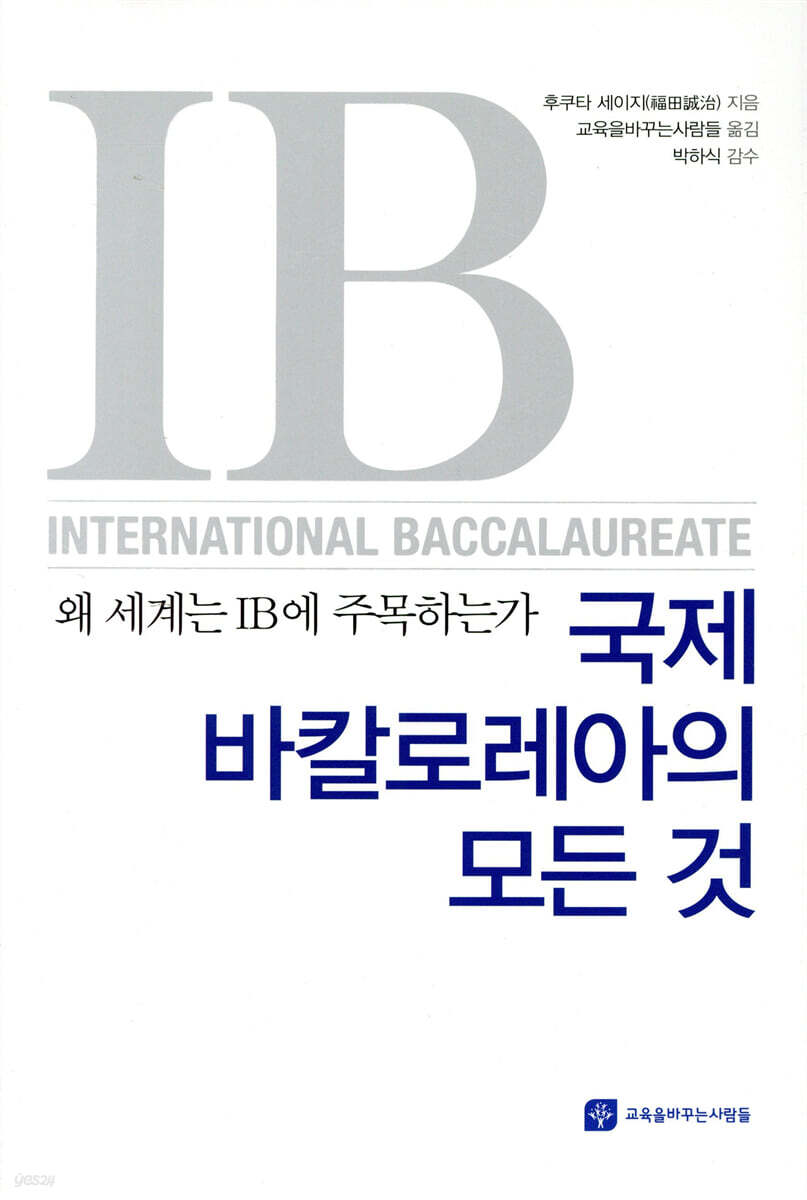
All About the International Baccalaureate
 |
Description
Book Introduction
Why the World Is Paying Attention to IB
A grand plan for the century, an educational reform and university entrance examination reform that looks ahead to the next 100 years of Japanese education has already begun, and the International Baccalaureate (IB) is at the center of it.
Everything about the IB (International Baccalaureate) is included in this one book!
The IB (International Baccalaureate) curriculum, ambitiously introduced in Japan, is a comprehensive educational reform that can be called a new Meiji Restoration.
Japan's university entrance examination reform aims to change Japan's academic performance by comprehensively reforming education so that high school and university education can lead to employment.
Author Seiji Fukuta (福田誠治) explains in detail the background of the IB and how it developed from a historical and educational philosophical perspective, based on extensive research and field visits over a long period of time.
In addition, it presents the characteristics/structure/curriculum comparison/evaluation of each of the three stages of the IB curriculum, PYP (curriculum for kindergarten and elementary school), MYP (curriculum for middle school), and DP (curriculum for high school - degree program), as well as the timetable for each grade level.
This one book will teach you everything about IB, from its roots to its implementation.
This is a must-read for anyone in the education field interested in college entrance exam reform and the introduction of the IB program in Korean education.
A grand plan for the century, an educational reform and university entrance examination reform that looks ahead to the next 100 years of Japanese education has already begun, and the International Baccalaureate (IB) is at the center of it.
Everything about the IB (International Baccalaureate) is included in this one book!
The IB (International Baccalaureate) curriculum, ambitiously introduced in Japan, is a comprehensive educational reform that can be called a new Meiji Restoration.
Japan's university entrance examination reform aims to change Japan's academic performance by comprehensively reforming education so that high school and university education can lead to employment.
Author Seiji Fukuta (福田誠治) explains in detail the background of the IB and how it developed from a historical and educational philosophical perspective, based on extensive research and field visits over a long period of time.
In addition, it presents the characteristics/structure/curriculum comparison/evaluation of each of the three stages of the IB curriculum, PYP (curriculum for kindergarten and elementary school), MYP (curriculum for middle school), and DP (curriculum for high school - degree program), as well as the timetable for each grade level.
This one book will teach you everything about IB, from its roots to its implementation.
This is a must-read for anyone in the education field interested in college entrance exam reform and the introduction of the IB program in Korean education.
- You can preview some of the book's contents.
Preview
index
Reviewer's Note 04
Preface 10
Chapter 1
How will college admissions change?
- It is conducted as a 3-stage test 27
-What is the High School Basic Academic Ability Diagnostic Test? 28
-What is the Common College Entrance Examination? 29
-Transition from score to step evaluation 32
-CBT (Computer-Based Test) 35
- 41 applications from each university
-Why competency? 42
-Building academic qualifications and classes from the field 45
-What are the future challenges? 48
Chapter 2
History of the International Baccalaureate (IB)
-Baccalaureate 53
-The Beginning of International Schools 56
-Alec Peterson's Appearance 58
-Establishment of the UN International School and the European School 59
-Educational Trends Since World War II 61
-British Sixth Form Reform Plan-Clauser Report 63
- Oxford Report 65: Sixth Form Reform in the UK
-Alec Peterson's High School Education Theory 69
-The founding of Atlantic College in 1971
-United World College (UWC) 75
-The Beginning of International University Admissions 78
-Preparation for International University Admissions 80
-Predecessor of the IBO (International Baccalaureate Organization) 81
-IB Curriculum Development Begins 84
-Establishment of the IB Curriculum 89
-Fill in the theory that connects the subjects 89
-Sevres International Conference 92
-Differences between Europe and North America 93
-IBO established in 1994
-Introducing IB to the United States 96
-IB's main exam 97
-99 Features of IB at the time of introduction
- UNESCO-hosted "Curriculum Development and Evaluation Seminar" 100
-Expansion of Vocational Subjects 101
-IB Curriculum Revision 102
- Efforts to maintain the IB organization and rapid expansion in North America 106
-Relationship with Education Policy in the 1980s 109
-High School-University Linkage and College Course Prerequisites in the United States 114
- Incorporating knowledge theory into evaluation 114
-From international school to domestic school 116
-Globalization and IB- 118
Dual Credit System, High School-University Linkage, and IB 119
Knowledge-Based Economics 120
-New Academic Achievement Center 121
-IB's Degeneration 124
-Rapid growth 125
- Curriculum Status of International Schools 126
-Modern Challenge 128
-IBO Reorganization 130
-Flat Earth 131
-Curriculum 132: Innovative and Creative Competency Model
-International Test 135 for IB Schools
-IB 40th Anniversary 136
- IB Curriculum Implementation Status 138
Chapter 3
IB Curriculum for the Knowledge-Based Economy
-IB Grade 144
-IB's Teaching Language 148
-IB's educational objectives 149
-IB's Learner Image 150
-IB's Teaching Method 159
Chapter 4
PYP (Primary Year Program)
-The process leading up to the establishment of the PYP curriculum 170
-PYP Curriculum 171
- Unit 173
-Paris International School 175
-IBPYP 177 in Denmark
-Tokyo International School 199
-Elementary School in Finland 202
-Practical Problem 204
Chapter 5
MYP (Middle School Curriculum)
-MYP 209
-Renault's judgment 210
-The 3 Principles of the International Schools Association Curriculum (ISAC) 210
- Structure of the International Schools Association Curriculum 212
- Learning Outcome Assessment of the International Schools Association Curriculum 214
-For creative learning 214
-Today's IBMYP Philosophy 215
Concept-Based Curriculum 217
-Global Context 218
-Learning Approach Skills 219
-MYP Curriculum Group 221
-Personal Project 225
-Local and Volunteer Activities 225
-Rating 225
-Tokyo International School Presentation 226
Chapter 6
DP (High School Curriculum - Degree Program)
-IB Degree Program Curriculum 235
-Curriculum alone is not enough 238
-Theory of Knowledge (TOK) 240
-What is an Extended Essay (EE)? 247
-Creativity, Activity, and Service (CAS) 248
-Japan's Current Situation 249
-Gunma International Academy 249
-255 IBDP schools in Finland
-IB School 264 in Denmark
Conclusion 268
Note 276
Preface 10
Chapter 1
How will college admissions change?
- It is conducted as a 3-stage test 27
-What is the High School Basic Academic Ability Diagnostic Test? 28
-What is the Common College Entrance Examination? 29
-Transition from score to step evaluation 32
-CBT (Computer-Based Test) 35
- 41 applications from each university
-Why competency? 42
-Building academic qualifications and classes from the field 45
-What are the future challenges? 48
Chapter 2
History of the International Baccalaureate (IB)
-Baccalaureate 53
-The Beginning of International Schools 56
-Alec Peterson's Appearance 58
-Establishment of the UN International School and the European School 59
-Educational Trends Since World War II 61
-British Sixth Form Reform Plan-Clauser Report 63
- Oxford Report 65: Sixth Form Reform in the UK
-Alec Peterson's High School Education Theory 69
-The founding of Atlantic College in 1971
-United World College (UWC) 75
-The Beginning of International University Admissions 78
-Preparation for International University Admissions 80
-Predecessor of the IBO (International Baccalaureate Organization) 81
-IB Curriculum Development Begins 84
-Establishment of the IB Curriculum 89
-Fill in the theory that connects the subjects 89
-Sevres International Conference 92
-Differences between Europe and North America 93
-IBO established in 1994
-Introducing IB to the United States 96
-IB's main exam 97
-99 Features of IB at the time of introduction
- UNESCO-hosted "Curriculum Development and Evaluation Seminar" 100
-Expansion of Vocational Subjects 101
-IB Curriculum Revision 102
- Efforts to maintain the IB organization and rapid expansion in North America 106
-Relationship with Education Policy in the 1980s 109
-High School-University Linkage and College Course Prerequisites in the United States 114
- Incorporating knowledge theory into evaluation 114
-From international school to domestic school 116
-Globalization and IB- 118
Dual Credit System, High School-University Linkage, and IB 119
Knowledge-Based Economics 120
-New Academic Achievement Center 121
-IB's Degeneration 124
-Rapid growth 125
- Curriculum Status of International Schools 126
-Modern Challenge 128
-IBO Reorganization 130
-Flat Earth 131
-Curriculum 132: Innovative and Creative Competency Model
-International Test 135 for IB Schools
-IB 40th Anniversary 136
- IB Curriculum Implementation Status 138
Chapter 3
IB Curriculum for the Knowledge-Based Economy
-IB Grade 144
-IB's Teaching Language 148
-IB's educational objectives 149
-IB's Learner Image 150
-IB's Teaching Method 159
Chapter 4
PYP (Primary Year Program)
-The process leading up to the establishment of the PYP curriculum 170
-PYP Curriculum 171
- Unit 173
-Paris International School 175
-IBPYP 177 in Denmark
-Tokyo International School 199
-Elementary School in Finland 202
-Practical Problem 204
Chapter 5
MYP (Middle School Curriculum)
-MYP 209
-Renault's judgment 210
-The 3 Principles of the International Schools Association Curriculum (ISAC) 210
- Structure of the International Schools Association Curriculum 212
- Learning Outcome Assessment of the International Schools Association Curriculum 214
-For creative learning 214
-Today's IBMYP Philosophy 215
Concept-Based Curriculum 217
-Global Context 218
-Learning Approach Skills 219
-MYP Curriculum Group 221
-Personal Project 225
-Local and Volunteer Activities 225
-Rating 225
-Tokyo International School Presentation 226
Chapter 6
DP (High School Curriculum - Degree Program)
-IB Degree Program Curriculum 235
-Curriculum alone is not enough 238
-Theory of Knowledge (TOK) 240
-What is an Extended Essay (EE)? 247
-Creativity, Activity, and Service (CAS) 248
-Japan's Current Situation 249
-Gunma International Academy 249
-255 IBDP schools in Finland
-IB School 264 in Denmark
Conclusion 268
Note 276
Into the book
Japan's university entrance examination reform aims to change Japan's academic performance by comprehensively reforming education so that high school and university education can lead to employment.
As a result, we hope that Japanese workplaces will also become globally applicable.
--- p.41
Subject knowledge and skills are formed into the so-called curriculum in the form of textbooks, teaching materials, and workbooks.
However, in reality, there exists another curriculum that has been taught naturally in parallel with this curriculum.
In education, this is called the hidden curriculum.
This is visualized through the measurement of competence. The current challenge is to analyze the assessment, "That child is smart," to extract competencies (e.g., "He is smart because he can do this"), and to systematize educational activities that foster these competencies individually or comprehensively.
--- p.48
The true test of education is whether we teach students to think for themselves and whether we spark their interest in applying their brains to the various problems and opportunities in their lives.
Only then can living knowledge be acquired.
--- p.64
The second characteristic of the IB Diploma Program is that it is not a system of disjointed subjects, but a general education program that is implemented over two years, and that it is an education that takes two years in any subject, where students acquire specialized but common foundational liberal arts.
--- p.70
To ensure that secondary education is on par with university entrance exam levels, they agreed that "rather than stuffing students' heads with fragmented facts, we should provide a balanced general education that teaches students how to apply knowledge."
The view of academic ability as 'learning' how to use the knowledge already acquired rather than 'filling' the head with fragmentary facts is closer to the discussion surrounding today's competencies.
--- p.84
I also understand Peterson's point that he believes that 'education is being distorted by intensive test preparation.'
Those who wanted to create international tests were opposed to the formation of academic qualifications for test preparation.
That is why I was thinking about how to create a system for integrating curriculum-based ability development and fostering sociality.
--- p.88
All subjects are treated equally.
In other words, the entire curriculum is designed to foster a high level of in-depth learning, tailored to each student's interests and abilities, while providing opportunities for each student to develop their potential. IB exams award grades for each subject.
However, the IBO (International Baccalaureate Organization) not only issues subject-specific transcripts, but also certifies the acquisition of an IB degree.
It would be fair to say that the former is for North America, and the latter for Europe. The IB exam began as an equivalent exam to the European Secondary Education Completion Examination.
This is the charm of the IB education system and its educationally meaningful feature.
--- p.100
The use of the concept of a learning society in the report “Learning to be” (1972) led to a conceptual shift from lifelong education to lifelong learning, an education that emphasizes subjectivity more.
This idea was in line with the IB's position.
--- p.102
The EU and OECD's academic qualification standards are structured around a competency model, which is an integrated practical ability across subjects, rather than a performance model, which focuses on the amount of knowledge or the level of skill attainment in each subject.
This trend was a good start for the IB curriculum.
--- p.128
Among the proposed contents, it is explained that 'the core competencies of the future will be emphasized as independent individual cases, including critical thinking, creativity, initiative, problem solving, risk assessment, decision-making, and constructive management of emotions.'
...
The prototype of this core competency is presented in the report of the working group compiled in November 2004, and the task of education is clearly stated as 'a shift from basic skills to competencies' and 'a shift in emphasis from education to learning'.
A closer look at the core competencies proposed by the European Commission reveals a significant overlap with the IB curriculum's learner profile.
Conversely, the IB curriculum can be understood as reflecting the common academic perspective of several European countries.
--- p.132
The IB curriculum consists of a core curriculum that integrates most subjects into thematic courses called Inquiry units in the Primary Years Programme (PYP), which includes childcare.
The middle school stage (MYP) is organized as a cross-curricular integrated curriculum using project-based, inquiry-based group learning, and only the two-year high school final stage (DP) is organized as a step-by-step curriculum by subject.
This exquisite combination nurtures children into 'thinking and acting' active participants in society and opens the door to specialized fields for lifelong learning.
This curriculum is functioning as the only world-class curriculum in today's global era.
--- p.143
IBMYP values ‘integrated learning’.
The traditional curriculum approach has traditionally focused on teaching knowledge and skills in an exclusive, non-overlapping manner. The IB rejects this approach, offering students as many diverse subjects, skills, and experiences as possible, thereby providing learning opportunities that foster a sense of knowledge as a unified whole with interconnected relationships.
By doing this, students develop a variety of skills and gain a sense of personal accomplishment.
This is because teaching based on the concept-centered curriculum principle, rather than the subject-based curriculum that arranges all knowledge and skills without overlap, is also based on the philosophy of holistic learning.
--- p.215
The appeal of the IB curriculum is that, although the subjects are designed to match the IB exams, which are equivalent to university entrance exams, the purpose of learning is not to pass the university entrance exam, but to explore specialized areas after entering university and to have the prospect of demonstrating those abilities in future careers or social life.
--- p.233
Common qualifications required of those who will lead the future society include broad general knowledge and deep expertise, problem-finding and problem-solving skills, teamwork and leadership (organizing heterogeneous groups), public spirit and ethics, and media utilization skills.
As a result, we hope that Japanese workplaces will also become globally applicable.
--- p.41
Subject knowledge and skills are formed into the so-called curriculum in the form of textbooks, teaching materials, and workbooks.
However, in reality, there exists another curriculum that has been taught naturally in parallel with this curriculum.
In education, this is called the hidden curriculum.
This is visualized through the measurement of competence. The current challenge is to analyze the assessment, "That child is smart," to extract competencies (e.g., "He is smart because he can do this"), and to systematize educational activities that foster these competencies individually or comprehensively.
--- p.48
The true test of education is whether we teach students to think for themselves and whether we spark their interest in applying their brains to the various problems and opportunities in their lives.
Only then can living knowledge be acquired.
--- p.64
The second characteristic of the IB Diploma Program is that it is not a system of disjointed subjects, but a general education program that is implemented over two years, and that it is an education that takes two years in any subject, where students acquire specialized but common foundational liberal arts.
--- p.70
To ensure that secondary education is on par with university entrance exam levels, they agreed that "rather than stuffing students' heads with fragmented facts, we should provide a balanced general education that teaches students how to apply knowledge."
The view of academic ability as 'learning' how to use the knowledge already acquired rather than 'filling' the head with fragmentary facts is closer to the discussion surrounding today's competencies.
--- p.84
I also understand Peterson's point that he believes that 'education is being distorted by intensive test preparation.'
Those who wanted to create international tests were opposed to the formation of academic qualifications for test preparation.
That is why I was thinking about how to create a system for integrating curriculum-based ability development and fostering sociality.
--- p.88
All subjects are treated equally.
In other words, the entire curriculum is designed to foster a high level of in-depth learning, tailored to each student's interests and abilities, while providing opportunities for each student to develop their potential. IB exams award grades for each subject.
However, the IBO (International Baccalaureate Organization) not only issues subject-specific transcripts, but also certifies the acquisition of an IB degree.
It would be fair to say that the former is for North America, and the latter for Europe. The IB exam began as an equivalent exam to the European Secondary Education Completion Examination.
This is the charm of the IB education system and its educationally meaningful feature.
--- p.100
The use of the concept of a learning society in the report “Learning to be” (1972) led to a conceptual shift from lifelong education to lifelong learning, an education that emphasizes subjectivity more.
This idea was in line with the IB's position.
--- p.102
The EU and OECD's academic qualification standards are structured around a competency model, which is an integrated practical ability across subjects, rather than a performance model, which focuses on the amount of knowledge or the level of skill attainment in each subject.
This trend was a good start for the IB curriculum.
--- p.128
Among the proposed contents, it is explained that 'the core competencies of the future will be emphasized as independent individual cases, including critical thinking, creativity, initiative, problem solving, risk assessment, decision-making, and constructive management of emotions.'
...
The prototype of this core competency is presented in the report of the working group compiled in November 2004, and the task of education is clearly stated as 'a shift from basic skills to competencies' and 'a shift in emphasis from education to learning'.
A closer look at the core competencies proposed by the European Commission reveals a significant overlap with the IB curriculum's learner profile.
Conversely, the IB curriculum can be understood as reflecting the common academic perspective of several European countries.
--- p.132
The IB curriculum consists of a core curriculum that integrates most subjects into thematic courses called Inquiry units in the Primary Years Programme (PYP), which includes childcare.
The middle school stage (MYP) is organized as a cross-curricular integrated curriculum using project-based, inquiry-based group learning, and only the two-year high school final stage (DP) is organized as a step-by-step curriculum by subject.
This exquisite combination nurtures children into 'thinking and acting' active participants in society and opens the door to specialized fields for lifelong learning.
This curriculum is functioning as the only world-class curriculum in today's global era.
--- p.143
IBMYP values ‘integrated learning’.
The traditional curriculum approach has traditionally focused on teaching knowledge and skills in an exclusive, non-overlapping manner. The IB rejects this approach, offering students as many diverse subjects, skills, and experiences as possible, thereby providing learning opportunities that foster a sense of knowledge as a unified whole with interconnected relationships.
By doing this, students develop a variety of skills and gain a sense of personal accomplishment.
This is because teaching based on the concept-centered curriculum principle, rather than the subject-based curriculum that arranges all knowledge and skills without overlap, is also based on the philosophy of holistic learning.
--- p.215
The appeal of the IB curriculum is that, although the subjects are designed to match the IB exams, which are equivalent to university entrance exams, the purpose of learning is not to pass the university entrance exam, but to explore specialized areas after entering university and to have the prospect of demonstrating those abilities in future careers or social life.
--- p.233
Common qualifications required of those who will lead the future society include broad general knowledge and deep expertise, problem-finding and problem-solving skills, teamwork and leadership (organizing heterogeneous groups), public spirit and ethics, and media utilization skills.
--- p.235
Publisher's Review
Efforts to free Japan's education from its isolation on the Galapagos Islands, such as by changing the university entrance examination system, have already begun.
The International Baccalaureate asks whether Japan is equipped to live as a prosperous, advanced country.
-From the text-
There is a lot of interest in the IB (International Baccalaureate) around the world.
In particular, in neighboring Japan, a comprehensive educational reform called the New Meiji Restoration has already begun, and the IB is at the center of it.
Japan has received approval from the International Baccalaureate Organization (IBO) headquarters to conduct some IB program subjects in Japanese, and is accelerating the introduction of the IB.
The author of this book, Seiji Fukuta, explains in detail the background of the IB's creation and its development from a historical and educational philosophical perspective, based on extensive research on the IB over a long period of time and visits to field schools.
The author points out the following about Japanese education:
'Japan is still unable to escape from the study system where all students run on the same curriculum and the same track, and many Japanese still think that raising test scores is education and preparing for tests is studying.
However, if you only study for the purpose of preparing for exams, it is difficult to ask questions about your life or learn for life.
Japan is now faced with the need to reform its school education system, which includes the existing academic ranking system and academic performance evaluations that intensify competition. Surprisingly, the author's awareness of the problems of Japanese education is not at all strange when applied to Korea's educational issues.
This is why the Korean education community must deeply study and learn from Japan's "Great Reform of Education and College Entrance System," a so-called "Grand Plan of the Century" that looks ahead 100 years.
A notable characteristic of the major reform of Japan's education and university entrance system is the attempt to closely link high school and university education.
In other words, it is a comprehensive reform of education that links high school and university education through the three elements of academic ability (e.g., deep understanding of knowledge, ability to think, judge, and express, and attitude to approach learning independently and collaboratively with diverse people) so that this can be carried over to the workplace.
Through this educational reform, Japan aims to transform its academic qualifications into internationally competitive, and ultimately, it hopes that Japanese workplaces will also become "globally viable."
The movement to free Japan's education from its Galapagos-like isolation is taking shape with the introduction and implementation of the IB.
The IB curriculum, ambitiously introduced in Japan, allows students to study at a high level across all subjects according to their interests and abilities, while providing each student with opportunities to develop their potential.
This reflects the IB curriculum's philosophy of 'student-centeredness'.
That is, we provide a curriculum that focuses on each and every child.
Is this even possible? For teachers accustomed to traditional school education, which has uniformly taught the same knowledge to all students, ignoring their individual circumstances, such doubts are natural.
The author introduces Finland's IB schools, mentioning Finland's educational infrastructure and high-quality teachers, a powerhouse in education.
Finnish teachers, like doctors, are said to design and teach customized lessons for each student.
We need to heed the arguments of education experts Andy Hargreaves and Michael Fullan that we need to invest in the professional capital of teachers to improve educational effectiveness.
The author also points out the global educational trends and the changing role of teachers as follows:
In other words, the world is now undergoing a major shift toward competency-based education, and all eyes in the global education community are focused on the IB.
The educational direction in many advanced countries is also changing from studying, which involves memorizing predetermined knowledge from textbooks, to learning, which involves exploring and creating unknown knowledge using textbooks. This is close to the discussion surrounding today's competencies.
Along with this, the role of teachers must shift from being knowledge transmitters who teach from textbooks to facilitators who guide and support learning. To ensure they can deliver this high-quality education, the International Baccalaureate Organization (IBO) requires all teachers to undergo training at international institutions.
The author has studied IB for a long time and wrote this book while visiting IB schools around the world.
This book devotes one chapter to each of the three stages of the IB curriculum: PYP (primary school curriculum), MYP (middle school curriculum), and DP (high school curriculum - degree program), presenting the characteristics of each stage's curriculum as well as its structure, subjects, assessments, schools implementing the curriculum, and specific timetables.
In addition to providing a detailed introduction to the philosophy and history of the IB, it also presents the IB curriculum in response to the knowledge-based economy, along with the IB learner image, teaching language, grade structure, educational objectives, and teaching methods.
This one book contains everything about the IB, or more precisely, all the information necessary for educators interested in introducing the IB to quickly and easily understand it.
In that sense, this book will serve as a practical guide to introducing the IB to educators, and as a helpful guide to understanding the IB to parents and the general public interested in the IB.
Korean education is adrift.
The saying that education is a "hundred-year plan" is meaningless, as Korean education has lost its purpose and direction, and is floundering, deepening social conflict.
In the face of sharply conflicting interests, the original meaning and purpose of education carry no weight, and calls for fair college entrance exams and educational reform are nothing more than empty slogans.
The comprehensive educational reform implemented in Japan, a country facing similar educational issues to Korea, and the major reform of Japan's education and college entrance system with a 100-year outlook will have significant implications for the Korean educational community.
I hope this book will serve as a compass for Korea's education system, which is shrouded in fog and unable to see ahead, and I recommend it to anyone in the education sector considering comprehensive reform of education, including college entrance exam reform.
The International Baccalaureate asks whether Japan is equipped to live as a prosperous, advanced country.
-From the text-
There is a lot of interest in the IB (International Baccalaureate) around the world.
In particular, in neighboring Japan, a comprehensive educational reform called the New Meiji Restoration has already begun, and the IB is at the center of it.
Japan has received approval from the International Baccalaureate Organization (IBO) headquarters to conduct some IB program subjects in Japanese, and is accelerating the introduction of the IB.
The author of this book, Seiji Fukuta, explains in detail the background of the IB's creation and its development from a historical and educational philosophical perspective, based on extensive research on the IB over a long period of time and visits to field schools.
The author points out the following about Japanese education:
'Japan is still unable to escape from the study system where all students run on the same curriculum and the same track, and many Japanese still think that raising test scores is education and preparing for tests is studying.
However, if you only study for the purpose of preparing for exams, it is difficult to ask questions about your life or learn for life.
Japan is now faced with the need to reform its school education system, which includes the existing academic ranking system and academic performance evaluations that intensify competition. Surprisingly, the author's awareness of the problems of Japanese education is not at all strange when applied to Korea's educational issues.
This is why the Korean education community must deeply study and learn from Japan's "Great Reform of Education and College Entrance System," a so-called "Grand Plan of the Century" that looks ahead 100 years.
A notable characteristic of the major reform of Japan's education and university entrance system is the attempt to closely link high school and university education.
In other words, it is a comprehensive reform of education that links high school and university education through the three elements of academic ability (e.g., deep understanding of knowledge, ability to think, judge, and express, and attitude to approach learning independently and collaboratively with diverse people) so that this can be carried over to the workplace.
Through this educational reform, Japan aims to transform its academic qualifications into internationally competitive, and ultimately, it hopes that Japanese workplaces will also become "globally viable."
The movement to free Japan's education from its Galapagos-like isolation is taking shape with the introduction and implementation of the IB.
The IB curriculum, ambitiously introduced in Japan, allows students to study at a high level across all subjects according to their interests and abilities, while providing each student with opportunities to develop their potential.
This reflects the IB curriculum's philosophy of 'student-centeredness'.
That is, we provide a curriculum that focuses on each and every child.
Is this even possible? For teachers accustomed to traditional school education, which has uniformly taught the same knowledge to all students, ignoring their individual circumstances, such doubts are natural.
The author introduces Finland's IB schools, mentioning Finland's educational infrastructure and high-quality teachers, a powerhouse in education.
Finnish teachers, like doctors, are said to design and teach customized lessons for each student.
We need to heed the arguments of education experts Andy Hargreaves and Michael Fullan that we need to invest in the professional capital of teachers to improve educational effectiveness.
The author also points out the global educational trends and the changing role of teachers as follows:
In other words, the world is now undergoing a major shift toward competency-based education, and all eyes in the global education community are focused on the IB.
The educational direction in many advanced countries is also changing from studying, which involves memorizing predetermined knowledge from textbooks, to learning, which involves exploring and creating unknown knowledge using textbooks. This is close to the discussion surrounding today's competencies.
Along with this, the role of teachers must shift from being knowledge transmitters who teach from textbooks to facilitators who guide and support learning. To ensure they can deliver this high-quality education, the International Baccalaureate Organization (IBO) requires all teachers to undergo training at international institutions.
The author has studied IB for a long time and wrote this book while visiting IB schools around the world.
This book devotes one chapter to each of the three stages of the IB curriculum: PYP (primary school curriculum), MYP (middle school curriculum), and DP (high school curriculum - degree program), presenting the characteristics of each stage's curriculum as well as its structure, subjects, assessments, schools implementing the curriculum, and specific timetables.
In addition to providing a detailed introduction to the philosophy and history of the IB, it also presents the IB curriculum in response to the knowledge-based economy, along with the IB learner image, teaching language, grade structure, educational objectives, and teaching methods.
This one book contains everything about the IB, or more precisely, all the information necessary for educators interested in introducing the IB to quickly and easily understand it.
In that sense, this book will serve as a practical guide to introducing the IB to educators, and as a helpful guide to understanding the IB to parents and the general public interested in the IB.
Korean education is adrift.
The saying that education is a "hundred-year plan" is meaningless, as Korean education has lost its purpose and direction, and is floundering, deepening social conflict.
In the face of sharply conflicting interests, the original meaning and purpose of education carry no weight, and calls for fair college entrance exams and educational reform are nothing more than empty slogans.
The comprehensive educational reform implemented in Japan, a country facing similar educational issues to Korea, and the major reform of Japan's education and college entrance system with a 100-year outlook will have significant implications for the Korean educational community.
I hope this book will serve as a compass for Korea's education system, which is shrouded in fog and unable to see ahead, and I recommend it to anyone in the education sector considering comprehensive reform of education, including college entrance exam reform.
GOODS SPECIFICS
- Date of publication: February 28, 2019
- Page count, weight, size: 288 pages | 519g | 152*225*17mm
- ISBN13: 9788996697176
- ISBN10: 8996697176
You may also like
카테고리
korean


korean

![GQ KOREA Mark (Monthly): December [2025]](http://librairie.coreenne.fr/cdn/shop/files/8ef265dbbfbf186523ed75ba7319009d.jpg?v=1765340328&width=3840)


