

What is contemporary art?
 |
Description
Book Introduction
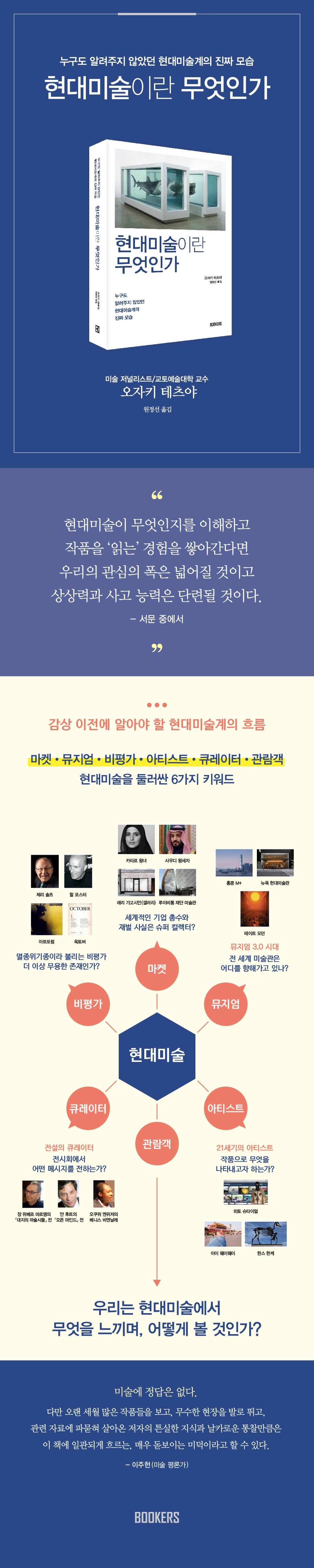
Who are the driving forces behind contemporary art today? The heads of global corporations, super-collectors like the Qatari princess and the Saudi crown prince, curators who maintain a subtle distance from capitalism, artists challenging the new order, and a diverse group of individuals—markets, museums, critics, and audiences—are all determining the value and price of contemporary art.
This will provide an opportunity to think about the value of contemporary art today through the definition of contemporary art by Tetsuya Ozaki, a leading Japanese art journalist and professor at the Kyoto University of Arts Graduate School.
This will provide an opportunity to think about the value of contemporary art today through the definition of contemporary art by Tetsuya Ozaki, a leading Japanese art journalist and professor at the Kyoto University of Arts Graduate School.
- You can preview some of the book's contents.
Preview
index
Recommended article by art critic Lee Ju-heon 4
Introduction 6
Introduction | The Olympics of Contemporary Art: Venice Biennale 18
Chapter 1: The Market | Battlefield of the Rough Dragons
The Billionaire's Hunting Instinct 42
War of the Super Collectors 52
The Princess is No. 1 Buyer 62
The Modern Medici Family 66
Art Dealer, The Glory and Darkness of the Gagosian Empire 76
"POWER 100", the back of the mirror that reflects the art world 90
Chapter 2: Museum | The Internal and External Troubles of the Art Hall
Hong Kong M+ CEO's sudden resignation 104
116 "Artwork Regulations" in Spain, Korea, and Japan
Fighting the Invisible Collection 134
Wanderings at the Museum of Modern Art, New York 150
Tate Modern's Wanderings 158
Chapter 3: The Critic | The Crisis of Criticism and Theory
Critics as an Endangered Species 174
Theorists and Activists as Endangered Species 186
Where Have Aesthetics Gone? 200
Boris Groys's Theory 212
Chapter 4: Curator | A Balanced View of History and Contemporaneity
"The Magicians of the Earth" Exhibition and "Documenta IX" 226
Hubert Martin - Sex, Death, and Anthropology 240
Jan Huth - Opening the 'Closed Circuit' 254
The vertical hoot and the horizontal martang 274
Chapter 5: Artists | What are the References in Contemporary Art?
Contemporary Art and 'World Standards' 292
The Struggle between Hito Steyerl and Hans Haacke 310
Quotes and References - The Shaken Definition of "Work" 324
Samuel Beckett and Modern Art 342
356 at the end of Duchamp's 'Toilet'
Chapter 6: The Audience | What is an Active Interpreter?
The Transformation of the Audience 372
The Three Elements of Modern Art 386
Chapter 7: Seven Creative Motivations of Modern Art | What Motivates Artists to Create Art?
Motivation 1.
Pursuit of New Perspectives and Senses 404
Motivation 2.
Exploring Medium and Perception 416
Motivation 3.
References and Objections to the System 432
Motivation 4.
Actuality and Politics 442
Motivation 5.
Thought, Philosophy, Science, and World Perception 456
Motivation 6.
Me and the World, Memory, History, and Community 468
Motivation 7.
Eros, Thanatos, and Holiness 482
Chapter 8: How to View Contemporary Art | How a Critic Appreciates Art
500 items for appreciating the work
Chapter 9: The Crisis of Painting and Photography | Contemporary Art Enters the Age of Installation
Why were flat works excluded? 528
Coming Out | So, What Is Contemporary Art? 546
Translator's Note 568 | References 570 | Illustration Sources 585 | Key People and Groups 588
Introduction 6
Introduction | The Olympics of Contemporary Art: Venice Biennale 18
Chapter 1: The Market | Battlefield of the Rough Dragons
The Billionaire's Hunting Instinct 42
War of the Super Collectors 52
The Princess is No. 1 Buyer 62
The Modern Medici Family 66
Art Dealer, The Glory and Darkness of the Gagosian Empire 76
"POWER 100", the back of the mirror that reflects the art world 90
Chapter 2: Museum | The Internal and External Troubles of the Art Hall
Hong Kong M+ CEO's sudden resignation 104
116 "Artwork Regulations" in Spain, Korea, and Japan
Fighting the Invisible Collection 134
Wanderings at the Museum of Modern Art, New York 150
Tate Modern's Wanderings 158
Chapter 3: The Critic | The Crisis of Criticism and Theory
Critics as an Endangered Species 174
Theorists and Activists as Endangered Species 186
Where Have Aesthetics Gone? 200
Boris Groys's Theory 212
Chapter 4: Curator | A Balanced View of History and Contemporaneity
"The Magicians of the Earth" Exhibition and "Documenta IX" 226
Hubert Martin - Sex, Death, and Anthropology 240
Jan Huth - Opening the 'Closed Circuit' 254
The vertical hoot and the horizontal martang 274
Chapter 5: Artists | What are the References in Contemporary Art?
Contemporary Art and 'World Standards' 292
The Struggle between Hito Steyerl and Hans Haacke 310
Quotes and References - The Shaken Definition of "Work" 324
Samuel Beckett and Modern Art 342
356 at the end of Duchamp's 'Toilet'
Chapter 6: The Audience | What is an Active Interpreter?
The Transformation of the Audience 372
The Three Elements of Modern Art 386
Chapter 7: Seven Creative Motivations of Modern Art | What Motivates Artists to Create Art?
Motivation 1.
Pursuit of New Perspectives and Senses 404
Motivation 2.
Exploring Medium and Perception 416
Motivation 3.
References and Objections to the System 432
Motivation 4.
Actuality and Politics 442
Motivation 5.
Thought, Philosophy, Science, and World Perception 456
Motivation 6.
Me and the World, Memory, History, and Community 468
Motivation 7.
Eros, Thanatos, and Holiness 482
Chapter 8: How to View Contemporary Art | How a Critic Appreciates Art
500 items for appreciating the work
Chapter 9: The Crisis of Painting and Photography | Contemporary Art Enters the Age of Installation
Why were flat works excluded? 528
Coming Out | So, What Is Contemporary Art? 546
Translator's Note 568 | References 570 | Illustration Sources 585 | Key People and Groups 588
Detailed image
Into the book
Famous luxury brands are generally enthusiastic about supporting culture and arts.
Even brands that do not own art galleries are continuing to support contemporary art by collecting artworks, hosting and sponsoring exhibitions, and even establishing awards.
---From "The War of the Super Collectors," "Chapter 1: Market"
Kramer, known as a conservative and sharp critic, left a comment in the late 1960s that has been talked about ever since: “As a work becomes more minimal, its explanation becomes more maximal.”
---From "Theorists and Movements as Endangered Species," Chapter 3, "Critics"
After the "Magicians of the Earth" exhibition, it became commonplace for artists from non-Western countries and the Third World to participate in international exhibitions.
A traveling exhibition curated by Hans Ulrich Obrist and Hou Hanlu on the development, progress and globalization of Asian cities.
Naturally, a large number of Asian artists from China, Taiwan, Japan, Korea, Thailand, Malaysia, and Singapore participated, and this project would not have been possible without Martang's pioneering efforts.
---From "The Magicians of the Earth" Exhibition and "Documenta IV", "Chapter 4 Curator"
Samuel Beckett, who had a great influence on modern art, said, "Imagine a dead imagination."
I think these are just words that both artists and viewers should keep in mind.
Contemporary art must be a good catalyst for imagination.
---From "The Three Elements of Modern Art," "Chapter 6: The Spectator"
Although there are many modern art pieces related to hearing, touch, smell, and taste, the majority are still visual art.
What does it mean to 'see'? This question may be the greatest and most eternal question among the five senses, not only for artists but for all humans.
Even brands that do not own art galleries are continuing to support contemporary art by collecting artworks, hosting and sponsoring exhibitions, and even establishing awards.
---From "The War of the Super Collectors," "Chapter 1: Market"
Kramer, known as a conservative and sharp critic, left a comment in the late 1960s that has been talked about ever since: “As a work becomes more minimal, its explanation becomes more maximal.”
---From "Theorists and Movements as Endangered Species," Chapter 3, "Critics"
After the "Magicians of the Earth" exhibition, it became commonplace for artists from non-Western countries and the Third World to participate in international exhibitions.
A traveling exhibition curated by Hans Ulrich Obrist and Hou Hanlu on the development, progress and globalization of Asian cities.
Naturally, a large number of Asian artists from China, Taiwan, Japan, Korea, Thailand, Malaysia, and Singapore participated, and this project would not have been possible without Martang's pioneering efforts.
---From "The Magicians of the Earth" Exhibition and "Documenta IV", "Chapter 4 Curator"
Samuel Beckett, who had a great influence on modern art, said, "Imagine a dead imagination."
I think these are just words that both artists and viewers should keep in mind.
Contemporary art must be a good catalyst for imagination.
---From "The Three Elements of Modern Art," "Chapter 6: The Spectator"
Although there are many modern art pieces related to hearing, touch, smell, and taste, the majority are still visual art.
What does it mean to 'see'? This question may be the greatest and most eternal question among the five senses, not only for artists but for all humans.
---「Motivation 2.
Exploration of Medium and Perception, from Chapter 7, “Seven Creative Motives of Modern Artworks”
Exploration of Medium and Perception, from Chapter 7, “Seven Creative Motives of Modern Artworks”
Publisher's Review
What Happens at the Venice Biennale, the Olympics of Contemporary Art
Many artists, collectors, and markets around the world pay attention to the 'Grand Art Tour'.
This is because you can see the contemporary visual arts scene at the Venice Biennale, the king of biennales, the Documenter held in the university city of Kassel, and the Münster Sculpture Project, which shows the current state of public art.
In particular, at the Venice Biennale, which is called the 'Olympic Games of the contemporary art world', participating countries compete to win the 'Golden Lion Award'.
Why do we pay attention to major events featuring international, yet unpopular artists? Because it determines the value of their work.
The author says that the people who gather at this biennale, that is, the privileged class, determine the value and price of contemporary art.
And, borrowing the concept of 'art world' from art philosopher Arthur Danto, we refer to these as 'art world in a narrow sense'.
This book explores the answer to that question through the large and small events that occurred in the contemporary art world, focusing on markets, museums, curators, artists, and critics, all of whom fall within the narrowly defined art world.
How the logic of the capitalist market economy and the establishment drives contemporary art.
There is much to be said for this grand question: 'What is contemporary art?'
Art in the industrialized era is difficult to define in a single line because it cannot be evaluated as a work in itself.
The saying, "Art is not an investment," is rendered meaningless by global business leaders and conglomerates who have become super collectors and collect art.
Wealthy gallerists buy and sell expensive artworks, and sometimes get into lawsuits because of their exorbitant fees.
Meanwhile, artists are increasingly engaging with philosophy rather than description, applying the academic term "Anthropocene" to their work.
Legendary curators, such as Okwu Enwezor's "Venice Biennale" (2015), which received support from Rolls-Royce but featured a reading of "Das Kapital," Martin's "Magicians of the Earth" (1989), which displayed Western and non-Western works on equal footing, and Jan Huth's "Open Mind" (1989), which displayed Van Gogh's works alongside outsider art, all seek to convey a certain message through their exhibitions.
Meanwhile, art museums are sometimes forced to suspend exhibitions due to their own censorship of artworks, and their role is expanding beyond exhibitions to become social and sociable venues.
Critics and art media outlets, which balance the various situations, are losing their role and influence as advertising space increases.
In this way, the art world of negotiation has led the contemporary art world and defined contemporary art according to the perspective of the capitalist market economy or a certain institutional system.
Art in the Industrial Age: What is the Role of the Audience?
Is it possible for contemporary art to exist without relying on the capitalist market economy? Like other consumer goods, contemporary art cannot escape the logic of capitalism.
The only ones who can look at contemporary art outside of that logic are individual art lovers, or viewers.
Until now, viewers (appreciators) have relied on 'retinal painting' as a form of perception or recognition.
However, contemporary artists create diverse works that cannot be interpreted simply by 'seeing and feeling'.
Since the appearance of Marcel Duchamp's Fountain (1917), 20th-century artists have pursued areas other than retinal painting.
He developed abstract art by sprinkling paint on canvas (Jackson Pollock), or presented various perceptions through his work by making perspective, a two-dimensional painting technique, three-dimensional (Takamatsu Jiro).
Also, he criticizes the system by serving free Pad Thai to visitors in an art museum while promoting relational aesthetics (Rikrit Tiravanija), or expresses his views on politics and ideology through his work by throwing a puck in front of Tiananmen Square (Ai Weiwei).
The personal experiences of abuse suffered as children are turned into works like autobiographical novels (Yayoi Kusama, Louise Bourgeois).
Until now, general appreciation of art required knowledge of art theory and art history.
However, the viewer of modern art does not need to know the system as much as the artist.
In order to understand contemporary artists who create works with a critical mind, knowledge of world affairs and world history is much more important.
Of course, if you know art theory and art history, your enjoyment of art will be enriched.
What the audience outside the system can do is become an active interpreter.
In addition, it is necessary to expand the experience of appreciating works of art and to continuously take interest in issues related to contemporary art.
The ability to see and feel is actually something that everyone possesses.
However, in order to evaluate things, it is important to accumulate life experiences such as broadening one's horizons and increasing one's knowledge.
This is also what viewers of art in the industrialized age must do.
Many artists, collectors, and markets around the world pay attention to the 'Grand Art Tour'.
This is because you can see the contemporary visual arts scene at the Venice Biennale, the king of biennales, the Documenter held in the university city of Kassel, and the Münster Sculpture Project, which shows the current state of public art.
In particular, at the Venice Biennale, which is called the 'Olympic Games of the contemporary art world', participating countries compete to win the 'Golden Lion Award'.
Why do we pay attention to major events featuring international, yet unpopular artists? Because it determines the value of their work.
The author says that the people who gather at this biennale, that is, the privileged class, determine the value and price of contemporary art.
And, borrowing the concept of 'art world' from art philosopher Arthur Danto, we refer to these as 'art world in a narrow sense'.
This book explores the answer to that question through the large and small events that occurred in the contemporary art world, focusing on markets, museums, curators, artists, and critics, all of whom fall within the narrowly defined art world.
How the logic of the capitalist market economy and the establishment drives contemporary art.
There is much to be said for this grand question: 'What is contemporary art?'
Art in the industrialized era is difficult to define in a single line because it cannot be evaluated as a work in itself.
The saying, "Art is not an investment," is rendered meaningless by global business leaders and conglomerates who have become super collectors and collect art.
Wealthy gallerists buy and sell expensive artworks, and sometimes get into lawsuits because of their exorbitant fees.
Meanwhile, artists are increasingly engaging with philosophy rather than description, applying the academic term "Anthropocene" to their work.
Legendary curators, such as Okwu Enwezor's "Venice Biennale" (2015), which received support from Rolls-Royce but featured a reading of "Das Kapital," Martin's "Magicians of the Earth" (1989), which displayed Western and non-Western works on equal footing, and Jan Huth's "Open Mind" (1989), which displayed Van Gogh's works alongside outsider art, all seek to convey a certain message through their exhibitions.
Meanwhile, art museums are sometimes forced to suspend exhibitions due to their own censorship of artworks, and their role is expanding beyond exhibitions to become social and sociable venues.
Critics and art media outlets, which balance the various situations, are losing their role and influence as advertising space increases.
In this way, the art world of negotiation has led the contemporary art world and defined contemporary art according to the perspective of the capitalist market economy or a certain institutional system.
Art in the Industrial Age: What is the Role of the Audience?
Is it possible for contemporary art to exist without relying on the capitalist market economy? Like other consumer goods, contemporary art cannot escape the logic of capitalism.
The only ones who can look at contemporary art outside of that logic are individual art lovers, or viewers.
Until now, viewers (appreciators) have relied on 'retinal painting' as a form of perception or recognition.
However, contemporary artists create diverse works that cannot be interpreted simply by 'seeing and feeling'.
Since the appearance of Marcel Duchamp's Fountain (1917), 20th-century artists have pursued areas other than retinal painting.
He developed abstract art by sprinkling paint on canvas (Jackson Pollock), or presented various perceptions through his work by making perspective, a two-dimensional painting technique, three-dimensional (Takamatsu Jiro).
Also, he criticizes the system by serving free Pad Thai to visitors in an art museum while promoting relational aesthetics (Rikrit Tiravanija), or expresses his views on politics and ideology through his work by throwing a puck in front of Tiananmen Square (Ai Weiwei).
The personal experiences of abuse suffered as children are turned into works like autobiographical novels (Yayoi Kusama, Louise Bourgeois).
Until now, general appreciation of art required knowledge of art theory and art history.
However, the viewer of modern art does not need to know the system as much as the artist.
In order to understand contemporary artists who create works with a critical mind, knowledge of world affairs and world history is much more important.
Of course, if you know art theory and art history, your enjoyment of art will be enriched.
What the audience outside the system can do is become an active interpreter.
In addition, it is necessary to expand the experience of appreciating works of art and to continuously take interest in issues related to contemporary art.
The ability to see and feel is actually something that everyone possesses.
However, in order to evaluate things, it is important to accumulate life experiences such as broadening one's horizons and increasing one's knowledge.
This is also what viewers of art in the industrialized age must do.
GOODS SPECIFICS
- Publication date: December 30, 2022
- Page count, weight, size: 600 pages | 912g | 140*210*35mm
- ISBN13: 9791190118477
- ISBN10: 1190118475
You may also like
카테고리
korean


korean

![GQ KOREA Mark (Monthly): December [2025]](http://librairie.coreenne.fr/cdn/shop/files/8ef265dbbfbf186523ed75ba7319009d.jpg?v=1765340328&width=3840)


