

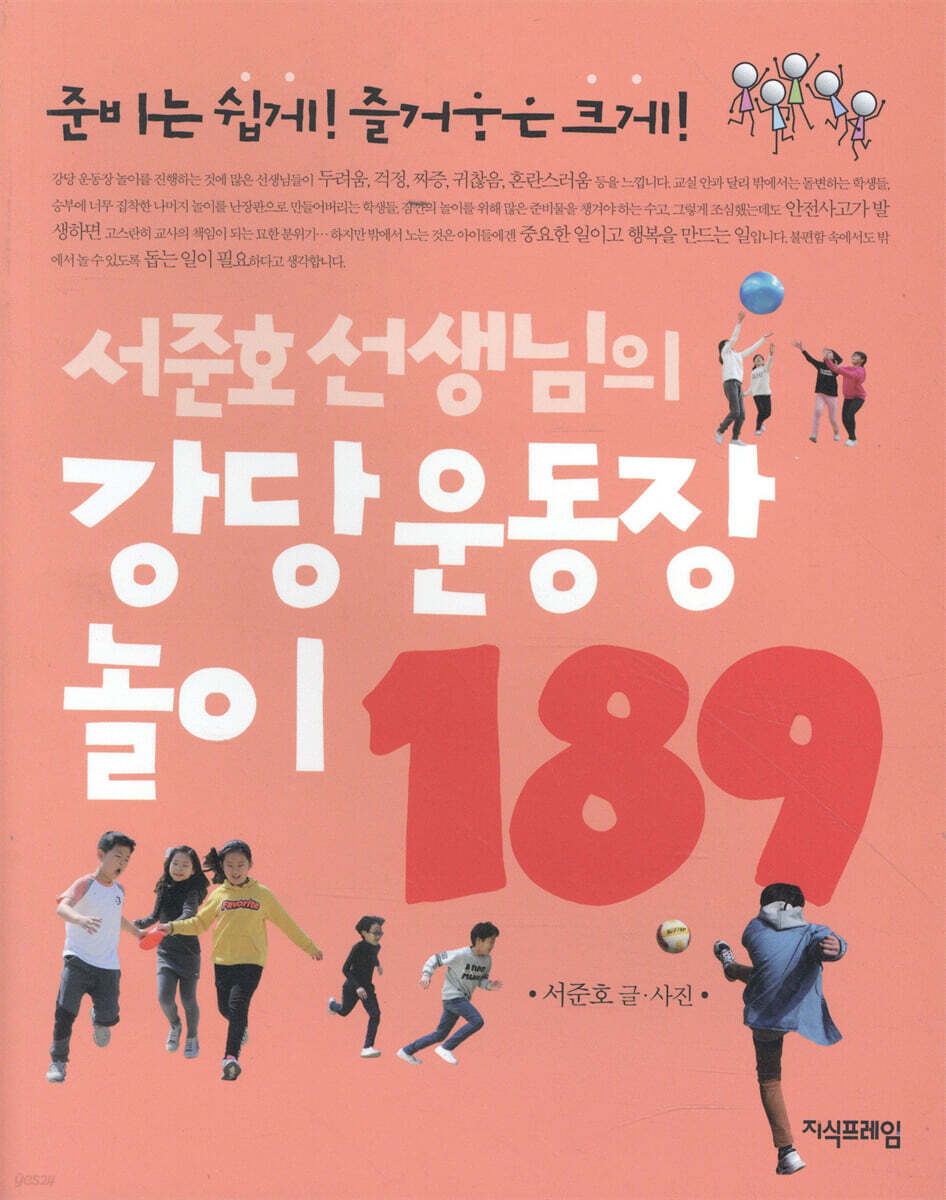
Teacher Seo Jun-ho's Lecture Hall Playground 189
 |
Description
Book Introduction
“Teacher, let’s play outside!”
Both teachers and children are happy
189 Lecture Hall Playground Games
For teachers, play outside the classroom can be a very burdensome activity.
It's not easy to step outside the classroom due to the early arrival of the heat, the constant presence of fine dust regardless of the season, and the various anxieties that arise due to the special nature of the large space.
However, it is not possible to confine energetic children to the classroom and let them be active all day long.
How can we make the auditorium playground games simpler, easier to prepare, and still fun?
From preparing for play to various application tips and problem-solving situations, teacher Seo Jun-ho, who has served as a play guide for many teachers with 『Classroom Play Encyclopedia 239』, has included all the know-how needed for playground play in the auditorium in this book.
Both teachers and children are happy
189 Lecture Hall Playground Games
For teachers, play outside the classroom can be a very burdensome activity.
It's not easy to step outside the classroom due to the early arrival of the heat, the constant presence of fine dust regardless of the season, and the various anxieties that arise due to the special nature of the large space.
However, it is not possible to confine energetic children to the classroom and let them be active all day long.
How can we make the auditorium playground games simpler, easier to prepare, and still fun?
From preparing for play to various application tips and problem-solving situations, teacher Seo Jun-ho, who has served as a play guide for many teachers with 『Classroom Play Encyclopedia 239』, has included all the know-how needed for playground play in the auditorium in this book.
- You can preview some of the book's contents.
Preview
index
prolog
Auditorium Playground Play Instructions
Part 1.
Movement play
Stand in a line | Gather by topic! | Follow the traffic light colors | Just follow the lines! | Explore the zigzag lines | Arrive first | Different rock-paper-scissors | 30-second bounce | Secretly switch feet! | Action rock-paper-scissors
Part 2.
Relay game
Zigzag Run|ABC Run|Fan Run|Glass Bully Run|Backpack Relay Run|Bodyguard Run|Add 1 Person|Between Friends|Rock-Paper-Scissors Relay|Telepathy Run|Number Card Run|2-Person 3-Way Relay|Go-Back Run|Broom Relay|Paper Airplane Relay|Newspaper Relay|Shape Making Relay|Mat Relay|Tic-Tac-Toe Run|Long Rope Passing Relay|Train Relay|Put Coins|Agility Run|Lift It Carefully!|Move 3 Balls|Move the Ping-Pong Balls!|Carry the Balls with the Plank!|Don't Bounce!|Hoop Relay|Look Through a Small Hole|Balloon Popping Relay
Part 3.
tag game
Catch and be caught|Super speed tag|Tag with variables|Ice tag|Shelter tag|Medic tag|Frog lock tag|3-color tag|Turn the towel|The number I chose|Shoulder tag|Line tag|One-square tag|Cicada tag|Rainbow tag|Plate cone tag|Separate-combine tag|3-6 step tag
Part 4.
ball game
Ball passing game|Ball interception|Pass the ball in a line|Escape the trap game|Through bowling game|Ground darts|Pass-shoot game|Over pass game|I'll call your name|Call your name!|Donut game|Hand cone|In three times|Run with the ball!|Volleyball carrying game|Where's the sole of your foot?|One-person dodgeball|Circular dodgeball|Mental dodgeball|Invincible dodgeball|Obstacle dodgeball|Spy dodgeball|Point dodgeball|4-zone dodgeball|Mat dodgeball|Mental concentration dodgeball|Topsy-turvy dodgeball|Human bowling dodgeball|Line dodgeball|Pair soccer|1:1 cone soccer|Shooting cone soccer|Mini cone soccer|Agility soccer|Cubicle soccer|Free-spirited soccer|Bowling soccer|Kickball|Line dodgeball|Pitcher dodgeball|Line dodgeball|Rugby ball dodgeball|Fist baseball|5-point fist baseball
Part 5.
Tool use play
Hula Hoop Between Cones|Stepping Stones Game|Hold Hands and Pass Through the Hoop Game|Come Back, Hula Hoop!|Hula Hoop Passing Game|Inside the Hoop|Hula Hoop Exploration|Throw the Ball|Around the World|Bounce, Bounce|Guess and It's My Coin! 1|Guess and It's My Coin! 2|Strong Spike!|Double Bounce Bounce|Balloon Competition|Blow a Balloon and Fly It Far|Bean Bag Battle|Moving Game|Mini Bean Bag Battle|Throw Bean Bags with Different Scores|Throw Bean Bags|Bean Bag Fishing|Put them in Order|Make a Line|Landing of a Flying Saucer|Knock Down Plastic Bottles|Flying Handball|Flying Disc Passing Game|Wolf and Flying Disc|3-Line Tug-of-War|Rope Breaking Game|Evade Power Lines Game|Ball Journey|Shape with Rope|Rubber Band Limbo Game|Avoid Dog Poop!|Trust Your Friends and Run|Treasure Hunt in the Dark|Fantasy Partners|Move Water!|Carry Water|Water Transport Game|Water Shot Put Game|Drawing a Picture with Water in a Plastic Bottle|With a Sprinkler|Where are my Shoes?|Shoot with Your Feet|Put Them on the Line!|Model on the Balance Beam|Seat on the Balance Beam Swap|Daewang Yutnori|Cone Flipping Game|Cone Flying Game|Sledding Game|Hanging Clothespins and Telling Your Friends!|We're Connected by Clothespins!|Clothespin Battle|Collect the Clothespins!|Wrestling on the Mat|Odd-Even Game|Dice and Ball
Part 6.
Floor and space play
Snail house game | Long line game | Figure 8 game | Dog bone game | Rattlesnake game | Defender pass game | East, West, South, North | Knock down the opposing team's cones! | Scarecrow and sparrow | Hopscotch | One square at a time | Who can last the longest | Body score game | Right foot - Left foot - Right hand - Left hand | Making shapes | The Rose of Sharon has bloomed | Why did you come to my house? | Getting older | Taking over the land | Expanding the land | Expanding one square at a time | Sand and sticks | Feeling the world with your fingertips | Finding my tree
Bonus Tip
Using 《Classroom Play Encyclopedia 239》 in the auditorium playground
Using "Auditorium Playground 189" in the Classroom
Epilogue
Auditorium Playground Play Instructions
Part 1.
Movement play
Stand in a line | Gather by topic! | Follow the traffic light colors | Just follow the lines! | Explore the zigzag lines | Arrive first | Different rock-paper-scissors | 30-second bounce | Secretly switch feet! | Action rock-paper-scissors
Part 2.
Relay game
Zigzag Run|ABC Run|Fan Run|Glass Bully Run|Backpack Relay Run|Bodyguard Run|Add 1 Person|Between Friends|Rock-Paper-Scissors Relay|Telepathy Run|Number Card Run|2-Person 3-Way Relay|Go-Back Run|Broom Relay|Paper Airplane Relay|Newspaper Relay|Shape Making Relay|Mat Relay|Tic-Tac-Toe Run|Long Rope Passing Relay|Train Relay|Put Coins|Agility Run|Lift It Carefully!|Move 3 Balls|Move the Ping-Pong Balls!|Carry the Balls with the Plank!|Don't Bounce!|Hoop Relay|Look Through a Small Hole|Balloon Popping Relay
Part 3.
tag game
Catch and be caught|Super speed tag|Tag with variables|Ice tag|Shelter tag|Medic tag|Frog lock tag|3-color tag|Turn the towel|The number I chose|Shoulder tag|Line tag|One-square tag|Cicada tag|Rainbow tag|Plate cone tag|Separate-combine tag|3-6 step tag
Part 4.
ball game
Ball passing game|Ball interception|Pass the ball in a line|Escape the trap game|Through bowling game|Ground darts|Pass-shoot game|Over pass game|I'll call your name|Call your name!|Donut game|Hand cone|In three times|Run with the ball!|Volleyball carrying game|Where's the sole of your foot?|One-person dodgeball|Circular dodgeball|Mental dodgeball|Invincible dodgeball|Obstacle dodgeball|Spy dodgeball|Point dodgeball|4-zone dodgeball|Mat dodgeball|Mental concentration dodgeball|Topsy-turvy dodgeball|Human bowling dodgeball|Line dodgeball|Pair soccer|1:1 cone soccer|Shooting cone soccer|Mini cone soccer|Agility soccer|Cubicle soccer|Free-spirited soccer|Bowling soccer|Kickball|Line dodgeball|Pitcher dodgeball|Line dodgeball|Rugby ball dodgeball|Fist baseball|5-point fist baseball
Part 5.
Tool use play
Hula Hoop Between Cones|Stepping Stones Game|Hold Hands and Pass Through the Hoop Game|Come Back, Hula Hoop!|Hula Hoop Passing Game|Inside the Hoop|Hula Hoop Exploration|Throw the Ball|Around the World|Bounce, Bounce|Guess and It's My Coin! 1|Guess and It's My Coin! 2|Strong Spike!|Double Bounce Bounce|Balloon Competition|Blow a Balloon and Fly It Far|Bean Bag Battle|Moving Game|Mini Bean Bag Battle|Throw Bean Bags with Different Scores|Throw Bean Bags|Bean Bag Fishing|Put them in Order|Make a Line|Landing of a Flying Saucer|Knock Down Plastic Bottles|Flying Handball|Flying Disc Passing Game|Wolf and Flying Disc|3-Line Tug-of-War|Rope Breaking Game|Evade Power Lines Game|Ball Journey|Shape with Rope|Rubber Band Limbo Game|Avoid Dog Poop!|Trust Your Friends and Run|Treasure Hunt in the Dark|Fantasy Partners|Move Water!|Carry Water|Water Transport Game|Water Shot Put Game|Drawing a Picture with Water in a Plastic Bottle|With a Sprinkler|Where are my Shoes?|Shoot with Your Feet|Put Them on the Line!|Model on the Balance Beam|Seat on the Balance Beam Swap|Daewang Yutnori|Cone Flipping Game|Cone Flying Game|Sledding Game|Hanging Clothespins and Telling Your Friends!|We're Connected by Clothespins!|Clothespin Battle|Collect the Clothespins!|Wrestling on the Mat|Odd-Even Game|Dice and Ball
Part 6.
Floor and space play
Snail house game | Long line game | Figure 8 game | Dog bone game | Rattlesnake game | Defender pass game | East, West, South, North | Knock down the opposing team's cones! | Scarecrow and sparrow | Hopscotch | One square at a time | Who can last the longest | Body score game | Right foot - Left foot - Right hand - Left hand | Making shapes | The Rose of Sharon has bloomed | Why did you come to my house? | Getting older | Taking over the land | Expanding the land | Expanding one square at a time | Sand and sticks | Feeling the world with your fingertips | Finding my tree
Bonus Tip
Using 《Classroom Play Encyclopedia 239》 in the auditorium playground
Using "Auditorium Playground 189" in the Classroom
Epilogue
Into the book
The application of play is the teacher's responsibility.
Curriculum and teachers' interests change constantly, but if we only proceed in a limited way, we end up repeating the same method as if we were under hypnosis.
It is necessary to adapt and combine one game so that it can be played with lower grades, higher grades, and sometimes with a large number of people.
In that sense, rather than trying to run all the games in this book, try selecting 30 to 40 games that suit you, applying them in various ways, and combining them with other games.
Adapting existing games to suit my environment and class requires experience and skill.
Let's try the games we played this year next year, and the year after that.
Each time there is a new outcome, and previous play experiences sometimes lead to a more refined progression.
--- From the "Auditorium Playground Play Instructions"
It is also the teacher's responsibility to link it to the curriculum.
You can simply play, but if you want to connect it to learning, you can find similar games and apply and develop them.
For example, let's say you chose 'Zigzag Running (2-01)' to link with a physical education class to improve running skills.
Let's start by playing around randomly, and then get together and try to figure out the main functions we'll use when playing.
We can also talk about how we can improve our performance and results.
We also watch demonstrations by students with outstanding skills, and sometimes we split up into groups to practice and research.
To make all this easier, it is best for teachers to experience play first.
After some time has passed, when you look at a class topic similar to that play, you can reconstruct it based on your past play experiences with a little more familiarity.
Therefore, rather than just understanding the games in your head, it is a good idea to experience the games in this book with teachers of the same grade, with children in your class, and sometimes even during training sessions.
--- From the "Auditorium Playground Play Instructions"
There are cases where it is more difficult to control children in auditoriums and playgrounds than in classrooms (this is actually not a problem with the location, but rather a lack of basic order and classroom management framework within the classroom).
Especially, if the children in the class do not pay attention to the teacher, it is natural that the content will not be conveyed even if the teacher explains it several times.
First, as in the whistle usage tips, let's make it so that the teacher can focus on the teacher by using the whistle and hand signals rather than words.
When children are focused, give them feedback by saying things like, “Thank you for looking at me” or “Thank you for focusing and looking at me.”
When explaining the rules of the game, first say, “I will now explain how to play.
“Please listen carefully,” he said, adding, “I will take your questions at once.
The teacher should have the opportunity to guide the children through the play at once with a comment like, “Please listen so that the teacher can explain as best as he can, even if you have any questions.”
Otherwise, your concentration may be constantly broken by children's words or questions.
It is better to demonstrate the explanation not only verbally but also with the help of the teacher or a few students (it is better to make an appointment in advance during break time) through body movements.
Because it is a game they have never experienced before, there is a possibility that they may not be able to properly understand what the teacher is saying.
After a thorough explanation, say, “Thank you for listening to my explanation.
Let's ask a question like, "Did you have any questions while listening to the explanation?"
--- From the "Auditorium Playground Play Instructions"
“If you listen to me, you can go out to the playground!” “I’m letting you play like this because you worked so hard.” “Why are you making such a fuss? Okay, let’s cancel our plans to go to the auditorium and playground this week!” “We can only play if the thermometer in our class is over 80 degrees!” Some teachers use play as a “reward” or a “threat” tool for the children in their class.
In fact, these words are used to train children to listen to the teacher by taking advantage of what they like.
But there are many classrooms that function well without using such language.
Children play daily, whether in the classroom, auditorium, or playground.
Think back to when you were young.
Just as we used to have fun with friends and eagerly anticipate picnics and special occasions, today's children are no different.
We must avoid using play as a tool to control children when they are out of control or when one or two children disrupt the atmosphere, or using play as a reward, as if the teacher were giving out gifts.
Play is just play.
During times when teachers are required to lead play, such as in physical education or club activities, teachers should lead the play, but later on, it should be recognized that it is natural for children to enjoy playing even without teachers leading.
Curriculum and teachers' interests change constantly, but if we only proceed in a limited way, we end up repeating the same method as if we were under hypnosis.
It is necessary to adapt and combine one game so that it can be played with lower grades, higher grades, and sometimes with a large number of people.
In that sense, rather than trying to run all the games in this book, try selecting 30 to 40 games that suit you, applying them in various ways, and combining them with other games.
Adapting existing games to suit my environment and class requires experience and skill.
Let's try the games we played this year next year, and the year after that.
Each time there is a new outcome, and previous play experiences sometimes lead to a more refined progression.
--- From the "Auditorium Playground Play Instructions"
It is also the teacher's responsibility to link it to the curriculum.
You can simply play, but if you want to connect it to learning, you can find similar games and apply and develop them.
For example, let's say you chose 'Zigzag Running (2-01)' to link with a physical education class to improve running skills.
Let's start by playing around randomly, and then get together and try to figure out the main functions we'll use when playing.
We can also talk about how we can improve our performance and results.
We also watch demonstrations by students with outstanding skills, and sometimes we split up into groups to practice and research.
To make all this easier, it is best for teachers to experience play first.
After some time has passed, when you look at a class topic similar to that play, you can reconstruct it based on your past play experiences with a little more familiarity.
Therefore, rather than just understanding the games in your head, it is a good idea to experience the games in this book with teachers of the same grade, with children in your class, and sometimes even during training sessions.
--- From the "Auditorium Playground Play Instructions"
There are cases where it is more difficult to control children in auditoriums and playgrounds than in classrooms (this is actually not a problem with the location, but rather a lack of basic order and classroom management framework within the classroom).
Especially, if the children in the class do not pay attention to the teacher, it is natural that the content will not be conveyed even if the teacher explains it several times.
First, as in the whistle usage tips, let's make it so that the teacher can focus on the teacher by using the whistle and hand signals rather than words.
When children are focused, give them feedback by saying things like, “Thank you for looking at me” or “Thank you for focusing and looking at me.”
When explaining the rules of the game, first say, “I will now explain how to play.
“Please listen carefully,” he said, adding, “I will take your questions at once.
The teacher should have the opportunity to guide the children through the play at once with a comment like, “Please listen so that the teacher can explain as best as he can, even if you have any questions.”
Otherwise, your concentration may be constantly broken by children's words or questions.
It is better to demonstrate the explanation not only verbally but also with the help of the teacher or a few students (it is better to make an appointment in advance during break time) through body movements.
Because it is a game they have never experienced before, there is a possibility that they may not be able to properly understand what the teacher is saying.
After a thorough explanation, say, “Thank you for listening to my explanation.
Let's ask a question like, "Did you have any questions while listening to the explanation?"
--- From the "Auditorium Playground Play Instructions"
“If you listen to me, you can go out to the playground!” “I’m letting you play like this because you worked so hard.” “Why are you making such a fuss? Okay, let’s cancel our plans to go to the auditorium and playground this week!” “We can only play if the thermometer in our class is over 80 degrees!” Some teachers use play as a “reward” or a “threat” tool for the children in their class.
In fact, these words are used to train children to listen to the teacher by taking advantage of what they like.
But there are many classrooms that function well without using such language.
Children play daily, whether in the classroom, auditorium, or playground.
Think back to when you were young.
Just as we used to have fun with friends and eagerly anticipate picnics and special occasions, today's children are no different.
We must avoid using play as a tool to control children when they are out of control or when one or two children disrupt the atmosphere, or using play as a reward, as if the teacher were giving out gifts.
Play is just play.
During times when teachers are required to lead play, such as in physical education or club activities, teachers should lead the play, but later on, it should be recognized that it is natural for children to enjoy playing even without teachers leading.
--- From the "Auditorium Playground Play Instructions"
Publisher's Review
Playing on the auditorium playground is not difficult!
Why do so many teachers find playground play difficult? While individual factors may vary, the most common ones include special equipment, child supervision, and safety concerns.
In this book's [Play Instructions], we first provide various information that will help you solve these concerns.
Many people feel burdened by the thought that they need to prepare something grand and special to play in the auditorium playground.
But that's not the case at all.
This book introduces games that can be easily played with simple supplies that can be easily obtained at school, such as marbles, bean bags, and hula hoops.
If the materials are simple, the time required to prepare for play is reduced, and the burden on the teacher is also significantly reduced.
It also includes detailed information on how to use whistles or sound devices to get children's attention in a large space, tips for lining up and dividing into teams, tips for explaining the rules of the game, and even how to deal with children who disrupt the play atmosphere.
We also provide detailed tips on how to prevent safety accidents, such as looking for 'dangerous elements in play' with children and talking about 'near-miss situations' that occurred just after play.
The author also shares his experience of creating enjoyable play classes in collaboration with teachers of the same grade level, and provides practical help to teachers who have had difficulties with playground play in the auditorium.
A play guide with various applications and variations
This book contains 189 different games that can be played in auditoriums and playgrounds.
You can play a movement game to warm up before starting other games in earnest, a relay game where you divide into teams and complete a mission and the first one to return wins, and various variations of tag.
There are also plenty of fun games that will capture children's hearts, including ball games that allow them to learn the basic rules and skills of games like dodgeball, soccer, and baseball, games using simple tools like hula hoops, bean bags, marbles, and jump rope, traditional games like 'Hangbangchigi' and 'Dogbone Game,' and games that utilize spaces or the floor outside the classroom.
The illustrations included with each game help you understand how to play along with detailed explanations of the game, and the 'Play Tips' allow you to modify, apply, and develop the game in various ways, thereby enabling you to operate the game in a three-dimensional way.
Additionally, if you increase the scale of the classroom play and slightly change the play method, it can become an auditorium playground play that the entire class can participate in.
Likewise, if you reduce the size of the playground play in the auditorium and modify the play method, it can be a classroom play that can be played in pairs or groups.
We also introduce [bonus tips] that can be used interchangeably both inside and outside the classroom.
Why do so many teachers find playground play difficult? While individual factors may vary, the most common ones include special equipment, child supervision, and safety concerns.
In this book's [Play Instructions], we first provide various information that will help you solve these concerns.
Many people feel burdened by the thought that they need to prepare something grand and special to play in the auditorium playground.
But that's not the case at all.
This book introduces games that can be easily played with simple supplies that can be easily obtained at school, such as marbles, bean bags, and hula hoops.
If the materials are simple, the time required to prepare for play is reduced, and the burden on the teacher is also significantly reduced.
It also includes detailed information on how to use whistles or sound devices to get children's attention in a large space, tips for lining up and dividing into teams, tips for explaining the rules of the game, and even how to deal with children who disrupt the play atmosphere.
We also provide detailed tips on how to prevent safety accidents, such as looking for 'dangerous elements in play' with children and talking about 'near-miss situations' that occurred just after play.
The author also shares his experience of creating enjoyable play classes in collaboration with teachers of the same grade level, and provides practical help to teachers who have had difficulties with playground play in the auditorium.
A play guide with various applications and variations
This book contains 189 different games that can be played in auditoriums and playgrounds.
You can play a movement game to warm up before starting other games in earnest, a relay game where you divide into teams and complete a mission and the first one to return wins, and various variations of tag.
There are also plenty of fun games that will capture children's hearts, including ball games that allow them to learn the basic rules and skills of games like dodgeball, soccer, and baseball, games using simple tools like hula hoops, bean bags, marbles, and jump rope, traditional games like 'Hangbangchigi' and 'Dogbone Game,' and games that utilize spaces or the floor outside the classroom.
The illustrations included with each game help you understand how to play along with detailed explanations of the game, and the 'Play Tips' allow you to modify, apply, and develop the game in various ways, thereby enabling you to operate the game in a three-dimensional way.
Additionally, if you increase the scale of the classroom play and slightly change the play method, it can become an auditorium playground play that the entire class can participate in.
Likewise, if you reduce the size of the playground play in the auditorium and modify the play method, it can be a classroom play that can be played in pairs or groups.
We also introduce [bonus tips] that can be used interchangeably both inside and outside the classroom.
GOODS SPECIFICS
- Date of issue: February 15, 2019
- Page count, weight, size: 476 pages | 814g | 165*210*30mm
- ISBN13: 9788994655734
- ISBN10: 8994655735
You may also like
카테고리
korean


korean

![GQ KOREA Mark (Monthly): December [2025]](http://librairie.coreenne.fr/cdn/shop/files/8ef265dbbfbf186523ed75ba7319009d.jpg?v=1765340328&width=3840)


