

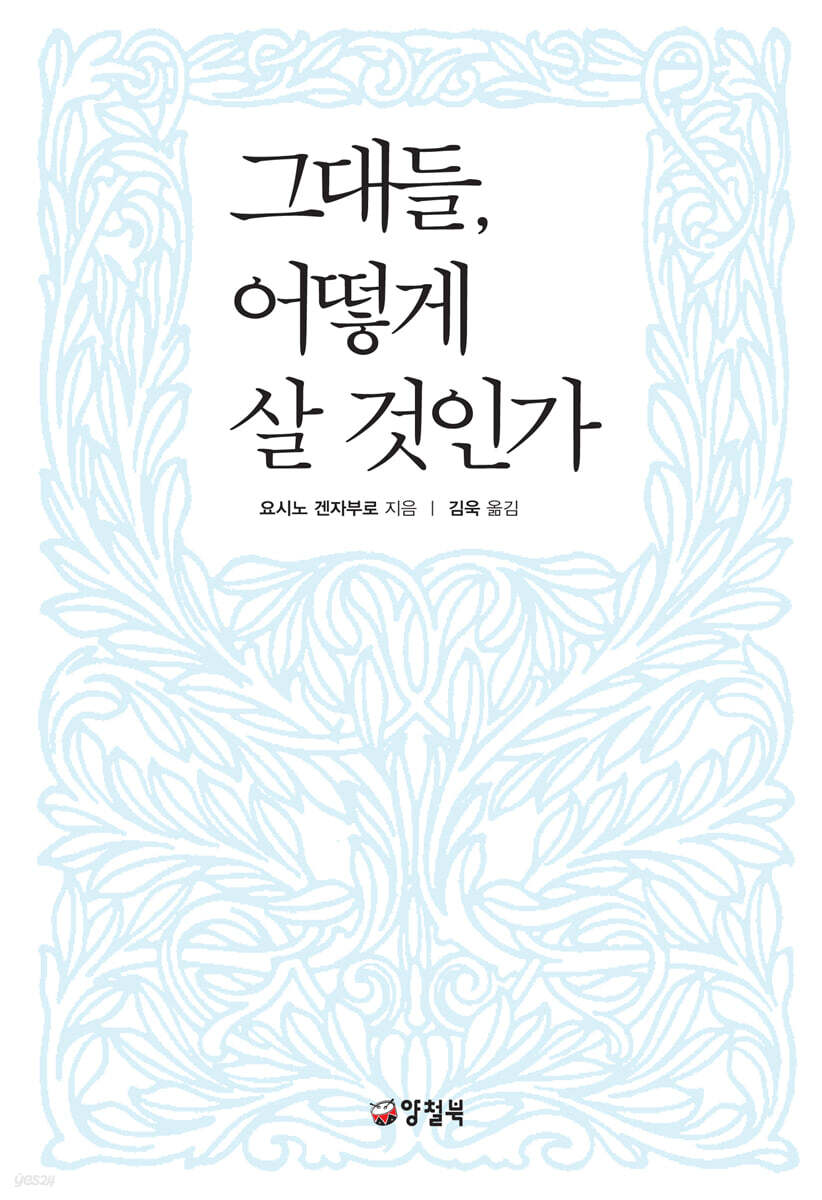
How will you live?
 |
Description
Book Introduction
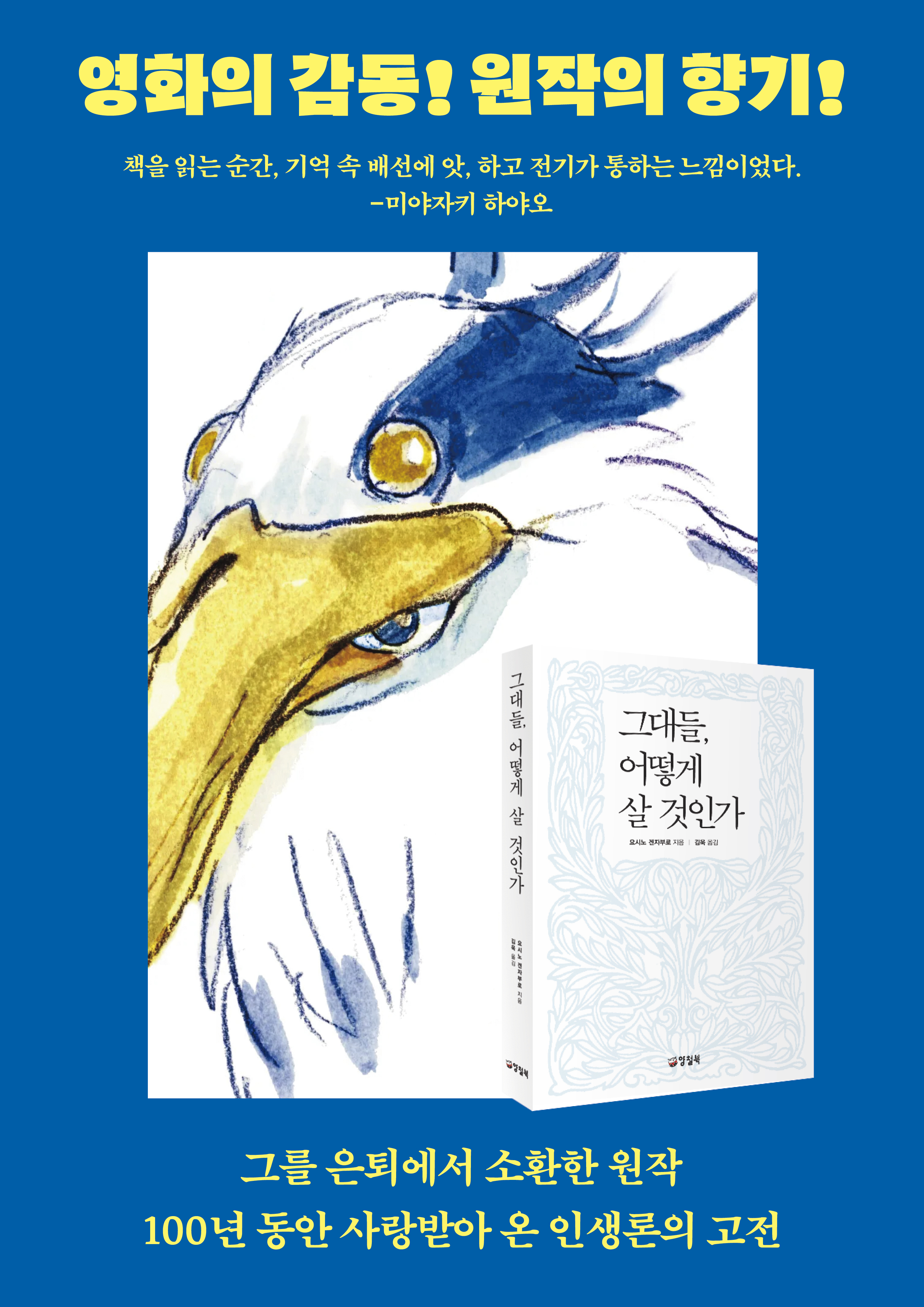
The scent of the original work, a film by Hayao Miyazaki
A classic philosophy of life loved for 100 years
The moment I read the book, I felt like an electric shock had run through the wiring in my memory.
- Hayao Miyazaki
It is a rare book that makes you think about what makes a life worth living.
- An Gwang-bok (teacher)
The main character, Koper, is fifteen years old and a second-year middle school student.
Coper is a nickname given to him by his maternal uncle after Copernicus.
While looking down at Ginza Street from the rooftop of a department store with my uncle, I begin to seriously think about life and the world.
After that, as I experienced various things at school and at home, my thoughts branched out and reached the fundamental question of 'how should I live?'
Affection and concern for neighbors and society, unvarnished friendship shown to poor friends, fervent admiration for heroes, and even the cowardice displayed when unable to overcome fear.
In this process, the maternal uncle acts as a mentor based on his knowledge encompassing philosophy, religion, science, and economics.
Each chapter is characterized by the way his uncle answers questions Koper encounters in his daily life through his diary and conversations.
Koper's daily life is filled with the honesty and cheerfulness of fifteen-year-olds, and his uncle's mentoring is based on a humanistic worldview and progressive view of history.
A classic philosophy of life loved for 100 years
The moment I read the book, I felt like an electric shock had run through the wiring in my memory.
- Hayao Miyazaki
It is a rare book that makes you think about what makes a life worth living.
- An Gwang-bok (teacher)
The main character, Koper, is fifteen years old and a second-year middle school student.
Coper is a nickname given to him by his maternal uncle after Copernicus.
While looking down at Ginza Street from the rooftop of a department store with my uncle, I begin to seriously think about life and the world.
After that, as I experienced various things at school and at home, my thoughts branched out and reached the fundamental question of 'how should I live?'
Affection and concern for neighbors and society, unvarnished friendship shown to poor friends, fervent admiration for heroes, and even the cowardice displayed when unable to overcome fear.
In this process, the maternal uncle acts as a mentor based on his knowledge encompassing philosophy, religion, science, and economics.
Each chapter is characterized by the way his uncle answers questions Koper encounters in his daily life through his diary and conversations.
Koper's daily life is filled with the honesty and cheerfulness of fifteen-year-olds, and his uncle's mentoring is based on a humanistic worldview and progressive view of history.
- You can preview some of the book's contents.
Preview
index
preface
Strange Experiences - On How to See Things
Brave Friends - A person who looks great and a great person
Newton's Apple and Powdered Milk - What is a True Discovery?
Poor Friend - About Poverty
Napoleon and His Friends - Who is the Great Man?
Snowy Day Incident
Memories of the Stone Steps: On the Greatness of Human Suffering and Mistakes
Improving relations
Narcissus and Gandhara Buddha statue
Spring morning
Until this book came out
Strange Experiences - On How to See Things
Brave Friends - A person who looks great and a great person
Newton's Apple and Powdered Milk - What is a True Discovery?
Poor Friend - About Poverty
Napoleon and His Friends - Who is the Great Man?
Snowy Day Incident
Memories of the Stone Steps: On the Greatness of Human Suffering and Mistakes
Improving relations
Narcissus and Gandhara Buddha statue
Spring morning
Until this book came out
Detailed image
Into the book
Now, under Koper's eyes and in places where Koper's eyes cannot reach, hundreds of thousands of people live unknown to Koper.
What kind of people are they?
What are you doing now?
What are you thinking about?
To Koper, the world unfolding beneath his eyes seemed like a world of unknown chaos.
An old man wearing glasses, a girl with short hair, an old woman with her hair up, a man wearing an apron, an office worker in a suit…
A variety of people living in the world appeared and disappeared before Koper. ---p.14
If we are born as humans and cannot live like humans, the civilization that humanity has built becomes a lie.
If the world is not one where everyone is treated equally, then that world is a lie.
Any honest person would not object to this idea.
But even if we think honestly, the world doesn't become honest.
Humanity has progressed, but that progress has not reached people's hearts.
Because of this, there are still many unresolved problems. ---p.121
Koper's heart grew heavier and heavier.
No matter how many excuses you make, the fact that you betrayed your friends doesn't change.
The fact that he betrayed his friends will always haunt Koper and weigh on his conscience.
Koper decided not to look for any more excuses.
Then, I felt a little better, but I couldn't stop thinking about how cowardly I had acted, and I felt so sorry to Kitami, Mizutani, and Uragawa that I couldn't express it in words.
I wanted to apologize to those three friends and say, 'I was wrong.'
But will the three people forgive Koper just because he apologizes?
If he admits that he was a coward, won't his friends be even more disappointed in Koper?
What kind of people are they?
What are you doing now?
What are you thinking about?
To Koper, the world unfolding beneath his eyes seemed like a world of unknown chaos.
An old man wearing glasses, a girl with short hair, an old woman with her hair up, a man wearing an apron, an office worker in a suit…
A variety of people living in the world appeared and disappeared before Koper. ---p.14
If we are born as humans and cannot live like humans, the civilization that humanity has built becomes a lie.
If the world is not one where everyone is treated equally, then that world is a lie.
Any honest person would not object to this idea.
But even if we think honestly, the world doesn't become honest.
Humanity has progressed, but that progress has not reached people's hearts.
Because of this, there are still many unresolved problems. ---p.121
Koper's heart grew heavier and heavier.
No matter how many excuses you make, the fact that you betrayed your friends doesn't change.
The fact that he betrayed his friends will always haunt Koper and weigh on his conscience.
Koper decided not to look for any more excuses.
Then, I felt a little better, but I couldn't stop thinking about how cowardly I had acted, and I felt so sorry to Kitami, Mizutani, and Uragawa that I couldn't express it in words.
I wanted to apologize to those three friends and say, 'I was wrong.'
But will the three people forgive Koper just because he apologizes?
If he admits that he was a coward, won't his friends be even more disappointed in Koper?
---p.198
Publisher's Review
A classic on youth life philosophy, written by the first editor-in-chief of "Sekai"
How Will You Live? was published in 1937.
It's already been over 80 years.
However, in Japan, it is still loved as a classic on life philosophy for young people.
Japanese animator Hayao Miyazaki said that the moment he read this book, “It felt like an electric shock had run through the wires buried in my memory,” and Ahn Gwang-bok, a philosophy teacher at Jungdong High School, praised it as “a rare book that makes you think about the value of life.”
The author of the book is Yoshino Genzaburo.
Although he may be unfamiliar to Koreans, he is a famous intellectual and editor representing 20th century Japan.
He served as the first editor-in-chief of "Sekai" from 1945 to 1965, leading the discourse on democracy, human rights, and peace.
"Sekai" was a critical magazine published by Iwanami Shoten, boasting a circulation of 200,000 copies in the 1950s and 1960s.
Yoshino Genzaburo was revered as the greatest editor of his time by Japanese editors. "How Will You Live?" is his masterpiece.
The year this book was published, 1937, was the year the Sino-Japanese War broke out.
In Europe, fascism was threatening many countries, and the dark clouds of World War II were hanging over the world.
In Japan, as militarism spread, freedom of speech and publication was severely restricted, and the labor movement and socialist movement suffered severe repression.
Books for young people that lauded Mussolini and Hitler as heroes were running rampant.
Even amidst this, intellectuals including Yoshino Genzaburo sought to preserve the spirit of humanism and believed that young people should be protected from the influence of the bad times.
I believed that the youth who have survived these difficult times are a precious resource who will carry us into the next era. Since there is still hope for them, I felt we must somehow let them know that there is a free and rich culture that transcends narrow-minded nationalism and reactionary ideology.
The book is the product of this fervent hope.
Although it was banned when the Pacific War began in earnest, the reason this book is still loved as a "classic on youth life" even after nearly 100 years is because it contains insights into life that are even more desperate in this era where capital has suppressed humanity.
Also, “teenage years are difficult and lonely.
There are many books on the market that offer comfort and encouragement to children who are having a hard time.
However, Professor Ahn Gwang-bok's evaluation that "there are not many books that make you think about the value of life like this book" accurately points out the reason why this book is loved in this era when individualism is at its peak.
The wanderings and growth of fifteen-year-old Koper
The main character, Koper, is fifteen years old and a second-year middle school student.
His real name is Junichi Honda, and Coper is a nickname given to him by his maternal uncle after Copernicus.
One day, while looking down on Ginza Street from the rooftop of a department store with his uncle, Koper begins to think seriously about life and the world.
It was the beginning of a conversation about the lives of teenagers.
At this time, Koper thinks that people are like 'molecules'.
The uncle hears Coper's thoughts and talks about Copernicus' epistemological shift.
He soon points out that Koper has begun to see the world from a self-centered to a relationship-centered perspective, and urges us to cherish that perspective.
From then on, the events and relationships that occur to Koper take on a new meaning.
Kitami becomes friends with Mizutani as he confronts the Yamaguchi gang who tease Uragawa, the son of a poor yubu shop owner, and learns that Uragawa, who doesn't study and only sleeps during class, is a master at making yubu. This makes him think about the true meaning of discovery, production relations, and poverty.
Then one day, Yamaguchi's gang lynches Kitami and his friends, and Koper can only watch from the side and cannot fight together.
To Koper, who is suffering from guilt for being a coward, his mother tells him about her memories of the stone steps during her school days.
Koper writes letters of apology to his friends, and his friends come to visit Koper while he is sick.
In this process, Koper realizes the greatness of human suffering, mistakes, and true courage.
Spring comes again and Koper thinks a lot as he looks at the daffodils blooming in the garden.
And then, with the fountain pen my mother bought me, I started writing something diligently in a notebook like my uncle.
Koper's wanderings are reborn as growing pains.
In this way, Koper grapples with issues such as dreams and reality, affection and concern for neighbors and society, unvarnished friendship shown to a poor friend, fervent worship of heroes, cowardice that cannot overcome fear, bullying and school violence.
These are issues that every teenager struggles with.
Therefore, these worries and wanderings may be trivial, but they are beautiful and precious in themselves.
And when these worries and wanderings are guided in the right direction, they lead to a valuable life.
This is why my uncle's advice, based on a humanistic worldview and progressive view of history, shines even brighter.
Mentoring with Storytelling
The 21st century is truly the age of storytelling and mentoring. "How Will You Live?" is about these very things.
At the front of each of the ten taps is Koper's daily life.
This daily life is soon the story of Koper's growth and wandering.
And this story is followed by the story of my maternal uncle.
In his notebook, his uncle kindly answers Koper's concerns based on his knowledge of philosophy, religion, science, and economics.
In today's terms, it's called mentoring.
Here, Koper is a wandering teenager, and his uncle is an intellectual who stands against rampant fascism, that is, the author himself.
“Uncle, I think people are really molecules.
I really had that thought today.” (omitted)
“···It is a truly great event that you considered yourself a molecule of the wide world today.
I hope what you experienced today leaves a deep mark on your heart.
The emotions you felt today, the thoughts you had, have a very important meaning.
“Because your perspective on life has changed from geocentrism to heliocentrism.”
It's surprising that he wrote in this way over 80 years ago, when the terms storytelling and mentoring weren't even properly conceptualized.
Perhaps the intellectuals' earnest desire to reveal the truth about militarism and offer hope to young people gave birth to this storytelling style that was ahead of its time.
How Will You Live? was published in 1937.
It's already been over 80 years.
However, in Japan, it is still loved as a classic on life philosophy for young people.
Japanese animator Hayao Miyazaki said that the moment he read this book, “It felt like an electric shock had run through the wires buried in my memory,” and Ahn Gwang-bok, a philosophy teacher at Jungdong High School, praised it as “a rare book that makes you think about the value of life.”
The author of the book is Yoshino Genzaburo.
Although he may be unfamiliar to Koreans, he is a famous intellectual and editor representing 20th century Japan.
He served as the first editor-in-chief of "Sekai" from 1945 to 1965, leading the discourse on democracy, human rights, and peace.
"Sekai" was a critical magazine published by Iwanami Shoten, boasting a circulation of 200,000 copies in the 1950s and 1960s.
Yoshino Genzaburo was revered as the greatest editor of his time by Japanese editors. "How Will You Live?" is his masterpiece.
The year this book was published, 1937, was the year the Sino-Japanese War broke out.
In Europe, fascism was threatening many countries, and the dark clouds of World War II were hanging over the world.
In Japan, as militarism spread, freedom of speech and publication was severely restricted, and the labor movement and socialist movement suffered severe repression.
Books for young people that lauded Mussolini and Hitler as heroes were running rampant.
Even amidst this, intellectuals including Yoshino Genzaburo sought to preserve the spirit of humanism and believed that young people should be protected from the influence of the bad times.
I believed that the youth who have survived these difficult times are a precious resource who will carry us into the next era. Since there is still hope for them, I felt we must somehow let them know that there is a free and rich culture that transcends narrow-minded nationalism and reactionary ideology.
The book is the product of this fervent hope.
Although it was banned when the Pacific War began in earnest, the reason this book is still loved as a "classic on youth life" even after nearly 100 years is because it contains insights into life that are even more desperate in this era where capital has suppressed humanity.
Also, “teenage years are difficult and lonely.
There are many books on the market that offer comfort and encouragement to children who are having a hard time.
However, Professor Ahn Gwang-bok's evaluation that "there are not many books that make you think about the value of life like this book" accurately points out the reason why this book is loved in this era when individualism is at its peak.
The wanderings and growth of fifteen-year-old Koper
The main character, Koper, is fifteen years old and a second-year middle school student.
His real name is Junichi Honda, and Coper is a nickname given to him by his maternal uncle after Copernicus.
One day, while looking down on Ginza Street from the rooftop of a department store with his uncle, Koper begins to think seriously about life and the world.
It was the beginning of a conversation about the lives of teenagers.
At this time, Koper thinks that people are like 'molecules'.
The uncle hears Coper's thoughts and talks about Copernicus' epistemological shift.
He soon points out that Koper has begun to see the world from a self-centered to a relationship-centered perspective, and urges us to cherish that perspective.
From then on, the events and relationships that occur to Koper take on a new meaning.
Kitami becomes friends with Mizutani as he confronts the Yamaguchi gang who tease Uragawa, the son of a poor yubu shop owner, and learns that Uragawa, who doesn't study and only sleeps during class, is a master at making yubu. This makes him think about the true meaning of discovery, production relations, and poverty.
Then one day, Yamaguchi's gang lynches Kitami and his friends, and Koper can only watch from the side and cannot fight together.
To Koper, who is suffering from guilt for being a coward, his mother tells him about her memories of the stone steps during her school days.
Koper writes letters of apology to his friends, and his friends come to visit Koper while he is sick.
In this process, Koper realizes the greatness of human suffering, mistakes, and true courage.
Spring comes again and Koper thinks a lot as he looks at the daffodils blooming in the garden.
And then, with the fountain pen my mother bought me, I started writing something diligently in a notebook like my uncle.
Koper's wanderings are reborn as growing pains.
In this way, Koper grapples with issues such as dreams and reality, affection and concern for neighbors and society, unvarnished friendship shown to a poor friend, fervent worship of heroes, cowardice that cannot overcome fear, bullying and school violence.
These are issues that every teenager struggles with.
Therefore, these worries and wanderings may be trivial, but they are beautiful and precious in themselves.
And when these worries and wanderings are guided in the right direction, they lead to a valuable life.
This is why my uncle's advice, based on a humanistic worldview and progressive view of history, shines even brighter.
Mentoring with Storytelling
The 21st century is truly the age of storytelling and mentoring. "How Will You Live?" is about these very things.
At the front of each of the ten taps is Koper's daily life.
This daily life is soon the story of Koper's growth and wandering.
And this story is followed by the story of my maternal uncle.
In his notebook, his uncle kindly answers Koper's concerns based on his knowledge of philosophy, religion, science, and economics.
In today's terms, it's called mentoring.
Here, Koper is a wandering teenager, and his uncle is an intellectual who stands against rampant fascism, that is, the author himself.
“Uncle, I think people are really molecules.
I really had that thought today.” (omitted)
“···It is a truly great event that you considered yourself a molecule of the wide world today.
I hope what you experienced today leaves a deep mark on your heart.
The emotions you felt today, the thoughts you had, have a very important meaning.
“Because your perspective on life has changed from geocentrism to heliocentrism.”
It's surprising that he wrote in this way over 80 years ago, when the terms storytelling and mentoring weren't even properly conceptualized.
Perhaps the intellectuals' earnest desire to reveal the truth about militarism and offer hope to young people gave birth to this storytelling style that was ahead of its time.
GOODS SPECIFICS
- Date of issue: June 15, 2012
- Page count, weight, size: 264 pages | 360g | 128*188*20mm
- ISBN13: 9788963720654
- ISBN10: 8963720659
You may also like
카테고리
korean


korean

![GQ KOREA Mark (Monthly): December [2025]](http://librairie.coreenne.fr/cdn/shop/files/8ef265dbbfbf186523ed75ba7319009d.jpg?v=1765340328&width=3840)


