

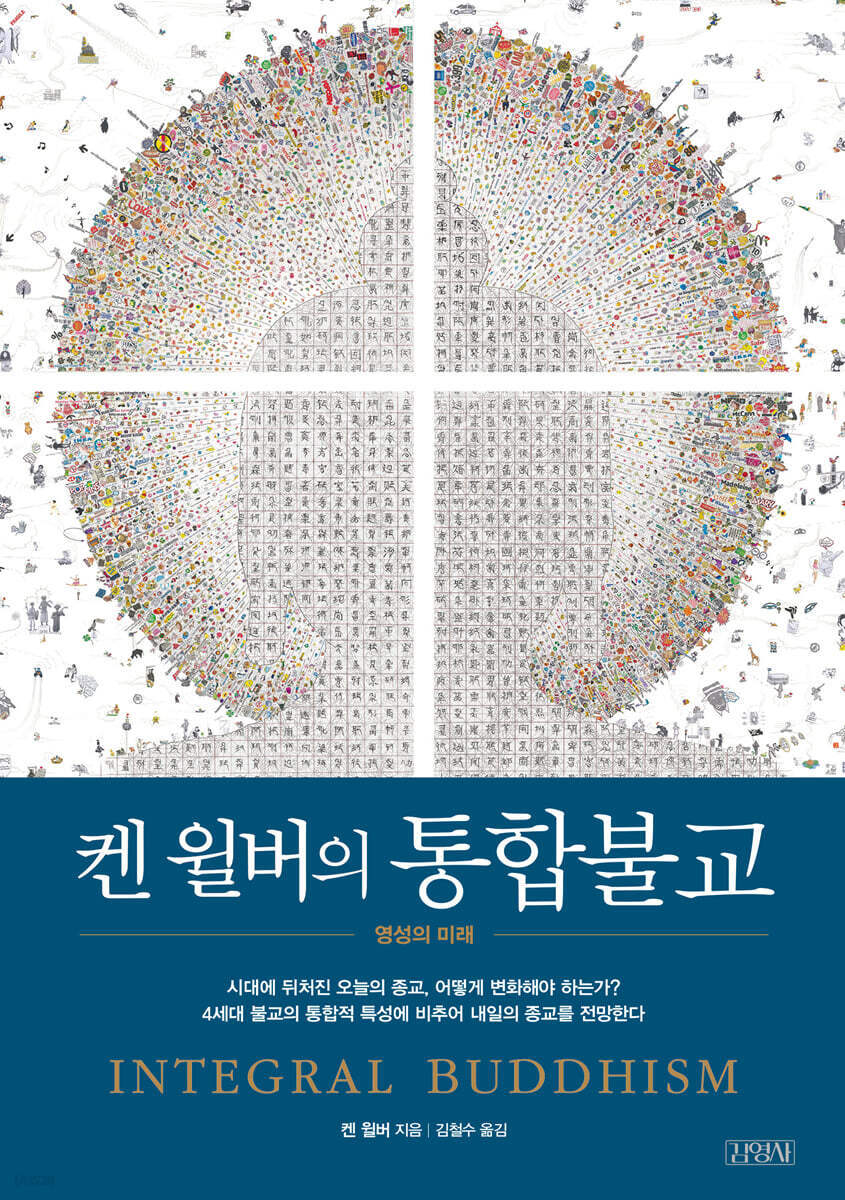
Ken Wilber's Unified Buddhism
 |
Description
Book Introduction
How should today's religion, which is outdated, change?
Ken Wilber's "Integrated Spirituality" Proposes a Vision for Tomorrow's Religion
Today's religion has ceded its power to capitalism and advanced science, and has retreated to the back alleys of the times.
How can we renew ourselves by incorporating the latest scientific and cultural achievements while maintaining the great teachings of our own spiritual tradition?
Ken Wilber, a world-renowned integrative thinker hailed as the “Einstein of consciousness research,” finds a breakthrough in problem-solving in Buddhism, which has continuously evolved while progressively accepting three major changes over the past 2,600 years.
We diagnose the crises and limitations of today's spiritual traditions through the precise AQAL model, and propose a fourth-generation Buddhism, or "integrated Buddhism," that applies the latest psychological and social scientific research findings on human consciousness to the original, open, and expansive characteristics of Buddhism.
Including the 'path to enlightenment (state of consciousness)' and the 'path to growth (structure of consciousness)' first mentioned in the previous work, 'Ken Wilber's Integrative Meditation', we examine typologies such as MBTI and Enneagram, multiple intelligences, quadrants, and shadow work as tools and standards for assessing true 'integrative spirituality'.
If the existing 'Won-Yong-Hoe-Tong' or 'Tong-Seop' were like a possibility or bibimbap without clear standards, Ken Wilber presents a new spiritual system that 'integrates' existing concepts by viewing them from various different dimensions through unique standards and discernment models.
Drawing on the integrative nature of fourth-generation Buddhism as a model, it presents a new vision of spirituality that further develops the wisdom and characteristics of each spiritual path while also reflecting the latest social, scientific, and cultural advances.
This book is a summary written by the author himself, explaining the main contents of 『Tomorrow's Religion (Geun-gan, Kim Young-sa)』, which is a culmination of half a century of research by Ken Wilber, and reveals the path forward for religion and spirituality in the 21st century.
Ken Wilber's "Integrated Spirituality" Proposes a Vision for Tomorrow's Religion
Today's religion has ceded its power to capitalism and advanced science, and has retreated to the back alleys of the times.
How can we renew ourselves by incorporating the latest scientific and cultural achievements while maintaining the great teachings of our own spiritual tradition?
Ken Wilber, a world-renowned integrative thinker hailed as the “Einstein of consciousness research,” finds a breakthrough in problem-solving in Buddhism, which has continuously evolved while progressively accepting three major changes over the past 2,600 years.
We diagnose the crises and limitations of today's spiritual traditions through the precise AQAL model, and propose a fourth-generation Buddhism, or "integrated Buddhism," that applies the latest psychological and social scientific research findings on human consciousness to the original, open, and expansive characteristics of Buddhism.
Including the 'path to enlightenment (state of consciousness)' and the 'path to growth (structure of consciousness)' first mentioned in the previous work, 'Ken Wilber's Integrative Meditation', we examine typologies such as MBTI and Enneagram, multiple intelligences, quadrants, and shadow work as tools and standards for assessing true 'integrative spirituality'.
If the existing 'Won-Yong-Hoe-Tong' or 'Tong-Seop' were like a possibility or bibimbap without clear standards, Ken Wilber presents a new spiritual system that 'integrates' existing concepts by viewing them from various different dimensions through unique standards and discernment models.
Drawing on the integrative nature of fourth-generation Buddhism as a model, it presents a new vision of spirituality that further develops the wisdom and characteristics of each spiritual path while also reflecting the latest social, scientific, and cultural advances.
This book is a summary written by the author himself, explaining the main contents of 『Tomorrow's Religion (Geun-gan, Kim Young-sa)』, which is a culmination of half a century of research by Ken Wilber, and reveals the path forward for religion and spirituality in the 21st century.
- You can preview some of the book's contents.
Preview
index
introduction
Part 1: The Past
Chapter 1: Historical Overview
Chapter 2 Some Possibilities
Part 2 Present
Chapter 3: Views and Vantage Points
1.
Status and structure
2.
Status and Point in Time
3.
Structure and Perspective
4.
spiritual intelligence
Chapter 4: Examples of More Integrative Spirituality
1.
Stepping stones and perspectives
2.
Status and Point in Time
3.
Shadow work
4.
quadrant
5.
typology
6.
The miracle of 'us'
7.
The True Power of Inner Thinking
Part 3: The Future
Chapter 5: The Future of Buddhism
Ken Wilber's major works
Translator's Note
Search
Part 1: The Past
Chapter 1: Historical Overview
Chapter 2 Some Possibilities
Part 2 Present
Chapter 3: Views and Vantage Points
1.
Status and structure
2.
Status and Point in Time
3.
Structure and Perspective
4.
spiritual intelligence
Chapter 4: Examples of More Integrative Spirituality
1.
Stepping stones and perspectives
2.
Status and Point in Time
3.
Shadow work
4.
quadrant
5.
typology
6.
The miracle of 'us'
7.
The True Power of Inner Thinking
Part 3: The Future
Chapter 5: The Future of Buddhism
Ken Wilber's major works
Translator's Note
Search
Detailed image
.jpg)
Into the book
While the world's sciences, arts, and humanities have raced toward the level of 'rationality' and 'pluralism' and are now reaching the revolutionary level of 'integralism,' most religions proudly keep their heels firmly planted on the lower level of 'mythology' and 'ethnocentrism.'
This underscores the paradox that religion remains the world's greatest single force causing conflict, imbalance, lack of love, war, and terrorism.
In fact, most of the terrorist attacks that have occurred over the past 30 years have been religious, not political, in nature.
--- p.185
Perhaps the most unique feature of Buddhism is its understanding that its own system is evolving or developing.
This is commonly expressed in terms of the 'three great turnings' of Buddhism, that is, the three major turnings that Buddhism has gone through.
--- p.16
If the first turn of the Dharma Wheel was the path of renunciation and resignation that denied the negative state of the contemptible cycle of reincarnation, the second turn was the path of transformation that transformed the negative state into a positive transcendent state through wisdom, and the third turn was not the path of renunciation or transformation, but the path of transmutation that directly entered the negative state of 'form' in order to immediately realize that the fundamental wisdom of 'emptiness' already exists within 'form'.
The motto here is “bring everything on the road.”
--- p.29
The Fourth Turning of the Wheel of Dharma will not only contain all the great truths of previous Buddhism, but will also add new discoveries from various fields such as evolutionary biology and developmental psychology, all of which are directly and closely related to the field of spirituality.
This new revolution, known by various names such as 'Evolutionary Buddhism' and 'Integral Buddhism', will, like all previous revolutions, incorporate and transcend previous truths—that is, it will retain all the core truths while adding new elements.
--- p.18
All core religions have been adding important new ideas and practices to their original core teachings for at least a thousand years.
The original teachings themselves were, virtually without exception, created in a time when people believed the Earth was flat and slavery was a normal and natural state, when women and other minorities were considered second-class citizens, and when not only was there no knowledge of evolution, but most of modern science had not yet been discovered.
--- p.6
Just as an acorn goes through a series of universal stages to become a pine tree or an egg to become a chick, so too do humans go through a series of universal stages to become mature beings.
This maturity is one that moves beyond deep-seated conflict and aggression and progresses toward consideration, love, and kindness.
--- p.34
The first core strength of Buddhism is that it was born as a "rational-world-centered" religion that does not accept any mythical authority but verifies it through personal experience and reason; the second is that it places the state at the center and forefront of spirituality.
--- p.187
Understanding science and spirituality means understanding not only how they relate to one another, but also why they are distinct disciplines, with different methodologies, different technologies, different modes of knowing, and different discoveries, and how all of this interrelate without contradiction or conflict.
--- p.194
If the experience of emptiness is the experience of freedom, the experience of color is the experience of fullness.
While the ball has remained unchanged from the beginning of time until now, color has been constantly changing, adding more complexity to the universe with each stage of evolution.
From simple quarks to atoms, molecules, cells, multicellular organisms, and organisms themselves evolved again, starting from single cells, into photosynthetic plants, animals with perceptual neural networks, and then into more complex forms, including the reptilian brainstem, limbic system, and tri-brained brain with more synaptic connections than all the stars in the universe.
--- p.35
The 'state' of consciousness is something that humanity has generally known for thousands of years.
These states, as direct and immediate first-person experiences, open the way to introspection, meditation, vision exploration, and other modes of direct experience.
On the other hand, the 'structure' of consciousness is an implicit and latent third-person mental pattern through which the mind sees and interprets not only the object world but also its own mental state.
Things like multiple intelligences are made up of structures, while things like present experiences, religious experiences, everyday emotions, and meditative states are made up of states.
--- p.49
Evolution continues.
The spirit continues to be active.
The structure of reality continues to evolve, becoming increasingly higher and more complex.
Since enlightenment includes oneness with the entire universe, enlightenment itself will become more fulfilling, and thus, one's union with God will also become more fulfilling.
By including structural stages and perspectives, we will be able to better understand the fullness of Buddha-nature, and thereby deepen the depth of 'enlightenment', which is the original goal of Buddhism.
This has been one of the primary goals of Buddhism since its inception.
The Fourth Cycle in Buddhism not only maintains consistency with Buddhism's own history and self-understanding, but also contains many important new elements that are worth recommending.
Now is the time ripe for such a revolution to arrive.
This underscores the paradox that religion remains the world's greatest single force causing conflict, imbalance, lack of love, war, and terrorism.
In fact, most of the terrorist attacks that have occurred over the past 30 years have been religious, not political, in nature.
--- p.185
Perhaps the most unique feature of Buddhism is its understanding that its own system is evolving or developing.
This is commonly expressed in terms of the 'three great turnings' of Buddhism, that is, the three major turnings that Buddhism has gone through.
--- p.16
If the first turn of the Dharma Wheel was the path of renunciation and resignation that denied the negative state of the contemptible cycle of reincarnation, the second turn was the path of transformation that transformed the negative state into a positive transcendent state through wisdom, and the third turn was not the path of renunciation or transformation, but the path of transmutation that directly entered the negative state of 'form' in order to immediately realize that the fundamental wisdom of 'emptiness' already exists within 'form'.
The motto here is “bring everything on the road.”
--- p.29
The Fourth Turning of the Wheel of Dharma will not only contain all the great truths of previous Buddhism, but will also add new discoveries from various fields such as evolutionary biology and developmental psychology, all of which are directly and closely related to the field of spirituality.
This new revolution, known by various names such as 'Evolutionary Buddhism' and 'Integral Buddhism', will, like all previous revolutions, incorporate and transcend previous truths—that is, it will retain all the core truths while adding new elements.
--- p.18
All core religions have been adding important new ideas and practices to their original core teachings for at least a thousand years.
The original teachings themselves were, virtually without exception, created in a time when people believed the Earth was flat and slavery was a normal and natural state, when women and other minorities were considered second-class citizens, and when not only was there no knowledge of evolution, but most of modern science had not yet been discovered.
--- p.6
Just as an acorn goes through a series of universal stages to become a pine tree or an egg to become a chick, so too do humans go through a series of universal stages to become mature beings.
This maturity is one that moves beyond deep-seated conflict and aggression and progresses toward consideration, love, and kindness.
--- p.34
The first core strength of Buddhism is that it was born as a "rational-world-centered" religion that does not accept any mythical authority but verifies it through personal experience and reason; the second is that it places the state at the center and forefront of spirituality.
--- p.187
Understanding science and spirituality means understanding not only how they relate to one another, but also why they are distinct disciplines, with different methodologies, different technologies, different modes of knowing, and different discoveries, and how all of this interrelate without contradiction or conflict.
--- p.194
If the experience of emptiness is the experience of freedom, the experience of color is the experience of fullness.
While the ball has remained unchanged from the beginning of time until now, color has been constantly changing, adding more complexity to the universe with each stage of evolution.
From simple quarks to atoms, molecules, cells, multicellular organisms, and organisms themselves evolved again, starting from single cells, into photosynthetic plants, animals with perceptual neural networks, and then into more complex forms, including the reptilian brainstem, limbic system, and tri-brained brain with more synaptic connections than all the stars in the universe.
--- p.35
The 'state' of consciousness is something that humanity has generally known for thousands of years.
These states, as direct and immediate first-person experiences, open the way to introspection, meditation, vision exploration, and other modes of direct experience.
On the other hand, the 'structure' of consciousness is an implicit and latent third-person mental pattern through which the mind sees and interprets not only the object world but also its own mental state.
Things like multiple intelligences are made up of structures, while things like present experiences, religious experiences, everyday emotions, and meditative states are made up of states.
--- p.49
Evolution continues.
The spirit continues to be active.
The structure of reality continues to evolve, becoming increasingly higher and more complex.
Since enlightenment includes oneness with the entire universe, enlightenment itself will become more fulfilling, and thus, one's union with God will also become more fulfilling.
By including structural stages and perspectives, we will be able to better understand the fullness of Buddha-nature, and thereby deepen the depth of 'enlightenment', which is the original goal of Buddhism.
This has been one of the primary goals of Buddhism since its inception.
The Fourth Cycle in Buddhism not only maintains consistency with Buddhism's own history and self-understanding, but also contains many important new elements that are worth recommending.
Now is the time ripe for such a revolution to arrive.
--- p.200
Publisher's Review
What should we do about religion, which has lost its place in modern life?
Finding a New Path in Ken Wilber's Integral Spirituality
Today's religion has ceded its power to capitalism and advanced science, and has retreated to the back alleys of the times.
How can we renew ourselves by incorporating the latest scientific and cultural achievements while maintaining the great teachings of our own spiritual tradition?
The author historically analyzes Buddhism, which has evolved over 2,600 years by continuously adding new content to its fundamental teachings while undergoing three major transformations, and proposes "Integrated Buddhism," a "fourth-generation Buddhism," by adding the latest psychological and social scientific research findings on the structural evolution and inner growth of human consciousness.
Using this as an exemplary case, we explore the problematic situation facing religion in general today and suggest a path toward 'integrated spirituality' as a way forward.
The Future of Religion as Seen Through Buddhism
The fundamental changes brought about by the fourth generation of Buddhism
In fact, the Western world has come to a standstill in spiritual growth.
Spiritual intelligence (structure of consciousness) as a path to spiritual growth has stopped at the level of myth, that is, the level of a typical seven-year-old child today, and spiritual experience (state of consciousness) as a path to awakening has been completely forbidden.
Indeed, this is the state of helplessness that Western spirituality suffers from today.
_p.119
In the 21st century, science, art, and other humanities are trying to enter the revolutionary 'integration' stage, beyond the 'rationality' and 'pluralism' stages in the developmental stages of consciousness structure: primordial → magic → myth → rationality → pluralism → integration → super integration. On the other hand, the world's religions are mostly stuck at the ethnocentric level of 'mythology'.
So, religion, contrary to the lofty ideals and goals it originally advocated and pursued, sometimes causes conflicts between ethnic groups, imbalances between classes, terrorism, and war.
The author diagnoses that the problem with these religions is due to the underdevelopment of 'spiritual intelligence', that is, the delayed development of the structure of consciousness.
Spiritual intelligence is one of the multiple intelligences of humans (there are about ten types of intelligence that humans possess, including cognitive intelligence, emotional intelligence, moral intelligence, and aesthetic intelligence), and is an intelligence that pursues the value and meaning of a sacred life.
While most major religions remain stuck in a mythological perspective, other fields of intelligence are freely moving toward higher perspectives such as rationality, pluralism, and integration. This is the situation we find ourselves in today.
This state of spiritually retarded development cannot but be a tremendous cultural tragedy.
Because 'spiritual intelligence' is the only multiple intelligence that has evolved to interact with spirit itself, that is, the intelligence that recognizes ultimate reality, ultimate truth, and ultimate goodness.
Spiritual intelligence is the guiding light for all other multiple intelligences, and it must lead the way by one or two steps.
However, the current spiritual intelligence, which is largely at the level of a myth, is actually one or two steps behind most other intelligences.
_p.108
So how can religion lead spirituality in line with the modern consciousness? The author surprisingly finds in Buddhism a way for religion to transform and be reborn as a desirable form.
It's not that I think Buddhism is superior to other religions or a higher religion.
To demonstrate the concrete form of integrated spirituality, it was necessary to provide a practical and specific example, rather than a general or abstract religion, and in this respect, Buddhism stood out as being more suitable than other religions.
Buddhism has historically been open to the continuous development and expansion of its doctrines, and has always been fully aware that its systems are evolving and developing.
In fact, because Buddhist teachings have undergone three major developmental 'turnings', they have the unique characteristic of being accustomed to updating the original teachings by adding new content.
Therefore, the form of integrated Buddhism or integrated spirituality presented by the author in this book is a more comprehensive, inclusive, and complete form of religion that preserves the original, fundamental teachings while adding newly discovered cutting-edge knowledge.
‘Integrated Buddhism’ is a powerful alternative that will lead the unified revolution.
The integrated revolution proposed by the author signifies a fundamental change in all human mental phenomena and abilities, including science, spirituality, art, humanities, and humanity.
The author delivers the following exciting message about the current situation in which the unification revolution is coming:
The Fourth Transition (the Fourth Revolution) in Buddhism not only maintains consistency with Buddhism's own history and self-understanding, but also contains many important new elements worthy of recommendation.
Now is the time ripe for such a revolution to arrive.
The world is at a crossroads of unprecedented and profound transformation, moving towards a fundamentally new level and type of awareness.
This is also supported by the fact that subsequent studies use terms such as ‘systemic,’ ‘unified,’ ‘holistic,’ ‘integrated,’ ‘inclusive,’ ‘accommodating,’ and ‘interconnected.’
Let us be clear that not only science, but also humanity and spirituality are part of this fundamental transformation.
Let us do our best to ensure that the path to great liberation is suitable for both the modern and post-modern world.
So let's prepare ourselves to leap forward into new transformations along that path.
Then Buddhism will be ready to give us the gift it has so excellently provided from time immemorial, even more frequently.
_p.201
What do Integrative Spirituality and Integrative Buddhism newly integrate?
Open spirituality encompassing scientific, psychological, medical, and sociological fields
The 'Integral Spirituality' that Ken Wilber talks about is a spirituality that includes the 'highest state-stage' interpreted by the 'integrative perspective' of a person who has reached the '(super)integrative stage', the highest developmental stage of the consciousness structure, that is, a 'mature perspective revealed by an inclusive, tolerant, and integrative structure'.
The author describes integrated spirituality as follows:
Integrative spirituality does not mean that all religions are melted into one universal religion.
This is similar to how 'international cuisine' doesn't mean that all food has to be Italian.
Integrative spirituality suggests that people at the integrated level of spiritual intelligence will demand an integrated explanation and understanding of their faith.
_p.95
In other words, 'integrated spirituality' or 'integrated religion' does not mean integrating various spiritualities/religions into a single spirituality/religion and creating a new 'something', but rather means an interpretation that accepts any type of religion as a 'Kosmos-like oneness' that includes and transcends it.
Ken Wilber suggests five major new essential elements that the fourth-generation Buddhists, 'integrated Buddhism' and 'integrated spirituality', must include.
It includes 'states of consciousness', 'structures of consciousness', 'quadrants', 'shadow work', and 'typology'.
These are so essential that it would be difficult to call it an integrated spirituality even if only one of them were excluded.
To summarize the concept briefly, it is as follows.
● Structure of consciousness: This refers to the level of consciousness formed by the social and cultural environment through historical development, and the perspective from which the world is viewed and interpreted.
(primordial → magical → mythical → rational → pluralistic → integrative)
● State of consciousness: refers to an individual's inner experience through meditation practice, etc.
(Joya → Jeongmyo → Wonin → Biwon)
● Shadow work: The shadow refers to the negative elements that make up our consciousness structure and state, but are not desired or properly integrated, and are suppressed, separated, or denied ownership, and are buried in the unconscious, where they exert influence.
Integrative spirituality must include an understanding of the shadow and a healing process.
● Quadrant: Refers to the four perspectives and dimensions that all phenomena have.
All things and events can be viewed from both an 'inner' and an 'outer' aspect, and from both an 'individual' and a 'collective' aspect.
This gives us an overall combination of four perspectives/dimensions.
● Typology: This refers to the consideration of individual characteristics and qualities that remain unchanged even when structures or conditions develop, such as masculinity/femininity or MBTI/Enneagram.
The Path of Awakening vs. the Path of Growth
A new scale for measuring human growth, development, and evolution
Ken Wilber argues that human spirituality has developed through two paths: 'states of consciousness' and 'structures of consciousness.'
'State of consciousness' is something that humanity has generally known for thousands of years, and it is the 'path of awakening' that Buddhism has pursued since its inception, that is, the path of first-person spiritual experience such as introspection and meditation.
In fact, it is a core element that can be said to be the starting point and reason for existence of all religions and spirituality.
In comparison, the 'Structure of Consciousness' is the 'Path of Growing Up', a path of third-person spiritual intelligence, newly discovered through Western scientific research just over 100 years ago.
Human consciousness has grown and developed through a process of transformation and transformation within a multi-layered structure consisting of several stages.
'Transformation' refers to the vertical rise and growth of perspective that occurs when moving from one level of consciousness structure to a higher level, while 'translation' refers to horizontal expansion within the same level.
When a phenomenon experienced by the consciousness of the ego is newly interpreted or understood at an equivalent level, it remains in the 'transformation' stage, but when the phenomenon rises to a higher existential level and is interpreted and understood completely differently, it is then categorized as the 'transformation' stage.
Wilber's unified theory details the various stages of development of the "states of consciousness" that are the path to awakening and the "structures of consciousness" that are the path to growth, providing a new approach and understanding of "enlightenment."
As historical and cultural beings, humans occupy a specific coordinate where the axis of the 'structure-stage (perspective)', which is the objective consciousness that evolved within the community, and the axis of the 'state-stage (point of view)', which is the inner consciousness of the individual, meet. This is called the 'dual center of gravity.'
In the theory of integration, there is something called the 'center of gravity' of the self.
The body has two centers of gravity: the 'structural center of gravity' and the 'state center of gravity'.
For example, if a person is mainly at the 'myth' level in the structural growth process of primordial → magic → myth → rational → multi-elemental → integration → super-integration, and is mainly at the 'myth' level in the development of the states of simple → subtle → cause → observation → non-dual, then the dual center of gravity of that person becomes 'myth-subtle'.
_p.54
The relationship between 'state (point of view)' and 'structure (perspective)' can be seen as the relationship between 'what is experienced' and 'how it is interpreted.'
For example, if there are three people who saw 'light' during meditation, they would all have seen this light in a 'subtle state'.
However, if the structure and stage of the three people are different, the way they interpret this spiritual experience called 'light' will also be different.
A person at the 'magic' stage will interpret this light from a first-person perspective as 'self', a person at the 'myth' stage will interpret it from an expanded second-person perspective as 'we', and a person at the 'rational' stage will interpret it from a global perspective as expanded from a critical third-person perspective.
Therefore, even if meditators are of the same level (state-stage), their interpretation and behavior of the same meditative experience will inevitably differ depending on the stage of consciousness structure they belong to.
The author sharply points out that both the state and structure of consciousness are essential elements that must be considered for spiritual growth, yet they have not been considered at all in any religion or meditation tradition to date. He then explains the path to spiritual growth that we must take forward as follows.
At any point in history and evolution, the upper limit of spiritual development is the sum total of all structures and states that have appeared up to that point.
Fully mature spirituality refers to a 'state-stage' in which one has experienced complete enlightenment or awakening, and such enlightenment is experienced from a fully mature perspective, not from the perspective (structure) of childhood or adolescence.
This perspective is the most recent, a mature one, revealed by a more inclusive, tolerant, and integrated structure, wiser and more perceptive than any perspective humanity has ever discovered.
This new understanding of enlightenment and full development from both our dual centers of gravity (the structural and the state perspectives) can be said to be a new yardstick for measuring human growth, development, and evolution.
_p.110
In this way, we reach 'integral spirituality', where spiritual intelligence that has reached the highest structural level, the integration level, experiences the spirituality of the non-dual state, the highest state level.
This book is an easy-to-understand summary of the core of "Tomorrow's Religion" (Geun-gan, Kim Young-sa), which is a culmination of half a century of research by world-renowned thinker Ken Wilber. It presents an excellent insight that today's religions, faced with serious problems, should heed: a blueprint for "integrated spirituality" that encompasses modern life and presents a vision for the future.
Finding a New Path in Ken Wilber's Integral Spirituality
Today's religion has ceded its power to capitalism and advanced science, and has retreated to the back alleys of the times.
How can we renew ourselves by incorporating the latest scientific and cultural achievements while maintaining the great teachings of our own spiritual tradition?
The author historically analyzes Buddhism, which has evolved over 2,600 years by continuously adding new content to its fundamental teachings while undergoing three major transformations, and proposes "Integrated Buddhism," a "fourth-generation Buddhism," by adding the latest psychological and social scientific research findings on the structural evolution and inner growth of human consciousness.
Using this as an exemplary case, we explore the problematic situation facing religion in general today and suggest a path toward 'integrated spirituality' as a way forward.
The Future of Religion as Seen Through Buddhism
The fundamental changes brought about by the fourth generation of Buddhism
In fact, the Western world has come to a standstill in spiritual growth.
Spiritual intelligence (structure of consciousness) as a path to spiritual growth has stopped at the level of myth, that is, the level of a typical seven-year-old child today, and spiritual experience (state of consciousness) as a path to awakening has been completely forbidden.
Indeed, this is the state of helplessness that Western spirituality suffers from today.
_p.119
In the 21st century, science, art, and other humanities are trying to enter the revolutionary 'integration' stage, beyond the 'rationality' and 'pluralism' stages in the developmental stages of consciousness structure: primordial → magic → myth → rationality → pluralism → integration → super integration. On the other hand, the world's religions are mostly stuck at the ethnocentric level of 'mythology'.
So, religion, contrary to the lofty ideals and goals it originally advocated and pursued, sometimes causes conflicts between ethnic groups, imbalances between classes, terrorism, and war.
The author diagnoses that the problem with these religions is due to the underdevelopment of 'spiritual intelligence', that is, the delayed development of the structure of consciousness.
Spiritual intelligence is one of the multiple intelligences of humans (there are about ten types of intelligence that humans possess, including cognitive intelligence, emotional intelligence, moral intelligence, and aesthetic intelligence), and is an intelligence that pursues the value and meaning of a sacred life.
While most major religions remain stuck in a mythological perspective, other fields of intelligence are freely moving toward higher perspectives such as rationality, pluralism, and integration. This is the situation we find ourselves in today.
This state of spiritually retarded development cannot but be a tremendous cultural tragedy.
Because 'spiritual intelligence' is the only multiple intelligence that has evolved to interact with spirit itself, that is, the intelligence that recognizes ultimate reality, ultimate truth, and ultimate goodness.
Spiritual intelligence is the guiding light for all other multiple intelligences, and it must lead the way by one or two steps.
However, the current spiritual intelligence, which is largely at the level of a myth, is actually one or two steps behind most other intelligences.
_p.108
So how can religion lead spirituality in line with the modern consciousness? The author surprisingly finds in Buddhism a way for religion to transform and be reborn as a desirable form.
It's not that I think Buddhism is superior to other religions or a higher religion.
To demonstrate the concrete form of integrated spirituality, it was necessary to provide a practical and specific example, rather than a general or abstract religion, and in this respect, Buddhism stood out as being more suitable than other religions.
Buddhism has historically been open to the continuous development and expansion of its doctrines, and has always been fully aware that its systems are evolving and developing.
In fact, because Buddhist teachings have undergone three major developmental 'turnings', they have the unique characteristic of being accustomed to updating the original teachings by adding new content.
Therefore, the form of integrated Buddhism or integrated spirituality presented by the author in this book is a more comprehensive, inclusive, and complete form of religion that preserves the original, fundamental teachings while adding newly discovered cutting-edge knowledge.
‘Integrated Buddhism’ is a powerful alternative that will lead the unified revolution.
The integrated revolution proposed by the author signifies a fundamental change in all human mental phenomena and abilities, including science, spirituality, art, humanities, and humanity.
The author delivers the following exciting message about the current situation in which the unification revolution is coming:
The Fourth Transition (the Fourth Revolution) in Buddhism not only maintains consistency with Buddhism's own history and self-understanding, but also contains many important new elements worthy of recommendation.
Now is the time ripe for such a revolution to arrive.
The world is at a crossroads of unprecedented and profound transformation, moving towards a fundamentally new level and type of awareness.
This is also supported by the fact that subsequent studies use terms such as ‘systemic,’ ‘unified,’ ‘holistic,’ ‘integrated,’ ‘inclusive,’ ‘accommodating,’ and ‘interconnected.’
Let us be clear that not only science, but also humanity and spirituality are part of this fundamental transformation.
Let us do our best to ensure that the path to great liberation is suitable for both the modern and post-modern world.
So let's prepare ourselves to leap forward into new transformations along that path.
Then Buddhism will be ready to give us the gift it has so excellently provided from time immemorial, even more frequently.
_p.201
What do Integrative Spirituality and Integrative Buddhism newly integrate?
Open spirituality encompassing scientific, psychological, medical, and sociological fields
The 'Integral Spirituality' that Ken Wilber talks about is a spirituality that includes the 'highest state-stage' interpreted by the 'integrative perspective' of a person who has reached the '(super)integrative stage', the highest developmental stage of the consciousness structure, that is, a 'mature perspective revealed by an inclusive, tolerant, and integrative structure'.
The author describes integrated spirituality as follows:
Integrative spirituality does not mean that all religions are melted into one universal religion.
This is similar to how 'international cuisine' doesn't mean that all food has to be Italian.
Integrative spirituality suggests that people at the integrated level of spiritual intelligence will demand an integrated explanation and understanding of their faith.
_p.95
In other words, 'integrated spirituality' or 'integrated religion' does not mean integrating various spiritualities/religions into a single spirituality/religion and creating a new 'something', but rather means an interpretation that accepts any type of religion as a 'Kosmos-like oneness' that includes and transcends it.
Ken Wilber suggests five major new essential elements that the fourth-generation Buddhists, 'integrated Buddhism' and 'integrated spirituality', must include.
It includes 'states of consciousness', 'structures of consciousness', 'quadrants', 'shadow work', and 'typology'.
These are so essential that it would be difficult to call it an integrated spirituality even if only one of them were excluded.
To summarize the concept briefly, it is as follows.
● Structure of consciousness: This refers to the level of consciousness formed by the social and cultural environment through historical development, and the perspective from which the world is viewed and interpreted.
(primordial → magical → mythical → rational → pluralistic → integrative)
● State of consciousness: refers to an individual's inner experience through meditation practice, etc.
(Joya → Jeongmyo → Wonin → Biwon)
● Shadow work: The shadow refers to the negative elements that make up our consciousness structure and state, but are not desired or properly integrated, and are suppressed, separated, or denied ownership, and are buried in the unconscious, where they exert influence.
Integrative spirituality must include an understanding of the shadow and a healing process.
● Quadrant: Refers to the four perspectives and dimensions that all phenomena have.
All things and events can be viewed from both an 'inner' and an 'outer' aspect, and from both an 'individual' and a 'collective' aspect.
This gives us an overall combination of four perspectives/dimensions.
● Typology: This refers to the consideration of individual characteristics and qualities that remain unchanged even when structures or conditions develop, such as masculinity/femininity or MBTI/Enneagram.
The Path of Awakening vs. the Path of Growth
A new scale for measuring human growth, development, and evolution
Ken Wilber argues that human spirituality has developed through two paths: 'states of consciousness' and 'structures of consciousness.'
'State of consciousness' is something that humanity has generally known for thousands of years, and it is the 'path of awakening' that Buddhism has pursued since its inception, that is, the path of first-person spiritual experience such as introspection and meditation.
In fact, it is a core element that can be said to be the starting point and reason for existence of all religions and spirituality.
In comparison, the 'Structure of Consciousness' is the 'Path of Growing Up', a path of third-person spiritual intelligence, newly discovered through Western scientific research just over 100 years ago.
Human consciousness has grown and developed through a process of transformation and transformation within a multi-layered structure consisting of several stages.
'Transformation' refers to the vertical rise and growth of perspective that occurs when moving from one level of consciousness structure to a higher level, while 'translation' refers to horizontal expansion within the same level.
When a phenomenon experienced by the consciousness of the ego is newly interpreted or understood at an equivalent level, it remains in the 'transformation' stage, but when the phenomenon rises to a higher existential level and is interpreted and understood completely differently, it is then categorized as the 'transformation' stage.
Wilber's unified theory details the various stages of development of the "states of consciousness" that are the path to awakening and the "structures of consciousness" that are the path to growth, providing a new approach and understanding of "enlightenment."
As historical and cultural beings, humans occupy a specific coordinate where the axis of the 'structure-stage (perspective)', which is the objective consciousness that evolved within the community, and the axis of the 'state-stage (point of view)', which is the inner consciousness of the individual, meet. This is called the 'dual center of gravity.'
In the theory of integration, there is something called the 'center of gravity' of the self.
The body has two centers of gravity: the 'structural center of gravity' and the 'state center of gravity'.
For example, if a person is mainly at the 'myth' level in the structural growth process of primordial → magic → myth → rational → multi-elemental → integration → super-integration, and is mainly at the 'myth' level in the development of the states of simple → subtle → cause → observation → non-dual, then the dual center of gravity of that person becomes 'myth-subtle'.
_p.54
The relationship between 'state (point of view)' and 'structure (perspective)' can be seen as the relationship between 'what is experienced' and 'how it is interpreted.'
For example, if there are three people who saw 'light' during meditation, they would all have seen this light in a 'subtle state'.
However, if the structure and stage of the three people are different, the way they interpret this spiritual experience called 'light' will also be different.
A person at the 'magic' stage will interpret this light from a first-person perspective as 'self', a person at the 'myth' stage will interpret it from an expanded second-person perspective as 'we', and a person at the 'rational' stage will interpret it from a global perspective as expanded from a critical third-person perspective.
Therefore, even if meditators are of the same level (state-stage), their interpretation and behavior of the same meditative experience will inevitably differ depending on the stage of consciousness structure they belong to.
The author sharply points out that both the state and structure of consciousness are essential elements that must be considered for spiritual growth, yet they have not been considered at all in any religion or meditation tradition to date. He then explains the path to spiritual growth that we must take forward as follows.
At any point in history and evolution, the upper limit of spiritual development is the sum total of all structures and states that have appeared up to that point.
Fully mature spirituality refers to a 'state-stage' in which one has experienced complete enlightenment or awakening, and such enlightenment is experienced from a fully mature perspective, not from the perspective (structure) of childhood or adolescence.
This perspective is the most recent, a mature one, revealed by a more inclusive, tolerant, and integrated structure, wiser and more perceptive than any perspective humanity has ever discovered.
This new understanding of enlightenment and full development from both our dual centers of gravity (the structural and the state perspectives) can be said to be a new yardstick for measuring human growth, development, and evolution.
_p.110
In this way, we reach 'integral spirituality', where spiritual intelligence that has reached the highest structural level, the integration level, experiences the spirituality of the non-dual state, the highest state level.
This book is an easy-to-understand summary of the core of "Tomorrow's Religion" (Geun-gan, Kim Young-sa), which is a culmination of half a century of research by world-renowned thinker Ken Wilber. It presents an excellent insight that today's religions, faced with serious problems, should heed: a blueprint for "integrated spirituality" that encompasses modern life and presents a vision for the future.
GOODS SPECIFICS
- Date of issue: March 2, 2022
- Page count, weight, size: 224 pages | 364g | 148*210*20mm
- ISBN13: 9788934952299
- ISBN10: 8934952296
You may also like
카테고리
korean


korean

![GQ KOREA Mark (Monthly): December [2025]](http://librairie.coreenne.fr/cdn/shop/files/8ef265dbbfbf186523ed75ba7319009d.jpg?v=1765340328&width=3840)


