

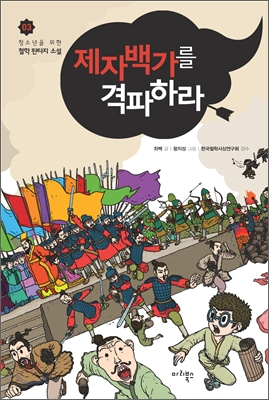
Defeat the Hundred Schools of Thought
 |
Description
Book Introduction
The thought of the Hundred Schools of Thought, which can be said to be the parents of Eastern thought.
The Hundred Schools of Thought, which means 'many wise teachers and their schools', tells the story of many thinkers who pooled their wisdom to overcome the chaotic Spring and Autumn Period and Warring States Period.
The story goes that when our human spirit awakened and began to think about and explain the world and humanity, there was Greece in the West, who created philosophy, and there were the Hundred Schools of Thought in the East.
With the completion of this book, the "Philosophical Fantasy Novels for Young Adults" series touches upon the fundamentals of logic, Greek philosophy, and Eastern philosophy, which are the major branches of philosophy.
Philosophical essays dealing with the philosophy of life are often published, but this book is noteworthy in that it is a "philosophical novel" written by a professional novelist who majored in philosophy.
Moreover, the Oriental philosophy section published this time draws readers in even more deeply into the story with its familiarity with the concept of the 'East' and the interesting historical background of the Spring and Autumn Period and the Warring States Period, when the Hundred Schools of Thought lived.
Wang Ji-seong's fantastical drawings also make the story of Zuo Baek more interesting.
The Hundred Schools of Thought, which means 'many wise teachers and their schools', tells the story of many thinkers who pooled their wisdom to overcome the chaotic Spring and Autumn Period and Warring States Period.
The story goes that when our human spirit awakened and began to think about and explain the world and humanity, there was Greece in the West, who created philosophy, and there were the Hundred Schools of Thought in the East.
With the completion of this book, the "Philosophical Fantasy Novels for Young Adults" series touches upon the fundamentals of logic, Greek philosophy, and Eastern philosophy, which are the major branches of philosophy.
Philosophical essays dealing with the philosophy of life are often published, but this book is noteworthy in that it is a "philosophical novel" written by a professional novelist who majored in philosophy.
Moreover, the Oriental philosophy section published this time draws readers in even more deeply into the story with its familiarity with the concept of the 'East' and the interesting historical background of the Spring and Autumn Period and the Warring States Period, when the Hundred Schools of Thought lived.
Wang Ji-seong's fantastical drawings also make the story of Zuo Baek more interesting.
- You can preview some of the book's contents.
Preview
index
00.
Jinu said, no matter how strange something is, if you experience it many times, you will eventually get used to it.
01.
Confucius said, "To know what you know and to deny what you do not know—this is knowledge."
02.
Mencius said, "The people are the most precious, the country next, and the ruler is the least."
03.
Ban Gu said, “In the age of war, scholars were divided and fought, each claiming that their own doctrine was the truth and the other’s was false. The opinions of the various schools of thought were rampant, and there was no unification.”
04.
The grandson said, "If you know your enemy and know yourself, you will not be imperiled in a hundred battles."
05.
Confucius said, "If you do not learn poetry, you will not be able to speak with others."
If you don't learn from examples, you can't stand together.
06.
Confucius said, "Isn't it a joy to learn and practice in due time?"
07.
Confucius said, "To learn without thinking is to be in the dark; to think without learning is to be in danger."
08.
Mencius said, “Pity is the beginning of virtue; shame is the beginning of righteousness; courtesy is the beginning of courtesy; and knowledge of right and wrong is the beginning of wisdom.”
09.
Mencius said, "To pretend to be human by force is the way of hegemony."
Doing good deeds with virtue is the royal way.
10.
The grandson said, "Of the thirty-six strategies, running away is the best."
11.
Mencius said, "If a feudal lord threatens the country, replace him."
If the monarch makes a serious mistake, remonstrate with him. If he does not listen to repeated remonstrations, change his position.
12.
Mozi said, "If you work hard, you will surely be well-governed; if you do not work hard, you will surely be in disarray; if you work hard, you will surely be at peace; if you do not work hard, you will surely be in danger."
13.
Liu Bei said, "Even if a good deed is small, it must be done; even if an evil deed is small, it must not be done."
14.
Lao Tzu said, "The Tao that can be expressed in words is not the Tao that remains forever."
15.
The Master said, "What can be accomplished through language and what can be reached through knowledge is limited to things.
16.
The Master said, "I once had a delightful dream in which I was a butterfly."
17.
The Master said, "Do not cut off the crane's legs because they are long."
18.
Han Feizi said, “If you want to rule the world, you must do so through humanity.”
Since recognition involves likes and dislikes, rewards and punishments can be used.
If you can use rewards and punishments, you can establish prohibitions and establish governance.
19.
Gongsun Long said, "A white horse is not a horse."
20.
Chuyeon said, “Before the heavens and the earth were created, there was chaos and deception.
Heaven and earth were created from this energy.
21.
Heo Haeng said, "The king should govern by plowing the fields with the people, preparing food for them, and cooking and eating the food himself."
22.
The eldest son said, "I will teach you the sword of the emperor, the sword of the feudal lord, and the sword of the common man."
23.
Han Feizi said, "Even if the court is filled with people who bring up the past kings and talk about benevolence and righteousness, the government will not be able to avoid chaos."
24.
As the novelist says, fiction transcends fact and meets truth.
Jinu said, no matter how strange something is, if you experience it many times, you will eventually get used to it.
01.
Confucius said, "To know what you know and to deny what you do not know—this is knowledge."
02.
Mencius said, "The people are the most precious, the country next, and the ruler is the least."
03.
Ban Gu said, “In the age of war, scholars were divided and fought, each claiming that their own doctrine was the truth and the other’s was false. The opinions of the various schools of thought were rampant, and there was no unification.”
04.
The grandson said, "If you know your enemy and know yourself, you will not be imperiled in a hundred battles."
05.
Confucius said, "If you do not learn poetry, you will not be able to speak with others."
If you don't learn from examples, you can't stand together.
06.
Confucius said, "Isn't it a joy to learn and practice in due time?"
07.
Confucius said, "To learn without thinking is to be in the dark; to think without learning is to be in danger."
08.
Mencius said, “Pity is the beginning of virtue; shame is the beginning of righteousness; courtesy is the beginning of courtesy; and knowledge of right and wrong is the beginning of wisdom.”
09.
Mencius said, "To pretend to be human by force is the way of hegemony."
Doing good deeds with virtue is the royal way.
10.
The grandson said, "Of the thirty-six strategies, running away is the best."
11.
Mencius said, "If a feudal lord threatens the country, replace him."
If the monarch makes a serious mistake, remonstrate with him. If he does not listen to repeated remonstrations, change his position.
12.
Mozi said, "If you work hard, you will surely be well-governed; if you do not work hard, you will surely be in disarray; if you work hard, you will surely be at peace; if you do not work hard, you will surely be in danger."
13.
Liu Bei said, "Even if a good deed is small, it must be done; even if an evil deed is small, it must not be done."
14.
Lao Tzu said, "The Tao that can be expressed in words is not the Tao that remains forever."
15.
The Master said, "What can be accomplished through language and what can be reached through knowledge is limited to things.
16.
The Master said, "I once had a delightful dream in which I was a butterfly."
17.
The Master said, "Do not cut off the crane's legs because they are long."
18.
Han Feizi said, “If you want to rule the world, you must do so through humanity.”
Since recognition involves likes and dislikes, rewards and punishments can be used.
If you can use rewards and punishments, you can establish prohibitions and establish governance.
19.
Gongsun Long said, "A white horse is not a horse."
20.
Chuyeon said, “Before the heavens and the earth were created, there was chaos and deception.
Heaven and earth were created from this energy.
21.
Heo Haeng said, "The king should govern by plowing the fields with the people, preparing food for them, and cooking and eating the food himself."
22.
The eldest son said, "I will teach you the sword of the emperor, the sword of the feudal lord, and the sword of the common man."
23.
Han Feizi said, "Even if the court is filled with people who bring up the past kings and talk about benevolence and righteousness, the government will not be able to avoid chaos."
24.
As the novelist says, fiction transcends fact and meets truth.
Detailed image
Publisher's Review
An essential introduction to youth philosophy that will help you find your path in life!
A section on Eastern philosophy that covers the thoughts of the Hundred Schools of Thought, which can be considered the parents of Eastern thought.
The philosophical fantasy novel for youth, "Defeat the Hundred Schools of Thought," a collection of Eastern philosophy by Zuo Baek, Korea's best martial arts writer, philosopher, and youth literature writer, has been published.
This novel series is an introduction to philosophy for young adults that approaches philosophical topics that are rarely found in novels.
Volume 1, "Escape the Labyrinth of Logic," covers logic that is essential to know in real life, and Volume 2, "Rescue Socrates," covers Greek philosophy, the birth of philosophy, and shows how philosophy, the "love of wisdom," has developed.
The third volume of the recently published book, “Defeat the Hundred Schools of Thought,” covers the thoughts of the Hundred Schools of Thought, which can be considered the parents of Eastern thought.
The Hundred Schools of Thought, which means 'many wise teachers and their schools', tells the story of many thinkers who pooled their wisdom to overcome the chaotic Spring and Autumn Period and Warring States Period.
The story goes that when our human spirit awakened and began to think about and explain the world and humanity, there was Greece in the West, who created philosophy, and there were the Hundred Schools of Thought in the East.
In this way, we are going to touch on the foundations of logic, Greek philosophy, and Eastern philosophy, which are the major branches of philosophy.
This is also the completion of the series that began in 2004 with the ambitious plan to interpret the academic discipline of philosophy as a novel, and to do so in a novel suitable for young readers.
I hope to continue with medieval and modern philosophy, but while writing this series, I lost over 10kg.
As this task was not easy, I am not sure if it will go as planned.
What was the point that Jwa-Baek was struggling with? He explains, "It was no easy task to reinterpret philosophy within the framework of its already academically systematized orthodoxy, and to craft it into a narrative that appeals to young people."
Nevertheless, the left-wing commentator said, “If you look closely, the reason why young people these days are hesitant when choosing a career path is because they have not been trained to think philosophically.
“Philosophy is essential for finding one’s own path in life,” he said, explaining why he desperately completed this project after much deliberation.
This is probably the reason why we, who are living in this day and age, especially the youth who are growing both physically and mentally, must learn philosophy.
Philosophical essays dealing with the philosophy of life are often published, but this book is noteworthy again for being a "philosophical novel" written by a professional novelist who majored in philosophy.
Moreover, the Oriental philosophy section published this time draws readers in even more deeply into the story with its familiarity with the concept of the 'East' and the interesting historical background of the Spring and Autumn Period and the Warring States Period, when the Hundred Schools of Thought lived.
Wang Ji-seong's fantastical drawings also make the story of Zuo Baek more interesting.
The historical background of "Defeat the Hundred Schools of Thought"
From the Spring and Autumn Period and the Warring States Period, when feudal lords fought for hegemony, to Qin Shi Huang's Burning of Books and Burying of Scholars
First, if you have knowledge of the historical background of China's Spring and Autumn Period and Warring States Period, you will enjoy this book even more.
The first dynasty in China was the Yin dynasty, and the Zhou dynasty that emerged later ruled China with a patriarchal system based on blood ties.
In other words, a father divides land among his sons, younger brothers, or nephews and appoints them as lords of that land and makes them rule over it.
This system was operated efficiently in the early days of the Zhou Dynasty, but as time passed, the blood relationship between father and son became more distant, becoming third, fifth, and seventh cousins, and it lost its efficiency.
Eventually, the feudal lords fought over hegemony over the land of China, leading to the chaotic Spring and Autumn Period and the Warring States Period.
During this time, people with wisdom emerged from all over the country to save the country from chaos, and these people were the Jakje Baekga.
The Spring and Autumn Period and the Warring States Period came to an end with the unification of the Qin Dynasty by Qin Shi Huang, and the school of thought that laid the ideological foundation for the unification of the Qin Dynasty was Legalism, one of the Hundred Schools of Thought.
The story of 『Defeat the Hundred Schools of Thought』 is set during the chaotic Spring and Autumn Period and the Warring States Period, up to the unification of China by Qin Shi Huang and the Burning of Books and Burying of Scholars.
It is regrettable that a significant portion of the excellent ideas and wisdom of the Hundred Schools of Thought, which sought to overcome the chaos caused by this incident, were not passed down to future generations.
But even the greatest Qin Shi Huang couldn't have burned all the books or killed all the scholars.
If we look at the fact that the ideas that were created in China, the Hundred Schools of Thought, which were created to resolve the chaos of the Spring and Autumn Period and the Warring States Period, still form an important axis of Eastern thought to this day.
Plot of "Defeat the Hundred Schools of Thought"
From Confucius, the founder of Confucianism, to Han Feizi, who laid the foundation for the unification of China.
Jinu, the protagonist who has experienced the world of logic and Greek philosophy in the library, is now dropped into the market of Hanbian during the Spring and Autumn Period of China.
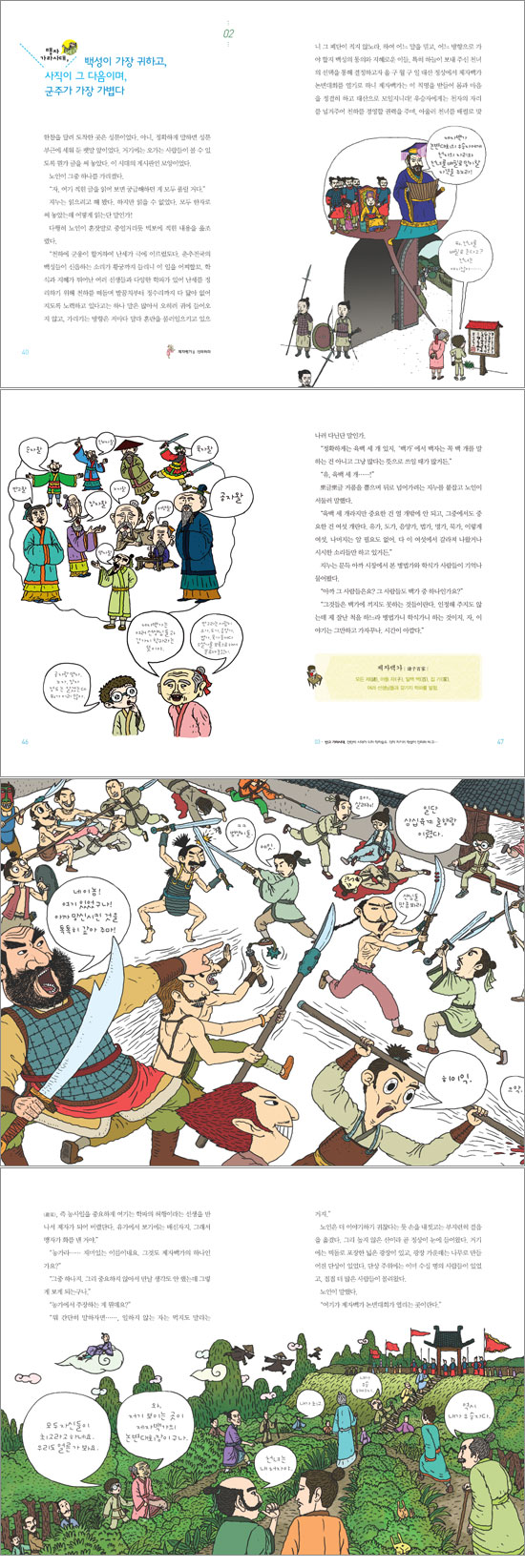
In the middle of the market, men are waving swords and making a fuss, shouting, "The world is ruled by swords and blood!" Jinu meets a shabby old man.
Jinu and the old man head to the place where the 'Hundred Schools of Thought Debate' is held, and on their journey, they meet the major thinkers of the Hundred Schools of Thought and gain enlightenment.
First of all, Confucius, the founder of Confucianism, talks about the ‘joy of learning.’
If you don't learn poetry, you can't speak it.
If you don't learn propriety, you can't stand together. (If you don't learn poetry, you can't speak. If you don't learn propriety, you can't stand together.) 'If you learn and practice it in time, isn't it enjoyable? (If you learn but don't think, you'll be in the dark. If you think but don't learn, you'll be in danger.)
Next, we meet Mencius, who claims that "human nature is good," Xunzi, who claims that "human nature is evil," and Gaozi, who claims that "human nature is neither good nor evil."
“Human nature is good.
We also hear Mencius's story about the politics of the king's way: "The king, too, is human, so he will be good by nature, and with that good heart, he will try to carry out good politics."
Mozi said, “If you work hard, you will surely be full; if you don’t work hard, you will surely be poor.
“Everything in the world is like this, so if you work hard, you will achieve it. If you don’t work hard, nothing will be achieved.”
Lao Tzu, the master of all Taoist schools, said, “The Tao that can be expressed in words is not the Tao that remains forever.”
In the book of Jangja, it is said, “Do not join the legs of a duck because they are short, and do not cut off the legs of a crane because they are long.
What is long should not be cut, and what is short should not be joined.
“If you leave it to its natural state, your worries will disappear on their own.”
After meeting Chuyeon and Heo Haeng, the two finally arrive at the venue of the debate between the Hundred Schools of Thought.
In the short story, Mencius and Xunzi discuss the theories of human nature being good and evil, Zhuangzi argues that "you cannot love everyone," and Mozi argues that "you must love everyone."
Then, Jangja talks about 'the sword of the emperor, the sword of the feudal lord, and the sword of the common man', and suddenly Han Feizi appears and confronts his teacher Xun Zi.
“Man is a being that pursues profit, and the only way to govern him is through law.
However, since the law alone cannot govern people, you can manipulate them as you wish by appropriately mixing in rewards.” The moment Han Feizi became convinced that he was the winner of the debate among the Hundred Schools of Thought, Li Si, who was also a disciple of Xun Zi, stabbed Han Feizi with a sword, saying, “There cannot be two best in the world.”
Immediately after, the director's order is given.
“Burn the books of the Hundred Schools of Thought, and bury the Hundred Schools of Thought in a pit.
“This is the will of Qin Shi Huang!” The venue quickly turns into a battlefield of swords flying, and Jinu barely manages to escape the venue, holding the old man’s hand.
But with a firm will to save the world, “We must defeat the tyrant and save our teachers with your united strength.
“Rise up! Raise your fists! So fight against the tyrant!” he shouts.
The old man, a novelist, writes Jinu's eloquence at the end of the book, and Jinu returns to the library.
A section on Eastern philosophy that covers the thoughts of the Hundred Schools of Thought, which can be considered the parents of Eastern thought.
The philosophical fantasy novel for youth, "Defeat the Hundred Schools of Thought," a collection of Eastern philosophy by Zuo Baek, Korea's best martial arts writer, philosopher, and youth literature writer, has been published.
This novel series is an introduction to philosophy for young adults that approaches philosophical topics that are rarely found in novels.
Volume 1, "Escape the Labyrinth of Logic," covers logic that is essential to know in real life, and Volume 2, "Rescue Socrates," covers Greek philosophy, the birth of philosophy, and shows how philosophy, the "love of wisdom," has developed.
The third volume of the recently published book, “Defeat the Hundred Schools of Thought,” covers the thoughts of the Hundred Schools of Thought, which can be considered the parents of Eastern thought.
The Hundred Schools of Thought, which means 'many wise teachers and their schools', tells the story of many thinkers who pooled their wisdom to overcome the chaotic Spring and Autumn Period and Warring States Period.
The story goes that when our human spirit awakened and began to think about and explain the world and humanity, there was Greece in the West, who created philosophy, and there were the Hundred Schools of Thought in the East.
In this way, we are going to touch on the foundations of logic, Greek philosophy, and Eastern philosophy, which are the major branches of philosophy.
This is also the completion of the series that began in 2004 with the ambitious plan to interpret the academic discipline of philosophy as a novel, and to do so in a novel suitable for young readers.
I hope to continue with medieval and modern philosophy, but while writing this series, I lost over 10kg.
As this task was not easy, I am not sure if it will go as planned.
What was the point that Jwa-Baek was struggling with? He explains, "It was no easy task to reinterpret philosophy within the framework of its already academically systematized orthodoxy, and to craft it into a narrative that appeals to young people."
Nevertheless, the left-wing commentator said, “If you look closely, the reason why young people these days are hesitant when choosing a career path is because they have not been trained to think philosophically.
“Philosophy is essential for finding one’s own path in life,” he said, explaining why he desperately completed this project after much deliberation.
This is probably the reason why we, who are living in this day and age, especially the youth who are growing both physically and mentally, must learn philosophy.
Philosophical essays dealing with the philosophy of life are often published, but this book is noteworthy again for being a "philosophical novel" written by a professional novelist who majored in philosophy.
Moreover, the Oriental philosophy section published this time draws readers in even more deeply into the story with its familiarity with the concept of the 'East' and the interesting historical background of the Spring and Autumn Period and the Warring States Period, when the Hundred Schools of Thought lived.
Wang Ji-seong's fantastical drawings also make the story of Zuo Baek more interesting.
The historical background of "Defeat the Hundred Schools of Thought"
From the Spring and Autumn Period and the Warring States Period, when feudal lords fought for hegemony, to Qin Shi Huang's Burning of Books and Burying of Scholars
First, if you have knowledge of the historical background of China's Spring and Autumn Period and Warring States Period, you will enjoy this book even more.
The first dynasty in China was the Yin dynasty, and the Zhou dynasty that emerged later ruled China with a patriarchal system based on blood ties.
In other words, a father divides land among his sons, younger brothers, or nephews and appoints them as lords of that land and makes them rule over it.
This system was operated efficiently in the early days of the Zhou Dynasty, but as time passed, the blood relationship between father and son became more distant, becoming third, fifth, and seventh cousins, and it lost its efficiency.
Eventually, the feudal lords fought over hegemony over the land of China, leading to the chaotic Spring and Autumn Period and the Warring States Period.
During this time, people with wisdom emerged from all over the country to save the country from chaos, and these people were the Jakje Baekga.
The Spring and Autumn Period and the Warring States Period came to an end with the unification of the Qin Dynasty by Qin Shi Huang, and the school of thought that laid the ideological foundation for the unification of the Qin Dynasty was Legalism, one of the Hundred Schools of Thought.
The story of 『Defeat the Hundred Schools of Thought』 is set during the chaotic Spring and Autumn Period and the Warring States Period, up to the unification of China by Qin Shi Huang and the Burning of Books and Burying of Scholars.
It is regrettable that a significant portion of the excellent ideas and wisdom of the Hundred Schools of Thought, which sought to overcome the chaos caused by this incident, were not passed down to future generations.
But even the greatest Qin Shi Huang couldn't have burned all the books or killed all the scholars.
If we look at the fact that the ideas that were created in China, the Hundred Schools of Thought, which were created to resolve the chaos of the Spring and Autumn Period and the Warring States Period, still form an important axis of Eastern thought to this day.
Plot of "Defeat the Hundred Schools of Thought"
From Confucius, the founder of Confucianism, to Han Feizi, who laid the foundation for the unification of China.
Jinu, the protagonist who has experienced the world of logic and Greek philosophy in the library, is now dropped into the market of Hanbian during the Spring and Autumn Period of China.
In the middle of the market, men are waving swords and making a fuss, shouting, "The world is ruled by swords and blood!" Jinu meets a shabby old man.
Jinu and the old man head to the place where the 'Hundred Schools of Thought Debate' is held, and on their journey, they meet the major thinkers of the Hundred Schools of Thought and gain enlightenment.
First of all, Confucius, the founder of Confucianism, talks about the ‘joy of learning.’
If you don't learn poetry, you can't speak it.
If you don't learn propriety, you can't stand together. (If you don't learn poetry, you can't speak. If you don't learn propriety, you can't stand together.) 'If you learn and practice it in time, isn't it enjoyable? (If you learn but don't think, you'll be in the dark. If you think but don't learn, you'll be in danger.)
Next, we meet Mencius, who claims that "human nature is good," Xunzi, who claims that "human nature is evil," and Gaozi, who claims that "human nature is neither good nor evil."
“Human nature is good.
We also hear Mencius's story about the politics of the king's way: "The king, too, is human, so he will be good by nature, and with that good heart, he will try to carry out good politics."
Mozi said, “If you work hard, you will surely be full; if you don’t work hard, you will surely be poor.
“Everything in the world is like this, so if you work hard, you will achieve it. If you don’t work hard, nothing will be achieved.”
Lao Tzu, the master of all Taoist schools, said, “The Tao that can be expressed in words is not the Tao that remains forever.”
In the book of Jangja, it is said, “Do not join the legs of a duck because they are short, and do not cut off the legs of a crane because they are long.
What is long should not be cut, and what is short should not be joined.
“If you leave it to its natural state, your worries will disappear on their own.”
After meeting Chuyeon and Heo Haeng, the two finally arrive at the venue of the debate between the Hundred Schools of Thought.
In the short story, Mencius and Xunzi discuss the theories of human nature being good and evil, Zhuangzi argues that "you cannot love everyone," and Mozi argues that "you must love everyone."
Then, Jangja talks about 'the sword of the emperor, the sword of the feudal lord, and the sword of the common man', and suddenly Han Feizi appears and confronts his teacher Xun Zi.
“Man is a being that pursues profit, and the only way to govern him is through law.
However, since the law alone cannot govern people, you can manipulate them as you wish by appropriately mixing in rewards.” The moment Han Feizi became convinced that he was the winner of the debate among the Hundred Schools of Thought, Li Si, who was also a disciple of Xun Zi, stabbed Han Feizi with a sword, saying, “There cannot be two best in the world.”
Immediately after, the director's order is given.
“Burn the books of the Hundred Schools of Thought, and bury the Hundred Schools of Thought in a pit.
“This is the will of Qin Shi Huang!” The venue quickly turns into a battlefield of swords flying, and Jinu barely manages to escape the venue, holding the old man’s hand.
But with a firm will to save the world, “We must defeat the tyrant and save our teachers with your united strength.
“Rise up! Raise your fists! So fight against the tyrant!” he shouts.
The old man, a novelist, writes Jinu's eloquence at the end of the book, and Jinu returns to the library.
GOODS SPECIFICS
- Date of publication: March 25, 2011
- Page count, weight, size: 224 pages | 406g | 148*210*20mm
- ISBN13: 9788994011226
- ISBN10: 8994011226
You may also like
카테고리
korean


korean

![GQ KOREA Mark (Monthly): December [2025]](http://librairie.coreenne.fr/cdn/shop/files/8ef265dbbfbf186523ed75ba7319009d.jpg?v=1765340328&width=3840)


