

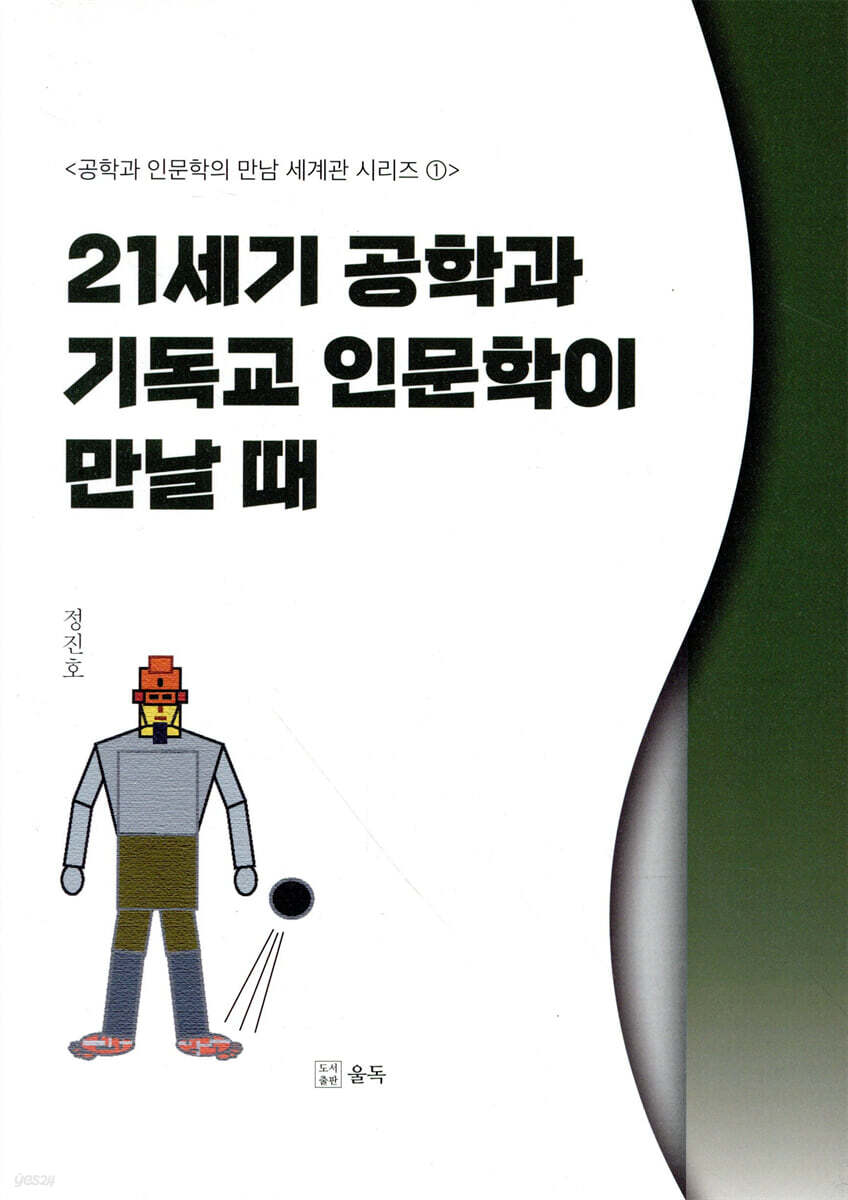
When 21st Century Engineering and Christian Humanities Meet
 |
Description
Book Introduction
A Christian Understanding of Engineering
Now, 21st century engineering is not simply established as engineering itself, but is being redefined by the philosophical and humanistic implications hidden within it.
So, for Christian engineers, Christian and biblical interpretation has become more important.
A Materials Engineer's Perspective on 21st-Century Civilization: Iron and Earth
History, beginning with a head of gold and ending with feet of iron and earth..., especially, the permutation of materials represented by gold, silver, copper, iron and earth suggests a very unique meaning.
This order is externally an order in which the metals become increasingly stronger, but their value appears to be in a decreasing order.
Does this not reflect the modern world, where world history, superficially strengthened and solidified by human-created materials and mechanical civilization, is gradually declining in its inner spiritual value? Is history truly regressing and rushing toward its end?
Intelligence and the Environment: A Fragile Glass Game
And so the war between Wilson and Dawkins began.
A scene of shock and horror...
In the place where the Taliban swept through,
Broken homes, wailing women and children...
Now, 21st century engineering is not simply established as engineering itself, but is being redefined by the philosophical and humanistic implications hidden within it.
So, for Christian engineers, Christian and biblical interpretation has become more important.
A Materials Engineer's Perspective on 21st-Century Civilization: Iron and Earth
History, beginning with a head of gold and ending with feet of iron and earth..., especially, the permutation of materials represented by gold, silver, copper, iron and earth suggests a very unique meaning.
This order is externally an order in which the metals become increasingly stronger, but their value appears to be in a decreasing order.
Does this not reflect the modern world, where world history, superficially strengthened and solidified by human-created materials and mechanical civilization, is gradually declining in its inner spiritual value? Is history truly regressing and rushing toward its end?
Intelligence and the Environment: A Fragile Glass Game
And so the war between Wilson and Dawkins began.
A scene of shock and horror...
In the place where the Taliban swept through,
Broken homes, wailing women and children...
- You can preview some of the book's contents.
Preview
index
[Preface]ㆍ6
1.
A Christian Understanding of Engineeringㆍ11
- Introduction
- Definition of engineering and its position as an academic discipline
- Two aspects of engineering concepts in the Bible
- Analysis of modern engineering problems
- The role of engineers as trustees of covenants, commandments, and orders
- Conclusion
2.
A Materials Engineer's Perspective on 21st-Century Civilization: Iron and Earth - 57
- Daniel's vision
- Pure Gold: Golden hair
- Silver: Chest and arms
- Brass/Bronze: Belly and thighs
- Iron: Calf
- Iron and Clay: Feet and Toes
- The Stone That Came: The End
3.
Intelligence and the Environment: A Fragile Glass Gameㆍ117
- Humans are a black box; they exist between biological determinism and cultural determinism.
- Humanity's game of chasing a utopian mirage
- Who is the real environmental destroyer?
The End of Orientalism and the Broken Glass Again
[Appendix]ㆍ144
COVID-19 and the End of Orientalism
- Human viruses and coronavirus vaccines
1.
A Christian Understanding of Engineeringㆍ11
- Introduction
- Definition of engineering and its position as an academic discipline
- Two aspects of engineering concepts in the Bible
- Analysis of modern engineering problems
- The role of engineers as trustees of covenants, commandments, and orders
- Conclusion
2.
A Materials Engineer's Perspective on 21st-Century Civilization: Iron and Earth - 57
- Daniel's vision
- Pure Gold: Golden hair
- Silver: Chest and arms
- Brass/Bronze: Belly and thighs
- Iron: Calf
- Iron and Clay: Feet and Toes
- The Stone That Came: The End
3.
Intelligence and the Environment: A Fragile Glass Gameㆍ117
- Humans are a black box; they exist between biological determinism and cultural determinism.
- Humanity's game of chasing a utopian mirage
- Who is the real environmental destroyer?
The End of Orientalism and the Broken Glass Again
[Appendix]ㆍ144
COVID-19 and the End of Orientalism
- Human viruses and coronavirus vaccines
Publisher's Review
preface
As the 21st century began, words like convergence, integration, and convergence began to be circulated.
Even in universities, convergence education that blends all academic disciplines is becoming popular, and new departments such as the Creative Convergence Education Center, the ICT Convergence Entrepreneurship Department, and the Social Convergence Autonomous Department have emerged.
This is because we have entered an era in which the academic and social phenomena of the world we live in are so complex that it is difficult to explain and understand them with the specialized education that was taught in the 20th century.
If the 20th century was an era that worshipped science and technology, the 21st century has entered an era of full-fledged four-dimensional engineering.
21st century engineering has become a comprehensive, interdisciplinary discipline that pursues utility and efficiency through the fusion of science, technology, and management economics, while also considering international politics, communication skills, the environment, and sustainability.
The millennium, like a ram, brings together two streams: past and present.
Around the 10th century, the rediscovery of Aristotle's extensive scientific writings, brought back from Arab countries by the Crusaders, brought about a major change in Western Europe, which had been bound by Christian theology and Platonic philosophy.
Universities were created as a worldview movement unfolded in monasteries, which were centers of learning, to reinterpret and teach the universe from various perspectives.
And there was a conflict and an attempt to harmonize and fuse Christian theology and Aristotelian science, which resulted in scholastic philosophy and its opposing empirical modern science.
The convergence of academic disciplines has brought about an expansion of worldview.
European society experienced a great transformation in the history of intellectual thought, with the Renaissance, the Reformation, and the subsequent Scientific and Industrial Revolutions, where science and technology met with humanistic thought, and an era of imperialism unfolded, in which Europe suddenly surpassed and conquered the East.
And another thousand years passed.
In the early 20th century, when the Wright brothers invented the airplane and Marconi invented wireless communication, in less than 100 years, humanity opened the era of the global village, connecting the entire world through transportation and communication.
Now in the 21st century, Elon Musk has launched a manned rocket, declaring the beginning of an era of private space tourism, and 6G satellite communications, beyond 5G, are heralding the beginning of an era of the Internet of Everything (EoT), connecting people and things across the globe.
In step with this, the parallel universe of the metaverse, which exists in a virtual space separate from the real universe in which we live, has begun to deeply penetrate our lives.
If the university was born as a fusion of Christian theology and Aristotelian science at the dawn of the new millennium in the 10th and 11th centuries, humanity is now heralding the birth of Metaversity as it enters the second new millennium in the 20th and 21st centuries.
In other words, the new convergence we face in the era of the Fourth Industrial Revolution is the convergence of the universe and the metaverse.
A small booklet has been prepared to interpret and prepare for that new era from a Christian perspective.
In the first chapter, we will explore the definition of engineering and its Christian interpretation in 21st-century terms.
In the second chapter, we will interpret the image of Daniel in the Bible from a diachronic point of view in time, a synchronic point of view in space, and a holistic point of view that runs through the Bible.
The special wisdom that interprets the zeitgeist and biblical worldview hidden within it from an engineering perspective will shine through.
The third and final chapter seeks to uncover the root causes of the most critical environmental problems of our time, revealing the arrogant intellect and greed that stem from human corruption.
This book is a collection of essays written based on worldview insights gained while teaching and researching at various universities in Korea, the United States, China, North Korea, and Canada over the past 25 years.
In the future, I plan to compile a series of essays and columns containing such worldview interpretations and commentaries.
I hope that this will be of some small help to readers in illuminating their insight into the times.
Jeong Jin-ho
As the 21st century began, words like convergence, integration, and convergence began to be circulated.
Even in universities, convergence education that blends all academic disciplines is becoming popular, and new departments such as the Creative Convergence Education Center, the ICT Convergence Entrepreneurship Department, and the Social Convergence Autonomous Department have emerged.
This is because we have entered an era in which the academic and social phenomena of the world we live in are so complex that it is difficult to explain and understand them with the specialized education that was taught in the 20th century.
If the 20th century was an era that worshipped science and technology, the 21st century has entered an era of full-fledged four-dimensional engineering.
21st century engineering has become a comprehensive, interdisciplinary discipline that pursues utility and efficiency through the fusion of science, technology, and management economics, while also considering international politics, communication skills, the environment, and sustainability.
The millennium, like a ram, brings together two streams: past and present.
Around the 10th century, the rediscovery of Aristotle's extensive scientific writings, brought back from Arab countries by the Crusaders, brought about a major change in Western Europe, which had been bound by Christian theology and Platonic philosophy.
Universities were created as a worldview movement unfolded in monasteries, which were centers of learning, to reinterpret and teach the universe from various perspectives.
And there was a conflict and an attempt to harmonize and fuse Christian theology and Aristotelian science, which resulted in scholastic philosophy and its opposing empirical modern science.
The convergence of academic disciplines has brought about an expansion of worldview.
European society experienced a great transformation in the history of intellectual thought, with the Renaissance, the Reformation, and the subsequent Scientific and Industrial Revolutions, where science and technology met with humanistic thought, and an era of imperialism unfolded, in which Europe suddenly surpassed and conquered the East.
And another thousand years passed.
In the early 20th century, when the Wright brothers invented the airplane and Marconi invented wireless communication, in less than 100 years, humanity opened the era of the global village, connecting the entire world through transportation and communication.
Now in the 21st century, Elon Musk has launched a manned rocket, declaring the beginning of an era of private space tourism, and 6G satellite communications, beyond 5G, are heralding the beginning of an era of the Internet of Everything (EoT), connecting people and things across the globe.
In step with this, the parallel universe of the metaverse, which exists in a virtual space separate from the real universe in which we live, has begun to deeply penetrate our lives.
If the university was born as a fusion of Christian theology and Aristotelian science at the dawn of the new millennium in the 10th and 11th centuries, humanity is now heralding the birth of Metaversity as it enters the second new millennium in the 20th and 21st centuries.
In other words, the new convergence we face in the era of the Fourth Industrial Revolution is the convergence of the universe and the metaverse.
A small booklet has been prepared to interpret and prepare for that new era from a Christian perspective.
In the first chapter, we will explore the definition of engineering and its Christian interpretation in 21st-century terms.
In the second chapter, we will interpret the image of Daniel in the Bible from a diachronic point of view in time, a synchronic point of view in space, and a holistic point of view that runs through the Bible.
The special wisdom that interprets the zeitgeist and biblical worldview hidden within it from an engineering perspective will shine through.
The third and final chapter seeks to uncover the root causes of the most critical environmental problems of our time, revealing the arrogant intellect and greed that stem from human corruption.
This book is a collection of essays written based on worldview insights gained while teaching and researching at various universities in Korea, the United States, China, North Korea, and Canada over the past 25 years.
In the future, I plan to compile a series of essays and columns containing such worldview interpretations and commentaries.
I hope that this will be of some small help to readers in illuminating their insight into the times.
Jeong Jin-ho
GOODS SPECIFICS
- Publication date: February 22, 2022
- Page count, weight, size: 452 pages | 408g | 152*225*30mm
- ISBN13: 9791197338625
- ISBN10: 1197338624
You may also like
카테고리
korean


korean

![GQ KOREA Mark (Monthly): December [2025]](http://librairie.coreenne.fr/cdn/shop/files/8ef265dbbfbf186523ed75ba7319009d.jpg?v=1765340328&width=3840)


