

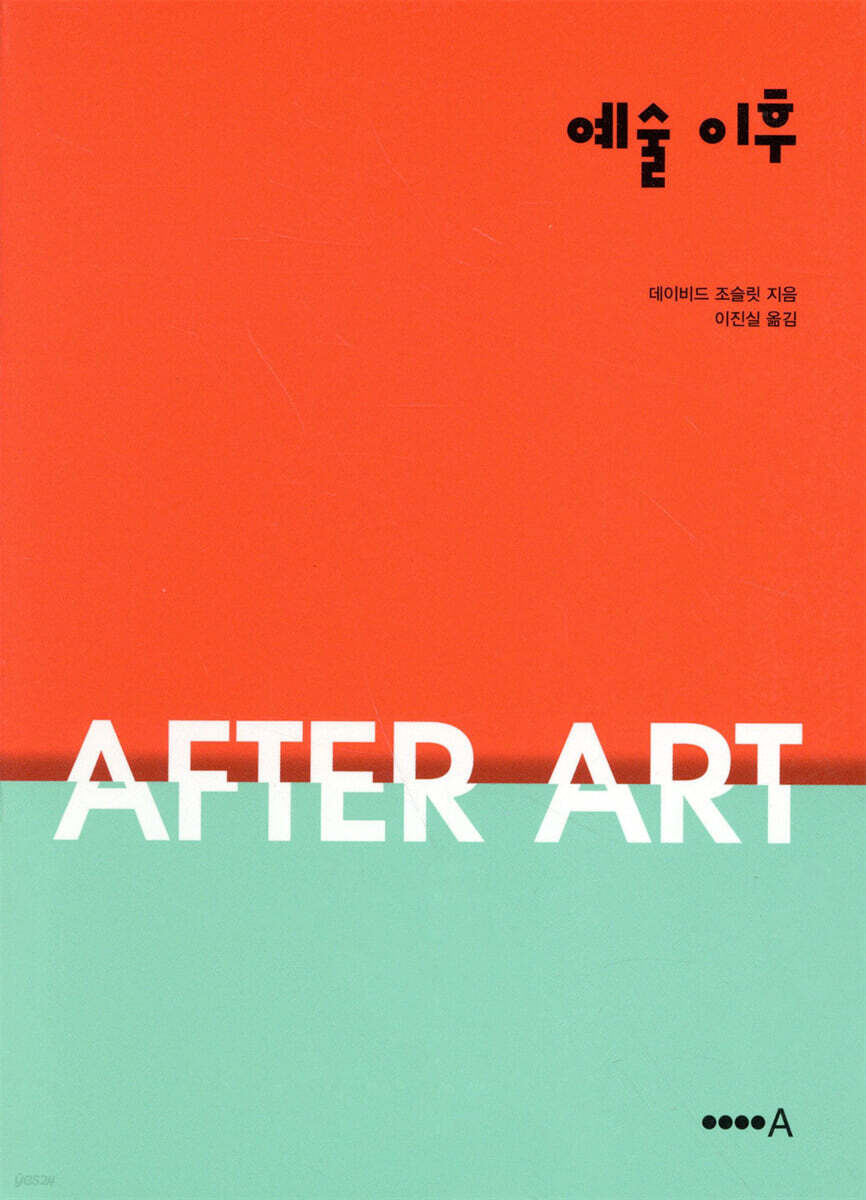
After art
 |
Description
Book Introduction
David Joselit, a renowned American art historian, points out in his book After Art that art has undergone significant changes in the era of globalization, digital networks, and financial capitalism, and proposes a new ecology of contemporary art.
As a suggestion for this, the author transfers the basic aesthetic premise from a specialized object called a 'work' to an abstract unit called an image.
What is now crucial is understanding how artworks circulate as images. Accordingly, the author proposes a new network aesthetic by defining the aesthetic value that arises from their circulation, dissemination, and transformation, rather than the content of the artwork or image itself. This, in turn, provides the most effective interpretive framework suited to contemporary art and architecture.
As a suggestion for this, the author transfers the basic aesthetic premise from a specialized object called a 'work' to an abstract unit called an image.
What is now crucial is understanding how artworks circulate as images. Accordingly, the author proposes a new network aesthetic by defining the aesthetic value that arises from their circulation, dissemination, and transformation, rather than the content of the artwork or image itself. This, in turn, provides the most effective interpretive framework suited to contemporary art and architecture.
- You can preview some of the book's contents.
Preview
index
Opening remarks
Image explosion
association
Format
strength
Acknowledgements
clear
Illustration credit
Lookup (Term)
Search (person name)
Image explosion
association
Format
strength
Acknowledgements
clear
Illustration credit
Lookup (Term)
Search (person name)
Into the book
『After Art』 will argue that images actually have enormous power because of their ability to be replicated, remediated, and disseminated at various speeds.
To harness this power for progressive purposes, it is essential to understand the potential of images themselves, rather than dismiss them as derivative, mute, and deceptive.
--- p.10
“People are now realizing that art is an international currency.” … … In a time of economic instability triggered by the global financial crisis since 2008, people now recognize art as an international currency.
--- p.31
We now have a saturated value that exists everywhere at once, rather than a halo of authenticity and authority emanating from a place-specific guarantee.
Where there was an aura, there is now a buzz.
Like a swarm of bees, a swarm of images creates a buzz, and when an image (whether it's a product, a policy, a person, or a work of art) reaches saturation, like a new idea or trend, a "buzz" occurs.
--- p.35
The shift I have proposed, away from object-based aesthetics in architecture and art, towards network aesthetics, which presupposes the emergence of form from clusters of images, requires a corresponding revision of critical methodology.
Objects characterized by identifiable boundaries and relative stability are suitable for a single meaning.
It is as if a clear outline of a container cannot help but contain a meaning.
--- p.72-73
Media is analog in a digital world.
Format regulates the power of an image by controlling its impact, speed, and clarity.
Formats can store such currency like batteries (as in the inscriptions of Hanne Darboven or Xu Bing, which inscribe vast invented languages, or in On Kawara's One Million Years, which imaginatively accumulates time in notebooks that exceed human comprehension).
Alternatively, the format could be used to stage extravagant consumption.
(…) In each of these cases, a format like Le Corbusier’s architectural promenade constitutes spatial relationships within a cluster of images.
--- p.86-87
What matters is how widely and easily the image connects.
This applies not only to messages, but also to other social currencies such as capital, real estate, and politics.
In an economy of image overproduction, connectivity is key.
This is the epistemology of search.
--- p.89
This explains why contemporary art has come to trivialize the production of content, preferring instead the production of new formats for existing images, and why many architects have employed the strategies of creating space through the analysis and formation of data, or through the shaping of data.
(…) Art and architecture practice both the epistemology and aesthetics of search engines, reformatting existing flows of images and information like Google's algorithms.
--- p.99
Art is a typical object of globalization, both as a raw material and as an experience.
Art occupies a vanguard position in an economy starved for authenticity.
Art performs a special kind of currency exchange.
Cultural differences become assets and are traded in currencies like the yen, renminbi, euro and dollar.
But art never becomes entirely monetary.
While today's art no longer has the same type of avant-garde as the early 20th century, there is also no neo-avant-garde, which was merely a repetition of early 20th-century gestures.
Now the images no longer have the goal of creating a utopia.
To harness this power for progressive purposes, it is essential to understand the potential of images themselves, rather than dismiss them as derivative, mute, and deceptive.
--- p.10
“People are now realizing that art is an international currency.” … … In a time of economic instability triggered by the global financial crisis since 2008, people now recognize art as an international currency.
--- p.31
We now have a saturated value that exists everywhere at once, rather than a halo of authenticity and authority emanating from a place-specific guarantee.
Where there was an aura, there is now a buzz.
Like a swarm of bees, a swarm of images creates a buzz, and when an image (whether it's a product, a policy, a person, or a work of art) reaches saturation, like a new idea or trend, a "buzz" occurs.
--- p.35
The shift I have proposed, away from object-based aesthetics in architecture and art, towards network aesthetics, which presupposes the emergence of form from clusters of images, requires a corresponding revision of critical methodology.
Objects characterized by identifiable boundaries and relative stability are suitable for a single meaning.
It is as if a clear outline of a container cannot help but contain a meaning.
--- p.72-73
Media is analog in a digital world.
Format regulates the power of an image by controlling its impact, speed, and clarity.
Formats can store such currency like batteries (as in the inscriptions of Hanne Darboven or Xu Bing, which inscribe vast invented languages, or in On Kawara's One Million Years, which imaginatively accumulates time in notebooks that exceed human comprehension).
Alternatively, the format could be used to stage extravagant consumption.
(…) In each of these cases, a format like Le Corbusier’s architectural promenade constitutes spatial relationships within a cluster of images.
--- p.86-87
What matters is how widely and easily the image connects.
This applies not only to messages, but also to other social currencies such as capital, real estate, and politics.
In an economy of image overproduction, connectivity is key.
This is the epistemology of search.
--- p.89
This explains why contemporary art has come to trivialize the production of content, preferring instead the production of new formats for existing images, and why many architects have employed the strategies of creating space through the analysis and formation of data, or through the shaping of data.
(…) Art and architecture practice both the epistemology and aesthetics of search engines, reformatting existing flows of images and information like Google's algorithms.
--- p.99
Art is a typical object of globalization, both as a raw material and as an experience.
Art occupies a vanguard position in an economy starved for authenticity.
Art performs a special kind of currency exchange.
Cultural differences become assets and are traded in currencies like the yen, renminbi, euro and dollar.
But art never becomes entirely monetary.
While today's art no longer has the same type of avant-garde as the early 20th century, there is also no neo-avant-garde, which was merely a repetition of early 20th-century gestures.
Now the images no longer have the goal of creating a utopia.
--- p.131-132
Publisher's Review
How is art changing in the Google age?
David Joselit, a renowned American art historian, points out in his book After Art that art has undergone significant changes in the era of globalization, digital networks, and financial capitalism, and proposes a new ecology of contemporary art.
As a suggestion for this, the author transfers the basic aesthetic premise from a specialized object called a 'work' to an abstract unit called an image.
Today, images exist as “visual bytes that are almost infinitely re-mediated” (p. 11), existing in a variety of ways on a variety of surfaces.
Of course, even before the advent of the digital age, images based on the “mechanical reproducibility” that Walter Benjamin noted, and the “simulacrum” images that Jean Baudrillard spoke of, often threatened or surpassed the privilege and hierarchy of originality that formed the basis of traditional art.
Joselit goes further here to draw attention to the collective and explosive power of images today, that is, their 'emergency'.
In other words, it focuses on the fact that there is nothing that can be called an image 'in itself', that the power of an image comes from nothing other than connection or connection, that it has infinite expandability and transformability, and that it forms a series of intensities and flows.
Therefore, what is now important is to understand how artworks are circulated as images. Accordingly, the author proposes a new network aesthetic by defining the aesthetic value that arises from their circulation, dissemination, and transformation, rather than the content of the artwork or image, thereby providing the most effective interpretive framework suitable for current art and architecture.
'After Art': From Artwork to Network Aesthetics
The 'post-art' that Joselit speaks of refers to the state of contemporary art in which it is becoming increasingly difficult to define the substance of a work of art, but above all, it is a conceptual shift that shifts the concept of art (or fine arts) from the unit of the work to the power/aftereffect itself created by the connection and flow of 'images'.
The author explains the meaning of the title of this book, 'After Art', by comparing it to the word 'post'.
“My title, ‘after,’ unlike the preposition ‘post’ in the word ‘posthistorical’ that Danto often uses, refers to both the reverberation of images (as in the term ‘afterimage’) following the spread of images and the pattern of circulation that appears after images enter the network.” (p. 156) In other words, rather than presenting a certain style that has now arrived as a division of art history, the author focuses on the temporality of ‘after’ as a framework for redefining the way images, and further, art, operate.
And the goal is to reexamine what kind of resistant potential art might have in an advanced global capitalism by confronting the vectors and explosive power that images acquire (only then) when they enter the network.
According to Joselit, what we should pay attention to in this unprecedented explosion of images is not simply the quantitative dimension, but rather the speed and circulation of the images through networks, that is, the vector dimension.
He likens the phenomenon to the ripple effects of global financial networks.
Now, “art is a fungible hedge,” and “the value (of art sold in blue-chip galleries around the world) must cross borders as easily as the dollar, euro, yen, and yuan.” (pp. 17-18) In this respect, Joselit defines contemporary art as a kind of currency.
Here, 'currency' is used as a dual metaphor, indicating the currency's acceptability while also recalling the flow of current that resets a series of circuits through connections and interruptions.
So, is Joselit trying to say that art is now nothing more than a financial product? No.
Art is a form of abstraction that circulates like currency, but it is clearly different from currency.
“Our first task is to figure out what kind of currency art is, or can be, and to understand the dynamics of art’s circulation based on the definition that currency is established through exchange.” (p. 19) If the neo-avant-garde practice that considered art outside of capital and had the nature of institutional criticism has already been digested into a gesture and petrified into a ‘collection,’ where can we now find the possibility of art’s resistance against capital?
As if to answer this question, Joselitus posits the potential of images similar to currency to penetrate the circuits of capital, altering or even disrupting their course.
"After Art" offers a fascinating and original theory of art and architecture in the age of global networks, analyzing the work of artists such as Matthew Barney, Ai Weiwei, Sherry Levine, and Pierre Huyghe, as well as OMA, Reiser+Umemoto, Rem Koolhaas, and Frank Gehry, as specific examples.
David Joselit, a renowned American art historian, points out in his book After Art that art has undergone significant changes in the era of globalization, digital networks, and financial capitalism, and proposes a new ecology of contemporary art.
As a suggestion for this, the author transfers the basic aesthetic premise from a specialized object called a 'work' to an abstract unit called an image.
Today, images exist as “visual bytes that are almost infinitely re-mediated” (p. 11), existing in a variety of ways on a variety of surfaces.
Of course, even before the advent of the digital age, images based on the “mechanical reproducibility” that Walter Benjamin noted, and the “simulacrum” images that Jean Baudrillard spoke of, often threatened or surpassed the privilege and hierarchy of originality that formed the basis of traditional art.
Joselit goes further here to draw attention to the collective and explosive power of images today, that is, their 'emergency'.
In other words, it focuses on the fact that there is nothing that can be called an image 'in itself', that the power of an image comes from nothing other than connection or connection, that it has infinite expandability and transformability, and that it forms a series of intensities and flows.
Therefore, what is now important is to understand how artworks are circulated as images. Accordingly, the author proposes a new network aesthetic by defining the aesthetic value that arises from their circulation, dissemination, and transformation, rather than the content of the artwork or image, thereby providing the most effective interpretive framework suitable for current art and architecture.
'After Art': From Artwork to Network Aesthetics
The 'post-art' that Joselit speaks of refers to the state of contemporary art in which it is becoming increasingly difficult to define the substance of a work of art, but above all, it is a conceptual shift that shifts the concept of art (or fine arts) from the unit of the work to the power/aftereffect itself created by the connection and flow of 'images'.
The author explains the meaning of the title of this book, 'After Art', by comparing it to the word 'post'.
“My title, ‘after,’ unlike the preposition ‘post’ in the word ‘posthistorical’ that Danto often uses, refers to both the reverberation of images (as in the term ‘afterimage’) following the spread of images and the pattern of circulation that appears after images enter the network.” (p. 156) In other words, rather than presenting a certain style that has now arrived as a division of art history, the author focuses on the temporality of ‘after’ as a framework for redefining the way images, and further, art, operate.
And the goal is to reexamine what kind of resistant potential art might have in an advanced global capitalism by confronting the vectors and explosive power that images acquire (only then) when they enter the network.
According to Joselit, what we should pay attention to in this unprecedented explosion of images is not simply the quantitative dimension, but rather the speed and circulation of the images through networks, that is, the vector dimension.
He likens the phenomenon to the ripple effects of global financial networks.
Now, “art is a fungible hedge,” and “the value (of art sold in blue-chip galleries around the world) must cross borders as easily as the dollar, euro, yen, and yuan.” (pp. 17-18) In this respect, Joselit defines contemporary art as a kind of currency.
Here, 'currency' is used as a dual metaphor, indicating the currency's acceptability while also recalling the flow of current that resets a series of circuits through connections and interruptions.
So, is Joselit trying to say that art is now nothing more than a financial product? No.
Art is a form of abstraction that circulates like currency, but it is clearly different from currency.
“Our first task is to figure out what kind of currency art is, or can be, and to understand the dynamics of art’s circulation based on the definition that currency is established through exchange.” (p. 19) If the neo-avant-garde practice that considered art outside of capital and had the nature of institutional criticism has already been digested into a gesture and petrified into a ‘collection,’ where can we now find the possibility of art’s resistance against capital?
As if to answer this question, Joselitus posits the potential of images similar to currency to penetrate the circuits of capital, altering or even disrupting their course.
"After Art" offers a fascinating and original theory of art and architecture in the age of global networks, analyzing the work of artists such as Matthew Barney, Ai Weiwei, Sherry Levine, and Pierre Huyghe, as well as OMA, Reiser+Umemoto, Rem Koolhaas, and Frank Gehry, as specific examples.
GOODS SPECIFICS
- Publication date: April 10, 2022
- Format: Hardcover book binding method guide
- Page count, weight, size: 192 pages | 226g | 120*165*20mm
- ISBN13: 9788965642763
- ISBN10: 8965642760
You may also like
카테고리
korean


korean

![GQ KOREA Mark (Monthly): December [2025]](http://librairie.coreenne.fr/cdn/shop/files/8ef265dbbfbf186523ed75ba7319009d.jpg?v=1765340328&width=3840)


