

The future lies in the sea
 |
Description
Book Introduction
The mysterious sea that holds the secrets of humanity and the Earth
Scientists from the Korea Institute of Ocean Science and Technology tell us
A fantastic and fascinating underwater story
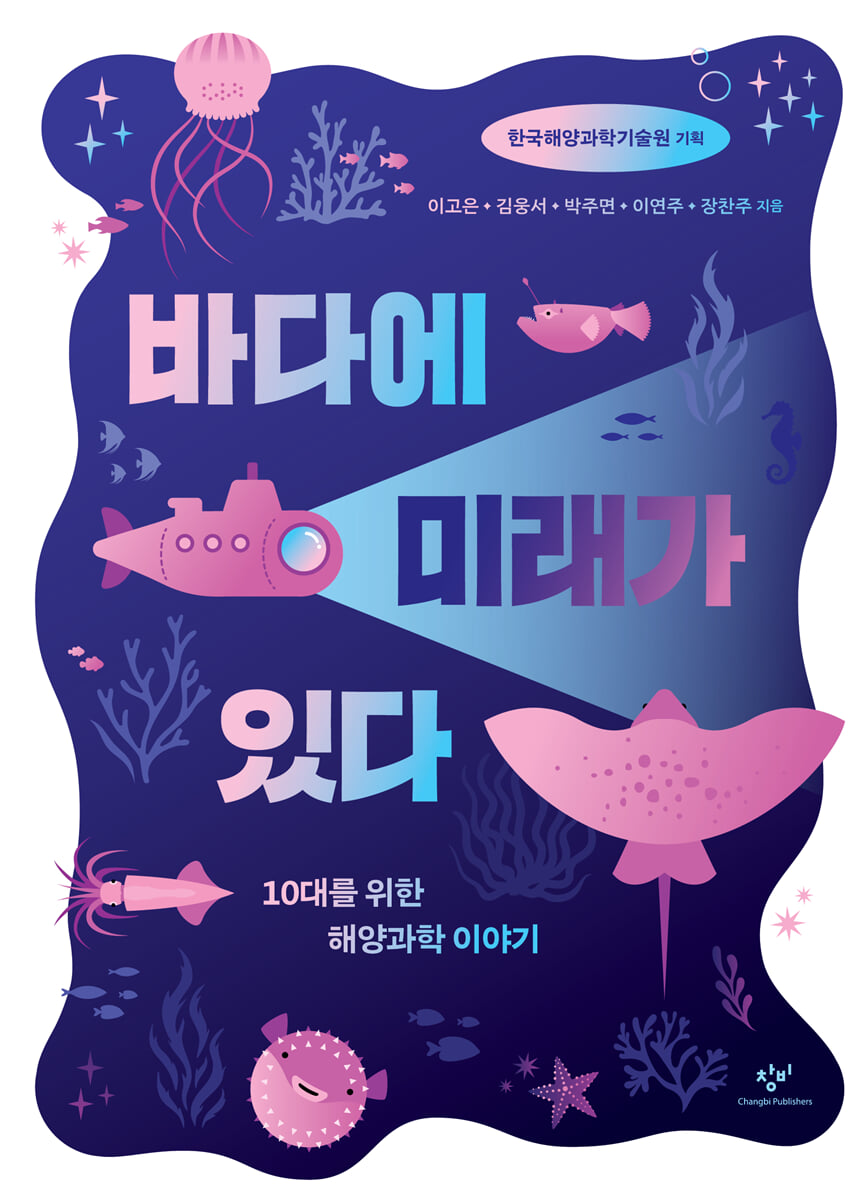
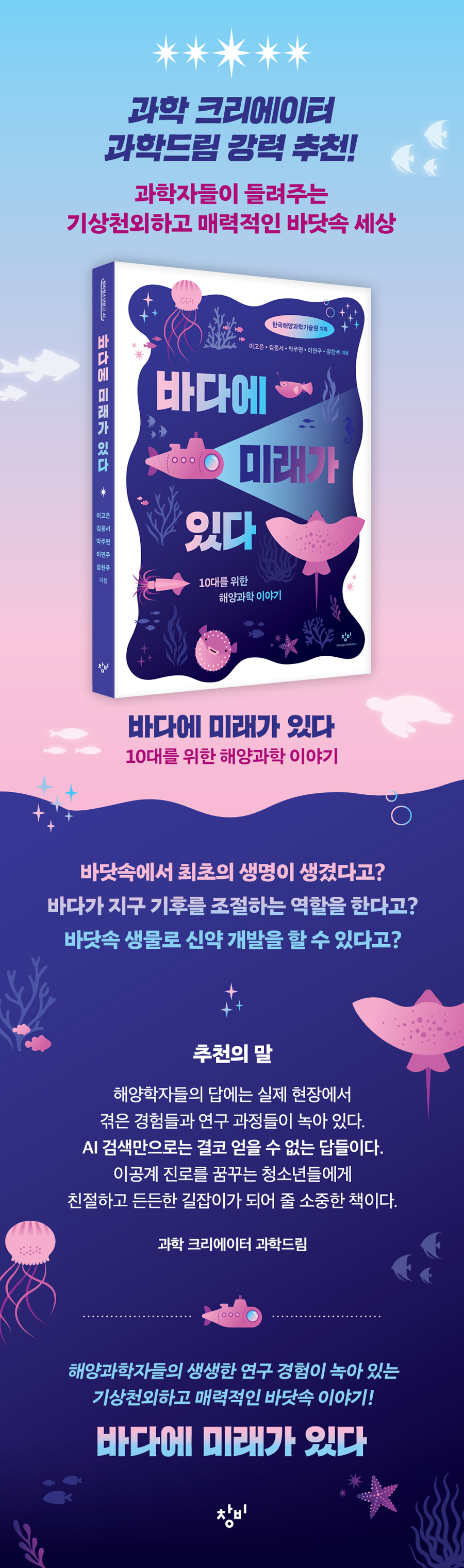
The book "The Future is in the Sea" (Changbi Youth Library 45) has been published, conveying the fascinating knowledge surrounding the marine ecosystem and the appeal of marine science, a convergent discipline that will help us imagine the future of humanity.
Author Lee Go-eun, winner of the Changbi Youth Book Award for her book, “Life Science News,” met with marine scientists from the Korea Institute of Ocean Science and Technology as an interviewer.
Starting with the story of the first Korean to explore 5,000 meters under the sea, it provides a variety of information on marine science, including fish resources and ecosystems, development of new drugs using marine life, and marine climate change.
Author Lee Go-eun, who is also a current science teacher, asks questions and leads conversations at a level suitable for young readers, allowing them to easily and enjoyably learn the high-level knowledge of renowned experts in each field.
Additionally, the vivid research experience and abundant photos of marine scientists make you feel as if you were actually at the sea.
Marine science, encompassing physics, life sciences, chemistry, and engineering, is a promising field with boundless possibilities as vast as the ocean.
This book, which tells the story of scientists who love the ocean, ask questions, and explore the unknown, will serve as a solid guide for young people considering a career in science and engineering.
Scientists from the Korea Institute of Ocean Science and Technology tell us
A fantastic and fascinating underwater story
The book "The Future is in the Sea" (Changbi Youth Library 45) has been published, conveying the fascinating knowledge surrounding the marine ecosystem and the appeal of marine science, a convergent discipline that will help us imagine the future of humanity.
Author Lee Go-eun, winner of the Changbi Youth Book Award for her book, “Life Science News,” met with marine scientists from the Korea Institute of Ocean Science and Technology as an interviewer.
Starting with the story of the first Korean to explore 5,000 meters under the sea, it provides a variety of information on marine science, including fish resources and ecosystems, development of new drugs using marine life, and marine climate change.
Author Lee Go-eun, who is also a current science teacher, asks questions and leads conversations at a level suitable for young readers, allowing them to easily and enjoyably learn the high-level knowledge of renowned experts in each field.
Additionally, the vivid research experience and abundant photos of marine scientists make you feel as if you were actually at the sea.
Marine science, encompassing physics, life sciences, chemistry, and engineering, is a promising field with boundless possibilities as vast as the ocean.
This book, which tells the story of scientists who love the ocean, ask questions, and explore the unknown, will serve as a solid guide for young people considering a career in science and engineering.
- You can preview some of the book's contents.
Preview
index
Introduction: The beginning of all questions was the sea.
Part 1: The Sea, Home to All Living Things
Chapter 1: Diving into the Origin of Life
Chapter 2: A profession that studies the world called the sea
Chapter 3: The Sea, the Cradle of Life
Chapter 4 Life Beyond Earth: Clues in the Deep Sea
Chapter 5: Competition, Development, and the Science of Coexistence
Part 2: Changing Fish, Shaking Ecosystems
Chapter 1 Fish or Fish?
Chapter 2: All About Fish Survival Strategies
Chapter 3: The Invisible Force That Moves the Sea
Chapter 4: Changing Seas, Moving Fish
Chapter 5: The Science of Protecting Fish
Part 3: Prescription of the Sea
Chapter 1: Pharmacy in the Waves
Chapter 2 Why is the sea poisonous?
Chapter 3: A Far Sea to Become Medicine
Chapter 4: New Materials and Beauty Gifted by the Sea
Chapter 5: What Gets Caught in a Scientist's Net?
Part 4: Warming Oceans, Endangered Creatures
Chapter 1: The Sea as a Climate Regulator
Chapter 2 Marine Heat Waves, Sea Heatwaves
Chapter 3: The Sea-Shaking Boundary
Chapter 4: Records of the Sea, Predictions of the Future
Chapter 5: When Science Becomes Our Common Language
Going out: The mind that holds on to the question until the end
Photo source
Part 1: The Sea, Home to All Living Things
Chapter 1: Diving into the Origin of Life
Chapter 2: A profession that studies the world called the sea
Chapter 3: The Sea, the Cradle of Life
Chapter 4 Life Beyond Earth: Clues in the Deep Sea
Chapter 5: Competition, Development, and the Science of Coexistence
Part 2: Changing Fish, Shaking Ecosystems
Chapter 1 Fish or Fish?
Chapter 2: All About Fish Survival Strategies
Chapter 3: The Invisible Force That Moves the Sea
Chapter 4: Changing Seas, Moving Fish
Chapter 5: The Science of Protecting Fish
Part 3: Prescription of the Sea
Chapter 1: Pharmacy in the Waves
Chapter 2 Why is the sea poisonous?
Chapter 3: A Far Sea to Become Medicine
Chapter 4: New Materials and Beauty Gifted by the Sea
Chapter 5: What Gets Caught in a Scientist's Net?
Part 4: Warming Oceans, Endangered Creatures
Chapter 1: The Sea as a Climate Regulator
Chapter 2 Marine Heat Waves, Sea Heatwaves
Chapter 3: The Sea-Shaking Boundary
Chapter 4: Records of the Sea, Predictions of the Future
Chapter 5: When Science Becomes Our Common Language
Going out: The mind that holds on to the question until the end
Photo source
Detailed image
Into the book
Reading this book might inspire some to dream of becoming a marine scientist.
Others might think of other avenues connecting us to the ocean, such as technology, the environment, policy, international cooperation, and writing.
Whether you love science, society, or people, the ocean holds a map of diverse career paths.
Is the sea a little closer now? As you close the book, the next question falls to you.
The sea is still in one place, but your gaze upon it will now be different from before.
If you have any questions, that's enough.
Because the sea is always waiting for someone who has questions.
--- From the author's note in the main text
This book is not intended to simply impart knowledge.
I wanted to show the faces of the people hidden behind the name of marine science and share the questions born from their lives.
textbook
I hope you can feel how complex and interesting the story is behind the one-line explanation.
--- p.9
In a word, marine science is ‘the science of studying the ocean.’
But the important thing here is that the ocean is not just a mass of water.
The ocean's physical phenomena, chemical composition, biodiversity, underwater topography, and even human activities, laws, and economic issues are all connected to it.
So marine science covers a really wide range of topics.
--- p.24
The ocean is a space with comprehensive value encompassing life, climate, energy, and industry.
So how much we understand the ocean and what choices we make now will be key to determining our future.
So I say this.
“To lose the sea is to lose the future.”
We have the right to develop the ocean, but we also have a responsibility to protect it.
Striking that balance wisely is the role of science and the task of all of us.
--- p.65
The ocean is a giant laboratory of life.
Countless living creatures experiment with survival in their own ways, fail, and try again.
In the process, they sometimes become similar to each other, and sometimes they evolve in completely different directions.
yo. this.
In this arena of change, life has proven itself worthy of survival.
It is actually secondary for humans to place that life on the table and evaluate its taste, or to develop it into medicine and discuss its effectiveness.
Because nature has long proven its worth through survival.
--- p.80
In the ocean, even if only the water temperature changes, phytoplankton, zooplankton, small fish, and even large fish change in a chain reaction.
If you follow a small fish like this, you can see how sensitively the ocean changes.
What kind of fish will we encounter in the future? The ocean is constantly changing.
Now is the time for all of us to think about it.
How to respond to climate change, how to make fisheries sustainable.
--- p.113
The 'poison' of the sea can be a threat to some, but it can be a life-saving 'hope' to others.
Isn't it fascinating how marine life is so connected to our health? There are still many more creatures yet to be discovered in the ocean.
So even now, many scientists are exploring the ocean and studying new creatures and ingredients.
--- p.147
Hungarian physiologist Albert Szent-Györgyi said, “Discovery is seeing what everyone else has seen and thinking what no one else has thought of.”
Scientists are finding treatments in familiar sea creatures like sea cucumbers, sponges, plankton, and clams in ways no one has ever imagined.
The ocean remains a treasure trove of future medicine.
But that treasure is not easily found by just anyone.
That is why scientists are still exploring the ocean to find potential medicines.
--- p.159~160
The ocean is not simply a mass of water covering the Earth's surface.
The real protagonist that drives the Earth's energy cycle, material cycle, and climate system is the ocean.
Although humans have lived on land and have understood the world as being centered on the earth, from the perspective of physics and chemistry, this planet might be better called the 'water planet'.
--- p.187~188
Climate change caused by global warming is no longer simply a problem for the marine ecosystem; it is also changing our living spaces.
The ocean is now barely maintaining its balance amidst the whirlwind of tremendous change.
What we need is to understand the changes in this vast ocean, to scientifically predict them, and to prepare to respond wisely.
Depending on what we choose now, the future ocean landscape could unfold completely differently.
--- p.216
Reading this book might inspire some to dream of becoming a marine scientist.
Others might think of other avenues connecting us to the ocean, such as technology, the environment, policy, international cooperation, and writing.
Science
Whether you like it, society, or people, the sea holds a map of various paths.
Is the sea a little closer now? As you close the book, the next question falls to you.
The sea is still in one place, but your gaze upon it will now be different from before.
If you have any questions, that's enough.
Because the sea is always waiting for someone who has questions.
Others might think of other avenues connecting us to the ocean, such as technology, the environment, policy, international cooperation, and writing.
Whether you love science, society, or people, the ocean holds a map of diverse career paths.
Is the sea a little closer now? As you close the book, the next question falls to you.
The sea is still in one place, but your gaze upon it will now be different from before.
If you have any questions, that's enough.
Because the sea is always waiting for someone who has questions.
--- From the author's note in the main text
This book is not intended to simply impart knowledge.
I wanted to show the faces of the people hidden behind the name of marine science and share the questions born from their lives.
textbook
I hope you can feel how complex and interesting the story is behind the one-line explanation.
--- p.9
In a word, marine science is ‘the science of studying the ocean.’
But the important thing here is that the ocean is not just a mass of water.
The ocean's physical phenomena, chemical composition, biodiversity, underwater topography, and even human activities, laws, and economic issues are all connected to it.
So marine science covers a really wide range of topics.
--- p.24
The ocean is a space with comprehensive value encompassing life, climate, energy, and industry.
So how much we understand the ocean and what choices we make now will be key to determining our future.
So I say this.
“To lose the sea is to lose the future.”
We have the right to develop the ocean, but we also have a responsibility to protect it.
Striking that balance wisely is the role of science and the task of all of us.
--- p.65
The ocean is a giant laboratory of life.
Countless living creatures experiment with survival in their own ways, fail, and try again.
In the process, they sometimes become similar to each other, and sometimes they evolve in completely different directions.
yo. this.
In this arena of change, life has proven itself worthy of survival.
It is actually secondary for humans to place that life on the table and evaluate its taste, or to develop it into medicine and discuss its effectiveness.
Because nature has long proven its worth through survival.
--- p.80
In the ocean, even if only the water temperature changes, phytoplankton, zooplankton, small fish, and even large fish change in a chain reaction.
If you follow a small fish like this, you can see how sensitively the ocean changes.
What kind of fish will we encounter in the future? The ocean is constantly changing.
Now is the time for all of us to think about it.
How to respond to climate change, how to make fisheries sustainable.
--- p.113
The 'poison' of the sea can be a threat to some, but it can be a life-saving 'hope' to others.
Isn't it fascinating how marine life is so connected to our health? There are still many more creatures yet to be discovered in the ocean.
So even now, many scientists are exploring the ocean and studying new creatures and ingredients.
--- p.147
Hungarian physiologist Albert Szent-Györgyi said, “Discovery is seeing what everyone else has seen and thinking what no one else has thought of.”
Scientists are finding treatments in familiar sea creatures like sea cucumbers, sponges, plankton, and clams in ways no one has ever imagined.
The ocean remains a treasure trove of future medicine.
But that treasure is not easily found by just anyone.
That is why scientists are still exploring the ocean to find potential medicines.
--- p.159~160
The ocean is not simply a mass of water covering the Earth's surface.
The real protagonist that drives the Earth's energy cycle, material cycle, and climate system is the ocean.
Although humans have lived on land and have understood the world as being centered on the earth, from the perspective of physics and chemistry, this planet might be better called the 'water planet'.
--- p.187~188
Climate change caused by global warming is no longer simply a problem for the marine ecosystem; it is also changing our living spaces.
The ocean is now barely maintaining its balance amidst the whirlwind of tremendous change.
What we need is to understand the changes in this vast ocean, to scientifically predict them, and to prepare to respond wisely.
Depending on what we choose now, the future ocean landscape could unfold completely differently.
--- p.216
Reading this book might inspire some to dream of becoming a marine scientist.
Others might think of other avenues connecting us to the ocean, such as technology, the environment, policy, international cooperation, and writing.
Science
Whether you like it, society, or people, the sea holds a map of various paths.
Is the sea a little closer now? As you close the book, the next question falls to you.
The sea is still in one place, but your gaze upon it will now be different from before.
If you have any questions, that's enough.
Because the sea is always waiting for someone who has questions.
--- p.242
Publisher's Review
From the origin of life to the development of new drugs
If you know the sea, you can see the Earth.
There has been a lot of interest in space exploration recently.
But there is a place as colorful and interesting as space.
It is a vast and deep ocean that covers 70% of the Earth's surface.
The ocean is where life first emerged, and holds the secrets of the origin of life and the possibility of extraterrestrial life.
Additionally, new drugs such as anti-inflammatory analgesics and anticancer drugs that we are familiar with have been developed using marine organisms, and marine microorganisms are attracting attention as a new method for developing eco-friendly energy.
Although the ocean is a treasure trove of knowledge and resources, only five countries in the world have manned submersibles capable of exploring the ocean to a depth of 6,000 meters.
There are scientists who have gone down to the deep sea, which is difficult and challenging to explore.
This is Dr. Woongseo Kim, who has been researching the ocean at the Korea Institute of Ocean Science and Technology for 30 years and even served as its director.
In Part 1, “The Sea, the Home of All Living Things,” Dr. Kim Woong-seo vividly tells the story of becoming the first Korean to explore the 5,000-meter deep Pacific Ocean in a submersible.
The deep sea is not simply the depths of the ocean, but a wondrous world of new life and resources, of which humanity knows only 5%.
For this reason, Korea is also actively exploring deep seas such as the Pacific Ocean using the unmanned remotely controlled submersible, Haemi-rae.
Part 1 covers the entire spectrum of marine science, including the importance of deep-sea exploration, what marine science is, what marine scientists study, and why we should study the ocean.
The sea awaits those who harbor questions.
For young people who wish to pursue a career in science and engineering
A vivid story that will inspire new dreams
Humans have been eating, recording, and trying to understand fish since time immemorial.
But why are some creatures called "fish" and others "raw fish"? In Part 2, "Changing Fish, Shaken Ecosystems," marine biologist Dr. Park Ju-myeon shares fascinating stories about fish resources and ecology, starting with the difference between "fish" and "raw fish" and exploring the diverse survival strategies of marine life.
You'll learn how marine life has evolved to survive and how closely connected they are within food chains and food webs, rediscovering the wonders of the ocean's ecosystem.
In Part 3, “Prescription of the Sea,” Dr. Lee Yeon-ju explains the development of new drugs and materials using newly emerging marine natural products.
The ocean, which still remains an 'unknown territory,' is attracting attention as a storehouse of resources for finding ingredients for new drug development.
Scientists are developing treatments from marine life in ways no one has ever imagined, such as making painkillers from pufferfish venom and anticancer drugs from the defense substances of sponges.
The value of marine life is increasing day by day, as it can be used not only as new drugs but also as new materials such as cosmetics and antifouling agents (substances that prevent biological adhesion).
It is not easy to go out into the rough seas and conduct field research.
There are countless instances where you have to ride on a boat that rocks violently, and you are exposed to heavy rain and cold wind.
Dr. Park Ju-myeon tells the story of catching fish by casting nets with fishermen on a fishing boat, and Dr. Lee Yeon-ju tells the story of diving into the Pacific Ocean's Micronesian sea and finding sponges.
Marine scientists, driven by a desire to understand the ocean even in challenging circumstances, venture beyond the waves toward a world yet unseen.
By observing scientists diligently researching in the marine science field, young people will be able to discover career paths they never knew existed and cultivate new dreams.
Strengthening integrated science and convergence science education
Marine science, a convergent discipline that envisions the future of humanity
According to the revised 2022 curriculum, a new subject, 'Climate Change and Environmental Ecology', has been added to the high school science electives.
A new subject was created to teach the severity of the climate crisis and the importance of protecting ecosystems.
The ocean, which stores most of the Earth's heat and carbon, is a key target for addressing the climate crisis.
In Part 4, “The Warming Ocean, Life in Crisis,” Dr. Chan-Joo Jang emphasizes the role the ocean plays in the Earth’s climate and discusses “marine heat waves,” an abnormally high temperature phenomenon that has recently increased rapidly.
Marine heat waves aren't just a problem for fish in the ocean.
Heated oceans cause abnormal weather events such as typhoons and heavy rains, as well as rising sea levels, shaking the Earth's climate system and changing our living spaces.
The warning that the future ocean landscape will unfold differently depending on the choices we make now is especially urgent for us who live in a place surrounded by the sea on three sides.
In accordance with the reform of the college entrance system, starting with the 2028 College Scholastic Ability Test (CSAT), elective subjects in the science exploration area will be abolished and only one subject, 'Integrated Science', will be taken.
The importance of integrated science education encompassing physics, chemistry, earth science, and life science is growing.
Marine science is a representative example of convergent science, as it brings together various fields such as physics, chemistry, life science, and engineering within the single field of the ocean.
It is also a 'strategic science' closely linked to security, diplomacy, and the economy, and a 'megascience' that requires national resources and infrastructure.
In this important field of marine science, Korean scientists are discovering new possibilities through persistent research and international cooperation.
By observing marine scientists exploring the origins of life and envisioning the future of Earth and humanity, you will be able to realize the importance and appeal of marine science as a discipline.
If you know the sea, you can see the Earth.
There has been a lot of interest in space exploration recently.
But there is a place as colorful and interesting as space.
It is a vast and deep ocean that covers 70% of the Earth's surface.
The ocean is where life first emerged, and holds the secrets of the origin of life and the possibility of extraterrestrial life.
Additionally, new drugs such as anti-inflammatory analgesics and anticancer drugs that we are familiar with have been developed using marine organisms, and marine microorganisms are attracting attention as a new method for developing eco-friendly energy.
Although the ocean is a treasure trove of knowledge and resources, only five countries in the world have manned submersibles capable of exploring the ocean to a depth of 6,000 meters.
There are scientists who have gone down to the deep sea, which is difficult and challenging to explore.
This is Dr. Woongseo Kim, who has been researching the ocean at the Korea Institute of Ocean Science and Technology for 30 years and even served as its director.
In Part 1, “The Sea, the Home of All Living Things,” Dr. Kim Woong-seo vividly tells the story of becoming the first Korean to explore the 5,000-meter deep Pacific Ocean in a submersible.
The deep sea is not simply the depths of the ocean, but a wondrous world of new life and resources, of which humanity knows only 5%.
For this reason, Korea is also actively exploring deep seas such as the Pacific Ocean using the unmanned remotely controlled submersible, Haemi-rae.
Part 1 covers the entire spectrum of marine science, including the importance of deep-sea exploration, what marine science is, what marine scientists study, and why we should study the ocean.
The sea awaits those who harbor questions.
For young people who wish to pursue a career in science and engineering
A vivid story that will inspire new dreams
Humans have been eating, recording, and trying to understand fish since time immemorial.
But why are some creatures called "fish" and others "raw fish"? In Part 2, "Changing Fish, Shaken Ecosystems," marine biologist Dr. Park Ju-myeon shares fascinating stories about fish resources and ecology, starting with the difference between "fish" and "raw fish" and exploring the diverse survival strategies of marine life.
You'll learn how marine life has evolved to survive and how closely connected they are within food chains and food webs, rediscovering the wonders of the ocean's ecosystem.
In Part 3, “Prescription of the Sea,” Dr. Lee Yeon-ju explains the development of new drugs and materials using newly emerging marine natural products.
The ocean, which still remains an 'unknown territory,' is attracting attention as a storehouse of resources for finding ingredients for new drug development.
Scientists are developing treatments from marine life in ways no one has ever imagined, such as making painkillers from pufferfish venom and anticancer drugs from the defense substances of sponges.
The value of marine life is increasing day by day, as it can be used not only as new drugs but also as new materials such as cosmetics and antifouling agents (substances that prevent biological adhesion).
It is not easy to go out into the rough seas and conduct field research.
There are countless instances where you have to ride on a boat that rocks violently, and you are exposed to heavy rain and cold wind.
Dr. Park Ju-myeon tells the story of catching fish by casting nets with fishermen on a fishing boat, and Dr. Lee Yeon-ju tells the story of diving into the Pacific Ocean's Micronesian sea and finding sponges.
Marine scientists, driven by a desire to understand the ocean even in challenging circumstances, venture beyond the waves toward a world yet unseen.
By observing scientists diligently researching in the marine science field, young people will be able to discover career paths they never knew existed and cultivate new dreams.
Strengthening integrated science and convergence science education
Marine science, a convergent discipline that envisions the future of humanity
According to the revised 2022 curriculum, a new subject, 'Climate Change and Environmental Ecology', has been added to the high school science electives.
A new subject was created to teach the severity of the climate crisis and the importance of protecting ecosystems.
The ocean, which stores most of the Earth's heat and carbon, is a key target for addressing the climate crisis.
In Part 4, “The Warming Ocean, Life in Crisis,” Dr. Chan-Joo Jang emphasizes the role the ocean plays in the Earth’s climate and discusses “marine heat waves,” an abnormally high temperature phenomenon that has recently increased rapidly.
Marine heat waves aren't just a problem for fish in the ocean.
Heated oceans cause abnormal weather events such as typhoons and heavy rains, as well as rising sea levels, shaking the Earth's climate system and changing our living spaces.
The warning that the future ocean landscape will unfold differently depending on the choices we make now is especially urgent for us who live in a place surrounded by the sea on three sides.
In accordance with the reform of the college entrance system, starting with the 2028 College Scholastic Ability Test (CSAT), elective subjects in the science exploration area will be abolished and only one subject, 'Integrated Science', will be taken.
The importance of integrated science education encompassing physics, chemistry, earth science, and life science is growing.
Marine science is a representative example of convergent science, as it brings together various fields such as physics, chemistry, life science, and engineering within the single field of the ocean.
It is also a 'strategic science' closely linked to security, diplomacy, and the economy, and a 'megascience' that requires national resources and infrastructure.
In this important field of marine science, Korean scientists are discovering new possibilities through persistent research and international cooperation.
By observing marine scientists exploring the origins of life and envisioning the future of Earth and humanity, you will be able to realize the importance and appeal of marine science as a discipline.
GOODS SPECIFICS
- Date of issue: October 24, 2025
- Page count, weight, size: 244 pages | 425g | 152*210*14mm
- ISBN13: 9788936452452
You may also like
카테고리
korean


korean

![GQ KOREA Mark (Monthly): December [2025]](http://librairie.coreenne.fr/cdn/shop/files/8ef265dbbfbf186523ed75ba7319009d.jpg?v=1765340328&width=3840)


