

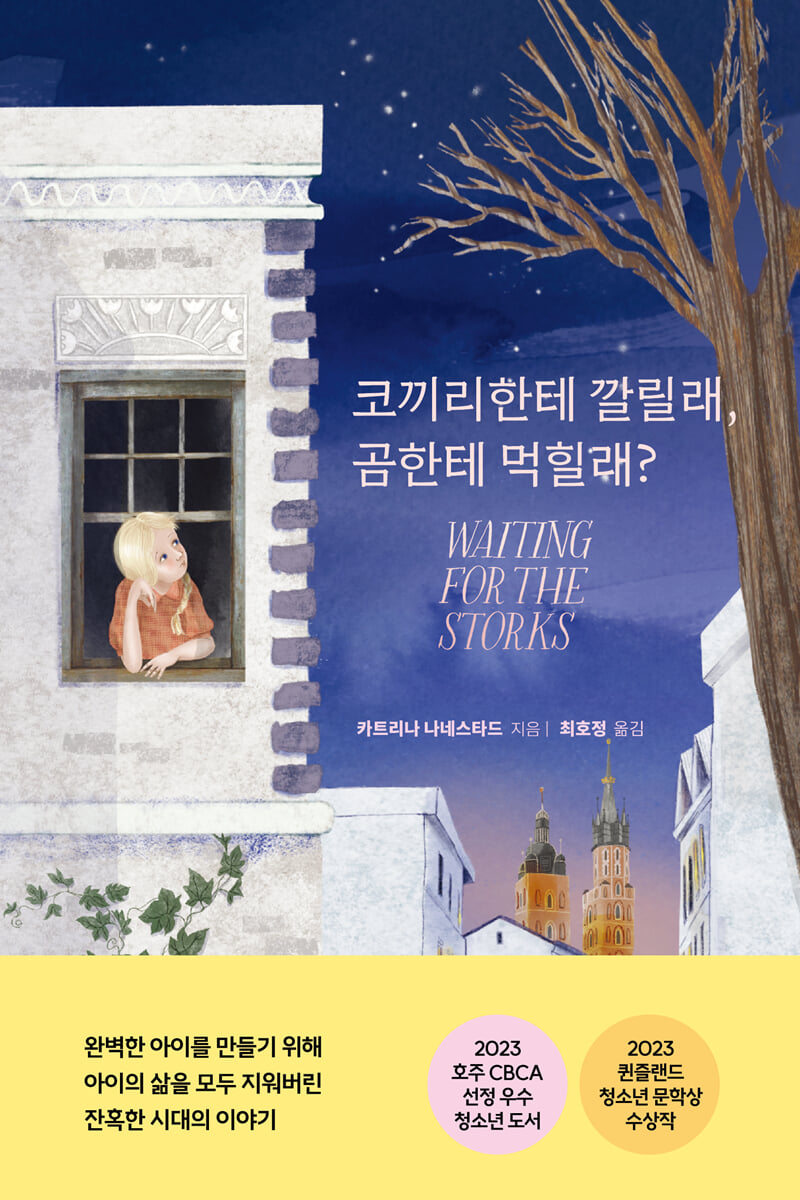
Do you want to be run over by an elephant or eaten by a bear?
 |
Description
Book Introduction
The girl who was asked the cruelest question in the world
And the answer the child found
"Do you want to be run over by an elephant or eaten by a bear?" is a young adult historical novel inspired by real events.
The novel, yet shocking historical event known as the Lebensborn Program, carried out by the Nazis during World War II, unfolds, drawing readers deeply into the story.
But this book is not a simple war story or a reenactment of a tragedy.
It delicately and lyrically depicts the identity crisis, crossroads of choice, and courageous process of growth that everyone experiences.
From flowing sentences and rhythmic lines that touch the emotions, to messages that question the essence of humanity at the boundary between history and the individual.
This work will resonate deeply with not only young people but also their parents and teachers.
And the answer the child found
"Do you want to be run over by an elephant or eaten by a bear?" is a young adult historical novel inspired by real events.
The novel, yet shocking historical event known as the Lebensborn Program, carried out by the Nazis during World War II, unfolds, drawing readers deeply into the story.
But this book is not a simple war story or a reenactment of a tragedy.
It delicately and lyrically depicts the identity crisis, crossroads of choice, and courageous process of growth that everyone experiences.
From flowing sentences and rhythmic lines that touch the emotions, to messages that question the essence of humanity at the boundary between history and the individual.
This work will resonate deeply with not only young people but also their parents and teachers.
- You can preview some of the book's contents.
Preview
Detailed image

Into the book
December 1941, Krakow, Poland
“Cream cheese on salami, or gravy on puppy seed cake?”
--- From the text
“We are storks, Sophia.
So no matter what happens to us and our homeland, no matter how many of us are driven from this land, we will return and reclaim our homeland.
“Just like the storks that come back every spring to build their nests.”
--- p.27
Being kidnapped is the worst thing that can happen to any child.
It's scary, mind-boggling, and heartbreaking.
It hurts like my arm is being pricked by a needle.
No, it's worse.
It's like the needle keeps poking deeper and deeper into my heart, stomach, and soul.
There isn't a single moment that goes by that doesn't ache in my heart because I miss my mom, dad, and home.
--- p.107
But just as the moment came, just before I opened my mouth, I remembered that that past had been erased and was gone.
Sophia Wolinski no longer exists.
I have a new story.
Once upon a time, I was Sophia Ullmann, a German orphan.
Now I am Sophia Engels, the beloved daughter.
I live in a fairy tale.
--- p.170
Finally, I say.
“I am a happy traitor.
You are a miserable hero.
Who chose the right one?
“We’re just children,” Tomas mutters.
“You shouldn’t be forced to choose like that.”
--- p.288
Because of that, I realize something important.
People are a mixture of good and bad, kind and mean, brave and cowardly, happy and sad.
No one is perfect.
And no one is entirely bad.
--- p.324
“I’m sorry my cooking skills are like this,” says the grandfather.
“If my loving wife were here, she would have made it much more delicious.
It would have been the same even if there was barely anything to put in the pot.
He loved cooking for other people.
“I think she’s still making soup for our loved ones in heaven.”
“Cream cheese on salami, or gravy on puppy seed cake?”
--- From the text
“We are storks, Sophia.
So no matter what happens to us and our homeland, no matter how many of us are driven from this land, we will return and reclaim our homeland.
“Just like the storks that come back every spring to build their nests.”
--- p.27
Being kidnapped is the worst thing that can happen to any child.
It's scary, mind-boggling, and heartbreaking.
It hurts like my arm is being pricked by a needle.
No, it's worse.
It's like the needle keeps poking deeper and deeper into my heart, stomach, and soul.
There isn't a single moment that goes by that doesn't ache in my heart because I miss my mom, dad, and home.
--- p.107
But just as the moment came, just before I opened my mouth, I remembered that that past had been erased and was gone.
Sophia Wolinski no longer exists.
I have a new story.
Once upon a time, I was Sophia Ullmann, a German orphan.
Now I am Sophia Engels, the beloved daughter.
I live in a fairy tale.
--- p.170
Finally, I say.
“I am a happy traitor.
You are a miserable hero.
Who chose the right one?
“We’re just children,” Tomas mutters.
“You shouldn’t be forced to choose like that.”
--- p.288
Because of that, I realize something important.
People are a mixture of good and bad, kind and mean, brave and cowardly, happy and sad.
No one is perfect.
And no one is entirely bad.
--- p.324
“I’m sorry my cooking skills are like this,” says the grandfather.
“If my loving wife were here, she would have made it much more delicious.
It would have been the same even if there was barely anything to put in the pot.
He loved cooking for other people.
“I think she’s still making soup for our loved ones in heaven.”
--- p.331
Publisher's Review
I was kidnapped because I was a perfect child.
In the 1940s, the Nazis secretly implemented the Lebensborn program to artificially create the "perfect Aryan."
The book's protagonist, Sophia, was kidnapped simply because she had shiny blonde hair and sparkling blue eyes.
Sophia, who was taken away, forgets her Polish family, language, name, and memories, and is 're-educated' with a German name, language, and ideology.
Based on a true story, this novel vividly shows how war erases children's identities.
The process by which a child's life is erased and rewritten raises strong historical resonances and ethical questions for readers.
A journey to find your true self and true value in the midst of a turbulent history.
This book is about a girl's journey to find her identity and values, whose life was crushed overnight.
This story is also a metaphor for the growth narrative that all teenagers experience.
Living in a new home with her memories lost, perhaps erased, Sophia begins to waver as she slowly regains her past.
The child asks questions as he faces the truth that he was kidnapped, a past different from that of other children his age, and a truth he wanted to forget.
Who am I, what kind of person am I?
The child is also confused as he experiences all the values he once held being turned upside down in a different life, in a different world.
Humans are beings who are born and raised in a society and acquire the values of that society as universal values.
It is rare to be forced to experience two worlds with such distinctly different values in a short period of time.
However, the extreme conditions of war force such an experience on Zophia.
It is easy and yet difficult to condemn Sophia's confusion, having to love what she once hated, and then finding herself loving something without even realizing it.
However, if we can understand Sophia, who was lost between those two worlds, and watch her journey with warm eyes, our youth will be able to embrace a 'wider world.'
This book is a story of 'finding myself and creating myself' for all young people.
The world is not dichotomous, so we can make better choices.
Humans are difficult beings to understand.
Since the beginning of time, and even now, wars have been constantly waged to take away each other's territory and lives, but on the other hand, there are also frequent instances of humanity being shown by people sacrificing themselves or dedicating themselves to saving others, even if they have no vested interest in doing so.
War is what maximizes the cruelty of this contradictory human existence, and in World War II, Hitler and the Nazis displayed unprecedented cruelty.
One of them is the 'Lebensborn' program, which cannot be understood with common sense and universal sensibility.
This program, which was a means to realize Hitler's vision of a superior race and ethnicity dominating the world, resulted in the kidnapping and destruction of hundreds of thousands of children.
In the process, those children who had no choice but to follow their instincts to survive are forced to choose things they could not choose, and are held accountable for those choices.
"Do you want to be run over by an elephant or eaten by a bear?", drawn from the perspective of one of them, Sophia, shows the moments of love and hate, bravery and cowardice, truth and lies that the child experienced, and suggests that such multifaceted human nature is not a manifestation of individual personality or characteristics, but is created and reinforced within the social structure, and that it is extremely difficult to escape the domination of such a social structure and make free choices.
The great impact of this book lies in the realization that, in this multifaceted world of human beings and society, the distinction between good and evil is not so simple.
Sophia's German parents were extremely loving parents to her, and she gradually developed a genuine affection for them, but she did not turn a blind eye to the evil nature of what they had done.
A person can be kind and selfish, and kind and cruel.
Rather than blurring the line between good and evil, this book emphasizes the 'narrative of choice' that seeks to preserve humanity in a situation where good and evil are connected in a way that makes it impossible to find a boundary like a Möbius strip.
That choice may sometimes bring pain, but it shows that we must continue to strive to maintain our dignity.
This book is highly recommended for young people who ponder the questions history poses to the present, identity, and human values, as well as for anyone who wants to immerse themselves in a compelling book for the first time in a while.
Can a dark and difficult story be this poignant?
There is one game that runs through the entire book: the "Choose One!" game that Sophia's family played.
This is not just a play on words, but a game that “makes you sharp and smart” that actually runs through our lives.
From what we eat and wear to college entrance exams, employment, marriage, and every other aspect of our daily lives, whether trivial or important, we make choices.
Life is about making choices without being conscious of them.
But then comes the moment of desperate choice.
Although it was so desperate and difficult for Sophia, the language in which the story is told is surprisingly lighthearted.
Just as the dark clouds feel heavy due to the brilliant sunlight, the true charm of this novel lies in the paradoxical aesthetics of the children's honest gaze, lively words, and laughter, making the weight of this heavy history feel even more poignant.
And the reader learns why life is both sad and beautiful.
In the 1940s, the Nazis secretly implemented the Lebensborn program to artificially create the "perfect Aryan."
The book's protagonist, Sophia, was kidnapped simply because she had shiny blonde hair and sparkling blue eyes.
Sophia, who was taken away, forgets her Polish family, language, name, and memories, and is 're-educated' with a German name, language, and ideology.
Based on a true story, this novel vividly shows how war erases children's identities.
The process by which a child's life is erased and rewritten raises strong historical resonances and ethical questions for readers.
A journey to find your true self and true value in the midst of a turbulent history.
This book is about a girl's journey to find her identity and values, whose life was crushed overnight.
This story is also a metaphor for the growth narrative that all teenagers experience.
Living in a new home with her memories lost, perhaps erased, Sophia begins to waver as she slowly regains her past.
The child asks questions as he faces the truth that he was kidnapped, a past different from that of other children his age, and a truth he wanted to forget.
Who am I, what kind of person am I?
The child is also confused as he experiences all the values he once held being turned upside down in a different life, in a different world.
Humans are beings who are born and raised in a society and acquire the values of that society as universal values.
It is rare to be forced to experience two worlds with such distinctly different values in a short period of time.
However, the extreme conditions of war force such an experience on Zophia.
It is easy and yet difficult to condemn Sophia's confusion, having to love what she once hated, and then finding herself loving something without even realizing it.
However, if we can understand Sophia, who was lost between those two worlds, and watch her journey with warm eyes, our youth will be able to embrace a 'wider world.'
This book is a story of 'finding myself and creating myself' for all young people.
The world is not dichotomous, so we can make better choices.
Humans are difficult beings to understand.
Since the beginning of time, and even now, wars have been constantly waged to take away each other's territory and lives, but on the other hand, there are also frequent instances of humanity being shown by people sacrificing themselves or dedicating themselves to saving others, even if they have no vested interest in doing so.
War is what maximizes the cruelty of this contradictory human existence, and in World War II, Hitler and the Nazis displayed unprecedented cruelty.
One of them is the 'Lebensborn' program, which cannot be understood with common sense and universal sensibility.
This program, which was a means to realize Hitler's vision of a superior race and ethnicity dominating the world, resulted in the kidnapping and destruction of hundreds of thousands of children.
In the process, those children who had no choice but to follow their instincts to survive are forced to choose things they could not choose, and are held accountable for those choices.
"Do you want to be run over by an elephant or eaten by a bear?", drawn from the perspective of one of them, Sophia, shows the moments of love and hate, bravery and cowardice, truth and lies that the child experienced, and suggests that such multifaceted human nature is not a manifestation of individual personality or characteristics, but is created and reinforced within the social structure, and that it is extremely difficult to escape the domination of such a social structure and make free choices.
The great impact of this book lies in the realization that, in this multifaceted world of human beings and society, the distinction between good and evil is not so simple.
Sophia's German parents were extremely loving parents to her, and she gradually developed a genuine affection for them, but she did not turn a blind eye to the evil nature of what they had done.
A person can be kind and selfish, and kind and cruel.
Rather than blurring the line between good and evil, this book emphasizes the 'narrative of choice' that seeks to preserve humanity in a situation where good and evil are connected in a way that makes it impossible to find a boundary like a Möbius strip.
That choice may sometimes bring pain, but it shows that we must continue to strive to maintain our dignity.
This book is highly recommended for young people who ponder the questions history poses to the present, identity, and human values, as well as for anyone who wants to immerse themselves in a compelling book for the first time in a while.
Can a dark and difficult story be this poignant?
There is one game that runs through the entire book: the "Choose One!" game that Sophia's family played.
This is not just a play on words, but a game that “makes you sharp and smart” that actually runs through our lives.
From what we eat and wear to college entrance exams, employment, marriage, and every other aspect of our daily lives, whether trivial or important, we make choices.
Life is about making choices without being conscious of them.
But then comes the moment of desperate choice.
Although it was so desperate and difficult for Sophia, the language in which the story is told is surprisingly lighthearted.
Just as the dark clouds feel heavy due to the brilliant sunlight, the true charm of this novel lies in the paradoxical aesthetics of the children's honest gaze, lively words, and laughter, making the weight of this heavy history feel even more poignant.
And the reader learns why life is both sad and beautiful.
GOODS SPECIFICS
- Date of issue: August 29, 2025
- Page count, weight, size: 352 pages | 473g | 135*200*20mm
- ISBN13: 9791199357303
- ISBN10: 1199357308
You may also like
카테고리
korean


korean

![GQ KOREA Mark (Monthly): December [2025]](http://librairie.coreenne.fr/cdn/shop/files/8ef265dbbfbf186523ed75ba7319009d.jpg?v=1765340328&width=3840)


