

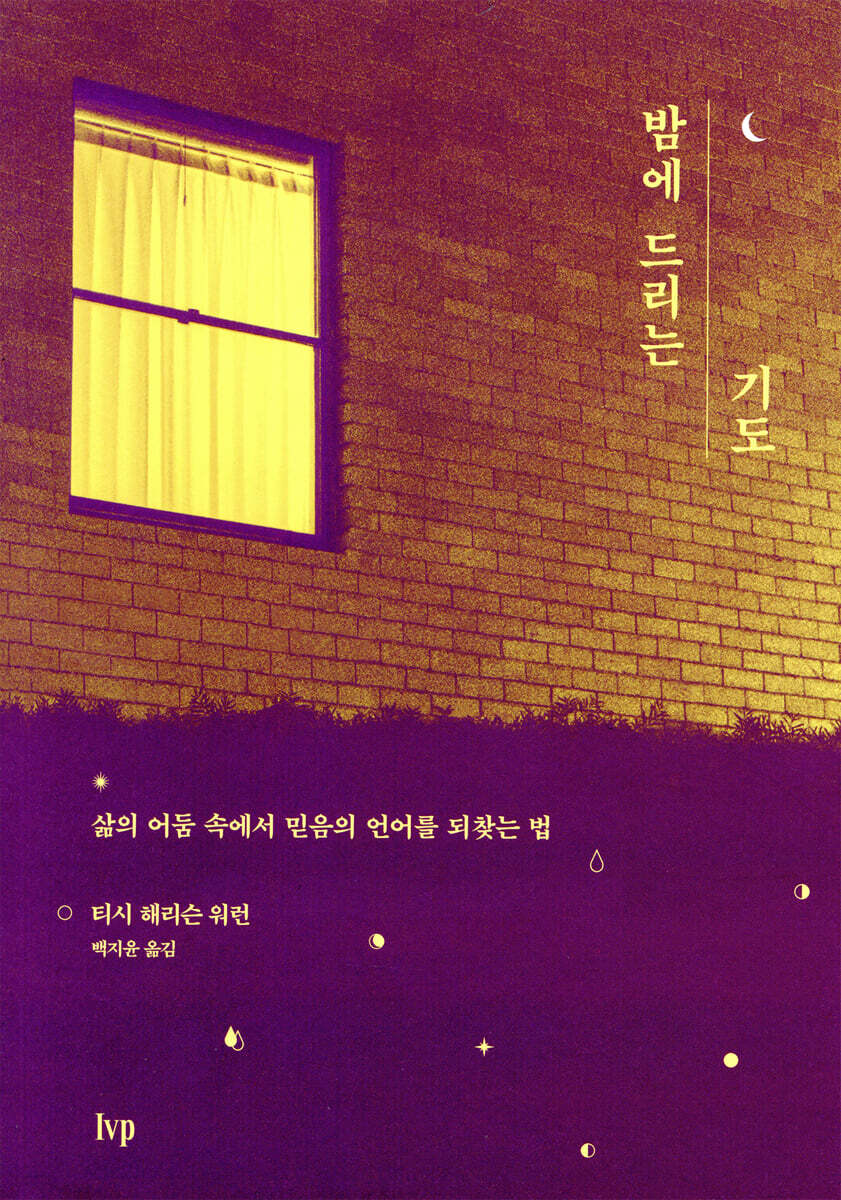
Prayer at night
 |
Description
Book Introduction
This book deals with the dark shadows of life cast beneath the ordinary daily lives, based on the traditions of the past and the church. In "A Prayer Called Today," Tish Harrison Warren showed us how to live an ordinary day with worship. In this book, "A Prayer at Night," she sheds light on the bare face of life that we face every night as we go to bed. From anxiety and fear to disease and death, we cannot control the dangers of life that lurk like the darkness around us. The author, going through a time of suffering when even prayer was impossible, deeply meditates on the Church's tradition of "night prayer," showing us how we can trust in God, who does not prevent life's suffering, and find comfort in Him. |
- You can preview some of the book's contents.
Preview
index
Author's Note
Part 1: Praying in the Dark
Entering
1.
In Search of Night Prayer - Sunset
2.
Dear Lord, protect me—in pain and in your presence.
Part 2: The Way of Vulnerability
3.
Weeping Tooth - Sigh
4.
The Watcher - Attention
5.
Working People - Recovery
Part 3: Taxonomy of Vulnerability
6.
Send your angels to the sleeping ones—the universe and everyday life.
7.
Lord Christ, care for the sick—embodiment
8.
Give rest to the weary—weakness and silence
9.
Bless the dying—re
10.
Comfort those who suffer—Comfort
11.
Take pity on those who suffer—unwavering and relentless
12.
Protect those who rejoice—thankfulness and composure
Part 4 completed
13.
I pray, relying on the Lord's love—at dawn
Acknowledgements
Questions for discussion and suggestions for action
main
Part 1: Praying in the Dark
Entering
1.
In Search of Night Prayer - Sunset
2.
Dear Lord, protect me—in pain and in your presence.
Part 2: The Way of Vulnerability
3.
Weeping Tooth - Sigh
4.
The Watcher - Attention
5.
Working People - Recovery
Part 3: Taxonomy of Vulnerability
6.
Send your angels to the sleeping ones—the universe and everyday life.
7.
Lord Christ, care for the sick—embodiment
8.
Give rest to the weary—weakness and silence
9.
Bless the dying—re
10.
Comfort those who suffer—Comfort
11.
Take pity on those who suffer—unwavering and relentless
12.
Protect those who rejoice—thankfulness and composure
Part 4 completed
13.
I pray, relying on the Lord's love—at dawn
Acknowledgements
Questions for discussion and suggestions for action
main
Detailed image

Into the book
My decision to trust God was not a simple cognitive exercise.
I wasn't trying to pass a Sunday school quiz.
I was trying to enter into a truth that was big enough to hold my own weakness, vulnerability, and weak faith, a truth that was as denial-proof as it was certain.
But how could I, exhausted by tears and blood, reach out for such truth, in a place where neither language nor certainty could be found?
---From "Entering"
We want grief to be a mission with an end.
Just as when our soul's oven timer goes off, we can move on to something else.
But grief doesn't work that way.
Trying to control sadness is like trying to control the weather.
Grief is not simply an intellectual activity or cognitive ability to deal with loss.
Grieving is the price we pay for being emotionally alive.
It is even the price of holiness.
Christians must become people who mourn.
---「3.
From "The Crying One - Sighs"
Today we tend to understand accomplishment as either our work or God's work, but never both.
Thus, we have come to believe, subtly, that our ability to act competes with God's ability to act.
We either believe the lie that goodness, truth, beauty, healing, and justice are created entirely through our own efforts, or we believe the lie that these things are granted by God without any action on our part.
Therefore, God is only useful as a miracle worker or a final decision maker.
For us, he is a magician who asks us to do things we don't want to do, using signs and articles to destroy the world.
In this type of thinking, you may call on God when you feel desperate, but mostly you rely on your own strength.
In the most basic things of life—washing clothes and making laws, finance and forestry, medicine and childcare, digging ditches and diplomacy—God is largely absent.
---「5.
From "Working People - Recovery"
God designed the universe and our bodies, and so every day we must face the fact that we are not stars on the center stage.
We are not the primary protagonists of the Earth, not even in our own lives.
The orbits of the planets each night, the activities of angels, and God's work in the world go on quite well without us.
For Christians, sleep is a concrete way of confessing that God's work is not up to us.
---「6.
Send your angels for the sleeping ones - from "The Universe and Everyday Reflections"
Every day I face big and small things that are difficult but don't kill me.
And I'm finding that what doesn't kill me actually makes me weaker, and maybe that's the point.
The way to glory is found through the way of the cross, and only through that way.
In the school of life's love, suffering, which does not kill us, makes us more alive to our need and helplessness, and thus more able to give and receive love.
---「10.
Comforting those who suffer - from “Comfort”
We must learn to trust God even to receive good things from Him.
And it is difficult to learn to receive good things from God.
Especially if you have been hurt before.
It is difficult to learn to trust in goodness and beauty.
To do this, we need to practice facing the reality of darkness, and at the same time, practice seeking and hoping for light.
---「12.
Protect the Joyful Ones—From Gratitude and Composure
There is heartbreak, pain, doubt, and despair in our lives, but what remains and always will remain is the love of Him who, as Gerard Manley Hopkins wrote, “has a beauty beyond change.”
The anchor that holds all theology and all Christian prayer and practice is God's loving love.
I wasn't trying to pass a Sunday school quiz.
I was trying to enter into a truth that was big enough to hold my own weakness, vulnerability, and weak faith, a truth that was as denial-proof as it was certain.
But how could I, exhausted by tears and blood, reach out for such truth, in a place where neither language nor certainty could be found?
---From "Entering"
We want grief to be a mission with an end.
Just as when our soul's oven timer goes off, we can move on to something else.
But grief doesn't work that way.
Trying to control sadness is like trying to control the weather.
Grief is not simply an intellectual activity or cognitive ability to deal with loss.
Grieving is the price we pay for being emotionally alive.
It is even the price of holiness.
Christians must become people who mourn.
---「3.
From "The Crying One - Sighs"
Today we tend to understand accomplishment as either our work or God's work, but never both.
Thus, we have come to believe, subtly, that our ability to act competes with God's ability to act.
We either believe the lie that goodness, truth, beauty, healing, and justice are created entirely through our own efforts, or we believe the lie that these things are granted by God without any action on our part.
Therefore, God is only useful as a miracle worker or a final decision maker.
For us, he is a magician who asks us to do things we don't want to do, using signs and articles to destroy the world.
In this type of thinking, you may call on God when you feel desperate, but mostly you rely on your own strength.
In the most basic things of life—washing clothes and making laws, finance and forestry, medicine and childcare, digging ditches and diplomacy—God is largely absent.
---「5.
From "Working People - Recovery"
God designed the universe and our bodies, and so every day we must face the fact that we are not stars on the center stage.
We are not the primary protagonists of the Earth, not even in our own lives.
The orbits of the planets each night, the activities of angels, and God's work in the world go on quite well without us.
For Christians, sleep is a concrete way of confessing that God's work is not up to us.
---「6.
Send your angels for the sleeping ones - from "The Universe and Everyday Reflections"
Every day I face big and small things that are difficult but don't kill me.
And I'm finding that what doesn't kill me actually makes me weaker, and maybe that's the point.
The way to glory is found through the way of the cross, and only through that way.
In the school of life's love, suffering, which does not kill us, makes us more alive to our need and helplessness, and thus more able to give and receive love.
---「10.
Comforting those who suffer - from “Comfort”
We must learn to trust God even to receive good things from Him.
And it is difficult to learn to receive good things from God.
Especially if you have been hurt before.
It is difficult to learn to trust in goodness and beauty.
To do this, we need to practice facing the reality of darkness, and at the same time, practice seeking and hoping for light.
---「12.
Protect the Joyful Ones—From Gratitude and Composure
There is heartbreak, pain, doubt, and despair in our lives, but what remains and always will remain is the love of Him who, as Gerard Manley Hopkins wrote, “has a beauty beyond change.”
The anchor that holds all theology and all Christian prayer and practice is God's loving love.
---「13.
I pray, relying on the Lord's love - from "Dawn"
I pray, relying on the Lord's love - from "Dawn"
Publisher's Review
The practice of prayer is the ergonomics of salvation,
This is how you learn to walk through the darkness of the world!
Every day when the sun sets and night falls, we go to sleep in our ordinary beds in our ordinary homes, living our ordinary lives.
No matter how important our profession, how rich or impressive we are, we all have to spend roughly a third of our lives unconscious.
While we sleep, we enter a state of 'vulnerability' where we can be harmed, robbed, or lose someone or something we love.
This is the bare face of life that we face every night when we go to bed.
The dark night of the soul that questions God's goodness
Night also signifies the dangers of life that are always lurking around us, like the darkness surrounding us.
As St. John of the Cross speaks of in his expression “the dark night of the soul,” there are times of sadness, doubt, and spiritual crisis when God seems invisible or distant.
Author Tish Harrison Warren, an Anglican priest, says he became “a priest who couldn’t pray” after experiencing the devastating pain of his father’s sudden death and two miscarriages.
It was a time of truly dark night, a time when the depth of suffering was so deep that I could no longer speak, no longer knew how to approach God, and no longer even sure if I could trust Him.
Why does God allow suffering in life? Life takes different forms, but everyone faces moments when this question arises.
There is no clear answer to this long and arduous struggle, which has been called 'theodicy.'
Because no words can comfort the pain.
Wrestling between the ever-present pain of life and the question of God's goodness, the author argues that theodicy is "a longing for a God who cares enough to pay attention to our suffering and take action, and for a God who will make all things new."
Ultimately, what a suffering person needs is not a logical answer to why suffering exists in the world, but the assurance that there is a good God and that He is acting on their behalf.
Prayer works within us and shapes us.
What held the author back in those dark times and gave him the strength to live again was none other than the church's prayers and practices, especially the night prayer (Compline).
The Night Prayer is a prayer service for the night among the Liturgy of the Hours (prayer services according to time) of the Anglican Prayer Book, and the author meditates deeply on a specific prayer that appears at the end of this service, line by line.
This prayer, which remembers in turn those who work at night, those who keep watch, those who weep, those who sleep, those who are sick, those who are tired, those who are dying, those who suffer, those who are in pain, and those who rejoice, enumerates specific categories of human vulnerability and invites God into each of the unique and concrete realities of life.
When we pray with the traditional prayers we have received from the Church rather than with spontaneous, self-expressive, "free-form" prayers, we pray beyond what we know, believe, and can audibly express within ourselves.
It is not that we pray with strength, but rather that prayer works within us, changing who we are and what we believe.
Prayer is “a vast field, with ample room for silence and cry, creativity and repetition, the original and the received, imagination and reason.”
God's love willingly discovered in the vulnerability of life
These examples of prayer take us out of ourselves and our momentary confines of time and into the long story of Christ's work in and through his people.
In it, the author discovers an obvious but surprising truth.
“As a riddle, God does not take away our vulnerability.
He comes into it.”
Not in the life of Jesus, “a man acquainted with suffering,” not in the evidence of any life, not in a comparison of all the good and all the evil in the world, but in the life of Jesus, “a man acquainted with suffering,” we discover God’s goodness, love, and presence.
All our sighs are united with the sighs of that life, which has experienced suffering and death in its entirety in the human body.
God's love, which is constant like the speed of light and not changeable like day and night, is the fixed center of our life and eternity.
A Prayer to Remember in the Face of Life's Unavoidable Hardships
In "Today's Worship," the author, who brought the life of worship to the dull everyday life, delicately and affectionately tells us through "Prayer at Night" how we can worship and walk the path of faith without denying the darkness that falls on our lives.
Although written in prose, it is beautifully written and reads like poetry, and the humor hidden like star candy throughout the heartbreaking stories is well-matched.
What is most beautiful of all is the prayer this book introduces.
As one recommender confessed, “Before I closed the last page, that prayer was on my tongue,” we too should remember this prayer when we face the inevitable hardships of life that will come our way one day.
“Dear Lord, watch over those who work, keep watch, and weep this night; send your angels to those who sleep.
Lord Christ, take care of the sick.
Give rest to the weary, bless the dying, comfort the afflicted, have pity on the suffering, and protect the joyful.
I pray relying on the Lord's love.
Amen.” (Anglican Prayer Book)
Target audience
- Those who want to learn a prayer to pray every night while reflecting on the day
-Those who wish to find God while passing through the darkness of everyday life.
- Those who do not feel God's help in the midst of pain and difficulties
- Those who are in the midst of the despair of life, wanting to pray but unable to do so.
- Those who find it difficult to believe in God's goodness when they see the evil and darkness of the world.
This is how you learn to walk through the darkness of the world!
Every day when the sun sets and night falls, we go to sleep in our ordinary beds in our ordinary homes, living our ordinary lives.
No matter how important our profession, how rich or impressive we are, we all have to spend roughly a third of our lives unconscious.
While we sleep, we enter a state of 'vulnerability' where we can be harmed, robbed, or lose someone or something we love.
This is the bare face of life that we face every night when we go to bed.
The dark night of the soul that questions God's goodness
Night also signifies the dangers of life that are always lurking around us, like the darkness surrounding us.
As St. John of the Cross speaks of in his expression “the dark night of the soul,” there are times of sadness, doubt, and spiritual crisis when God seems invisible or distant.
Author Tish Harrison Warren, an Anglican priest, says he became “a priest who couldn’t pray” after experiencing the devastating pain of his father’s sudden death and two miscarriages.
It was a time of truly dark night, a time when the depth of suffering was so deep that I could no longer speak, no longer knew how to approach God, and no longer even sure if I could trust Him.
Why does God allow suffering in life? Life takes different forms, but everyone faces moments when this question arises.
There is no clear answer to this long and arduous struggle, which has been called 'theodicy.'
Because no words can comfort the pain.
Wrestling between the ever-present pain of life and the question of God's goodness, the author argues that theodicy is "a longing for a God who cares enough to pay attention to our suffering and take action, and for a God who will make all things new."
Ultimately, what a suffering person needs is not a logical answer to why suffering exists in the world, but the assurance that there is a good God and that He is acting on their behalf.
Prayer works within us and shapes us.
What held the author back in those dark times and gave him the strength to live again was none other than the church's prayers and practices, especially the night prayer (Compline).
The Night Prayer is a prayer service for the night among the Liturgy of the Hours (prayer services according to time) of the Anglican Prayer Book, and the author meditates deeply on a specific prayer that appears at the end of this service, line by line.
This prayer, which remembers in turn those who work at night, those who keep watch, those who weep, those who sleep, those who are sick, those who are tired, those who are dying, those who suffer, those who are in pain, and those who rejoice, enumerates specific categories of human vulnerability and invites God into each of the unique and concrete realities of life.
When we pray with the traditional prayers we have received from the Church rather than with spontaneous, self-expressive, "free-form" prayers, we pray beyond what we know, believe, and can audibly express within ourselves.
It is not that we pray with strength, but rather that prayer works within us, changing who we are and what we believe.
Prayer is “a vast field, with ample room for silence and cry, creativity and repetition, the original and the received, imagination and reason.”
God's love willingly discovered in the vulnerability of life
These examples of prayer take us out of ourselves and our momentary confines of time and into the long story of Christ's work in and through his people.
In it, the author discovers an obvious but surprising truth.
“As a riddle, God does not take away our vulnerability.
He comes into it.”
Not in the life of Jesus, “a man acquainted with suffering,” not in the evidence of any life, not in a comparison of all the good and all the evil in the world, but in the life of Jesus, “a man acquainted with suffering,” we discover God’s goodness, love, and presence.
All our sighs are united with the sighs of that life, which has experienced suffering and death in its entirety in the human body.
God's love, which is constant like the speed of light and not changeable like day and night, is the fixed center of our life and eternity.
A Prayer to Remember in the Face of Life's Unavoidable Hardships
In "Today's Worship," the author, who brought the life of worship to the dull everyday life, delicately and affectionately tells us through "Prayer at Night" how we can worship and walk the path of faith without denying the darkness that falls on our lives.
Although written in prose, it is beautifully written and reads like poetry, and the humor hidden like star candy throughout the heartbreaking stories is well-matched.
What is most beautiful of all is the prayer this book introduces.
As one recommender confessed, “Before I closed the last page, that prayer was on my tongue,” we too should remember this prayer when we face the inevitable hardships of life that will come our way one day.
“Dear Lord, watch over those who work, keep watch, and weep this night; send your angels to those who sleep.
Lord Christ, take care of the sick.
Give rest to the weary, bless the dying, comfort the afflicted, have pity on the suffering, and protect the joyful.
I pray relying on the Lord's love.
Amen.” (Anglican Prayer Book)
Target audience
- Those who want to learn a prayer to pray every night while reflecting on the day
-Those who wish to find God while passing through the darkness of everyday life.
- Those who do not feel God's help in the midst of pain and difficulties
- Those who are in the midst of the despair of life, wanting to pray but unable to do so.
- Those who find it difficult to believe in God's goodness when they see the evil and darkness of the world.
GOODS SPECIFICS
- Date of issue: September 7, 2021
- Page count, weight, size: 320 pages | 320g | 137*195*30mm
- ISBN13: 9788932818627
- ISBN10: 8932818622
You may also like
카테고리
korean


korean

![GQ KOREA Mark (Monthly): December [2025]](http://librairie.coreenne.fr/cdn/shop/files/8ef265dbbfbf186523ed75ba7319009d.jpg?v=1765340328&width=3840)


