

Korean language outing vocabulary
 |
Description
Book Introduction
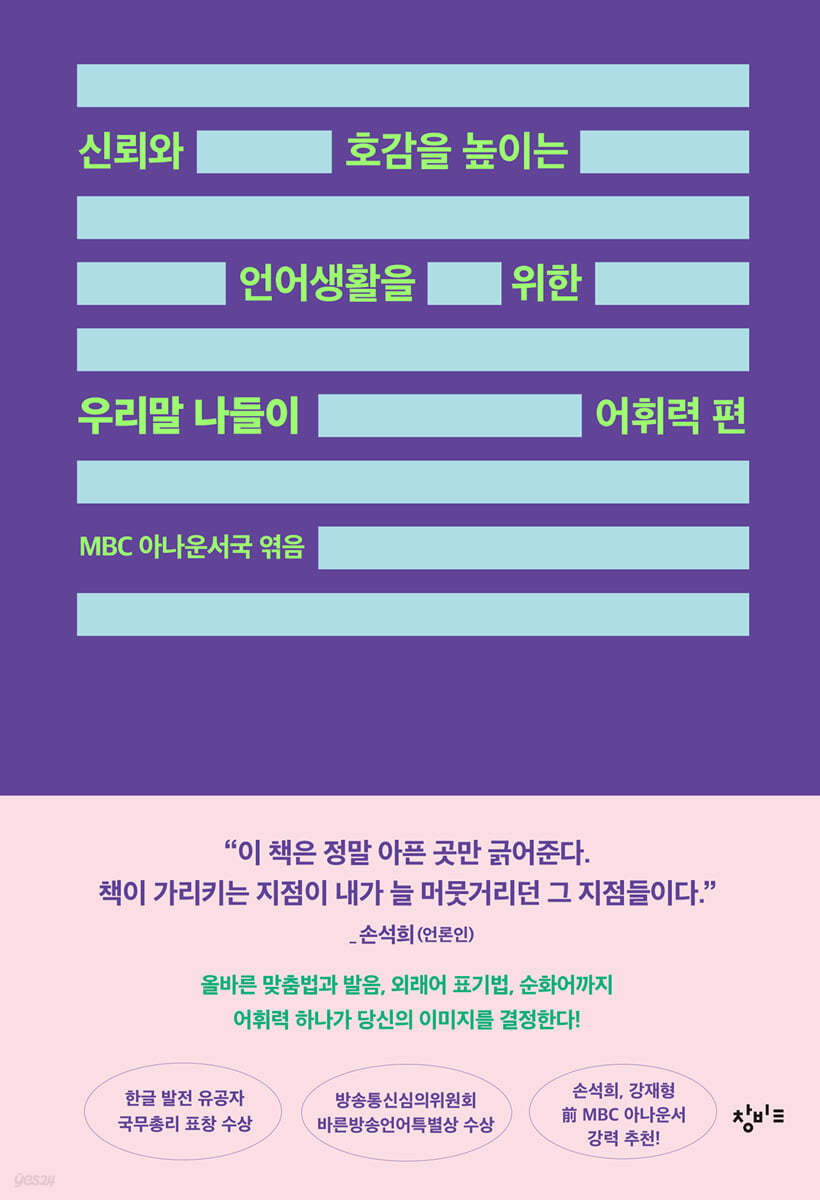
Meet "Our Language Tour," a guide to correct language for all citizens, now available as a book!
Everything You Need to Know About "Real Vocabulary" from MBC Announcers
MBC TV program "Our Language Outing" was produced with the aim of learning accurate Korean in an easy and fun way while preserving and cultivating our language and writing.
It began broadcasting in December 1997 and has maintained its position for approximately 30 years, serving as a true guide to correct language for the entire nation.
However, after 30 years, the state of pollution of our language is becoming increasingly serious.
It is not a joke but reality that 'today' is confused with 'Friday', 'three days' is mistaken with 'four days', and 'a boring apology' is understood as a 'boring apology'.
Accordingly, MBC announcers who created "Our Language Outing" gathered together and compiled a book by carefully selecting content from the past 10 years of broadcasts that is relevant and necessary for the present age.
『Korean Language Outing Vocabulary』 teaches correct spelling and foreign word notation, and suggests purified words that can be used to refine outdated expressions and unfamiliar foreign words.
It also points out instances where common mispronunciations lead to incorrect spellings.
In particular, the QR code was inserted to allow users to hear accurate pronunciation in the voices of MBC announcers Kim Soo-ji and Jeong Young-han, increasing comprehension and usability.
“The points that the book points to are the points where I have always hesitated.
As journalist Son Seok-hee said, “If you read just two or three pages, you will understand what this means,” it contains basic and fundamental vocabulary and grammar that are easily spoken and used in real life, but are often confused and made mistakes.
In an era where we communicate through writing both in our daily lives and at work, vocabulary is both a means of self-expression and an important criterion for evaluation.
Even a small spelling or typographical error can erode trust and goodwill.
If you find yourself struggling to use a spell checker even when writing short texts, if you constantly look up words you know but don't know their exact meanings in the dictionary, if you only use words you use every day, if you've ever been criticized for spelling errors or unclear writing, then open up "Korean Language Outing Vocabulary" right now.
By learning vocabulary from an announcer who uses correct and accurate language, you can reduce your fear of speaking, reading, and writing and improve your level of language skills.
Everything You Need to Know About "Real Vocabulary" from MBC Announcers
MBC TV program "Our Language Outing" was produced with the aim of learning accurate Korean in an easy and fun way while preserving and cultivating our language and writing.
It began broadcasting in December 1997 and has maintained its position for approximately 30 years, serving as a true guide to correct language for the entire nation.
However, after 30 years, the state of pollution of our language is becoming increasingly serious.
It is not a joke but reality that 'today' is confused with 'Friday', 'three days' is mistaken with 'four days', and 'a boring apology' is understood as a 'boring apology'.
Accordingly, MBC announcers who created "Our Language Outing" gathered together and compiled a book by carefully selecting content from the past 10 years of broadcasts that is relevant and necessary for the present age.
『Korean Language Outing Vocabulary』 teaches correct spelling and foreign word notation, and suggests purified words that can be used to refine outdated expressions and unfamiliar foreign words.
It also points out instances where common mispronunciations lead to incorrect spellings.
In particular, the QR code was inserted to allow users to hear accurate pronunciation in the voices of MBC announcers Kim Soo-ji and Jeong Young-han, increasing comprehension and usability.
“The points that the book points to are the points where I have always hesitated.
As journalist Son Seok-hee said, “If you read just two or three pages, you will understand what this means,” it contains basic and fundamental vocabulary and grammar that are easily spoken and used in real life, but are often confused and made mistakes.
In an era where we communicate through writing both in our daily lives and at work, vocabulary is both a means of self-expression and an important criterion for evaluation.
Even a small spelling or typographical error can erode trust and goodwill.
If you find yourself struggling to use a spell checker even when writing short texts, if you constantly look up words you know but don't know their exact meanings in the dictionary, if you only use words you use every day, if you've ever been criticized for spelling errors or unclear writing, then open up "Korean Language Outing Vocabulary" right now.
By learning vocabulary from an announcer who uses correct and accurate language, you can reduce your fear of speaking, reading, and writing and improve your level of language skills.
- You can preview some of the book's contents.
Preview
index
Opening remarks
How to use this book
Chapter 1: Spelling that you won't get confused if you know it properly
Thin and slender
Cover up and be covered
A box of tissues, a box of tissues, and a box of tissues
It's a dog and it's a dog
Number and quantity, focus and focus
To kick and to kick away
Fit together and fit together
Stepped out and stepped out
Throw away and throw away
Wide and spacious
Spacious and wide, flat and broad
Press down and press down
Simple and concise
Soak and soak, lock and lock
Inheritance and reciprocity
Cover and be covered
On the contrary, on the contrary
The aftermath and the aftermath
Stop by and listen
Bedside and pillowcase
In the head and in the mind
Not enough and not enough
Murpak and Kneepad
Become red and become red, become bright and become red
Copy and imitate
See you soon
To sag and to sag
The four seasons come and the four seasons come
It's not funny and it's not funny
To giggle and giggle
From the beginning and from the very beginning
It's awkward and it's not pretty
cheeky and cheeky
Until now and until now
A flaw in jade and a flaw in jade
We are crying and crying
To force in and to force in
Shrink and shrink
Original and original
One after another
Step on and trample on
Chewy and chewy
Chusuru and Chusuri
Hit and hit
Pay and pay
Kekemukda and kekaemukda
Kkokkohada and quekkehada
Patou and Patou
There are many and many fictions
Hagiyawa Hagisa
A difference of one point and one end
Haerong Haerong and Heron Heron
Cancel and hedge
To be in a coma and to be in a coma
Blurry and hazy
Scatter and scatter and mess up
+ Korean language problem
Chapter 2: Incorrect expressions that follow from incorrect pronunciation
Kang So-ju and Kkang So-ju
Gwanssire and Gwansiri
To grumble and to grumble
My ears are stuffy and ringing
Whispers and whispers and whispers
Crackling and crackling
Kanggri and Sagri
Flutter and flutter
to break and to break
Four or five
frown and frown
After party and after party
Can't be separated no matter how hard you try and can't be separated no matter how hard you try
As the saying goes, it's true
The tongue and the tongue
Encounter and confront
Hair clumps and hair clumps
Messeukdaero and gourmet
Munggeuljeokda and Minggijeokda
Stars and stars
Fluffy and fluffy
The original bird and the owl
Swelling and swelling
Break and shatter
Booths and Bushi
Pa-gae-da and Po-gae-da
Sharp and sharp
Saechimdegi and Saechimttegi
I think so, I think so
Saengtung and Saengtung
Songgol Songgol and Songgle Songgle
Sukmaek and mugwort veins
Smursmur and twenty twenty
Aguijjim and Agujjim
Awkward and awkward
Urda and Urda
How much and how much
Enganhi and Enganhi
Yeseureopda and old-fashioned
Omrida and Omurida
The area is wide
handful and handful
Scraps and scraps
Jeong Na-mi and Jeong Nae-mi
Tiny and small
Sleepy and sleepy
Whether you like it or not
Short and concise
Jjippudunghada and Jjippudeunghada
Complicated and complicated
Like iron and like iron
Tamtakji and Tamtakchi
The sun is scorching and blazing
One finger and one strand
A little bit and a handful
pale and haggard
Heo Gu-han and Heo Gu-heon
Ugly and hideous
+ Korean language problem
Chapter 3: How to Write Foreign Words Correctly as Much as You Know
Gratin and gratin
Gradients and gradients
Nonsense and nonsense
Navigation and Navigation
Licenses and Licenses
Rendezvous and rendezvous
Lemonade and Lemonade
Launch and launch
Rouge and Rouge
Baton and baton
Bonnet and bonnet
Sherbet and sorbet
Sausages and sausages, messages and messages
Supermarkets and hypermarkets
Straw and straw
Sprinklers and sprinklers
Encore and encore
Allergies and Allergies
Adlib and ad-lib
Accessories and Accessories
Endorphins and endorphins
Jackets and jackets
Cardigans and cardigans
Caramel and caramel
Curtains and curtains
Collaboration and collaboration
Cake and cake and cake
Corduroy and corduroy
Croissants and croissants
Tumbling and tumbling
Ticketing and Ticketing
Foil and foil
Fried chicken and fried chicken
+ Foreign language problem
Chapter 4: Purified Korean words that help you use language correctly
To raise the national flag
An apprentice is a trainee
The high ground is a sand dune
Navy is dark brown
To launch an offensive and push forward
An excavator is an excavator
Blind
It's a common occurrence
The short sword is used for preparation or cutting
Polka dot pattern is a water drop pattern
The punks are raw
To do everything without any gaps
To bury means to bury
All statements are made as the first statement
Mudepo is reckless
Droplets are droplets of saliva
To be revealed or exposed
To be shiny and sparkly
To wave one's hand in refusal
The report is a report of circumstances
The archive is a repository of materials.
The extract is a true liquid
Back and forth, back and forth
The next day is the next day
An automated external defibrillator is an automated cardiac defibrillator.
Cut
To aim is to aim at
The end is a period
Gather your strength to focus on something
The flyer is a rumor
To extract means to pull out
The first is the first
Pop-up window is a notification window + pure Korean language problem
+ Korean Language Assessment Test
How to use this book
Chapter 1: Spelling that you won't get confused if you know it properly
Thin and slender
Cover up and be covered
A box of tissues, a box of tissues, and a box of tissues
It's a dog and it's a dog
Number and quantity, focus and focus
To kick and to kick away
Fit together and fit together
Stepped out and stepped out
Throw away and throw away
Wide and spacious
Spacious and wide, flat and broad
Press down and press down
Simple and concise
Soak and soak, lock and lock
Inheritance and reciprocity
Cover and be covered
On the contrary, on the contrary
The aftermath and the aftermath
Stop by and listen
Bedside and pillowcase
In the head and in the mind
Not enough and not enough
Murpak and Kneepad
Become red and become red, become bright and become red
Copy and imitate
See you soon
To sag and to sag
The four seasons come and the four seasons come
It's not funny and it's not funny
To giggle and giggle
From the beginning and from the very beginning
It's awkward and it's not pretty
cheeky and cheeky
Until now and until now
A flaw in jade and a flaw in jade
We are crying and crying
To force in and to force in
Shrink and shrink
Original and original
One after another
Step on and trample on
Chewy and chewy
Chusuru and Chusuri
Hit and hit
Pay and pay
Kekemukda and kekaemukda
Kkokkohada and quekkehada
Patou and Patou
There are many and many fictions
Hagiyawa Hagisa
A difference of one point and one end
Haerong Haerong and Heron Heron
Cancel and hedge
To be in a coma and to be in a coma
Blurry and hazy
Scatter and scatter and mess up
+ Korean language problem
Chapter 2: Incorrect expressions that follow from incorrect pronunciation
Kang So-ju and Kkang So-ju
Gwanssire and Gwansiri
To grumble and to grumble
My ears are stuffy and ringing
Whispers and whispers and whispers
Crackling and crackling
Kanggri and Sagri
Flutter and flutter
to break and to break
Four or five
frown and frown
After party and after party
Can't be separated no matter how hard you try and can't be separated no matter how hard you try
As the saying goes, it's true
The tongue and the tongue
Encounter and confront
Hair clumps and hair clumps
Messeukdaero and gourmet
Munggeuljeokda and Minggijeokda
Stars and stars
Fluffy and fluffy
The original bird and the owl
Swelling and swelling
Break and shatter
Booths and Bushi
Pa-gae-da and Po-gae-da
Sharp and sharp
Saechimdegi and Saechimttegi
I think so, I think so
Saengtung and Saengtung
Songgol Songgol and Songgle Songgle
Sukmaek and mugwort veins
Smursmur and twenty twenty
Aguijjim and Agujjim
Awkward and awkward
Urda and Urda
How much and how much
Enganhi and Enganhi
Yeseureopda and old-fashioned
Omrida and Omurida
The area is wide
handful and handful
Scraps and scraps
Jeong Na-mi and Jeong Nae-mi
Tiny and small
Sleepy and sleepy
Whether you like it or not
Short and concise
Jjippudunghada and Jjippudeunghada
Complicated and complicated
Like iron and like iron
Tamtakji and Tamtakchi
The sun is scorching and blazing
One finger and one strand
A little bit and a handful
pale and haggard
Heo Gu-han and Heo Gu-heon
Ugly and hideous
+ Korean language problem
Chapter 3: How to Write Foreign Words Correctly as Much as You Know
Gratin and gratin
Gradients and gradients
Nonsense and nonsense
Navigation and Navigation
Licenses and Licenses
Rendezvous and rendezvous
Lemonade and Lemonade
Launch and launch
Rouge and Rouge
Baton and baton
Bonnet and bonnet
Sherbet and sorbet
Sausages and sausages, messages and messages
Supermarkets and hypermarkets
Straw and straw
Sprinklers and sprinklers
Encore and encore
Allergies and Allergies
Adlib and ad-lib
Accessories and Accessories
Endorphins and endorphins
Jackets and jackets
Cardigans and cardigans
Caramel and caramel
Curtains and curtains
Collaboration and collaboration
Cake and cake and cake
Corduroy and corduroy
Croissants and croissants
Tumbling and tumbling
Ticketing and Ticketing
Foil and foil
Fried chicken and fried chicken
+ Foreign language problem
Chapter 4: Purified Korean words that help you use language correctly
To raise the national flag
An apprentice is a trainee
The high ground is a sand dune
Navy is dark brown
To launch an offensive and push forward
An excavator is an excavator
Blind
It's a common occurrence
The short sword is used for preparation or cutting
Polka dot pattern is a water drop pattern
The punks are raw
To do everything without any gaps
To bury means to bury
All statements are made as the first statement
Mudepo is reckless
Droplets are droplets of saliva
To be revealed or exposed
To be shiny and sparkly
To wave one's hand in refusal
The report is a report of circumstances
The archive is a repository of materials.
The extract is a true liquid
Back and forth, back and forth
The next day is the next day
An automated external defibrillator is an automated cardiac defibrillator.
Cut
To aim is to aim at
The end is a period
Gather your strength to focus on something
The flyer is a rumor
To extract means to pull out
The first is the first
Pop-up window is a notification window + pure Korean language problem
+ Korean Language Assessment Test
Detailed image
Publisher's Review
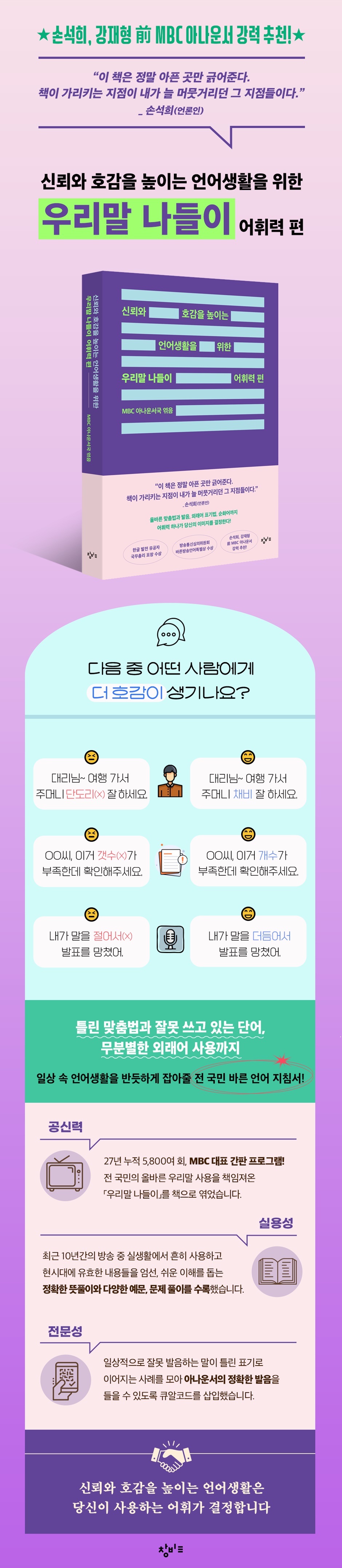
“This book really hits the nail on the head.
“The points the book points to are the points I have always hesitated at.” _Son Seok-hee (journalist)
A comprehensive coverage of MBC's flagship program "Our Language Outing"
The most accurate and practical language guide
“If it’s a three-day holiday, shouldn’t I have four days off?” “I submitted it on Friday because it was supposed to be submitted today. Is that wrong?” “I wanted to go alone, but they said mixed-gender accommodations aren’t allowed, so I couldn’t go.” These are anecdotes that have become topics of conversation on social media related to the lack of vocabulary.
Some people might not know what's wrong with this, and others might be surprised and think, 'You don't even know this much?'
So how many errors are there in the following sentence? "For the first time in a long time, I made kimchi with my family, put it in the refrigerator in my room, and locked the door." The correct sentence is "For the first time in a long time, I made kimchi with my family, put it in the refrigerator in my room, and locked the door." However, some might argue that this sentence contains no errors.
And that's not all.
The term "vocabulary shortage issue" has become a trend, and everyone has probably experienced at least once in their life when they couldn't think of the right words or expressions to express their feelings, so they just repeated similar words or just lumped together words like "daebak", "best", or "wow".
It all comes down to 'vocabulary'.
Nowadays, the lack of vocabulary and literacy is emerging as a social problem regardless of generation.
MBC TV program "Our Language Outing," which promotes accurate Korean language in a fun way and paves the way for the right path for the Korean language to take, is joining hands with Changbi Education to present a vocabulary book.
"Our Language Outing" has served as a guide for the correct language use of the entire nation for approximately 30 years, and its credibility has been recognized by winning the Prime Minister's Award for Contribution to the Development of the Korean Language in 2005 and the Korea Communications Standards Commission's Special Award for Correct Broadcasting Language in 2015, 2016, 2018, and 2019.
Among them, we have carefully selected content that is relevant to the present age based on broadcasts from the past 10 years and compiled it into the 『Korean Language Outing Vocabulary Edition』.
If you need a practical, practical, and professional guide to language learning that's relevant to your daily life, this is the book for you.
Correct spelling and pronunciation, foreign language notation, and even Korean words
Essential vocabulary for everyday life in one book
"Korean Language Outing Vocabulary" guides those who have ever felt the need to study due to a lack of vocabulary to easily and enjoyably build their vocabulary and cultivate a proper language life.
In Chapter 1, ‘Spelling Rules You Won’t Get Confused If You Know Them Properly,’ we introduce spelling rules that are easy to get wrong.
We have selected everyday words that we think we know well, such as dog/dog, wide/neoldarada, and stuffed/pushed in, which we find confusing when we actually try to write.
In Chapter 2, 'Incorrect Expressions Continuing from Mispronunciation', we will correct words where pronunciation errors lead to spelling errors.
Here are some examples of mistakes that are easy to make because they are written as they are spoken, such as the pronunciation “탈래야 탈수으면” but the correct pronunciation is “뜨려야 탈수있는 いつ”, and the correct pronunciation is “귀띔” but not “귀띔” or “귀띰”.
In particular, the QR code was inserted to allow users to hear accurate pronunciation in the voices of MBC announcers Kim Soo-ji and Jeong Young-han, increasing comprehension and usability.
In Chapter 3, 'Correct Use of Foreign Words as Much as You Know', the correct spelling of foreign words used in daily life such as croissant/croissant, sprinkler/sprinkler is introduced, and further, in Chapter 4, 'Purified Korean Words that Help with Correct Language Life', it suggests purified Korean words that can be used instead of foreign words, Japanese-style expressions, and outdated words that are used indiscriminately.
This is where the efforts of "Our Language Tour" stand out, as it corrects incorrect language usage and seeks out value-oriented language that suits the times.
In addition to this, you can also find various reading materials that will help you develop a more cultured and enriched language life, such as Korean words, proverbs, idioms, and idioms that are good to know together.
One word of vocabulary determines your image!
The most reliable way to increase vocabulary, credibility, and favorability all at once
As the title and subtitle, “Korean Language Outing Vocabulary: For a Language Life That Increases Trust and Liking,” suggest, this book focuses on how using the right vocabulary can serve as an effective tool for increasing trust and liking.
We promote ourselves through social media and communicate through messengers.
Whether preparing for a job, studying, or working, paperwork is essential, including self-introductions, reports, business emails, reports, plans, and proposals.
In an era where we communicate through writing both in our daily lives and at work, vocabulary is both a means of self-expression and an important criterion for evaluation.
That is why vocabulary is an important weapon that is directly related to trust and likability toward me.
Even a small spelling or typographical error can erode trust and goodwill.
Do you struggle to write without a spell checker or dictionary? Have you ever felt frustrated because you couldn't find the words to clearly express your thoughts? Have you ever blushed from a spelling mistake? If so, open this book.
This book will serve as a unique language guide for office workers who need to write clearly and concisely, job seekers about to enter the workforce, teenagers who need to study basic vocabulary for college entrance exams, aspiring broadcasters/publishers, teachers and parents who want to teach students and children the correct use of Korean, and anyone who wants to learn Korean properly and improve their vocabulary.
“The points the book points to are the points I have always hesitated at.” _Son Seok-hee (journalist)
A comprehensive coverage of MBC's flagship program "Our Language Outing"
The most accurate and practical language guide
“If it’s a three-day holiday, shouldn’t I have four days off?” “I submitted it on Friday because it was supposed to be submitted today. Is that wrong?” “I wanted to go alone, but they said mixed-gender accommodations aren’t allowed, so I couldn’t go.” These are anecdotes that have become topics of conversation on social media related to the lack of vocabulary.
Some people might not know what's wrong with this, and others might be surprised and think, 'You don't even know this much?'
So how many errors are there in the following sentence? "For the first time in a long time, I made kimchi with my family, put it in the refrigerator in my room, and locked the door." The correct sentence is "For the first time in a long time, I made kimchi with my family, put it in the refrigerator in my room, and locked the door." However, some might argue that this sentence contains no errors.
And that's not all.
The term "vocabulary shortage issue" has become a trend, and everyone has probably experienced at least once in their life when they couldn't think of the right words or expressions to express their feelings, so they just repeated similar words or just lumped together words like "daebak", "best", or "wow".
It all comes down to 'vocabulary'.
Nowadays, the lack of vocabulary and literacy is emerging as a social problem regardless of generation.
MBC TV program "Our Language Outing," which promotes accurate Korean language in a fun way and paves the way for the right path for the Korean language to take, is joining hands with Changbi Education to present a vocabulary book.
"Our Language Outing" has served as a guide for the correct language use of the entire nation for approximately 30 years, and its credibility has been recognized by winning the Prime Minister's Award for Contribution to the Development of the Korean Language in 2005 and the Korea Communications Standards Commission's Special Award for Correct Broadcasting Language in 2015, 2016, 2018, and 2019.
Among them, we have carefully selected content that is relevant to the present age based on broadcasts from the past 10 years and compiled it into the 『Korean Language Outing Vocabulary Edition』.
If you need a practical, practical, and professional guide to language learning that's relevant to your daily life, this is the book for you.
Correct spelling and pronunciation, foreign language notation, and even Korean words
Essential vocabulary for everyday life in one book
"Korean Language Outing Vocabulary" guides those who have ever felt the need to study due to a lack of vocabulary to easily and enjoyably build their vocabulary and cultivate a proper language life.
In Chapter 1, ‘Spelling Rules You Won’t Get Confused If You Know Them Properly,’ we introduce spelling rules that are easy to get wrong.
We have selected everyday words that we think we know well, such as dog/dog, wide/neoldarada, and stuffed/pushed in, which we find confusing when we actually try to write.
In Chapter 2, 'Incorrect Expressions Continuing from Mispronunciation', we will correct words where pronunciation errors lead to spelling errors.
Here are some examples of mistakes that are easy to make because they are written as they are spoken, such as the pronunciation “탈래야 탈수으면” but the correct pronunciation is “뜨려야 탈수있는 いつ”, and the correct pronunciation is “귀띔” but not “귀띔” or “귀띰”.
In particular, the QR code was inserted to allow users to hear accurate pronunciation in the voices of MBC announcers Kim Soo-ji and Jeong Young-han, increasing comprehension and usability.
In Chapter 3, 'Correct Use of Foreign Words as Much as You Know', the correct spelling of foreign words used in daily life such as croissant/croissant, sprinkler/sprinkler is introduced, and further, in Chapter 4, 'Purified Korean Words that Help with Correct Language Life', it suggests purified Korean words that can be used instead of foreign words, Japanese-style expressions, and outdated words that are used indiscriminately.
This is where the efforts of "Our Language Tour" stand out, as it corrects incorrect language usage and seeks out value-oriented language that suits the times.
In addition to this, you can also find various reading materials that will help you develop a more cultured and enriched language life, such as Korean words, proverbs, idioms, and idioms that are good to know together.
One word of vocabulary determines your image!
The most reliable way to increase vocabulary, credibility, and favorability all at once
As the title and subtitle, “Korean Language Outing Vocabulary: For a Language Life That Increases Trust and Liking,” suggest, this book focuses on how using the right vocabulary can serve as an effective tool for increasing trust and liking.
We promote ourselves through social media and communicate through messengers.
Whether preparing for a job, studying, or working, paperwork is essential, including self-introductions, reports, business emails, reports, plans, and proposals.
In an era where we communicate through writing both in our daily lives and at work, vocabulary is both a means of self-expression and an important criterion for evaluation.
That is why vocabulary is an important weapon that is directly related to trust and likability toward me.
Even a small spelling or typographical error can erode trust and goodwill.
Do you struggle to write without a spell checker or dictionary? Have you ever felt frustrated because you couldn't find the words to clearly express your thoughts? Have you ever blushed from a spelling mistake? If so, open this book.
This book will serve as a unique language guide for office workers who need to write clearly and concisely, job seekers about to enter the workforce, teenagers who need to study basic vocabulary for college entrance exams, aspiring broadcasters/publishers, teachers and parents who want to teach students and children the correct use of Korean, and anyone who wants to learn Korean properly and improve their vocabulary.
GOODS SPECIFICS
- Date of issue: January 13, 2025
- Page count, weight, size: 296 pages | 376g | 130*190*20mm
- ISBN13: 9791165703110
- ISBN10: 1165703114
You may also like
카테고리
korean


korean

![GQ KOREA Mark (Monthly): December [2025]](http://librairie.coreenne.fr/cdn/shop/files/8ef265dbbfbf186523ed75ba7319009d.jpg?v=1765340328&width=3840)


