

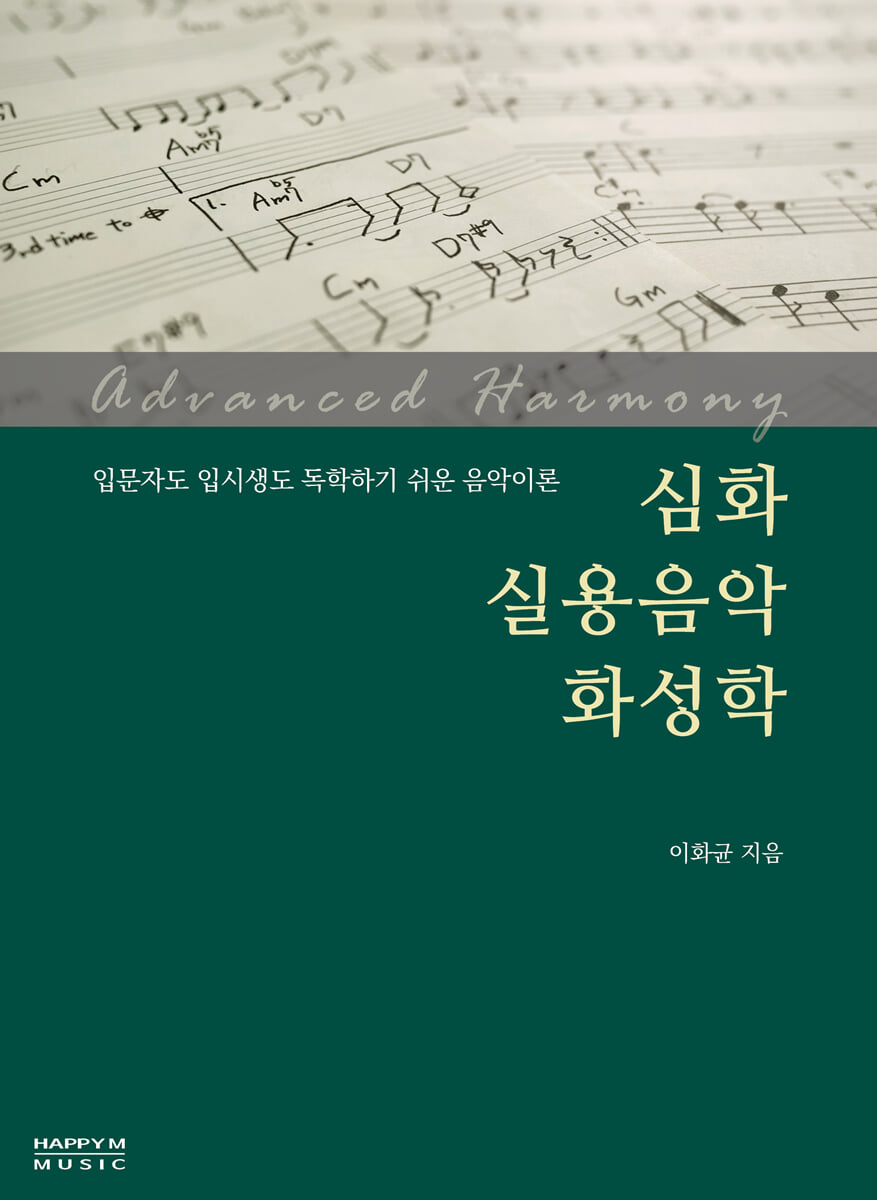
Advanced Practical Music Harmony
 |
Description
Book Introduction
Music theory that is easy to learn on your own, even for beginners and college students.
You may have started studying theory because you want to perform and compose music, or simply because you need knowledge about music.
And if you have studied hard in basic practical music harmony, you will be able to read sheet music at least and communicate musically.
However, to this extent, it may feel like it is not musically complete, or you may want to be more ambitious.
This is because basic practical music harmony literally only covers the basics.
If the previous content was about understanding music and sheet music, 『Advanced Practical Music Harmony』 covers the overall structure and usage of harmony and scales.
Mars details the principles of composition and natural progression, and the scale details the types of notes that can be matched to the corresponding chord.
Additionally, we explain how to analyze this content so that it can be applied in actual fields.
This textbook is a sequel to 'Basic Practical Music Harmony'.
I hope that many people will enjoy their music lives through this textbook.
You may have started studying theory because you want to perform and compose music, or simply because you need knowledge about music.
And if you have studied hard in basic practical music harmony, you will be able to read sheet music at least and communicate musically.
However, to this extent, it may feel like it is not musically complete, or you may want to be more ambitious.
This is because basic practical music harmony literally only covers the basics.
If the previous content was about understanding music and sheet music, 『Advanced Practical Music Harmony』 covers the overall structure and usage of harmony and scales.
Mars details the principles of composition and natural progression, and the scale details the types of notes that can be matched to the corresponding chord.
Additionally, we explain how to analyze this content so that it can be applied in actual fields.
This textbook is a sequel to 'Basic Practical Music Harmony'.
I hope that many people will enjoy their music lives through this textbook.
- You can preview some of the book's contents.
Preview
index
Chapter 1.
rehearsal
Chapter 2.
mode
Origin of the mod
Types and features of mods
Creating modes using whole and semitones
Creating modes using compositional relationships
Creating a mod using characteristic notes
Chapter 3.
Various scales
Major Chord Scale
Jazz minor scale
Various scales
Chapter 4.
Progression and changes in code
Harmonic rhythm
Progression of root notes
Dominant motion
End of contract law
Changes in dominant chords
Altered Tension and Scale
Chapter 5.
Nondiatonic chord
Secondary dominant
Extended Dominant
Substitute Dominant
Chapter 6.
Related II-7
Related II-7 of Secondary Dominant
Related II-7 of Extended Dominant
Substitute Dominant's Related II-7
Application of Related II-7
Chord scale of Related II-7
Chapter 7.
minor harmony
Chord scale of minor harmony
Minor Harmony Chord Function
Minor Harmony Cessation
Chapter 8.
Modal Interchange
What is a modal interchange?
Modal Interchange Code
Chapter 9.
Code voicing
Dense and Gary layouts
Drop voicing
Use of voicing
Low interval limit
Chapter 10.
Melody and notes
Harmonious and non-harmonic sounds
Types of non-harmonic sounds
motive
Appendix 1. Instrument Theory
Types of instruments
Korean musical instruments
Appendix 2: Answers to Practice Problems
Appendix 3 Comprehensive Practice Problem Answers
rehearsal
Chapter 2.
mode
Origin of the mod
Types and features of mods
Creating modes using whole and semitones
Creating modes using compositional relationships
Creating a mod using characteristic notes
Chapter 3.
Various scales
Major Chord Scale
Jazz minor scale
Various scales
Chapter 4.
Progression and changes in code
Harmonic rhythm
Progression of root notes
Dominant motion
End of contract law
Changes in dominant chords
Altered Tension and Scale
Chapter 5.
Nondiatonic chord
Secondary dominant
Extended Dominant
Substitute Dominant
Chapter 6.
Related II-7
Related II-7 of Secondary Dominant
Related II-7 of Extended Dominant
Substitute Dominant's Related II-7
Application of Related II-7
Chord scale of Related II-7
Chapter 7.
minor harmony
Chord scale of minor harmony
Minor Harmony Chord Function
Minor Harmony Cessation
Chapter 8.
Modal Interchange
What is a modal interchange?
Modal Interchange Code
Chapter 9.
Code voicing
Dense and Gary layouts
Drop voicing
Use of voicing
Low interval limit
Chapter 10.
Melody and notes
Harmonious and non-harmonic sounds
Types of non-harmonic sounds
motive
Appendix 1. Instrument Theory
Types of instruments
Korean musical instruments
Appendix 2: Answers to Practice Problems
Appendix 3 Comprehensive Practice Problem Answers
Publisher's Review
Check out Happy M Guitar's music theory lectures on YouTube in book form.
This is an advanced theory textbook designed for those studying practical music.
1.
We have compiled a separate list of frequently asked questions during class.
Questions that you may have while studying music or questions that you may be curious about in real-life situations are explained separately in the Check! section.
2.
Summary of frequently used terms
Music theory often uses a mix of Korean and English notation.
This textbook uses both notations, but lists the notation that is more commonly used in practice first, and the notation that is less frequently used last.
3.
No more drawing keyboards to solve problems.
There are practice problems at the middle or end of each unit, and the answers to these are included in the final appendix.
And to help beginners understand more easily, keyboard images are included.
4.
Good to know information
Although less important than the main text of music theory, useful information for practical situations is included in the appendix.
This book explains things in the simplest possible way so that anyone can easily study them.
If you still have trouble understanding, try studying with the video lectures on YouTube's "Happy M Guitar."
This is an advanced theory textbook designed for those studying practical music.
1.
We have compiled a separate list of frequently asked questions during class.
Questions that you may have while studying music or questions that you may be curious about in real-life situations are explained separately in the Check! section.
2.
Summary of frequently used terms
Music theory often uses a mix of Korean and English notation.
This textbook uses both notations, but lists the notation that is more commonly used in practice first, and the notation that is less frequently used last.
3.
No more drawing keyboards to solve problems.
There are practice problems at the middle or end of each unit, and the answers to these are included in the final appendix.
And to help beginners understand more easily, keyboard images are included.
4.
Good to know information
Although less important than the main text of music theory, useful information for practical situations is included in the appendix.
This book explains things in the simplest possible way so that anyone can easily study them.
If you still have trouble understanding, try studying with the video lectures on YouTube's "Happy M Guitar."
GOODS SPECIFICS
- Publication date: February 19, 2021
- Page count, weight, size: 208 pages | 188*257*20mm
- ISBN13: 9791197094521
- ISBN10: 1197094520
You may also like
카테고리
korean


korean

![GQ KOREA Mark (Monthly): December [2025]](http://librairie.coreenne.fr/cdn/shop/files/8ef265dbbfbf186523ed75ba7319009d.jpg?v=1765340328&width=3840)


