

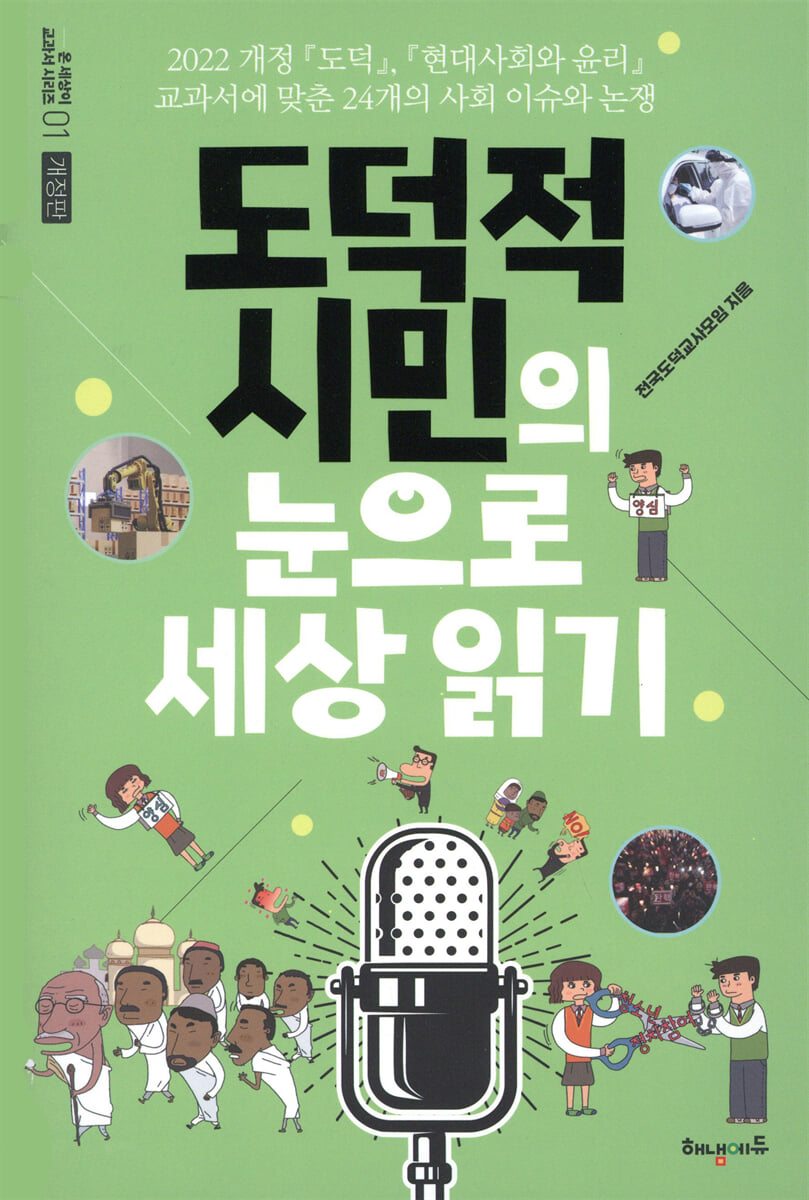
Reading the World Through the Eyes of a Moral Citizen
 |
Description
Book Introduction
Teachers from the National Moral Teachers Association explain the controversial issues in our society in an easy-to-understand manner. A revised edition has been published to align with the 2022 revised moral education curriculum!
An out-of-classroom textbook that fosters young people's discussion skills through moral and ethical awareness and critical thinking.
This is a revised edition of "Reading the World through the Eyes of a Moral Citizen," created by teachers from the National Moral Teachers Association in 2021.
This book examines recent social issues such as 'artificial intelligence,' 'assisted euthanasia,' 'the happiness index,' and 'the right to form a family' from the perspective of moral philosophy and ethical awareness, and is designed to help young people develop critical thinking and discussion skills.
New topics have been added to align with the 2022 revised curriculum's ethics and subjects, and numerous social issues are explained in a friendly and engaging way that appeals to young people.
Through this book, young people will be able to discuss issues in our society and confirm that moral citizens are the ones who create a fair and livable world.
An out-of-classroom textbook that fosters young people's discussion skills through moral and ethical awareness and critical thinking.
This is a revised edition of "Reading the World through the Eyes of a Moral Citizen," created by teachers from the National Moral Teachers Association in 2021.
This book examines recent social issues such as 'artificial intelligence,' 'assisted euthanasia,' 'the happiness index,' and 'the right to form a family' from the perspective of moral philosophy and ethical awareness, and is designed to help young people develop critical thinking and discussion skills.
New topics have been added to align with the 2022 revised curriculum's ethics and subjects, and numerous social issues are explained in a friendly and engaging way that appeals to young people.
Through this book, young people will be able to discuss issues in our society and confirm that moral citizens are the ones who create a fair and livable world.
index
preface
Ⅰ A society where you and I live together
·Can one become a moral citizen by living solely according to one's conscience?·
How far can rights be restricted for the public interest?
·Do we have to stand on the side of the country?·
Is foreign aid our obligation?
How should we interpret 'freedom of religion'?
Why is happiness the highest value of a moral citizen?
Ⅱ Beyond Discrimination and Hatred
·Do we have the freedom to hate?·
Should we accept strangers?
Should we remove corsets to achieve gender equality?
What is a good family?
Ⅲ A Look toward Fairness and Justice
Should we provide a 'basic income' to all citizens?
·How should juvenile crimes be punished justly?·
·Can we trust the media?·
·Can the exam be a fair competition?·
What is human labor?
Should the State Allow the Right to Assisted Dying?
Ⅳ Democracy realized through participation
·How far can youth participate in politics?·
·Can I not vote?·
·Can violent protests be justified?·
Ⅴ For a Sustainable Future
Is nature conservation for humans or for nature?
Is meat-eating natural?
Can we coexist with artificial intelligence?
·The image of citizens in the contactless era·
Virtual Space: What's Real?
Ⅰ A society where you and I live together
·Can one become a moral citizen by living solely according to one's conscience?·
How far can rights be restricted for the public interest?
·Do we have to stand on the side of the country?·
Is foreign aid our obligation?
How should we interpret 'freedom of religion'?
Why is happiness the highest value of a moral citizen?
Ⅱ Beyond Discrimination and Hatred
·Do we have the freedom to hate?·
Should we accept strangers?
Should we remove corsets to achieve gender equality?
What is a good family?
Ⅲ A Look toward Fairness and Justice
Should we provide a 'basic income' to all citizens?
·How should juvenile crimes be punished justly?·
·Can we trust the media?·
·Can the exam be a fair competition?·
What is human labor?
Should the State Allow the Right to Assisted Dying?
Ⅳ Democracy realized through participation
·How far can youth participate in politics?·
·Can I not vote?·
·Can violent protests be justified?·
Ⅴ For a Sustainable Future
Is nature conservation for humans or for nature?
Is meat-eating natural?
Can we coexist with artificial intelligence?
·The image of citizens in the contactless era·
Virtual Space: What's Real?
Into the book
Of course, the standard of happiness cannot be applied equally everywhere.
However, no matter how different people feel about happiness, it has some objective conditions.
To use an analogy, the moon in the sky appears in different forms depending on the time and location, but the moon itself remains the same.
While perspectives on what constitutes happiness may vary across time and region, we can all agree that happiness is necessary.
--- From "Why is happiness the highest value of a moral citizen?"
No matter how much you think you are family, you cannot become family if you do not meet the conditions set by the country.
It may seem difficult to understand at first, but it is true.
Well then, you could say this:
“Why don’t you just think of yourself as a family without necessarily seeking recognition from the state?”
…that just as each person determines their own life, they must also determine the relationships that are important and precious to them.
That is the crux of the family formation debate.
--- From "What is a Good Family?"
From a moral perspective, can a patient's decision to die be justified? In this regard, euthanasia can be viewed from two perspectives: utilitarianism and deontology, both of which focus on consequences and motivation.
…both utilitarianism and deontology can be applied differently in individual situations.
That is why we cannot say that euthanasia is “morally justified” or “morally unjustified” based on just one theory.
In particular, the decision on whether to allow euthanasia should be made based on stricter and more careful grounds, as it determines human life.
--- From "Should the State Allow the Right to Assisted Euthanasia?"
Celebrity A experienced something absurd.
Because the cover song he sang was becoming a hot topic online.
You might think it's a good thing for a celebrity to become a topic of conversation, right? The problem is that Mr. A has never sung a cover song before.
… people’s opinions are also divided.
On the one hand, some say that creating cover songs using artificial intelligence is a form of play culture, and that it is proof that art is no longer the exclusive domain of artists, but rather that we have entered a world where anyone can easily produce and consume art.
But on the other hand, some criticize AI cover songs for going beyond the level of fun.
Using someone else's voice without permission is a copyright infringement, and misusing it can cause serious problems.
What do you guys think?
However, no matter how different people feel about happiness, it has some objective conditions.
To use an analogy, the moon in the sky appears in different forms depending on the time and location, but the moon itself remains the same.
While perspectives on what constitutes happiness may vary across time and region, we can all agree that happiness is necessary.
--- From "Why is happiness the highest value of a moral citizen?"
No matter how much you think you are family, you cannot become family if you do not meet the conditions set by the country.
It may seem difficult to understand at first, but it is true.
Well then, you could say this:
“Why don’t you just think of yourself as a family without necessarily seeking recognition from the state?”
…that just as each person determines their own life, they must also determine the relationships that are important and precious to them.
That is the crux of the family formation debate.
--- From "What is a Good Family?"
From a moral perspective, can a patient's decision to die be justified? In this regard, euthanasia can be viewed from two perspectives: utilitarianism and deontology, both of which focus on consequences and motivation.
…both utilitarianism and deontology can be applied differently in individual situations.
That is why we cannot say that euthanasia is “morally justified” or “morally unjustified” based on just one theory.
In particular, the decision on whether to allow euthanasia should be made based on stricter and more careful grounds, as it determines human life.
--- From "Should the State Allow the Right to Assisted Euthanasia?"
Celebrity A experienced something absurd.
Because the cover song he sang was becoming a hot topic online.
You might think it's a good thing for a celebrity to become a topic of conversation, right? The problem is that Mr. A has never sung a cover song before.
… people’s opinions are also divided.
On the one hand, some say that creating cover songs using artificial intelligence is a form of play culture, and that it is proof that art is no longer the exclusive domain of artists, but rather that we have entered a world where anyone can easily produce and consume art.
But on the other hand, some criticize AI cover songs for going beyond the level of fun.
Using someone else's voice without permission is a copyright infringement, and misusing it can cause serious problems.
What do you guys think?
--- From "Virtual Space, What is Real?"
Publisher's Review
“Awake, moral citizens change the world.”
We examine various issues and controversies in our society from the perspective of moral philosophy and ethics and seek ways to live as a good citizen.
Regardless of East or West, the foundation of public education is to cultivate ‘citizens.’
Citizens are different from citizens.
Becoming a citizen is a right that is acquired naturally by being born in that country.
But citizens are nurtured through education.
A citizen is a subject living in a democratic society who participates in and debates public issues and policy decision-making processes.
These debates are imbued with ethical and philosophical values and concepts.
In other words, if you don't think ethically and philosophically, you can't make sound arguments or judgments.
In that sense, the ability to debate based on ethical reasoning is an ability that citizens must possess.
However, these abilities cannot be instilled in someone.
It is nurtured through taking an interest in various social issues and debating them with others.
This book covers a wide range of social issues, from conscience, rights and duties to happiness, family, the environment, labor, hate, death, and artificial intelligence.
And for each issue, it shows various positions on the controversial part.
Of course, it doesn't give you an exact answer.
It shows how discussions have been conducted in our society so far and what philosophical and ethical values and concepts are included in them.
Furthermore, we are discussing how such issues and controversies relate to the lives of young people.
Based on this, it is said that life as a citizen is by no means unrelated to the lives of young people.
This book ultimately tells us that we cannot be good citizens without thinking about moral human beings.
When we have a deep understanding of humanity, society, and nature, our lives as citizens can become stronger.
This will also be an essential part of establishing the identity and philosophy of civil society.
We examine various issues and controversies in our society from the perspective of moral philosophy and ethics and seek ways to live as a good citizen.
Regardless of East or West, the foundation of public education is to cultivate ‘citizens.’
Citizens are different from citizens.
Becoming a citizen is a right that is acquired naturally by being born in that country.
But citizens are nurtured through education.
A citizen is a subject living in a democratic society who participates in and debates public issues and policy decision-making processes.
These debates are imbued with ethical and philosophical values and concepts.
In other words, if you don't think ethically and philosophically, you can't make sound arguments or judgments.
In that sense, the ability to debate based on ethical reasoning is an ability that citizens must possess.
However, these abilities cannot be instilled in someone.
It is nurtured through taking an interest in various social issues and debating them with others.
This book covers a wide range of social issues, from conscience, rights and duties to happiness, family, the environment, labor, hate, death, and artificial intelligence.
And for each issue, it shows various positions on the controversial part.
Of course, it doesn't give you an exact answer.
It shows how discussions have been conducted in our society so far and what philosophical and ethical values and concepts are included in them.
Furthermore, we are discussing how such issues and controversies relate to the lives of young people.
Based on this, it is said that life as a citizen is by no means unrelated to the lives of young people.
This book ultimately tells us that we cannot be good citizens without thinking about moral human beings.
When we have a deep understanding of humanity, society, and nature, our lives as citizens can become stronger.
This will also be an essential part of establishing the identity and philosophy of civil society.
GOODS SPECIFICS
- Date of issue: July 1, 2024
- Page count, weight, size: 295 pages | 548g | 152*225*19mm
- ISBN13: 9788964462089
- ISBN10: 8964462084
You may also like
카테고리
korean


korean

![GQ KOREA Mark (Monthly): December [2025]](http://librairie.coreenne.fr/cdn/shop/files/8ef265dbbfbf186523ed75ba7319009d.jpg?v=1765340328&width=3840)


