

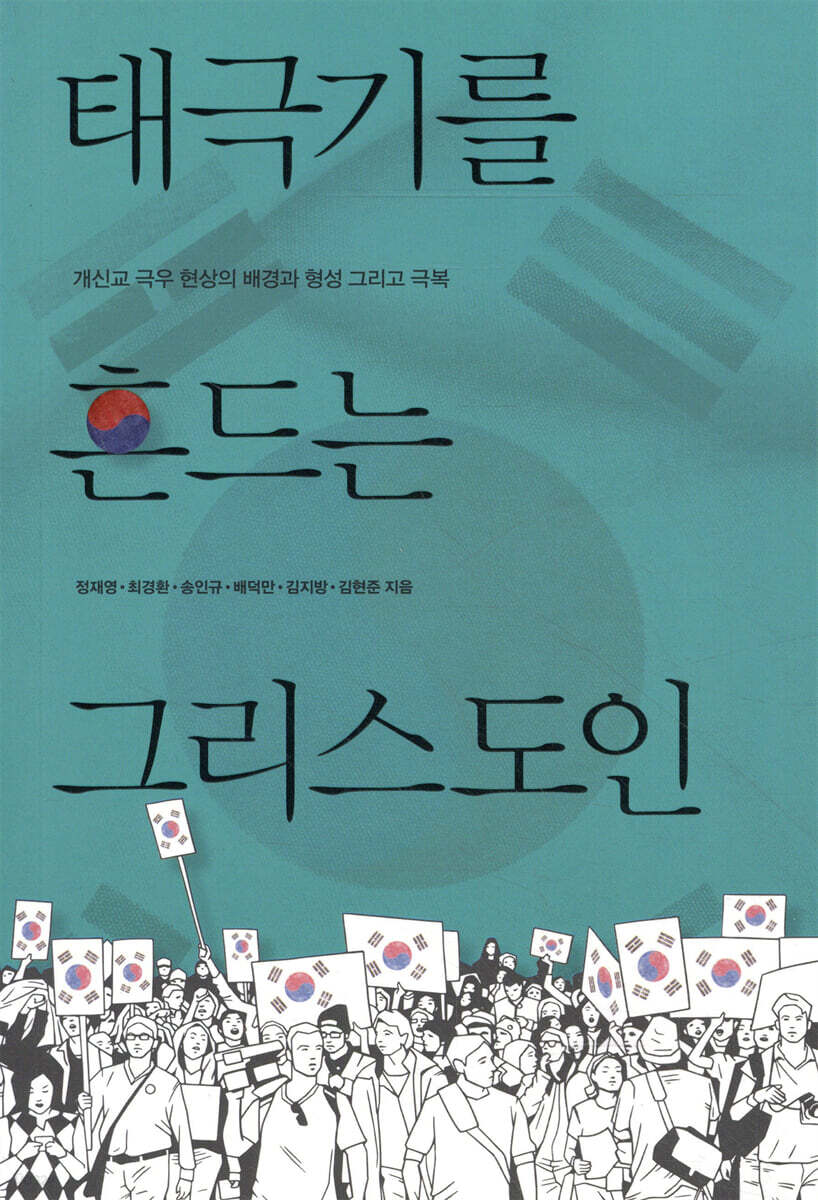
Christians waving the Taegeukgi
 |
Description
Book Introduction
How should we understand the far-right forces within Protestantism?
By understanding the true nature of far-right Christians and examining their formation process and aspects,
It illuminates the path to true Christianity, healthy Christians, and a complete church!
Established to conduct various research activities and publish materials with the motto of ‘Church for the Kingdom of God, Exploration for the Korean Church’
A magazine jointly produced by the Research Center for the Korean Churches and IVP Korea
“Church Exploration Forum” Issue 10 Released!
This book broadens our understanding of the relationship between Protestants and politics by examining the existence and characteristics of far-right Christians within the Korean church, and further seeks ways to unite in Christ despite differences in ideology and thought.
Based on a survey, we take a close look at the inner world and political consciousness of conservative Protestants, analyze it sociologically, and critically examine it from the perspective of evangelical spirit and public theology.
If we must move from "a place of pursuit of interests and rights to a place of reconciliation and service," where do we stand now? Where should we take our next steps? This book will serve as a compass.
By understanding the true nature of far-right Christians and examining their formation process and aspects,
It illuminates the path to true Christianity, healthy Christians, and a complete church!
Established to conduct various research activities and publish materials with the motto of ‘Church for the Kingdom of God, Exploration for the Korean Church’
A magazine jointly produced by the Research Center for the Korean Churches and IVP Korea
“Church Exploration Forum” Issue 10 Released!
This book broadens our understanding of the relationship between Protestants and politics by examining the existence and characteristics of far-right Christians within the Korean church, and further seeks ways to unite in Christ despite differences in ideology and thought.
Based on a survey, we take a close look at the inner world and political consciousness of conservative Protestants, analyze it sociologically, and critically examine it from the perspective of evangelical spirit and public theology.
If we must move from "a place of pursuit of interests and rights to a place of reconciliation and service," where do we stand now? Where should we take our next steps? This book will serve as a compass.
- You can preview some of the book's contents.
Preview
index
Preface _Song In-gyu
01 The Inner World of a Conservative Protestant _ Jae-young Jeong
02 Political Consciousness of Conservative Protestants _ Jae-young Jeong
03 Public Theology and Church Politics _Choi Kyung-hwan
04 Far-Right Thought: Identity, Formation, and Evangelical Evaluation _Song In-gyu
05 From Theological Fundamentalism to Political Extremism _ Baek Deok-man
06 Church in the Square, Embarrassing and Familiar _Kim Ji-bang
07 Does Evangelicalism Have an Anti-Intellectual Spirituality? _Kim Hyun-jun
Appendix: Conservative Protestant Group Interview Questionnaire/Survey Items
01 The Inner World of a Conservative Protestant _ Jae-young Jeong
02 Political Consciousness of Conservative Protestants _ Jae-young Jeong
03 Public Theology and Church Politics _Choi Kyung-hwan
04 Far-Right Thought: Identity, Formation, and Evangelical Evaluation _Song In-gyu
05 From Theological Fundamentalism to Political Extremism _ Baek Deok-man
06 Church in the Square, Embarrassing and Familiar _Kim Ji-bang
07 Does Evangelicalism Have an Anti-Intellectual Spirituality? _Kim Hyun-jun
Appendix: Conservative Protestant Group Interview Questionnaire/Survey Items
Into the book
There are people with various positions in society, and all ideas should be respected as long as they do not contain anti-social elements.
It doesn't matter if it's conservative or progressive.
Liberalism and communitarianism, which have long been parallel in political philosophy, also have their own limitations, and various discussions to overcome these have continued throughout history.
The problem is overly biased thinking.
While not everyone needs to think in an average way or hold an ambivalent stance, it is not advisable to uncritically accept or unconditionally oppose historical events or figures based on one's own perspective.
---From Chapter 1, “The Inner World of Conservative Protestants”
Another problem with regard to the church's political participation is that the social consciousness of the Korean church is very conservative.
Conservatism itself is not a problem, but an overly conservative social view is problematic in that it tends to lack even sound criticism because it focuses primarily on maintaining reality and protecting vested interests.
---From Chapter 2, “The Political Consciousness of Conservative Protestants”
The situation in which the church directly participated in politics and stopped the wheel was an emergency and a last resort.
Making that judgment and decision is never an easy task.
There is no formula or guide.
This is a kind of political decision and theological judgment.
Bonhoeffer considered this to be a command from God, and he obeyed it.
Perhaps the third and final decision may not be easily applicable in today's democratic society.
---From Chapter 3, “Public Theology and Church Politics”
If we trace the historical and socio-psychological roots of the emergence and flourishing of right-wing ideology, we find that the Korean War is lurking behind it.
If the Korean War had not occurred, extreme right-wing thinking would not exist today, or would have taken on a fundamentally different form.
It has been nearly 70 years since the war broke out and the armistice was reached, but there are few South Koreans born in this land who are free from the aftereffects of the Korean War.
---From Chapter 4, “Extreme Right-Wing Thought”
Basically, Korean society has been constantly placed in an extreme environment of binary choice.
South and North, Yeongnam and Honam, Gangnam and Gangbuk, Seoul and the provinces, left and right, ruling and opposition parties, rich and poor, bosses and workers, progressives and conservatives.
In this situation, the Korean church, especially fundamentalists, must quickly shift from pursuing interests and rights to a position of reconciliation and service by focusing on the universal values given to them.
We must not repeat these biased choices and partisan support any longer.
---From Chapter 5, “From Theological Fundamentalism to Political Extremism”
I witnessed it in the square.
Those who have experienced that turbulent history with their whole body.
The scene where they vomit out the trauma of history like a terrible motion sickness.
In one corner of the Seoul Plaza prayer meeting were elderly reservists wearing Marine Corps combat uniforms.
This is the generation that experienced war and military dictatorship.
They reacted violently to the words communist, socialist, and progressive.
---From Chapter 6, “The Church in the Square, Embarrassing and Familiar”
Anti-intellectualism, rather than respecting the critical capacity and qualifications of the intellect, grants only faith (and religious passion) the right to criticize the intellect.
The function of intellect is devalued and only the function of faith is praised.
In churches and missionary organizations, Christian intellectual training programs are not meant to train critical 'intellect', but rather serve as religious rituals that promote 'Christian' faith and integrate the religious community.
It doesn't matter if it's conservative or progressive.
Liberalism and communitarianism, which have long been parallel in political philosophy, also have their own limitations, and various discussions to overcome these have continued throughout history.
The problem is overly biased thinking.
While not everyone needs to think in an average way or hold an ambivalent stance, it is not advisable to uncritically accept or unconditionally oppose historical events or figures based on one's own perspective.
---From Chapter 1, “The Inner World of Conservative Protestants”
Another problem with regard to the church's political participation is that the social consciousness of the Korean church is very conservative.
Conservatism itself is not a problem, but an overly conservative social view is problematic in that it tends to lack even sound criticism because it focuses primarily on maintaining reality and protecting vested interests.
---From Chapter 2, “The Political Consciousness of Conservative Protestants”
The situation in which the church directly participated in politics and stopped the wheel was an emergency and a last resort.
Making that judgment and decision is never an easy task.
There is no formula or guide.
This is a kind of political decision and theological judgment.
Bonhoeffer considered this to be a command from God, and he obeyed it.
Perhaps the third and final decision may not be easily applicable in today's democratic society.
---From Chapter 3, “Public Theology and Church Politics”
If we trace the historical and socio-psychological roots of the emergence and flourishing of right-wing ideology, we find that the Korean War is lurking behind it.
If the Korean War had not occurred, extreme right-wing thinking would not exist today, or would have taken on a fundamentally different form.
It has been nearly 70 years since the war broke out and the armistice was reached, but there are few South Koreans born in this land who are free from the aftereffects of the Korean War.
---From Chapter 4, “Extreme Right-Wing Thought”
Basically, Korean society has been constantly placed in an extreme environment of binary choice.
South and North, Yeongnam and Honam, Gangnam and Gangbuk, Seoul and the provinces, left and right, ruling and opposition parties, rich and poor, bosses and workers, progressives and conservatives.
In this situation, the Korean church, especially fundamentalists, must quickly shift from pursuing interests and rights to a position of reconciliation and service by focusing on the universal values given to them.
We must not repeat these biased choices and partisan support any longer.
---From Chapter 5, “From Theological Fundamentalism to Political Extremism”
I witnessed it in the square.
Those who have experienced that turbulent history with their whole body.
The scene where they vomit out the trauma of history like a terrible motion sickness.
In one corner of the Seoul Plaza prayer meeting were elderly reservists wearing Marine Corps combat uniforms.
This is the generation that experienced war and military dictatorship.
They reacted violently to the words communist, socialist, and progressive.
---From Chapter 6, “The Church in the Square, Embarrassing and Familiar”
Anti-intellectualism, rather than respecting the critical capacity and qualifications of the intellect, grants only faith (and religious passion) the right to criticize the intellect.
The function of intellect is devalued and only the function of faith is praised.
In churches and missionary organizations, Christian intellectual training programs are not meant to train critical 'intellect', but rather serve as religious rituals that promote 'Christian' faith and integrate the religious community.
---From Chapter 7, “Does Evangelicalism Have an Anti-Intellectualistic Spirituality?”
Publisher's Review
Amidst the polarization and conflict of political views,
Today, our society accepts the polarization of political views and the resulting discord and jealousy among its members as an inevitable condition of the times.
Meanwhile, a significant proportion of conservative Protestants are facing suspicion and criticism that they are fanning this polarization and conflict with their "extreme right-wing" tendencies.
Here, "extreme right-wing" thinking encompasses right-leaning tendencies, attitudes, and mentalities, often manifesting in extreme forms such as anti-communism and pro-American obsession, and extreme antipathy toward progressive political and social policies.
In this context, the need has arisen to first clarify the true nature of the far right, then reflect on why far-right thinking is currently emerging in Korea, and how evangelical Christians should understand and respond to it.
Far-right Christians, who are they?
Since the so-called Taegeukgi rallies began, the image of the Taegeukgi has come to be associated with the extreme right, anti-communism, blindly pro-Americanism, and older people.
The national symbol, the Taegeukgi, is being used as a collateral victim of political ideology to divide and divide the Republic of Korea.
However, a significant number of Protestants with conservative beliefs are participating in the Taegeukgi rally.
Moreover, following a series of incidents led by Pastor Jeon Gwang-hoon following the coronavirus pandemic, not only the participants in the Taegeukgi rally but also the entire Protestant church are facing harsh criticism.
Who are these self-proclaimed conservative believers who participate in Taegeukgi rallies or call for them? We refer to them as "extreme right-wing Christians," and we aim to understand their existence and characteristics more precisely and in greater detail.
This is because, despite differences in thought and ideology, Christian brothers and sisters must encourage each other and seek ways to move forward together.
Furthermore, it is the path for true Christians to reconsider the principle of separation of church and state from a new perspective and to extend the arm of evangelical forgiveness and inclusion to those with different political ideologies.
Analytical Identity Analysis of Far-Right Christians
The two articles that mark the beginning of this book, “The Inner World of Conservative Protestants” and “The Political Consciousness of Conservative Protestants,” were written based on two surveys conducted in July 2020.
“The Inner World of Conservative Protestants” delves into the inner world of far-right Christians from a political perspective by gathering relevant information through focused group interviews and intensive conversations with a small number of individuals who have participated in Taegeukgi rallies and intend to do so in the future.
“Political Consciousness of Conservative Protestants” analyzes the political consciousness of 570 Protestants who consider themselves conservative, based on a typical survey.
The aim is to broaden understanding of the relationship between Protestants and politics by understanding the attitudes and views of conservative Protestants toward politics.
To advance to become a true Christian and a healthy Christian
“Public Theology and Church Politics” articulates what public theology is in its proper sense and, in light of this, critically examines distorted forms of public theology and political participation.
“Extreme Right Thought” points out that those who hold extremist ideas are often extreme in the content and expression of their beliefs, and considers how to evaluate extremist ideas in light of the Protestant evangelical spirit that regards the Bible as the final authority for all faith and action.
"From Theological Fundamentalism to Political Extremism" offers a historical and realistic analysis of the tragic fusion of fundamentalism and the political far right.
“The Church in the Square, Embarrassing and Familiar” thoroughly exposes the pragmatic relationship that has developed between church and politics since 2000.
In “Does Evangelicalism Have an Anti-Intellectual Spirituality?” the cause of the emergence of far-right groups within the Korean church is found in anti-intellectualism.
Only when we recognize the value of intelligence and train it properly will we be able to build healthy Christians and a healthy church.
Today, our society accepts the polarization of political views and the resulting discord and jealousy among its members as an inevitable condition of the times.
Meanwhile, a significant proportion of conservative Protestants are facing suspicion and criticism that they are fanning this polarization and conflict with their "extreme right-wing" tendencies.
Here, "extreme right-wing" thinking encompasses right-leaning tendencies, attitudes, and mentalities, often manifesting in extreme forms such as anti-communism and pro-American obsession, and extreme antipathy toward progressive political and social policies.
In this context, the need has arisen to first clarify the true nature of the far right, then reflect on why far-right thinking is currently emerging in Korea, and how evangelical Christians should understand and respond to it.
Far-right Christians, who are they?
Since the so-called Taegeukgi rallies began, the image of the Taegeukgi has come to be associated with the extreme right, anti-communism, blindly pro-Americanism, and older people.
The national symbol, the Taegeukgi, is being used as a collateral victim of political ideology to divide and divide the Republic of Korea.
However, a significant number of Protestants with conservative beliefs are participating in the Taegeukgi rally.
Moreover, following a series of incidents led by Pastor Jeon Gwang-hoon following the coronavirus pandemic, not only the participants in the Taegeukgi rally but also the entire Protestant church are facing harsh criticism.
Who are these self-proclaimed conservative believers who participate in Taegeukgi rallies or call for them? We refer to them as "extreme right-wing Christians," and we aim to understand their existence and characteristics more precisely and in greater detail.
This is because, despite differences in thought and ideology, Christian brothers and sisters must encourage each other and seek ways to move forward together.
Furthermore, it is the path for true Christians to reconsider the principle of separation of church and state from a new perspective and to extend the arm of evangelical forgiveness and inclusion to those with different political ideologies.
Analytical Identity Analysis of Far-Right Christians
The two articles that mark the beginning of this book, “The Inner World of Conservative Protestants” and “The Political Consciousness of Conservative Protestants,” were written based on two surveys conducted in July 2020.
“The Inner World of Conservative Protestants” delves into the inner world of far-right Christians from a political perspective by gathering relevant information through focused group interviews and intensive conversations with a small number of individuals who have participated in Taegeukgi rallies and intend to do so in the future.
“Political Consciousness of Conservative Protestants” analyzes the political consciousness of 570 Protestants who consider themselves conservative, based on a typical survey.
The aim is to broaden understanding of the relationship between Protestants and politics by understanding the attitudes and views of conservative Protestants toward politics.
To advance to become a true Christian and a healthy Christian
“Public Theology and Church Politics” articulates what public theology is in its proper sense and, in light of this, critically examines distorted forms of public theology and political participation.
“Extreme Right Thought” points out that those who hold extremist ideas are often extreme in the content and expression of their beliefs, and considers how to evaluate extremist ideas in light of the Protestant evangelical spirit that regards the Bible as the final authority for all faith and action.
"From Theological Fundamentalism to Political Extremism" offers a historical and realistic analysis of the tragic fusion of fundamentalism and the political far right.
“The Church in the Square, Embarrassing and Familiar” thoroughly exposes the pragmatic relationship that has developed between church and politics since 2000.
In “Does Evangelicalism Have an Anti-Intellectual Spirituality?” the cause of the emergence of far-right groups within the Korean church is found in anti-intellectualism.
Only when we recognize the value of intelligence and train it properly will we be able to build healthy Christians and a healthy church.
GOODS SPECIFICS
- Date of issue: May 6, 2021
- Page count, weight, size: 296 pages | 153*224*20mm
- ISBN13: 9788932818276
- ISBN10: 8932818274
You may also like
카테고리
korean


korean

![GQ KOREA Mark (Monthly): December [2025]](http://librairie.coreenne.fr/cdn/shop/files/8ef265dbbfbf186523ed75ba7319009d.jpg?v=1765340328&width=3840)


