

This is my first time doing math like this 4
 |
Description
Book Introduction
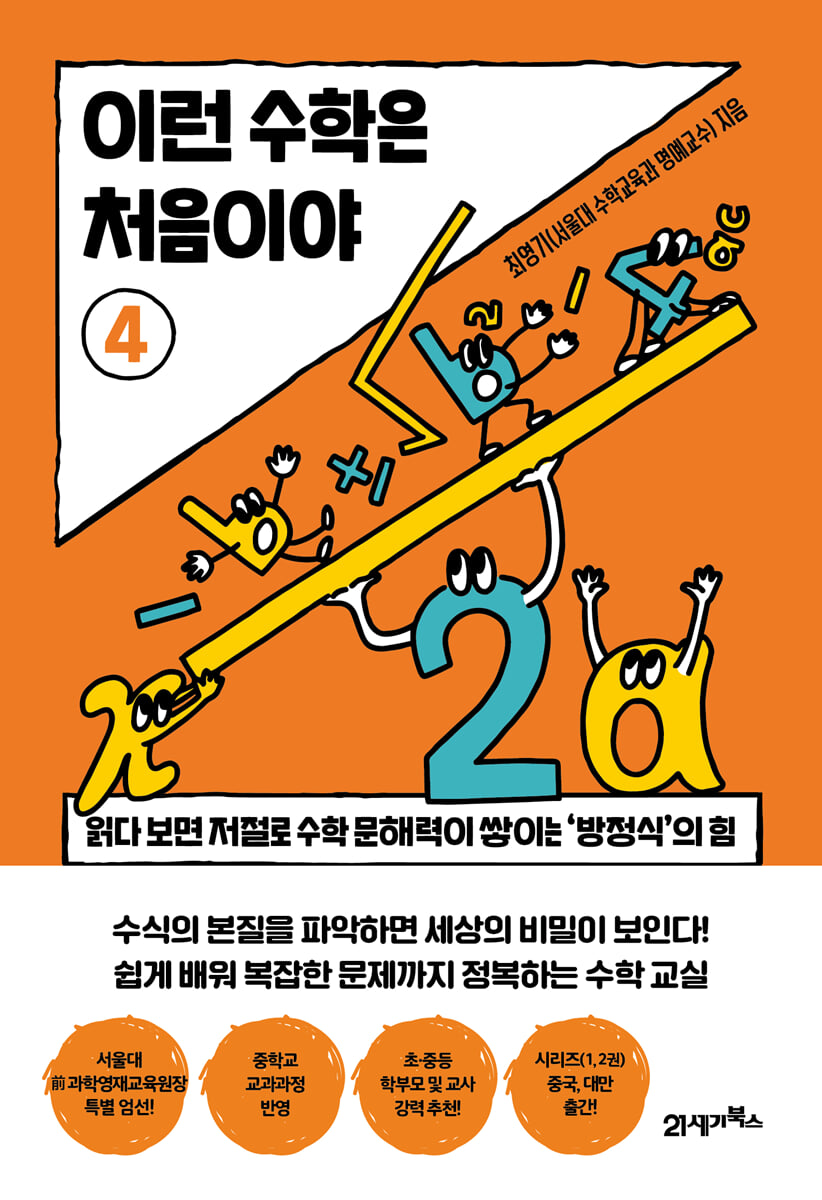
“Math worries are now completely different!” The popular "This is my first time seeing math like this" series presented by a professor of mathematics education at Seoul National University! “For the first time in my life, math is fun!”, “As math literacy builds, grades naturally go up”, “I’m no longer a math novice!” The fourth story in the bestselling “This Kind of Math Is the First Time” series, which has received overwhelming support and choice from parents of elementary and middle school children by solving the “math worries” of our children who wanted to give up on math, is finally beginning. 『This is the first time I've seen math like this』 Following Volume 1 'Plane Figures', Volume 2 'Numbers', and Volume 3 'Solid Figures', the newly published Volume 4 embarks on an adventure into the 'World of Equations'. In this book, Professor Choi Young-gi of the Department of Mathematics Education at Seoul National University unfolds equations, the flower of mathematics, into an exciting story, immersing us in the infinite fun of 'formulas' and 'equations.' The author argues that the concepts of formulas and equations provide students with a powerful weapon that allows them to structurally understand and address the diverse problems of the world we live in beyond the scope of mathematics textbooks, and to find breakthroughs in problem-solving. As the author says, after going through the journey of using letters in formulas as guided by this book, from linear equations to quadratic equations and even higher-order equations that go beyond middle school mathematics, you will gain a "mathematical eye" that can see through the essence of formulas based on the "mathematical literacy" you have accumulated along the way. |
- You can preview some of the book's contents.
Preview
index
Publishing books in an era that requires forward-looking mathematical skills
Prologue Let's go find the secrets of the world of mathematics!
Lecture 1: The World of Formulas Opened with Letters: Formulas, Unknowns, and Equations
start
What is the difference between a formula and a sentence?
Ta-da! The text appears!
Characters that make complex math problems easier
A way to compare two quantities, a ratio
The World of Equations
Math needs translation too!
The process of finding the answer to an equation
Classification of equations
What does it mean to solve an equation?
Interesting linear equations from the Greek era
Clarifying the ambiguous with formulas
Don't be fooled by formulas, choose wisely.
How to Choose Unknowns Wisely
Understanding natural phenomena through equations
The moment you open your eyes to math 1 Thinking more simply
■ Looking back at the story 1
Level up with Quadratic Equations in Lesson 2! - Square Roots, Factoring, Perfecting Squares, and the Relationship Between Roots and Coefficients
start
The Amazing Role of 0
What is the opposite of square?
Quadratic equations of various shapes
Solving quadratic equations using factorization
Solving quadratic equations using perfect squares
Relationship between roots and coefficients of quadratic equations
Solving Quadratic Equations with Ancient Babylonian Ideas
What happens if we swap the coefficients of the quadratic and constant terms?
If you look at it, it's a quadratic equation
How does the equation change if we change the unknown variable?
The moment when you open your eyes to mathematics 2 The golden ratio
■ Looking back at the story 2
Lecture 3: Beyond Middle School Mathematics: A New Perspective - Imaginary Numbers, Imaginary Roots, and the Relationship Between Roots and Coefficients of Higher-Order Equations
start
A shift in thinking, the emergence of scarecrows
Two different roots
Relationship between roots and coefficients of higher-order equations
The moment you open your eyes to math: Two key problems in three equations
■ Looking back at the story 3
Acknowledgements
Prologue Let's go find the secrets of the world of mathematics!
Lecture 1: The World of Formulas Opened with Letters: Formulas, Unknowns, and Equations
start
What is the difference between a formula and a sentence?
Ta-da! The text appears!
Characters that make complex math problems easier
A way to compare two quantities, a ratio
The World of Equations
Math needs translation too!
The process of finding the answer to an equation
Classification of equations
What does it mean to solve an equation?
Interesting linear equations from the Greek era
Clarifying the ambiguous with formulas
Don't be fooled by formulas, choose wisely.
How to Choose Unknowns Wisely
Understanding natural phenomena through equations
The moment you open your eyes to math 1 Thinking more simply
■ Looking back at the story 1
Level up with Quadratic Equations in Lesson 2! - Square Roots, Factoring, Perfecting Squares, and the Relationship Between Roots and Coefficients
start
The Amazing Role of 0
What is the opposite of square?
Quadratic equations of various shapes
Solving quadratic equations using factorization
Solving quadratic equations using perfect squares
Relationship between roots and coefficients of quadratic equations
Solving Quadratic Equations with Ancient Babylonian Ideas
What happens if we swap the coefficients of the quadratic and constant terms?
If you look at it, it's a quadratic equation
How does the equation change if we change the unknown variable?
The moment when you open your eyes to mathematics 2 The golden ratio
■ Looking back at the story 2
Lecture 3: Beyond Middle School Mathematics: A New Perspective - Imaginary Numbers, Imaginary Roots, and the Relationship Between Roots and Coefficients of Higher-Order Equations
start
A shift in thinking, the emergence of scarecrows
Two different roots
Relationship between roots and coefficients of higher-order equations
The moment you open your eyes to math: Two key problems in three equations
■ Looking back at the story 3
Acknowledgements
Detailed image
.jpg)
Into the book
In today's rapidly changing world, where every second counts, education that provides only set answers is no longer sufficient.
Future-oriented mathematical skills are required.
Future-oriented mathematical skills mean not only acquiring mathematical knowledge, but also the ability to transfer mathematical knowledge in various situations.
These abilities are developed through critical thinking about problems, the process of justifying and questioning one's own thinking, and the various trials and errors that follow, along with the reflection that follows.
--- p.4
The world of mathematics still has many secrets that have yet to be revealed.
That means there are many treasures to be discovered in mathematics, right? There are many ways to uncover hidden truths in mathematics, and one of them is using equations.
An equation is something that expresses something hidden in a formula, and then we use the mathematical knowledge we have studied to find the answer.
And as you study equations, you naturally develop the ability to analyze situations and structure them, which can maximize your ability to rationally solve problems in real-world situations.
--- p.8
Using letters not only makes it easier to understand and solve math problems, but also allows us to explain general principles without being limited to specific numbers or situations.
That is, in mathematics, letters are used to represent universal ideas.
So the introduction of writing was one of the great revolutions in the world of mathematics.
Mathematics could develop more quickly with the use of letters.
--- p.21
Classifying equations helps us understand the form of the solutions.
For example, you can know what solutions a linear equation and a quadratic equation have and what their characteristics are.
As we classify various equations, we will be able to better understand and develop important concepts such as unknowns, coefficients, and degrees.
--- p.47
When finding the roots of a quadratic equation, use factorization or the root formula.
However, we can obtain interesting information about the roots by using only the coefficients of the equation, without having to find the roots directly.
This is called the 'relationship between the roots and coefficients of a quadratic equation'.
Knowing this relationship can teach us more interesting things about equations.
--- p.103
Scarecrow is one of the concepts that emerged to overcome these limitations.
This shift in mathematical thinking went beyond the middle school level, but the introduction of imaginary numbers was a great help in solving difficult problems in mathematics that had not been solved before.
Future-oriented mathematical skills are required.
Future-oriented mathematical skills mean not only acquiring mathematical knowledge, but also the ability to transfer mathematical knowledge in various situations.
These abilities are developed through critical thinking about problems, the process of justifying and questioning one's own thinking, and the various trials and errors that follow, along with the reflection that follows.
--- p.4
The world of mathematics still has many secrets that have yet to be revealed.
That means there are many treasures to be discovered in mathematics, right? There are many ways to uncover hidden truths in mathematics, and one of them is using equations.
An equation is something that expresses something hidden in a formula, and then we use the mathematical knowledge we have studied to find the answer.
And as you study equations, you naturally develop the ability to analyze situations and structure them, which can maximize your ability to rationally solve problems in real-world situations.
--- p.8
Using letters not only makes it easier to understand and solve math problems, but also allows us to explain general principles without being limited to specific numbers or situations.
That is, in mathematics, letters are used to represent universal ideas.
So the introduction of writing was one of the great revolutions in the world of mathematics.
Mathematics could develop more quickly with the use of letters.
--- p.21
Classifying equations helps us understand the form of the solutions.
For example, you can know what solutions a linear equation and a quadratic equation have and what their characteristics are.
As we classify various equations, we will be able to better understand and develop important concepts such as unknowns, coefficients, and degrees.
--- p.47
When finding the roots of a quadratic equation, use factorization or the root formula.
However, we can obtain interesting information about the roots by using only the coefficients of the equation, without having to find the roots directly.
This is called the 'relationship between the roots and coefficients of a quadratic equation'.
Knowing this relationship can teach us more interesting things about equations.
--- p.103
Scarecrow is one of the concepts that emerged to overcome these limitations.
This shift in mathematical thinking went beyond the middle school level, but the introduction of imaginary numbers was a great help in solving difficult problems in mathematics that had not been solved before.
--- p.126
Publisher's Review
A math classroom where you can learn with ease and conquer even complex problems.
The surest way to the top!
Many parents say that their children were good at math until they entered competitions in elementary school, but at some point, they started to avoid math and their grades plummeted.
In fact, according to statistics from the Board of Education, the percentage of students who responded that they were 'dropouts' was 11.3% in 6th grade elementary school, 22.6% in 3rd grade middle school, and 32.3% in 2nd grade high school.
Even if they did not give up, the percentage of respondents who said math was 'difficult', 'I hate it', or 'I plan to give up soon' exceeded an average of 30%.
The reason why more students give up on math as they advance in grade level is because of the ‘cumulative effect.’
As learning gaps that are briefly missed in the math curriculum accumulate, they lead to a significant drop in math grades.
Therefore, in order to avoid giving up on mathematics, a subject where interconnectivity is much more important than other subjects, you must not only build a solid foundation, but also build 'mathematical literacy' on top of that foundation and perfect it with your skills.
If you faithfully follow this process, it will not be difficult to reach the top ranks in mathematics.
Moreover, if you were to choose the most important subject that determines university level, it would be mathematics.
This is why you should never give up on math.
If you can fully understand the core concepts of the regular curriculum and expand them beyond the textbook with the 'This is My First Time with Math' series and 'Seoul National University Style Math', you will never become a 'math dropout'.
Rather, it will be reborn as a 'math predator'.
Mathematical problem-solving skills are growing rapidly
The world of 'formulas' and 'equations'!
This book consists of three lectures.
First, in Lesson 1, 'The World of Formulas Opened with Text,' we will look at the difference between formulas and sentences and learn about the use of letters in formulas to make complex mathematical problems easier.
After that, we will learn the concepts and principles of linear equations in earnest and discuss how to use them.
It also provides detailed and friendly explanations on how to turn sentences into equations using the unknown variable 'X' and on the classification of various equations.
The second lecture, "Level Up with Quadratic Equations!", invites readers into the world of quadratic equations, which go beyond linear equations.
First, we will look at the role of the number '0', which is very important in quadratic equations, and the concept of square roots, and then we will look closely at solving equations using factorization and perfect squares.
It also discusses equations from the Greek era, further increasing interest in equations.
In the final three lectures, “Beyond Middle School Mathematics: A New Perspective,” we will examine higher-order equations that go beyond middle school mathematics.
And in the section titled 'The Moment You Open Your Eyes to Math' included between the main text, it provides an interesting explanation of how equations can be used and how they are actually used.
The 'Story Review' section at the end of each chapter organizes mathematical concepts and formulas with curriculum notation to help readers understand them at a glance.
If you slowly follow this entire process, the core concepts that you must know in middle school math will be organized in your head naturally, and as you expand beyond that, math classes that used to feel difficult will become enjoyable.
You will also have the amazing experience of solving difficult math problems without any difficulty.
The author, Professor Choi Young-gi, emphasizes that learning equations is not limited to simply improving math grades.
As you study equations, your ability to analyze situations and structure problems will naturally develop.
This leads to the ability to solve problems rationally in real life, not just in the world of mathematics.
In fact, equations are a very important tool for understanding natural and social phenomena, and they also play a major role in revealing the amazing secrets of the natural world and solving social problems.
Therefore, it is worthwhile to study the equations that have contributed greatly to the advancement of civilization.
Furthermore, after completing the journey into the world of equations that this book invites, readers will be rewarded with improved math scores.
☞ Other books by the same author that are good to read together
▶ If Mathematics Is This Beautiful | Written by Choi Young-gi | 21st Century Books | Published March 11, 2019 | 17,000 won
▶ Math Like This Is the First Time | Written by Choi Young-gi | 21st Century Books | Published November 11, 2020 | 17,000 won
▶ Math Like This: A First Time 2 | Written by Choi Young-gi | 21st Century Books | Published May 20, 2021 | 17,000 won
▶ Math Like This: A First Time 3 | Written by Choi Young-gi | 21st Century Books | Published July 1, 2022 | 17,000 won
▶ The Great Uproar Over the Selection of the Captain | Written by Choi Young-gi and Kim Seon-ja / Illustrated by Youngsu | 21st Century Books | Published October 20, 2023 | 13,000 won
☞ 21st Century Books related site
▶ Facebook facebook.com/jiinpill21
▶ Post post.naver.com/21c_editors
▶ Instagram instagram.com/jiinpill21
▶ Homepage www.book21.com
▶ YouTube youtube.com/book21pub
The surest way to the top!
Many parents say that their children were good at math until they entered competitions in elementary school, but at some point, they started to avoid math and their grades plummeted.
In fact, according to statistics from the Board of Education, the percentage of students who responded that they were 'dropouts' was 11.3% in 6th grade elementary school, 22.6% in 3rd grade middle school, and 32.3% in 2nd grade high school.
Even if they did not give up, the percentage of respondents who said math was 'difficult', 'I hate it', or 'I plan to give up soon' exceeded an average of 30%.
The reason why more students give up on math as they advance in grade level is because of the ‘cumulative effect.’
As learning gaps that are briefly missed in the math curriculum accumulate, they lead to a significant drop in math grades.
Therefore, in order to avoid giving up on mathematics, a subject where interconnectivity is much more important than other subjects, you must not only build a solid foundation, but also build 'mathematical literacy' on top of that foundation and perfect it with your skills.
If you faithfully follow this process, it will not be difficult to reach the top ranks in mathematics.
Moreover, if you were to choose the most important subject that determines university level, it would be mathematics.
This is why you should never give up on math.
If you can fully understand the core concepts of the regular curriculum and expand them beyond the textbook with the 'This is My First Time with Math' series and 'Seoul National University Style Math', you will never become a 'math dropout'.
Rather, it will be reborn as a 'math predator'.
Mathematical problem-solving skills are growing rapidly
The world of 'formulas' and 'equations'!
This book consists of three lectures.
First, in Lesson 1, 'The World of Formulas Opened with Text,' we will look at the difference between formulas and sentences and learn about the use of letters in formulas to make complex mathematical problems easier.
After that, we will learn the concepts and principles of linear equations in earnest and discuss how to use them.
It also provides detailed and friendly explanations on how to turn sentences into equations using the unknown variable 'X' and on the classification of various equations.
The second lecture, "Level Up with Quadratic Equations!", invites readers into the world of quadratic equations, which go beyond linear equations.
First, we will look at the role of the number '0', which is very important in quadratic equations, and the concept of square roots, and then we will look closely at solving equations using factorization and perfect squares.
It also discusses equations from the Greek era, further increasing interest in equations.
In the final three lectures, “Beyond Middle School Mathematics: A New Perspective,” we will examine higher-order equations that go beyond middle school mathematics.
And in the section titled 'The Moment You Open Your Eyes to Math' included between the main text, it provides an interesting explanation of how equations can be used and how they are actually used.
The 'Story Review' section at the end of each chapter organizes mathematical concepts and formulas with curriculum notation to help readers understand them at a glance.
If you slowly follow this entire process, the core concepts that you must know in middle school math will be organized in your head naturally, and as you expand beyond that, math classes that used to feel difficult will become enjoyable.
You will also have the amazing experience of solving difficult math problems without any difficulty.
The author, Professor Choi Young-gi, emphasizes that learning equations is not limited to simply improving math grades.
As you study equations, your ability to analyze situations and structure problems will naturally develop.
This leads to the ability to solve problems rationally in real life, not just in the world of mathematics.
In fact, equations are a very important tool for understanding natural and social phenomena, and they also play a major role in revealing the amazing secrets of the natural world and solving social problems.
Therefore, it is worthwhile to study the equations that have contributed greatly to the advancement of civilization.
Furthermore, after completing the journey into the world of equations that this book invites, readers will be rewarded with improved math scores.
☞ Other books by the same author that are good to read together
▶ If Mathematics Is This Beautiful | Written by Choi Young-gi | 21st Century Books | Published March 11, 2019 | 17,000 won
▶ Math Like This Is the First Time | Written by Choi Young-gi | 21st Century Books | Published November 11, 2020 | 17,000 won
▶ Math Like This: A First Time 2 | Written by Choi Young-gi | 21st Century Books | Published May 20, 2021 | 17,000 won
▶ Math Like This: A First Time 3 | Written by Choi Young-gi | 21st Century Books | Published July 1, 2022 | 17,000 won
▶ The Great Uproar Over the Selection of the Captain | Written by Choi Young-gi and Kim Seon-ja / Illustrated by Youngsu | 21st Century Books | Published October 20, 2023 | 13,000 won
☞ 21st Century Books related site
▶ Facebook facebook.com/jiinpill21
▶ Post post.naver.com/21c_editors
▶ Instagram instagram.com/jiinpill21
▶ Homepage www.book21.com
▶ YouTube youtube.com/book21pub
GOODS SPECIFICS
- Date of issue: April 17, 2024
- Page count, weight, size: 152 pages | 280g | 135*197*11mm
- ISBN13: 9791171175383
- ISBN10: 1171175388
You may also like
카테고리
korean


korean

![GQ KOREA Mark (Monthly): December [2025]](http://librairie.coreenne.fr/cdn/shop/files/8ef265dbbfbf186523ed75ba7319009d.jpg?v=1765340328&width=3840)


